


2 Chronicles 25:28
- וַיִּשָּׂאֻהוּvai·yi·sa·'U·huand they carried himH5375Conj-w ¦ V-Qal-ConsecImperf-3mp ¦ 3msVerb Qal Consecutive Imperfect 3rd Plural Masculineוַandיִּשָּׂאֻthey carriedהוּhim
- עַל'alonH5921PrepPreposition
- הַסּוּסִיםha·su·Sim<the> horsesH5483Art ¦ N-mpNoun Plural Masculine Absoluteהַ<the>סּוּסִיםhorses
- וַיִּקְבְּרוּvai·yik·be·Ruand they buriedH6912Conj-w ¦ V-Qal-ConsecImperf-3mpVerb Qal Consecutive Imperfect 3rd Plural Masculineוַandיִּקְבְּרוּthey buried
- אֹתוֹ'o·To<obj.> himH853DirObjM ¦ 3msParticle Object Indicatorאֹת<obj.>וֹhim
- עִם'imwithH5973PrepPreposition
- אֲבֹתָיו'a·vo·Tavhis ancestorsH1N-fpc ¦ 3msNoun Plural Feminine Constructאֲבֹתָיancestorsוhis
- בְּעִירbe·'Irin [the] city ofH5892Prep-b ¦ N-fscNoun Singular Feminine Constructבְּinעִיר[the] city of
- יְהוּדָהye·hu·DahJudahH3063N-properNoun Proper Location
English is a literal word-by-word gloss of the Hebrew, not the KJV's wording. Why?
This is the original text the KJV's translators worked from — each Hebrew word with its own literal English meaning in this verse, prepared by scholars at Tyndale House, Cambridge. The KJV translates whole sentences, not word by word, so its wording differs: one Hebrew word can become several English words, and the KJV may choose “the LORD” where the gloss reads “Yahweh”. Both are faithful — they answer different questions. For the KJV's own rendering, switch to the KJV text.
Details
See on the biblical-era map
Study this verse
Public-domain commentary
Matthew Henry
From his Commentary on the Whole Bible. Henry comments on passages, not single verses — this entry covers 2 Chronicles 25:17–28. His three-level outline is real structure in the source text, so it is rendered as structure.
We have here this degenerate prince mortified by his neighbour and murdered by his own subjects.
I.Never was proud prince more thoroughly mortified than Amaziah was by Joash king of Israel.
1.This part of the story (which was as fully related Kg2 14:8, etc., as it is here) - embracing the foolish challenge which Amaziah sent to Joash (Ch2 25:17), his haughty scornful answer to it (Ch2 25:18), with the friendly advice he gave him to sit still and know when he was well off, (Ch2 25:19), - his wilfully persisting in his challenge (Ch2 25:20, Ch2 25:21), the defeat that was given him (Ch2 25:22), and the calamity he brought upon himself and his city thereby (Ch2 25:23, Ch2 25:24), - verifies two of Solomon's proverbs: - (1.) That a man's pride will bring him low, Pro 29:23. It goes before his destruction; not only procures it meritoriously, but is often the immediate occasion of it. He that exalteth himself shall be abased. (2.) That he that goes forth hastily to strive will probably not know what to do in the end thereof, when his neighbour has put him to shame, Pro 25:8. He that is fond of contention may have enough of it sooner than he thinks of.
2.But there are two passages in this story which we had not before in the Kings.
(1.)That Amaziah took advice before he challenged the king of Israel, Ch2 25:17. But of whom? Not of the prophet - he was not made of the king's counsel; but of his statesmen that would flatter him and bid him go up and prosper. It is good to take advice, but then it must be of those that are fit to advise us. Those that will not take advice from the word of God, which would guide them aright, will justly be left to the bad advice of those that will counsel them to their destruction. Let those be made fools that will not be made wise.
(2.)Amaziah's imprudence is here made the punishment of his impiety (Ch2 25:20): It was of the Lord; he left him to himself to act thus foolishly, that he and his people might be delivered into the hands of their enemies, because they had forsaken God and sought after the gods of Edom. Those that will not persuaded to do well for their souls will justly be given up to their own counsels to do ill for themselves even in their outward affairs.
II.Never was poor prince more violently pursued by his own subjects.
From the time that he departed from the Lord (so it may be read, Ch2 25:27) the hearts of his subjects departed from him, and they began to form a design against him in Jerusalem. It is probable they were exasperated against him more for his rashly engaging in a war against Israel than for his worshipping the gods of Edom. But at length the ferment grew so high, and he perceived the plot to be laid so deeply, that he thought fit to quit his royal city and flee to Lachish, either as a private place where he might be hid or as a strong place where he might be guarded; but they sent after him thither, and slew him there. By this the putting of him to death seems to have been done deliberately, and to have been the act, not of a disgusted servant or two, but of a considerable body that durst avow it. How unrighteous soever they were herein, God was righteous.
Continue studying 2 Chronicles 25:28 across the web’s major study libraries — every link below opens this exact verse, chapter, or book on the destination site.
Read & Compare
 BibleGatewayThis verse in more than 200 translations and 70 languages.
 Bible.comThe YouVersion reader — hundreds of translations, reading plans, and highlights.
 ESV.orgCrossway's official English Standard Version reader.
 NET BibleThe NET translation with 60,000+ translators' notes on every rendering decision.
 STEP BibleTyndale House's free study tool — original text, vocabulary, and scholarly resources.
 BibliaLogos Bible Software's free web reader.
 USCCBThe New American Bible (Revised Edition) with the U.S. bishops' study notes.
Commentaries
 BibleHub CommentariesDozens of classic commentaries on this verse, gathered on one page.
 StudyLightMore than 100 commentary sets — the largest collection on the web.
 BibleRefPlain-English commentary on what this verse means, verse by verse.
 Enduring WordDavid Guzik's free commentary on this chapter, widely used by Bible teachers.
 Bible Study ToolsVerse commentary alongside Greek and Hebrew study aids.
Original Language & Research
- BibleHub InterlinearThe verse word by word — original language, transliteration, and English.
- BibleHub LexiconEvery word's original-language definition and Strong's entry.
 Blue Letter BibleDeep-study tools — Strong's numbers, concordance, and word studies.
 SefariaThe Hebrew text with Rashi and centuries of Jewish commentary.
Sermons, Hymns & Audio


TrulyRandomVerse is not affiliated with these sites and doesn’t control their content. They’re linked because they’re genuinely useful.
Summary
2 Chronicles 25:28 concludes the tragic narrative of King Amaziah of Judah, detailing the transport of his body "upon horses" from Lachish, where he was assassinated, back to Jerusalem for burial "with his fathers in the city of Judah." This seemingly dignified burial, afforded to a king who met an ignominious end due to his disobedience and pride, underscores the complex interplay of royal tradition, divine judgment, and the enduring legacy of the Davidic covenant, even amidst personal failure.
Context
ShowHideLiterary Context
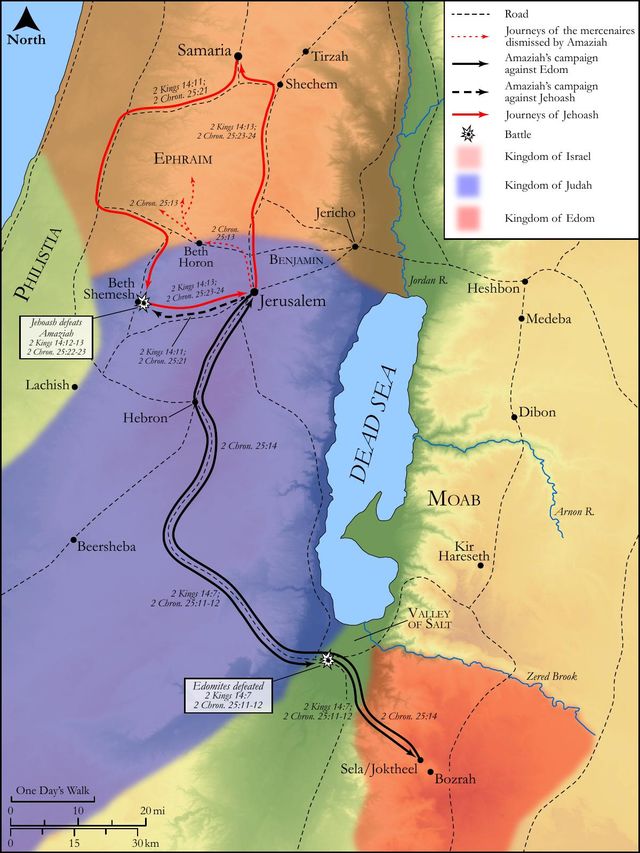
This verse serves as the concluding statement for the reign of King Amaziah, immediately following the account of his assassination in 2 Chronicles 25:27. The preceding narrative in 2 Chronicles 25 meticulously charts Amaziah's initial, albeit partial, obedience to the Lord (2 Chronicles 25:2), his significant military victory over Edom, and his subsequent catastrophic turn to idolatry by worshipping the very gods of the people he had conquered (2 Chronicles 25:14). This spiritual rebellion led to God's judgment, culminating in his foolish challenge to King Jehoash of Israel, a devastating defeat for Judah, and the plundering of the temple and royal treasury (2 Chronicles 25:23-24). The verse thus provides the final, grim detail of a reign marked by initial promise, profound spiritual failure, and a violent end, emphasizing the direct consequences of his choices.
Historical & Cultural Context
King Amaziah reigned over the Kingdom of Judah in the 9th century BCE, following the division of the united monarchy. Royal burials in ancient Judah were highly significant, typically occurring in the "City of David" (Jerusalem), within the royal necropolis, signifying a king's legitimate place in the Davidic lineage. The phrase "city of Judah" in this context is a clear reference to Jerusalem, the capital. Amaziah's flight to Lachish, a strategically important fortified city in the Shephelah region southwest of Jerusalem, indicates his attempt to escape the conspiracy that formed against him in Jerusalem. Despite his assassination far from the capital, the decision to transport his body "upon horses" back to Jerusalem for burial with his ancestors highlights the cultural importance of proper royal funerary rites, even for a king who died in disgrace. This act ensured his recognition within the royal succession, regardless of the ignominious circumstances of his death.
Key Themes
ShowHideThe narrative of Amaziah's reign, concluded by this verse, powerfully illustrates several key themes prevalent throughout the books of Chronicles. First, the theme of consequences for disobedience is paramount; Amaziah's initial "right" actions were undermined by a "heart not perfect" (2 Chronicles 25:2), leading to idolatry and ultimately his downfall. His story is a stark reminder that even those in positions of power are subject to divine judgment for their unfaithfulness. Second, the theme of divine sovereignty and justice is evident as God's warnings through prophets were ignored, and the subsequent events, including the conspiracy and assassination, are presented as direct outworkings of divine retribution for his apostasy (2 Chronicles 25:15-16). Finally, the verse subtly touches upon the continuity of the Davidic dynasty; despite Amaziah's personal failures and violent end, his burial "with his fathers" in the royal necropolis underscores the enduring, albeit sometimes strained, nature of the covenant God made with David, ensuring a continuous line of kings, even through flawed individuals.
Exposition and Analysis
ShowHideKey Word Analysis
ShowHideThe mention of "horses" (H5483) as the mode of transport for Amaziah's body from Lachish to Jerusalem is significant. Horses were a symbol of speed, power, and often, dignity in ancient Near Eastern cultures. While the immediate context is one of a king fleeing and being assassinated, the use of horses for his return journey suggests a deliberate effort to afford him a measure of royal dignity in death, or at least a swift and formal transport befitting a king, rather than a clandestine or undignified removal. It highlights the formality of the process, ensuring his body's proper return for a royal burial.
This verb (H6912) signifies the act of interment, a crucial ritual in ancient Israelite society that marked the finality of death and the proper honoring of the deceased. To be "buried with his fathers" was a highly esteemed privilege for kings, indicating burial in the royal necropolis, typically within the City of David in Jerusalem. This phrase confirms Amaziah's legitimate place within the lineage of Davidic kings, despite the ignominious circumstances of his death and the divine judgment on his reign. It speaks to the enduring respect for royal tradition and the importance of ancestral burial.
This proper noun (H3063) refers to the Southern Kingdom of Judah, specifically its capital, Jerusalem, as the place of burial. While Amaziah was killed in Lachish, his body was brought back to Jerusalem for burial. This detail emphasizes Jerusalem's central role as the political and religious heart of Judah and the traditional burial ground for its kings. It underscores the continued recognition of Jerusalem as the seat of the Davidic dynasty, even in a time of turmoil and regicide, and highlights the territory over which Amaziah reigned.
Verse Breakdown
ShowHide"And they brought him upon horses"
This clause describes the immediate action following Amaziah's assassination. The identity of "they" is not explicitly stated but implies those responsible for the proper handling of a king's body, likely loyalists or officials who, despite the conspiracy and regicide, adhered to the established royal protocols for funerary transport. The use of "horses" suggests a formal, swift, and perhaps dignified procession, contrasting with the undignified circumstances of his death.
"and buried him with his fathers"
This phrase signifies that Amaziah was interred in the royal burial grounds, alongside previous kings of Judah. This was a customary honor for kings, typically located in the City of David in Jerusalem. Despite his apostasy and violent end, this burial affirms his place within the royal lineage and the continuity of the Davidic dynasty. It suggests that even in disgrace, his status as king was acknowledged in death.
"in the city of Judah"
This final phrase explicitly names the destination of his body and the site of his burial. "The city of Judah" refers to Jerusalem, the capital. This detail confirms that despite the conspiracy originating in Jerusalem and his flight to Lachish, he was ultimately returned to the traditional royal necropolis, reinforcing the institutional continuity of the monarchy.
Literary Devices
ShowHideThe verse employs several literary devices to convey its meaning and impact. Juxtaposition is prominent, contrasting the ignominious flight and assassination of King Amaziah in Lachish with the formal and seemingly dignified transport "upon horses" and burial "with his fathers in the city of Judah." This contrast highlights the tension between his personal failure and the enduring institutional practices of the monarchy. There is also a subtle irony in this dignified burial for a king whose reign ended in disgrace due to his own pride and idolatry. Furthermore, the mention of "the city of Judah" serves as symbolism, representing not just a geographical location but the enduring lineage of David, the covenant God made with him, and the continuity of the kingdom, even through the reigns of flawed monarchs. The verse's concise nature also contributes to its impact, delivering the final, decisive blow to Amaziah's narrative with a sense of grim finality.
Theological and Thematic Connections
ShowHideThe account of Amaziah's death and burial in 2 Chronicles 25:28 serves as a potent theological statement about the consequences of unfaithfulness and the nature of divine judgment within the covenant relationship. His story is a stark reminder that even those who begin well can fall prey to pride and idolatry, leading to severe repercussions. The Chronicler emphasizes that Amaziah's downfall was not merely a political mishap but a direct result of his turning away from God, highlighting the principle that obedience brings blessing and disobedience brings judgment. Despite the ignominious end, his burial in the royal necropolis underscores God's faithfulness to His covenant with David, ensuring a continuous line of kings, even if individual kings failed. This narrative reinforces the Chronicler's overarching message that the well-being of the king and the nation is inextricably linked to their fidelity to YHWH.
Reflection and Application
ShowHideAmaziah's story, culminating in his ignominious death and formal burial, offers profound lessons for believers today. His initial "doing what was right in the sight of the Lord, but not with a perfect heart" (2 Chronicles 25:2) serves as a powerful warning against partial obedience or a divided heart. It reminds us that true devotion requires wholehearted commitment, not just outward conformity. Like Amaziah, we can be tempted to bring "idols" into our lives after a victory—whether they are literal idols or modern forms such as success, comfort, approval, or self-reliance. His pride, leading him to challenge Israel and ignore prophetic warnings, underscores the destructive nature of arrogance. For us, this means cultivating humility, listening to wise counsel, and remaining teachable, especially after accomplishments. Ultimately, Amaziah's narrative calls us to consider the long-term consequences of our choices, emphasizing that spiritual health and flourishing are directly tied to our unwavering fidelity to God, rather than fleeting successes or external recognition.
Questions for Reflection
ShowHideFAQ
ShowHideWhy was Amaziah buried in Jerusalem after being killed in Lachish?
ShowHideDespite his assassination in Lachish, King Amaziah was transported back to Jerusalem for burial because it was the traditional and culturally mandated burial site for the kings of Judah. Jerusalem, specifically the City of David, housed the royal necropolis where most of the Davidic kings were interred. This practice underscored the continuity of the Davidic dynasty and the importance of proper royal funerary rites, even for a king who met an ignominious end. It ensured his place within the lineage of kings, regardless of the circumstances of his death.
Who were "they" who brought him on horses?
ShowHideThe text does not explicitly name "they," but it likely refers to loyalists, royal officials, or those responsible for upholding the established protocols for a king's death and burial. Despite the conspiracy that led to Amaziah's assassination, there would have been individuals or factions who still honored the institution of kingship and the need for a proper royal burial. The use of "horses" suggests a formal and swift transport, indicating a deliberate effort to return the king's body to the capital for interment according to custom.
What does "with his fathers" signify in the context of royal burials?
ShowHideTo be buried "with his fathers" signifies interment in the royal burial grounds, typically located in the City of David in Jerusalem. This phrase indicates that the king was buried alongside his royal predecessors, affirming his legitimate place in the Davidic lineage and the continuity of the monarchy. It was a mark of honor and a confirmation of his status as a king of Judah, even if his reign ended in disgrace, as was the case with Amaziah. It connected him to the ancestral line and the enduring covenant God made with David.
Christ-Centered Fulfillment
ShowHideThe tragic narrative of King Amaziah, culminating in his ignominious death and subsequent burial in the "city of Judah," serves as a poignant backdrop against which the perfect Kingship of Jesus Christ shines even brighter. Amaziah, despite his initial good intentions, was a flawed king whose reign ended in judgment due to his divided heart, idolatry, and pride. His death in exile and return for burial in Jerusalem, while upholding royal tradition, still speaks to the consequences of his unfaithfulness. In stark contrast, Jesus Christ, the true and eternal King, was without sin (Hebrews 4:15) and perfectly obedient to the Father, even unto death on a cross (Philippians 2:8). While Amaziah's body was brought back to the earthly "city of Judah" for a burial that marked the end of his earthly reign, Christ's death was not the end but the means to a glorious resurrection and ascension, establishing an eternal kingdom not of this world (John 18:36). His burial was brief, followed by triumph over death, and He now reigns from the heavenly Jerusalem, preparing a place for all who believe in Him in the New Jerusalem (Revelation 21:1-4). Amaziah's story is a shadow of human kingship's limitations, pointing to the ultimate, perfect, and eternally reigning King, Jesus, who offers not judgment for sin but eternal life through His perfect sacrifice and resurrection.