


2 Chronicles 21:16
- וַיָּעַרvai·Ya·'arand he stirred upH5782Conj-w ¦ V-Hiphil-ConsecImperf-3msVerb Hiphil Consecutive Imperfect 3rd Singular Masculineוַandיָּעַרhe stirred up
- יְהוָהYah·wehYahwehH3068N-properNoun Proper Title
- עַל'alonH5921PrepPreposition
- יְהוֹרָםye·ho·RamJehoramH3088N-proper-mNoun Proper Masculine
- אֵת'et<obj.>H853DirObjMParticle Object Indicator
- רוּחַRu·ach[the] spirit ofH7307N-fscNoun Singular Feminine Construct
- הַפְּלִשְׁתִּיםha·pe·lish·Timthe PhilistinesH6430Art ¦ N-mpNoun Gentilic Plural Masculine AbsoluteהַtheפְּלִשְׁתִּיםPhilistines
- וְהָעַרְבִיםve·Ha·'ar·Vimand the ArabsH6163Conj-w ¦ Art ¦ N-mpNoun Gentilic Plural Masculine AbsoluteוְandהָtheעַרְבִיםArabs
- אֲשֶׁר'a·SherwhoH834RelParticle Relative
- עַל'al[were] onH5921PrepPreposition
- יַדyad[the] handH3027N-cscNoun Singular common gender Construct
- כּוּשִׁיםku·Shim[the] CushitesH3569N-mpNoun Gentilic Plural Masculine Absolute
English is a literal word-by-word gloss of the Hebrew, not the KJV's wording. Why?
This is the original text the KJV's translators worked from — each Hebrew word with its own literal English meaning in this verse, prepared by scholars at Tyndale House, Cambridge. The KJV translates whole sentences, not word by word, so its wording differs: one Hebrew word can become several English words, and the KJV may choose “the LORD” where the gloss reads “Yahweh”. Both are faithful — they answer different questions. For the KJV's own rendering, switch to the KJV text.
Details
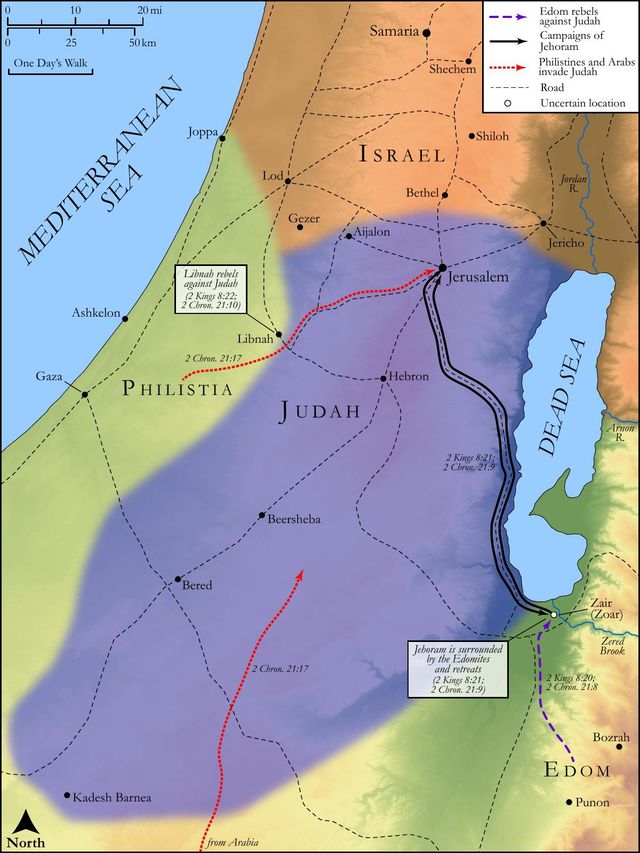
See on the biblical-era map
Study this verse
Public-domain commentary
Matthew Henry
From his Commentary on the Whole Bible. Henry comments on passages, not single verses — this entry covers 2 Chronicles 21:12–20. His three-level outline is real structure in the source text, so it is rendered as structure.
Here we have, I. A warning from God sent to Jehoram by a writing from Elijah the prophet. By this it appears that Jehoram came to the throne, and showed himself what he was before Elijah's translation. It is true we find Elisha attending Jehoshaphat, and described as pouring water on the hands of Elijah, after the story of Elijah's translation (Kg2 3:11); but that might be, and that description might be given of him, while Elijah was yet on earth: and it is certain that that history is put out of its proper place, for we read of Jehoshaphat's death, and Jehoram's coming to the crown, before we read of Elijah's translation, Kg1 22:50. We will suppose that the time of his departure was at hand, so that he could not go in person to Jehoram; but that, hearing of his great wickedness in murdering his brethren, he left this writing it is probable with Elisha, to be sent him by the first opportunity, that it might either be a means to reclaim him or a witness against him that he was fairly told what would be in the end hereof. The message is sent him in the name of the Lord God of David his father (Ch2 21:12), upbraiding him with his relation to David as that which, though it was his honour, was an aggravation of his degeneracy. 1. His crimes are plainly charged upon him - his departure from the good ways of God, in which he had been educated, and which he had been directed and encouraged to walk in by the example of his good father and grandfather, who lived and died in peace and honour (Ch2 21:12) - his conformity to the ways of the house of Ahab, that impious scandalous family - his setting up and enforcing idolatry in his kingdom - and his murdering his brethren because they were better than himself, Ch2 21:13. These are the heads of the indictment against him. 2. Judgment is given against him for these crimes; he is plainly told that his sin should certainly be the ruin, (1.) Of his kingdom and family (Ch2 21:14): "With a heavy stroke, even that of war and captivity, will the Lord smite thy people and thy children," etc. Bad men bring God's judgments upon all about them. His people justly suffer because they had complied with his idolatry, and his wives because they had drawn him to it. (2.) Of his health and life: "Thou shalt have great sickness, very painful and tedious, and at last mortal," Ch2 21:15. This he is warned of before, that his blood might be upon his own head, the watchman having delivered his soul; and that when these things so particularly foretold, came to pass, it might appear that they did not come by chance, but as the punishment of his sins, and were so intended. And now if, as he had learned of Ahab to do wickedly, he had but learned even of Ahab to humble himself upon the receipt of this threatening message from Elijah - if, like (Kg1 21:27), he had rent his clothes, put on sackcloth, and fasted - who knows but, like him, he might have obtained at least a reprieve? But it does not appear that he took any notice of it; he threw it by as waste-paper; Elijah seemed to him as one that mocked. But those that will not believe shall feel.
II.The threatened judgments brought upon him because he slighted the warning.
No marvel that hardened sinners are not frightened from sin and to repentance by the threatenings of misery in another world, which is future and out of sight, when the certain prospect of misery in this world, the sinking of their estates and the ruin of their healths, will not restrain them from vicious courses.
1.See Jehoram here stripped of all his comforts. God stirred up the spirit of his neighbours against him, who had loved and feared Jehoshaphat, but hated and despised him, looking upon it as a scandalous thing for a nation to change their gods. Some occasion or other they took to quarrel with him, invaded his country, but, as it should seem, fought neither against small nor great, but the king's house only; they made directly to that, and carried away all the substance that was found in it. No mention is made of their carrying any away captive but the king's wives and his sons, Ch2 21:17. Thus God made it evident that the controversy was with him and his house. Here it is only said, They carried away his sons; but we find (Ch2 22:1) that they slew them all. Blood for blood. He had slain all his brethren, to strengthen himself; and now all his sons are slain but one, and so he is weakened. If he had not been of the house of David, that one would not have escaped. When Jeroboam's house, and Baasha's, and Ahab's, were destroyed, there was none left; but David's house must not be wholly extirpated, though sometimes wretchedly degenerated, because a blessing was in it, no less a blessing than that of the Messiah.
2.See him tormented with sore diseases and of long continuance, such as were threatened in the law against those that would not fear the Lord their God, Deu 28:58, Deu 28:59. His disease was very grievous. It lay in his bowels, producing a continual griping, and with this there was a complication of other sore diseases. The affliction was moreover very tedious. Two years he continued ill, and could get no relief; for the disease was incurable, though he was in the prime of life, not forty years old. Asa, whose heart was perfect with God though in some instances he stepped aside, was diseased only in his feet; but Jehoram, whose heart was wicked, was struck in his inwards, and he that had no bowels of compassion towards his brethren was so plagued in his bowels that they fell out. Even good men, and those who are very dear to God, may be afflicted with diseases of this kind; but to them they are fatherly chastisements, and by the support of divine consolations the soul may dwell at ease even then when the body lies in pain. These sore diseases seized him just after his house was plundered and his wives and children were carried away.
(1.)Perhaps his grief and anguish of mind for that calamity might occasion his sickness, or at least contribute to the heightening of it.
(2.)By this sickness he was disabled to do any thing for the recovery of them or the revenge of the injury done him.
(3.)It added, no doubt, very much to his grief, in his sickness, that he was deprived of the society of his wives and children and that all the substance of his house was carried away. To be sick and poor, sick and solitary, but especially to be sick and in sin, sick and under the curse of God, sick and destitute of grace to bear the affliction, and of comfort to counter-balance it - is a most deplorable case.
3.See him buried in disgrace. He reigned but eight years, and then departed without being desired, Ch2 21:20. Nobody valued him while he lived, none lamented him when he died, but all wished that no greater loss might ever come to Jerusalem. To show what little affection or respect they had for him, they would not bury him in the sepulchres of the kings, as thinking him unworthy to be numbered among them who had governed so ill. The excluding of his body from the sepulchres of his fathers might be ordered by Providence as an intimation of the everlasting separation of the souls of the wicked after death, from the spirits of just men. This further disgrace they put upon him, that they made no burning for him, like the burning of his fathers, Ch2 21:19. His memory was far from being sweet and precious to them, and therefore they did not honour it with any sweet odours or precious spices, though we may suppose that his dead body, after so long and loathsome a disease, needed something to perfume it. The generality of the people, though prone to idolatry, yet had no true kindness for their idolatrous kings. Wickedness and profaneness make men despicable even in the eyes of those who have but little religion themselves, while natural conscience itself often gives honour to those who are truly pious. Those that despise God shall be lightly esteemed, as Jehoram was.
Historical interpretation
Historical reception
1 surviving comment on this verse from the historical church.
Just read the books of Paralipomenon and this is what you will find written in the second book: “And the Lord stirred up against Jehoram the spirit of the Philistines and of the Arabians who border on the Ethiopians. And they came up to the land of Judah and wasted it, and they carried away all substance that was found in the king’s house.” Here we have a clear indication of how God stirs up enemies to lay waste those countries that he judges to be deserving of such punishment. And yet, was it not of their own will that the Philistines and Arabs came to lay waste the country of Judah? Or did they so come of their own will that the Scripture lies where it tells us that the Lord stirred up their spirit to do so? On the contrary. Both statements are true because they did come of their own will and God did stir up their spirit. The same thing could also be expressed by saying that God both stirred up their spirit and that they came nevertheless of their own will. For the Almighty, who cannot possibly will anything unjust, is able to set in motion even the inclinations of their will in human hearts in order to accomplish through these people whatever he wishes to achieve through their agency.
Continue studying 2 Chronicles 21:16 across the web’s major study libraries — every link below opens this exact verse, chapter, or book on the destination site.
Read & Compare
 BibleGatewayThis verse in more than 200 translations and 70 languages.
 Bible.comThe YouVersion reader — hundreds of translations, reading plans, and highlights.
 ESV.orgCrossway's official English Standard Version reader.
 NET BibleThe NET translation with 60,000+ translators' notes on every rendering decision.
 STEP BibleTyndale House's free study tool — original text, vocabulary, and scholarly resources.
 BibliaLogos Bible Software's free web reader.
 USCCBThe New American Bible (Revised Edition) with the U.S. bishops' study notes.
Commentaries
 BibleHub CommentariesDozens of classic commentaries on this verse, gathered on one page.
 StudyLightMore than 100 commentary sets — the largest collection on the web.
 BibleRefPlain-English commentary on what this verse means, verse by verse.
 Enduring WordDavid Guzik's free commentary on this chapter, widely used by Bible teachers.
 Bible Study ToolsVerse commentary alongside Greek and Hebrew study aids.
Original Language & Research
- BibleHub InterlinearThe verse word by word — original language, transliteration, and English.
- BibleHub LexiconEvery word's original-language definition and Strong's entry.
 Blue Letter BibleDeep-study tools — Strong's numbers, concordance, and word studies.
 SefariaThe Hebrew text with Rashi and centuries of Jewish commentary.
Sermons, Hymns & Audio


TrulyRandomVerse is not affiliated with these sites and doesn’t control their content. They’re linked because they’re genuinely useful.
Summary
Second Chronicles 21:16 vividly illustrates the unfolding of divine judgment upon King Jehoram of Judah, whose reign was characterized by profound wickedness and apostasy. This verse marks a critical turning point, revealing God's active and sovereign hand in orchestrating the actions of foreign nations—specifically the Philistines and Arabians—to serve as instruments of His righteous retribution against a disobedient king and his kingdom. It underscores the inescapable consequences of rejecting God's covenant and highlights the principle that divine justice will ultimately prevail.
Context
ShowHideLiterary Context
This verse immediately follows the prophetic pronouncement delivered by Elijah (or a prophet in his spirit) against King Jehoram (2 Chronicles 21:12-15). Jehoram, unlike his righteous father Jehoshaphat, had plunged Judah into idolatry, murdering his own brothers to consolidate power and marrying Athaliah, the wicked daughter of Ahab, thereby adopting the abominable practices of the northern kingdom of Israel (compare with 2 Chronicles 21:4-6). Elijah's letter foretold severe judgment: a great plague on Jehoram's people, family, and possessions, and a grievous illness upon Jehoram himself. Verse 16 initiates the fulfillment of this prophecy, detailing the specific agents—the Philistines and Arabians—through whom God would bring calamity, leading directly into the subsequent account of their invasion and plunder in 2 Chronicles 21:17.
Historical & Cultural Context
Jehoram reigned over Judah from approximately 848-841 BC. His marriage to Athaliah was a political alliance with the Omride dynasty of Israel, but it proved to be a spiritual disaster, importing Baal worship into Judah. The Philistines were traditional adversaries of Israel and Judah, dwelling along the coastal plain to the west. The Arabians, particularly those "near the Ethiopians" (likely referring to tribes south or southeast of Judah, possibly in the Arabian peninsula or Transjordan region, bordering the Cushite/Ethiopian sphere of influence), were nomadic or semi-nomadic groups known for their raiding activities. Their mention here signifies a broad coalition or coordinated attack from different geographical directions, highlighting the widespread nature of the judgment. The fact that these historical enemies are "stirred up" by the LORD emphasizes God's control over geopolitical events and His ability to use any nation to accomplish His purposes.
Key Themes
ShowHideThe most prominent theme is Divine Judgment and Retribution, directly linking Jehoram's profound apostasy and wickedness to the calamities that befall him and Judah. The phrase "the LORD stirred up" unequivocally establishes God's direct agency and sovereignty in orchestrating these events, not merely permitting them. This underscores the Consequences of Disobedience, particularly for covenant leaders, demonstrating that rebellion against God's law brings severe personal and national calamity, as foretold by Elijah in 2 Chronicles 21:14-15. Furthermore, the verse highlights God's Sovereignty Over Nations, illustrating His capacity to use even hostile foreign powers as instruments of His divine will, demonstrating that no earthly power operates outside His ultimate control. This principle is seen throughout the Old Testament, from God raising up nations to punish Israel to His control over the rise and fall of empires, as articulated in passages like Daniel 2:21.
Exposition and Analysis
ShowHideKey Word Analysis
ShowHideThis refers to Jehovah (H3068) , the self-Existent or Eternal God, the Jewish national name of God. Its use here emphasizes that the instigator of the judgment is the covenant God of Israel, highlighting His personal and righteous involvement in the affairs of His people and their king. This is not a random event but a direct act of the sovereign God.
This verb (H5782) means to wake, arouse, incite, or provoke. Its active use here indicates a divine initiative, not merely a passive allowance of events. God actively impelled or instigated the hostile actions of the Philistines and Arabians against Jehoram. It conveys a strong sense of purposeful, sovereign action, emphasizing that these attacks were not random misfortunes but divinely orchestrated judgments.
This noun (H7307) , while often meaning "wind" or "breath," here refers to the disposition, will, or inclination of a rational being. In this context, it signifies that God supernaturally influenced the inner resolve, animosity, and aggressive intent of these nations, directing their inherent hostility towards Judah and Jehoram. It points to God's profound control over the hearts and minds of people, even those outside His covenant.
Verse Breakdown
ShowHide"Moreover the LORD stirred up against Jehoram"
This opening clause immediately establishes the divine origin of the impending calamity. It is not a natural disaster or a random geopolitical event, but a direct, purposeful act of God. The phrase "stirred up" (עוּר) emphasizes God's active incitement and sovereign control over the hearts and actions of nations, directing their will and movements as instruments of His justice against Jehoram. This highlights God's role as the ultimate arbiter of justice in human affairs.
"the spirit of the Philistines, and of the Arabians"
This specifies the agents of God's judgment. "The spirit" here refers not just to their physical presence or military might, but to their disposition, their will, or their inclination to attack. God supernaturally influenced their resolve and directed their aggression towards Judah and Jehoram, turning their inherent animosity into a tool for divine retribution. This demonstrates God's ability to use even those who are not His covenant people to accomplish His sovereign purposes.
"that [were] near the Ethiopians"
This geographical detail helps locate the specific Arabian tribes involved, likely those in the southern reaches of the Arabian desert, possibly extending towards the borders of Cush (Ethiopia). This precision underscores the historical reality of the event and the widespread nature of the threat Jehoram faced, indicating that God's judgment would come from multiple, formidable directions. It suggests a coordinated or multi-pronged assault, emphasizing the comprehensive nature of God's judgment.
Literary Devices
ShowHideThe verse employs several significant literary devices. Divine Agency is paramount, as the text explicitly states "the LORD stirred up," leaving no doubt that God is the primary actor behind the events. This highlights His sovereignty and active involvement in human history, particularly in executing justice. There is also a strong element of Irony, as the very nations that were often adversaries of God's people are now used by God as instruments to punish His own rebellious king. This demonstrates God's ability to turn the intentions of the wicked to serve His righteous purposes. Furthermore, the verse serves as Foreshadowing, setting the stage for the severe plundering and personal suffering that Jehoram would endure, as detailed in the subsequent verses of 2 Chronicles 21. The use of "spirit" to describe the Philistines and Arabians also hints at a Supernatural Influence, emphasizing that their actions were not merely human initiatives but divinely orchestrated.
Theological and Thematic Connections
ShowHideThis verse profoundly illustrates the biblical principle of divine retribution, where God actively intervenes in human affairs to bring judgment upon wickedness, especially among those who bear His name. It demonstrates that God's sovereignty extends not only over His covenant people but also over the nations of the world, using them as instruments to accomplish His holy will. Jehoram's reign serves as a stark warning that disobedience and apostasy, particularly from a position of leadership, will not go unpunished. God's justice is not passive; He actively "stirs up" circumstances and even hostile forces to bring about consequences for sin, ensuring that righteousness and covenant faithfulness are upheld. This passage reinforces the truth that God is intimately involved in the course of history, orchestrating events to fulfill His righteous purposes, even when it involves the suffering of His own people due to their rebellion.
Reflection and Application
ShowHideSecond Chronicles 21:16 serves as a potent reminder that God is not a distant, disengaged deity but an active, sovereign, and just ruler over all creation. For believers today, while we live under the new covenant of grace, the underlying principles of God's character—His holiness, justice, and sovereignty—remain immutable. This verse challenges us to take sin seriously, recognizing that our actions, especially those that defy God's revealed will, have profound consequences, both personal and communal. It calls us to a deeper trust in God's ultimate control, even when faced with seemingly chaotic or threatening circumstances, understanding that He can use any situation or entity to fulfill His purposes. Ultimately, it compels us to live lives of humble obedience and faithfulness, knowing that God is intimately involved in our world and holds all things in His powerful hand. This divine oversight provides both a warning against rebellion and a profound comfort for those who seek to honor Him, knowing that He works all things for the good of those who love Him (Romans 8:28).
Questions for Reflection
ShowHideFAQ
ShowHideWhat does it mean that the LORD "stirred up the spirit" of these nations? Was it against their will?
ShowHideThe phrase "stirred up the spirit" (Hebrew: עוּר, 'ur') signifies a divine incitement or provocation. It doesn't necessarily mean God forced these nations to act against their inherent will, but rather that He supernaturally influenced their existing inclinations or animosities, directing them towards Jehoram and Judah at a specific time and for a specific purpose. The Philistines and Arabians were already historical adversaries of Judah, and God activated their latent hostility or provided the opportune moment and motivation for them to attack. This highlights God's sovereignty over the hearts and minds of all people, even those who do not acknowledge Him, as He can use their natural desires and geopolitical ambitions to fulfill His own righteous judgments, as seen in other instances where God uses foreign powers, such as Assyria as His "rod" in Isaiah 10:5 or Cyrus in Isaiah 45:1-7. This divine orchestration ensures that even the actions of the wicked ultimately serve God's overarching plan.
Christ-Centered Fulfillment
ShowHideWhile 2 Chronicles 21:16 depicts God's judgment on a wicked king, it ultimately points to the greater King, Jesus Christ, who perfectly fulfills God's righteous demands and stands as the ultimate arbiter of justice. Jehoram's reign, marked by apostasy and violence, invited divine wrath, demonstrating the severe consequences of sin and rebellion against God's covenant. In stark contrast, Jesus, the true Son of David, lived a life of perfect obedience, never stirring up God's wrath but rather perfectly pleasing Him. He willingly became the recipient of God's judgment on the cross, taking upon Himself the "stirred up" wrath for the sins of humanity, so that those who believe in Him might be spared (compare Romans 8:1 and 2 Corinthians 5:21). Furthermore, Christ's sovereignty far surpasses that of any earthly king; He is the King of kings and Lord of lords, exercising ultimate authority over all nations and spiritual forces. While God "stirred up" nations against Jehoram, in Christ, God has disarmed and triumphed over the spiritual powers of darkness, making a public spectacle of them (see Colossians 2:15). The narrative of judgment in 2 Chronicles 21:16 thus ultimately magnifies the grace and justice found in Christ, who delivers us from the judgment we deserve and reigns eternally in righteousness, offering salvation to all who turn to Him (John 3:16).