


2 Chronicles 26:10
- וַיִּבֶןvai·Yi·venand he builtH1129Conj-w ¦ V-Qal-ConsecImperf-3msVerb Qal Consecutive Imperfect 3rd Singular Masculineוַandיִּבֶןhe built
- מִגְדָּלִיםmig·da·LimtowersH4026N-mpNoun Plural Masculine Absolute
- בַּמִּדְבָּרba·mid·Barin the wildernessH4057Prep-b ¦ N-msNoun Singular Masculine Absoluteבַּin theמִּדְבָּרwilderness
- וַיַּחְצֹבvai·yach·Tzoand he dugH2672Conj-w ¦ V-Qal-ConsecImperf-3msVerb Qal Consecutive Imperfect 3rd Singular Masculineוַandיַּחְצֹבhe dug
- בֹּרוֹתbo·RotwellsH953N-fpNoun Plural Feminine Absolute
- רַבִּיםra·BimmanyH7227Adj-mpAdjective Plural Masculine Absolute
- כִּיkiforH3588PrtParticle Conditional
- מִקְנֶהmik·nehlivestockH4735N-msNoun Singular Masculine Absolute
- רַּבravmuchH7227Adj-msAdjective Singular Masculine Absolute
- הָיָהHa·yahit belongedH1961V-Qal-Perf-3msVerb Qal Perfect 3rd Singular Masculine
- לוֹloto <the> himPrep-l ¦ 3msSuffix Personal 3rd Singular Masculineלto <the>וֹhim
- וּבַשְּׁפֵלָהu·va·she·fe·Lahand in the ShephelahH8219Conj-w ¦ Prep-b ¦ N-fsNoun Singular Feminine Absoluteוּandבַin theשְּׁפֵלָהShephelah
- וּבַמִּישׁוֹרu·va·mi·Shorand in the plainH4334Conj-w ¦ Prep-b ¦ N-msNoun Singular Masculine Absoluteוּandבַin theמִּישׁוֹרplain
- אִכָּרִים'i·ka·RimfarmersH406N-mpNoun Plural Masculine Absolute
- וְכֹרְמִיםve·kho·re·Mimand vinedressersH3755Conj-w ¦ N-mpNoun Plural Masculine Absoluteוְandכֹרְמִיםvinedressers
- בֶּהָרִיםbe·ha·Rimin the mountainsH2022Prep-b ¦ N-mpNoun Plural Masculine Absoluteבֶּin theהָרִיםmountains
- וּבַכַּרְמֶלu·va·kar·Meland in the orchardsH3759Conj-w ¦ Prep-b ¦ N-msNoun Singular Masculine Absoluteוּandבַin theכַּרְמֶלorchards
- כִּיkiforH3588PrtParticle Conditional
- אֹהֵב'o·HevlovingH157V-Qal-Prtcpl-msVerb Qal Participle Singular Masculine Absolute
- אֲדָמָה'a·da·Mah[the] groundH127N-fsNoun Singular Feminine Absolute
- הָיָהha·Yahhe wasH1961V-Qal-Perf-3msVerb Qal Perfect 3rd Singular Masculine
English is a literal word-by-word gloss of the Hebrew, not the KJV's wording. Why?
This is the original text the KJV's translators worked from — each Hebrew word with its own literal English meaning in this verse, prepared by scholars at Tyndale House, Cambridge. The KJV translates whole sentences, not word by word, so its wording differs: one Hebrew word can become several English words, and the KJV may choose “the LORD” where the gloss reads “Yahweh”. Both are faithful — they answer different questions. For the KJV's own rendering, switch to the KJV text.
Details
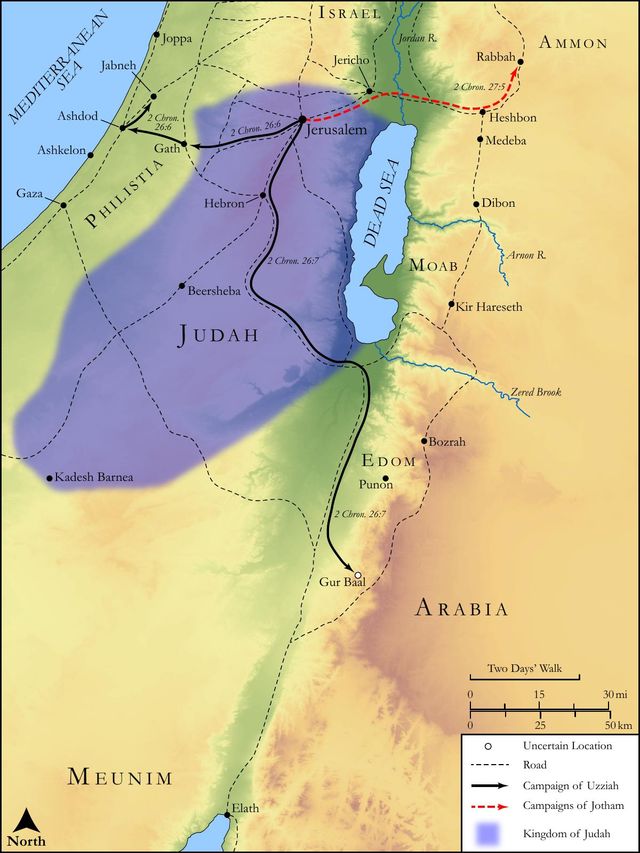
See on the biblical-era map
Study this verse
Public-domain commentary
Matthew Henry
From his Commentary on the Whole Bible. Henry comments on passages, not single verses — this entry covers 2 Chronicles 26:1–15. His three-level outline is real structure in the source text, so it is rendered as structure.
We have here an account of two things concerning Uzziah: -
I.His piety.
In this he was not very eminent or zealous; yet he did that which was right in the sight of the Lord. He kept up the pure worship of the true God as his father did, and was better than his father, inasmuch as we have no reason to think he ever worshipped idols as his father did, no, not in his latter days, when his heart was lifted up. It is said (Ch2 26:5), He sought God in the days of Zechariah, who, some think, was the son of the Zechariah whom his grandfather Joash slew. This Zechariah was one that had understanding in the visions of God, either the visions which he himself was favoured with or the visions of the preceding prophets. He was well versed in prophecy, and conversed much with the upper world, was an intelligent, devout, good man; and, it seems, had great influence with Uzziah. Happy are the great men who have such about them and are willing to be advised by them; but unhappy those who seek God only while they have such with them and have not a principle in themselves to bear them out to the end.
II.His prosperity.
1.In general, as long as he sought the Lord, and minded religion, God made him to prosper. Note,
(1.)Those only prosper whom God makes to prosper; for prosperity is his gift.
(2.)Religion and piety are very friendly to outward prosperity. Many have found and owned this, that as long as they sought the Lord and kept close to their duty they prospered; but since they forsook God every thing has gone cross.
2.Here are several particular instances of his prosperity: - (1.) His success in his wars: God helped him (Ch2 26:7), and then he triumphed over the Philistines (those old enemies of God's people), demolished the fortifications of their cities, and put garrisons of his own among them, Ch2 26:6. He obliged the Ammonites to pay him tribute, Ch2 26:8. He made all quiet about him, and kept them in awe. (2.) The greatness of his fame and reputation. His name was celebrated throughout all the neighbouring countries (Ch2 26:8) and it was a good name, a name for good things with God and good people. This is true fame, and makes a man truly honourable. (3.) His buildings. While he acted offensively abroad, he did not neglect the defence of his kingdom at home, but built towers in Jerusalem and fortified them, Ch2 26:9. Much of the wall of Jerusalem was in his father's time broken down, particularly at the corner gate. But his best fortification of Jerusalem was his close adherence to the worship of God: if his father had not forsaken this the wall of Jerusalem would not have been broken down. While he fortified the city, he did not forget the country, but built towers in the desert too (Ch2 26:10), to protect the country people from the inroads of the plunderers, bands of whom sometimes alarmed them and plundered them, as Ch2 21:16. (4.) His husbandry. He dealt much in cattle and corn, employed many hands, and got much wealth by his dealing; for he took a pleasure in it: he loved husbandry (Ch2 21:10), and probably did himself inspect his affairs in the country, which was no disparagement to him, but an advantage, as it encouraged industry among his subjects. It is an honour to the husbandman's calling that one of the most illustrious princes of the house of David followed it and loved it. He was not one of those that delight in war, nor did he addict himself to sport and pleasure, but delighted in the innocent and quiet employments of the husbandman. (5.) His standing armies. He had, as it should seem, two military establishments. [1.] A host of fighting men that were to make excursions abroad. These went out to war by bands, Ch2 21:11. They fetched in spoil from the neighbouring countries by way of reprisal for the depredations they had so often made upon Judah, [2.] Another army for guards and garrisons, that were ready to defend the country in case it should be invaded, Ch2 21:12, Ch2 21:13. So great were their number and valour that they made war with mighty power; no enemy durst face them, or, at least, could stand before them. Men unarmed can do little in war. Uzziah therefore furnished himself with a great armoury, whence his soldiers were supplied with arms offensive and defensive (Ch2 21:14), spears, bows, and slings, shields, helmets, and habergeons: swords are not mentioned, because it is probable that every man had a sword of his own, which he wore constantly. Engines were invented, in his time, for annoying besiegers with darts and stones shot from the towers and bulwarks, Ch2 21:15. What a pity it is that the wars and fightings which come from men's lusts have made it necessary for cunning men to employ their skill in inventing instruments of death.
Continue studying 2 Chronicles 26:10 across the web’s major study libraries — every link below opens this exact verse, chapter, or book on the destination site.
Read & Compare
 BibleGatewayThis verse in more than 200 translations and 70 languages.
 Bible.comThe YouVersion reader — hundreds of translations, reading plans, and highlights.
 ESV.orgCrossway's official English Standard Version reader.
 NET BibleThe NET translation with 60,000+ translators' notes on every rendering decision.
 STEP BibleTyndale House's free study tool — original text, vocabulary, and scholarly resources.
 BibliaLogos Bible Software's free web reader.
 USCCBThe New American Bible (Revised Edition) with the U.S. bishops' study notes.
Commentaries
 BibleHub CommentariesDozens of classic commentaries on this verse, gathered on one page.
 StudyLightMore than 100 commentary sets — the largest collection on the web.
 BibleRefPlain-English commentary on what this verse means, verse by verse.
 Enduring WordDavid Guzik's free commentary on this chapter, widely used by Bible teachers.
 Bible Study ToolsVerse commentary alongside Greek and Hebrew study aids.
Original Language & Research
- BibleHub InterlinearThe verse word by word — original language, transliteration, and English.
- BibleHub LexiconEvery word's original-language definition and Strong's entry.
 Blue Letter BibleDeep-study tools — Strong's numbers, concordance, and word studies.
 SefariaThe Hebrew text with Rashi and centuries of Jewish commentary.
Sermons, Hymns & Audio


TrulyRandomVerse is not affiliated with these sites and doesn’t control their content. They’re linked because they’re genuinely useful.
Summary
King Uzziah of Judah, a monarch celebrated for his initial faithfulness and military triumphs, also demonstrated profound administrative foresight and economic diligence. This verse illuminates his strategic investments in the kingdom's infrastructure, specifically the construction of watchtowers in the desert and the excavation of numerous wells. These vital projects were essential for safeguarding and sustaining his extensive livestock holdings. His comprehensive approach to agriculture, encompassing diverse terrains from the fertile lowlands and plains to the rugged mountains and the rich Carmel region, underscored his deep personal passion for "husbandry," a love for the land that directly contributed to the kingdom's remarkable prosperity and stability throughout his reign.
Context
ShowHideLiterary Context
2 Chronicles 26:10 is situated within the Chronicler's detailed account of King Uzziah's reign, which is predominantly depicted as a period of significant national strength and divine blessing for Judah. The preceding verses establish Uzziah's ascension to the throne at a remarkably young age (sixteen), his initial commitment to seeking God's guidance through the prophet Zechariah, and the subsequent divine favor that propelled him to military successes and widespread renown (see 2 Chronicles 26:1-8). This specific verse, therefore, marks a transition in the narrative focus from his military prowess to his domestic policies and economic initiatives. It showcases that Uzziah's leadership was comprehensive, extending beyond defense to include strategic economic development, laying the groundwork for the kingdom's flourishing. This period of prosperity, however, stands in stark contrast to the later narrative of Uzziah's pride, his unlawful entry into the temple, and his subsequent affliction with leprosy, which serves as a poignant reminder of the consequences of disobedience, as detailed in 2 Chronicles 26:16-21.
Historical & Cultural Context
The economy of ancient Israel was fundamentally agrarian, heavily reliant on the successful cultivation of crops and the rearing of livestock. Water was an exceptionally precious and often scarce commodity, particularly in the arid and semi-arid regions of Judah. Furthermore, the constant threat of nomadic raiders posed a significant danger to shepherds and their valuable flocks, making security a paramount concern for any responsible leader. In this context, Uzziah's actions—building "towers in the desert" and "digging many wells"—were not merely displays of royal wealth or power, but rather vital, pragmatic measures for the kingdom's survival, economic stability, and expansion. These towers functioned as essential watchtowers to guard against raids and as fortified outposts for shepherds, while the wells provided indispensable water for both human settlements and the burgeoning animal herds, thereby enabling the expansion of grazing lands into previously unusable areas. The explicit mention of "low country" (the Shephelah), "plains" (coastal or Jordan Valley plains), "mountains" (the Judean highlands), and "Carmel" (a renowned fertile region) highlights the diverse topography of Judah and underscores Uzziah's integrated and strategic approach to maximizing agricultural productivity across all available land.
Key Themes
ShowHideThis verse powerfully illustrates several central themes within the Chronicler's theological framework and broader biblical theology. It prominently features the theme of diligent leadership and foresight, showcasing Uzziah's proactive and strategic approach to managing the kingdom's natural and human resources. This comprehensive stewardship was foundational for both national security and economic well-being. The emphasis on "much cattle" and the diverse range of agricultural pursuits highlights the theme of economic prosperity and wise resource management, demonstrating how prudent and active stewardship can lead to abundance. Furthermore, Uzziah's personal "love for husbandry" elevates the value of agriculture as a foundational and respected pursuit, indispensable for the nation's sustenance and overall prosperity. Implicitly, the verse also touches upon the theme of blessing through diligence and seeking God, as Uzziah's practical efforts and strategic investments were integral to the broader prosperity God granted him, particularly as long as he sought the Lord, as explicitly stated earlier in his reign in 2 Chronicles 26:5.
Exposition and Analysis
ShowHideKey Word Analysis
ShowHideThis primitive root signifies "to have affection for (sexually or otherwise); (be-) love(-d, -ly, -r), like, friend." In the context of Uzziah, this word indicates a deep personal interest, passion, and genuine delight in the work of agriculture and animal husbandry. It suggests that his extensive investments were not merely a matter of political duty or economic strategy, but flowed from a sincere appreciation for the land and its productivity.
Derived from the root meaning "to be red," this term refers to "soil (from its general redness); country, earth, ground, husband(-man) (-ry), land." When coupled with ʼâhab ("loved"), the phrase "loved husbandry" (literally "loved the ground") reveals Uzziah's profound connection to and active involvement in the agricultural life of his kingdom. It highlights his hands-on approach and personal investment in the foundational economic activities of the nation.
From a root meaning "to be great," this noun refers to "a tower (from its size or height); by analogy, a rostrum; figuratively, a (pyramidal) bed of flowers." In this context, these were fortified structures or watchtowers. Their construction in the desert indicates Uzziah's strategic foresight in establishing security infrastructure to protect valuable livestock and shepherds from nomadic raiders, guard water sources, and potentially serve as strategic outposts along trade routes or borders.
Verse Breakdown
ShowHide"Also he built towers in the desert,"
This clause highlights King Uzziah's strategic foresight in establishing essential security infrastructure. The "desert" refers to the wilderness areas of Judah, which, while often used for grazing, were vulnerable to attacks. These towers provided crucial protection for valuable livestock and the people tending them, demonstrating a proactive approach to national security.
"and digged many wells:"
This further emphasizes Uzziah's practical and vital investments in the kingdom's economic foundation. Wells were indispensable for water supply in the arid climate of Judah, enabling the sustenance of large herds and supporting agricultural endeavors, thereby directly contributing to the kingdom's economic stability and growth by expanding arable and grazing lands.
"for he had much cattle, both in the low country, and in the plains:"
This clause provides the rationale and necessity behind Uzziah's infrastructural projects. His wealth and the kingdom's prosperity were significantly tied to his extensive livestock holdings. The "low country" (Shephelah) and "plains" (such as the coastal plain or Jordan valley) were fertile areas highly suitable for grazing, indicating the vastness and diversity of his agricultural enterprises.
"husbandmen [also], and vine dressers in the mountains, and in Carmel:"
This demonstrates the comprehensive nature and breadth of Uzziah's agricultural interests. "Husbandmen" (farmers) and "vine dressers" cultivated various crops, including vineyards, in the "mountains" (the Judean hills, suitable for terraced farming) and the highly fertile "Carmel" region, renowned for its rich soil and productive vineyards. This illustrates a holistic approach to land utilization across the kingdom's varied topography.
"for he loved husbandry."
This concluding clause provides the profound personal motivation behind Uzziah's extensive agricultural and infrastructural investments. His genuine passion and personal delight in farming and animal rearing were the driving forces behind his strategic efforts, transforming a royal interest into a source of widespread national prosperity and stability.
Literary Devices
ShowHideThe verse employs several descriptive elements to vividly portray Uzziah's comprehensive administrative prowess and the resulting prosperity of his reign. The meticulous listing of diverse geographical regions—"low country," "plains," "mountains," and "Carmel"—functions as a powerful form of merism, encompassing the entire spectrum of Judah's varied topography and thereby emphasizing the vast and all-encompassing scope of Uzziah's agricultural enterprises across the kingdom. This detailed enumeration underscores the breadth and variety of his holdings and strategic investments. Furthermore, the concluding phrase "for he loved husbandry" acts as a profound summary statement and explanation, attributing Uzziah's diligent and extensive efforts not merely to royal duty or strategic necessity but to a deep, personal passion. This revelation of his intrinsic motivation adds significant depth to the portrayal of his character, suggesting that his success was not accidental but deeply rooted in genuine interest and hands-on involvement, thereby offering the reader crucial insight into the king's character and priorities.
Theological and Thematic Connections
ShowHideUzziah's diligent and strategic investments in infrastructure and agriculture powerfully underscore the biblical principle that God often blesses human diligence, wise stewardship, and proactive efforts. His actions exemplify the wisdom literature's emphasis on hard work, foresight, and prudent management as pathways to prosperity and stability. The king's "love for husbandry" reflects a deep appreciation for the foundational work of cultivating the earth and tending to its resources, echoing humanity's original commission in Genesis 2:15. This verse demonstrates how a leader's personal values and practical efforts, when aligned with seeking God, can bring tangible benefits to an entire nation. It also highlights the importance of providing for the physical needs and security of the populace as a vital aspect of righteous and responsible governance.
Reflection and Application
ShowHideKing Uzziah's reign, particularly as depicted in this verse, offers profound and enduring lessons on the nature of effective leadership, the virtue of personal diligence, and the critical importance of stewarding resources wisely. His commitment to building foundational infrastructure and nurturing the land serves as a powerful reminder that true and lasting prosperity—whether for an individual, a family, or an entire community—often stems from investing in basic, often unglamorous, necessities with foresight and dedication. This passage calls us to thoughtfully consider our own "deserts" and "wells"—the areas of our lives that require foundational work, diligent effort, and long-term planning for sustained well-being. Uzziah's personal passion for "husbandry" encourages us to cultivate a similar joy and purpose in our own work, understanding that our labor, when undertaken with care, intentionality, and foresight, can yield abundant fruit and significantly contribute to the well-being of those around us. Ultimately, this verse challenges us to be proactive and faithful stewards of the resources, talents, and opportunities God has graciously entrusted to us, recognizing that our practical efforts, when coupled with a heart that genuinely seeks the Lord, can become powerful channels for divine blessing and flourishing.
Questions for Reflection
ShowHideFAQ
ShowHideWhat does "he loved husbandry" truly mean in the context of King Uzziah's reign?
ShowHideThe phrase "he loved husbandry" (KJV) or "he was a lover of the ground" (NIV, ESV) signifies King Uzziah's deep personal interest, passion, and active involvement in agriculture and animal husbandry. It indicates that his extensive projects—such as building towers and digging wells—were not merely strategic decisions made by a distant ruler, but were driven by a genuine delight in the land and its productivity. This personal passion likely fueled his foresight and investment in these foundational aspects of the kingdom's economy, demonstrating a hands-on approach to leadership that recognized the vital role of farming and livestock for national well-being. It highlights that his remarkable success was not accidental but stemmed from a diligent and engaged approach to his royal responsibilities.
Why were "towers in the desert" and "many wells" so important for Uzziah's kingdom?
ShowHideIn ancient Judah, an agrarian society heavily reliant on livestock and crops, "towers in the desert" and "many wells" were absolutely critical for economic stability and security. The "desert" (wilderness areas) was often used for grazing large herds of cattle, but it was also highly vulnerable to raids by nomadic groups. The towers served as essential watchtowers to protect the flocks, shepherds, and wells from such attacks, acting as fortified outposts. Wells were the lifeblood of the region, providing indispensable water for both the vast livestock and the human population in an arid climate. Uzziah's significant investment in these infrastructures allowed for the expansion of grazing lands, ensured the survival and flourishing of his economically vital herds, and demonstrated a comprehensive approach to securing and sustaining the kingdom's resources. This foresight was a key component of his prosperity, as noted in 2 Chronicles 26:5.
Christ-Centered Fulfillment
ShowHideKing Uzziah's diligent stewardship and comprehensive provision for his people, as vividly portrayed in his building of protective towers and the digging of life-giving wells, serve as a tangible, earthly shadow of Christ's ultimate and eternal provision for His people. While Uzziah secured physical sustenance and protection for his temporal kingdom, Jesus Christ is the true and eternal King who provides spiritual sustenance and eternal security. Just as Uzziah dug wells to provide life-giving water in a literal desert, Christ offers "living water" that truly quenches spiritual thirst forever, promising that whoever drinks of it will never thirst again (John 4:14) and inviting all who are thirsty to come to Him (John 7:37-38). Uzziah's "love for husbandry" and his dedicated care for his flocks profoundly foreshadow the ultimate Good Shepherd, Jesus, who not only intimately knows His sheep but willingly lays down His life for them (John 10:11). Furthermore, Uzziah's construction of protective towers points to Christ as our ultimate refuge and impregnable fortress, the one who builds His church, against which the very gates of hell shall not prevail (Matthew 16:18). In Christ, we find not merely temporary prosperity and physical security, but an eternal kingdom and an unfailing supply of grace, truth, and life that far surpasses any earthly provision or human endeavor (Hebrews 12:28).