


2 Chronicles 26:11
Bible text: King James Version (1769 Blayney text) · Public domain
Bible text: King James Version with Strong's numbers · Public domain
Bible text: Berean Standard Bible · Public domain
Bible text: American Standard Version (1901) · Public domain
Bible text: World English Bible, Messianic edition · Public domain
Bible text: Geneva Bible (1599) · Public domain
Bible text: Young's Literal Translation · Public domain
- וַיְהִיvay·Hiand it belongedH1961Conj-w ¦ V-Qal-ConsecImperf-3msVerb Qal Consecutive Imperfect 3rd Singular Masculineוַandיְהִיit belonged
- לְעֻזִּיָּהוּle·'u·zi·Ya·huto UzziahH5818Prep-l ¦ N-proper-mNoun Proper MasculineלְtoעֻזִּיָּהוּUzziah
- חַיִלcha·Yilan armyH2428N-msNoun Singular Masculine Absolute
- עֹשֵׂה'o·SehdoingH6213V-Qal-Prtcpl-msVerb Qal Participle Singular Masculine Construct
- מִלְחָמָהmil·cha·Mah<of> battleH4421N-fsNoun Singular Feminine Absolute
- יוֹצְאֵיyotz·'Ei[those who] go forth ofH3318V-Qal-Prtcpl-mpVerb Qal Participle Plural Masculine Construct
- צָבָאtza·Va'warH6635N-msNoun Singular Masculine Absolute
- לִגְדוּדlig·Dudto troop[s]H1416Prep-l ¦ N-msNoun Singular Masculine Absoluteלִtoגְדוּדtroop[s]
- בְּמִסְפַּרbe·mis·Parby [the] number ofH4557Prep-b ¦ N-mscNoun Singular Masculine Constructבְּbyמִסְפַּר[the] number of
- פְּקֻדָּתָםpe·ku·da·Tamtheir musterH6486N-fsc ¦ 3mpNoun Singular Feminine Constructפְּקֻדָּתָmusterםtheir
- בְּיַדbe·Yadby [the] hand ofH3027Prep-b ¦ N-cscNoun Singular common gender Constructבְּbyיַד[the] hand of
- יְעִיאֵלye·'u·'elJeielH3273N-proper-mNoun Proper Masculine
- הַסּוֹפֵרha·so·Ferthe scribeH5608Art ¦ N-msNoun Singular Masculine Absoluteהַtheסּוֹפֵרscribe
- וּמַעֲשֵׂיָהוּu·ma·'a·se·Ya·huand MaaseiahH4641Conj-w ¦ N-proper-mNoun Proper MasculineוּandמַעֲשֵׂיָהוּMaaseiah
- הַשּׁוֹטֵרha·sho·Terthe officialH7860Art ¦ V-Qal-Prtcpl-msVerb Qal Participle Singular Masculine Absoluteהַtheשּׁוֹטֵרofficial
- עַל'alonH5921PrepPreposition
- יַדyad[the] hand ofH3027N-cscNoun Singular common gender Construct
- חֲנַנְיָהוּcha·nan·Ya·huHananiahH2608N-proper-mNoun Proper Masculine
- מִשָּׂרֵיmi·sa·Reione of [the] officials ofH8269Prep-m ¦ N-mpcNoun Plural Masculine Constructמִone ofשָּׂרֵי[the] officials of
- הַמֶּלֶךְha·Me·lekhthe kingH4428Art ¦ N-msNoun Singular Masculine Absoluteהַtheמֶּלֶךְking
English is a literal word-by-word gloss of the Hebrew, not the KJV's wording. Why?
This is the original text the KJV's translators worked from — each Hebrew word with its own literal English meaning in this verse, prepared by scholars at Tyndale House, Cambridge. The KJV translates whole sentences, not word by word, so its wording differs: one Hebrew word can become several English words, and the KJV may choose “the LORD” where the gloss reads “Yahweh”. Both are faithful — they answer different questions. For the KJV's own rendering, switch to the KJV text.
Details
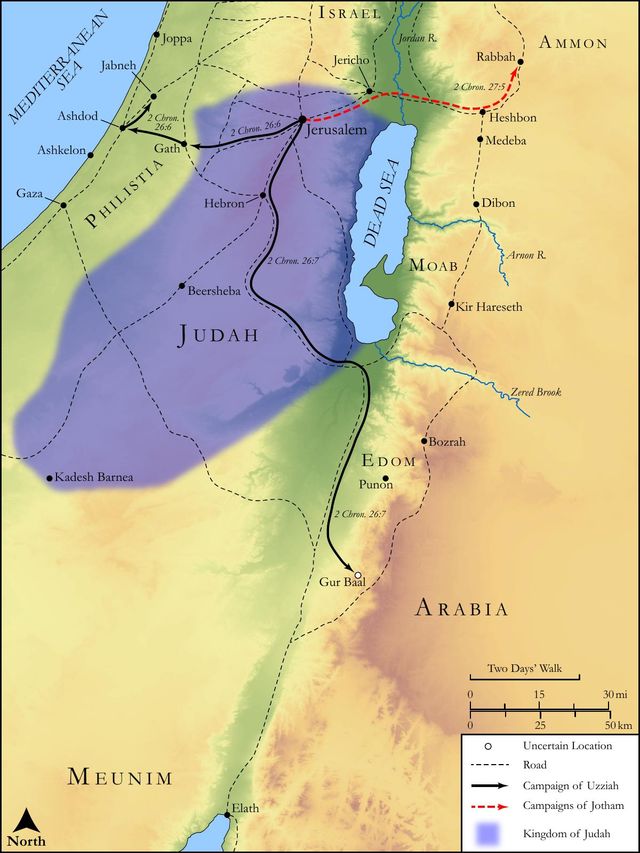
See on the biblical-era map
Study this verse
Public-domain commentary
Matthew Henry
From his Commentary on the Whole Bible. Henry comments on passages, not single verses — this entry covers 2 Chronicles 26:1–15. His three-level outline is real structure in the source text, so it is rendered as structure.
We have here an account of two things concerning Uzziah: -
I.His piety.
In this he was not very eminent or zealous; yet he did that which was right in the sight of the Lord. He kept up the pure worship of the true God as his father did, and was better than his father, inasmuch as we have no reason to think he ever worshipped idols as his father did, no, not in his latter days, when his heart was lifted up. It is said (Ch2 26:5), He sought God in the days of Zechariah, who, some think, was the son of the Zechariah whom his grandfather Joash slew. This Zechariah was one that had understanding in the visions of God, either the visions which he himself was favoured with or the visions of the preceding prophets. He was well versed in prophecy, and conversed much with the upper world, was an intelligent, devout, good man; and, it seems, had great influence with Uzziah. Happy are the great men who have such about them and are willing to be advised by them; but unhappy those who seek God only while they have such with them and have not a principle in themselves to bear them out to the end.
II.His prosperity.
1.In general, as long as he sought the Lord, and minded religion, God made him to prosper. Note,
(1.)Those only prosper whom God makes to prosper; for prosperity is his gift.
(2.)Religion and piety are very friendly to outward prosperity. Many have found and owned this, that as long as they sought the Lord and kept close to their duty they prospered; but since they forsook God every thing has gone cross.
2.Here are several particular instances of his prosperity: - (1.) His success in his wars: God helped him (Ch2 26:7), and then he triumphed over the Philistines (those old enemies of God's people), demolished the fortifications of their cities, and put garrisons of his own among them, Ch2 26:6. He obliged the Ammonites to pay him tribute, Ch2 26:8. He made all quiet about him, and kept them in awe. (2.) The greatness of his fame and reputation. His name was celebrated throughout all the neighbouring countries (Ch2 26:8) and it was a good name, a name for good things with God and good people. This is true fame, and makes a man truly honourable. (3.) His buildings. While he acted offensively abroad, he did not neglect the defence of his kingdom at home, but built towers in Jerusalem and fortified them, Ch2 26:9. Much of the wall of Jerusalem was in his father's time broken down, particularly at the corner gate. But his best fortification of Jerusalem was his close adherence to the worship of God: if his father had not forsaken this the wall of Jerusalem would not have been broken down. While he fortified the city, he did not forget the country, but built towers in the desert too (Ch2 26:10), to protect the country people from the inroads of the plunderers, bands of whom sometimes alarmed them and plundered them, as Ch2 21:16. (4.) His husbandry. He dealt much in cattle and corn, employed many hands, and got much wealth by his dealing; for he took a pleasure in it: he loved husbandry (Ch2 21:10), and probably did himself inspect his affairs in the country, which was no disparagement to him, but an advantage, as it encouraged industry among his subjects. It is an honour to the husbandman's calling that one of the most illustrious princes of the house of David followed it and loved it. He was not one of those that delight in war, nor did he addict himself to sport and pleasure, but delighted in the innocent and quiet employments of the husbandman. (5.) His standing armies. He had, as it should seem, two military establishments. [1.] A host of fighting men that were to make excursions abroad. These went out to war by bands, Ch2 21:11. They fetched in spoil from the neighbouring countries by way of reprisal for the depredations they had so often made upon Judah, [2.] Another army for guards and garrisons, that were ready to defend the country in case it should be invaded, Ch2 21:12, Ch2 21:13. So great were their number and valour that they made war with mighty power; no enemy durst face them, or, at least, could stand before them. Men unarmed can do little in war. Uzziah therefore furnished himself with a great armoury, whence his soldiers were supplied with arms offensive and defensive (Ch2 21:14), spears, bows, and slings, shields, helmets, and habergeons: swords are not mentioned, because it is probable that every man had a sword of his own, which he wore constantly. Engines were invented, in his time, for annoying besiegers with darts and stones shot from the towers and bulwarks, Ch2 21:15. What a pity it is that the wars and fightings which come from men's lusts have made it necessary for cunning men to employ their skill in inventing instruments of death.
Continue studying 2 Chronicles 26:11 across the web’s major study libraries — every link below opens this exact verse, chapter, or book on the destination site.
Read & Compare
 BibleGatewayThis verse in more than 200 translations and 70 languages.
 Bible.comThe YouVersion reader — hundreds of translations, reading plans, and highlights.
 ESV.orgCrossway's official English Standard Version reader.
 NET BibleThe NET translation with 60,000+ translators' notes on every rendering decision.
 STEP BibleTyndale House's free study tool — original text, vocabulary, and scholarly resources.
 BibliaLogos Bible Software's free web reader.
 USCCBThe New American Bible (Revised Edition) with the U.S. bishops' study notes.
Commentaries
 BibleHub CommentariesDozens of classic commentaries on this verse, gathered on one page.
 StudyLightMore than 100 commentary sets — the largest collection on the web.
 BibleRefPlain-English commentary on what this verse means, verse by verse.
 Enduring WordDavid Guzik's free commentary on this chapter, widely used by Bible teachers.
 Bible Study ToolsVerse commentary alongside Greek and Hebrew study aids.
Original Language & Research
- BibleHub InterlinearThe verse word by word — original language, transliteration, and English.
- BibleHub LexiconEvery word's original-language definition and Strong's entry.
 Blue Letter BibleDeep-study tools — Strong's numbers, concordance, and word studies.
 SefariaThe Hebrew text with Rashi and centuries of Jewish commentary.
Sermons, Hymns & Audio


TrulyRandomVerse is not affiliated with these sites and doesn’t control their content. They’re linked because they’re genuinely useful.
Summary
This verse meticulously details the formidable military organization of King Uzziah's reign, showcasing the administrative precision and strategic structure that underpinned his powerful army. It describes a "host of fighting men" who were deployed "by bands," indicating a highly disciplined and well-managed force. The text further attributes this sophisticated system to the diligent oversight of specific royal officials: Jeiel the scribe, Maaseiah the ruler, and Hananiah, one of the king's captains, thereby underscoring the deep administrative capacity and effective delegation that characterized Judah's military might during Uzziah's prosperous era.
Context
ShowHideLiterary Context
This verse is strategically placed within the Chronicler's comprehensive account of King Uzziah's reign in 2 Chronicles 26. The chapter begins by highlighting Uzziah's initial righteousness and his dedication to seeking God, which directly resulted in divine blessing, leading to his remarkable prosperity and strength, as stated in 2 Chronicles 26:5. Verse 11, along with the subsequent verses that elaborate on his military innovations, fortifications, and vast army (2 Chronicles 26:12-15), serves as a vivid illustration of the zenith of Uzziah's power and success. This detailed portrayal of his military prowess creates a stark contrast with the tragic narrative turn, where Uzziah's pride leads to his downfall and affliction with leprosy (2 Chronicles 26:16-21), powerfully reinforcing the Chronicler's overarching theological theme: divine blessing is contingent upon humility and sustained obedience, and pride inevitably precedes a fall.
Historical & Cultural Context
King Uzziah ruled Judah during the 8th century BCE, a period characterized by significant geopolitical flux and the persistent threat from powerful regional empires. In such an environment, a robust and well-organized military was not merely a symbol of national prestige but an absolute prerequisite for national security, territorial integrity, and strategic influence. During his reign, Uzziah successfully engaged with and subdued neighboring peoples, including the Philistines, Arabs, and Ammonites, making them tributaries to Judah (2 Chronicles 26:6-8). The explicit mention of scribes and rulers working in conjunction with military captains in this verse illuminates the sophisticated administrative infrastructure of the Judean monarchy. It indicates that civil officials played an integral role in the logistical, organizational, and record-keeping aspects of the army. This level of meticulous detail in military accounting and structured organization points to a highly developed state apparatus, capable of sustaining and effectively deploying a professional fighting force, rather than relying solely on ad-hoc or temporary levies.
Key Themes
ShowHideThis verse significantly contributes to several profound themes woven throughout the book of Chronicles and specifically within Uzziah's narrative. Firstly, it powerfully illustrates the theme of divine blessing and prosperity that is consistently shown to accompany righteous and God-seeking leadership. Uzziah's formidable military strength is presented as a direct manifestation of God's favor and the prosperity He granted him, as noted in 2 Chronicles 26:5. Secondly, the detailed account of administrative oversight highlights the importance of competent administration and wise delegation as essential components of effective governance. Uzziah's ability to empower skilled officials to manage critical aspects of his kingdom, particularly its military, is a testament to his leadership. Thirdly, the description of the army's precise organization implicitly underscores order, discipline, and thorough preparation as vital elements for national security and success. Finally, while not explicitly stated within this single verse, the broader narrative of 2 Chronicles 26 introduces the critical theme of the inherent dangers of pride in prosperity, as Uzziah's impressive achievements and the very strength described in this verse ultimately paved the way for his spiritual downfall.
Exposition and Analysis
ShowHideKey Word Analysis
ShowHideThis term (H2428) denotes a "force," whether of men, means, or other resources, often translated as "army," "might," or "valor." In this context, it signifies a robust, well-equipped, and capable fighting body, implying strength, effectiveness, and even valor. For Uzziah's reign, it emphasizes that his military was not merely numerous but formidable and effective.
This word (H1416) refers to a "crowd," specifically of soldiers, indicating an "army," "band of men," or "troop." The phrase "by bands" (plural form in the KJV) signifies that the army was organized into distinct, disciplined units or divisions. This structure points to a professional and strategically deployable army, capable of coordinated action, rather than an undifferentiated mass of individuals, reflecting a high level of military sophistication.
This term (H4557) refers to a "number," whether definite or indefinite, and abstractly, "narration" or "reckoning." Here, it signifies a precise census, registration, or detailed count. The mention of an "account" underscores the meticulous administrative oversight and record-keeping that characterized Uzziah's military. It implies a systematic enrollment, perhaps a roster, managed by the named officials, ensuring accurate knowledge of the army's size and composition, which was crucial for logistics and deployment.
This primitive word (H3027) literally means "hand" but is used extensively to denote "power," "means," "direction," "custody," or "authority." The phrase "by the hand of" or "under the hand of" signifies that Jeiel, Maaseiah, and Hananiah were operating under the authority and direction of King Uzziah, and that the military organization was directly managed or overseen by them. It highlights their executive authority and responsibility in this administrative process.
Verse Breakdown
ShowHide"Moreover Uzziah had an host of fighting men"
This opening clause immediately establishes King Uzziah's significant military strength and the formidable nature of his army. It sets the stage for the detailed description that follows, emphasizing that his reign was characterized by a powerful and effective fighting force, a clear testament to the prosperity and blessing God granted him.
"that went out to war by bands"
This phrase provides crucial insight into the structured and organized character of Uzziah's military. The deployment "by bands" implies that the soldiers were not a disorganized multitude but operated in disciplined, cohesive units, allowing for strategic maneuvers, coordinated action, and greater effectiveness in battle. This speaks to a high level of military professionalism.
"according to the number of their account"
This part of the verse highlights the meticulous administrative processes in place within Uzziah's kingdom. It indicates that the army's size and composition were precisely documented, suggesting a regular census, registration, or detailed roster of soldiers. This level of administrative detail underscores the efficiency and thoroughness of Uzziah's government in managing its military resources.
"by the hand of Jeiel the scribe and Maaseiah the ruler, under the hand of Hananiah, [one] of the king's captains"
This concluding clause identifies the specific officials responsible for this sophisticated military administration. Jeiel the scribe and Maaseiah the ruler were likely civil administrators overseeing the registration, logistics, and perhaps even the training of the troops. Hananiah, as "one of the king's captains," was a high-ranking military officer who provided overall supervision and command. This clear chain of command and delegation demonstrates the sophisticated bureaucratic structure that supported Uzziah's extensive military endeavors.
Literary Devices
ShowHideThe Chronicler employs several literary devices in 2 Chronicles 26:11 to convey the magnitude of Uzziah's military power and administrative acumen. The primary device is Enumeration and Detailing, as the text meticulously lists the specific officials—Jeiel the scribe, Maaseiah the ruler, and Hananiah the captain—who were responsible for the military's organization and "account." This precise naming of individuals, coupled with descriptive phrases like "by bands" and "according to the number of their account," serves to emphasize the high degree of administrative sophistication and the sheer scale of Uzziah's military might. This detailed accounting not only provides historical information but also functions as a form of Amplification, underscoring the extraordinary nature of Uzziah's achievements and the extent of God's blessing upon him. Furthermore, within the broader narrative of 2 Chronicles 26, this detailed description of Uzziah's peak strength serves a subtle but potent Foreshadowing function. This zenith of earthly power and success ultimately precedes his tragic downfall due to pride, creating a poignant contrast between external might and internal spiritual vulnerability, highlighting a key theological message of the Chronicler.
Theological and Thematic Connections
ShowHideThe detailed description of Uzziah's military strength and organization in this verse is far more than a mere historical record; it serves as a profound theological statement. It powerfully illustrates the principle that God's blessing, bestowed upon Uzziah for his early faithfulness and diligent seeking of the Lord, manifested in tangible and practical ways, including robust national security and administrative excellence. This divine favor empowered Uzziah to build a formidable kingdom, demonstrating how God can equip, prosper, and enable those who walk righteously before Him, even in seemingly secular and strategic matters like military preparedness. However, the Chronicler's narrative consistently reminds the reader that such prosperity, while divinely granted, can become a dangerous snare if not met with continued humility, gratitude, and absolute dependence on God. This is a crucial lesson that Uzziah tragically failed to heed, serving as a perpetual warning against the perils of pride born from success.
Reflection and Application
ShowHideThe account of Uzziah's meticulously organized military offers profound and enduring lessons for believers today, extending far beyond the literal battlefield to encompass all spheres of life. Just as Uzziah's kingdom flourished through order, preparation, and the strategic deployment of skilled leadership, so too can our personal lives, our families, our churches, and our ministries benefit immensely from intentionality, good stewardship, and wise delegation. This verse serves as a powerful reminder that divine blessing often works in tandem with human diligence and competence; God empowers us not to be passive recipients, but to be excellent and responsible stewards of the resources, talents, and opportunities He graciously provides. However, the broader narrative of Uzziah's reign serves as a crucial and sobering cautionary tale: success, even when undeniably divinely granted, carries the insidious potential to breed pride, which can inevitably lead to a devastating downfall. It challenges us to constantly examine our hearts, ensuring that our confidence remains firmly rooted in God's sovereign grace and unfailing power, rather than in our own achievements, our accumulated resources, or our organizational prowess. True, lasting strength and genuine prosperity are ultimately found in sustained humility, unwavering dependence on the Lord, and a recognition that all good things come from Him.
Questions for Reflection
ShowHideFAQ
ShowHideWho were Jeiel, Maaseiah, and Hananiah, and what were their specific roles in Uzziah's military organization?
ShowHideJeiel the scribe and Maaseiah the ruler were significant administrative officials within King Uzziah's sophisticated government. Their roles likely involved the meticulous census, registration, and record-keeping of the army, as well as overseeing its logistical support and perhaps even aspects of training. Hananiah, identified as "one of the king's captains," was a high-ranking military officer who provided overall supervision and command over these administrative and organizational efforts. Together, they represent a highly developed system of military management, where civil and military leaders collaborated seamlessly to ensure the army's precise organization, readiness, and effective deployment, showcasing Uzziah's capacity for wise delegation and the depth of his kingdom's administrative capabilities.
How does this verse fit into the overall narrative and theological message of Uzziah's reign in 2 Chronicles?
ShowHideThis verse is a pivotal highlight in the narrative of Uzziah's reign, marking the zenith of his power and illustrating the tangible results of God's blessing upon his early faithfulness. 2 Chronicles 26:5 explicitly states that "as long as he sought the Lord, God made him prosper," and the detailed description of his organized and formidable army in 2 Chronicles 26:11 serves as a prime example of this divinely granted prosperity and strength. However, this verse also functions as a crucial setup for the tragic turn in Uzziah's story, where his great success and power ultimately lead to overweening pride and his subsequent downfall due to an act of presumption against God (2 Chronicles 26:16). Thus, the verse underscores the Chronicler's recurring theological theme that even divinely granted success and remarkable achievements must be met with sustained humility and faithful obedience to God.
Christ-Centered Fulfillment
ShowHideWhile 2 Chronicles 26:11 vividly portrays the earthly strength and meticulous organization of King Uzziah's army, a symbol of his divinely blessed yet ultimately temporal kingdom, it powerfully points forward to the eternal and spiritual kingdom of Jesus Christ. Uzziah's "host of fighting men" was a force of human might, meticulously accounted for by scribes and rulers, designed for earthly conquest and defense. In stark contrast, Jesus Christ, the true King of kings and Lord of lords, commands a spiritual "host"—His church—whose strength is not derived from human prowess, military might, or meticulous earthly accounting, but from the indwelling power of the Holy Spirit (Acts 1:8). His "going out to war" is not against flesh and blood, but against spiritual forces of evil and the dominion of darkness, equipping His followers with the full armor of God for spiritual battles. Unlike Uzziah, whose great success tragically led to pride and a fall from grace, Christ's reign is eternally marked by perfect humility, self-emptying love, and unwavering obedience to the Father, culminating in His ultimate triumph through self-sacrifice on the cross (Philippians 2:8). The ultimate "account" for Christ's followers is not a military census or an earthly roster, but their names being eternally written in the Lamb's Book of Life, signifying their unshakeable citizenship in His eternal kingdom (Hebrews 12:28).