


2 Kings 5:2
- וַאֲרָםva·'a·Ramand AramH758Conj-w ¦ N-properNoun Proper LocationוַandאֲרָםAram
- יָצְאוּya·tze·'Uthey had gone outH3318V-Qal-Perf-3cpVerb Qal Perfect 3rd Plural common gender
- גְדוּדִיםge·du·Dimmarauding bandsH1416N-mpNoun Plural Masculine Absolute
- וַיִּשְׁבּוּvai·yish·Buand they had taken captiveH7617Conj-w ¦ V-Qal-ConsecImperf-3mpVerb Qal Consecutive Imperfect 3rd Plural Masculineוַandיִּשְׁבּוּthey had taken captive
- מֵאֶרֶץme·'E·retzfrom [the] land ofH776Prep-m ¦ N-fscNoun Singular Feminine Constructמֵfromאֶרֶץ[the] land of
- יִשְׂרָאֵלYis·ra·'ElIsraelH3478N-properNoun Proper Location
- נַעֲרָהna·'a·Raha girlH5291N-fsNoun Singular Feminine Absolute
- קְטַנָּהke·ta·NahyoungH6996Adj-fsAdjective Singular Feminine Absolute
- וַתְּהִיva·te·Hiand she wasH1961Conj-w ¦ V-Qal-ConsecImperf-3fsVerb Qal Consecutive Imperfect 3rd Singular Feminineוַandתְּהִיshe was
- לִפְנֵיlif·Nei<to> beforeH6440Prep-l ¦ N-mpcNoun Plural Masculine Constructלִ<to>פְנֵיbefore
- אֵשֶׁת'E·shet[the] wife ofH802N-fscNoun Singular Feminine Construct
- נַעֲמָןna·'a·ManNaamanH5283N-proper-mNoun Proper Masculine
English is a literal word-by-word gloss of the Hebrew, not the KJV's wording. Why?
This is the original text the KJV's translators worked from — each Hebrew word with its own literal English meaning in this verse, prepared by scholars at Tyndale House, Cambridge. The KJV translates whole sentences, not word by word, so its wording differs: one Hebrew word can become several English words, and the KJV may choose “the LORD” where the gloss reads “Yahweh”. Both are faithful — they answer different questions. For the KJV's own rendering, switch to the KJV text.
Details
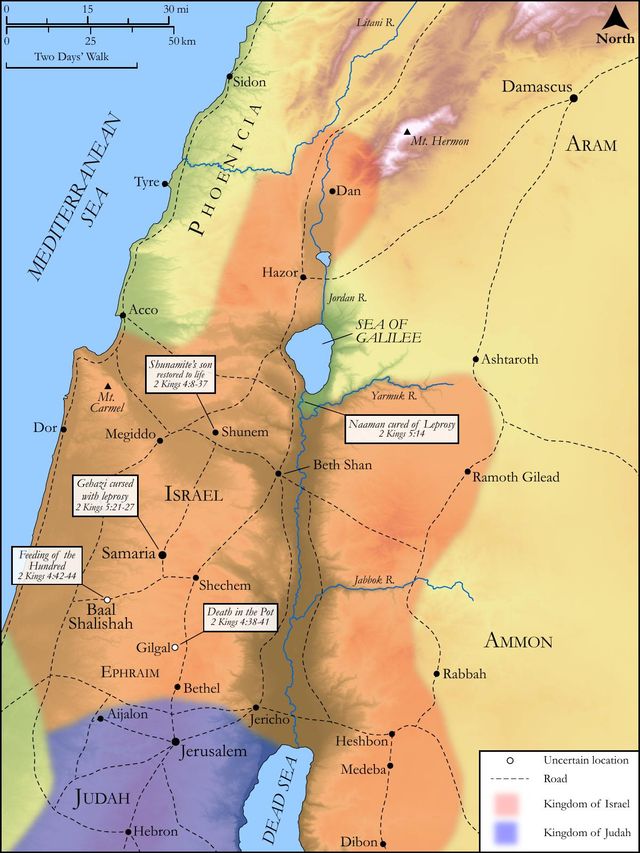
See on the biblical-era map
Study this verse
Public-domain commentary
Matthew Henry
From his Commentary on the Whole Bible. Henry comments on passages, not single verses — this entry covers 2 Kings 5:1–8. His two-level outline is real structure in the source text, so it is rendered as structure.
Our saviour's miracles were intended for the lost sheep of the house of Israel, yet one, like a crumb, fell from the table to a woman of Canaan; so this one miracle Elisha wrought for Naaman, a Syrian; for God does good to all, and will have all men to be saved. Here is,
I.The great affliction Naaman was under, in the midst of all his honours, Kg2 5:1.
He was a great man, in a great place; not only rich and raised, but particularly happy for two things: - 1. That he had been very serviceable to his country. God made him so: By him the Lord had often given deliverance to Syria, success in their wars even with Israel. The preservation and prosperity even of those that do not know God and serve him must be ascribed to him, for he is the Saviour of all men, but especially of those that believe. Let Israel know that when the Syrians prevailed it was from the Lord. 2. That he was very acceptable to his prince, was his favourite, and prime-minister of state; so great was he, so high, so honourable, and a mighty man of valour; but he was a leper, was under that loathsome disease, which made him a burden to himself. Note, (1.) No man's greatness, or honour, or interest, or valour, or victory, can set him out of the reach of the sorest calamities of human life; there is many a sickly crazy body under rich and gay clothing. (2.) Every man has some but or other in his character, something that blemishes and diminishes him, some allay to his grandeur, some damp to his joy; he may be very happy, very good, yet, in something or other, not so good as he should be nor so happy as he would be. Naaman was a great as the world could make him, and yet (as bishop Hall expresses it) the basest slave in Syria would not change skins with him.
II.The notice that was given him of Elisha's power, by a little maid that waited on his lady, Kg2 5:2, Kg2 5:3.
This maid was, by birth, an Israelite, providentially carried captive into Syria, and there preferred into Naaman's family, where she published Elisha's fame to the honour of Israel and Israel's God. The unhappy dispersing of the people of God has sometimes proved the happy occasion of the diffusion of the knowledge of God, Act 8:4. This little maid,
1.As became a true-born Israelite, consulted the honour of her country, and could give an account, though but a girl, of the famous prophet they had among them. Children should betimes acquaint themselves with the wondrous works of God, that, wherever they go, they may have them to talk of. See Psa 8:2.
2.As became a good servant, she desired the health and welfare of her master, though she was a captive, a servant by force; much more should servants of choice seek their masters' good. The Jews in Babylon were to seek the peace of the land of their captivity. Jer 29:7. Elisha had not cleansed any leper in Israel (Luk 4:27), yet this little maid, from the other miracles he had wrought, inferred that he could cure her master, and from his common beneficence inferred that he would do it, though he was a Syrian. Servants may be blessings to the families where they are, by telling what they know of the glory of God and the honour of his prophets.
III.The application which the king of Syria hereupon made to the king of Israel on Naaman's behalf.
Naaman took notice of the intelligence, though given by a simple maid, and did not despise it for the sake of her meanness, when it tended to his bodily health. he did not say, "The girl talks like a fool; how can any prophet of Israel do that for me which all the physicians of Syria have attempted in vain?" Though he neither loved nor honoured the Jewish nation, yet, if one of that nation can but cure him of his leprosy, he will thankfully acknowledge the obligation. O that those who are spiritually diseased would hearken thus readily to the tidings brought them of the great Physician! See what Naaman did upon this little hint.
1.He would not send for the prophet to come to him, but such honour would he pay to one that had so much of a divine power with him as to be able to cure diseases that he would go to him himself, though he himself was sickly, unfit for society, the journey long, and the country an enemy's; princes, he thinks, must stoop to prophets when they need them.
2.He would not go incognito - in disguise, though his errand proclaimed his loathsome disease, but went in state, and with a great retinue, to do the more honour to the prophet.
3.He would not go empty-handed, but took with him gold, silver, and raiment, to present to his physician. Those that have wealth, and want health show which they reckon the more valuable blessing; what will they not give for ease, and strength, and soundness of body?
4.He would not go without a letter to the king of Israel from the king his master, who did himself earnestly desire his recovery. He knows not where in Samaria to find this wonder-working prophet, but takes it for granted the king knows where to find him; and, to engage the prophet to do his utmost for Naaman, he will go to him supported with the interest of two kings. If the king of Syria must entreat his help, he hopes the king of Israel, being his liege-lord, may command it. The gifts of the subject must all be (he thinks) for the service and honour of the prince, and therefore he desires the king that he would recover the leper (Kg2 5:6), taking it for granted that there was a greater intimacy between the king and the prophet than really there was.
IV.The alarm this gave to the king of Israel, Kg2 5:7. He apprehended there was in this letter,
1.A great affront upon God, and therefore he rent his clothes, according to the custom of the Jews when they heard or read that which they thought blasphemous; and what less could it be than to attribute to him a divine power? "Am I a God, to kill whom I will, and make alive whom I will? No, I pretend not to such an authority." Nebuchadnezzar did, as we find, Dan 5:19. "Am I a God, to kill with a word, and make alive with a word? No, I pretend not to such a power;" thus this great man, this bad man, is made to own that he is but a man. Why did he not, with this consideration, correct himself for his idolatry, and reason thus: - Shall I worship those as gods that can neither kill nor make alive, can do neither good nor evil?
2.A bad design upon himself. He appeals to those about him for this: "See how he seeketh a quarrel against me; he requires me to recover the leper, and if I do not, though I cannot, he will make that a pretence to wage war with me," which he suspects the rather because Naaman is his general. had he rightly understood the meaning of the letter, that when the king wrote to him to recover the leper he meant that he would take care he might be recovered, he would not have been in this fright. Note, We often create a great deal of uneasiness to ourselves by misinterpreting the words and actions of others that are well intended: it is charity to ourselves to think no evil. If he had bethought himself of Elisha, and his power, he would easily have understood the letter, and have known what he had to do; but he is put into this confusion by making himself a stranger to the prophet: the captive maid had him more in her thoughts than the king had.
V.The proffer which Elisha made of his services.
He was willing to do any thing to make his prince easy, though he was neglected and his former good services were forgotten by him. Hearing on which occasion the king had rent his clothes, he sent to him to let him know that if his patient would come to him he should not lose his labour (Kg2 5:8): He shall know that there is a prophet in Israel (and it were sad with Israel if there were not), that there is a prophet in Israel who can do that which the king of Israel dares not attempt, which the prophets of Syria cannot pretend to. It was not for his own honour, but for the honour of God, that he coveted to make them all know that there was a prophet in Israel, though obscure and overlooked.
Continue studying 2 Kings 5:2 across the web’s major study libraries — every link below opens this exact verse, chapter, or book on the destination site.
Read & Compare
 BibleGatewayThis verse in more than 200 translations and 70 languages.
 Bible.comThe YouVersion reader — hundreds of translations, reading plans, and highlights.
 ESV.orgCrossway's official English Standard Version reader.
 NET BibleThe NET translation with 60,000+ translators' notes on every rendering decision.
 STEP BibleTyndale House's free study tool — original text, vocabulary, and scholarly resources.
 BibliaLogos Bible Software's free web reader.
 USCCBThe New American Bible (Revised Edition) with the U.S. bishops' study notes.
Commentaries
 BibleHub CommentariesDozens of classic commentaries on this verse, gathered on one page.
 StudyLightMore than 100 commentary sets — the largest collection on the web.
 BibleRefPlain-English commentary on what this verse means, verse by verse.
 Enduring WordDavid Guzik's free commentary on this chapter, widely used by Bible teachers.
 Bible Study ToolsVerse commentary alongside Greek and Hebrew study aids.
Original Language & Research
- BibleHub InterlinearThe verse word by word — original language, transliteration, and English.
- BibleHub LexiconEvery word's original-language definition and Strong's entry.
 Blue Letter BibleDeep-study tools — Strong's numbers, concordance, and word studies.
 SefariaThe Hebrew text with Rashi and centuries of Jewish commentary.
Sermons, Hymns & Audio


TrulyRandomVerse is not affiliated with these sites and doesn’t control their content. They’re linked because they’re genuinely useful.
Summary
Second Kings 5:2 introduces a seemingly minor but ultimately pivotal character in the unfolding narrative of Naaman's miraculous healing: a young Israelite girl. Captured by Syrian raiding parties and forced into servitude within Naaman's household, her tragic circumstances are revealed as a divinely orchestrated placement. This verse masterfully sets the stage for her courageous and compassionate testimony, which will initiate the journey of a powerful Syrian general toward not only physical restoration from leprosy but, more profoundly, a spiritual revelation of the one true God.
Context
ShowHideLiterary Context
This verse immediately follows the introduction of Naaman in 2 Kings 5:1, establishing his esteemed military position and his debilitating affliction of leprosy. Verse 2 then shifts focus abruptly to an unexpected and seemingly insignificant character, the "little maid," whose presence in Naaman's household is absolutely crucial to the narrative's progression. Her subsequent testimony in 2 Kings 5:3 directly prompts Naaman to seek Elisha, propelling the plot forward and demonstrating the profound impact of a humble witness. The inclusion of this seemingly minor detail underscores the narrative's emphasis on God's sovereign hand working through unexpected channels and individuals, often in stark contrast to the grand figures and events typically highlighted in historical accounts. The story of Naaman's healing is a significant episode within the broader Elisha cycle, demonstrating God's power to heal and His willingness to extend His grace beyond the borders of Israel, even to an enemy commander.
Historical & Cultural Context
The period of the Divided Monarchy (Israel and Judah) was characterized by frequent conflicts and border skirmishes with neighboring Aram (Syria). The term "companies" (Hebrew: gedudim) refers to small, mobile raiding bands rather than full-scale armies. These groups would conduct opportunistic incursions into enemy territory to plunder resources, livestock, and, significantly, people, who would then be taken captive and sold into slavery or forced servitude. Such raids were a common and terrifying aspect of life on the borders of Israel and Syria, creating widespread insecurity. The "little maid" was a victim of this harsh reality, plucked from her home, culture, and family, and thrust into a foreign household. Her specific position as a servant to Naaman's wife indicates a close, personal form of servitude, granting her intimate knowledge of the household's affairs and Naaman's private affliction, setting the stage for her intervention.
Key Themes
ShowHideThis verse powerfully introduces several foundational themes that resonate throughout the book of 2 Kings and the broader biblical narrative. Firstly, it highlights Divine Providence Amidst Adversity. The girl's horrific experience of captivity, a clear act of human evil and violence, is providentially used by God to position her for a redemptive purpose. This echoes the profound theme seen in Genesis 50:20, where Joseph declares that what his brothers intended for evil, God intended for good, demonstrating God's ability to orchestrate even the darkest circumstances for His ultimate glory. Secondly, it underscores The Power of the Unlikely Messenger. The girl is young, female, a slave, and an enemy alien – embodying the lowest social status and least power in her new environment. Yet, it is through her humble and compassionate witness that God's plan for Naaman begins, a consistent pattern in Scripture where God uses the weak and despised to shame the strong, as articulated in 1 Corinthians 1:27-29. Thirdly, it exemplifies Faithfulness in Captivity. Despite her traumatic displacement and servitude, the girl retains her faith in God and His prophet, demonstrating a remarkable lack of bitterness and a profound concern for her captor's well-being. This reflects a deep-seated trust in God's power and goodness even in the direst circumstances, a testament to her spiritual resilience.
Exposition and Analysis
ShowHideKey Word Analysis
ShowHideThis noun refers to a crowd, especially of soldiers, or a band of men or troops. In this context, it signifies small, mobile raiding detachments rather than a full army. This emphasizes the opportunistic and often brutal nature of these incursions, highlighting the constant threat of such raids on Israel's borders and underscoring the seemingly random, yet ultimately providential, circumstances of the girl's capture.
This adjective means abbreviated, diminutive, or small, literally (in quantity, size, or number) or figuratively (in age or importance). Applied to the maid, it emphasizes her youth, vulnerability, and apparent insignificance in the grand scheme of international politics and military power. This description starkly contrasts with the immense impact she is about to have, highlighting God's preference for using the humble.
This feminine noun refers to a girl, from infancy to adolescence; a damsel, maiden, or young woman. Coupled with "little" (qâṭân), it further underscores her youth and vulnerability. Her status as a "maid" denotes her servitude, a common fate for captives among the nations of that day, yet it is precisely this position that places her in a unique role for God's purposes.
This noun, typically plural but always singular in meaning, refers to "the face" or "presence." In this context, "waited on" is an idiomatic expression indicating that she "stood before" or "was in the presence of" Naaman's wife, serving her directly. This implies personal attendance and close proximity, signifying a position of some trust and intimacy within the inner circle of the household. This close access to Naaman's wife, and by extension Naaman himself, was crucial for her to observe his condition and eventually offer her counsel.
Verse Breakdown
ShowHide"And the Syrians had gone out by companies,"
This clause establishes the historical context of frequent, aggressive raids by Aram (Syria) into Israelite territory. It paints a picture of a volatile border region where such incursions were common, leading to disruption, plunder, and the taking of captives. The "companies" denote small, mobile units, emphasizing the opportunistic and often brutal nature of these attacks.
"and had brought away captive out of the land of Israel a little maid;"
This describes the specific, tragic outcome of one such raid – the capture of a young Israelite girl. The phrase highlights the trauma of forced displacement and the profound injustice of slavery. Her being "out of the land of Israel" underscores her foreignness in Syria and her status as an enemy national, making her subsequent compassion for Naaman even more remarkable. Her "littleness" emphasizes her extreme vulnerability and apparent powerlessness.
"and she waited on Naaman's wife."
This clause specifies her new role and placement within Naaman's household. Her service to Naaman's wife positioned her in a unique vantage point, allowing her to observe Naaman's suffering and to gain the trust necessary to speak freely. This seemingly mundane detail of her servitude is, in fact, the linchpin for the entire narrative of Naaman's healing, demonstrating God's meticulous orchestration of circumstances and His ability to use the most unlikely individuals.
Literary Devices
ShowHideThe narrative of 2 Kings 5:2 employs several potent literary devices that enrich its theological message. Irony is profoundly evident, as the Syrian raiders, intending harm, plunder, and the subjugation of an Israelite, unwittingly become instruments of God's redemptive plan by bringing the very person who will initiate Naaman's healing into his household. This act of aggression ultimately leads to a revelation of the true God to a powerful Gentile. Foreshadowing is also skillfully used; the immediate introduction of this "little maid" hints at the significant, unexpected role she is destined to play, signaling to the reader that the solution to Naaman's immense problem will come from a humble and unlikely source, not from human power or prestige. There is a strong Contrast established between Naaman's high status, military power, and debilitating affliction, and the maid's low status, powerlessness, and profound spiritual insight. This juxtaposition highlights God's preference for using the weak and overlooked to accomplish His mighty purposes, subverting human expectations. Finally, the entire scenario is steeped in Divine Providence, showcasing God's sovereign hand working through seemingly random or even evil human actions to achieve His ultimate good and to extend His grace beyond conventional boundaries.
Theological and Thematic Connections
ShowHideThe story of the little maid in 2 Kings 5:2 is a profound testament to God's sovereign control over all circumstances, even those born of human sin, violence, and injustice. It powerfully reveals that God's redemptive purposes are not limited by human power structures, social status, national boundaries, or even the most tragic personal experiences. He can and does use the most lowly and unexpected individuals to bring about His will, demonstrating His unparalleled power to turn evil intentions into opportunities for good and to extend His grace to those outside the covenant community of Israel. This narrative challenges us to see God's hand at work in the mundane, the tragic, and the seemingly insignificant, reminding us that no situation is beyond His redemptive reach and that His plans often unfold through the most surprising agents.
Reflection and Application
ShowHideThe brief yet impactful mention of the "little maid" in 2 Kings 5:2 offers profound and enduring lessons for contemporary believers. Her story challenges us to reconsider our notions of influence and significance, reminding us that God often chooses the least likely among us – those overlooked by the world – to accomplish His greatest works. Despite being a victim of war, forced into servitude, and separated from all she knew, she did not allow bitterness, despair, or the trauma of her circumstances to silence her faith or extinguish her compassion. Instead, she demonstrated remarkable courage and conviction, speaking up for her captor's healing when no one else could or would. This prompts us to examine our own lives: Are we faithful witnesses in our "captive" circumstances, whether they be challenging workplaces, difficult family dynamics, seemingly insignificant daily interactions, or even personal suffering? Do we recognize God's sovereign hand at work even in adversity, trusting that He can redeem any situation for His glory and use us as His instruments? The little maid's extraordinary example calls us to cultivate a compassionate heart, a discerning spirit, and a readiness to speak truth and hope, regardless of our perceived status, our personal hardships, or the potential risks involved. Her story is a powerful reminder that true impact often stems not from power, but from humble faithfulness.
Questions for Reflection
ShowHideFAQ
ShowHideWhat does "companies" mean in this context, and why is it significant?
ShowHideIn 2 Kings 5:2, "companies" translates the Hebrew word gedudim (H1416), which refers to small, mobile raiding bands or detachments of soldiers. These were not full-scale armies engaged in pitched battles, but rather opportunistic groups that would conduct incursions into enemy territory to plunder goods, livestock, and people, often taking captives for slavery or servitude. This is significant because it highlights the constant threat of such marauding groups along the border between Israel and Aram (Syria) during the period of the Divided Monarchy. The "little maid" was not captured in a major war but in a random, brutal raid, underscoring the vulnerability of the populace and the seemingly arbitrary nature of her misfortune. Yet, it is precisely through this seemingly random act of violence that God's providential hand is revealed, positioning her in Naaman's household for a divine purpose, demonstrating His ability to work through even human evil.
Why is the "little maid" given such prominence in the narrative if she is merely a slave?
ShowHideThe "little maid" is given prominence precisely because she is a slave and seemingly insignificant, which aligns with a recurring biblical theme: God often chooses the humble, the weak, and the overlooked to accomplish His mighty purposes. Her low social status and vulnerability contrast sharply with Naaman's high military and political standing, highlighting that God's power and wisdom operate independently of human hierarchies and worldly power structures. Her faith, compassion, and courageous testimony, despite her traumatic circumstances, are presented as the catalyst for Naaman's journey to healing and knowledge of the true God. Her story serves as a powerful reminder that God can use anyone, regardless of their age, gender, social standing, or personal tragedy, to fulfill His divine plan and reveal His glory. This echoes the sentiment found in 1 Corinthians 1:27, where Paul states that God chooses "the foolish things of the world to shame the wise; God chose the weak things of the world to shame the strong."
Christ-Centered Fulfillment
ShowHideThe narrative of the "little maid" in 2 Kings 5:2, a seemingly insignificant captive who becomes an instrument of salvation for a powerful Gentile, beautifully foreshadows the expansive, inclusive, and counter-cultural nature of God's redemptive plan fully realized in Jesus Christ. Just as this young Israelite servant, through her compassionate witness, pointed Naaman to the prophet Elisha, who in turn pointed to the healing power of God, so too does the entire Old Testament narrative, with its prophets and promises, point to Jesus. Christ himself came not as a conquering king in earthly splendor, but as a humble servant, taking on the very nature of a bond-servant (Philippians 2:7), embodying the "least of these" (Matthew 25:40) while holding all divine authority. His earthly ministry consistently embraced the lowly, the sick, and the "outsiders," extending God's grace to Gentiles like the Syrophoenician woman (Mark 7:24-30) and the Roman centurion (Matthew 8:5-13), demonstrating that God's favor is not confined by human distinctions. The little maid's witness, born of compassion despite her suffering and status as a captive, reflects the call for all believers, regardless of their circumstances, to be witnesses to the ultimate Healer and Deliverer, Jesus Christ, who is the Lamb of God who takes away the sin of the world. Through His sacrifice, Christ extends His cleansing and salvation to all nations, just as Naaman, a Syrian enemy, found physical cleansing and spiritual faith.