


1 Samuel 13:18
Bible text: King James Version (1769 Blayney text) · Public domain
Bible text: King James Version with Strong's numbers · Public domain
Bible text: Berean Standard Bible · Public domain
Bible text: American Standard Version (1901) · Public domain
Bible text: World English Bible, Messianic edition · Public domain
Bible text: Geneva Bible (1599) · Public domain
Bible text: Young's Literal Translation · Public domain
- וְהָרֹאשׁve·ha·Roshand the companyH7218Conj-w ¦ Art ¦ N-msNoun Singular Masculine Absoluteוְandהָtheרֹאשׁcompany
- אֶחָד'e·ChadoneH259N-fsNoun Singular Feminine Absolute
- יִפְנֶהyif·Nehit turnedH6437V-Qal-Imperf-3msVerb Qal Imperfect 3rd Singular Masculine
- דֶּרֶךְDe·rekh[the] direction ofH1870N-cscNoun Singular common gender Construct
- בֵּיתbeitBethH1032N-properNoun Proper Location
- חֹרוֹןcho·RonHoronH1032N-properNoun Proper Location
- וְהָרֹאשׁve·ha·Roshand the companyH7218Conj-w ¦ Art ¦ N-msNoun Singular Masculine Absoluteוְandהָtheרֹאשׁcompany
- אֶחָד'e·ChadoneH259N-fsNoun Singular Feminine Absolute
- יִפְנֶהyif·Nehit turnedH6437V-Qal-Imperf-3msVerb Qal Imperfect 3rd Singular Masculine
- דֶּרֶךְDe·rekh[the] directionH1870N-cscNoun Singular common gender Construct
- הַגְּבוּלha·ge·Vulthe borderH1366Art ¦ N-msNoun Singular Masculine Absoluteהַtheגְּבוּלborder
- הַנִּשְׁקָףha·nish·Kafwhich looks downH8259Art ¦ V-Niphal-Prtcpl-msVerb Niphal Participle Singular Masculine Absoluteהַwhichנִּשְׁקָףlooks down
- עַל'aloverH5921PrepPreposition
- גֵּיgei[the] valley ofH1516N-cscNoun Singular common gender Construct
- הַצְּבֹעִיםha·tze·vo·'Im<the> ZeboimH6650Art ¦ N-properNoun Proper Locationהַ<the>צְּבֹעִיםZeboim
- הַמִּדְבָּרָהha·mid·Ba·rahthe wilderness towardsH4057Art ¦ N-ms ¦ SfxNoun Singular Masculine Absoluteהַtheמִּדְבָּרָwildernessהtowards
English is a literal word-by-word gloss of the Hebrew, not the KJV's wording. Why?
This is the original text the KJV's translators worked from — each Hebrew word with its own literal English meaning in this verse, prepared by scholars at Tyndale House, Cambridge. The KJV translates whole sentences, not word by word, so its wording differs: one Hebrew word can become several English words, and the KJV may choose “the LORD” where the gloss reads “Yahweh”. Both are faithful — they answer different questions. For the KJV's own rendering, switch to the KJV text.
Details
See on the biblical-era map
Study this verse
Public-domain commentary
Matthew Henry
From his Commentary on the Whole Bible. Henry comments on passages, not single verses — this entry covers 1 Samuel 13:15–23.
Here, 1. Samuel departs in displeasure. Saul has set up for himself, and now he is left to himself: Samuel gat him from Gilgal (Sa1 13:15), and it does not appear that he either prayed with Saul or directed him. Yet in going up to Gibeah of Benjamin, which was Saul's city, he intimated that he had not quite abandoned him, but waited to do him a kindness another time. Or he went to the college of the prophets there, to pray for Saul when he did not think fit to pray with him. 2. Saul goes after him to Gibeah, and there musters his army, and finds his whole number to be but 600 men, Sa1 13:15, Sa1 13:16. Thus were they for their sin diminished and brought low. 3. The Philistines ravage the country, and put all the adjacent parts under contribution. The body of their army, or standing camp (as it is called in the margin, Sa1 13:23), lay in an advantageous pass at Michmash, but thence they sent out three separate parties or detachments that took several ways, to plunder the country, and bring in provisions for the army, Sa1 13:17, Sa1 13:18. By these the land of Israel was both terrified and impoverished, and the Philistines were animated and enriched. This the sin of Israel brought upon them, Isa 42:24. 4. The Israelites that take the field with Saul are unarmed, having only slings and clubs, not a sword or spear among them all, except what Saul and Jonathan themselves have, Sa1 13:19, Sa1 13:22. See here, (1.) How politic the Philistines were, when they had power in their hands, and did what they pleased in Israel. They put down all the smiths' shops, transplanted the smiths into their own country, and forbade any Israelite, under severe penalties, to exercise the trade or mystery of working in brass or iron, though they had rich mines of both (Deu 8:9) in such plenty that it was said of Asher, his shoes shall be iron and brass, Deu 33:25. This was subtilely done of the Philistines, for hereby they not only prevented the people of Israel from making themselves weapons of war (by which they would be both disused to military exercises and unfurnished when there was occasion), but obliged them to a dependence upon them even for the instruments of husbandry; they must go to them, that is, to some or other of their garrisons, which were dispersed in the country, to have all their iron-work done, and no more might an Israelite do than use a file (Sa1 13:20, Sa1 13:21), and no doubt the Philistines' smiths brought the Israelites long bills for work done. (2.) How impolitic Saul was, that did not, in the beginning of his reign, set himself to redress this grievance. Samuel's not doing it was very excusable; he fought with other artillery; thunder and lightning, in answer to his prayer, were to him instead of sword and spear; but for Saul, that pretended to be a king like the kings of the nations, to leave his soldiers without swords and spears, and take no care to provide them, especially when he might have done it out of the spoils of the Ammonites whom he conquered in the beginning of his reign, was such a piece of negligence as could by no means be excused. (3.) How slothful and mean-spirited the Israelites were, that suffered the Philistines thus to impose upon them and had no thought nor spirit to help themselves. It was reckoned very bad with them when there was not a shield or spear found among 40,000 in Israel (Jdg 5:8), and it was not better now, when there was never an Israelite with a sword by his side but the king and his son, never a soldier, never a gentleman; surely they were reduced to this, or began to be so, in Samuel's time, for we never find him with sword or spear in his hand. If they had not been dispirited, they could not have been disarmed, but it was sin that made them naked to their shame.
Continue studying 1 Samuel 13:18 across the web’s major study libraries — every link below opens this exact verse, chapter, or book on the destination site.
Read & Compare
 BibleGatewayThis verse in more than 200 translations and 70 languages.
 Bible.comThe YouVersion reader — hundreds of translations, reading plans, and highlights.
 ESV.orgCrossway's official English Standard Version reader.
 NET BibleThe NET translation with 60,000+ translators' notes on every rendering decision.
 STEP BibleTyndale House's free study tool — original text, vocabulary, and scholarly resources.
 BibliaLogos Bible Software's free web reader.
 USCCBThe New American Bible (Revised Edition) with the U.S. bishops' study notes.
Commentaries
 BibleHub CommentariesDozens of classic commentaries on this verse, gathered on one page.
 StudyLightMore than 100 commentary sets — the largest collection on the web.
 BibleRefPlain-English commentary on what this verse means, verse by verse.
 Enduring WordDavid Guzik's free commentary on this chapter, widely used by Bible teachers.
 Bible Study ToolsVerse commentary alongside Greek and Hebrew study aids.
Original Language & Research
- BibleHub InterlinearThe verse word by word — original language, transliteration, and English.
- BibleHub LexiconEvery word's original-language definition and Strong's entry.
 Blue Letter BibleDeep-study tools — Strong's numbers, concordance, and word studies.
 SefariaThe Hebrew text with Rashi and centuries of Jewish commentary.
Sermons, Hymns & Audio


TrulyRandomVerse is not affiliated with these sites and doesn’t control their content. They’re linked because they’re genuinely useful.
Summary
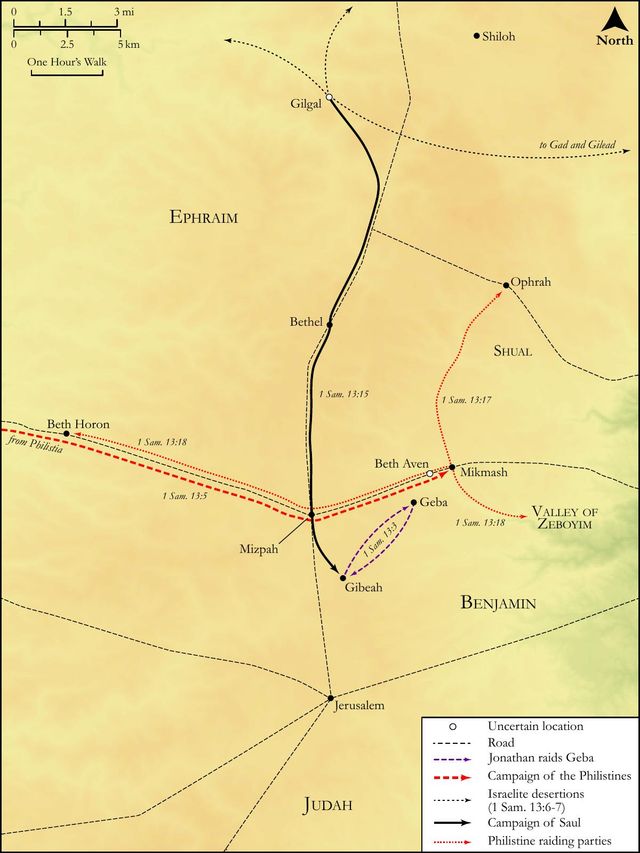
1 Samuel 13:18 meticulously details the strategic dispersal of two Philistine raiding companies, one moving westward towards the critical pass of Bethhoron, and another eastward towards the Valley of Zeboim and the wilderness. This precise geographical snapshot underscores the pervasive extent of Philistine dominance over Israel, demonstrating their sophisticated military tactics and the dire, oppressive circumstances faced by the nascent Israelite kingdom under King Saul, thereby setting the stage for the desperate need for divine intervention and deliverance.
Context
ShowHideLiterary Context
This verse is deeply embedded within the unfolding narrative of King Saul's early reign, immediately following a critical turning point. Saul's impulsive and disobedient act of offering a burnt offering before the prophet Samuel's arrival, driven by fear and impatience, resulted in Samuel's severe rebuke and the pronouncement that Saul's kingdom would not endure 1 Samuel 13:13-14. Against this backdrop of divine displeasure and Israelite vulnerability, the Philistines, a formidable military power, had amassed an overwhelming force at Michmash, described with hyperbole to emphasize their vast numbers and the terror they inspired 1 Samuel 13:5. The Israelite response was one of profound fear and disarray, with many hiding in caves, thickets, and pits, or fleeing across the Jordan River 1 Samuel 13:6-7. To further exert control and systematically plunder the land, the Philistines dispatched three companies of raiders. Verse 17 details the first company's movement northward toward Ophrah, while verse 18, the focus of this commentary, specifically delineates the westward and eastward movements of the remaining two companies, collectively painting a comprehensive and sobering picture of Israel's encirclement and subjugation.
Historical & Cultural Context
The period of the early Israelite monarchy was characterized by persistent conflict with the Philistines, a powerful group of "Sea Peoples" who had settled on the coastal plain of Canaan. Their military superiority was largely due to their monopoly on iron technology, which gave them an advantage in weaponry and tools, and their sophisticated military organization. The strategic dispersal of raiding parties, as described in 1 Samuel 13:18, was a common and effective tactic in ancient warfare for asserting control, disrupting local economies, and intimidating the populace into submission. By sending companies in multiple directions, the Philistines could simultaneously plunder resources, prevent any coordinated Israelite resistance, and maintain a broad territorial grip, effectively strangling the nascent Israelite kingdom. The specific locations mentioned—Bethhoron, a crucial pass connecting the central highlands to the coastal plain, and the Valley of Zeboim, leading to the wilderness near the Jordan Valley—underscore the Philistines' tactical understanding of the terrain and their intent to dominate key arteries and regions of Israel, extending their influence from west to east.
Key Themes
ShowHideThe meticulous geographical details in this verse contribute significantly to several overarching themes in the book of 1 Samuel. Firstly, it powerfully illustrates the extent of Philistine dominance and oppression over Israel. The Philistines were not merely engaging in a single battle but actively subjugating the land through widespread economic disruption and psychological intimidation, highlighting Israel's desperate need for a strong, God-ordained leader who could truly deliver them. Secondly, the strategic military dispersal of the Philistine companies showcases their tactical prowess and the comprehensive nature of their control, contrasting sharply with Israel's disarray and fear as described in 1 Samuel 13:6. This strategic detail underscores the overwhelming odds against Israel and sets the stage for the remarkable, divinely-empowered victory that follows, particularly through Jonathan's faith-filled initiative in 1 Samuel 14. Finally, the geographical specificity of Bethhoron and the Valley of Zeboim grounds the narrative in historical reality, emphasizing the tangible nature of Israel's plight and the historical accuracy of the biblical account, making the subsequent deliverance all the more impactful and demonstrating God's sovereign involvement in the specific details of His people's history.
Exposition and Analysis
ShowHideKey Word Analysis
ShowHideDerived from "house of hollowness," this refers to a pair of strategically vital towns, Upper and Lower Bethhoron, situated along a steep pass connecting the central Benjaminite plateau to the coastal plain. Control of this pass was crucial for military movements and trade, making it a frequent battleground throughout Israelite history (e.g., Joshua 10:10-11). The Philistine company heading this way aimed to secure the western approach to the central highlands and potentially cut off escape routes or supply lines, asserting dominance over a critical artery.
Meaning "hyenas" or "gazelles," this term likely refers to a specific valley or wadi (a dry riverbed that fills with water during rain) leading eastward from the central Benjaminite plateau down towards the Jordan Valley wilderness. Its mention indicates the Philistines' intention to control the eastern flank, potentially to prevent Israelite forces from regrouping in the Jordan Valley or to secure access to additional raiding grounds, thereby completing their encirclement.
This term describes uncultivated, often arid or semi-arid land used primarily for grazing, but also for military maneuvers, refuge, or as a buffer zone. In this context, "toward the wilderness" suggests the Philistine company was extending its reach into less populated, more rugged terrain, perhaps to secure their eastern flank or to pursue fleeing Israelites. It emphasizes the comprehensive nature of their territorial control, pushing Israelite resistance into the most desolate areas.
Verse Breakdown
ShowHide"And another company turned the way [to] Bethhoron"
This clause describes the westward movement of one of the Philistine raiding parties. By targeting Bethhoron, they were securing a crucial strategic pass that linked the central highlands with the coastal plain, effectively controlling a major artery for movement and communication within Israelite territory. This move highlights their intent to dominate the heartland and prevent any organized resistance from the west, indicating a calculated and effective military strategy.
"and another company turned [to] the way of the border that looketh to the valley of Zeboim toward the wilderness"
This clause details the eastward thrust of the third Philistine company. Their route towards the "border" and the "Valley of Zeboim" indicates a movement towards the eastern edge of the central plateau, descending into the wilderness area near the Jordan Valley. This strategic maneuver aimed to secure the eastern flank of the Philistine main force at Michmash, prevent Israelite escape or reinforcement from that direction, and extend their plundering operations into the less populated, yet strategically important, eastern regions. This shows a comprehensive encirclement and subjugation of Israelite land.
Literary Devices
ShowHideThe verse primarily employs Geographical Realism and Detailed Description. The precise naming of specific locations like Bethhoron and the Valley of Zeboim grounds the narrative firmly in the historical and geographical realities of ancient Israel. This meticulous detail serves not merely as a factual report but as a literary device to underscore the overwhelming nature of the Philistine threat. By showing the enemy's widespread and strategic movements across identifiable terrain, the author vividly portrays the extent of Israel's subjugation and the dire circumstances they faced. This detailed description also functions as Foreshadowing, subtly setting the stage for the dramatic intervention and deliverance that will follow, particularly through Jonathan's daring act, which will directly confront this widespread Philistine presence. The contrast between the Philistines' organized, widespread movements and Israel's scattered, fearful state (as described in preceding verses) is a form of Juxtaposition, emphasizing the desperate need for divine intervention and highlighting the stark difference in military capability and morale.
Theological and Thematic Connections
ShowHide1 Samuel 13:18, though seemingly a mere logistical detail, carries profound theological weight. It serves as a stark illustration of Israel's utter helplessness and the depth of their oppression when they operate outside of God's perfect timing and command, as exemplified by Saul's premature sacrifice. The meticulous description of the enemy's movements underscores that God is intimately aware of every detail of His people's circumstances, even the seemingly mundane strategic maneuvers of their adversaries. This divine omniscience and sovereign oversight mean that no threat, however widespread or strategically deployed, is beyond His knowledge or control. The very bleakness of this situation, meticulously detailed, magnifies the glory of God's subsequent deliverance, demonstrating that His power is most perfectly displayed when His people are at their weakest and most desperate. It is a testament to the truth that even in the face of overwhelming odds and pervasive enemy activity, God is sovereignly working His purposes.
Reflection and Application
ShowHideThe detailed account of the Philistine raiding parties in 1 Samuel 13:18 serves as a powerful reminder that even in moments of profound national distress or personal trial, God is intimately aware of every detail of our circumstances. Just as the Philistines' movements were meticulously observed and recorded, so too are the "movements" of the adversaries or challenges we face in our lives. This verse calls us to recognize that no threat is hidden from God's sight, and no oppressive circumstance is beyond His sovereign knowledge and ultimate control. It encourages us to trust in God's overarching plan, even when our immediate situation feels overwhelming and our enemies seem to be everywhere, strategically positioned to cause maximum disruption. The very precision of the enemy's movements sets the stage for God's precise and powerful deliverance, often through unexpected means or individuals, much like Jonathan's later act of faith. Therefore, we are called to cultivate a faith that acknowledges God's presence and power even in the most dire and detailed descriptions of our struggles, knowing that He is orchestrating His purposes for our ultimate good and His glory, and that His deliverance is always perfectly timed and executed.
Questions for Reflection
ShowHideFAQ
ShowHideWhy are these specific locations like Bethhoron and Zeboim mentioned in such detail?
ShowHideThe detailed mention of Bethhoron and the Valley of Zeboim serves multiple crucial purposes. Firstly, it provides geographical realism, grounding the biblical narrative in actual, identifiable locations within ancient Israel. This historical accuracy reinforces the veracity of the account. Secondly, these locations were strategically significant. Bethhoron was a vital pass connecting the central highlands to the coastal plain, while the Valley of Zeboim led towards the Jordan Valley wilderness. By detailing the Philistines' movements into these specific areas, the text underscores the extent and thoroughness of their dominance over Israelite territory. It shows that the Philistines were not merely fighting a localized battle but systematically asserting control over key arteries and regions, effectively encircling and subjugating the Israelite population. This precision vividly portrays the dire circumstances Israel faced before God's intervention, making the subsequent deliverance all the more impactful and highlighting the need for a divinely empowered deliverer.
Christ-Centered Fulfillment
ShowHideWhile 1 Samuel 13:18 describes a moment of profound national oppression and a seemingly overwhelming enemy, it subtly points forward to the ultimate Deliverer, Jesus Christ. The Philistine companies, strategically dispersed to dominate Israel, foreshadow the pervasive and strategic nature of spiritual darkness and the forces of evil that seek to oppress humanity. Just as Israel found itself without a king capable of truly delivering them from this widespread threat, humanity was utterly helpless against the dominion of sin and death. Christ, however, entered into our "wilderness" of sin and suffering, not as a king who fails like Saul, but as the perfect Lamb of God who takes away the sin of the world. He confronted the enemy in the spiritual "Bethhorons" and "Zeboims" of temptation and spiritual battle, ultimately triumphing over all principalities and powers through His death and resurrection Colossians 2:15. Unlike the temporary relief offered by human leaders, Christ's victory provides eternal freedom and establishes a kingdom that will never be overthrown, offering true peace and security even amidst the "raiding parties" of life's trials John 16:33. He is the ultimate fulfillment of Israel's desperate need for a deliverer, the one who brings true liberation from every form of oppression, both seen and unseen, establishing a reign of peace and righteousness.