


1 Samuel 13:17
Bible text: King James Version (1769 Blayney text) · Public domain
Bible text: King James Version with Strong's numbers · Public domain
Bible text: Berean Standard Bible · Public domain
Bible text: American Standard Version (1901) · Public domain
Bible text: World English Bible, Messianic edition · Public domain
Bible text: Geneva Bible (1599) · Public domain
Bible text: Young's Literal Translation · Public domain
- וַיֵּצֵאvai·ye·Tze'and it came outH3318Conj-w ¦ V-Qal-ConsecImperf-3msVerb Qal Consecutive Imperfect 3rd Singular Masculineוַandיֵּצֵאit came out
- הַמַּשְׁחִיתha·mash·Chitthe destroyerH7843Art ¦ N-msNoun Singular Masculine Absoluteהַtheמַּשְׁחִיתdestroyer
- מִמַּחֲנֵהmi·ma·cha·Nehfrom [the] camp ofH4264Prep-m ¦ N-fscNoun Singular Feminine Constructמִfromמַּחֲנֵה[the] camp of
- פְלִשְׁתִּיםfe·lish·Tim[the] PhilistinesH6430N-mpNoun Gentilic Plural Masculine Absolute
- שְׁלֹשָׁהshe·lo·ShahthreeH7969N-csNoun Singular common gender Absolute
- רָאשִׁיםra·ShimcompaniesH7218N-mpNoun Plural Masculine Absolute
- הָרֹאשׁha·Roshthe companyH7218Art ¦ N-msNoun Singular Masculine Absoluteהָtheרֹאשׁcompany
- אֶחָד'e·ChadoneH259N-fsNoun Singular Feminine Absolute
- יִפְנֶהyif·Nehit turnedH6437V-Qal-Imperf-3msVerb Qal Imperfect 3rd Singular Masculine
- אֶל'eltoH413PrepPreposition
- דֶּרֶךְDe·rekh[the] direction ofH1870N-cscNoun Singular common gender Construct
- עָפְרָה'a·fe·RahOphrahH6084N-properNoun Proper Location
- אֶל'eltoH413PrepPreposition
- אֶרֶץ'E·retz[the] land ofH776N-fscNoun Singular Feminine Construct
- שׁוּעָלshu·'AlShualH7777N-proper-mNoun Proper Masculine
English is a literal word-by-word gloss of the Hebrew, not the KJV's wording. Why?
This is the original text the KJV's translators worked from — each Hebrew word with its own literal English meaning in this verse, prepared by scholars at Tyndale House, Cambridge. The KJV translates whole sentences, not word by word, so its wording differs: one Hebrew word can become several English words, and the KJV may choose “the LORD” where the gloss reads “Yahweh”. Both are faithful — they answer different questions. For the KJV's own rendering, switch to the KJV text.
Details
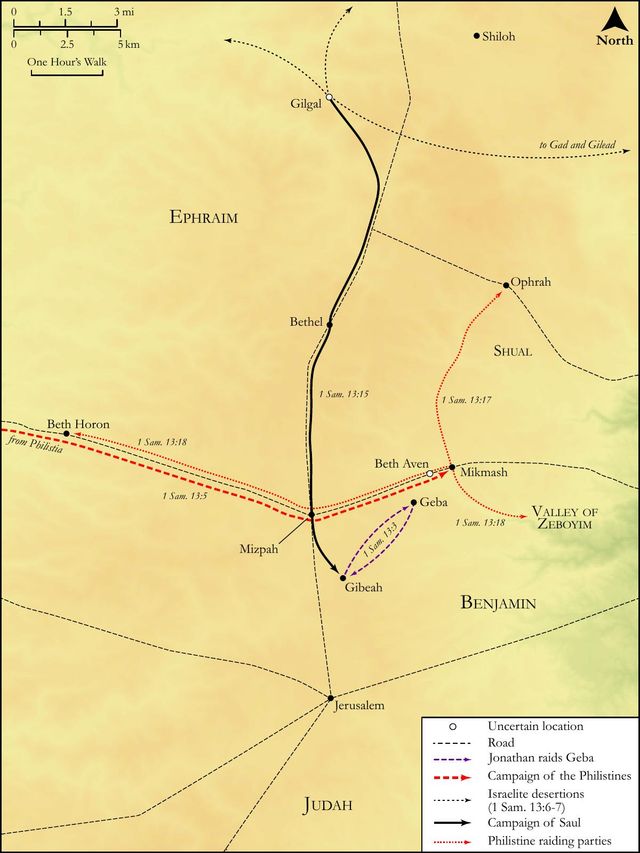
See on the biblical-era map
Study this verse
Public-domain commentary
Matthew Henry
From his Commentary on the Whole Bible. Henry comments on passages, not single verses — this entry covers 1 Samuel 13:15–23.
Here, 1. Samuel departs in displeasure. Saul has set up for himself, and now he is left to himself: Samuel gat him from Gilgal (Sa1 13:15), and it does not appear that he either prayed with Saul or directed him. Yet in going up to Gibeah of Benjamin, which was Saul's city, he intimated that he had not quite abandoned him, but waited to do him a kindness another time. Or he went to the college of the prophets there, to pray for Saul when he did not think fit to pray with him. 2. Saul goes after him to Gibeah, and there musters his army, and finds his whole number to be but 600 men, Sa1 13:15, Sa1 13:16. Thus were they for their sin diminished and brought low. 3. The Philistines ravage the country, and put all the adjacent parts under contribution. The body of their army, or standing camp (as it is called in the margin, Sa1 13:23), lay in an advantageous pass at Michmash, but thence they sent out three separate parties or detachments that took several ways, to plunder the country, and bring in provisions for the army, Sa1 13:17, Sa1 13:18. By these the land of Israel was both terrified and impoverished, and the Philistines were animated and enriched. This the sin of Israel brought upon them, Isa 42:24. 4. The Israelites that take the field with Saul are unarmed, having only slings and clubs, not a sword or spear among them all, except what Saul and Jonathan themselves have, Sa1 13:19, Sa1 13:22. See here, (1.) How politic the Philistines were, when they had power in their hands, and did what they pleased in Israel. They put down all the smiths' shops, transplanted the smiths into their own country, and forbade any Israelite, under severe penalties, to exercise the trade or mystery of working in brass or iron, though they had rich mines of both (Deu 8:9) in such plenty that it was said of Asher, his shoes shall be iron and brass, Deu 33:25. This was subtilely done of the Philistines, for hereby they not only prevented the people of Israel from making themselves weapons of war (by which they would be both disused to military exercises and unfurnished when there was occasion), but obliged them to a dependence upon them even for the instruments of husbandry; they must go to them, that is, to some or other of their garrisons, which were dispersed in the country, to have all their iron-work done, and no more might an Israelite do than use a file (Sa1 13:20, Sa1 13:21), and no doubt the Philistines' smiths brought the Israelites long bills for work done. (2.) How impolitic Saul was, that did not, in the beginning of his reign, set himself to redress this grievance. Samuel's not doing it was very excusable; he fought with other artillery; thunder and lightning, in answer to his prayer, were to him instead of sword and spear; but for Saul, that pretended to be a king like the kings of the nations, to leave his soldiers without swords and spears, and take no care to provide them, especially when he might have done it out of the spoils of the Ammonites whom he conquered in the beginning of his reign, was such a piece of negligence as could by no means be excused. (3.) How slothful and mean-spirited the Israelites were, that suffered the Philistines thus to impose upon them and had no thought nor spirit to help themselves. It was reckoned very bad with them when there was not a shield or spear found among 40,000 in Israel (Jdg 5:8), and it was not better now, when there was never an Israelite with a sword by his side but the king and his son, never a soldier, never a gentleman; surely they were reduced to this, or began to be so, in Samuel's time, for we never find him with sword or spear in his hand. If they had not been dispirited, they could not have been disarmed, but it was sin that made them naked to their shame.
Historical interpretation
Historical reception
1 surviving comment on this verse from the historical church.
And three companies went out to pillage from the camps of the Philistines, etc. And everyone who legitimately fights in her camps feels that the Church is daily tested by these three companies. For three companies go out to pillage from the camps of the Philistines when impure spirits attempt to assault the guard of our inner man, either his rational part, or his irascible part, or his concupiscible part, trying to strip them of the riches of virtues, whether individually in each of them or all in one. To these parts, indeed, also correspond the names of those places and the said companies that went out. The way of Ephrath, which means the growing one, against which the first company marched, is the concupiscible part of the soul; rightly named thus, because it never ceases seeking increase; indeed, of good things, if it is ruled by Israel, that is, by the soul that longs for uprightness and the vision of God; but of evil things, if setting itself against the laws, it is ravaged by the wickedness of vices and unclean spirits. And it is fitting that when speaking of the first company, he said, “It marched against the way of Ephrath,” he added, "to the land of Saul"; for the first and indeed greatest aim of the wicked spirits is to turn the leaders themselves of the holy struggle away from the undertakings of virtues by the concupiscence either of the soul or of the flesh; so that from the deprivation of the leaders of justice, the wicked contagion may more freely spread among the unsuspecting people. The road to Bethoron, which means the house of wrath, to which the second company was heading, indicates even by its name the passion of the mind it signifies. This house was well governed by the Israelite owner when that exceedingly meek man, who was more meek than all the men who dwelt on the land, left Pharaoh, being greatly angered, to liberate the people of God. The Philistine, however, was plundered, when Cain, who was of the evil one, greatly angered by the righteousness of his good brother, was provoked to such an extent that by his wrath he broke the first laws of brotherhood through murder. The valley of Seboim, which means of the roes or the deer, to which the third company turned, figuratively announces the rational insight of the mind. For these animals are said to excel in keen sight; hence they are also called Dorcades by the Greeks from keen seeing; and it is not for nothing that they are so often mentioned in the Song of Songs under the praise of Christ and the Church. And rightly, not a mountain but the valley of the roes is mentioned, rightly placed against the desert; because we always need the help of humility, especially when discerning good and evil, lest our judgment goes astray, and the humbler one is, the more they understand what of the world is less to be loved and sought. Therefore, the road to the boundary of the impending valley of the Dorcades holds the way of the growing one, and also the way of the house of wrath, possessed by Israel in peace, when the people of God or any faithful person, with humble intent, recognizes what should be followed and what should be scorned, and endeavors to grow in the things that they usefully recognize should be followed until the perfect day; strives to be healthily angry and not to sin for anything that attempts to hinder either their spiritual insight or their progress and course; so that anyone who foolishly chooses evil for good by erroneous reasoning, and harmfully desires to pursue these harmfully chosen things, and thinks it necessary to be angry for everything that resists such concupiscence, all the paths and bounds of this person's mind are devastated by the bitterness of the invisible enemy.
Continue studying 1 Samuel 13:17 across the web’s major study libraries — every link below opens this exact verse, chapter, or book on the destination site.
Read & Compare
 BibleGatewayThis verse in more than 200 translations and 70 languages.
 Bible.comThe YouVersion reader — hundreds of translations, reading plans, and highlights.
 ESV.orgCrossway's official English Standard Version reader.
 NET BibleThe NET translation with 60,000+ translators' notes on every rendering decision.
 STEP BibleTyndale House's free study tool — original text, vocabulary, and scholarly resources.
 BibliaLogos Bible Software's free web reader.
 USCCBThe New American Bible (Revised Edition) with the U.S. bishops' study notes.
Commentaries
 BibleHub CommentariesDozens of classic commentaries on this verse, gathered on one page.
 StudyLightMore than 100 commentary sets — the largest collection on the web.
 BibleRefPlain-English commentary on what this verse means, verse by verse.
 Enduring WordDavid Guzik's free commentary on this chapter, widely used by Bible teachers.
 Bible Study ToolsVerse commentary alongside Greek and Hebrew study aids.
Original Language & Research
- BibleHub InterlinearThe verse word by word — original language, transliteration, and English.
- BibleHub LexiconEvery word's original-language definition and Strong's entry.
 Blue Letter BibleDeep-study tools — Strong's numbers, concordance, and word studies.
 SefariaThe Hebrew text with Rashi and centuries of Jewish commentary.
Sermons, Hymns & Audio


TrulyRandomVerse is not affiliated with these sites and doesn’t control their content. They’re linked because they’re genuinely useful.
Summary
1 Samuel 13:17 offers a stark portrayal of Israel's vulnerable state under King Saul, immediately following his act of disobedience. This verse meticulously details the Philistines' strategic deployment of three distinct raiding parties, or "spoilers," from their main encampment. These companies fanned out into various parts of Israelite territory, specifically mentioning Ophrah and the land of Shual, thereby demonstrating the Philistines' overwhelming military dominance and their deliberate intent to economically cripple and demoralize the nascent Israelite kingdom through widespread plunder and destruction.
Context
ShowHideLiterary Context
This verse is situated at a pivotal moment in the narrative of Saul's early reign, directly following a series of events that underscore Israel's precarious position. Jonathan's audacious strike against a Philistine garrison at Geba ignited a massive Philistine counter-mobilization at Michmash, described in 1 Samuel 13:5. The sheer size of the Philistine army instilled widespread fear, leading to significant desertion among the Israelite forces, leaving Saul with a drastically diminished and demoralized contingent, as recounted in 1 Samuel 13:6-7. In this atmosphere of desperation and prolonged waiting for Samuel, Saul presumptuously offered a burnt offering himself, incurring Samuel's severe rebuke and the divine pronouncement that his kingdom would not endure (1 Samuel 13:13-14). Verse 17 directly illustrates the immediate and tangible consequence of Israel's vulnerable state and Saul's failed leadership, as the Philistines assert their dominance by sending out destructive raiding parties, highlighting the direct link between Saul's disobedience and Israel's suffering.
Historical & Cultural Context
The Philistines were a formidable military and political power among the nations round about, particularly dominant in the coastal plains. Their technological superiority, especially their mastery of ironworking, gave them a significant military advantage over the Israelites, who largely relied on bronze. Philistine military strategy extended beyond pitched battles to include widespread raiding and economic warfare, designed to subjugate their neighbors. Sending out "spoilers" or raiding parties was a common and effective tactic to plunder resources, destroy crops, seize livestock, and demoralize the civilian population, thereby crippling the enemy's ability to sustain itself and resist. The mention of specific locations like Ophrah and the land of Shual indicates that these incursions were not random acts of banditry but rather targeted operations against strategic or agriculturally vital areas within Israelite territory, underscoring the extent of Philistine control and the severe pressure exerted on Israel. This tactic aimed to break the will of the Israelite people and ensure their continued subservience.
Key Themes
ShowHideThis verse powerfully contributes to several overarching themes within the book of 1 Samuel. Firstly, it vividly illustrates the theme of Philistine Dominance and Military Strategy, showcasing their organized and destructive methods of warfare that extended beyond direct confrontation to systematic economic destabilization. Secondly, it underscores Israel's Vulnerability and Disorganization under Saul's early reign, demonstrating their inability to protect their own people and territory from widespread plunder, a stark contrast to the divine protection promised under faithful leadership. The actions of the "spoilers" exemplify Economic Warfare and Plunder, a deliberate tactic to weaken Israel's economic base and undermine its morale, forcing submission. Finally, the dire circumstances depicted here serve as a tangible manifestation of the Consequences of Disobedience, as Saul's presumptuous act has left Israel in a precarious position, seemingly abandoned to the enemy's ravages. This sets the stage for the desperate need for a deliverer and a truly God-anointed king, a role that will ultimately be filled by David, whose anointing is described in 1 Samuel 16.
Exposition and Analysis
ShowHideKey Word Analysis
ShowHideDerived from the primitive root H7843, this term signifies to "decay" or "ruin" (causatively). In this context, it refers to those who actively bring about destruction, devastation, and waste. These were not mere opportunistic thieves but organized agents of ruin, indicating a deliberate strategy of economic and social disruption designed to cripple Israel's ability to sustain itself and resist. The Philistines sought to inflict maximum damage and demoralization, ensuring their dominance.
This word (H7218) literally means "head" or "chief," but figuratively it refers to distinct, organized units or detachments, each with its own leader or direction. The use of "three companies" emphasizes the coordinated and widespread nature of the Philistine incursion, demonstrating their military sophistication and the comprehensive reach of their destructive operations across Israelite territory. It highlights that these were not random bands but structured forces.
Verse Breakdown
ShowHide"And the spoilers came out of the camp of the Philistines in three companies:"
This clause establishes the origin and organized nature of the threat. The "spoilers" are identified as destructive raiders, not acting independently but as a deliberate deployment from the main Philistine encampment. This indicates a coordinated military strategy rather than a rogue element. The division into "three companies" signifies a widespread, systematic operation, designed to cover a large geographical area and maximize disruption, rather than a single concentrated attack. This detail underscores the Philistines' tactical superiority and Israel's inability to effectively contain or counter their widespread incursions.
"one company turned unto the way [that leadeth to] Ophrah, unto the land of Shual:"
This segment provides specific geographical details, delineating the direction and reach of one of the raiding parties. The mention of "Ophrah" (likely located in the territory of Benjamin, north of Michmash) and "the land of Shual" (possibly referring to a region characterized by wild animals like foxes or jackals, suggesting a less populated but still strategically important or agriculturally viable area) grounds the narrative in concrete reality. This precision emphasizes the tangible and pervasive nature of the Philistine threat, demonstrating their deep penetration into Israelite territory and their intent to plunder and devastate key regions, thereby extending their control and demonstrating Israel's vulnerability.
Literary Devices
ShowHideThe verse employs several effective literary devices to convey the gravity of Israel's precarious situation. Imagery is powerfully utilized, painting a vivid picture of destructive "spoilers" fanning out in "three companies," which evokes a strong sense of overwhelming, pervasive threat. This imagery underscores the Philistine's military might and Israel's profound vulnerability. The use of Geographical Specificity with "Ophrah" and "the land of Shual" grounds the narrative in a tangible reality, making the Philistine incursion feel immediate and widespread to the original audience. This specificity emphasizes the extent of the Philistine's control and the dire consequences for the Israelite populace. Furthermore, the description of "spoilers" carries a strong sense of Foreshadowing, hinting at the ongoing struggle and the deep-seated issues within Saul's leadership that will continue to plague his reign, ultimately necessitating the rise of a new, more faithful king.
Theological and Thematic Connections
ShowHideThis verse, depicting the Philistine "spoilers" spreading across Israelite land, serves as a stark illustration of the consequences of Israel's spiritual and leadership failures. While the immediate catalyst is Saul's presumptuous sacrifice, the broader context of God's covenant with Israel suggests that such oppression often served as a divine discipline, calling the people back to faithfulness. It highlights the profound vulnerability of a people when their leadership is not aligned with God's will, leaving them exposed to external threats and the ravages of their enemies. The Philistine's systematic plundering reflects a deeper spiritual reality: when God's people are disobedient, they can lose their "spoils"—their blessings, security, and even their land—to the enemy. This serves as a cautionary tale, emphasizing that true security and prosperity are found not in human strength or strategic prowess alone, but in faithful obedience and humble reliance on God.
Reflection and Application
ShowHideThe scene of Philistine "spoilers" systematically ravaging Israelite territory offers a potent metaphor for the challenges and spiritual attacks believers may face in their own lives. Just as the Philistines aimed to demoralize and deplete Israel's resources, so too can spiritual adversaries seek to plunder our joy, peace, and spiritual vitality through various "companies" of temptation, doubt, discouragement, and worldly distractions. This passage prompts us to critically examine our own vulnerabilities: are there areas in our lives where disobedience, presumption, or a lack of humble reliance on God's strength have left us exposed to spiritual "spoilers"? It serves as a powerful reminder that true security is not found in our own abilities, resources, or even well-intentioned but disobedient actions, but rather in faithful obedience to God and humble reliance on His power and timing. When circumstances seem dire and overwhelming, we are called to vigilant discernment, recognizing the nature of the "spoilers" and seeking God's strategy for protection and deliverance, rather than resorting to self-reliant or disobedient actions that only deepen our vulnerability.
Questions for Reflection
ShowHideFAQ
ShowHideWhat is the significance of the Philistines being described as "spoilers" rather than just an army?
ShowHideThe term "spoilers" (derived from the Hebrew root shâchath, H7843) emphasizes their specific intent and method of warfare. It signifies that their primary goal was not merely a pitched battle, but rather a systematic campaign of destruction, plunder, and economic devastation. These "spoilers" were raiding parties whose mission was to lay waste to the land, seize resources, destroy crops, and demoralize the civilian population. This tactic was a form of economic warfare designed to cripple Israel's ability to sustain itself and resist, highlighting the brutal and comprehensive nature of the Philistine oppression and their intent to thoroughly subdue the Israelite kingdom.
What is the importance of "three companies" and the specific geographical locations mentioned?
ShowHideThe mention of "three companies" (from the Hebrew rôʼsh, H7218, meaning "heads" or "units") indicates a coordinated and widespread military operation. It signifies that the Philistines were not engaging in random acts of banditry but were systematically fanning out into Israelite territory in organized detachments. This demonstrates their military sophistication and their ability to assert control over a broad area. The specific geographical locations, Ophrah (H6084) and the land of Shual (H7777), further emphasize the tangible and pervasive nature of the threat. These were likely strategic points or agriculturally important areas within Israelite territory, underscoring the depth of the Philistine incursion and the widespread impact on the Israelite populace. It shows that the Philistines had effectively penetrated and were exploiting the heartland of Israel, leaving no region untouched by their destructive presence.
Christ-Centered Fulfillment
ShowHideThe dire situation in 1 Samuel 13:17 with Israel vulnerable to the destructive "spoilers" of the Philistines under a failing king, powerfully anticipates the ultimate need for a perfect King who would decisively defeat all spiritual "spoilers." Saul's inability to protect his people from physical plunder foreshadows the greater human inability to overcome the spiritual forces of darkness. Jesus Christ, the true King, stands in stark contrast to Saul. He is the one who came not to be plundered, but to plunder the strong man and set the captives free, as He Himself declared in Mark 3:27. Through His death and resurrection, Christ decisively disarmed the principalities and powers, triumphing over them by the cross, as celebrated in Colossians 2:15. He is the Good Shepherd who lays down His life for the sheep, ensuring that no one can snatch them out of His hand, promising abundant life in John 10:10 and eternal security in John 10:28. Unlike Saul's kingdom, which was vulnerable to "spoilers," Christ's eternal kingdom is impregnable, and He has already defeated the ultimate "spoiler," Satan, who came to steal, kill, and destroy, as revealed in Hebrews 2:14-15. In Christ, believers find ultimate security and deliverance from all spiritual oppression, as He reigns as the victorious King over every enemy.