


Joshua 18:14
Bible text: King James Version (1769 Blayney text) · Public domain
Bible text: King James Version with Strong's numbers · Public domain
Bible text: Berean Standard Bible · Public domain
Bible text: American Standard Version (1901) · Public domain
Bible text: World English Bible, Messianic edition · Public domain
Bible text: Geneva Bible (1599) · Public domain
Bible text: Young's Literal Translation · Public domain
- וְתָאַרve·ta·'Arand it turnsH8388Conj-w ¦ V-Qal-ConsecPerf-3msVerb Qal Consecutive Perfect 3rd Singular Masculineוְandתָאַרit turns
- הַגְּבוּלha·ge·Vulthe borderH1366Art ¦ N-msNoun Singular Masculine Absoluteהַtheגְּבוּלborder
- וְנָסַבve·na·Savand it turnsH5437Conj-w ¦ V-Niphal-ConsecPerf-3msVerb Niphal Consecutive Perfect 3rd Singular Masculineוְandנָסַבit turns
- לִפְאַתlif·'atto [the] side ofH6285Prep-l ¦ N-fscNoun Singular Feminine Constructלִtoפְאַת[the] side of
- יָםyam[the] westH3220N-msNoun Singular Masculine Absolute
- נֶגְבָּהNeg·bahsouth -wardH5045N-ms ¦ SfxNoun Singular Masculine Absoluteנֶגְבָּsouthה-ward
- מִןminfromH4480PrepPreposition
- הָהָרha·Harthe mountainH2022Art ¦ N-msNoun Singular Masculine Absoluteהָtheהָרmountain
- אֲשֶׁר'a·SherwhichH834RelParticle Relative
- עַל'al[is] onH5921PrepPreposition
- פְּנֵיpe·Nei[the] face ofH6440N-mpcNoun Plural Masculine Construct
- בֵיתveitBethH1032N-properNoun Proper Location
- חֹרוֹןcho·rOnHoronH1032N-properNoun Proper Location
- נֶגְבָּהneg·Bah[the] south towardsH5045N-ms ¦ SfxNoun Singular Masculine Absoluteנֶגְבָּ[the] southהtowards
- וְהָיוּve·ha·yahand they areH1961Conj-w ¦ V-Qal-ConsecPerf-3cpVerb Qal Consecutive Perfect 3rd Plural common genderוְandהָיוּthey are
- תֹצְאֹתָיוto·tze·'o·Tavits extremitiesH8444N-fpc ¦ 3msNoun Plural Feminine Constructתֹצְאֹתָיextremitiesוits
- אֶל'eltoH413PrepPreposition
- קִרְיַתkir·yatKiriathH7154N-properNoun Proper Location
- בַּעַלba·'alBaalH7154N-properNoun Proper Location
- הִיאhi'thatH1931Pro-3fsPronoun Personal 3rd Singular Feminine
- קִרְיַתkir·Yat[is] KiriathH7157N-properNoun Proper Location
- יְעָרִיםye·'a·RimJearimH7157N-properNoun Proper Location
- עִיר'ir[the] city ofH5892N-fscNoun Singular Feminine Construct
- בְּנֵיbe·Nei[the] descendants ofH1121N-mpcNoun Plural Masculine Construct
- יְהוּדָהye·hu·DahJudahH3063N-properNoun Proper Location
- זֹאתzotthisH2063PrtParticle Demonstrative
- פְּאַתpe·'at[is the] side ofH6285N-fscNoun Singular Feminine Construct
- יָםYam[the] westH3220N-msNoun Singular Masculine Absolute
English is a literal word-by-word gloss of the Hebrew, not the KJV's wording. Why?
This is the original text the KJV's translators worked from — each Hebrew word with its own literal English meaning in this verse, prepared by scholars at Tyndale House, Cambridge. The KJV translates whole sentences, not word by word, so its wording differs: one Hebrew word can become several English words, and the KJV may choose “the LORD” where the gloss reads “Yahweh”. Both are faithful — they answer different questions. For the KJV's own rendering, switch to the KJV text.
Details
See on the biblical-era maps
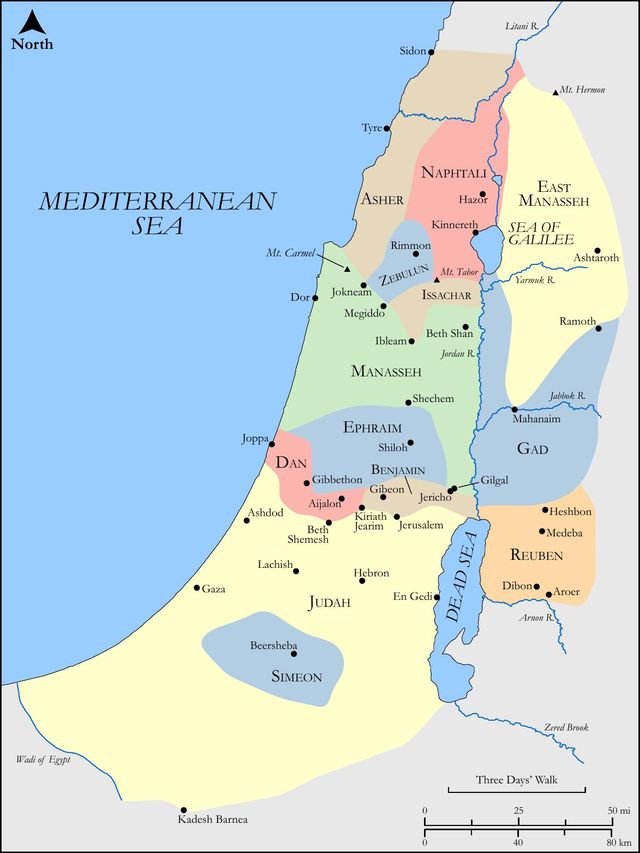
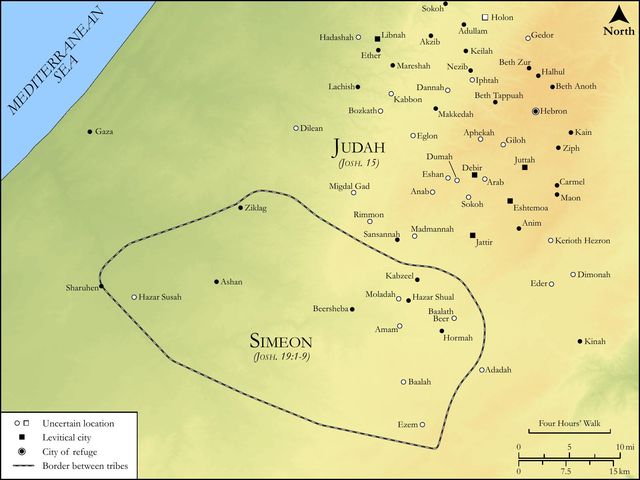
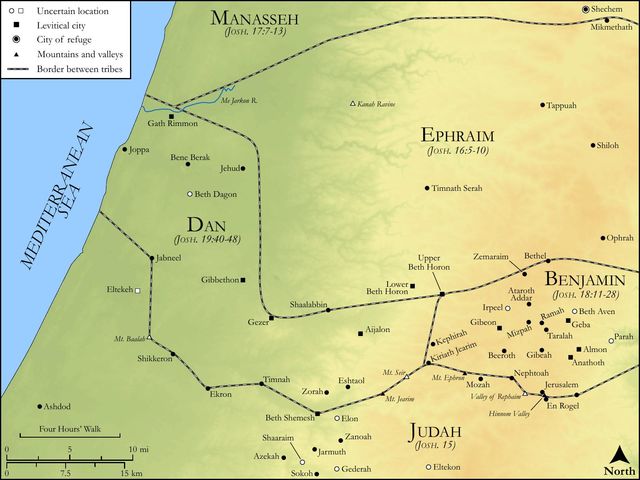
Study this verse
Public-domain commentary
Matthew Henry
From his Commentary on the Whole Bible. Henry comments on passages, not single verses — this entry covers Joshua 18:11–28.
We have here the lot of the tribe of Benjamin, which Providence cast next to Joseph on the one hand, because Benjamin was own and only brother to Joseph, and was little Benjamin (Psa 68:27), that needed the protection of great Joseph, and yet had a better protector, for the Lord shall cover him all the day long, Deu 33:12. And it was next to Judah on the other hand, that this tribe might hereafter unite with Judah in an adherence to the throne of David and the temple at Jerusalem. Here we have, 1. The exact borders and limits of this tribe, which we need not be exact in the explication of. As it had Judah on the south and Joseph on the north, so it had Jordan on the east and Dan on the west. The western border is said to compass the corner of the sea southward (Jos 18:14), whereas no part of the lot of this tribe came near to the great sea. Bishop Patrick thinks the meaning is that it ran along in a parallel line to the great sea, though at a distance. Dr. Fuller suggests that since it is not called the great sea, but only the sea, which often signifies any lake or mere, it may be meant of the pool of Gibeon, which may be called a corner or canton of the sea; it is called the great waters of Gibeon (Jer 41:12), and it is compassed by the western border of this tribe. 2. The particular cities in this tribe, not all, but the most considerable. Twenty-six are here named. Jericho is put first, though dismantled, and forbidden to be rebuilt as a city with gates and walls, because it might be built and inhabited as a country village, and so was not useless to this tribe. Gilgal, where Israel first encamped when Saul was made king (Sa1 11:15), was in this tribe. It was afterwards a very profane place. Hos 9:15, All their wickedness is in Gilgal. Beth-el was in this tribe, a famous place. Though Benjamin adhered to the house of David, yet Beth-el, it seems, was in the possession of the house of Joseph (Jdg 1:23-25), and there Jeroboam set up one of his calves. In this tribe was Gibeon, where the altar was in the beginning of Solomon's time, Ch2 1:3. Gibeah likewise, that infamous place where the Levite's concubine was abused. Mizpeh, and near it Samuel's Ebenezer, and also Anathoth, Jeremiah's city, were in this tribe, as was the northern part of Jerusalem. Paul was the honour of this tribe (Rom 11:1; Phi 3:5); but where his land lay we know not: he sought the better country.
Continue studying Joshua 18:14 across the web’s major study libraries — every link below opens this exact verse, chapter, or book on the destination site.
Read & Compare
 BibleGatewayThis verse in more than 200 translations and 70 languages.
 Bible.comThe YouVersion reader — hundreds of translations, reading plans, and highlights.
 ESV.orgCrossway's official English Standard Version reader.
 NET BibleThe NET translation with 60,000+ translators' notes on every rendering decision.
 STEP BibleTyndale House's free study tool — original text, vocabulary, and scholarly resources.
 BibliaLogos Bible Software's free web reader.
 USCCBThe New American Bible (Revised Edition) with the U.S. bishops' study notes.
Commentaries
 BibleHub CommentariesDozens of classic commentaries on this verse, gathered on one page.
 StudyLightMore than 100 commentary sets — the largest collection on the web.
 BibleRefPlain-English commentary on what this verse means, verse by verse.
 Enduring WordDavid Guzik's free commentary on this chapter, widely used by Bible teachers.
 Bible Study ToolsVerse commentary alongside Greek and Hebrew study aids.
Original Language & Research
- BibleHub InterlinearThe verse word by word — original language, transliteration, and English.
- BibleHub LexiconEvery word's original-language definition and Strong's entry.
 Blue Letter BibleDeep-study tools — Strong's numbers, concordance, and word studies.
 SefariaThe Hebrew text with Rashi and centuries of Jewish commentary.
Sermons, Hymns & Audio


TrulyRandomVerse is not affiliated with these sites and doesn’t control their content. They’re linked because they’re genuinely useful.
Summary
Joshua 18:14 meticulously delineates a specific segment of the western boundary for the tribe of Benjamin's allotted territory within the Promised Land. This verse, part of a broader section detailing the precise borders and cities assigned to Benjamin after the casting of lots at Shiloh, underscores the divine order, precision, and faithfulness of God in fulfilling His covenant promises to Israel by providing each tribe with its designated inheritance.
Context
ShowHideLiterary Context
Joshua 18:14 is situated within the detailed account of the land distribution to the remaining seven tribes of Israel (Joshua 18:1-19:51), following the initial conquests and the allocation of territory to Judah, Ephraim, and Manasseh. Specifically, it belongs to the description of Benjamin's inheritance (Joshua 18:11-28), which was the first of the seven tribes to receive its portion after a comprehensive survey of the land. The preceding verses (Joshua 18:4-9) describe Joshua's command to send out men to survey the land and record its divisions, emphasizing the meticulous and orderly nature of this process. This verse, therefore, is not merely a geographical marker but a testament to the systematic fulfillment of God's promise, ensuring that every boundary was clearly defined and understood, preventing future disputes and establishing tribal identity within the nascent nation. It serves as a concrete example of the divine blueprint being laid out for the nascent nation, transitioning from a nomadic, conquering force to a settled, agricultural society.
Historical & Cultural Context
The division of land was a foundational act for the newly formed nation of Israel, transitioning from a nomadic, conquering force to a settled, agricultural society. In Israel, precise land demarcation was crucial for establishing ownership, taxation, and tribal identity, often involving natural landmarks and surveyed lines. The act of casting lots at Shiloh was not a random event but a divinely guided process, signifying God's sovereign hand in the distribution, ensuring that the inheritance was truly from Him. The mention of "the corner of the sea" almost certainly refers to the Mediterranean Sea, which formed a natural western boundary for many tribal territories. Cities like Bethhoron and Kirjathjearim were significant strategic and cultural landmarks, often situated on key trade routes or elevated positions, making them ideal points for defining borders. The fact that Kirjathjearim is noted as "a city of the children of Judah" highlights the precise intersection of tribal territories, demonstrating the careful interweaving of the twelve tribes' portions and the complex yet orderly nature of the land allocation.
Key Themes
ShowHideThis verse powerfully contributes to several overarching themes within the book of Joshua and the Pentateuch. Firstly, it exemplifies Divine Order and Precision, revealing God as a meticulous architect who meticulously plans and executes His purposes, down to the exact boundaries of a tribe's inheritance. This precision underscores His sovereignty and foresight. Secondly, it highlights the Fulfillment of Promise, as the very act of dividing the land is the culmination of centuries of divine promises made to Abraham, Isaac, and Jacob concerning their descendants inheriting the land of Canaan (e.g., Genesis 15:18-21). Every boundary marker was a tangible sign of God's unwavering faithfulness, demonstrating that not one word of His good promise failed. Thirdly, it solidifies Tribal Identity and Inheritance, providing each tribe with a distinct, God-given territory essential for their self-governance, economic stability, and the preservation of their unique heritage within the covenant community. This defined space was crucial for their identity as the people of God, living out their covenant responsibilities within their designated spheres, and establishing their future as a settled nation.
Exposition and Analysis
ShowHideKey Word Analysis
ShowHideThis verb (H8388) signifies "to delineate," "to mark out," or "to extend." Its use here emphasizes the deliberate and precise nature of the boundary setting. It implies a careful surveying process, where lines were not arbitrarily assigned but meticulously determined, often by following natural contours or established landmarks. This speaks to the intentionality behind the land's division, reflecting God's orderly character and the tangible reality of His fulfilled promises.
Meaning "to revolve, surround, or border" (H5437), this word illustrates the winding and encircling path of the border. Rather than a straight, artificial line, the boundary followed the natural topography, curving around geographical features like hills and valleys. This further highlights the practical and detailed approach to land division, making use of the existing landscape to define the tribal territories, ensuring natural and defensible borders.
Verse Breakdown
ShowHide"And the border was drawn [thence], and compassed the corner of the sea southward"
This clause initiates the description of Benjamin's western border, indicating its starting point or direction. "Thence" implies a continuation from a previously described point, suggesting a logical flow in the boundary's delineation. "The corner of the sea" refers to the Mediterranean coast, establishing the extreme western limit of the territory. The direction "southward" specifies the trajectory of this segment of the border, moving along the coast.
"from the hill that [lieth] before Bethhoron southward"
This provides a crucial landmark for the border's path. Bethhoron (H1032), likely referring to Upper Bethhoron, was a strategically important city on a major ascent from the coastal plain to the central highlands. The border is described as running from a specific hill situated "before" (pânîym, H6440, meaning "in front of" or "facing") Bethhoron, continuing its southward trajectory. This detail anchors the boundary to a recognizable geographical feature, ensuring clarity and precision.
"and the goings out thereof were at Kirjathbaal, which [is] Kirjathjearim, a city of the children of Judah"
This clause marks the end point or junction of this particular segment of the western border. "Goings out" (tôwtsâʼâh, H8444) refers to the termination or extension of the boundary. Kirjathbaal (H7154), later known as Kirjathjearim (H7157), was a significant city. The parenthetical clarification, "a city of the children of Judah" (Yᵉhûwdâh, H3063), is vital, indicating that this point was where Benjamin's western border met the northern boundary of Judah's territory, creating a shared frontier between the two tribes and emphasizing the interconnectedness of their inheritances.
"this [was] the west quarter."
This concluding phrase succinctly summarizes the preceding description, confirming that the detailed geographical markers delineate the entire western side of Benjamin's tribal inheritance. It provides a clear and unambiguous statement of the boundary's orientation, leaving no doubt as to the defined territory.
Literary Devices
ShowHideThe primary literary device at play in Joshua 18:14, and indeed throughout the land allocation chapters, is Topographical Detail. The meticulous enumeration of specific geographical features—such as "the corner of the sea," "the hill that lieth before Bethhoron," and "Kirjathbaal, which is Kirjathjearim"—serves to establish the absolute precision and specificity of the land division. This level of detail is not merely descriptive; it functions as a form of Legal Language, akin to a deed or property survey, solidifying the divine grant of land to each tribe. The repetition of directional indicators like "southward" further reinforces the clarity and exactness of the boundaries. This detailed mapping underscores the divine order and the fulfillment of covenant promises, transforming abstract promises into tangible, defensible territories, and providing a foundational legal framework for the emerging nation of Israel.
Theological and Thematic Connections
ShowHideJoshua 18:14, with its detailed description of Benjamin's western border, profoundly illustrates God's meticulous nature and His unwavering commitment to His covenant promises. The precision in land allocation is not arbitrary; it signifies God's sovereign design for His people, providing them with a secure inheritance and a defined space in which to live out their covenant responsibilities. This divine ordering speaks to a God who cares about the details of His creation and His people's lives, ensuring stability and identity. It reminds us that God's promises are concrete and reliable, fulfilled with exactitude, even when the process seems lengthy or complex. The physical boundaries for Israel foreshadow the spiritual boundaries and inheritance God provides for His people today, offering security, identity, and purpose within His kingdom, demonstrating His faithfulness across generations.
Reflection and Application
ShowHideThe ancient details of Joshua 18:14 might seem distant, yet they offer profound insights for contemporary believers. This verse, embedded in a narrative of divine land distribution, reminds us that our God is a God of order, precision, and faithfulness. Just as He meticulously defined the physical boundaries for Israel, He has a precise plan for our lives, our spiritual inheritance, and the boundaries of our calling. This should inspire immense trust: if God cares about the exact location of an ancient tribal border, how much more does He care about the intricate details of our existence, our provision, and our eternal destiny? Understanding that our "lines have fallen in pleasant places" (as Psalm 16:6 beautifully puts it) in Christ provides profound security and peace. It calls us to live within the "boundaries" of His Word and His will, finding our true identity and purpose not in worldly possessions or achievements, but in the spiritual inheritance He has graciously bestowed upon us. This passage encourages us to embrace God's divine order in our own lives, trusting that His meticulous care extends to every aspect of our journey, guiding us to our ultimate, glorious inheritance and enabling us to flourish within His perfect design.
Questions for Reflection
ShowHideFAQ
ShowHideWhy are these geographical details so important in the Bible?
ShowHideThe meticulous geographical details in passages like Joshua 18:14 are crucial for several reasons. First, they demonstrate the historical veracity of the biblical narrative, grounding the events in real places and times. This precision validates the claims of the text. Second, they underscore the fulfillment of God's promises to Abraham, Isaac, and Jacob, showing how the land, specifically delineated, was indeed given to their descendants as an inheritance (e.g., Genesis 15:18). Third, these details establish tribal identity and boundaries, which were vital for the social, economic, and political organization of ancient Israel. They prevented disputes and ensured each tribe knew its God-given portion. Finally, they reveal God's meticulous and orderly character, showing that His divine plan extends to the most intricate specifics, ensuring that His will is carried out with precision and purpose for His people.
What is the significance of "Kirjathbaal, which is Kirjathjearim"?
ShowHideKirjathbaal, later known as Kirjathjearim, was a significant city that served as a key landmark on the border between the tribes of Benjamin and Judah. Its dual name reflects a transition in its identity or common usage over time, perhaps indicating a change in its primary association or a more widely adopted name. Its importance extends beyond simply being a border marker; it later gained historical prominence as the place where the Ark of the Covenant resided for many years after its return from the Philistines, before King David brought it to Jerusalem. This detail highlights how seemingly minor geographical points in the allocation narrative can later become central to Israel's sacred history, connecting the initial divine ordering of the land to the unfolding narrative of God's presence among His people and the establishment of their worship.
How was the land divided among the tribes?
ShowHideThe land was divided among the tribes through a combination of divine guidance and practical surveying. After the initial conquests, Joshua commanded representatives from the remaining seven tribes to survey the land and divide it into seven parts, describing each part by its cities (Joshua 18:4-6). This survey was then brought back to Joshua at Shiloh, where the Tabernacle was located. The final allocation was determined by casting lots before the Lord (Joshua 18:10). This method ensured that the division was seen as divinely ordained, preventing human favoritism or disputes and affirming God's ultimate sovereignty over the land. While the lots determined the general areas, the detailed descriptions, like that in Joshua 18:14, then meticulously defined the exact boundaries, often following natural geographical features, thereby solidifying each tribe's unique and God-given inheritance.
Christ-Centered Fulfillment
ShowHideThe precise delineation of tribal boundaries in Joshua 18:14, though seemingly a mundane geographical detail, finds profound Christ-centered fulfillment in the New Covenant. Just as God meticulously prepared and allocated a physical inheritance for His people Israel, He has, with even greater precision and love, prepared an eternal spiritual inheritance for all who are "in Christ" (e.g., Ephesians 1:11). Jesus Christ is the ultimate "inheritance" (e.g., Hebrews 1:2), the true "Promised Land" in whom all the promises of God find their "Yes" and "Amen" (e.g., 2 Corinthians 1:20). The meticulous boundaries of Benjamin's territory foreshadow the secure and everlasting dwelling place that Christ prepares for His followers, ensuring their eternal security and belonging (e.g., John 14:2-3). The detailed mapping of the land points to the perfect, unchangeable plan of redemption, where believers are brought into a new covenant relationship, inheriting eternal life and a place in God's kingdom, not by lot or human survey, but by the finished work of the Lamb of God, who takes away the sin of the world. Ultimately, the physical inheritance in Joshua points to the spiritual reality that our true home and secure boundaries are found in Christ, who is our peace and our eternal portion (e.g., Colossians 1:12), granting us an imperishable inheritance reserved in heaven (e.g., 1 Peter 1:4).