


2 Samuel 8:13
Bible text: King James Version (1769 Blayney text) · Public domain
Bible text: Berean Standard Bible · Public domain
Bible text: American Standard Version (1901) · Public domain
Bible text: World English Bible, Messianic edition · Public domain
Bible text: Geneva Bible (1599) · Public domain
Bible text: Young's Literal Translation · Public domain
- וַיַּעַשׂvai·Ya·'asand he madeH6213Conj-w ¦ V-Qal-ConsecImperf-3msVerb Qal Consecutive Imperfect 3rd Singular Masculineוַandיַּעַשׂhe made
- דָּוִדda·VidDavidH1732N-proper-mNoun Proper Masculine
- שֵׁםShema nameH8034N-msNoun Singular Masculine Absolute
- בְּשֻׁבוֹbe·shu·Vowhen he returnedH7725Prep-b ¦ V-Qal-Inf ¦ 3msVerb Qal Infinitive Constructבְּwhenשֻׁבreturnedוֹhe
- מֵהַכּוֹתוֹme·ha·ko·Tofrom he defeatingH5221Prep-m ¦ V-Hiphil-Inf ¦ 3msVerb Hiphil Infinitive Constructמֵfromהַכּוֹתdefeatingוֹhe
- אֶת'et<obj.>H853DirObjMParticle Object Indicator
- אֲרָם'a·RamAramH758N-properNoun Proper Location
- בְּגֵיאbe·gei'in [the] Valley ofH1516Prep-b ¦ N-properNoun Proper Locationבְּinגֵיא[the] Valley of
- מֶלַחMe·lachSaltH4417N-properNoun Proper Location
- שְׁמוֹנָהshe·mo·Naheight-H8083N-csNoun Singular common gender Absolute
- עָשָׂר'a·SarteenH6240N-csNoun Singular common gender Absolute
- אָלֶף'A·lefthousandH505N-csNoun Singular common gender Absolute
English is a literal word-by-word gloss of the Hebrew, not the KJV's wording. Why?
This is the original text the KJV's translators worked from — each Hebrew word with its own literal English meaning in this verse, prepared by scholars at Tyndale House, Cambridge. The KJV translates whole sentences, not word by word, so its wording differs: one Hebrew word can become several English words, and the KJV may choose “the LORD” where the gloss reads “Yahweh”. Both are faithful — they answer different questions. For the KJV's own rendering, switch to the KJV text.
Details
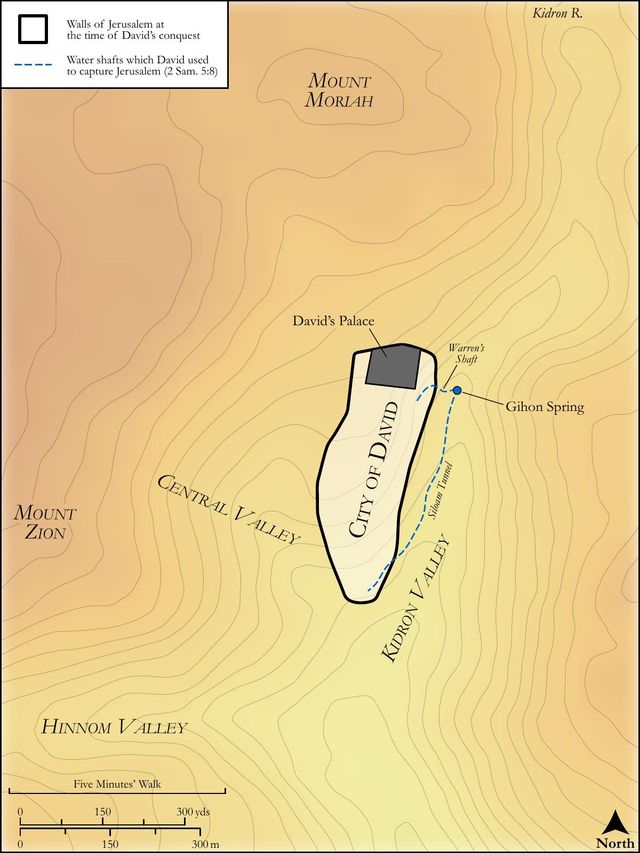
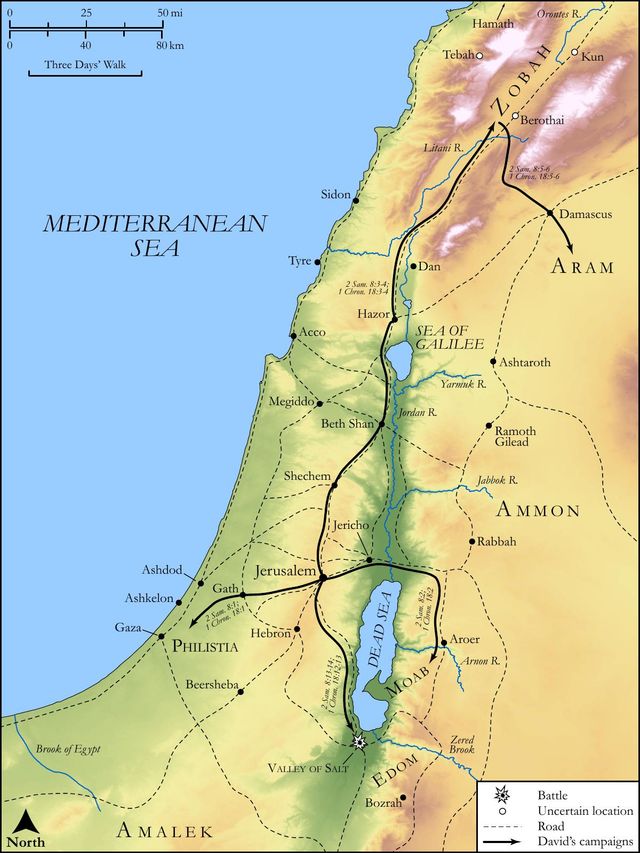
See on the biblical-era maps
Study this verse
Public-domain commentary
Matthew Henry
From his Commentary on the Whole Bible. Henry comments on passages, not single verses — this entry covers 2 Samuel 8:9–14.
Here is, 1. The court made to David by the king of Hamath, who, it seems was at this time at war with the king of Zobah. He hearing of David's success against his enemy, sent his own son ambassador to him (Sa2 8:9, Sa2 8:10), to congratulate him on his victory, to return him thanks for the favour he had done him in breaking the power of one he was in fear of, and to beg his friendship. Thus he not only secured but strengthened himself. And David lost nothing by taking this little prince under his protection, any more than the old Romans did by the like policy; for the wealth he had from the countries he conquered by way of spoil he had from this by way of present or gratuity: Vessels of silver and gold. Better get by composition than by compulsion. 2. The offering David made to God of the spoils of the nations and all the rich things that were brought him. He dedicated all to the Lord, Sa2 8:11, Sa2 8:12. This crowned all his victories, and made them far to out-shine Alexander's or Caesar's, that they sought their own glory, but he aimed at the glory of God. All the precious things he was master of were dedicated things, that is, they were designed for the building of the temple; and a good omen it was of kindness to the Gentiles in the fulness of time, and of the making of God's house a house of prayer for all people, that the temple was built of the spoils and presents of Gentile nations, in allusion to which we find the kings of the earth bringing their glory and honour into the new Jerusalem, Rev 21:24. Their gods of gold David burnt (Sa2 5:21), but their vessels of gold he dedicated. Thus in the conquest of a soul, by the grace of the Son of David, what stands in opposition to God must be destroyed, every lust mortified and crucified, but what may glorify him must be dedicated and the property of it altered. Even the merchandise and the hire must be holiness to the Lord (Isa 23:18), the gain consecrated to the Lord of the whole earth (Mic 4:13), and then it is truly our own and that most comfortably. 3. The reputation he got, in a particular manner, by his victory over the Syrians and their allies the Edomites, who acted in conjunction with them, as appears by comparing the title of the 60th Psalm, which was penned on this occasion, with Sa2 8:13. He got himself a name for all that conduct and courage which are the praise of a great and distinguished general. Something extraordinary, it is likely, there was in that action, which turned very much to his honour, yet he is careful to transfer the honour to God, as appears by the psalm he penned on this occasion, Sa2 8:12. It is through God that we do valiantly. 4. His success against the Edomites. They all became David's servants, Sa2 8:14. Now, and not till now, Isaac's blessing was accomplished, by which Jacob was made Esau's Lord (Gen 27:37-40) and the Edomites continued long tributary to the kings of Judah, as the Moabites were to the kings of Israel, till, in Joram's time, they revolted (Ch2 21:8) as Isaac had there foretold that Esau should, in process of time, break the yoke from off his neck. Thus David by his conquests, (1.) Secured peace to his son, that he might have time to build the temple. And, (2.) Procured wealth for his son, that he might have wherewith to build it. God employs his servants variously, some in one employment, others in another, some in the spiritual battles, others in the spiritual buildings; and one prepares work for the other, that God may have the glory of all. All David's victories were typical of the success of the gospel against the kingdom of Satan, in which the Son of David rode forth, conquering and to conquer, and he shall reign till he has brought down all opposing rule, principality, and power: and he has, as David had (Sa2 8:2), a line to kill and a line to save; for the same gospel is to some a savour of life unto life, to others a savour of death unto death.
Continue studying 2 Samuel 8:13 across the web’s major study libraries — every link below opens this exact verse, chapter, or book on the destination site.
Read & Compare
 BibleGatewayThis verse in more than 200 translations and 70 languages.
 Bible.comThe YouVersion reader — hundreds of translations, reading plans, and highlights.
 ESV.orgCrossway's official English Standard Version reader.
 NET BibleThe NET translation with 60,000+ translators' notes on every rendering decision.
 STEP BibleTyndale House's free study tool — original text, vocabulary, and scholarly resources.
 BibliaLogos Bible Software's free web reader.
 USCCBThe New American Bible (Revised Edition) with the U.S. bishops' study notes.
Commentaries
 BibleHub CommentariesDozens of classic commentaries on this verse, gathered on one page.
 StudyLightMore than 100 commentary sets — the largest collection on the web.
 BibleRefPlain-English commentary on what this verse means, verse by verse.
 Enduring WordDavid Guzik's free commentary on this chapter, widely used by Bible teachers.
 Bible Study ToolsVerse commentary alongside Greek and Hebrew study aids.
Original Language & Research
- BibleHub InterlinearThe verse word by word — original language, transliteration, and English.
- BibleHub LexiconEvery word's original-language definition and Strong's entry.
 Blue Letter BibleDeep-study tools — Strong's numbers, concordance, and word studies.
 SefariaThe Hebrew text with Rashi and centuries of Jewish commentary.
Sermons, Hymns & Audio


TrulyRandomVerse is not affiliated with these sites and doesn’t control their content. They’re linked because they’re genuinely useful.
Summary
2 Samuel 8:13 encapsulates a defining moment in King David's reign, underscoring his divinely blessed military prowess and the subsequent renown he acquired. This verse specifically details a decisive victory over a formidable adversary, identified as the Edomites, in the strategically vital Valley of Salt. The conquest, which resulted in the defeat of eighteen thousand men, not only solidified David's reputation but also significantly expanded and secured the nascent Israelite kingdom, serving as a tangible testament to God's unwavering favor and faithfulness to His covenant promises.
Context
ShowHideLiterary Context
2 Samuel 8 functions as a pivotal summary chapter within the narrative of David's reign, meticulously cataloging his extensive military triumphs and the subsequent consolidation of his kingdom. This chapter immediately follows the profound establishment of the Davidic Covenant in 2 Samuel 7, where God solemnly promises to establish David's house and kingdom eternally. Chapter 8, therefore, serves as the practical demonstration and initial fulfillment of these divine assurances, showcasing God's active preservation and success granted to David in his endeavors. Verse 13, in particular, highlights a significant victory that directly contributes to David's burgeoning fame and underscores the divine blessing promised earlier. The chapter then transitions to detail David's administrative structure and key officials, indicating that these military achievements laid the essential groundwork for a period of relative peace, internal organization, and the flourishing of the unified monarchy.
Historical & Cultural Context
David's reign (circa 1010-970 BC) marked a transformative era for Israel, characterized by significant territorial expansion, political centralization, and the establishment of Jerusalem as the capital. During this period, Israel faced constant threats from surrounding nations, including the Philistines, Moabites, Ammonites, Arameans (Syrians), and Edomites, all vying for regional dominance. The "Valley of Salt" is widely identified with the Arabah, the rift valley extending south from the Dead Sea, which was a critical strategic corridor. Control over this region was vital for securing trade routes to the Red Sea and asserting influence over Edom, a long-standing adversary descended from Esau. Among the kings of that day, a king's legitimacy, power, and the stability of his kingdom were inextricably linked to military success, which was often interpreted as a direct manifestation of divine favor. The cultural aspiration of "making a name" (Hebrew: wayya'as lo shem) was paramount for kings, signifying a lasting legacy, widespread prestige, and the enduring power of their dynasty.
Key Themes
ShowHideThis verse powerfully illustrates several foundational themes prevalent throughout 2 Samuel and the broader Deuteronomistic History. Foremost is the theme of Divine Favor and Blessing, as David's military successes are consistently presented not as mere human achievement but as direct evidence of God's presence and active preservation. This is explicitly stated elsewhere in the chapter, such as when "the LORD preserved David wherever he went" (2 Samuel 8:6 and 2 Samuel 8:14). The verse also highlights David's Renown and Authority, directly fulfilling God's promise to "make for you a great name" (2 Samuel 7:9). Furthermore, it underscores the crucial theme of the Consolidation of the Kingdom. These decisive victories, particularly over a formidable foe like Edom, were indispensable for securing Israel's borders, establishing its regional dominance, and paving the way for the unified monarchy's golden age under David's rule.
Exposition and Analysis
ShowHideKey Word Analysis
ShowHideFrom the same root as dôd (loving); David, the youngest son of Jesse. In this context, "David" refers to the anointed King of Israel, whose military triumphs and administrative successes are consistently attributed to God's favor and presence. His name here represents the divinely chosen leader through whom God's promises to Israel are being fulfilled.
From ʻâsâh (to do or make) and shêm (an appellation, honor, authority, character). This idiomatic Hebrew phrase literally means "he made for himself a name," signifying the achievement of great fame, renown, or a lasting reputation. In the biblical context, it implies a significant accomplishment that brings widespread recognition and honor, often associated with divine blessing and the establishment of a powerful and enduring legacy for a king.
From gayʼ (a gorge, valley) and melach (salt). This geographical location is widely identified with the Arabah, the rift valley extending south from the Dead Sea. Its name, "Valley of Salt," likely refers to the high salinity of the region due to the proximity of the Dead Sea and salt deposits. This area was strategically important, controlling access to trade routes and serving as a natural boundary between Judah and Edom. A decisive victory here was crucial for asserting control over Edomite territory and securing Israel's southern flank.
A primitive root meaning "to strike (lightly or severely, literally or figuratively)." In this military context, "smiting" denotes a decisive, overwhelming defeat inflicted upon the enemy, often implying a comprehensive slaughter or rout. It emphasizes the totality of David's victory over his adversaries.
From shᵉmôneh (eight), ʻâsâr (ten), and ʼeleph (thousand). This numerical designation specifies the scale of the military force defeated by David. Whether a precise count or a conventional representation of a vast multitude, it underscores the magnitude of the victory and the devastating blow dealt to the enemy.
Verse Breakdown
ShowHide"And David gat [him] a name"
This opening clause immediately establishes the central outcome and theological significance of the military campaign: David's enhanced reputation and widespread renown. This "name" signifies not merely personal fame but the recognition of his divinely sanctioned authority and the established power of the Israelite kingdom under his rule. It implies that God was actively working through David to fulfill His promises to make his name great.
"when he returned from smiting of the Syrians"
This phrase identifies the specific context for David's increased fame – a significant military engagement. While the Masoretic Text (KJV's basis) reads "Syrians" (Hebrew: 'aram'), scholarly consensus, supported by the parallel account in 1 Chronicles 18:12 and the superscription of Psalm 60, indicates that the original or intended reading was "Edomites" (Hebrew: 'edom'). This is a common scribal error due to the similar appearance of the Hebrew letters resh (ר) and dalet (ד). The victory over Edom was particularly important because Edom was a long-standing rival and a formidable power in the region. The phrase "smiting of" indicates a decisive and overwhelming defeat inflicted upon the enemy.
"in the valley of salt, [being] eighteen thousand [men]."
This final clause provides crucial details about the battle: its location and the scale of the victory. The "Valley of Salt" pinpoints the geographical area of the conflict, emphasizing its strategic importance as a gateway to Edomite territory. The number "eighteen thousand men" represents a substantial military force, indicating the magnitude of the victory and the devastating blow dealt to the Edomites. This figure, whether a precise historical count or a conventional representation of a vast multitude, underscores the completeness and decisiveness of David's triumph, further solidifying his control over the region.
Literary Devices
ShowHide2 Samuel 8:13 employs several literary devices to convey its profound message. The phrase "David gat him a name" is a powerful example of Metonymy, where "name" stands in for David's entire reputation, authority, and lasting legacy as a divinely appointed king. The entire chapter, including this verse, functions as a Summary Narrative, providing a concise, high-level account of David's military achievements rather than a detailed battle narrative. This summarization effectively highlights the overall success and divine backing of David's reign, emphasizing outcomes over intricate processes. The number "eighteen thousand men" could be interpreted as Hyperbole, a common literary technique used to emphasize the overwhelming nature of a victory and the sheer scale of the enemy's defeat, though it could also be a precise historical figure. Furthermore, the implicit connection between David's military success and God's prior promises in 2 Samuel 7 suggests a clear Theological Interpretation of History, where earthly events are presented as direct evidence of divine providence and the faithful fulfillment of God's word.
Theological and Thematic Connections
ShowHideThe victory described in 2 Samuel 8:13 transcends a mere military conquest; it is a profound theological statement about God's unwavering faithfulness to His covenant promises. David's "name" being "made" is not a result of his own strength or ambition alone, but a direct consequence of God's active presence, preservation, and empowerment. This decisive victory over a significant adversary like Edom, a descendant of Esau, also carries deep echoes of the ancient Jacob-Esau rivalry, suggesting a divine hand in the destiny of nations and the ultimate ascendancy of Israel. It powerfully demonstrates how God uses the earthly reign of His anointed king to secure His people, expand His kingdom, and establish a secure dwelling place for Israel, thereby laying essential groundwork for the future messianic hope. David's military success, therefore, serves as a tangible sign of God's blessing and His commitment to establishing a secure dwelling place for His chosen people.
Reflection and Application
ShowHide2 Samuel 8:13 offers a profound lens through which to view the nature of true honor, lasting impact, and divine partnership. David's "name" was not self-manufactured or earned through sheer human effort; rather, it was a byproduct of his faithful, courageous, and divinely empowered service. His widespread renown came as a gift from God's hand, demonstrating that genuine influence, a good reputation, and enduring legacy are ultimately gifts from above, graciously bestowed upon those who walk in obedience, humility, and trust in the Almighty. For believers today, this verse challenges us to critically examine what kind of "name" we are seeking to make in our lives. Are we driven by personal ambition, fleeting recognition, and worldly accolades, or are our lives authentically dedicated to honoring God's name, exalting His character, and advancing His kingdom? Our ultimate aim should be to live in such a way that God alone is glorified, recognizing that any success, recognition, or positive impact we have is a direct result of His grace working powerfully through us. When we prioritize God's will, seek His kingdom first, and faithfully steward the gifts He has given, He promises to establish our paths and, as it pleases Him, grant us a good name in His sight and in the eyes of others, reflecting His character and power to a watching world.
Questions for Reflection
ShowHideFAQ
ShowHideWas this victory against Syrians or Edomites?
ShowHideWhile the King James Version of 2 Samuel 8:13 states "Syrians," the overwhelming scholarly consensus, supported by parallel biblical texts, indicates that this victory was over the Edomites. The parallel account in 1 Chronicles 18:12 explicitly attributes the victory to Abishai over the Edomites in the Valley of Salt. Furthermore, the superscription of Psalm 60 also references Joab's victory over Edom in the Valley of Salt. The discrepancy is widely believed to be a scribal error, as the Hebrew letters for "Syrians" (אֲרָם, 'aram) and "Edomites" (אֱדוֹם, 'edom) are very similar in appearance. The geographical context of the "Valley of Salt" (the Arabah, south of the Dead Sea) also strongly points to Edomite territory, making an Edomite victory far more plausible.
What is the significance of the "Valley of Salt"?
ShowHideThe "Valley of Salt" (גֵּיא מֶלַח, ge' melach) is generally identified with the Arabah, the southern extension of the Great Rift Valley, stretching south from the Dead Sea. This region was strategically vital for several reasons: it controlled access to important trade routes, including those to the Red Sea, and it served as a natural boundary and frequent point of contention between the kingdoms of Judah and Edom. Its name likely derives from the high concentration of salt and mineral deposits in the area, particularly near the Dead Sea. A decisive victory here, as described in 2 Samuel 8:13, would have been crucial for securing Israel's southern border, asserting dominance over the long-standing adversary, Edom, and potentially gaining control over valuable trade routes, thereby enhancing Israel's economic and geopolitical standing.
What does "gat him a name" mean in this context?
ShowHideThe phrase "gat him a name" (וַיַּעַשׂ לוֹ שֵׁם, wayya'as lo shem) is an idiomatic expression in Hebrew that translates to "he made for himself a name" or "he acquired renown." In the context of ancient kingship, this signified achieving great fame, prestige, and a lasting reputation. It implies a significant accomplishment that brings widespread recognition and honor, often associated with military victories, the expansion of territory, and the establishment of a powerful and enduring legacy for a king and his dynasty. For David, this "name" was not merely a result of his own efforts but was deeply intertwined with God's divine favor and the fulfillment of God's promise to make David's name great, as stated in 2 Samuel 7:9. It underscores his divinely appointed authority and the security and expansion of his kingdom under God's blessing.
Christ-Centered Fulfillment
ShowHideThe earthly renown and consolidated kingdom of David, exemplified by his "making a name" through military victory in 2 Samuel 8:13, powerfully foreshadow the ultimate and everlasting "name" and kingdom of Jesus Christ. David's temporary dominion over earthly adversaries points to Christ's eternal triumph over sin, death, and spiritual principalities. While David's fame was achieved through physical conquest and the defeat of human enemies, Jesus's name was "made" through His perfect obedience, His sacrificial death on the cross, and His glorious resurrection. The Apostle Paul declares that because of Christ's profound humility and obedience unto death, God "highly exalted him and bestowed on him the name that is above every name, so that at the name of Jesus every knee should bow, in heaven and on earth and under the earth, and every tongue confess that Jesus Christ is Lord, to the glory of God the Father" (Philippians 2:9-11). David's victory secured a physical kingdom with temporal boundaries, but Christ's victory on the cross disarmed the spiritual powers and authorities, triumphing over them (Colossians 2:15), establishing an eternal, spiritual kingdom that knows no end. Ultimately, David's name and legacy, though great and divinely blessed, fade in comparison to the supreme Name of Jesus, through whom alone salvation is found, for "there is no other name under heaven given among men by which we must be saved" (Acts 4:12).