


2 Samuel 8:14
Bible text: King James Version (1769 Blayney text) · Public domain
Bible text: King James Version with Strong's numbers · Public domain
Bible text: Berean Standard Bible · Public domain
Bible text: American Standard Version (1901) · Public domain
Bible text: World English Bible, Messianic edition · Public domain
Bible text: Geneva Bible (1599) · Public domain
Bible text: Young's Literal Translation · Public domain
- וַיָּשֶׂםvai·Ya·semand he putH7760Conj-w ¦ V-Qal-ConsecImperf-3msVerb Qal Consecutive Imperfect 3rd Singular Masculineוַandיָּשֶׂםhe put
- בֶּאֱדוֹםbe·'e·Domin EdomH123Prep-b ¦ N-proper-mNoun Proper MasculineבֶּinאֱדוֹםEdom
- נְצִבִיםne·tzi·VimgarrisonsH5333N-mpNoun Plural Masculine Absolute
- בְּכָלbe·kholin allH3605Prep-b ¦ N-mscNoun Singular Masculine Constructבְּinכָלall
- אֱדוֹם'e·dOmEdomH123N-proper-mNoun Proper Masculine
- שָׂםsamhe putH7760V-Qal-Perf-3msVerb Qal Perfect 3rd Singular Masculine
- נְצִבִיםne·tzi·VimgarrisonsH5333N-mpNoun Plural Masculine Absolute
- וַיְהִיvay·Hiand it wasH1961Conj-w ¦ V-Qal-ConsecImperf-3msVerb Qal Consecutive Imperfect 3rd Singular Masculineוַandיְהִיit was
- כָלkholallH3605N-mscNoun Singular Masculine Construct
- אֱדוֹם'e·DomEdomH123N-proper-mNoun Proper Masculine
- עֲבָדִים'a·va·DimservantsH5650N-mpNoun Plural Masculine Absolute
- לְדָוִדle·da·Vidof DavidH1732Prep-l ¦ N-proper-mNoun Proper MasculineלְofדָוִדDavid
- וַיּוֹשַׁעvai·Yo·o·sha'and he gave victory toH3467Conj-w ¦ V-Hiphil-ConsecImperf-3msVerb Hiphil Consecutive Imperfect 3rd Singular Masculineוַandיּוֹשַׁעhe gave victory to
- יְהוָהYah·wehYahwehH3068N-properNoun Proper Title
- אֶת'et<obj.>H853DirObjMParticle Object Indicator
- דָּוִדda·VidDavidH1732N-proper-mNoun Proper Masculine
- בְּכֹלbe·Kholin everyH3605Prep-b ¦ N-msNoun Singular Masculine Absoluteבְּinכֹלevery
- אֲשֶׁר'a·SherwhereH834RelParticle Relative
- הָלָךְha·Lakhhe wentH1980V-Qal-Perf-3msVerb Qal Perfect 3rd Singular Masculine
English is a literal word-by-word gloss of the Hebrew, not the KJV's wording. Why?
This is the original text the KJV's translators worked from — each Hebrew word with its own literal English meaning in this verse, prepared by scholars at Tyndale House, Cambridge. The KJV translates whole sentences, not word by word, so its wording differs: one Hebrew word can become several English words, and the KJV may choose “the LORD” where the gloss reads “Yahweh”. Both are faithful — they answer different questions. For the KJV's own rendering, switch to the KJV text.
Details
See on the biblical-era maps
Study this verse
Public-domain commentary
Matthew Henry
From his Commentary on the Whole Bible. Henry comments on passages, not single verses — this entry covers 2 Samuel 8:9–14.
Here is, 1. The court made to David by the king of Hamath, who, it seems was at this time at war with the king of Zobah. He hearing of David's success against his enemy, sent his own son ambassador to him (Sa2 8:9, Sa2 8:10), to congratulate him on his victory, to return him thanks for the favour he had done him in breaking the power of one he was in fear of, and to beg his friendship. Thus he not only secured but strengthened himself. And David lost nothing by taking this little prince under his protection, any more than the old Romans did by the like policy; for the wealth he had from the countries he conquered by way of spoil he had from this by way of present or gratuity: Vessels of silver and gold. Better get by composition than by compulsion. 2. The offering David made to God of the spoils of the nations and all the rich things that were brought him. He dedicated all to the Lord, Sa2 8:11, Sa2 8:12. This crowned all his victories, and made them far to out-shine Alexander's or Caesar's, that they sought their own glory, but he aimed at the glory of God. All the precious things he was master of were dedicated things, that is, they were designed for the building of the temple; and a good omen it was of kindness to the Gentiles in the fulness of time, and of the making of God's house a house of prayer for all people, that the temple was built of the spoils and presents of Gentile nations, in allusion to which we find the kings of the earth bringing their glory and honour into the new Jerusalem, Rev 21:24. Their gods of gold David burnt (Sa2 5:21), but their vessels of gold he dedicated. Thus in the conquest of a soul, by the grace of the Son of David, what stands in opposition to God must be destroyed, every lust mortified and crucified, but what may glorify him must be dedicated and the property of it altered. Even the merchandise and the hire must be holiness to the Lord (Isa 23:18), the gain consecrated to the Lord of the whole earth (Mic 4:13), and then it is truly our own and that most comfortably. 3. The reputation he got, in a particular manner, by his victory over the Syrians and their allies the Edomites, who acted in conjunction with them, as appears by comparing the title of the 60th Psalm, which was penned on this occasion, with Sa2 8:13. He got himself a name for all that conduct and courage which are the praise of a great and distinguished general. Something extraordinary, it is likely, there was in that action, which turned very much to his honour, yet he is careful to transfer the honour to God, as appears by the psalm he penned on this occasion, Sa2 8:12. It is through God that we do valiantly. 4. His success against the Edomites. They all became David's servants, Sa2 8:14. Now, and not till now, Isaac's blessing was accomplished, by which Jacob was made Esau's Lord (Gen 27:37-40) and the Edomites continued long tributary to the kings of Judah, as the Moabites were to the kings of Israel, till, in Joram's time, they revolted (Ch2 21:8) as Isaac had there foretold that Esau should, in process of time, break the yoke from off his neck. Thus David by his conquests, (1.) Secured peace to his son, that he might have time to build the temple. And, (2.) Procured wealth for his son, that he might have wherewith to build it. God employs his servants variously, some in one employment, others in another, some in the spiritual battles, others in the spiritual buildings; and one prepares work for the other, that God may have the glory of all. All David's victories were typical of the success of the gospel against the kingdom of Satan, in which the Son of David rode forth, conquering and to conquer, and he shall reign till he has brought down all opposing rule, principality, and power: and he has, as David had (Sa2 8:2), a line to kill and a line to save; for the same gospel is to some a savour of life unto life, to others a savour of death unto death.
Continue studying 2 Samuel 8:14 across the web’s major study libraries — every link below opens this exact verse, chapter, or book on the destination site.
Read & Compare
 BibleGatewayThis verse in more than 200 translations and 70 languages.
 Bible.comThe YouVersion reader — hundreds of translations, reading plans, and highlights.
 ESV.orgCrossway's official English Standard Version reader.
 NET BibleThe NET translation with 60,000+ translators' notes on every rendering decision.
 STEP BibleTyndale House's free study tool — original text, vocabulary, and scholarly resources.
 BibliaLogos Bible Software's free web reader.
 USCCBThe New American Bible (Revised Edition) with the U.S. bishops' study notes.
Commentaries
 BibleHub CommentariesDozens of classic commentaries on this verse, gathered on one page.
 StudyLightMore than 100 commentary sets — the largest collection on the web.
 BibleRefPlain-English commentary on what this verse means, verse by verse.
 Enduring WordDavid Guzik's free commentary on this chapter, widely used by Bible teachers.
 Bible Study ToolsVerse commentary alongside Greek and Hebrew study aids.
Original Language & Research
- BibleHub InterlinearThe verse word by word — original language, transliteration, and English.
- BibleHub LexiconEvery word's original-language definition and Strong's entry.
 Blue Letter BibleDeep-study tools — Strong's numbers, concordance, and word studies.
 SefariaThe Hebrew text with Rashi and centuries of Jewish commentary.
Sermons, Hymns & Audio


TrulyRandomVerse is not affiliated with these sites and doesn’t control their content. They’re linked because they’re genuinely useful.
Summary
2 Samuel 8:14 masterfully culminates the record of David's extensive military campaigns, specifically highlighting his complete subjugation of Edom, a long-standing adversary of Israel. The verse powerfully declares that David's widespread success and security were not merely the result of his strategic brilliance or military might, but were unequivocally a direct consequence of the Lord's active preservation and divine favor, underscoring God's unwavering faithfulness to His chosen king.
Context
ShowHideLiterary Context
This verse serves as the concluding statement to a chapter that meticulously chronicles David's impressive military conquests and the subsequent expansion and consolidation of his kingdom. Chapter 8 opens with David's victory over the Philistines, a perennial threat, and proceeds to detail his subjugation of Moab, Zobah, Syria (Aram), and Ammon. The conquest of Edom, presented here, represents the final major military achievement in this sequence, demonstrating David's comprehensive dominion over the surrounding nations. The chapter then shifts to an administrative summary, listing David's key officials, emphasizing the establishment of a stable and powerful monarchy under divine blessing. The repeated phrase, "And the LORD preserved David whithersoever he went," acts as a theological refrain, framing all of David's successes as divinely enabled.
Historical & Cultural Context
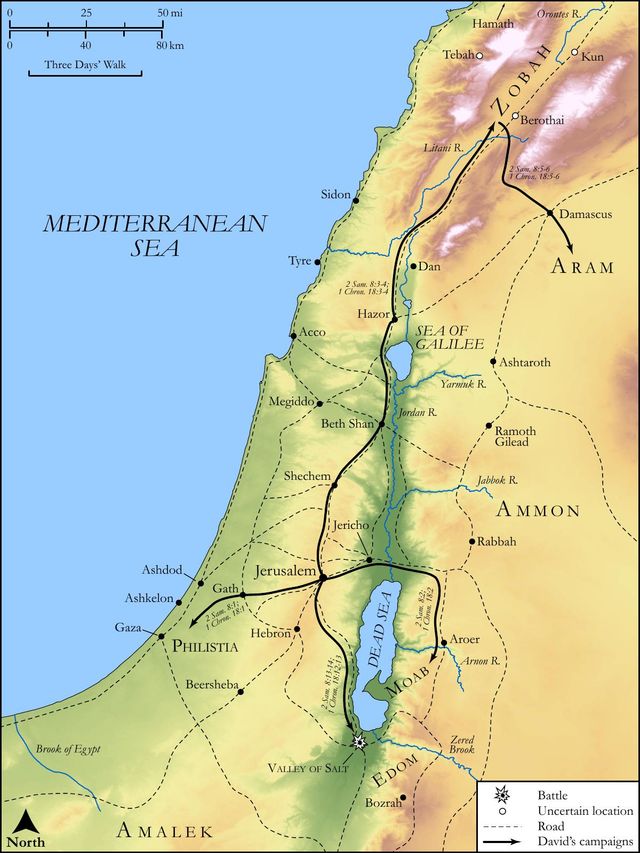
Edom, located southeast of Judah, was a mountainous region inhabited by the descendants of Esau, Jacob's twin brother. The relationship between Israel and Edom had historically been fraught with tension and conflict, dating back to their patriarchal origins (see Genesis 27:40). Edom often obstructed Israelite passage (as seen in Numbers 20:14-21) and later raided Judah. David's conquest of Edom was not merely punitive but highly strategic. It secured Israel's southern flank, controlled vital trade routes (like the King's Highway), and likely provided access to valuable copper mines in the Arabah. The establishment of "garrisons" (military outposts) was a common practice, as David had done in Syria of Damascus, for maintaining control over conquered territories, ensuring subservience and the collection of tribute.
Key Themes
ShowHideThe overarching theme in 2 Samuel 8, powerfully summarized in verse 14, is Divine Preservation and Providence. The repeated declaration that "the LORD preserved David whithersoever he went" is not a mere addendum but the theological lens through which all David's victories are to be understood. It highlights that his military prowess and strategic genius were ultimately empowered and protected by God, fulfilling the promises made in the Davidic Covenant (e.g., 2 Samuel 7:9). This verse also underscores the Consolidation of David's Kingdom, showing how his reign brought unprecedented security and territorial expansion to Israel, transforming it into a regional power. Furthermore, David's subjugation of Edom, making them his "servants," is seen as a Fulfillment of Prophecy, aligning with ancient oracles concerning Israel's dominion over its neighbors, including the descendants of Esau, as foretold by Balaam in Numbers 24:18.
Exposition and Analysis
ShowHideKey Word Analysis
ShowHideWhile the Strong's entry is singular, the context here uses the plural form, referring to military posts, appointed governors, or permanent occupying forces. Its use here signifies a complete and lasting military and administrative control over Edom. It implies not just a temporary victory, but the establishment of a sustained presence to ensure Edom's subservience and prevent rebellion, effectively integrating Edom into David's sphere of influence.
Similar to "garrisons," the Strong's entry is singular, but the verse employs the plural form. In this context, "servants" denotes a status of subjection. It means the Edomites became a tributary state, owing allegiance and tribute to David. This was a common political arrangement among the kings of that day, signifying a loss of independent sovereignty and incorporation into a larger empire, confirming David's status as a dominant regional king.
This verb is crucial, meaning "to save," "to deliver," "to grant victory," or "to bring salvation." It is a theological term emphasizing active divine intervention. It's not merely that David was lucky or skilled, but that God actively intervened to ensure his safety, success, and ultimate triumph against all adversaries. This word attributes David's unparalleled achievements directly to God's power and faithfulness.
Verse Breakdown
ShowHide"And he put garrisons in Edom;"
This initial clause states David's decisive action immediately following his military victory. The placement of "garrisons" indicates a strategic move to secure the conquered territory, preventing future insurrections and ensuring ongoing control. It highlights the practical, military aspect of David's dominion.
"throughout all Edom put he garrisons,"
This repetition serves to emphasize the thoroughness and comprehensiveness of David's conquest. It was not a partial or superficial victory, but a complete subjugation of the entire Edomite territory, leaving no part uncontrolled. This reinforces the extent of David's power and the effectiveness of his military strategy.
"and all they of Edom became David's servants."
This clause describes the political and social outcome of the military conquest. The Edomites, as a people, were brought under David's authority, losing their independence and becoming David's servants. This meant they were subject to tribute, forced labor, or other forms of subservience, solidifying David's empire.
"And the LORD preserved David whithersoever he went."
This is the theological climax of the verse and indeed the chapter. It attributes all of David's military successes and the expansion of his kingdom directly to divine protection and enablement. It is a powerful declaration that God was actively involved in David's life and reign, ensuring his safety and victory in every campaign and journey, affirming the covenant promises made to him.
Literary Devices
ShowHideThe verse employs several literary devices to convey its profound message. The most prominent is Repetition, specifically in the phrase "put he garrisons in Edom; throughout all Edom put he garrisons." This reiteration emphasizes the totality and thoroughness of David's conquest, leaving no doubt about the extent of his dominion over Edom. This repetition also builds a sense of overwhelming power and control. Furthermore, the verse functions as a form of Narrative Theology or Divine Commentary, where the narrator explicitly interjects a theological statement ("And the LORD preserved David whithersoever he went") to interpret the preceding historical events. This device ensures that the reader understands the ultimate source of David's success is not merely human might but divine intervention and favor. The structure also exhibits a subtle Parallelism, contrasting human action ("he put garrisons," "became David's servants") with divine action ("the LORD preserved David"), ultimately underscoring the supremacy of the latter as the enabling force behind the former.
Theological and Thematic Connections
ShowHide2 Samuel 8:14 stands as a powerful testament to God's sovereign hand in human affairs, particularly in the establishment and preservation of His chosen king and kingdom. It reinforces the theological truth that true success and security are ultimately derived from divine favor, not merely human strength or strategy. This verse demonstrates God's faithfulness to His covenant promises, specifically those made to David in 2 Samuel 7, where God pledged to establish David's house and kingdom forever. The subjugation of Edom, a descendant of Esau, also serves as a poignant fulfillment of ancient prophecies concerning the dominion of Israel over its neighbors, illustrating God's long-term plan unfolding through history. This divine preservation assures us that God is actively involved in upholding His purposes and protecting those He has chosen for His work.
Reflection and Application
ShowHideThis verse offers profound lessons for the believer today, reminding us that our ultimate security and success in life's endeavors are rooted in God's active preservation and enabling grace. Just as David faced formidable enemies and achieved remarkable victories because the Lord was with him, we too can approach our challenges with confidence, knowing that if we walk in God's will, His presence and power will sustain us. This doesn't negate our effort or strategy, but rather elevates them, placing them within the context of divine partnership. It calls us to cultivate a deep trust in God's sovereignty, acknowledging that even our greatest achievements are ultimately gifts from His hand. When we experience breakthroughs or overcome obstacles, this verse prompts us to direct our praise and gratitude to the Lord, recognizing Him as the ultimate source of our strength and salvation. It encourages humility in success and steadfast faith in adversity, knowing that our God is able to preserve us "whithersoever we go."
Questions for Reflection
ShowHideFAQ
ShowHideWhat is the significance of David putting "garrisons" in Edom?
ShowHideThe act of putting "garrisons" (military outposts or appointed governors) in Edom signifies David's complete military conquest and subsequent political control over the territory. It means that Edom was not just defeated in battle, but thoroughly subjugated and integrated into David's empire as his servants. This ensured ongoing tribute, prevented rebellion, and secured vital trade routes and resources for Israel, solidifying David's position as a dominant regional power. It was a common practice among the kings of that day for maintaining control over conquered lands.
How does this verse demonstrate God's faithfulness to His promises?
ShowHideThis verse powerfully demonstrates God's faithfulness by showing the fulfillment of prophecies and promises related to Israel's dominion and David's reign. For instance, the subjugation of Edom aligns with ancient prophecies concerning the descendants of Esau becoming servants to Israel (e.g., Genesis 27:40 and Numbers 24:18). More broadly, the declaration that "the LORD preserved David whithersoever he went" is a direct fulfillment of God's covenant promise to David in 2 Samuel 7:9, where God promised to be with him and make his name great. David's success was not accidental but divinely orchestrated, proving God's unwavering commitment to His word.
Christ-Centered Fulfillment
ShowHide2 Samuel 8:14, with its declaration of David's comprehensive victory and the Lord's preserving hand, powerfully foreshadows the ultimate reign and triumph of Jesus Christ. David, as the anointed king who subdues all his enemies and establishes a kingdom of peace, serves as a type of the Messiah. Just as David put garrisons in Edom and made them his servants, Christ, through His death and resurrection, has utterly defeated all spiritual enemies—sin, death, and the powers of darkness—and established His eternal dominion. The declaration that "the LORD preserved David whithersoever he went" finds its ultimate fulfillment in Christ, whom God preserved through the cross, raising Him from the dead and exalting Him to the highest place (as seen in Philippians 2:9-11). Christ's victory is not merely regional but universal, as all authority in heaven and on earth has been given to Him (Matthew 28:18). He is the true King who reigns over all nations, and His kingdom will have no end, bringing all things into subjection under His feet (1 Corinthians 15:25). Thus, David's earthly conquests and divine preservation point forward to the Lamb of God who has conquered and now reigns eternally, making all His enemies His footstool (Hebrews 10:13).