


2 Samuel 8:10
Bible text: King James Version (1769 Blayney text) · Public domain
Bible text: King James Version with Strong's numbers · Public domain
Bible text: Berean Standard Bible · Public domain
Bible text: American Standard Version (1901) · Public domain
Bible text: World English Bible, Messianic edition · Public domain
Bible text: Geneva Bible (1599) · Public domain
Bible text: Young's Literal Translation · Public domain
- וַיִּשְׁלַחvai·yish·Lachand he sentH7971Conj-w ¦ V-Qal-ConsecImperf-3msVerb Qal Consecutive Imperfect 3rd Singular Masculineוַandיִּשְׁלַחhe sent
- תֹּעִיTo·'iToiH8583N-proper-mNoun Proper Masculine
- אֶת'et<obj.>H853DirObjMParticle Object Indicator
- יוֹרָםyo·romJoramH3141N-proper-mNoun Proper Masculine
- בְּנוֹbe·Nohis sonH1121N-msc ¦ 3msNoun Singular Masculine Constructבְּנsonוֹhis
- אֶל'eltoH413PrepPreposition
- הַמֶּלֶךְha·Me·lekhthe kingH4428Art ¦ N-msNoun Singular Masculine Absoluteהַtheמֶּלֶךְking
- דָּוִדDa·vidDavidH1732N-proper-mNoun Proper Masculine
- לִשְׁאָלlish·'olto askH7592Prep-l ¦ V-Qal-InfVerb Qal Infinitive Constructלִtoשְׁאָלask
- לוֹloof <the> himPrep-l ¦ 3msSuffix Personal 3rd Singular Masculineלof <the>וֹhim
- לְשָׁלוֹםle·sha·Lomto welfareH7965Prep-l ¦ N-msNoun Singular Masculine Absoluteלְtoשָׁלוֹםwelfare
- וּלְבָרֲכוֹu·le·va·ra·Khoand to bless himH1288Conj-w ¦ Prep-l ¦ V-Piel-Inf ¦ 3msVerb Piel Infinitive Constructוּandלְtoבָרֲכblessוֹhim
- עַל'alonH5921PrepPreposition
- אֲשֶׁר'a·SherthatH834RelParticle Relative
- נִלְחַםnil·Chamhe had waged warH3898V-Niphal-Perf-3msVerb Niphal Perfect 3rd Singular Masculine
- בַּהֲדַדְעֶזֶרba·ha·dad·'E·zeragainst HadadezerH1909Prep-b ¦ N-proper-mNoun Proper MasculineבַּagainstהֲדַדְעֶזֶרHadadezer
- וַיַּכֵּהוּvai·ya·Ke·huand he had defeated himH5221Conj-w ¦ V-Hiphil-ConsecImperf-3ms ¦ 3msVerb Hiphil Consecutive Imperfect 3rd Singular Masculineוַandיַּכֵּhe had defeatedהוּhim
- כִּיkiforH3588PrtParticle Conditional
- אִישׁ'ish<the> man ofH376N-mscNoun Singular Masculine Construct
- מִלְחֲמוֹתmil·cha·Mot<the> wars ofH4421N-fpcNoun Plural Feminine Construct
- תֹּעִיTo·'iToiH8583N-proper-mNoun Proper Masculine
- הָיָהha·Yahhe wasH1961V-Qal-Perf-3msVerb Qal Perfect 3rd Singular Masculine
- הֲדַדְעָזֶרha·dad·'A·zerHadadezerH1909N-proper-mNoun Proper Masculine
- וּבְיָדוֹu·ve·ya·Doand in his handH3027Conj-w ¦ Prep-b ¦ N-csc ¦ 3msNoun Singular common gender Constructוּandבְinיָדhandוֹhis
- הָיוּha·Yuthey wereH1961V-Qal-Perf-3cpVerb Qal Perfect 3rd Plural common gender
- כְּלֵיke·leiarticles ofH3627N-mpcNoun Plural Masculine Construct
- כֶסֶףKhe·sefsilverH3701N-msNoun Singular Masculine Absolute
- וּכְלֵיu·khe·leiand articles ofH3627Conj-w ¦ N-mpcNoun Plural Masculine Constructוּandכְלֵיarticles of
- זָהָבza·HavgoldH2091N-msNoun Singular Masculine Absolute
- וּכְלֵיu·khe·Leiand articles ofH3627Conj-w ¦ N-mpcNoun Plural Masculine Constructוּandכְלֵיarticles of
- נְחֹשֶׁתne·Cho·shetbronzeH5178N-fsNoun Singular Feminine Absolute
English is a literal word-by-word gloss of the Hebrew, not the KJV's wording. Why?
This is the original text the KJV's translators worked from — each Hebrew word with its own literal English meaning in this verse, prepared by scholars at Tyndale House, Cambridge. The KJV translates whole sentences, not word by word, so its wording differs: one Hebrew word can become several English words, and the KJV may choose “the LORD” where the gloss reads “Yahweh”. Both are faithful — they answer different questions. For the KJV's own rendering, switch to the KJV text.
Details
See on the biblical-era maps

Study this verse
Public-domain commentary
Matthew Henry
From his Commentary on the Whole Bible. Henry comments on passages, not single verses — this entry covers 2 Samuel 8:9–14.
Here is, 1. The court made to David by the king of Hamath, who, it seems was at this time at war with the king of Zobah. He hearing of David's success against his enemy, sent his own son ambassador to him (Sa2 8:9, Sa2 8:10), to congratulate him on his victory, to return him thanks for the favour he had done him in breaking the power of one he was in fear of, and to beg his friendship. Thus he not only secured but strengthened himself. And David lost nothing by taking this little prince under his protection, any more than the old Romans did by the like policy; for the wealth he had from the countries he conquered by way of spoil he had from this by way of present or gratuity: Vessels of silver and gold. Better get by composition than by compulsion. 2. The offering David made to God of the spoils of the nations and all the rich things that were brought him. He dedicated all to the Lord, Sa2 8:11, Sa2 8:12. This crowned all his victories, and made them far to out-shine Alexander's or Caesar's, that they sought their own glory, but he aimed at the glory of God. All the precious things he was master of were dedicated things, that is, they were designed for the building of the temple; and a good omen it was of kindness to the Gentiles in the fulness of time, and of the making of God's house a house of prayer for all people, that the temple was built of the spoils and presents of Gentile nations, in allusion to which we find the kings of the earth bringing their glory and honour into the new Jerusalem, Rev 21:24. Their gods of gold David burnt (Sa2 5:21), but their vessels of gold he dedicated. Thus in the conquest of a soul, by the grace of the Son of David, what stands in opposition to God must be destroyed, every lust mortified and crucified, but what may glorify him must be dedicated and the property of it altered. Even the merchandise and the hire must be holiness to the Lord (Isa 23:18), the gain consecrated to the Lord of the whole earth (Mic 4:13), and then it is truly our own and that most comfortably. 3. The reputation he got, in a particular manner, by his victory over the Syrians and their allies the Edomites, who acted in conjunction with them, as appears by comparing the title of the 60th Psalm, which was penned on this occasion, with Sa2 8:13. He got himself a name for all that conduct and courage which are the praise of a great and distinguished general. Something extraordinary, it is likely, there was in that action, which turned very much to his honour, yet he is careful to transfer the honour to God, as appears by the psalm he penned on this occasion, Sa2 8:12. It is through God that we do valiantly. 4. His success against the Edomites. They all became David's servants, Sa2 8:14. Now, and not till now, Isaac's blessing was accomplished, by which Jacob was made Esau's Lord (Gen 27:37-40) and the Edomites continued long tributary to the kings of Judah, as the Moabites were to the kings of Israel, till, in Joram's time, they revolted (Ch2 21:8) as Isaac had there foretold that Esau should, in process of time, break the yoke from off his neck. Thus David by his conquests, (1.) Secured peace to his son, that he might have time to build the temple. And, (2.) Procured wealth for his son, that he might have wherewith to build it. God employs his servants variously, some in one employment, others in another, some in the spiritual battles, others in the spiritual buildings; and one prepares work for the other, that God may have the glory of all. All David's victories were typical of the success of the gospel against the kingdom of Satan, in which the Son of David rode forth, conquering and to conquer, and he shall reign till he has brought down all opposing rule, principality, and power: and he has, as David had (Sa2 8:2), a line to kill and a line to save; for the same gospel is to some a savour of life unto life, to others a savour of death unto death.
Continue studying 2 Samuel 8:10 across the web’s major study libraries — every link below opens this exact verse, chapter, or book on the destination site.
Read & Compare
 BibleGatewayThis verse in more than 200 translations and 70 languages.
 Bible.comThe YouVersion reader — hundreds of translations, reading plans, and highlights.
 ESV.orgCrossway's official English Standard Version reader.
 NET BibleThe NET translation with 60,000+ translators' notes on every rendering decision.
 STEP BibleTyndale House's free study tool — original text, vocabulary, and scholarly resources.
 BibliaLogos Bible Software's free web reader.
 USCCBThe New American Bible (Revised Edition) with the U.S. bishops' study notes.
Commentaries
 BibleHub CommentariesDozens of classic commentaries on this verse, gathered on one page.
 StudyLightMore than 100 commentary sets — the largest collection on the web.
 BibleRefPlain-English commentary on what this verse means, verse by verse.
 Enduring WordDavid Guzik's free commentary on this chapter, widely used by Bible teachers.
 Bible Study ToolsVerse commentary alongside Greek and Hebrew study aids.
Original Language & Research
- BibleHub InterlinearThe verse word by word — original language, transliteration, and English.
- BibleHub LexiconEvery word's original-language definition and Strong's entry.
 Blue Letter BibleDeep-study tools — Strong's numbers, concordance, and word studies.
 SefariaThe Hebrew text with Rashi and centuries of Jewish commentary.
Sermons, Hymns & Audio


TrulyRandomVerse is not affiliated with these sites and doesn’t control their content. They’re linked because they’re genuinely useful.
Summary
This verse records a pivotal diplomatic encounter during King David's reign, where Toi, the king of Hamath, dispatches his son Joram to Jerusalem, bearing valuable gifts of silver, gold, and bronze. This act of homage and gratitude is a direct consequence of David's decisive military victory over Hadadezer, the powerful Aramean king of Zobah, who had previously been a formidable adversary to Toi. The delegation from Hamath serves as tangible evidence of David's expanding influence and the regional recognition of his kingdom as a dominant force, attracting alliances and tribute from surrounding nations and underscoring the divine favor upon his reign.
Context
ShowHideLiterary Context
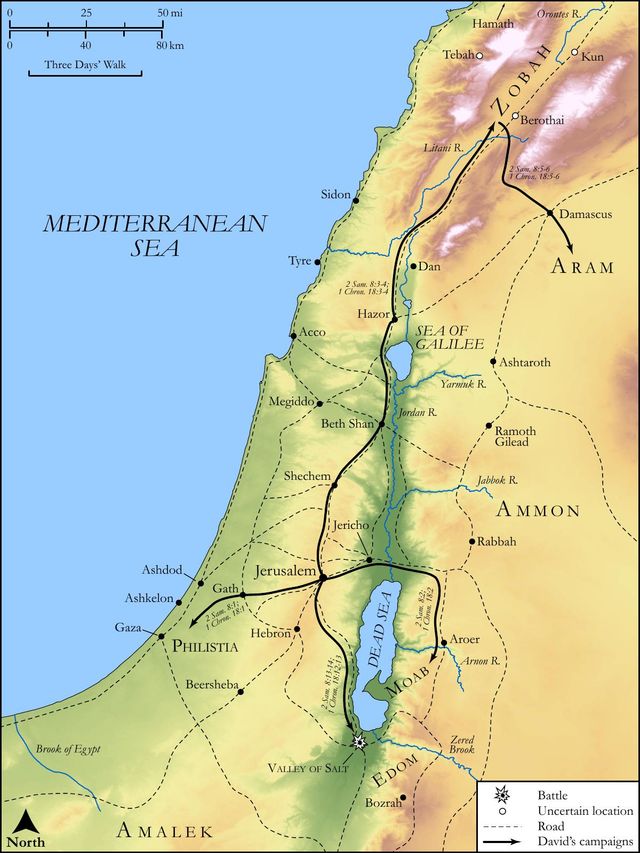
2 Samuel 8 marks a significant turning point in the narrative of David's reign, shifting from the internal consolidation of his kingdom and the establishment of Jerusalem as his capital to a series of impactful external military campaigns. The chapter opens by detailing David's subjugation of the Philistines and Moabites, demonstrating his growing military might. Crucially, 2 Samuel 8:3-8 recounts David's monumental victory over Hadadezer, King of Zobah, a powerful Aramean ruler who sought to expand his dominion towards the Euphrates. David not only decisively defeated Hadadezer but also captured immense spoils, including chariots, horses, and vast quantities of bronze. Verse 9 then introduces Toi, King of Hamath, who, upon hearing of Hadadezer's defeat, initiates a diplomatic mission. Thus, 2 Samuel 8:10 functions as a direct consequence and powerful testament to the far-reaching impact of David's military prowess, showcasing how his victories led to diplomatic recognition and the flow of tribute from neighboring kingdoms. The subsequent verses, 2 Samuel 8:11-12, further emphasize the theological dimension by detailing David's dedication of all these spoils and tribute to the Lord.
Historical & Cultural Context
The nations round about Israel in David's day were characterized by dynamic power struggles, shifting alliances, and the constant assertion of dominance through military conquest. It was a common and expected practice for victorious kings to receive tribute from defeated or newly allied states as a sign of submission, homage, or gratitude for liberation. Hamath, an Aramean kingdom situated north of Zobah (in modern Syria), would have found itself under considerable threat from Hadadezer's expansionist ambitions, likely having endured conflicts or oppression from him. David's decisive defeat of Hadadezer therefore removed a significant regional oppressor, providing immense relief and strategic advantage to Hamath. In this geopolitical landscape, Toi's diplomatic mission, sending his own son Joram as an envoy, accompanied by valuable gifts of silver, gold, and bronze, was a culturally expected and highly significant act. Such a delegation signified profound respect, homage, and a clear desire for a peaceful relationship or even a formal alliance with the newly dominant power. These gifts were not merely presents but tangible symbols of submission and acknowledgment of David's superior might and the growing prestige of his kingdom.
Key Themes
ShowHideThis verse powerfully illustrates the theme of divine blessing and the expansion of David's kingdom, demonstrating how God was actively fulfilling His covenant promises to make David's name great and establish his throne securely. It highlights the consolidation of power under David, as his military triumphs translate into diplomatic recognition and the influx of wealth into Israel. The act of Toi sending his son and tribute underscores the theme of international recognition and homage, signifying that David's dominion extended beyond Israel's immediate borders and commanded respect from foreign rulers. Furthermore, an underlying theme of justice and liberation is present, as David's defeat of an oppressive force like Hadadezer brings relief and security to smaller kingdoms such as Hamath, leading to expressions of gratitude and alliance. This also subtly points to the stewardship of wealth, as the following verses reveal David dedicating these treasures to the Lord, indicating that his reign and its successes were ultimately for God's glory and the advancement of His kingdom, as seen in 2 Samuel 8:11-12.
Exposition and Analysis
ShowHideKey Word Analysis
ShowHideThis term signifies not merely a biological offspring but often carries implications of identity, inheritance, and representation. In this context, Toi sending his "son" Joram underscores the profound importance and sincerity of the diplomatic mission. A son, particularly a royal prince, held significant authority and represented the king's deepest commitment, trust, and desire for a lasting relationship, far beyond what a mere messenger could convey.
The phrase "to salute him" literally translates to "to ask concerning his welfare" or "to inquire about his peace." This is more than a casual greeting; it is a formal diplomatic overture, expressing a profound desire for peaceful and harmonious relations between the two kingdoms. It signifies a respectful inquiry into David's well-being and a wish for a state of peace, reflecting Toi's earnest intent to establish or confirm a non-hostile and potentially beneficial relationship.
In this context, "to bless" means to offer congratulations, express good wishes, and acknowledge David's success and prosperity. Toi is recognizing David's divinely-aided victory and expressing gratitude for the relief and security it brought to Hamath. This term implies a recognition of David's elevated status and a desire for his continued favor, acknowledging the positive impact of David's actions on Toi's kingdom.
Verse Breakdown
ShowHide"Then Toi sent Joram his son unto king David"
This opening clause immediately establishes the diplomatic initiative, originating from Toi, the King of Hamath, and directed towards King David. The deliberate choice to send his own son, Joram, a royal prince, highlights the extreme importance and sincerity of the mission, conveying the highest level of respect and honor accorded to David, and signifying a deep, personal commitment to the diplomatic outcome.
"to salute him, and to bless him"
This phrase articulates the dual and intertwined purposes of Joram's embassy. Firstly, to formally greet David and initiate or confirm peaceful relations ("to salute him," i.e., inquire about his peace and welfare). Secondly, to offer congratulations and expressions of goodwill for his recent military triumph ("to bless him"), acknowledging the positive impact of David's victory.
"because he had fought against Hadadezer, and smitten him: for Hadadezer had wars with Toi"
This provides the crucial motivation and geopolitical context for Toi's actions. David's decisive victory over Hadadezer, a common and formidable enemy who had previously oppressed or waged war against Hamath, directly benefited Toi's kingdom. This strategic outcome transformed David from a potential rival into a strategic ally and liberator from a significant regional threat.
"And [Joram] brought with him vessels of silver, and vessels of gold, and vessels of brass"
These precious items represent the substantial tribute and homage offered by Toi. Such gifts were not merely presents but tangible symbols of submission, alliance, and the recognition of David's superior power and wealth. The specific enumeration of silver, gold, and brass (bronze) highlights their significant value and strategic importance, as bronze was a vital material for weaponry and tools in that day, while gold and silver represented immense economic and symbolic power.
Literary Devices
ShowHideThe passage adeptly employs Narrative Progression, seamlessly transitioning from David's military conquests to their far-reaching diplomatic consequences, thereby illustrating the rapid and significant expansion of his influence. A clear relationship of Cause and Effect is established: David's decisive defeat of Hadadezer (the cause) directly precipitates Toi's diplomatic mission and the offering of lavish tribute (the effect). The detailed enumeration of "vessels of silver, and vessels of gold, and vessels of brass" functions as a form of Merism, representing the totality of valuable tribute and emphasizing the immense wealth and prestige now flowing into David's burgeoning kingdom. This specific listing also serves as potent Symbolism, where the material wealth symbolizes the recognition of David's dominion, the peace secured through his victories, and the divine favor resting upon his reign. The sending of Joram, Toi's son, is a form of Metonymy, where the son stands for the full sincerity and commitment of the father and his kingdom.
Theological and Thematic Connections
ShowHideThis passage powerfully underscores the unfolding of God's covenant promises to David, particularly the assurance of a great name and an established kingdom. David's military successes are not merely human achievements but are divinely enabled, leading to the expansion of Israel's influence and the widespread acknowledgment of God's favor upon David. The tribute received from foreign nations, including Hamath, signifies the wealth and resources flowing into the kingdom, which David, in turn, dedicates to the Lord. This act of dedication demonstrates a profound recognition of divine sovereignty over all earthly possessions and victories, transforming worldly spoils into sacred offerings and aligning David's reign with God's ultimate purposes for Israel, showcasing that true prosperity under God's blessing is directed back to Him.
Reflection and Application
ShowHide2 Samuel 8:10 offers profound insights into the nature of divine sovereignty, the role of human leadership, and the ripple effects of righteous and decisive action. David's victory, though achieved through military might, was ultimately an instrument in God's hands to establish peace and order in the region, bringing unexpected relief to those oppressed by a common enemy. For believers today, this reminds us that God often works through seemingly secular or unexpected means—be it political events, economic shifts, or even conflicts—to advance His kingdom purposes and bring about His will. Our successes, whether personal or corporate, should be viewed as opportunities to acknowledge God's guiding hand, to steward resources wisely, and to dedicate our "spoils" (our talents, wealth, influence, and achievements) back to Him, just as David dedicated the tribute to the Lord. It also challenges us to consider how our actions, when aligned with God's will and pursued with integrity, can bring about unexpected blessings and build bridges with those who were once estranged, fostering peace and mutual benefit beyond our immediate expectations, ultimately redounding to God's glory.
Questions for Reflection
ShowHideFAQ
ShowHideWhy did Toi send his son Joram, and not just a regular messenger or envoy?
ShowHideThe sending of a royal prince, such as Joram, was a highly significant diplomatic gesture among the kings of that day, conveying the utmost respect, sincerity, and importance of the mission. A son would typically possess the authority to negotiate on behalf of his father and represented a deeper, more personal commitment to the proposed alliance or homage than a mere servant or messenger. This act also served as a powerful sign of trust and honor, underscoring the profound impact of David's victory over Hadadezer and Toi's earnest desire for a strong, peaceful relationship with the newly dominant power. It was a clear signal of Hamath's genuine intent and high regard for David.
What was the significance of the "vessels of silver, and vessels of gold, and vessels of brass"?
ShowHideThese vessels were not merely decorative items but represented significant wealth and strategic resources in that day. Precious metals like silver and gold served as universal forms of currency and potent symbols of status and power, while brass (bronze) was a crucial material for tools, weaponry, and artistic craftsmanship. Their presentation as tribute signified Toi's acknowledgment of David's superior power and wealth, serving as a form of homage or payment for the peace and relief David had brought to Hamath. Such gifts augmented David's treasury and underscored the prosperity and prestige of his kingdom, as further detailed in 2 Samuel 8:11-12, where David dedicates these and other spoils to the Lord, transforming them into sacred offerings.
Who was Hadadezer, and why was his defeat so important to Toi and David?
ShowHideHadadezer was the powerful King of Zobah, an Aramean kingdom located north of Damascus, and a significant regional player who sought to expand his territory towards the Euphrates River. His ambitions put him in direct conflict with other Aramean states, like Hamath, and potentially threatened Israel's northern borders. His defeat by David, as described in 2 Samuel 8:3-8, was a monumental victory for David, crippling a major regional rival, securing Israel's northern frontier, and bringing immense spoils and strategic resources into David's kingdom. For smaller kingdoms like Hamath, Hadadezer's defeat meant liberation from a powerful oppressor, prompting Toi's grateful and strategic diplomatic overture to David, seeking alliance and peace with the new dominant power.
Christ-Centered Fulfillment
ShowHideWhile 2 Samuel 8:10 describes an earthly king receiving tribute for military victory, it powerfully foreshadows the ultimate reign of the Messiah, Jesus Christ. David, as a type of Christ, receives homage and gifts from foreign nations, symbolizing the universal dominion that will belong to the Son of David. Just as David brought peace and liberation to Hamath by defeating Hadadezer, Christ, the true King, triumphs over the ultimate enemies: sin, death, and Satan, liberating humanity from their spiritual bondage. Nations and peoples, once estranged and at war with God due to their sin, will ultimately come to Him, offering their worship and spiritual gifts, acknowledging His supreme authority and the eternal peace He secures. This is beautifully echoed in Old Testament prophecies like Psalm 72:10-11, which speaks of kings bringing tribute to the Messiah, and Isaiah 60:6, envisioning nations bringing their wealth to Zion. The "vessels of silver, gold, and brass" brought to David can be seen as a precursor to the spiritual treasures and diverse gifts that believers, drawn from every tribe, tongue, people, and nation, bring to Christ in worship and service. His kingdom is not established by earthly conquest but by sacrificial love and resurrection power, drawing all people to Himself, as promised in John 12:32. Ultimately, every knee will bow and every tongue confess that Jesus Christ is Lord, to the glory of God the Father, a fulfillment far grander and more enduring than any earthly kingdom, as declared in Philippians 2:10-11.