


Genesis 43:27
Bible text: King James Version (1769 Blayney text) · Public domain
Bible text: Berean Standard Bible · Public domain
Bible text: American Standard Version (1901) · Public domain
Bible text: World English Bible, Messianic edition · Public domain
Bible text: Geneva Bible (1599) · Public domain
Bible text: Young's Literal Translation · Public domain
- וַיִּשְׁאַלvai·yish·'Aland he askedH7592Conj-w ¦ V-Qal-ConsecImperf-3msVerb Qal Consecutive Imperfect 3rd Singular Masculineוַandיִּשְׁאַלhe asked
- לָהֶםla·Hemof themPrep-l ¦ 3mpSuffix Personal 3rd Plural Masculineלָofהֶםthem
- לְשָׁלוֹםle·sha·Lomto welfareH7965Prep-l ¦ N-msNoun Singular Masculine Absoluteלְtoשָׁלוֹםwelfare
- וַיֹּאמֶרvai·Yo·merand he saidH559Conj-w ¦ V-Qal-ConsecImperf-3msVerb Qal Consecutive Imperfect 3rd Singular Masculineוַandיֹּאמֶרhe said
- הֲשָׁלוֹםha·sha·Lom¿ healthH7965Interrog ¦ N-msNoun Singular Masculine Absoluteהֲ¿שָׁלוֹםhealth
- אֲבִיכֶם'a·vi·Khem[is] your fatherH1N-msc ¦ 2mpNoun Singular Masculine Constructאֲבִי[is] fatherכֶםyour
- הַזָּקֵןha·za·Ken<the> oldH2205Art ¦ Adj-msAdjective Singular Masculine Absoluteהַ<the>זָּקֵןold
- אֲשֶׁר'a·SherwhomH834RelParticle Relative
- אֲמַרְתֶּם'a·mar·Temyou spokeH559V-Qal-Perf-2mpVerb Qal Perfect 2nd Plural Masculine
- הַעוֹדֶנּוּha·'o·De·nu¿ [is] still heH5750Interrog ¦ Adj-msc ¦ 3msAdjective Numerical Singular Masculine Constructהַ¿עוֹדֶ[is] stillנּוּhe
- חָיChaialiveH2416Adj-msAdjective Singular Masculine Absolute
English is a literal word-by-word gloss of the Hebrew, not the KJV's wording. Why?
This is the original text the KJV's translators worked from — each Hebrew word with its own literal English meaning in this verse, prepared by scholars at Tyndale House, Cambridge. The KJV translates whole sentences, not word by word, so its wording differs: one Hebrew word can become several English words, and the KJV may choose “the LORD” where the gloss reads “Yahweh”. Both are faithful — they answer different questions. For the KJV's own rendering, switch to the KJV text.
Details
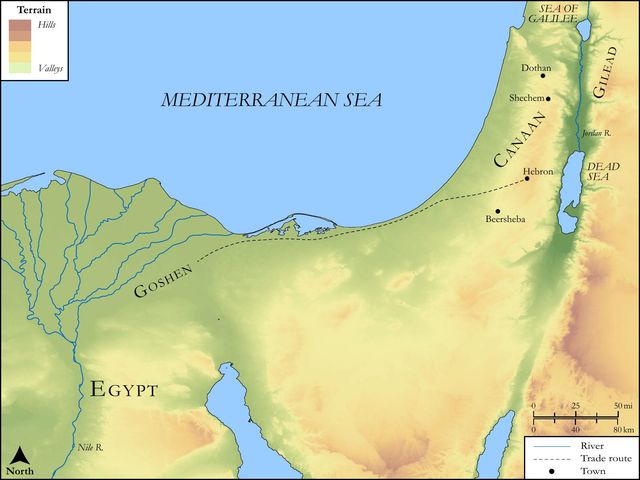
See on the biblical-era maps


Study this verse
Public-domain commentary
Matthew Henry
From his Commentary on the Whole Bible. Henry comments on passages, not single verses — this entry covers Genesis 43:26–34. His four-level outline is real structure in the source text, so it is rendered as structure.
Here is, I. The great respect that Joseph's brethren paid to him. When they brought him the present, they bowed themselves before him (Gen 43:26); and again, when they gave him an account of their father's health, they made obeisance, and called him, Thy servant our father, Gen 43:28. Thus were Joseph's dreams fulfilled more and more: and even the father, by the sons, bowed before him, according to the dream, Gen 37:10. Probably Jacob had directed them, if they had occasion to speak of him to the man, the lord of the land, to call him his servant.
II.The great kindness that Joseph showed to them, while they little thought it was a brotherly kindness. Here is,
1.His kind enquiry concerning Jacob: Is he yet alive? - a very fit question to be asked concerning any, especially concerning old people; for we are dying daily: it is strange that we are yet alive. Jacob had said many years before, I will go to the grave to my son; but he is yet alive: we must not die when we will.
2.The kind notice he took of Benjamin, his own brother.
(1.)He put up a prayer for him: God be gracious unto thee, my son, Gen 43:29. Joseph's favour, though he was the lord of the land, would do him little good, unless God were gracious to him. Many seek the ruler's favour, but Joseph directs him to seek the favour of the ruler of rulers.
(2.)He shed some tears for him, Gen 43:30. His natural affection to his brother, his joy to see him, his concern at seeing him and the rest of them in distress for bread, and the remembrance of his own griefs since he last saw him, produced a great agitation in him, which perhaps was the more uneasy because he endeavoured to stifle and suppress it; but he was forced to retire into his closet, there to give vent to his feeling by tears. Note,
[1.]Tears of tenderness and affection are no disparagement at all, even to great and wise men.
[2.]Gracious weepers should not proclaim their tears. My soul shall weep in secret, says the prophet, Jer 13:17. Peter went out and wept bitterly. See Mat 26:75.
3.His kind entertainment of them all. When his weeping had subsided so that he could refrain himself, he sat down to dinner with them, treated them nobly, and yet contrived every thing to amuse them.
(1.)He ordered three tables to be spread, one for his brethren, another for the Egyptians that dined with him (for so different were their customs that they did not care to eat together), another for himself, who durst not own himself a Hebrew, and yet would not sit with the Egyptians. See here an instance,
[1.]Of hospitality and good house-keeping, which are very commendable, according as the ability is.
[2.]Of compliance with people's humours, even whimsical ones, as bishop Patrick calls this of the Egyptians not eating with the Hebrews. Though Joseph was the lord of the land, and orders were given that all people should obey him, yet he would not force the Egyptians to eat with the Hebrews, against their minds, but let them enjoy their humours. Spirits truly generous hate to impose.
[3.]Of the early distance between Jews and Gentiles; one table would not hold them.
(2.)He placed his brethren according to their seniority (Gen 43:33), as if he could certainly divine. Some think they placed themselves so, according to their custom; but, if so, I see not why such particular notice is taken of it, especially as a thing they marvelled at.
(3.)He gave them a very plentiful entertainment, sent messes to them from his own table, Gen 43:34. This was the more generous in him, and the more obliging to them, because of the present scarcity of provisions. In a day of famine, it is enough to be fed; but here they were feasted. Perhaps they had not had such a good dinner for many months. It is said, They drank and were merry; their cares and fears were now over, and they ate their bread with joy, concluding they were now upon good terms with the man, the lord of the land. If God accept our works, our present, we have reason to be cheerful. Yet when we sit, as they here did, to eat with a ruler, we should consider what is before us, and not indulge our appetite, nor be desirous of dainties, Pro 23:1-3. Joseph gave them to understand that Benjamin was his favourite; for his mess was five times as much as any of theirs, not as if he would have him eat so much more than the rest, for then he must eat more than would do him good (and it is no act of friendship, but rather an injury and unkindness, to press any either to eat or drink to excess), but thus he would testify his particular respect for him, that he might try whether his brethren would envy Benjamin his larger messes, as formerly they had envied himself his finer coat. And it must be our rule, in such cases, to be content with what we have, and not to grieve at what others have.
Historical interpretation
Historical reception
1 surviving comment on this verse from the historical church.
When Joseph entered the house, his brothers brought him an offering and bowed down to him trembling. He inquired about their welfare, and they took heart. He asked if their father was alive, and they were put at ease. He asked whether that one was their brother, and he blessed him and said, “God be gracious to you my son,” and all fear was taken from their mind. It was in the Egyptian language that Joseph blessed Benjamin, and it was through an interpreter that they heard these initial [exchanges].
Continue studying Genesis 43:27 across the web’s major study libraries — every link below opens this exact verse, chapter, or book on the destination site.
Read & Compare
 BibleGatewayThis verse in more than 200 translations and 70 languages.
 Bible.comThe YouVersion reader — hundreds of translations, reading plans, and highlights.
 ESV.orgCrossway's official English Standard Version reader.
 NET BibleThe NET translation with 60,000+ translators' notes on every rendering decision.
 STEP BibleTyndale House's free study tool — original text, vocabulary, and scholarly resources.
 BibliaLogos Bible Software's free web reader.
 USCCBThe New American Bible (Revised Edition) with the U.S. bishops' study notes.
Commentaries
 BibleHub CommentariesDozens of classic commentaries on this verse, gathered on one page.
 StudyLightMore than 100 commentary sets — the largest collection on the web.
 BibleRefPlain-English commentary on what this verse means, verse by verse.
 Enduring WordDavid Guzik's free commentary on this chapter, widely used by Bible teachers.
 Bible Study ToolsVerse commentary alongside Greek and Hebrew study aids.
Original Language & Research
- BibleHub InterlinearThe verse word by word — original language, transliteration, and English.
- BibleHub LexiconEvery word's original-language definition and Strong's entry.
 Blue Letter BibleDeep-study tools — Strong's numbers, concordance, and word studies.
 SefariaThe Hebrew text with Rashi and centuries of Jewish commentary.
Sermons, Hymns & Audio


TrulyRandomVerse is not affiliated with these sites and doesn’t control their content. They’re linked because they’re genuinely useful.
Summary
Genesis 43:27 captures a deeply poignant moment as Joseph, now the powerful vizier of Egypt, inquires about the well-being of his family, particularly his aged father Jacob, upon the second arrival of his brothers. This seemingly simple yet profoundly significant question is laden with Joseph's enduring filial affection, strategic intent to test his brothers' character, and serves as a pivotal step in God's unfolding divine plan to preserve the nascent nation of Israel amidst a severe regional famine.
Context
ShowHideLiterary Context
This verse is situated within the dramatic narrative of Joseph's reunion with his brothers in Egypt, following their second journey to purchase grain during a severe famine. Having previously demanded that they bring their youngest brother, Benjamin, to prove their honesty (Genesis 42:20), Joseph now hosts them in his own house for a meal. The preceding verses describe the brothers' apprehension and their presentation of gifts, while the subsequent verses detail Joseph's emotional struggle and the elaborate meal, all building towards the revelation of his identity and the eventual reconciliation of the family. Joseph's direct inquiry about his father's welfare is the first intimate personal question he poses, revealing his true heart amidst his powerful facade.
Historical & Cultural Context
The setting is ancient Egypt during a period of widespread famine, forcing people from surrounding lands, including Canaan, to seek sustenance. The cultural norms of the time dictated strict protocols for interaction between high-ranking officials and foreign visitors, yet Joseph's invitation to dine at his house was an extraordinary gesture of hospitality, indicating his favor and setting the stage for a more personal exchange. The patriarchal society placed immense value on the elder, particularly the family patriarch, making Joseph's specific inquiry about his father's health and survival a culturally significant demonstration of respect and concern, even from a powerful official.
Key Themes
ShowHideGenesis 43:27 intricately weaves into several overarching themes within the Joseph narrative and the broader book of Genesis. It highlights the theme of Divine Providence, demonstrating how God orchestrates seemingly disparate events—like famine and Joseph's rise to power—to fulfill His covenant promises to Abraham, Isaac, and Jacob (Genesis 12:2-3). The verse also underscores the theme of Familial Reconciliation and Forgiveness, as Joseph, despite profound past betrayal, actively seeks the well-being of his family, setting the stage for their eventual restoration. Furthermore, it touches upon the theme of Testing and Transformation, as Joseph's questions serve to probe his brothers' character and reveal their growth and remorse since their earlier callous actions, preparing them for a deeper encounter with truth and grace, much like the testing of Abraham's faith in Genesis 22.
Exposition and Analysis
ShowHideKey Word Analysis
ShowHideA primitive root meaning "to inquire; by implication, to request; by extension, to demand." In this context, it signifies Joseph's deliberate and purposeful act of seeking information, not merely a casual greeting. His inquiry is laden with deeper meaning, going beyond politeness to a genuine desire to ascertain the state of his family, particularly his father.
A word encompassing "safe, i.e. (figuratively) well, happy, friendly; also (abstractly) welfare, i.e. health, prosperity, peace." This term is far richer than a simple inquiry about physical health. Joseph is asking about their holistic state of completeness, well-being, prosperity, and peace in all aspects of life—spiritual, emotional, and physical. It reflects a deep, comprehensive concern for their flourishing.
Meaning "old; aged, ancient (man), elder(-est), old (man, men and...women), senator." This specific descriptor emphasizes Jacob's advanced age and vulnerability, highlighting Joseph's particular concern for his father's condition. It evokes the respect and care due to an elder, a significant cultural value.
Meaning "alive; hence, raw (flesh); fresh (plant, water, year), strong; also (as noun, especially in the feminine singular and masculine plural) life (or living thing), whether literally or figuratively." Joseph's direct question, "Is he yet alive?", underscores the depth of his anxiety and the twenty-year separation, during which he had no knowledge of his father's survival, having been presumed dead himself. It is a raw, emotional query.
Verse Breakdown
ShowHide"And he asked them of [their] welfare"
Joseph initiates the conversation not with administrative matters but with a deeply personal inquiry, using the comprehensive term shalom. This immediately shifts the tone from a formal encounter with a foreign dignitary to a more intimate familial interaction, signaling Joseph's underlying connection and concern for his brothers and their household.
"and said"
This simple conjunction introduces Joseph's direct speech, emphasizing the intentionality and personal nature of his subsequent questions, moving from a general inquiry to a specific focus on his father.
"[Is] your father well, the old man of whom ye spake?"
Joseph's specific focus on "your father" reveals his profound filial concern. The addition "the old man of whom ye spake" serves as a crucial reminder to his brothers of their previous conversation in Genesis 42:13, where they had mentioned their father and youngest brother. This phrase also subtly tests their consistency and honesty, while simultaneously expressing Joseph's deep personal longing for his father.
"[Is] he yet alive?"
This final, stark question lays bare Joseph's deepest anxiety and hope. After two decades of separation and presumed death, the question of Jacob's continued existence is paramount. It is a deeply emotional query that underscores the long-standing pain and uncertainty Joseph has carried, and it is a critical step in verifying the conditions necessary for his eventual self-revelation.
Literary Devices
ShowHideThe verse employs several significant literary devices. Dialogue is central, as Joseph's direct questions drive the narrative forward and reveal his inner state. The use of Repetition in "Is your father well... Is he yet alive?" emphasizes Joseph's intense focus and concern for Jacob, highlighting the emotional weight of the inquiry. There is also profound Irony present; the powerful Egyptian governor is, unbeknownst to his brothers, the very son they betrayed, and his questions, while seemingly a test of their honesty, are deeply rooted in his own filial love. Furthermore, the scene is rich with Foreshadowing, as Joseph's meticulous inquiry and testing of his brothers' character prepare the way for the dramatic revelation of his identity and the subsequent reconciliation, which will ultimately preserve the family of Israel. The term shalom itself functions as a form of Symbolism, representing not just peace but the holistic well-being and restoration that Joseph desires for his family and that God intends for His people.
Theological and Thematic Connections
ShowHideJoseph's poignant inquiry in Genesis 43:27 serves as a powerful testament to the enduring nature of familial love and God's sovereign hand in preserving His covenant people. Despite the profound betrayal he suffered at his brothers' hands, Joseph's immediate and deep concern for his father's welfare demonstrates a heart that has moved beyond bitterness towards reconciliation, even before his identity is revealed. This moment is not merely a personal reunion but a crucial step in God's overarching plan to preserve the family of Jacob, from whom the nation of Israel would descend, ensuring the lineage through which the Messiah would eventually come. Joseph's actions, guided by divine providence, illustrate how God uses human circumstances, even painful ones, to accomplish His redemptive purposes, transforming brokenness into blessing and preparing the way for a greater work of salvation.
Reflection and Application
ShowHideJoseph's example in Genesis 43:27 offers timeless lessons for believers today, primarily calling us to cultivate genuine and compassionate concern for the holistic well-being of others, especially family members and the vulnerable. His patient and discerning approach to reconciliation with his brothers, allowing time for their transformation and demonstrating a love that transcends past hurts, teaches us the value of wisdom, grace, and forgiveness in navigating strained relationships. We are reminded that true concern extends beyond superficial inquiries to a deep desire for the shalom—the complete flourishing—of those around us. Ultimately, Joseph's story, even in this seemingly small interaction, powerfully illustrates God's sovereign hand at work, orchestrating events for His ultimate purposes and for the good of those who love Him, encouraging us to trust His plan even amidst personal pain and societal upheaval, knowing that He can redeem any situation for His glory.
Questions for Reflection
ShowHideFAQ
ShowHideWhy did Joseph specifically ask about his father, Jacob?
ShowHideJoseph's inquiry about Jacob was multifaceted. Primarily, it stemmed from genuine filial love and profound concern for his aged father, whom he had not seen in over two decades since his brothers sold him into slavery. He knew Jacob had grieved deeply over his presumed death, as recounted in Genesis 37:35. Secondly, it served as a strategic test for his brothers, allowing Joseph to assess their current character, their honesty, and their care for Jacob, contrasting it with their past disregard for their father's feelings and their callousness towards Joseph himself. This question was a crucial step in his plan to discern their repentance and prepare for his eventual self-revelation, as hinted at in Genesis 42:15-20.
What is the significance of "welfare" (shalom) in this context?
ShowHideThe Hebrew word shalom (שָׁלוֹם), translated as "welfare," is much broader than just physical health or peace. As seen in other biblical contexts like Numbers 6:26 or Isaiah 26:3, it encompasses a holistic state of completeness, well-being, prosperity, and health in every aspect of life—spiritual, emotional, and physical. Joseph's use of shalom indicates a deep, comprehensive inquiry into the overall state of his family, particularly his father, reflecting a desire for their total flourishing, not just their physical survival during the famine.
Christ-Centered Fulfillment
ShowHideJoseph, in his suffering, exaltation, and ultimate role as a preserver and reconciler of his family, serves as a profound type of Christ. Just as Joseph, though rejected by his brothers and sold into slavery (Genesis 37:28), became the means of their salvation from famine and reconciliation with their father, so too Christ, rejected by His own people (John 1:11), became the means of salvation and reconciliation for humanity with God the Father. Joseph's deep concern for his family's shalom—their holistic welfare—his testing of his brothers' hearts, and his eventual provision for them in a time of severe famine, powerfully reflect Christ's own compassionate care for His people, His discerning testing of their faith, and His ultimate provision of spiritual sustenance and eternal life. Through His sacrifice, Christ brings about a greater reconciliation than any earthly family reunion, restoring broken humanity to a right relationship with God and offering the ultimate shalom that surpasses all understanding (Philippians 4:7).