


Genesis 42:20
Bible text: King James Version (1769 Blayney text) · Public domain
Bible text: Berean Standard Bible · Public domain
Bible text: American Standard Version (1901) · Public domain
Bible text: World English Bible, Messianic edition · Public domain
Bible text: Geneva Bible (1599) · Public domain
Bible text: Young's Literal Translation · Public domain
- וְאֶתve·'Etand <obj.>H853Conj-w ¦ DirObjMParticle Object Indicatorוְandאֶת<obj.>
- אֲחִיכֶם'a·chi·Khemyour brotherH251N-msc ¦ 2mpNoun Singular Masculine Constructאֲחִיbrotherכֶםyour
- הַקָּטֹןha·ka·Ton<the> youngH6996Art ¦ Adj-msAdjective Singular Masculine Absoluteהַ<the>קָּטֹןyoung
- תָּבִיאוּta·Vi·'uyou will bringH935V-Hiphil-Imperf-2mpVerb Hiphil Imperfect 2nd Plural Masculine
- אֵלַי'e·Laito meH413Prep ¦ 1csPreposition Definiteאֵלַtoיme
- וְיֵאָמְנוּve·ye·'a·me·Nuso they may be verifiedH539Conj-w ¦ V-Niphal-ConjImperf-3mpVerb Niphal Conjunction+Imperfect 3rd Plural Masculineוְsoיֵאָמְנוּthey may be verified
- דִבְרֵיכֶםdiv·rei·Khemyour wordsH1697N-mpc ¦ 2mpNoun Plural Masculine Constructדִבְרֵיwordsכֶםyour
- וְלֹאve·Lo'and notH3808Conj-w ¦ NegParticle Negativeוְandלֹאnot
- תָמוּתוּta·Mu·tuyou will dieH4191V-Qal-Imperf-2mpVerb Qal Imperfect 2nd Plural Masculine
- וַיַּעֲשׂוּvai·ya·'a·suand they didH6213Conj-w ¦ V-Qal-ConsecImperf-3mpVerb Qal Consecutive Imperfect 3rd Plural Masculineוַandיַּעֲשׂוּthey did
- כֵןKhensoH3651AdvAdverb
English is a literal word-by-word gloss of the Hebrew, not the KJV's wording. Why?
This is the original text the KJV's translators worked from — each Hebrew word with its own literal English meaning in this verse, prepared by scholars at Tyndale House, Cambridge. The KJV translates whole sentences, not word by word, so its wording differs: one Hebrew word can become several English words, and the KJV may choose “the LORD” where the gloss reads “Yahweh”. Both are faithful — they answer different questions. For the KJV's own rendering, switch to the KJV text.
Details
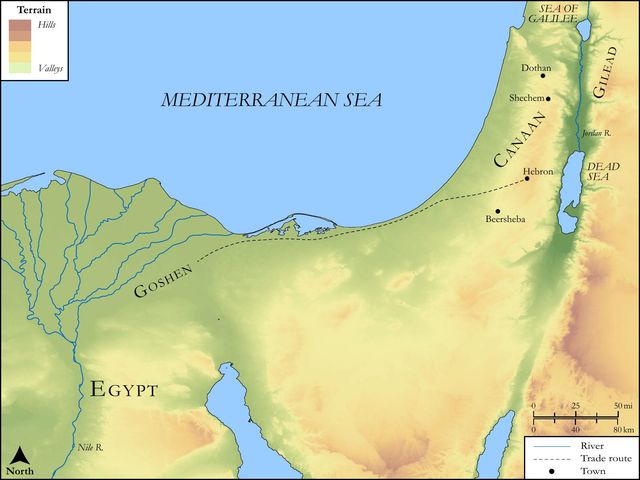
See on the biblical-era maps


Study this verse
Public-domain commentary
Matthew Henry
From his Commentary on the Whole Bible. Henry comments on passages, not single verses — this entry covers Genesis 42:7–20. His two-level outline is real structure in the source text, so it is rendered as structure.
We may well wonder that Joseph, during the twenty years that he had now been in Egypt, especially during the last seven years that he had been in power there, never sent to his father to acquaint him with his circumstances; nay, it is strange that he who so often went throughout all the land of Egypt (Gen 41:45, Gen 41:46) never made an excursion to Canaan, to visit his aged father, when he was in the borders of Egypt, that lay next to Canaan. Perhaps it would not have been above three or four days' journey for him in his chariot. It is a probable conjecture that his whole management of himself in this affair was by special direction from Heaven, that the purpose of God concerning Jacob and his family might be accomplished. When Joseph's brethren came, he knew them by many a satisfactory token, but they knew not him, little thinking to find him there, Gen 42:8. He remembered the dreams (Gen 42:9), but they had forgotten them. The laying up of God's oracles in our hearts will be of excellent use to us in all our conduct. Joseph had an eye to his dreams, which he knew to be divine, in his carriage towards his brethren, and aimed at the accomplishment of them and the bringing of his brethren to repentance for their former sins; and both these points were gained.
I.He showed himself very rigorous and harsh with them.
The very manner of his speaking, considering the post he was in, was enough to frighten them; for he spoke roughly to them, Gen 42:7. He charged them with bad designs against the government (Gen 42:9), treated them as dangerous persons, saying, You are spies, and protesting by the life of Pharaoh that they were so, Gen 42:16. Some make this an oath, others make it no more than a vehement asseveration, like that, as thy soul liveth; however it was more than yea, yea, and nay, nay, and therefore came of evil. Note, Bad words are soon learned by converse with those that use them, but not so soon unlearned. Joseph, by being much at court, got the courtier's oath, By the life of Pharaoh, perhaps designing hereby to confirm his brethren in their belief that he was an Egyptian, and not an Israelite. They knew this was not the language of a son of Abraham. When Peter would prove himself no disciple of Christ, he cursed and swore. Now why was Joseph thus hard upon his brethren? We may be sure it was not from a spirit of revenge, that he might now trample upon those who had formerly trampled upon him; he was not a man of that temper. But,
1.It was to enrich his own dreams, and complete the accomplishment of them.
2.It was to bring them to repentance.
3.It was to get out of them an account of the state of their family, which he longed to know: they would have discovered him if he had asked as a friend, therefore he asks as a judge. Not seeing his brother Benjamin with them, perhaps he began to suspect that they had made away with him too, and therefore gives them occasion to speak of their father and brother. Note, God in his providence sometimes seems harsh with those he loves, and speaks roughly to those for whom yet he has great mercy in store.
II.They, hereupon, were very submissive.
They spoke to him with all the respect imaginable: Nay, my lord (Gen 42:10) - a great change since they said, Behold, this dreamer comes. They very modestly deny the charge: We are no spies. They tell him their business, that they came to buy food, a justifiable errand, and the same that many strangers came to Egypt upon at this time. They undertake to give a particular account of themselves and their family (Gen 42:13), and this was what they wanted.
III.He clapped them all up in prison for three days, Gen 42:17.
Thus God deals with the souls he designs for special comfort and honour; he first humbles them, and terrifies them, and brings them under a spirit of bondage, and then binds up their wounds by the Spirit of adoption.
IV.He concluded with them, at last, that one of them should be left as a hostage, and the rest should go home and fetch Benjamin.
It was a very encouraging word he said to them (Gen 42:18): I fear God; as if he had said, "You may assure yourselves I will do you no wrong; I dare not, for I know that, high as I am, there is one higher than I." Note, With those that fear God we have reason to expect fair dealing. The fear of God will be a check upon those that are in power, to restrain them from abusing their power to oppression and tyranny. Those that have no one else to stand in awe of ought to stand in awe of their own consciences. See Neh 5:15, So did not I, because of the fear of God.
Continue studying Genesis 42:20 across the web’s major study libraries — every link below opens this exact verse, chapter, or book on the destination site.
Read & Compare
 BibleGatewayThis verse in more than 200 translations and 70 languages.
 Bible.comThe YouVersion reader — hundreds of translations, reading plans, and highlights.
 ESV.orgCrossway's official English Standard Version reader.
 NET BibleThe NET translation with 60,000+ translators' notes on every rendering decision.
 STEP BibleTyndale House's free study tool — original text, vocabulary, and scholarly resources.
 BibliaLogos Bible Software's free web reader.
 USCCBThe New American Bible (Revised Edition) with the U.S. bishops' study notes.
Commentaries
 BibleHub CommentariesDozens of classic commentaries on this verse, gathered on one page.
 StudyLightMore than 100 commentary sets — the largest collection on the web.
 BibleRefPlain-English commentary on what this verse means, verse by verse.
 Enduring WordDavid Guzik's free commentary on this chapter, widely used by Bible teachers.
 Bible Study ToolsVerse commentary alongside Greek and Hebrew study aids.
Original Language & Research
- BibleHub InterlinearThe verse word by word — original language, transliteration, and English.
- BibleHub LexiconEvery word's original-language definition and Strong's entry.
 Blue Letter BibleDeep-study tools — Strong's numbers, concordance, and word studies.
 SefariaThe Hebrew text with Rashi and centuries of Jewish commentary.
Sermons, Hymns & Audio


TrulyRandomVerse is not affiliated with these sites and doesn’t control their content. They’re linked because they’re genuinely useful.
Summary
Genesis 42:20 marks a pivotal moment in Joseph's intricate plan, where he, as Egypt's governor, demands his brothers bring their youngest sibling, Benjamin, as irrefutable proof of their honesty. This command served not only to verify their claims and avert their immediate death but also as a profound test of their character, setting the stage for a dramatic family reconciliation orchestrated by divine providence. Their immediate and fearful compliance underscores the gravity of their situation and Joseph's strategic authority.
Context
ShowHideLiterary Context
This verse is situated within the gripping narrative of Joseph's reunion with his estranged brothers, who, unknowingly, stand before the very sibling they betrayed years ago. Having risen to immense power in Egypt (Genesis 41:40), Joseph encounters his ten older brothers who have journeyed from famine-stricken Canaan to purchase grain. He immediately recognizes them but conceals his identity, treating them as spies. His demand for Benjamin is a calculated maneuver, a critical test designed to probe their hearts and ascertain if their character has changed since their cruel act of selling him into slavery (Genesis 37:28). This command also serves to bring Jacob's beloved youngest son to Egypt, setting the stage for the entire family's relocation and preservation, fulfilling Joseph's earlier prophetic dreams (Genesis 37:5-11).
Historical & Cultural Context
Canaan and the lands about it frequently experienced severe famines, making Egypt, with its Nile-fed agriculture and sophisticated grain storage, a vital refuge. Joseph's position as "governor over the land" (Genesis 42:6) granted him absolute authority, including the power of life and death over foreign visitors. In this cultural setting, a family's integrity and the truthfulness of one's word were paramount. Joseph's demand for Benjamin was not merely arbitrary; it was a culturally intelligible means of verifying claims and ensuring the visitors were not spies, a common concern for powerful nations. The concept of a "pledge" or "hostage" (though not explicitly stated, implied by the demand for Benjamin) was also a recognized practice to ensure compliance and good faith in dealings.
Key Themes
ShowHideGenesis 42:20 contributes significantly to several overarching themes in the Joseph narrative and the book of Genesis. Divine Providence and Sovereignty are central, as God orchestrates human actions and difficult circumstances to fulfill His ultimate purposes, preserving His chosen family (Genesis 50:20). The verse highlights the theme of Testing and Verification, as Joseph's command serves as a crucible to reveal the true state of his brothers' hearts and to initiate a process of spiritual transformation. It also underscores the Consequences of Sin and the Path to Redemption, as the brothers' fear and forced obedience are direct repercussions of their past cruelty, yet this very trial becomes the catalyst for their repentance and eventual reconciliation. Finally, the emphasis on "words being verified" reinforces the biblical importance of Truthfulness and Integrity, demonstrating that genuine character is proven by actions that align with one's claims.
Exposition and Analysis
ShowHideKey Word Analysis
ShowHideH6996 (qâṭân) refers to something abbreviated, diminutive, or small, whether in quantity, size, number, or figuratively, in age or importance. Here, it specifically denotes the "youngest" in terms of age, emphasizing Benjamin's tender years and his special place as the last son of Rachel, a particularly vulnerable and cherished member of Jacob's family.
H251 (ʼâch) is a primitive word meaning "brother" in its widest sense, encompassing literal relationship, metaphorical affinity, or resemblance. In this context, it highlights the blood tie between Benjamin and the other brothers, making Joseph's demand a direct challenge to their familial loyalty and responsibility.
H1697 (dâbâr) is a rich Hebrew term meaning "word," but by implication, it can also refer to a "matter," "thing," "affair," "report," or "speech." Here, it refers to the brothers' verbal claims of being honest men with a living father and a youngest brother at home. Joseph's demand is for tangible proof to substantiate these spoken assertions.
H539 (ʼâman) is a primitive root meaning "to build up or support," "to be firm or faithful," "to trust or believe," or "to be permanent or quiet." In this context, "verified" means their words will be established, confirmed, or proven true, moving from mere statements to undeniable facts. It signifies the transition from a claim to a demonstrated reality, emphasizing the need for integrity and trustworthiness.
H6213 (ʻâsâh) is a primitive root meaning "to do or make" in the broadest sense and widest application. This simple yet powerful word signifies the brothers' immediate and complete compliance with Joseph's command. It conveys their action, their performance of the task, highlighting their submission to Joseph's authority and the dire consequences of disobedience.
Verse Breakdown
ShowHide"But bring your youngest brother unto me;"
This clause reveals Joseph's direct and non-negotiable command. It is the core of his test, focusing on Benjamin, the only full brother Joseph has, and Jacob's last remaining son from Rachel. The demand is a strategic move to ascertain the brothers' willingness to sacrifice for their family and their father's affections, a stark contrast to their past actions concerning Joseph.
"so shall your words be verified,"
This phrase articulates the purpose of Joseph's demand. The brothers had claimed to be "true men" (Genesis 42:11) and spoke of their father and youngest brother. Joseph insists on physical proof to confirm the veracity of their statements, moving beyond mere verbal assurances to tangible evidence of their integrity.
"and ye shall not die."
This clause presents the life-or-death ultimatum. Joseph, wielding absolute power, makes their survival contingent upon their obedience. This threat underscores the severity of their predicament and the immense pressure they were under, forcing them to confront the difficult decision of returning to Jacob with such a perilous request.
"And they did so."
This concise statement highlights the immediate, unequivocal, and fearful compliance of the brothers. Faced with the overwhelming authority of the Egyptian governor and the threat of death, they had no alternative but to submit to his demand. This simple declaration sets in motion the subsequent events of the narrative, leading to the dramatic unfolding of Joseph's plan.
Literary Devices
ShowHideThe verse employs several potent literary devices. Ultimatum is central, as Joseph presents a clear, non-negotiable demand with severe consequences for non-compliance, forcing the brothers into a desperate situation. There is profound Irony in Joseph, the very brother they sold into slavery, now holding their lives in his hands and testing their integrity. This reversal of fortune highlights divine justice and the unexpected ways God works. The demand for Benjamin also serves as Foreshadowing, hinting at the deeper reconciliation that will occur when the entire family is reunited. The phrase "your words be verified" emphasizes the Symbolism of truth and integrity, suggesting that true character is not merely spoken but demonstrated through action.
THEOLOGICAL AND THEMATIC CONNECTIONS
ShowHideGenesis 42:20 profoundly illustrates God's intricate and sovereign plan, even amidst human sin and suffering. Joseph's seemingly harsh demand is not arbitrary but a divinely orchestrated test, designed to bring about the brothers' repentance and the ultimate preservation of the family of promise. This situation exemplifies how God uses difficult circumstances and human choices to achieve His redemptive purposes, transforming past wrongs into opportunities for growth and reconciliation. It underscores the truth that God is always working behind the scenes, weaving together seemingly disparate events to fulfill His covenant promises and bring about His good will.
Reflection and Application
ShowHideGenesis 42:20 offers profound insights for believers today, reminding us that God's sovereign hand is at work even in the most perplexing and challenging circumstances of our lives. Just as Joseph's brothers faced a seemingly impossible demand that forced them to confront their past and trust in an unknown future, we too are called to trust in God's unseen plan, even when the immediate events are difficult to comprehend. This verse underscores the vital importance of integrity—our words must be "verified" by our actions, reflecting a genuine and consistent character before God and others. Furthermore, it beautifully illustrates how past wrongs, though leading to painful consequences, can be used by God as catalysts for profound personal growth, repentance, and ultimately, reconciliation. We are encouraged to embrace trials as opportunities for God to refine us, knowing that He works all things for good for those who love Him and are called according to His purpose (Romans 8:28).
Questions for Reflection
ShowHideFAQ
ShowHideWhy did Joseph specifically demand Benjamin's presence?
ShowHideJoseph's demand for Benjamin's presence was a multifaceted and strategic move. Primarily, it served as a crucial test of his brothers' character and integrity. He wanted to ascertain if they still harbored the same jealousy and disregard for their father's affections that led them to sell Joseph into slavery (Genesis 37:28). Their willingness to endanger Benjamin, Jacob's youngest and most beloved son (the only other son of Rachel), would reveal the true state of their hearts. Secondly, it was a practical step to bring Benjamin to Egypt, a necessary part of Joseph's prophetic dreams, which depicted his family bowing before him (Genesis 37:7-10). This move also set the stage for the entire family to eventually relocate to Egypt, thus preserving them from the severe famine and fulfilling God's covenant promises to Abraham, Isaac, and Jacob.
What does "so shall your words be verified" mean in this context?
ShowHideThe phrase "so shall your words be verified" means that the brothers' claims of being honest men with a living father and a younger brother would be proven true through tangible evidence. Joseph was not content with their verbal assurances; he demanded the physical presence of Benjamin as irrefutable proof to confirm their story. This was a critical step in Joseph's plan to test their sincerity and to move from suspicion to a confirmed understanding of their character. It underscores the biblical emphasis on integrity, where one's actions must substantiate one's claims.
What was the immediate impact of Joseph's command on his brothers?
ShowHideThe immediate impact of Joseph's command on his brothers was profound fear and distress. They were already in a precarious situation, accused of being spies, and now faced a life-or-death ultimatum. The demand for Benjamin would have stirred deep anxieties, forcing them to confront their father Jacob with the request to part with his most cherished son, a constant reminder of Joseph's presumed death. Their response, as stated by "And they did so," highlights their immediate and absolute submission, driven by the overwhelming authority of the Egyptian governor and the dire consequences of disobedience. This fear and compliance set in motion a painful but necessary journey of self-reflection and repentance.
Christ-Centered Fulfillment
ShowHideThe narrative of Joseph, particularly his testing of his brothers and subsequent reconciliation, serves as a powerful and poignant type of Christ. Joseph, though innocent of any wrongdoing, suffered immensely at the hands of his own brothers, being sold for a price and enduring great hardship (Genesis 37:28). Yet, through his suffering and subsequent exaltation to power in Egypt, he became the means of salvation and preservation for his family, saving them from famine and death. This mirrors Christ, the innocent Son of God, who suffered rejection and death at the hands of His own people, yet through His crucifixion and resurrection, He was exalted to the right hand of God (Philippians 2:6-11) and became the ultimate means of salvation and reconciliation for all humanity (Romans 5:10). Joseph's hidden identity and eventual revelation to his brothers, leading to their repentance and the restoration of their relationship, beautifully foreshadows Christ's future revelation to Israel and the world, bringing about ultimate redemption and the establishment of His kingdom. This verse, with its demand for "verification" and the brothers' fearful obedience, points to the sovereign authority of God's plan, which, through seemingly harsh circumstances, orchestrates the path to reconciliation and the fulfillment of divine promises, ultimately culminating in the saving work of the Lamb of God, who takes away the sin of the world (John 1:29).