


Genesis 42:19
Bible text: King James Version (1769 Blayney text) · Public domain
Bible text: Berean Standard Bible · Public domain
Bible text: American Standard Version (1901) · Public domain
Bible text: World English Bible, Messianic edition · Public domain
Bible text: Geneva Bible (1599) · Public domain
Bible text: Young's Literal Translation · Public domain
- אִם'imifH518PrtParticle Conditional
- כֵּנִיםke·Nim[are] honestH3651Adj-mpAdjective Plural Masculine Absolute
- אַתֶּם'a·TemyouH859Pro-2mpPronoun Personal 2nd Plural Masculine
- אֲחִיכֶם'a·chi·Khemyour brotherH251N-msc ¦ 2mpNoun Singular Masculine Constructאֲחִיbrotherכֶםyour
- אֶחָד'e·ChadoneH259Adj-fsAdjective Numerical Singular Feminine Absolute
- יֵאָסֵרye·'a·Serlet him be imprisonedH631V-Niphal-Imperf-3msVerb Niphal Imperfect 3rd Singular Masculine
- בְּבֵיתbe·Veitin [the] house ofH1004Prep-b ¦ N-mscNoun Singular Masculine Constructבְּinבֵית[the] house of
- מִשְׁמַרְכֶםmish·mar·Khemyour custodyH4929N-msc ¦ 2mpNoun Singular Masculine Constructמִשְׁמַרְcustodyכֶםyour
- וְאַתֶּםve·'a·Temand youH859Conj-w ¦ Pro-2mpPronoun Personal 2nd Plural Masculineוְandאַתֶּםyou
- לְכוּle·KhugoH1980V-Qal-Imp-2mpVerb Qal Imperative 2nd Plural Masculine
- הָבִיאוּha·Vi·'utakeH935V-Hiphil-Imp-2mpVerb Hiphil Imperative 2nd Plural Masculine
- שֶׁבֶרShe·ver[the] grain ofH7668N-mscNoun Singular Masculine Construct
- רַעֲבוֹןra·'a·Von[the] hunger ofH7459N-mscNoun Singular Masculine Construct
- בָּתֵּיכֶםba·tei·Khemyour householdsH1004N-mpc ¦ 2mpNoun Plural Masculine Constructבָּתֵּיhouseholdsכֶםyour
English is a literal word-by-word gloss of the Hebrew, not the KJV's wording. Why?
This is the original text the KJV's translators worked from — each Hebrew word with its own literal English meaning in this verse, prepared by scholars at Tyndale House, Cambridge. The KJV translates whole sentences, not word by word, so its wording differs: one Hebrew word can become several English words, and the KJV may choose “the LORD” where the gloss reads “Yahweh”. Both are faithful — they answer different questions. For the KJV's own rendering, switch to the KJV text.
Details
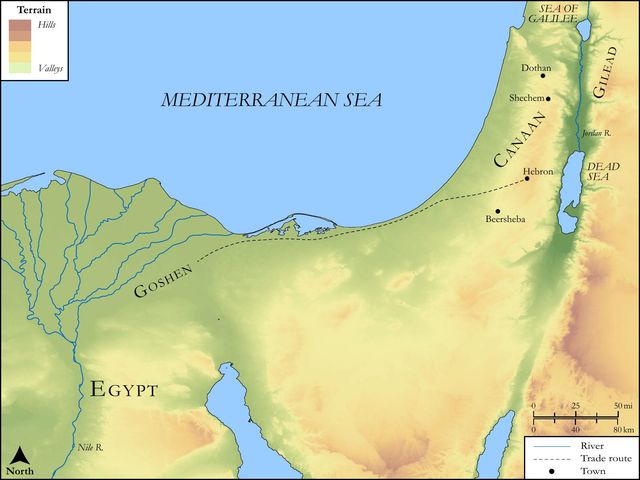
See on the biblical-era maps


Study this verse
Public-domain commentary
Matthew Henry
From his Commentary on the Whole Bible. Henry comments on passages, not single verses — this entry covers Genesis 42:7–20. His two-level outline is real structure in the source text, so it is rendered as structure.
We may well wonder that Joseph, during the twenty years that he had now been in Egypt, especially during the last seven years that he had been in power there, never sent to his father to acquaint him with his circumstances; nay, it is strange that he who so often went throughout all the land of Egypt (Gen 41:45, Gen 41:46) never made an excursion to Canaan, to visit his aged father, when he was in the borders of Egypt, that lay next to Canaan. Perhaps it would not have been above three or four days' journey for him in his chariot. It is a probable conjecture that his whole management of himself in this affair was by special direction from Heaven, that the purpose of God concerning Jacob and his family might be accomplished. When Joseph's brethren came, he knew them by many a satisfactory token, but they knew not him, little thinking to find him there, Gen 42:8. He remembered the dreams (Gen 42:9), but they had forgotten them. The laying up of God's oracles in our hearts will be of excellent use to us in all our conduct. Joseph had an eye to his dreams, which he knew to be divine, in his carriage towards his brethren, and aimed at the accomplishment of them and the bringing of his brethren to repentance for their former sins; and both these points were gained.
I.He showed himself very rigorous and harsh with them.
The very manner of his speaking, considering the post he was in, was enough to frighten them; for he spoke roughly to them, Gen 42:7. He charged them with bad designs against the government (Gen 42:9), treated them as dangerous persons, saying, You are spies, and protesting by the life of Pharaoh that they were so, Gen 42:16. Some make this an oath, others make it no more than a vehement asseveration, like that, as thy soul liveth; however it was more than yea, yea, and nay, nay, and therefore came of evil. Note, Bad words are soon learned by converse with those that use them, but not so soon unlearned. Joseph, by being much at court, got the courtier's oath, By the life of Pharaoh, perhaps designing hereby to confirm his brethren in their belief that he was an Egyptian, and not an Israelite. They knew this was not the language of a son of Abraham. When Peter would prove himself no disciple of Christ, he cursed and swore. Now why was Joseph thus hard upon his brethren? We may be sure it was not from a spirit of revenge, that he might now trample upon those who had formerly trampled upon him; he was not a man of that temper. But,
1.It was to enrich his own dreams, and complete the accomplishment of them.
2.It was to bring them to repentance.
3.It was to get out of them an account of the state of their family, which he longed to know: they would have discovered him if he had asked as a friend, therefore he asks as a judge. Not seeing his brother Benjamin with them, perhaps he began to suspect that they had made away with him too, and therefore gives them occasion to speak of their father and brother. Note, God in his providence sometimes seems harsh with those he loves, and speaks roughly to those for whom yet he has great mercy in store.
II.They, hereupon, were very submissive.
They spoke to him with all the respect imaginable: Nay, my lord (Gen 42:10) - a great change since they said, Behold, this dreamer comes. They very modestly deny the charge: We are no spies. They tell him their business, that they came to buy food, a justifiable errand, and the same that many strangers came to Egypt upon at this time. They undertake to give a particular account of themselves and their family (Gen 42:13), and this was what they wanted.
III.He clapped them all up in prison for three days, Gen 42:17.
Thus God deals with the souls he designs for special comfort and honour; he first humbles them, and terrifies them, and brings them under a spirit of bondage, and then binds up their wounds by the Spirit of adoption.
IV.He concluded with them, at last, that one of them should be left as a hostage, and the rest should go home and fetch Benjamin.
It was a very encouraging word he said to them (Gen 42:18): I fear God; as if he had said, "You may assure yourselves I will do you no wrong; I dare not, for I know that, high as I am, there is one higher than I." Note, With those that fear God we have reason to expect fair dealing. The fear of God will be a check upon those that are in power, to restrain them from abusing their power to oppression and tyranny. Those that have no one else to stand in awe of ought to stand in awe of their own consciences. See Neh 5:15, So did not I, because of the fear of God.
Continue studying Genesis 42:19 across the web’s major study libraries — every link below opens this exact verse, chapter, or book on the destination site.
Read & Compare
 BibleGatewayThis verse in more than 200 translations and 70 languages.
 Bible.comThe YouVersion reader — hundreds of translations, reading plans, and highlights.
 ESV.orgCrossway's official English Standard Version reader.
 NET BibleThe NET translation with 60,000+ translators' notes on every rendering decision.
 STEP BibleTyndale House's free study tool — original text, vocabulary, and scholarly resources.
 BibliaLogos Bible Software's free web reader.
 USCCBThe New American Bible (Revised Edition) with the U.S. bishops' study notes.
Commentaries
 BibleHub CommentariesDozens of classic commentaries on this verse, gathered on one page.
 StudyLightMore than 100 commentary sets — the largest collection on the web.
 BibleRefPlain-English commentary on what this verse means, verse by verse.
 Enduring WordDavid Guzik's free commentary on this chapter, widely used by Bible teachers.
 Bible Study ToolsVerse commentary alongside Greek and Hebrew study aids.
Original Language & Research
- BibleHub InterlinearThe verse word by word — original language, transliteration, and English.
- BibleHub LexiconEvery word's original-language definition and Strong's entry.
 Blue Letter BibleDeep-study tools — Strong's numbers, concordance, and word studies.
 SefariaThe Hebrew text with Rashi and centuries of Jewish commentary.
Sermons, Hymns & Audio


TrulyRandomVerse is not affiliated with these sites and doesn’t control their content. They’re linked because they’re genuinely useful.
Summary
Genesis 42:19 records Joseph, now the powerful Egyptian governor, imposing a crucial condition on his ten older brothers who have arrived from Canaan seeking grain during a severe famine. He demands that one brother remain imprisoned as a hostage while the others return home with provisions, with the explicit requirement that they bring their youngest brother, Benjamin, back to Egypt as proof of their integrity. This command is a calculated and pivotal step in Joseph's intricate, divinely guided strategy to test his brothers' character, assess their transformation, ensure his family's safety, and orchestrate a profound reunion.
Context
ShowHideLiterary Context
Genesis 42:19 is embedded within the dramatic narrative of Joseph's reconciliation with his brothers, a story that spans Genesis 37-50. Preceding this verse, Joseph, long thought dead by his family, has risen from slavery and imprisonment to become the second most powerful man in Egypt, responsible for managing the severe famine gripping the region (Genesis 41:37-45). His brothers, unaware of his identity, arrive in Egypt to purchase food, bowing before him just as Joseph's prophetic dreams had foretold years earlier (Genesis 37:5-10). Joseph immediately recognizes them but chooses to conceal his identity, treating them harshly and accusing them of being spies (Genesis 42:7-9). This specific verse, therefore, marks a critical turning point, as Joseph moves from initial accusation to a concrete plan designed to test their character, particularly concerning their treatment of Benjamin, their full brother, and their aged father Jacob. It sets the stage for the escalating tension and eventual revelation that will unfold in subsequent chapters.
Historical & Cultural Context
The nations round about, particularly during times of widespread famine, saw Egypt as a critical granary, making it a natural destination for those seeking sustenance. The practice of taking hostages, as Joseph does here, was a common and recognized method in ancient diplomacy and jurisprudence to ensure compliance, guarantee a promise, or secure the return of individuals. It served as a powerful deterrent against deceit and a tangible bond for future actions. Furthermore, the concept of "true men" (integrity, trustworthiness) was paramount in a society where oaths, covenants, and familial bonds were foundational. Joseph's demand for Benjamin's presence also reflects the cultural significance of a full brother and the patriarchal authority of Jacob, whose well-being and the continuation of his lineage through Benjamin were of utmost importance. The severity of the famine, described in Genesis 41:56-57, underscores the desperate circumstances that compelled the brothers to undertake such a perilous journey, making Joseph's offer of grain a powerful leverage point.
Key Themes
ShowHideThis verse significantly contributes to several overarching themes in Genesis. Divine Providence is central, as Joseph's suffering and subsequent exaltation are revealed to be part of God's overarching plan to preserve the nascent nation of Israel (Genesis 50:20). The theme of Testing and Verification is prominent, as Joseph's elaborate scheme is designed to probe his brothers' hearts, revealing whether they have repented of their past cruelty and developed genuine familial care, especially for Benjamin (Genesis 42:21-23). This leads to the theme of Reconciliation and Forgiveness, which is ultimately achieved through a process of confession and demonstrated change of heart. The narrative also highlights the Weight of Sin and its Consequences, as the brothers' past actions against Joseph now return to haunt them, forcing them to confront their guilt. Finally, the theme of Familial Dynamics is explored in depth, showcasing the complex relationships, rivalries, and eventual restoration within Jacob's family, laying the groundwork for the formation of the twelve tribes of Israel.
Exposition and Analysis
ShowHideKey Word Analysis
ShowHideThis word, translated as "true" in "If ye [be] true [men]," comes from a root meaning "set upright." As an adjective, it signifies "just" or "right," but often functions adverbially or conjunctively to mean "rightly" or "so." In this context, it goes beyond mere factual accuracy to imply moral uprightness, integrity, and trustworthiness. Joseph is not just asking if their story is factual, but if they are genuinely reliable and honest individuals, unlike the deceitful men who sold him into slavery. He demands proof of their changed character.
Translated as "bound" in "let one of your brethren be bound," this primitive root means "to yoke or hitch," and by analogy, "to fasten in any sense." It conveys the act of securing someone, often implying imprisonment or restraint. The use of this word emphasizes the physical confinement and hostage-taking, a severe condition designed to ensure the brothers' return and compliance with Joseph's demands. It underscores the gravity of the situation and the binding nature of the agreement.
Appearing twice in the verse, translated as "house" in "house of your prison" and "houses" in "famine of your houses," this word primarily means "a house" but carries a wide range of applications, including family, household, palace, or even a prison. Its dual usage here highlights a stark contrast: the "house of your prison" represents confinement and testing, while "your houses" represents their desperate need for sustenance and the familial responsibility that drives them. It underscores the domestic sphere as both a place of deprivation and a motivation for their actions.
Verse Breakdown
ShowHide"If ye [be] true [men]"
This opening phrase establishes the core challenge. Joseph is not merely seeking verification of their story but probing their moral integrity. He is demanding proof of their trustworthiness and reliability, implicitly questioning whether they have truly changed from the deceitful and callous individuals who betrayed him years ago. This sets the stage for a test of character rather than just a factual inquiry.
"let one of your brethren be bound in the house of your prison"
This is the central demand and the most severe condition. Joseph insists on holding one brother hostage, a common practice among the nations of that day to secure a promise or ensure compliance. This act serves multiple purposes: it prevents the brothers from simply fleeing, compels their return with Benjamin, and forces them to confront the weight of their familial bonds and responsibilities, particularly regarding the welfare of one of their own. It is a direct consequence of their past actions and a catalyst for their introspection.
"go ye, carry corn for the famine of your houses"
Despite the harshness of the hostage demand, Joseph demonstrates a strategic mercy. He acknowledges their desperate need and permits them to take the much-needed grain back to their starving families in Canaan. This provision serves as both an act of compassion and a powerful incentive, ensuring that they have the means to survive the famine while simultaneously obligating their return with Benjamin. It highlights Joseph's blend of sternness and compassion, all within the framework of his overarching, divinely guided plan.
Literary Devices
ShowHideGenesis 42:19 effectively employs several literary devices to enhance its narrative power and theological depth. Dramatic Irony is paramount, as the audience knows Joseph's true identity and his past, while his brothers remain oblivious. This creates tension and anticipation, as Joseph's seemingly harsh actions are understood by the reader as part of a redemptive plan, contrasting sharply with the brothers' fear and confusion. The verse also utilizes Foreshadowing, as Joseph's demand for Benjamin's presence and the subsequent trials hint at the eventual revelation of his identity and the family's full reunion. The "house of your prison" and the "corn for the famine" serve as powerful Symbols: the prison symbolizes the brothers' spiritual bondage to their past sin and the confinement of their guilt, while the corn symbolizes God's provision and the means of salvation, both physical and spiritual, offered through Joseph. The contrast between the brothers' desperate need and Joseph's calculated control underscores the theme of divine sovereignty working through human agency.
Theological and Thematic Connections
ShowHideJoseph's actions in Genesis 42:19 powerfully illustrate the divine principle that God often uses trials and difficult circumstances to test character, expose hidden truths, and bring about repentance and transformation. This intricate plan, orchestrated by Joseph, is ultimately a reflection of God's sovereign hand at work, meticulously guiding events to preserve His covenant people and fulfill His promises. The testing of the brothers forces them to confront their past sins, particularly their cruelty towards Joseph and their father's grief, leading them to a place of introspection and eventual confession. This process of trial, conviction, and eventual reconciliation foreshadows the broader redemptive narrative of God's dealings with humanity, where suffering and testing can lead to spiritual growth, a deeper understanding of sin, and a path toward restoration.
Reflection and Application
ShowHideGenesis 42:19 offers profound insights into how God works in our lives. Just as Joseph used a seemingly harsh trial to bring his brothers to a place of introspection, confession, and eventual reconciliation, God often allows challenging circumstances to enter our lives. These "tests" are not arbitrary punishments but purposeful tools in His hands, designed to refine our character, expose areas of our hearts that need transformation, and guide us toward His perfect will. When we face difficult situations that compel us to confront our own "truth" or integrity, we are invited to consider if there are hidden "prisons" of unconfessed sin or unresolved relationships that God is seeking to address. This passage reminds us that even when our circumstances seem confusing, painful, or unjust, there can be a divine, redemptive purpose at work, leading to restoration, deeper understanding, and a stronger reliance on God's sovereignty. Our response to such trials reveals the "truth" of our own hearts and determines our path toward genuine transformation and reconciliation, both with God and with others.
Questions for Reflection
ShowHideFAQ
ShowHideWhy did Joseph not reveal himself immediately to his brothers?
ShowHideJoseph's decision not to reveal his identity immediately was a complex and multifaceted strategic choice, deeply intertwined with divine providence. He needed to test his brothers' character and observe if they had repented of their past cruelty, especially regarding their treatment of Benjamin and their aged father, Jacob. Joseph sought to determine if their hearts had changed from the callous individuals who sold him into slavery (Genesis 37:26-28). He also desired to ensure the well-being of his father and Benjamin, whom he hadn't seen in years. Furthermore, Joseph's actions were part of God's larger providential plan to bring the entire family to Egypt, preserving them from the severe famine and setting the stage for the fulfillment of Joseph's prophetic dreams, ultimately preparing them to become a great nation (Genesis 45:5-8).
What was the significance of taking a hostage in this context?
ShowHideThe act of taking a hostage, specifically Simeon in this case (Genesis 42:24), was a common and legally recognized practice among the nations of that day, as when Jehoash king of Israel took hostages and returned to Samaria. It served as a powerful guarantee or bond to ensure that a promise would be kept or that individuals would return. For Joseph, holding a brother hostage was crucial to compel the others to return with Benjamin, the key to his test. It was a severe but effective measure to prevent deception and ensure their compliance. This act also forced the remaining brothers to confront their familial responsibility and the weight of their collective actions, as one of their own was now suffering a consequence directly linked to their past deceit.
Christ-Centered Fulfillment
ShowHideJoseph, through his suffering, rejection by his own brethren, exaltation to a position of power, and ultimate role as a preserver of life for his people, serves as a profound type of Christ. In Genesis 42:19, Joseph's seemingly harsh test, which brings his brothers to a place of confession and repentance, deeply mirrors Christ's redemptive work. Just as Joseph was rejected by his own, yet rose to save them, Christ, though innocent, was rejected and crucified by His own people (Isaiah 53:3-5). Yet, in His glorious exaltation, He does not immediately reveal Himself in full judgment but offers a path to reconciliation through repentance and faith. Like Joseph, who provided physical grain to save his family from famine, Christ offers Himself as the spiritual "Bread of Life" to save humanity from eternal spiritual death (John 6:35). His "testing" of humanity, through the call to acknowledge sin and believe in Him, ultimately leads to a deeper revelation of Himself and a restoration of relationship, fulfilling God's overarching redemptive plan for His chosen people and all who believe (2 Corinthians 5:18-19). Joseph's humility and forgiveness, despite his power, prefigure Christ's ultimate act of atonement, where He, though God, humbled Himself to reconcile humanity to God (Philippians 2:9-11).