


Genesis 42:26
Bible text: King James Version (1769 Blayney text) · Public domain
Bible text: Berean Standard Bible · Public domain
Bible text: American Standard Version (1901) · Public domain
Bible text: World English Bible, Messianic edition · Public domain
Bible text: Geneva Bible (1599) · Public domain
Bible text: Young's Literal Translation · Public domain
- וַיִּשְׂאוּvai·yis·'Uand they liftedH5375Conj-w ¦ V-Qal-ConsecImperf-3mpVerb Qal Consecutive Imperfect 3rd Plural Masculineוַandיִּשְׂאוּthey lifted
- אֶת'et<obj.>H853DirObjMParticle Object Indicator
- שִׁבְרָםshiv·Ramtheir grainH7668N-msc ¦ 3mpNoun Singular Masculine Constructשִׁבְרָgrainםtheir
- עַל'alonH5921PrepPreposition
- חֲמֹרֵיהֶםcha·mo·rei·Hemtheir donkeysH2543N-mpc ¦ 3mpNoun Plural Masculine Constructחֲמֹרֵיdonkeysהֶםtheir
- וַיֵּלְכוּvai·ye·le·Khuand they wentH1980Conj-w ¦ V-Qal-ConsecImperf-3mpVerb Qal Consecutive Imperfect 3rd Plural Masculineוַandיֵּלְכוּthey went
- מִשָּׁםmi·Shamfrom thereH8033Prep-m ¦ AdvAdverbמִfromשָּׁםthere
English is a literal word-by-word gloss of the Hebrew, not the KJV's wording. Why?
This is the original text the KJV's translators worked from — each Hebrew word with its own literal English meaning in this verse, prepared by scholars at Tyndale House, Cambridge. The KJV translates whole sentences, not word by word, so its wording differs: one Hebrew word can become several English words, and the KJV may choose “the LORD” where the gloss reads “Yahweh”. Both are faithful — they answer different questions. For the KJV's own rendering, switch to the KJV text.
Details
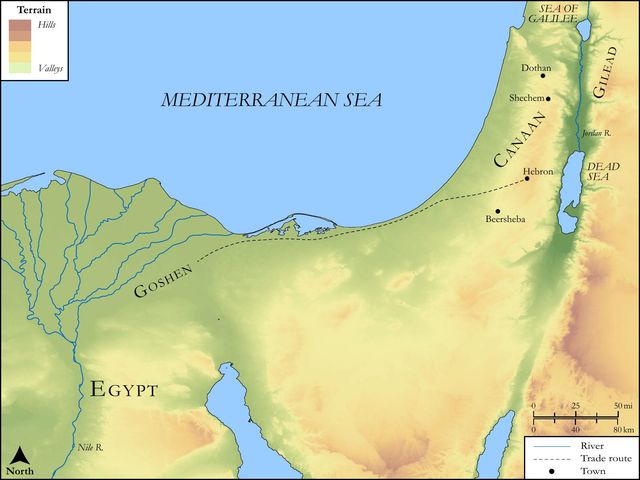
See on the biblical-era maps


Study this verse
Public-domain commentary
Matthew Henry
From his Commentary on the Whole Bible. Henry comments on passages, not single verses — this entry covers Genesis 42:21–28. His three-level outline is real structure in the source text, so it is rendered as structure.
Here is, I. The penitent reflection Joseph's brethren made upon the wrong they had formerly done to him, Gen 42:21. They talked the matter over in the Hebrew tongue, not suspecting that Joseph, whom they took for a native of Egypt, understood them, much less that he was the person they spoke of.
1.They remembered with regret the barbarous cruelty wherewith they persecuted him: We are verily guilty concerning our brother. We do not read that they said this during their three days' imprisonment; but now, when the matter had come to some issue and they saw themselves still embarrassed, now they began to relent. Perhaps Joseph's mention of the fear of God (Gen 42:18) put them upon consideration and extorted this reflection. Now see here,
(1.)The office of conscience; it is a remembrancer, to bring to mind things long since said and done, to show us wherein we have erred, though it was long ago, as the reflection here mentioned was above twenty years after the sin was committed. As time will not wear out the guilt of sin, so it will not blot out the records of conscience; when the guilt of this sin of Joseph's brethren was fresh they made light of it, and sat down to eat bread; but now, long afterwards, their consciences reminded them of it.
(2.)The benefit of affliction; they often prove the happy and effectual means of awakening conscience, and bringing sin to our remembrance, Job 13:26.
(3.)The evil of guilt concerning our brethren; of all their sins, it was this that conscience now reproached them for. Whenever we think we have wrong done us, we ought to remember the wrong we have done to others, Ecc 7:21, Ecc 7:22.
2.Reuben alone remembered, with comfort, that he had been an advocate for his brother, and had done what he could to prevent the mischief they did him (Gen 42:22): Spoke I not unto you, saying, Do not sin against the child? Note,
(1.)It is an aggravation of any sin that it was committed against admonitions.
(2.)When we come to share with others in their calamities, it will be a comfort to us if we have the testimony of our consciences for us that we did not share with them in their iniquities, but, in our places, witnessed against them. This shall be our rejoicing in the day of evil, and shall take out the sting.
II.Joseph's tenderness towards them upon this occasion.
He retired from them to weep, Gen 42:24. Though his reason directed that he should still carry himself as a stranger to them, because they were not as yet humbled enough, yet natural affection could not but work, for he was a man of a tender spirit. This represents the tender mercies of our God towards repenting sinners. See Jer 31:20, Since I spoke against him I do earnestly remember him still. See Jdg 10:16.
III.The imprisonment of Simeon, Gen 42:24.
He chose him for the hostage probably because he remembered him to have been his most bitter enemy, or because he observed him now to be least humbled and concerned; he bound him before their eyes to affect them all; or perhaps it is intimated that, though he bound him with some severity before them, yet afterwards, when they were gone, he took off his bonds.
IV.The dismission of the rest of them.
They came for corn, and corn they had; and not only so, but every man had his money restored in his sack's mouth. Thus Christ, our Joseph, gives out supplies without money and without price. Therefore the poor are invited to buy, Rev 3:17, Rev 3:18. This put them into great consternation (Gen 42:28): Their heart failed them, and they were afraid, saying one to another, What is this that God hath done to us?
1.It was really a merciful event; for I hope they had no wrong done to them when they had their money given them back, but a kindness; yet they were thus terrified by it. Note,
(1.)Guilty consciences are apt to take good providences in a bad sense, and to put wrong constructions even upon those things that make for them. They flee when none pursues.
(2.)Wealth sometimes brings as much care along with it as want does, and more too. If they had been robbed of their money, they could not have been worse frightened than they were now when they found their money in their sacks. Thus he whose ground brought forth plentifully said, What shall I do? Luk 12:17.
2.Yet in their circumstances it was very amazing. They knew that the Egyptians abhorred a Hebrew (Gen 43:32), and therefore, since they could not expect to receive any kindness from them, they concluded that this was done with a design to pick a quarrel with them, and the rather because the man, the lord of the land, had charged them as spies. Their own consciences also were awake, and their sins set in order before them; and this put them into confusion. Note,
(1.)When men's spirits are sinking every thing helps to sink them.
(2.)When the events of Providence concerning us are surprising it is good to enquire what it is that God has done and is doing with us, and to consider the operation of his hands.
Continue studying Genesis 42:26 across the web’s major study libraries — every link below opens this exact verse, chapter, or book on the destination site.
Read & Compare
 BibleGatewayThis verse in more than 200 translations and 70 languages.
 Bible.comThe YouVersion reader — hundreds of translations, reading plans, and highlights.
 ESV.orgCrossway's official English Standard Version reader.
 NET BibleThe NET translation with 60,000+ translators' notes on every rendering decision.
 STEP BibleTyndale House's free study tool — original text, vocabulary, and scholarly resources.
 BibliaLogos Bible Software's free web reader.
 USCCBThe New American Bible (Revised Edition) with the U.S. bishops' study notes.
Commentaries
 BibleHub CommentariesDozens of classic commentaries on this verse, gathered on one page.
 StudyLightMore than 100 commentary sets — the largest collection on the web.
 BibleRefPlain-English commentary on what this verse means, verse by verse.
 Enduring WordDavid Guzik's free commentary on this chapter, widely used by Bible teachers.
 Bible Study ToolsVerse commentary alongside Greek and Hebrew study aids.
Original Language & Research
- BibleHub InterlinearThe verse word by word — original language, transliteration, and English.
- BibleHub LexiconEvery word's original-language definition and Strong's entry.
 Blue Letter BibleDeep-study tools — Strong's numbers, concordance, and word studies.
 SefariaThe Hebrew text with Rashi and centuries of Jewish commentary.
Sermons, Hymns & Audio


TrulyRandomVerse is not affiliated with these sites and doesn’t control their content. They’re linked because they’re genuinely useful.
Summary
Genesis 42:26 records the departure of Joseph's ten brothers from Egypt, their donkeys laden with the grain they had purchased to alleviate the severe famine in Canaan. This moment marks a crucial turning point after their initial, unrecognized encounter with Joseph, who, as Egypt's governor, had accused them of espionage, demanded the presence of their youngest brother Benjamin, and secretly returned their money to their sacks, thereby setting in motion the next phase of God's intricate plan for reconciliation and divine revelation within Jacob's family.
Context
ShowHideLiterary Context
This verse is situated at the close of the brothers' first visit to Egypt, immediately following Joseph's complex instructions and actions. In Genesis 42:9-25, Joseph had accused them of being spies, imprisoned Simeon, and demanded they bring Benjamin to prove their honesty. Crucially, Joseph also commanded that their sacks be filled with grain and their money secretly returned, a detail that will be discovered in the very next verse, Genesis 42:27. Thus, Genesis 42:26 serves as the physical transition point, initiating their journey back to Canaan, laden not only with provisions but also with the heavy burden of Joseph's accusations, the absence of Simeon, and the daunting task of convincing Jacob to release Benjamin. It is a moment of physical departure that signifies the beginning of a profound internal and relational journey.
Historical & Cultural Context
The setting is ancient Egypt during a severe, multi-year famine that affected the entire region, as described in Genesis 41:56-57. Grain was the primary staple food, and its scarcity would have led to widespread suffering and death. Egypt, under Joseph's divinely inspired administration, was the only place with an abundance of stored grain, making it the sole source of relief for surrounding nations, including Canaan. The use of "asses" (donkeys) for transporting goods was common practice in Egypt and Canaan, as they were reliable pack animals capable of carrying substantial loads over long distances. The act of "lading" them with "corn" (grain) underscores the desperate need for provisions and the practical realities of survival during such a widespread crisis.
Key Themes
ShowHideGenesis 42:26 contributes to several overarching themes within the Joseph narrative and the book of Genesis. It highlights Divine Providence, as God's plan, initiated through Joseph's dreams in Genesis 37:5-11, is undeniably unfolding, even though the brothers are oblivious to Joseph's identity or God's hand in their circumstances. The verse also underscores the theme of Testing and Transformation, as Joseph's actions are designed not for revenge but to test his brothers' character and bring them to repentance for their past sin of selling him into slavery (Genesis 37:28). Furthermore, it sets the stage for the crucial theme of Reconciliation and Restoration of the Family, which is the ultimate goal of Joseph's elaborate plan, culminating in his self-revelation in Genesis 45:1-8.
Exposition and Analysis
ShowHideKey Word Analysis
ShowHideThis verb (H5375) means "to lift, to bear, to carry." In this context, it specifically refers to the act of loading or burdening the animals. It implies a significant weight and volume, emphasizing the substantial amount of grain the brothers acquired. The word also carries connotations of bearing a burden, which resonates with the emotional and spiritual weight the brothers were carrying due to Joseph's accusations and the unfolding events.
The term (H2543) refers specifically to a male donkey, often noted for its reddish-brown or dun color. Donkeys were the primary beasts of burden in the days of the patriarchs, essential for transport over long distances. Their presence here highlights the practical necessity of carrying large quantities of grain back to Canaan to sustain their large family during the famine.
This word (H7668) literally means "grain" or "victuals" (provisions). In the KJV, "corn" is a generic term for cereal grains like wheat or barley, not maize. Its inclusion underscores the life-sustaining nature of their purchase, directly addressing the famine's impact and highlighting Joseph's role as the provider of life-saving sustenance.
This primitive root (H3212) means "to walk" or "to go." Here, it signifies their physical movement away from Egypt, marking the beginning of their journey home. More than just a physical act, "departed" also implies a transition from one phase of Joseph's test to the next, as they carry with them the immediate consequences of their encounter and the seeds of future developments.
Verse Breakdown
ShowHide"And they laded their asses with the corn"
This clause describes the practical and laborious act of the brothers preparing for their journey. It signifies the successful acquisition of the much-needed grain, a testament to Joseph's provision and the brothers' initial purpose in coming to Egypt. The phrase emphasizes the physical burden of the grain, which was essential for their survival and that of their families in famine-stricken Canaan.
"and departed thence"
This simple phrase marks the physical departure of the brothers from Egypt. It represents the conclusion of their first encounter with Joseph and the commencement of their journey back to their father, Jacob. This departure is not merely a logistical act but the beginning of a journey fraught with anxiety, uncertainty, and the weight of Joseph's demands, particularly the requirement to bring Benjamin back to Egypt.
Literary Devices
ShowHideThe verse employs Conciseness to convey a significant moment with remarkable brevity, allowing the reader to infer the underlying tension and implications. There is profound Irony in the scene: the brothers, who once sold Joseph into slavery, are now utterly dependent on him for their survival, unknowingly bowing before him as he had dreamed years ago. The "corn" itself functions as Symbolism, representing not only physical sustenance but also the means by which Joseph's divine plan is being enacted. It is the very commodity that brings his brothers back to him, forcing them into a position of humility and dependence, paving the way for future Reconciliation.
Theological and Thematic Connections
ShowHideGenesis 42:26 encapsulates the unfolding of divine providence through human actions, even when those actions are driven by desperation or ignorance. The brothers, focused on the immediate need for survival and the daunting task set by the Egyptian governor, are unknowingly participating in God's grand design for their family's redemption. This journey, laden with grain, is also laden with the weight of past sin and the promise of future reconciliation, orchestrated by Joseph, who serves as God's instrument.
Reflection and Application
ShowHideGenesis 42:26 serves as a powerful reminder that God's sovereign plan often unfolds in ways we do not immediately comprehend. The brothers were consumed by their immediate concerns – the famine, Joseph's accusations, Simeon's imprisonment, and the demand for Benjamin – yet beneath it all, God was meticulously working out His redemptive purposes. For us, this highlights the importance of trusting God's unseen hand, especially when our circumstances seem chaotic, unfair, or overwhelming. It encourages us to look beyond the immediate trials to discern God's larger narrative of grace and restoration. This passage also implicitly calls us to consider our own past actions and the consequences they may have, reminding us that God can use even our deepest regrets and most challenging situations to bring about repentance, reconciliation, and profound spiritual growth within our lives and relationships.
Questions for Reflection
ShowHideFAQ
ShowHideWhat is meant by "corn" in Genesis 42:26?
ShowHideIn the King James Version, "corn" is a general term referring to any cereal grain, such as wheat or barley, which were staple crops in Egypt and Canaan. It does not refer to maize (Indian corn), which was unknown in that region at the time. The text indicates the brothers were loading their donkeys with the grain they had purchased to alleviate the famine in Canaan, highlighting the life-sustaining nature of their acquisition and the severity of the regional famine described in Genesis 41:56-57.
Why did Joseph put his brothers through such a difficult test?
ShowHideJoseph's actions were not motivated by revenge but by a divine purpose to test his brothers' character, bring them to repentance, and ultimately reconcile his family. By demanding Benjamin's presence and creating a situation of distress (including the secret return of their money in Genesis 42:27-28), Joseph forced his brothers to confront their past sin of selling him into slavery (Genesis 37:28) and to demonstrate a change of heart, particularly their care for their youngest brother and their aged father, Jacob. This painful process was essential for their spiritual and relational restoration, culminating in Joseph's emotional self-revelation in Genesis 45:1-8.
Christ-Centered Fulfillment
ShowHideThe departure of Joseph's brothers, laden with grain and burdened by the unknown, profoundly foreshadows the redemptive work of Jesus Christ. Joseph, though rejected and betrayed by his own family (Genesis 37:28), becomes the unrecognised savior who provides life-sustaining provisions and ultimately orchestrates reconciliation for his estranged family, saving them from famine. This mirrors Christ, who, though rejected and crucified by His own people (John 1:11), becomes the ultimate provider of spiritual sustenance and salvation for all humanity. The brothers' journey, marked by their sin and their unwitting encounter with their deliverer, reflects humanity's condition: estranged from God due to sin, yet unknowingly approaching the only One who can provide true life and reconciliation through His suffering, death, and resurrection (Romans 5:8-10). Just as Joseph orchestrates a painful but redemptive process to bring his brothers to repentance and restoration, Christ's work on the cross brings about the possibility of repentance and reconciliation with God, transforming brokenness into a testament of divine grace and forgiveness for all who believe (2 Corinthians 5:18-19).