


Genesis 42:11
Bible text: King James Version (1769 Blayney text) · Public domain
Bible text: Berean Standard Bible · Public domain
Bible text: American Standard Version (1901) · Public domain
Bible text: World English Bible, Messianic edition · Public domain
Bible text: Geneva Bible (1599) · Public domain
Bible text: Young's Literal Translation · Public domain
- כֻּלָּנוּku·La·nuall of usH3605N-msc ¦ 1cpNoun Singular Masculine Constructכֻּלָּall ofנוּus
- בְּנֵיbe·Nei[are] sons ofH1121N-mpcNoun Plural Masculine Construct
- אִישׁ'isha manH376N-msNoun Singular Masculine Absolute
- אֶחָד'e·ChadoneH259Adj-fsAdjective Numerical Singular Feminine Absolute
- נָחְנוּNa·che·nuweH5168Pro-1cpPronoun Personal 1st Plural common gender
- כֵּנִיםke·Nim[are] honestH3651Adj-mpAdjective Plural Masculine Absolute
- אֲנַחְנוּ'a·Nach·nuweH587Pro-1cpPronoun Personal 1st Plural common gender
- לֹאlo'notH3808NegParticle Negative
- הָיוּha·Yuthey areH1961V-Qal-Perf-3cpVerb Qal Perfect 3rd Plural common gender
- עֲבָדֶיךָ'a·va·Dei·khayour servantsH5650N-mpc ¦ 2msNoun Plural Masculine Constructעֲבָדֶיservantsךָyour
- מְרַגְּלִיםme·ra·ge·LimspiesH7270V-Piel-Prtcpl-mpVerb Piel Participle Plural Masculine Absolute
English is a literal word-by-word gloss of the Hebrew, not the KJV's wording. Why?
This is the original text the KJV's translators worked from — each Hebrew word with its own literal English meaning in this verse, prepared by scholars at Tyndale House, Cambridge. The KJV translates whole sentences, not word by word, so its wording differs: one Hebrew word can become several English words, and the KJV may choose “the LORD” where the gloss reads “Yahweh”. Both are faithful — they answer different questions. For the KJV's own rendering, switch to the KJV text.
Details
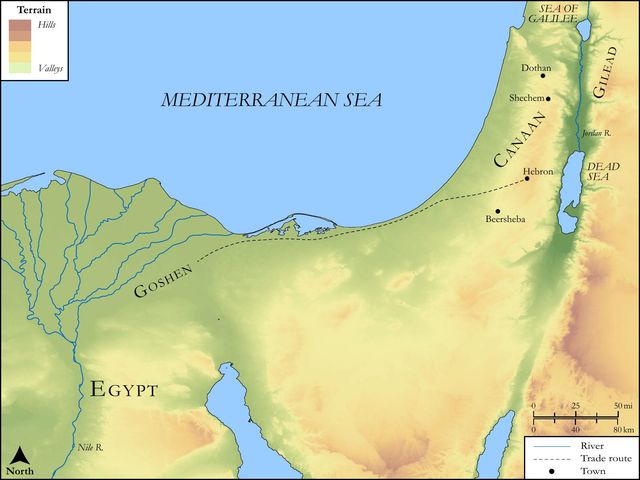
See on the biblical-era maps


Study this verse
Public-domain commentary
Matthew Henry
From his Commentary on the Whole Bible. Henry comments on passages, not single verses — this entry covers Genesis 42:7–20. His two-level outline is real structure in the source text, so it is rendered as structure.
We may well wonder that Joseph, during the twenty years that he had now been in Egypt, especially during the last seven years that he had been in power there, never sent to his father to acquaint him with his circumstances; nay, it is strange that he who so often went throughout all the land of Egypt (Gen 41:45, Gen 41:46) never made an excursion to Canaan, to visit his aged father, when he was in the borders of Egypt, that lay next to Canaan. Perhaps it would not have been above three or four days' journey for him in his chariot. It is a probable conjecture that his whole management of himself in this affair was by special direction from Heaven, that the purpose of God concerning Jacob and his family might be accomplished. When Joseph's brethren came, he knew them by many a satisfactory token, but they knew not him, little thinking to find him there, Gen 42:8. He remembered the dreams (Gen 42:9), but they had forgotten them. The laying up of God's oracles in our hearts will be of excellent use to us in all our conduct. Joseph had an eye to his dreams, which he knew to be divine, in his carriage towards his brethren, and aimed at the accomplishment of them and the bringing of his brethren to repentance for their former sins; and both these points were gained.
I.He showed himself very rigorous and harsh with them.
The very manner of his speaking, considering the post he was in, was enough to frighten them; for he spoke roughly to them, Gen 42:7. He charged them with bad designs against the government (Gen 42:9), treated them as dangerous persons, saying, You are spies, and protesting by the life of Pharaoh that they were so, Gen 42:16. Some make this an oath, others make it no more than a vehement asseveration, like that, as thy soul liveth; however it was more than yea, yea, and nay, nay, and therefore came of evil. Note, Bad words are soon learned by converse with those that use them, but not so soon unlearned. Joseph, by being much at court, got the courtier's oath, By the life of Pharaoh, perhaps designing hereby to confirm his brethren in their belief that he was an Egyptian, and not an Israelite. They knew this was not the language of a son of Abraham. When Peter would prove himself no disciple of Christ, he cursed and swore. Now why was Joseph thus hard upon his brethren? We may be sure it was not from a spirit of revenge, that he might now trample upon those who had formerly trampled upon him; he was not a man of that temper. But,
1.It was to enrich his own dreams, and complete the accomplishment of them.
2.It was to bring them to repentance.
3.It was to get out of them an account of the state of their family, which he longed to know: they would have discovered him if he had asked as a friend, therefore he asks as a judge. Not seeing his brother Benjamin with them, perhaps he began to suspect that they had made away with him too, and therefore gives them occasion to speak of their father and brother. Note, God in his providence sometimes seems harsh with those he loves, and speaks roughly to those for whom yet he has great mercy in store.
II.They, hereupon, were very submissive.
They spoke to him with all the respect imaginable: Nay, my lord (Gen 42:10) - a great change since they said, Behold, this dreamer comes. They very modestly deny the charge: We are no spies. They tell him their business, that they came to buy food, a justifiable errand, and the same that many strangers came to Egypt upon at this time. They undertake to give a particular account of themselves and their family (Gen 42:13), and this was what they wanted.
III.He clapped them all up in prison for three days, Gen 42:17.
Thus God deals with the souls he designs for special comfort and honour; he first humbles them, and terrifies them, and brings them under a spirit of bondage, and then binds up their wounds by the Spirit of adoption.
IV.He concluded with them, at last, that one of them should be left as a hostage, and the rest should go home and fetch Benjamin.
It was a very encouraging word he said to them (Gen 42:18): I fear God; as if he had said, "You may assure yourselves I will do you no wrong; I dare not, for I know that, high as I am, there is one higher than I." Note, With those that fear God we have reason to expect fair dealing. The fear of God will be a check upon those that are in power, to restrain them from abusing their power to oppression and tyranny. Those that have no one else to stand in awe of ought to stand in awe of their own consciences. See Neh 5:15, So did not I, because of the fear of God.
Continue studying Genesis 42:11 across the web’s major study libraries — every link below opens this exact verse, chapter, or book on the destination site.
Read & Compare
 BibleGatewayThis verse in more than 200 translations and 70 languages.
 Bible.comThe YouVersion reader — hundreds of translations, reading plans, and highlights.
 ESV.orgCrossway's official English Standard Version reader.
 NET BibleThe NET translation with 60,000+ translators' notes on every rendering decision.
 STEP BibleTyndale House's free study tool — original text, vocabulary, and scholarly resources.
 BibliaLogos Bible Software's free web reader.
 USCCBThe New American Bible (Revised Edition) with the U.S. bishops' study notes.
Commentaries
 BibleHub CommentariesDozens of classic commentaries on this verse, gathered on one page.
 StudyLightMore than 100 commentary sets — the largest collection on the web.
 BibleRefPlain-English commentary on what this verse means, verse by verse.
 Enduring WordDavid Guzik's free commentary on this chapter, widely used by Bible teachers.
 Bible Study ToolsVerse commentary alongside Greek and Hebrew study aids.
Original Language & Research
- BibleHub InterlinearThe verse word by word — original language, transliteration, and English.
- BibleHub LexiconEvery word's original-language definition and Strong's entry.
 Blue Letter BibleDeep-study tools — Strong's numbers, concordance, and word studies.
 SefariaThe Hebrew text with Rashi and centuries of Jewish commentary.
Sermons, Hymns & Audio


TrulyRandomVerse is not affiliated with these sites and doesn’t control their content. They’re linked because they’re genuinely useful.
Summary
Genesis 42:11 records the desperate plea of Joseph's brothers, who, facing a severe accusation of espionage from the powerful Egyptian governor they do not recognize as their long-lost sibling, vehemently assert their shared lineage and honest intentions, declaring, "We are all one man's sons; we are true men, thy servants are no spies." This pivotal moment highlights their vulnerability and underscores the dramatic irony of their situation as they unknowingly stand before the brother they betrayed.
Context
ShowHideLiterary Context
This verse is embedded within the dramatic unfolding of Genesis chapter 42, which initiates the second major phase of the Joseph narrative. Following the severe famine that grips the entire region, Jacob sends his ten eldest sons to Egypt to purchase grain. Upon their arrival, they encounter Joseph, now the powerful vizier, who immediately recognizes them but chooses to conceal his identity. Joseph's accusation in Genesis 42:9, branding them as spies, is a calculated move designed to test their character, evoke their remorse, and ultimately compel them to bring Benjamin, his full brother, to Egypt, thereby setting the stage for the fulfillment of his prophetic dreams from Genesis 37:7. The brothers' collective response in this verse is a fervent and desperate self-defense, emphasizing their shared heritage and honest intentions within this unfolding divine drama.
Historical & Cultural Context
During periods of widespread famine, Egypt, with its predictable Nile floods and advanced agricultural systems, often served as a granary for the surrounding nations. People from surrounding lands, including Canaan, would travel there to buy food. The accusation of "spies" was a serious charge among the nations of that day, often punishable by death, as it implied an intent to gather intelligence for a foreign power, posing a direct threat to national security. The concept of family lineage and tribal identity was paramount; being "one man's sons" implied a shared loyalty, trustworthiness, and a common purpose, making the idea of one brother spying against another, or a family collectively engaging in espionage, culturally incongruous. Furthermore, the practice of a powerful official testing foreign visitors was not uncommon, serving both as a security measure and a display of authority.
Key Themes
ShowHideThe verse significantly contributes to several overarching themes in the Joseph narrative and the book of Genesis. It highlights the theme of Divine Providence, demonstrating how God orchestrates human actions and circumstances, even seemingly negative ones like Joseph's harshness, to fulfill His ultimate redemptive plan for Israel, as seen in Genesis 50:20. The brothers' desperate plea also underscores the theme of Guilt and Repentance, as their current distress is a direct consequence of their past sin against Joseph, pushing them towards self-examination and eventual contrition. Furthermore, the emphasis on their shared lineage, "one man's sons," foreshadows the eventual Reconciliation and Restoration of the Family of Israel, a central goal of Joseph's testing, which culminates in Genesis chapter 45.
Exposition and Analysis
ShowHideKey Word Analysis
ShowHideFrom בָּנָה; a son (as a builder of the family name), in the widest sense (of literal and figurative relationship, including grandson, subject, nation, quality or condition, etc.). Here, it emphasizes their direct, shared paternal lineage, implying a common identity and loyalty. By stating they are "one man's sons," they appeal to the fundamental bond of kinship as evidence against the charge of being spies, suggesting that family members would not act against the interests of their own.
A numeral from אָחַד; properly, united, i.e. one; or (as an ordinal) first. In this context, "one man's" stresses the singular, unifying origin of all the brothers. It reinforces their collective identity and shared heritage, serving as a powerful counter-argument to the idea that they would be disloyal or deceptive. Their unity in origin is presented as proof of their unity in purpose—to buy grain, not to spy.
From כּוּן; properly, set upright; hence (figuratively as adjective) just; but usually (as adverb or conjunction) rightly or so. The KJV translates this as "true," conveying honesty, sincerity, and uprightness. By declaring themselves "true men," the brothers assert their integrity and straightforward intentions, directly refuting the accusation of being deceitful spies. This word emphasizes their moral character and their desire to be perceived as honorable individuals.
Verse Breakdown
ShowHide"We are all one man's sons;"
This initial clause serves as the brothers' primary defense, emphasizing their shared, singular paternal origin. It is an appeal to their common family identity and the inherent loyalty expected within such a close-knit group. The implication is that men from the same respectable family would not engage in deceitful activities like espionage, especially against a foreign power when their sole purpose is to procure food for survival. This statement highlights the irony of their situation, as they are indeed sons of one man, Jacob, and unknowingly stand before their own brother.
"we are true men,"
Following their appeal to lineage, this clause directly addresses the accusation of being spies by asserting their moral character. The phrase "true men" signifies their honesty, sincerity, and uprightness. They are vehemently denying any duplicity or hidden motives, affirming that their intentions in coming to Egypt are transparent and honorable. This declaration stands in stark contrast to the deceptive nature of spies, underscoring their desire to be perceived as trustworthy and reliable individuals.
"thy servants are no spies."
This final clause is a direct, unequivocal denial of the accusation. By referring to themselves as "thy servants," they adopt a posture of humility and submission to the governor's authority, further attempting to convey their peaceful and non-threatening intentions. The explicit negation "no spies" leaves no room for ambiguity regarding their purpose, serving as a desperate plea to avert the severe consequences associated with such a grave charge.
Literary Devices
ShowHideThe verse is rich in Irony, as Joseph's brothers, in their desperate plea of innocence, unknowingly stand before the very brother they betrayed years ago. Their assertion of being "one man's sons" is profoundly ironic, given their past disunity and cruelty towards Joseph. There is also a strong Contrast between their self-proclaimed identity as "true men" and the accusation of being "spies," highlighting the tension and misunderstanding of the scene. The overall tone is one of Pleading and Supplication, as the brothers, in a vulnerable position, attempt to convince a powerful authority figure of their integrity through their words.
Theological and Thematic Connections
ShowHideGenesis 42:11 serves as a powerful illustration of God's intricate and often mysterious work in human history, demonstrating His sovereign hand even through the fractured relationships and misunderstandings of individuals. The brothers' desperate declaration of truth, born out of fear and confusion, is part of a larger divine tapestry designed to bring about repentance, reconciliation, and the preservation of God's covenant people. This narrative underscores that God's purposes are often realized through challenging circumstances, where human sin and suffering are ultimately redeemed for good, shaping character and preparing hearts for deeper revelation.
Reflection and Application
ShowHideGenesis 42:11 offers profound insights into the human condition, reminding us of the innate desire to be seen as truthful and trustworthy, especially when facing accusations. The brothers' desperate plea highlights the importance of integrity in our interactions and the weight of our reputation. For us, this passage encourages self-examination: are we living lives that reflect truth and honesty, even when it's difficult? Furthermore, it serves as a powerful reminder that God often uses challenging, confusing, or even seemingly unjust circumstances to bring about His greater purposes. Just as Joseph's brothers were unaware of the divine orchestration behind their trials, we too must learn to trust in God's sovereign plan, even when our immediate circumstances are bewildering or painful. This narrative invites us to cultivate patience, humility, and a willingness to allow God to work through our difficulties for our spiritual growth and for the ultimate good of His kingdom, knowing that He is always at work, even when His hand is hidden.
Questions for Reflection
ShowHideFAQ
ShowHideWhy did Joseph accuse his brothers of being spies?
ShowHideJoseph's accusation of his brothers being spies was not based on genuine belief, but rather a deliberate and strategic maneuver. His primary motivations were to test their character, determine if they had changed from the cruel and deceitful men who sold him into slavery (Genesis 37:28), and to compel them to bring his full brother, Benjamin, to Egypt. This was essential for the fulfillment of his prophetic dreams (Genesis 37:5-10) and to orchestrate a complete family reunion and reconciliation, which was crucial for the preservation of the nascent nation of Israel during the severe famine. Joseph used this "test" to gauge their integrity and to set in motion the events that would lead to God's redemptive plan for his family.
Christ-Centered Fulfillment
ShowHideThe narrative of Joseph, particularly the scene in Genesis 42:11, serves as a profound and compelling type of Christ. Joseph, though rejected by his own brothers (John 1:11) and subjected to immense suffering and humiliation, is ultimately exalted to a position of power, becoming the unexpected savior who preserves the lives of his family and the lineage of Israel during a time of famine. Similarly, Jesus, the Son of God, was rejected by His own people, humbled Himself to the point of death on a cross (Philippians/2-7-8), yet was exalted by God to be Lord and Christ. He is the ultimate deliverer and preserver of humanity, providing spiritual sustenance and eternal life as the true "Bread of Life" (John 6:35). Joseph's hidden identity, his testing of his brothers, and his eventual revelation leading to reconciliation mirror Christ's first coming in humility, His testing of humanity through His teachings and life, and His ultimate revelation as Lord and Savior, bringing about reconciliation between God and humanity (Romans 5:10; Colossians 1:20). Just as Joseph used his power to bring about good from evil, Christ's sacrifice on the cross transformed the ultimate evil into the ultimate good, offering redemption and new life to all who believe.