


Genesis 42:33
Bible text: King James Version (1769 Blayney text) · Public domain
Bible text: King James Version with Strong's numbers · Public domain
Bible text: Berean Standard Bible · Public domain
Bible text: American Standard Version (1901) · Public domain
Bible text: World English Bible, Messianic edition · Public domain
Bible text: Geneva Bible (1599) · Public domain
Bible text: Young's Literal Translation · Public domain
- וַיֹּאמֶרvai·Yo·merand he saidH559Conj-w ¦ V-Qal-ConsecImperf-3msVerb Qal Consecutive Imperfect 3rd Singular Masculineוַandיֹּאמֶרhe said
- אֵלֵינוּ'e·Lei·nuto usH413Prep ¦ 1cpPreposition Definiteאֵלֵיtoנוּus
- הָאִישׁha·'Ishthe manH376Art ¦ N-msNoun Singular Masculine Absoluteהָtheאִישׁman
- אֲדֹנֵי'a·do·Nei[the] lord<s> ofH113N-mpcNoun Plural Masculine Construct
- הָאָרֶץha·'A·retzthe landH776Art ¦ N-fsNoun Singular Feminine Absoluteהָtheאָרֶץland
- בְּזֹאתbe·Zotby thisH2063Prep-b ¦ PrtParticle Demonstrativeבְּbyזֹאתthis
- אֵדַע'e·Da'I will knowH3045V-Qal-Imperf-1csVerb Qal Imperfect 1st Singular common gender
- כִּיkithatH3588PrtParticle Conditional
- כֵנִיםkhe·Nim[are] honestH3651Adj-mpAdjective Plural Masculine Absolute
- אַתֶּם'a·TemyouH859Pro-2mpPronoun Personal 2nd Plural Masculine
- אֲחִיכֶם'a·chi·Khemyour brotherH251N-msc ¦ 2mpNoun Singular Masculine Constructאֲחִיbrotherכֶםyour
- הָאֶחָדha·'e·Chad<the> oneH259Art ¦ Adj-fsAdjective Numerical Singular Feminine Absoluteהָ<the>אֶחָדone
- הַנִּיחוּha·Ni·chuleaveH5117V-Hiphil-Imp-2mpVerb Hiphil Imperative 2nd Plural Masculine
- אִתִּי'i·Tiwith meH854Prep ¦ 1csPreposition Definiteאִתִּwithיme
- וְאֶתve·'Etand <obj.>H853Conj-w ¦ DirObjMParticle Object Indicatorוְandאֶת<obj.>
- רַעֲבוֹןra·'a·Von[the] hunger ofH7459N-mscNoun Singular Masculine Construct
- בָּתֵּיכֶםba·tei·Khemyour householdsH1004N-mpc ¦ 2mpNoun Plural Masculine Constructבָּתֵּיhouseholdsכֶםyour
- קְחוּke·ChutakeH3947V-Qal-Imp-2mpVerb Qal Imperative 2nd Plural Masculine
- וָלֵכוּva·Le·khuand goH1980Conj-w ¦ V-Qal-Imp-2mpVerb Qal Imperative 2nd Plural Masculineוָandלֵכוּgo
English is a literal word-by-word gloss of the Hebrew, not the KJV's wording. Why?
This is the original text the KJV's translators worked from — each Hebrew word with its own literal English meaning in this verse, prepared by scholars at Tyndale House, Cambridge. The KJV translates whole sentences, not word by word, so its wording differs: one Hebrew word can become several English words, and the KJV may choose “the LORD” where the gloss reads “Yahweh”. Both are faithful — they answer different questions. For the KJV's own rendering, switch to the KJV text.
Details
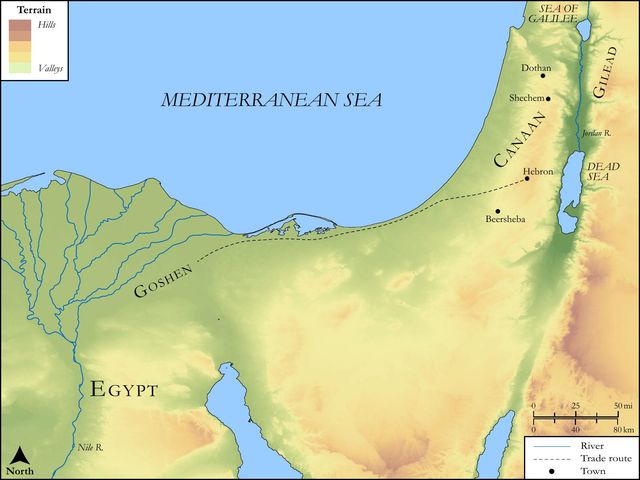
See on the biblical-era maps


Study this verse
Public-domain commentary
Matthew Henry
From his Commentary on the Whole Bible. Henry comments on passages, not single verses — this entry covers Genesis 42:29–38.
Here is, 1. The report which Jacob's sons made to their father of the great distress they had been in in Egypt; how they had been suspected, and threatened, and obliged to leave Simeon a prisoner there, till they should bring Benjamin with them thither. Who would have thought of this when they left home? When we go abroad we should consider how many sad accidents, that we little think of, may befall us before we return home. We know not what a day may bring forth; we ought therefore to be always ready for the worst. 2. The deep impression this made upon the good man. The very bundles of money which Joseph returned, in kindness to his father, frightened him (Gen 42:35); for he concluded it was done with some mischievous design, or perhaps suspected his own sons to have committed some offence, and so to have run themselves into a praemunire - a penalty, which is intimated in what he says (Gen 42:36): Me have you bereaved. He seems to lay the fault upon them; knowing their characters, he feared they had provoked the Egyptians, and perhaps forcibly, or fraudulently, brought home their money. Jacob is here much out of temper. (1.) He has very melancholy apprehensions concerning the present state of his family: Joseph is not, and Simeon is not; whereas Joseph was in honour and Simeon in the way to it. Note, We often perplex ourselves with our own mistakes, even in matters of fact. True griefs may arise from false intelligence and suppositions, Sa2 13:31. Jacob gives up Joseph for gone, and Simeon and Benjamin as being in danger; and he concludes, All these things are against me. It proved otherwise, that all these were for him, were working together for his good and the good of his family: yet here he thinks them all against him. Note, Through our ignorance and mistake, and the weakness of our faith, we often apprehend that to be against us which is really for us. We are afflicted in body, estate, name, and relations; and we think all these things are against us, whereas these are really working for us the weight of glory. (2.) He is at present resolved that Benjamin shall not go down. Reuben will undertake to bring him back in safety (Gen 42:37), not so much as putting in, If the Lord will, nor expecting the common disasters of travellers; but he foolishly bids Jacob slay his two sons (which, it is likely, he was very proud of) if he brought him not back; as if the death of two grandsons could satisfy Jacob for the death of a son. No, Jacob's present thoughts are, My son shall not go down with you. He plainly intimates a distrust of them, remembering that he never saw Joseph since he had been with them; therefore, "Benjamin shall not go with you, by the way in which you go, for you will bring down my gray hairs with sorrow to the grave." Note, It is bad with a family when children conduct themselves so ill that their parents know not how to trust them.
Continue studying Genesis 42:33 across the web’s major study libraries — every link below opens this exact verse, chapter, or book on the destination site.
Read & Compare
 BibleGatewayThis verse in more than 200 translations and 70 languages.
 Bible.comThe YouVersion reader — hundreds of translations, reading plans, and highlights.
 ESV.orgCrossway's official English Standard Version reader.
 NET BibleThe NET translation with 60,000+ translators' notes on every rendering decision.
 STEP BibleTyndale House's free study tool — original text, vocabulary, and scholarly resources.
 BibliaLogos Bible Software's free web reader.
 USCCBThe New American Bible (Revised Edition) with the U.S. bishops' study notes.
Commentaries
 BibleHub CommentariesDozens of classic commentaries on this verse, gathered on one page.
 StudyLightMore than 100 commentary sets — the largest collection on the web.
 BibleRefPlain-English commentary on what this verse means, verse by verse.
 Enduring WordDavid Guzik's free commentary on this chapter, widely used by Bible teachers.
 Bible Study ToolsVerse commentary alongside Greek and Hebrew study aids.
Original Language & Research
- BibleHub InterlinearThe verse word by word — original language, transliteration, and English.
- BibleHub LexiconEvery word's original-language definition and Strong's entry.
 Blue Letter BibleDeep-study tools — Strong's numbers, concordance, and word studies.
 SefariaThe Hebrew text with Rashi and centuries of Jewish commentary.
Sermons, Hymns & Audio


TrulyRandomVerse is not affiliated with these sites and doesn’t control their content. They’re linked because they’re genuinely useful.
Summary
Genesis 42:33 captures a pivotal moment in Joseph's intricate test of his brothers, where, disguised as the powerful Egyptian vizier, he demands one brother remain as a hostage in Egypt. This condition is presented as the definitive proof of their honesty regarding their claims of being "true men" and of their intention to return with their youngest brother, Benjamin. While seemingly harsh, this strategic command is a crucial step in Joseph's divinely orchestrated plan to assess his brothers' transformation, ensure the safe arrival of Benjamin, and ultimately facilitate the reconciliation and preservation of Jacob's entire family amidst a devastating famine.
Context
ShowHideLiterary Context
Genesis 42:33 is nestled within the dramatic and emotionally charged narrative of Joseph's reunion with his brothers, years after their betrayal. The preceding verses detail the brothers' initial journey to Egypt seeking grain, their encounter with Joseph (whom they do not recognize), and Joseph's initial accusations of espionage. Joseph's demand for Benjamin's presence, first hinted at in Genesis 42:15-16, is reiterated and solidified in this verse, serving as the central condition for their proving their "truthfulness." This sets the stage for the brothers' agonizing deliberation, their eventual return to Canaan, and the subsequent events that will bring Jacob and Benjamin to Egypt, ultimately leading to Joseph's revelation and the family's reconciliation.
Historical & Cultural Context
The severe famine gripping "all the face of the earth" (Genesis 41:56) provides the dire backdrop for the brothers' journey to Egypt, which, under Joseph's wise administration, was the only land with abundant grain. In the lands of the patriarchs, such widespread famines were catastrophic, often leading to mass migrations and societal collapse. The practice of taking hostages or requiring a guarantee for an agreement was a well-established diplomatic and legal custom. A powerful ruler, like Joseph (as the vizier), would demand a family member as surety to ensure compliance, loyalty, or the return of a party. This was not merely an arbitrary act but a recognized means of securing trust and obligation in a world without formal international treaties or rapid communication.
Key Themes
ShowHideThis verse powerfully contributes to several overarching themes in Genesis. It highlights Divine Sovereignty and Providence, demonstrating how God orchestrates human events, even suffering and deception, to fulfill His redemptive purposes, as seen in Joseph's rise to power (Genesis 45:7-8). The demand for a hostage is a crucial element in Joseph's Test of Character and Transformation, forcing his brothers to confront their past actions and reveal whether they have developed genuine familial loyalty and integrity, particularly concerning Benjamin, whom Jacob cherishes (Genesis 44:20). It also underscores the Consequences of Sin and the Path to Reconciliation, showing the arduous journey required for the brothers to acknowledge their guilt and for healing to occur within the fractured family.
Exposition and Analysis
ShowHideGenesis 42:33 encapsulates the stringent terms Joseph imposes on his brothers, designed to probe their character and set in motion the next phase of his intricate plan.
Key Word Analysis
ShowHideA primitive root meaning "to ascertain by seeing," but used in a great variety of senses including "to discern," "to perceive," "to be aware," and "to comprehend." Here, Joseph's use of "know" goes beyond mere factual verification; he seeks a deep, experiential understanding of their true nature, whether they are genuinely changed men capable of loyalty and compassion, unlike their past selves.
From a root meaning "set upright"; figuratively, "just." As an adverb or conjunction, it often means "rightly" or "so." In this context, "true men" (כֵּנִים, kēnim) signifies not just honesty in their immediate statements, but uprightness, integrity, and trustworthiness of character. Joseph is testing their moral fiber, seeking evidence of a profound shift from the deceitful individuals who conspired against him.
A primitive root meaning "to deposit"; by implication, "to allow to stay." This word emphasizes the deliberate act of leaving one of the brothers behind as a surety. It implies a forced separation, a calculated move by Joseph to secure the return of the others and, more importantly, the arrival of Benjamin, ensuring the complete family unit would eventually come to Egypt.
Verse Breakdown
ShowHide"And the man, the lord of the country, said unto us"
This phrase establishes the power dynamic. Joseph, though their brother, is perceived by them as a formidable, authoritative Egyptian official—the "lord of the country." This perception is critical to the brothers' fear and compliance, as they are entirely unaware of his true identity and the redemptive purpose behind his commands.
"Hereby shall I know that ye [are] true [men]"
This is the core of Joseph's test. He is not merely seeking verification of their current claims of being honest men and having a youngest brother; he is probing their integrity and character. The demand for a hostage is the crucible through which their "truthfulness" will be revealed, forcing them to demonstrate a trustworthiness and familial loyalty they conspicuously lacked when they sold Joseph into slavery.
"leave one of your brethren [here] with me, and take [food for] the famine of your households, and be gone"
This clause outlines the specific, severe conditions. The requirement to leave a brother (Simeon, as later revealed in Genesis 42:24) as a hostage ensures their return, particularly with Benjamin. This act places immense pressure on them, forcing them to confront the gravity of their situation and the potential loss of another brother. Simultaneously, Joseph's permission to take food for their starving families demonstrates a blend of strict justice and compassionate provision, highlighting his underlying desire for their well-being and the preservation of his family.
Literary Devices
ShowHideThe passage employs several significant literary devices. Irony is prominent, as Joseph, the very brother they betrayed, now holds their lives and the fate of their families in his hands, unbeknownst to them. He is the one testing their "truthfulness," a quality they utterly lacked in their dealings with him. Suspense is masterfully built through Joseph's veiled identity and his seemingly arbitrary demands, leaving both the brothers and the reader uncertain of his true intentions. The demand for a hostage also functions as Foreshadowing, hinting at the future events that will compel the brothers to return with Benjamin, leading to further trials and ultimately, the grand revelation and reconciliation. The "famine of your households" serves as a powerful Motif, constantly reminding the brothers of the dire stakes and the urgency of their mission, driving the narrative forward.
Theological and Thematic Connections
ShowHideGenesis 42:33 is a profound illustration of God's intricate and often mysterious ways of working through human circumstances to achieve His divine purposes. Joseph's actions, though appearing as human strategy and even manipulation, are deeply embedded in God's sovereign plan to preserve the nascent nation of Israel and fulfill His covenant promises to Abraham, Isaac, and Jacob. The severe test imposed on the brothers serves as a refining fire, designed not to punish them vindictively, but to bring them to a place of genuine repentance, self-awareness, and familial reconciliation, thereby preparing them to be the progenitors of a righteous nation. This passage underscores that God often uses challenging, uncomfortable, and even seemingly unjust situations to expose sin, cultivate character, and ultimately deliver His people.
Reflection and Application
ShowHideGenesis 42:33 offers profound insights into how God works through challenging circumstances to achieve His redemptive purposes. Joseph's test, though difficult and emotionally charged for his brothers, was ultimately for their good and the preservation of their family. Similarly, we often encounter situations that test our integrity, loyalty, and faith, revealing deeper truths about our character and relationships. These trials, while uncomfortable, can serve as refining fires, prompting us to confront our past failings, grow in virtue, and strengthen our trust in God's sovereign hand. The passage also underscores the enduring importance of truthfulness and integrity in all our interactions, as these qualities are foundational to building and restoring trust, paving the way for healing and reconciliation in broken relationships. It reminds us that God's plans often unfold in ways we don't immediately understand, but His ultimate goal is always our good and the advancement of His kingdom.
Questions for Reflection
ShowHideFAQ
ShowHideWhy did Joseph not reveal himself immediately to his brothers?
ShowHideJoseph's primary objective was not merely to reunite with his family but to test his brothers' character and discern if they had truly changed since they sold him into slavery. He needed to ensure their repentance, their genuine concern for their aged father Jacob, and their youngest brother Benjamin, before revealing his identity. This was crucial for the future stability and integrity of the family of Israel, ensuring that the past patterns of jealousy and betrayal would not resurface and that the family could be truly reconciled and preserved for God's redemptive plan (Genesis 45:5-8).
Does Joseph's demand for a hostage reflect a recognized practice among the nations of that day?
ShowHideYes, the practice of holding a hostage was a recognized and common method in the diplomacy and legal proceedings of the nations of that day, as when Jehoash king of Israel took hostages and returned to Samaria. It served as a guarantee for the return of a party, the fulfillment of an agreement, or as a surety for good behavior. Joseph's actions were consistent with the customs of his time and place, lending credibility to his disguise as an Egyptian official and ensuring the brothers' compliance and eventual return with Benjamin. This practice is attested in various ancient texts and archaeological findings from the period.
Christ-Centered Fulfillment
ShowHideJoseph, in his suffering, exaltation, and ultimate role as a preserver of life, serves as a profound type of Christ. Like Joseph, Christ was rejected and betrayed by His own brethren (the Jewish people, as seen in John 1:11) yet ascended to a position of ultimate authority and power at the right hand of God (Ephesians 1:20-21). Joseph's actions in Genesis 42:33, though seemingly harsh, were driven by a redemptive purpose: to test, refine, and ultimately save his family from famine, bringing them into a place of provision and reconciliation. Similarly, Christ, through His suffering and death, tested humanity's sinfulness and offered the ultimate provision for spiritual famine. His "demands" for repentance and faith (Mark 1:15), though challenging, are designed to bring about a deeper transformation in our character, leading us to true reconciliation with God (2 Corinthians 5:18-19) and eternal life, just as Joseph's test led his brothers to repentance and the family's reunification in Egypt, foreshadowing the greater spiritual reunion found in Christ.