


Genesis 42:32
Bible text: King James Version (1769 Blayney text) · Public domain
Bible text: Berean Standard Bible · Public domain
Bible text: American Standard Version (1901) · Public domain
Bible text: World English Bible, Messianic edition · Public domain
Bible text: Geneva Bible (1599) · Public domain
Bible text: Young's Literal Translation · Public domain
- שְׁנֵיםshe·neim[are] two [plus]H8147Adj-cdAdjective Numerical Dual common gender Absolute
- עָשָׂר'a·SartenH6240Adj-csAdjective Numerical Singular common gender Absolute
- אֲנַחְנוּ'a·Nach·nuweH587Pro-1cpPronoun Personal 1st Plural common gender
- אַחִים'a·ChimbrothersH251N-mpNoun Plural Masculine Absolute
- בְּנֵיbe·Neisons ofH1121N-mpcNoun Plural Masculine Construct
- אָבִינוּ'a·Vi·nuour fatherH1N-msc ¦ 1cpNoun Singular Masculine Constructאָבִיfatherנוּour
- הָאֶחָדha·'e·Chadthe oneH259Art ¦ Adj-fsAdjective Numerical Singular Feminine Absoluteהָtheאֶחָדone
- אֵינֶנּוּ'ei·Ne·nunot [is] heH369N-msc ¦ 3msNoun Singular Masculine Constructאֵינֶnot [is]נּוּhe
- וְהַקָּטֹןve·ha·ka·Tonand the young [brother]H6996Conj-w ¦ Art ¦ Adj-msAdjective Singular Masculine Absoluteוְandהַtheקָּטֹןyoung [brother]
- הַיּוֹםhai·Yomthis dayH3117Art ¦ N-msNoun Singular Masculine Absoluteהַthisיּוֹםday
- אֶת'et[is] withH854PrepPreposition
- אָבִינוּ'a·Vi·nuour fatherH1N-msc ¦ 1cpNoun Singular Masculine Constructאָבִיfatherנוּour
- בְּאֶרֶץbe·'E·retzin [the] land ofH776Prep-b ¦ N-fscNoun Singular Feminine Constructבְּinאֶרֶץ[the] land of
- כְּנָעַןke·Na·'anCanaanH3667N-properNoun Proper Location
English is a literal word-by-word gloss of the Hebrew, not the KJV's wording. Why?
This is the original text the KJV's translators worked from — each Hebrew word with its own literal English meaning in this verse, prepared by scholars at Tyndale House, Cambridge. The KJV translates whole sentences, not word by word, so its wording differs: one Hebrew word can become several English words, and the KJV may choose “the LORD” where the gloss reads “Yahweh”. Both are faithful — they answer different questions. For the KJV's own rendering, switch to the KJV text.
Details
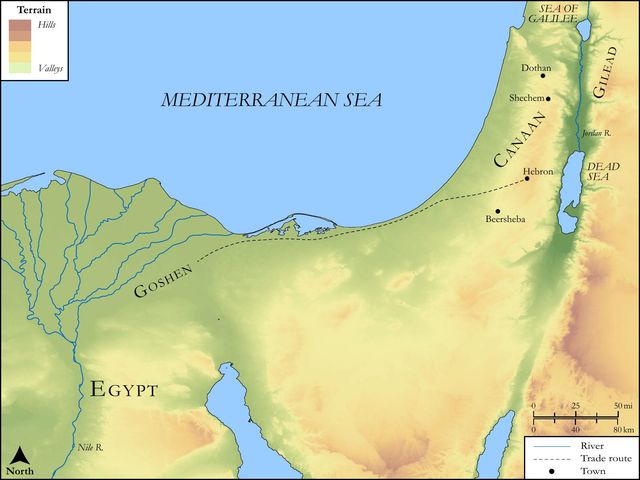
See on the biblical-era maps


Study this verse
Public-domain commentary
Matthew Henry
From his Commentary on the Whole Bible. Henry comments on passages, not single verses — this entry covers Genesis 42:29–38.
Here is, 1. The report which Jacob's sons made to their father of the great distress they had been in in Egypt; how they had been suspected, and threatened, and obliged to leave Simeon a prisoner there, till they should bring Benjamin with them thither. Who would have thought of this when they left home? When we go abroad we should consider how many sad accidents, that we little think of, may befall us before we return home. We know not what a day may bring forth; we ought therefore to be always ready for the worst. 2. The deep impression this made upon the good man. The very bundles of money which Joseph returned, in kindness to his father, frightened him (Gen 42:35); for he concluded it was done with some mischievous design, or perhaps suspected his own sons to have committed some offence, and so to have run themselves into a praemunire - a penalty, which is intimated in what he says (Gen 42:36): Me have you bereaved. He seems to lay the fault upon them; knowing their characters, he feared they had provoked the Egyptians, and perhaps forcibly, or fraudulently, brought home their money. Jacob is here much out of temper. (1.) He has very melancholy apprehensions concerning the present state of his family: Joseph is not, and Simeon is not; whereas Joseph was in honour and Simeon in the way to it. Note, We often perplex ourselves with our own mistakes, even in matters of fact. True griefs may arise from false intelligence and suppositions, Sa2 13:31. Jacob gives up Joseph for gone, and Simeon and Benjamin as being in danger; and he concludes, All these things are against me. It proved otherwise, that all these were for him, were working together for his good and the good of his family: yet here he thinks them all against him. Note, Through our ignorance and mistake, and the weakness of our faith, we often apprehend that to be against us which is really for us. We are afflicted in body, estate, name, and relations; and we think all these things are against us, whereas these are really working for us the weight of glory. (2.) He is at present resolved that Benjamin shall not go down. Reuben will undertake to bring him back in safety (Gen 42:37), not so much as putting in, If the Lord will, nor expecting the common disasters of travellers; but he foolishly bids Jacob slay his two sons (which, it is likely, he was very proud of) if he brought him not back; as if the death of two grandsons could satisfy Jacob for the death of a son. No, Jacob's present thoughts are, My son shall not go down with you. He plainly intimates a distrust of them, remembering that he never saw Joseph since he had been with them; therefore, "Benjamin shall not go with you, by the way in which you go, for you will bring down my gray hairs with sorrow to the grave." Note, It is bad with a family when children conduct themselves so ill that their parents know not how to trust them.
Continue studying Genesis 42:32 across the web’s major study libraries — every link below opens this exact verse, chapter, or book on the destination site.
Read & Compare
 BibleGatewayThis verse in more than 200 translations and 70 languages.
 Bible.comThe YouVersion reader — hundreds of translations, reading plans, and highlights.
 ESV.orgCrossway's official English Standard Version reader.
 NET BibleThe NET translation with 60,000+ translators' notes on every rendering decision.
 STEP BibleTyndale House's free study tool — original text, vocabulary, and scholarly resources.
 BibliaLogos Bible Software's free web reader.
 USCCBThe New American Bible (Revised Edition) with the U.S. bishops' study notes.
Commentaries
 BibleHub CommentariesDozens of classic commentaries on this verse, gathered on one page.
 StudyLightMore than 100 commentary sets — the largest collection on the web.
 BibleRefPlain-English commentary on what this verse means, verse by verse.
 Enduring WordDavid Guzik's free commentary on this chapter, widely used by Bible teachers.
 Bible Study ToolsVerse commentary alongside Greek and Hebrew study aids.
Original Language & Research
- BibleHub InterlinearThe verse word by word — original language, transliteration, and English.
- BibleHub LexiconEvery word's original-language definition and Strong's entry.
 Blue Letter BibleDeep-study tools — Strong's numbers, concordance, and word studies.
 SefariaThe Hebrew text with Rashi and centuries of Jewish commentary.
Sermons, Hymns & Audio


TrulyRandomVerse is not affiliated with these sites and doesn’t control their content. They’re linked because they’re genuinely useful.
Summary
Genesis 42:32 captures the brothers' carefully constructed explanation to Joseph, whom they do not recognize, regarding their family's composition. They inform him that they were originally twelve brothers, sons of their father, but one is "not" (a euphemism for Joseph, whom they sold into slavery), and the youngest, Benjamin, remains with their father Jacob in Canaan. This statement, laden with unspoken guilt and partial truth, serves as a pivotal moment in Joseph's ongoing test of his brothers, highlighting the deep emotional and spiritual scars left by their past sin and setting the stage for future revelation and reconciliation.
Context
ShowHideLiterary Context
This verse is a direct response from Joseph's ten elder brothers to his accusation that they are spies and his demand that they prove their honesty by bringing their youngest brother, Benjamin, to Egypt. Joseph, now the powerful governor of Egypt, has recognized his brothers, but they have not recognized him. Their declaration in Genesis 42:32 is part of their attempt to explain their family situation and the extreme difficulty, if not impossibility, of bringing Benjamin to Egypt. It immediately follows Joseph's initial accusation and their desperate plea, setting up the subsequent narrative where Joseph keeps Simeon as a hostage to ensure Benjamin's arrival. This moment is crucial in Joseph's divinely orchestrated plan to test his brothers' character and observe if they have changed from the callous individuals who once betrayed him, as detailed in Genesis 37.
Historical & Cultural Context
The narrative unfolds during a severe famine that afflicted not only Egypt but also the surrounding regions, including Canaan. This widespread scarcity compelled people to travel to Egypt, which had prepared for the famine under Joseph's wise administration. In the households of the patriarchs, family lineage and the number of sons were paramount for a family's strength, legacy, and economic security. The loss of a son, especially a beloved one, was a profound tragedy, as seen in Jacob's prolonged grief over Joseph's presumed death (Genesis 37:34-35). The brothers' journey from Canaan to Egypt for grain highlights the economic desperation and the immense power wielded by Egyptian officials, who controlled the vital food supply. Their explanation to Joseph reflects the cultural expectation of accounting for one's family and origin when dealing with foreign authorities.
Key Themes
ShowHideGenesis 42:32 contributes significantly to several overarching themes in the Joseph narrative and the book of Genesis. It underscores the theme of divine sovereignty, where God orchestrates seemingly coincidental events and human actions (including sin) to fulfill His redemptive purposes, ultimately preserving the covenant family of Israel from famine. The brothers' partial truth highlights the consequences of sin and deception, showing how past transgressions continue to haunt and shape present circumstances, creating a burden of guilt and fear. Furthermore, the verse initiates a crucial phase in the theme of testing and transformation, as Joseph uses their words to devise a plan that will reveal whether his brothers have matured and whether their loyalty to their father and youngest brother has superseded their past envy and cruelty. This sets the stage for the eventual reconciliation and restoration of the fractured family, a central motif in the latter chapters of Genesis, particularly evident in Joseph's revelation to his brothers.
Exposition and Analysis
ShowHideKey Word Analysis
ShowHideThis word (H251) denotes a brother, but in a wider sense, it can also refer to kindred or those with metaphorical affinity. In this context, it emphasizes the blood relation that binds them, even though their actions had severely fractured that bond. The brothers are asserting their familial identity, perhaps hoping to appear less threatening than a group of unrelated men, while simultaneously acknowledging the original, complete family unit.
This numeral (H259) primarily means "united" or "one." Here, it starkly highlights the numerical absence of Joseph. The use of "one" rather than a name or a direct statement of death is a deliberate euphemism, maintaining the lie they had told their father and avoiding a direct confession of their complicity in Joseph's disappearance. It underscores the profound void left in the family.
This term (H6996) signifies "abbreviated," "diminutive," or "youngest" in age. Its inclusion emphasizes Benjamin's tender age and, more importantly, his unique position as the last remaining son of Rachel, Jacob's beloved wife. This detail immediately signals Benjamin's special status and Jacob's deep attachment, which Joseph, knowing his father, would understand and exploit for his testing strategy.
Verse Breakdown
ShowHide"We [be] twelve brethren, sons of our father"
This opening clause establishes the original, complete familial unit of Jacob's sons. It is a statement of fact, presenting their identity and lineage to the Egyptian governor. It subtly reminds the brothers themselves of the full family, a stark contrast to their present, diminished number due to their own sin.
"one [is] not"
This is the poignant and deceptive core of the statement. The Hebrew phrase 'êynennû (אֵינֶנּוּ) is a euphemism, literally meaning "he is not" or "he is no more." It refers to Joseph, whom they had sold into slavery years earlier. By using this vague phrase, they avoid confessing their guilt while maintaining the deception that Joseph had perished, a lie their father Jacob still believed. This partial truth underscores their ongoing burden of guilt and the profound sorrow it had inflicted upon their family.
"and the youngest [is] this day with our father in the land of Canaan"
This final clause explains Benjamin's absence from the group. It highlights Benjamin's status as the youngest and his current location in Canaan with their father. This detail is crucial for Joseph's plan, as he knows Benjamin is the only other son of Rachel and thus uniquely precious to Jacob, especially after Joseph's presumed death. The brothers' reluctance to bring Benjamin stems from their understanding of Jacob's profound attachment and their fear of causing him further grief.
Literary Devices
ShowHideThe verse employs several significant literary devices. Euphemism is prominently featured in the phrase "one [is] not," which delicately and deceptively conveys Joseph's absence without revealing the brothers' culpability in his disappearance. This allows them to speak a partial truth while concealing their profound sin. Dramatic Irony pervades the entire scene, as the audience knows that the brothers are speaking to Joseph himself, the very "one" they claim is "not." This creates tension and highlights the brothers' ignorance of the divine orchestration at play. Finally, the statement also functions as Foreshadowing, setting the stage for Joseph's subsequent actions—his demand for Benjamin's presence—which will further test his brothers' character, loyalty, and capacity for repentance, ultimately leading to the climactic revelation and reconciliation of the family.
Theological and Thematic Connections
ShowHideGenesis 42:32, though a simple declaration, is rich with theological and thematic implications. It powerfully illustrates the pervasive nature of sin and its long-lasting consequences, as the brothers' past betrayal of Joseph continues to dictate their present actions and anxieties. Their carefully worded euphemism reveals the burden of unconfessed sin and the difficulty of living with deception. Yet, within this human brokenness, God's divine sovereignty is unmistakably at work. Joseph's position in Egypt, a direct result of their sin, is now being used by God to test and transform his brothers, preparing them for reconciliation and ensuring the preservation of the covenant family during a severe famine. This passage reminds us that God can use even our deepest failures and the painful fallout of sin to bring about His redemptive purposes, refining character and leading to genuine repentance and restoration.
Reflection and Application
ShowHideGenesis 42:32 serves as a profound mirror for self-reflection, urging us to examine the hidden corners of our own lives where unaddressed sin or unresolved conflict might still cast a shadow. The brothers' carefully chosen words, designed to obscure their guilt, remind us that deception, even by omission, carries a heavy burden and can perpetuate cycles of pain within families and communities. This passage challenges us to consider the long-term consequences of our actions and the importance of confronting truth, no matter how difficult. Yet, it also offers immense hope, demonstrating God's patient and persistent work of redemption. Even in the midst of human failings and the painful fallout of past choices, God is actively orchestrating circumstances to bring about repentance, healing, and reconciliation. We are called to trust in God's sovereign hand, knowing that He can transform our brokenness into a pathway for His glory, leading us towards genuine restoration and freedom from the burdens of our past.
Questions for Reflection
ShowHideFAQ
ShowHideWhy did the brothers use the phrase "one [is] not" instead of saying Joseph was dead?
ShowHideThe phrase "one [is] not" (Hebrew: 'êynennû) is a deliberate euphemism. The brothers knew Joseph was not dead but had been sold into slavery by them. Using this vague phrase allowed them to maintain the lie they had told their father, Jacob, for years, regarding Joseph's supposed death (Genesis 37:31-33), while also avoiding a direct falsehood or a confession of their complicity to the powerful Egyptian governor (Joseph), whom they did not recognize. It subtly reflects their deep-seated guilt and ongoing deception.
How does this verse contribute to Joseph's testing of his brothers?
ShowHideThis verse provides Joseph with the precise information he needs to continue his intricate test. By confirming that Benjamin is still with Jacob and that the family is aware of one brother's "absence," Joseph can then demand Benjamin's presence in Egypt. This demand forces his brothers into an agonizing dilemma, compelling them to choose between their own safety and their father's profound attachment to Benjamin, thereby revealing their true character, their loyalty to their father, and their capacity for change and repentance, a process that culminates in Genesis 44.
What is the significance of Benjamin being mentioned as "the youngest" and "with our father"?
ShowHideBenjamin was Jacob's youngest son and the only other son by his beloved wife Rachel, making him incredibly precious to Jacob, especially after Joseph's presumed death (Genesis 35:16-18). His being "with our father" highlights Jacob's deep attachment and fear of losing him, as Jacob had already experienced immense grief over Joseph. This detail makes Joseph's demand for Benjamin a significant and emotionally charged test of the brothers' willingness to sacrifice for their family and their father, demonstrating if their hearts had softened and if they valued Benjamin's well-being over their own.
Christ-Centered Fulfillment
ShowHideThe narrative of Joseph, particularly the brothers' partial confession in Genesis 42:32, powerfully foreshadows Christ's redemptive work. Joseph, though unjustly rejected, betrayed, and sold into slavery by his own brothers (Genesis 37:28), ultimately becomes the means of their salvation and the preservation of the covenant family of Israel, saving them and many nations from famine. This mirrors Christ, who was rejected by His own people (John 1:11), suffered, and was crucified, yet through His suffering and death, He became the ultimate Savior of humanity. Just as Joseph's suffering led to reconciliation and life for his family, Christ's suffering and death on the cross bring about reconciliation between God and humanity, offering eternal life and spiritual sustenance to all who believe (Romans 5:10). The brothers' journey from deception and guilt to eventual repentance and reconciliation with Joseph, facilitated by Joseph's strategic testing and ultimate grace, vividly illustrates humanity's need for repentance and faith in Christ to be reconciled to a holy God. God's sovereign hand, evident in orchestrating Joseph's life for His divine purposes, finds its ultimate and glorious fulfillment in the meticulously planned and executed salvation through Jesus Christ, the true Bread of Life who sustains His people (John 6:35).