


Genesis 42:34
- וְהָבִיאוּVe·ha·vi·'uand bringH935Conj-w ¦ V-Hiphil-Imp-2mpVerb Hiphil Imperative 2nd Plural Masculineוְandהָבִיאוּbring
- אֶת'et<obj.>H853DirObjMParticle Object Indicator
- אֲחִיכֶם'a·chi·Khemyour brotherH251N-msc ¦ 2mpNoun Singular Masculine Constructאֲחִיbrotherכֶםyour
- הַקָּטֹןha·ka·Ton<the> youngH6996Art ¦ Adj-msAdjective Singular Masculine Absoluteהַ<the>קָּטֹןyoung
- אֵלַי'e·Laito meH413Prep ¦ 1csPreposition Definiteאֵלַtoיme
- וְאֵדְעָהve·'e·de·'Ahso let me knowH3045Conj-w ¦ V-Qal-Imperf-1csVerb Qal Imperfect 1st Singular common genderוְsoאֵדְעָהlet me know
- כִּיkithatH3588PrtParticle Conditional
- לֹאlo'notH3808NegParticle Negative
- מְרַגְּלִיםme·ra·ge·Lim[are] spiesH7270V-Piel-Prtcpl-mpVerb Piel Participle Plural Masculine Absolute
- אַתֶּם'a·TemyouH859Pro-2mpPronoun Personal 2nd Plural Masculine
- כִּיkithatH3588PrtParticle Conditional
- כֵנִיםkhe·Nim[are] honestH3651Adj-mpAdjective Plural Masculine Absolute
- אַתֶּם'a·TemyouH859Pro-2mpPronoun Personal 2nd Plural Masculine
- אֶת'et<obj.>H853DirObjMParticle Object Indicator
- אֲחִיכֶם'a·chi·Khemyour brotherH251N-msc ¦ 2mpNoun Singular Masculine Constructאֲחִיbrotherכֶםyour
- אֶתֵּן'e·TenI will giveH5414V-Qal-Imperf-1csVerb Qal Imperfect 1st Singular common gender
- לָכֶםla·Khemto <the> youPrep-l ¦ 2mpSuffix Personal 2nd Plural Masculineלָto <the>כֶםyou
- וְאֶתve·'Etand <obj.>H853Conj-w ¦ DirObjMParticle Object Indicatorוְandאֶת<obj.>
- הָאָרֶץha·'A·retzthe landH776Art ¦ N-fsNoun Singular Feminine Absoluteהָtheאָרֶץland
- תִּסְחָרוּtis·Cha·ruyou will go about inH5503V-Qal-Imperf-2mpVerb Qal Imperfect 2nd Plural Masculine
English is a literal word-by-word gloss of the Hebrew, not the KJV's wording. Why?
This is the original text the KJV's translators worked from — each Hebrew word with its own literal English meaning in this verse, prepared by scholars at Tyndale House, Cambridge. The KJV translates whole sentences, not word by word, so its wording differs: one Hebrew word can become several English words, and the KJV may choose “the LORD” where the gloss reads “Yahweh”. Both are faithful — they answer different questions. For the KJV's own rendering, switch to the KJV text.
Details
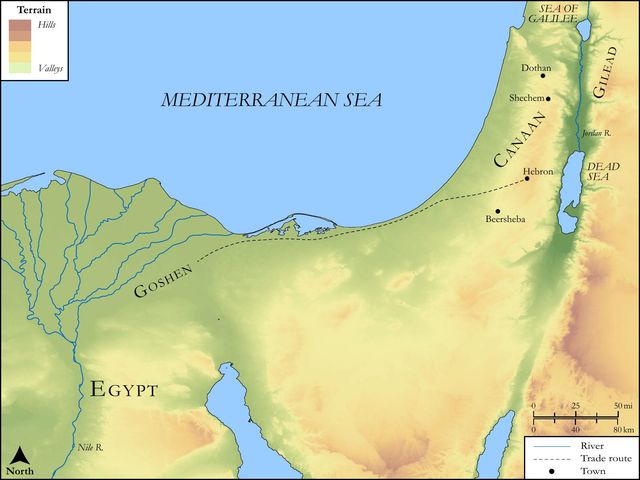
See on the biblical-era maps


Study this verse
Public-domain commentary
Matthew Henry
From his Commentary on the Whole Bible. Henry comments on passages, not single verses — this entry covers Genesis 42:29–38.
Here is, 1. The report which Jacob's sons made to their father of the great distress they had been in in Egypt; how they had been suspected, and threatened, and obliged to leave Simeon a prisoner there, till they should bring Benjamin with them thither. Who would have thought of this when they left home? When we go abroad we should consider how many sad accidents, that we little think of, may befall us before we return home. We know not what a day may bring forth; we ought therefore to be always ready for the worst. 2. The deep impression this made upon the good man. The very bundles of money which Joseph returned, in kindness to his father, frightened him (Gen 42:35); for he concluded it was done with some mischievous design, or perhaps suspected his own sons to have committed some offence, and so to have run themselves into a praemunire - a penalty, which is intimated in what he says (Gen 42:36): Me have you bereaved. He seems to lay the fault upon them; knowing their characters, he feared they had provoked the Egyptians, and perhaps forcibly, or fraudulently, brought home their money. Jacob is here much out of temper. (1.) He has very melancholy apprehensions concerning the present state of his family: Joseph is not, and Simeon is not; whereas Joseph was in honour and Simeon in the way to it. Note, We often perplex ourselves with our own mistakes, even in matters of fact. True griefs may arise from false intelligence and suppositions, Sa2 13:31. Jacob gives up Joseph for gone, and Simeon and Benjamin as being in danger; and he concludes, All these things are against me. It proved otherwise, that all these were for him, were working together for his good and the good of his family: yet here he thinks them all against him. Note, Through our ignorance and mistake, and the weakness of our faith, we often apprehend that to be against us which is really for us. We are afflicted in body, estate, name, and relations; and we think all these things are against us, whereas these are really working for us the weight of glory. (2.) He is at present resolved that Benjamin shall not go down. Reuben will undertake to bring him back in safety (Gen 42:37), not so much as putting in, If the Lord will, nor expecting the common disasters of travellers; but he foolishly bids Jacob slay his two sons (which, it is likely, he was very proud of) if he brought him not back; as if the death of two grandsons could satisfy Jacob for the death of a son. No, Jacob's present thoughts are, My son shall not go down with you. He plainly intimates a distrust of them, remembering that he never saw Joseph since he had been with them; therefore, "Benjamin shall not go with you, by the way in which you go, for you will bring down my gray hairs with sorrow to the grave." Note, It is bad with a family when children conduct themselves so ill that their parents know not how to trust them.
Continue studying Genesis 42:34 across the web’s major study libraries — every link below opens this exact verse, chapter, or book on the destination site.
Read & Compare
 BibleGatewayThis verse in more than 200 translations and 70 languages.
 Bible.comThe YouVersion reader — hundreds of translations, reading plans, and highlights.
 ESV.orgCrossway's official English Standard Version reader.
 NET BibleThe NET translation with 60,000+ translators' notes on every rendering decision.
 STEP BibleTyndale House's free study tool — original text, vocabulary, and scholarly resources.
 BibliaLogos Bible Software's free web reader.
 USCCBThe New American Bible (Revised Edition) with the U.S. bishops' study notes.
Commentaries
 BibleHub CommentariesDozens of classic commentaries on this verse, gathered on one page.
 StudyLightMore than 100 commentary sets — the largest collection on the web.
 BibleRefPlain-English commentary on what this verse means, verse by verse.
 Enduring WordDavid Guzik's free commentary on this chapter, widely used by Bible teachers.
 Bible Study ToolsVerse commentary alongside Greek and Hebrew study aids.
Original Language & Research
- BibleHub InterlinearThe verse word by word — original language, transliteration, and English.
- BibleHub LexiconEvery word's original-language definition and Strong's entry.
 Blue Letter BibleDeep-study tools — Strong's numbers, concordance, and word studies.
 SefariaThe Hebrew text with Rashi and centuries of Jewish commentary.
Sermons, Hymns & Audio


TrulyRandomVerse is not affiliated with these sites and doesn’t control their content. They’re linked because they’re genuinely useful.
Summary
Genesis 42:34 records Joseph's pivotal demand to his brothers: they must bring their youngest brother, Benjamin, to Egypt. This condition serves as the critical test of their character and integrity, the lynchpin in Joseph's intricate plan to verify their honesty, secure the release of their imprisoned brother Simeon, and ultimately orchestrate the full reunion and preservation of Jacob's family during the severe famine.
Context
ShowHideLiterary Context
Genesis 42:34 is situated at a crucial turning point in the Joseph narrative, specifically within the initial encounter between Joseph and his brothers in Egypt. Following years of separation, Joseph, now the powerful governor of Egypt, recognizes his brothers who have come to buy grain during a severe famine. He chooses not to reveal his identity immediately, instead accusing them of being spies (Genesis 42:9). As part of his elaborate test, Joseph holds Simeon hostage (Genesis 42:24) and sends the others back to Canaan with grain, demanding that they return with their youngest brother, Benjamin. This demand is the central obstacle they must overcome to prove their innocence and secure Simeon's release, setting the stage for the deeply emotional and transformative events of Genesis 44 and Genesis 45.
Historical & Cultural Context
The events unfold against the backdrop of a widespread famine, a common and devastating occurrence in the ancient Near East, which often forced migrations and interactions between different peoples. Egypt, with its predictable Nile floods, was a granary for the region, making it a destination for those seeking survival. The accusation of "spies" was a serious charge, often punishable by death, reflecting the geopolitical realities and suspicions between nations. Joseph's demand for Benjamin also touches upon cultural norms regarding family honor, the importance of lineage (especially the youngest son, often a favorite, as seen with Jacob and Benjamin), and the concept of a "hostage" or "bond" to ensure compliance. The brothers' need to "traffick in the land" highlights the economic necessity of free movement and trade for their survival and prosperity, which would only be granted upon proving their trustworthiness to the Egyptian authorities.
Key Themes
ShowHideThis verse powerfully contributes to several overarching themes in Genesis. Firstly, it underscores the theme of Divine Providence and Sovereignty, demonstrating how God orchestrates seemingly coincidental or difficult circumstances (like the famine and Joseph's rise to power, as detailed in Genesis 41:37-45) to fulfill His purposes and preserve His covenant people. Secondly, the narrative deeply explores the theme of Testing and Transformation, as Joseph's demand for Benjamin serves as a profound test of his brothers' character, revealing whether they have truly changed from their past betrayal (Genesis 37:18-28). Finally, it is a crucial step toward Family Reconciliation and Restoration, a central motif in the latter part of Genesis, where broken relationships are healed and the family of Israel is preserved and brought together, ultimately leading to their growth into a nation.
Exposition and Analysis
ShowHideGenesis 42:34 encapsulates Joseph's strategic and deeply personal condition for his brothers' full acceptance and the release of Simeon. The verse reads, "And bring your youngest brother unto me: then shall I know that ye [are] no spies, but [that] ye [are] true [men: so] will I deliver you your brother, and ye shall traffick in the land."
Key Word Analysis
ShowHideThis primitive word denotes a close familial bond, extending beyond literal siblings to include kindred or metaphorical affinity. In this context, it emphasizes the profound significance of Benjamin as a full brother to Joseph and a beloved son to Jacob, highlighting the familial stakes of Joseph's demand. The repetition of "brother" (youngest brother, your brother Simeon) underscores the theme of family and its restoration.
This primitive root signifies not merely intellectual apprehension but a deep, experiential understanding or ascertainment, often implying recognition, care, or even judgment. Joseph's desire to "know" his brothers are "true men" goes beyond a simple fact-check; he seeks a profound, verifiable demonstration of their transformed character and integrity, a knowing born of their actions.
Derived from a root meaning "set upright," this word describes something as just, right, or genuine. When Joseph demands they prove themselves "true men," he is not just asking them to be "not spies" but to demonstrate a positive quality of uprightness, honesty, and trustworthiness. This speaks to a fundamental shift in their moral character from their past deceit.
This primitive root means "to travel round," specifically as a pedlar or merchant. In this context, it refers to the freedom to conduct business, trade, and move without suspicion within Egypt. It signifies not just survival but full acceptance, security, and the restoration of their reputation, allowing them to thrive economically under Joseph's protection.
Verse Breakdown
ShowHide"And bring your youngest brother unto me"
This is Joseph's non-negotiable demand, the central condition upon which all else hinges. It is a calculated move, designed to test his brothers' loyalty and compassion, particularly towards Benjamin, who, like Joseph, was a son of Rachel and a favorite of Jacob. This demand forces them to confront their past actions and demonstrate a changed heart regarding familial responsibility.
"then shall I know that ye [are] no spies, but [that] ye [are] true [men"
This clause reveals the purpose of the demand. Joseph seeks definitive proof of their integrity. "No spies" addresses the immediate accusation, while "true men" (Hebrew: anashim kenim) goes deeper, implying a positive affirmation of their uprightness, honesty, and trustworthiness. Joseph is testing their moral fiber, seeking evidence of a transformation from the deceit and cruelty they exhibited years earlier.
"so will I deliver you your brother"
This refers to Simeon, whom Joseph held hostage as collateral. His release is directly contingent upon their compliance with the demand concerning Benjamin. This creates immediate pressure and motivation for the brothers to fulfill Joseph's condition, as Simeon's life and freedom are at stake.
"and ye shall traffick in the land"
This final promise outlines the ultimate benefit of their compliance. It signifies full restoration of trust and access to Egyptian resources. Once proven "true men," they would be permitted to move freely, conduct business, and purchase grain without hindrance or suspicion, ensuring their continued survival and prosperity during the famine.
Literary Devices
ShowHideThe verse employs several significant literary devices. Irony is prominent, as the brothers are unknowingly negotiating with the very brother they betrayed, and his "test" ironically forces them to confront the very sin of abandoning a brother. The demand for Benjamin serves as a powerful Symbolism of their past crime; just as they once removed a beloved brother from his father, they are now faced with the prospect of doing so again, but this time, the choice is framed as a path to redemption. The entire interaction functions as a Testing Motif, a recurring theme in biblical narratives where characters' faith, loyalty, and character are revealed through trials. Joseph's statement, "then shall I know," highlights this deliberate and purposeful examination. The phrase "true men" also serves as a Foreshadowing of the profound change that will be demonstrated, particularly by Judah, in the subsequent chapters, validating Joseph's test.
Theological and Thematic Connections
ShowHideGenesis 42:34 is a profound illustration of God's intricate and often mysterious ways of working out His purposes through human actions and difficult circumstances. Joseph's demand for Benjamin, while seemingly harsh, is a divinely orchestrated test designed to bring about repentance, reconciliation, and the preservation of the covenant family. It underscores that God often uses trials not to punish, but to refine character, expose hidden motives, and lead His people to a deeper reliance on Him and a greater integrity in their relationships. This narrative highlights that true reconciliation requires more than just words; it demands tangible proof of a changed heart and a willingness to make amends, reflecting God's desire for genuine transformation in His people.
Reflection and Application
ShowHideGenesis 42:34 offers profound insights into the nature of integrity, the process of reconciliation, and the sovereign hand of God in our lives. Joseph's demand for Benjamin is a powerful reminder that genuine trust, once broken, is not easily restored; it often requires tangible evidence of a changed heart and a willingness to step into uncomfortable situations to prove one's sincerity. For us, this narrative challenges us to examine our own lives: Are we "true men and women" in our dealings, not just avoiding deceit, but actively pursuing honesty and integrity? When relationships are strained, are we willing to undergo the difficult "tests" that might lead to true reconciliation, even if it means confronting past failures or making significant sacrifices? Furthermore, Joseph's story encourages us to trust in God's overarching plan, even when circumstances seem harsh or unfair. Just as God used Joseph's trials to preserve a nation, He often uses our difficulties to refine our character, deepen our faith, and work out His good and perfect will, leading us to greater spiritual maturity and ultimately, to His glory. We are called to embrace these moments of testing as opportunities for growth, trusting that God is always at work, even when His methods are mysterious.
Questions for Reflection
ShowHideFAQ
ShowHideWhy did Joseph specifically demand Benjamin?
ShowHideJoseph demanded Benjamin for several interconnected and strategic reasons. Firstly, it served as a profound test of his brothers' character and their transformation. Having previously sold Joseph, another beloved son of Rachel, into slavery, Joseph needed to ascertain if they would now protect and value Benjamin, Jacob's youngest and most cherished son. This would reveal if their hearts had truly changed and if they now prioritized familial bonds over self-preservation. Secondly, Benjamin was Joseph's only full brother, and Joseph deeply longed to see him and reunite his immediate family, a key step in his broader plan for reconciliation. Finally, bringing Benjamin would necessitate Jacob's involvement, eventually leading to the entire family's relocation to Egypt, which was part of God's larger providential plan to preserve them during the severe famine, as seen in Genesis 45:7-8.
What does "traffick in the land" signify in this context?
ShowHideThe phrase "traffick in the land" (from the Hebrew çâchar) signifies that Joseph's brothers would be granted full freedom and security to conduct business, trade, and move about within Egypt without any suspicion or hindrance. It represents a promise of full acceptance and the restoration of their reputation. Once their honesty was proven by bringing Benjamin, they would no longer be treated as spies but as trusted individuals, ensuring their physical safety and economic well-being. This promise extended beyond mere survival, indicating that they would be able to thrive and operate freely within the land, under Joseph's protection and favor, as implied by the later provisions Joseph makes for them in Goshen.
How does Joseph's testing of his brothers reflect God's ways with humanity?
ShowHideJoseph's testing of his brothers mirrors God's ways with humanity in several significant aspects. Like Joseph, God often allows or orchestrates trials and difficult circumstances, not to gain information He doesn't already possess, but to reveal character, expose sin, humble the proud, and lead to repentance and spiritual growth. These tests are designed to refine faith and produce perseverance, as described in James 1:2-4. Just as Joseph's test ultimately led to reconciliation and the preservation of his family, God's tests are always purposed for our good, leading to deeper faith, restoration, and the fulfillment of His divine plan, even through painful processes. This divine working is a demonstration of God's sovereign providence, where He works all things for the good of those who love Him (Romans 8:28).
Christ-Centered Fulfillment
ShowHideThe narrative of Joseph, including his testing of his brothers and the ultimate reconciliation, serves as a powerful and profound type of Christ. Joseph, though innocent, suffered immensely at the hands of his own brethren, was unjustly imprisoned, yet was ultimately exalted to a position of supreme power in Egypt, becoming the preserver and reconciler of his family. Similarly, Christ, the innocent Son of God, suffered rejection and death at the hands of humanity, was unjustly crucified, yet was exalted to the right hand of the Father (Philippians 2:9-11), and now stands as the ultimate reconciler of humanity to God (2 Corinthians 5:18-19). Joseph's demand for Benjamin, a "cost" or "proof" required for full restoration and the release of Simeon, can be seen as foreshadowing the "cost" of discipleship or the "proof" of faith required for our reconciliation with God through Christ. Ultimately, Christ is the greater Joseph, who, through His own perfect sacrifice and glorious resurrection, brings His scattered brethren (all who believe) into a restored relationship with the Father, preserving them eternally from spiritual famine and granting them full access and freedom in the land of His everlasting kingdom (John 14:6). He is the one who "knows" us fully, yet still welcomes us when we turn to Him in truth and repentance, delivering us from the bondage of sin and allowing us to "traffick" freely in the blessings of His grace.