


Genesis 42:36
Bible text: King James Version (1769 Blayney text) · Public domain
Bible text: King James Version with Strong's numbers · Public domain
Bible text: Berean Standard Bible · Public domain
Bible text: American Standard Version (1901) · Public domain
Bible text: World English Bible, Messianic edition · Public domain
Bible text: Geneva Bible (1599) · Public domain
Bible text: Young's Literal Translation · Public domain
- וַיֹּאמֶרvai·Yo·merand he saidH559Conj-w ¦ V-Qal-ConsecImperf-3msVerb Qal Consecutive Imperfect 3rd Singular Masculineוַandיֹּאמֶרhe said
- אֲלֵהֶם'a·le·Hemto themH413Prep ¦ 3mpPreposition Definiteאֲלֵtoהֶםthem
- יַעֲקֹבya·'a·KoJacobH3290N-proper-mNoun Proper Masculine
- אֲבִיהֶם'a·vi·Hemtheir fatherH1N-msc ¦ 3mpNoun Singular Masculine Constructאֲבִיfatherהֶםtheir
- אֹתִי'o·Ti<obj.> meH853DirObjM ¦ 1csParticle Object Indicatorאֹתִ<obj.>יme
- שִׁכַּלְתֶּםshi·kal·Temyou are making childlessH7921V-Piel-Perf-2mpVerb Piel Perfect 2nd Plural Masculine
- יוֹסֵףyo·SefJosephH3130N-proper-mNoun Proper Masculine
- אֵינֶנּוּ'ei·Ne·nunot [is] heH369N-msc ¦ 3msNoun Singular Masculine Constructאֵינֶnot [is]נּוּhe
- וְשִׁמְעוֹןve·shim·'onand SimeonH8095Conj-w ¦ N-proper-mNoun Proper MasculineוְandשִׁמְעוֹןSimeon
- אֵינֶנּוּ'ei·Ne·nunot [is] heH369N-msc ¦ 3msNoun Singular Masculine Constructאֵינֶnot [is]נּוּhe
- וְאֶתve·'Etand <obj.>H853Conj-w ¦ DirObjMParticle Object Indicatorוְandאֶת<obj.>
- בִּנְיָמִןbin·ya·MinBenjaminH1144N-proper-mNoun Proper Masculine
- תִּקָּחוּti·Ka·chuyou will takeH3947V-Qal-Imperf-2mpVerb Qal Imperfect 2nd Plural Masculine
- עָלַי'a·Laion meH5921Prep ¦ 1csPreposition Definiteעָלַonיme
- הָיוּha·Yuthey areH1961V-Qal-Perf-3cpVerb Qal Perfect 3rd Plural common gender
- כֻלָּנָהkhu·La·nahall of themH3605N-msc ¦ 3fpNoun Singular Masculine Constructכֻלָּall ofנָהthem
English is a literal word-by-word gloss of the Hebrew, not the KJV's wording. Why?
This is the original text the KJV's translators worked from — each Hebrew word with its own literal English meaning in this verse, prepared by scholars at Tyndale House, Cambridge. The KJV translates whole sentences, not word by word, so its wording differs: one Hebrew word can become several English words, and the KJV may choose “the LORD” where the gloss reads “Yahweh”. Both are faithful — they answer different questions. For the KJV's own rendering, switch to the KJV text.
Details
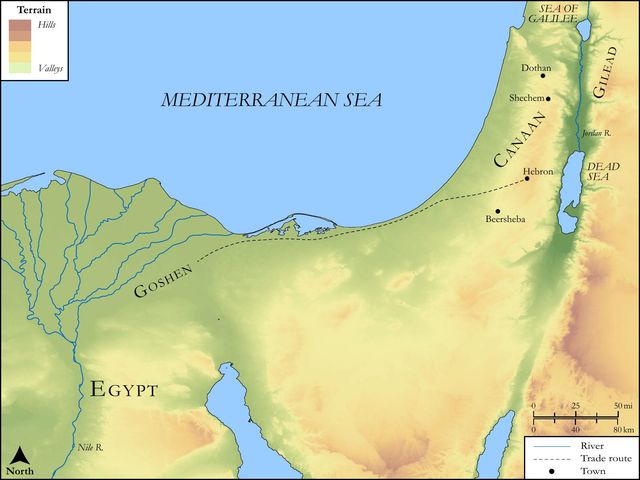
See on the biblical-era maps


Study this verse
Public-domain commentary
Matthew Henry
From his Commentary on the Whole Bible. Henry comments on passages, not single verses — this entry covers Genesis 42:29–38.
Here is, 1. The report which Jacob's sons made to their father of the great distress they had been in in Egypt; how they had been suspected, and threatened, and obliged to leave Simeon a prisoner there, till they should bring Benjamin with them thither. Who would have thought of this when they left home? When we go abroad we should consider how many sad accidents, that we little think of, may befall us before we return home. We know not what a day may bring forth; we ought therefore to be always ready for the worst. 2. The deep impression this made upon the good man. The very bundles of money which Joseph returned, in kindness to his father, frightened him (Gen 42:35); for he concluded it was done with some mischievous design, or perhaps suspected his own sons to have committed some offence, and so to have run themselves into a praemunire - a penalty, which is intimated in what he says (Gen 42:36): Me have you bereaved. He seems to lay the fault upon them; knowing their characters, he feared they had provoked the Egyptians, and perhaps forcibly, or fraudulently, brought home their money. Jacob is here much out of temper. (1.) He has very melancholy apprehensions concerning the present state of his family: Joseph is not, and Simeon is not; whereas Joseph was in honour and Simeon in the way to it. Note, We often perplex ourselves with our own mistakes, even in matters of fact. True griefs may arise from false intelligence and suppositions, Sa2 13:31. Jacob gives up Joseph for gone, and Simeon and Benjamin as being in danger; and he concludes, All these things are against me. It proved otherwise, that all these were for him, were working together for his good and the good of his family: yet here he thinks them all against him. Note, Through our ignorance and mistake, and the weakness of our faith, we often apprehend that to be against us which is really for us. We are afflicted in body, estate, name, and relations; and we think all these things are against us, whereas these are really working for us the weight of glory. (2.) He is at present resolved that Benjamin shall not go down. Reuben will undertake to bring him back in safety (Gen 42:37), not so much as putting in, If the Lord will, nor expecting the common disasters of travellers; but he foolishly bids Jacob slay his two sons (which, it is likely, he was very proud of) if he brought him not back; as if the death of two grandsons could satisfy Jacob for the death of a son. No, Jacob's present thoughts are, My son shall not go down with you. He plainly intimates a distrust of them, remembering that he never saw Joseph since he had been with them; therefore, "Benjamin shall not go with you, by the way in which you go, for you will bring down my gray hairs with sorrow to the grave." Note, It is bad with a family when children conduct themselves so ill that their parents know not how to trust them.
Historical interpretation
Historical reception
1 surviving comment on this verse from the historical church.
Now notice a still greater wonder and see how blessed Joseph, who knew that his father suffered intolerable sorrow on his account, as if what he had endured before were not enough, now causes Benjamin to be taken from him. Surely by this act he knew that his father would suffer increased grief. I do not believe that all these things happened without the dispensation of the Holy Spirit. God, whose judgments are often hidden but never unjust and who refused to notify blessed Jacob that his son was living, likewise did not allow holy Joseph to declare his glory to his father. Rather, as was said, by keeping Simeon in bonds and taking away Benjamin, he increased the distress of his father. If we heed these facts devoutly and carefully, dearly beloved, we realize that God acted with great mercy. Since the beginning of the world he has done to his saints what he fulfilled in blessed Jacob with great kindness. However, notice carefully why this happened.Although servants and friends of God have avoided capital sins and perform many good works, still we do not believe that they have been without slight offenses, because God does not lie when he says, “Not even an infant one day old upon the earth is without sin.” Moreover, blessed John the Evangelist, who surely was not inferior to holy Jacob in merits, proclaims, “If we say that we have no sin, we deceive ourselves, and the truth is not in us.” Furthermore, we read elsewhere: “The just man falls seven times and rises again.” Therefore, since blessed Jacob could not be without those slight sins, as was already said, God wanted to consume those small offenses in this world by the fire of tribulation. Thus was fulfilled in him what God said through the Holy Spirit: “As the test of what the potter molds is in the furnace, so in his conversation is the test of a man.” Moreover, “God scourges every son whom he received,” and “through many tribulations we must enter the kingdom of God.” Therefore, in order that our God might present holy Jacob as purified gold at the future judgment, he first removed all the stains of sin from him, so that the other fiery witness might be able to find in him nothing to burn.
Continue studying Genesis 42:36 across the web’s major study libraries — every link below opens this exact verse, chapter, or book on the destination site.
Read & Compare
 BibleGatewayThis verse in more than 200 translations and 70 languages.
 Bible.comThe YouVersion reader — hundreds of translations, reading plans, and highlights.
 ESV.orgCrossway's official English Standard Version reader.
 NET BibleThe NET translation with 60,000+ translators' notes on every rendering decision.
 STEP BibleTyndale House's free study tool — original text, vocabulary, and scholarly resources.
 BibliaLogos Bible Software's free web reader.
 USCCBThe New American Bible (Revised Edition) with the U.S. bishops' study notes.
Commentaries
 BibleHub CommentariesDozens of classic commentaries on this verse, gathered on one page.
 StudyLightMore than 100 commentary sets — the largest collection on the web.
 BibleRefPlain-English commentary on what this verse means, verse by verse.
 Enduring WordDavid Guzik's free commentary on this chapter, widely used by Bible teachers.
 Bible Study ToolsVerse commentary alongside Greek and Hebrew study aids.
Original Language & Research
- BibleHub InterlinearThe verse word by word — original language, transliteration, and English.
- BibleHub LexiconEvery word's original-language definition and Strong's entry.
 Blue Letter BibleDeep-study tools — Strong's numbers, concordance, and word studies.
 SefariaThe Hebrew text with Rashi and centuries of Jewish commentary.
Sermons, Hymns & Audio


TrulyRandomVerse is not affiliated with these sites and doesn’t control their content. They’re linked because they’re genuinely useful.
Summary
Genesis 42:36 captures the profound anguish of Jacob, who, overwhelmed by a series of perceived losses, laments the disappearance of Joseph, the captivity of Simeon, and the imminent threat of losing his youngest and most beloved son, Benjamin. From his limited human perspective, Jacob interprets these compounding misfortunes as a conspiracy against him, expressing deep despair and a feeling of abandonment amidst the severe famine and ongoing family trials, unable to discern God's sovereign, redemptive plan unfolding behind the scenes.
Context
ShowHideLiterary Context
Genesis 42:36 is a pivotal emotional outburst within the larger Joseph narrative, specifically following the first journey of Jacob's ten elder sons to Egypt to buy grain during a severe famine. The immediate preceding verses detail their return to Canaan, the discovery of the money in their sacks, and their recounting of the Egyptian governor's demand: they must bring their youngest brother, Benjamin, to Egypt to prove their honesty and secure Simeon's release, who has been held hostage. This demand plunges Jacob into deep despair, as he had already grieved Joseph as dead for many years (Genesis 37:31-35). The verse serves as a dramatic climax to this initial phase of the reunion, highlighting Jacob's profound suffering and setting the stage for the reluctant decision to send Benjamin, which is crucial for the full revelation of Joseph's identity in subsequent chapters (Genesis 45:1-15).
Historical & Cultural Context
The narrative unfolds against the backdrop of a severe, multi-year famine that gripped the nations round about Egypt, forcing people to travel great distances for sustenance, as depicted in Genesis 41:56-57. In this patriarchal society, sons were considered the primary means of lineage continuation, family strength, and security, making the loss of a child a devastating blow. Jacob's particular attachment to Benjamin stemmed from his birth to Rachel, his beloved wife who died in childbirth (Genesis 35:16-19), making Benjamin a living link to her memory. The dangers of travel, the authority of foreign rulers, and the absolute necessity of grain for survival underscore the precariousness of their situation and the weight of Jacob's decision.
Key Themes
ShowHideThis verse powerfully contributes to several key themes woven throughout the book of Genesis and the Joseph narrative. It underscores the theme of human suffering and despair, portraying Jacob's raw grief and limited perspective in the face of overwhelming circumstances. It highlights the stark contrast between human perception and divine providence, as Jacob, consumed by his immediate pain, cannot see how these very trials are being orchestrated by God for the preservation of his family and the fulfillment of the covenant promises made to Abraham, Isaac, and himself (Genesis 12:1-3). Furthermore, it emphasizes God's sovereignty working through adversity, demonstrating that even through the most painful and seemingly chaotic events, God remains in control, subtly guiding circumstances to achieve His ultimate good purposes, a truth explicitly articulated later by Joseph in Genesis 50:20.
Exposition and Analysis
ShowHideKey Word Analysis
ShowHideThis word (H1) signifies Jacob's role not just as a biological parent but as the patriarch of the nascent nation of Israel. His lament is not merely personal grief but the cry of the covenant head, whose family's very existence is seemingly threatened. The weight of his responsibility and the perceived failure to protect his offspring amplify his despair.
The verb (H7921) is a strong term, meaning "to miscarry" or "to suffer abortion," and by analogy, "to bereave (of children)." It conveys the profound, visceral pain of being stripped of one's offspring, a sense of being made childless or having one's family line cut off. Jacob's use of this word underscores the depth of his emotional agony, feeling as though his sons are being forcibly taken from him, leaving him desolate.
This versatile verb (H3947) means "to take" in a wide variety of applications, from accepting to seizing. In Jacob's lament, "ye will take Benjamin away," it carries a sense of forceful removal and irreversible loss. It highlights his perception that his remaining hope and comfort are being actively stripped from him, not by external forces alone, but by the actions (however unwilling) of his own sons.
Verse Breakdown
ShowHide"And Jacob their father said unto them,"
This opening sets the scene, identifying the speaker as the patriarch, Jacob, and the audience as his sons who have just returned from Egypt. The title "their father" emphasizes the familial context of his despair and the deep emotional bond that underpins his subsequent lament.
"Me have ye bereaved [of my children]:"
Jacob expresses his profound sense of loss directly to his sons, implying that their actions (or the consequences of their actions in Egypt) have led to his current state of desolation. The term "bereaved" conveys a deep, almost existential sorrow, as if his very essence as a father is being stripped away through the cumulative loss of his offspring.
"Joseph [is] not, and Simeon [is] not,"
This clause articulates the immediate sources of Jacob's grief. Joseph, his beloved son, has been presumed dead for years. Now, Simeon is held captive in Egypt, his fate uncertain. The repeated "is not" underscores the stark, painful reality of their absence and the feeling of irreversible loss that weighs heavily on Jacob's heart.
"and ye will take Benjamin [away]:"
This expresses Jacob's greatest fear and the impending threat that pushes him to the brink. Benjamin, the youngest son of Rachel, represents Jacob's last tangible connection to his beloved deceased wife. The potential loss of Benjamin is the final, unbearable blow, sealing his perceived fate of utter desolation.
"all these things are against me."
This climactic statement encapsulates Jacob's overwhelming despair and his limited human perspective. From his viewpoint, every circumstance—famine, Joseph's disappearance, Simeon's captivity, and the demand for Benjamin—appears to conspire against him. He feels targeted by misfortune, unable to discern the divine providence that is, ironically, orchestrating these very events for his family's ultimate preservation and reunion.
Literary Devices
ShowHideJacob's lament in Genesis 42:36 is rich with literary devices that amplify its emotional impact. Hyperbole is evident in Jacob's declaration, "all these things are against me," as he perceives every event as a personal attack, exaggerating the adversity from his limited viewpoint. This statement also employs Pathos, evoking deep sympathy for the suffering patriarch who feels utterly overwhelmed and abandoned. The Repetition of "is not" ("Joseph is not, and Simeon is not") underscores the cumulative nature of his perceived losses, building a sense of escalating tragedy and emphasizing the void left by his sons' absence. Furthermore, the passage is imbued with dramatic Irony, as Jacob's profound despair stems from events that are, unbeknownst to him, being divinely orchestrated for his family's salvation and reunion. His lament, born of a limited human perspective, stands in stark contrast to the divine wisdom and benevolent purpose secretly at work.
Theological and Thematic Connections
ShowHideJacob's heart-wrenching lament in Genesis 42:36 offers a poignant glimpse into the reality of human suffering and the profound limitations of our perspective when faced with adversity. It reminds us that even faithful individuals can experience deep despair and feel abandoned by God when circumstances seem overwhelmingly negative. However, the broader narrative of Joseph reveals that God's sovereign hand is always at work, even when His purposes are hidden from our immediate view. What appears to be a series of devastating misfortunes is, in fact, God's intricate plan unfolding to preserve His covenant people and bring about His redemptive will. This tension between human perception and divine providence is a recurring theme in Scripture, assuring us that God's wisdom and goodness transcend our understanding.
Reflection and Application
ShowHideJacob's cry, "all these things are against me," resonates deeply with the human experience of feeling overwhelmed by life's trials. In moments of profound loss, uncertainty, or compounding difficulties, it is natural to feel that circumstances are conspiring against us, leading to despair and a sense of abandonment. This verse serves as a powerful reminder that our immediate perception is often limited; what appears to be a series of misfortunes may, in God's sovereign plan, be part of a larger, beneficial, and redemptive purpose. It challenges us to cultivate a deeper, unwavering trust in God's ultimate goodness and faithfulness, even when His hand is not immediately discernible and the path forward seems bleak. Jacob's story, which ultimately turns from profound despair to unexpected joy and reunion, offers enduring hope that even the darkest valleys can lead to unforeseen blessings and divine fulfillment, urging perseverance and faith through trials.
Questions for Reflection
ShowHideFAQ
ShowHideWhy does Jacob say "all these things are against me" if God is working for his good?
ShowHideJacob's statement reflects his limited human perspective in the midst of overwhelming suffering and perceived loss. At this moment, he is entirely unaware of Joseph's survival and the intricate, providential plan God is orchestrating through these difficult circumstances. From Jacob's viewpoint, he has lost his beloved Joseph, Simeon is now imprisoned in Egypt, and Benjamin, his last son from Rachel, is at risk of being taken away. This series of events leads him to the natural, albeit incomplete, conclusion that everything is conspiring against him. This highlights a common human experience: the inability to see God's unseen hand at work until the full story unfolds, often much later, as seen when Joseph later declares God's good purpose in Genesis 50:20.
What does "bereaved" mean in the context of Genesis 42:36?
ShowHideIn this context, "bereaved" translates the Hebrew word shakal (H7921), which signifies the profound sorrow and pain of suffering the loss of children or being made childless. Jacob feels that his sons, through their actions and the resulting circumstances, are unwilling instruments of his renewed sorrow. He perceives himself to be losing his children one by one, emphasizing the deep emotional anguish and the sense of being stripped of his offspring. It's a powerful expression of a father's grief over the perceived destruction of his family line and the deep emotional void left by his absent sons.
Christ-Centered Fulfillment
ShowHideJacob's profound despair, born from perceived loss and the inability to discern God's hidden hand, finds a powerful Christ-centered fulfillment. Just as Jacob mourned Joseph, believing him utterly lost to a violent death, only for Joseph to emerge as the providential savior who preserved his family from famine, so too God's ultimate plan of salvation unfolded through the apparent loss and suffering of His beloved Son, Jesus Christ. The Father, in His divine wisdom, allowed His Son to be "taken away" through crucifixion (Acts 2:23), seemingly a tragic end that left His disciples in despair. Yet, through Christ's death and glorious resurrection, He became the ultimate deliverer, not just of a family from physical famine, but of all who believe from spiritual famine and eternal death (John 6:35). Jacob's eventual reunion with Joseph and the preservation of his lineage prefigure the glorious reunion of God's people with Christ, where all perceived losses are redeemed, and God's perfect, redemptive plan, often hidden in suffering and apparent defeat, is ultimately revealed and fulfilled in Him, who "gave himself for our sins to rescue us from the present evil age" (Galatians 1:4).