


Genesis 43:14
Bible text: King James Version (1769 Blayney text) · Public domain
Bible text: King James Version with Strong's numbers · Public domain
Bible text: Berean Standard Bible · Public domain
Bible text: American Standard Version (1901) · Public domain
Bible text: World English Bible, Messianic edition · Public domain
Bible text: Geneva Bible (1599) · Public domain
Bible text: Young's Literal Translation · Public domain
- וְאֵלve·'Eland GodH410Conj-w ¦ N-mscNoun Singular Masculine ConstructוְandאֵלGod
- שַׁדַּיsha·DaiAlmightyH7706N-properNoun Proper Title
- יִתֵּןyi·Tenmay he giveH5414V-Qal-Imperf-3msVerb Qal Imperfect 3rd Singular Masculine
- לָכֶםla·Khemto youPrep-l ¦ 2mpSuffix Personal 2nd Plural Masculineלָtoכֶםyou
- רַחֲמִיםra·cha·Mimcompassion<s>H7356N-mpNoun Plural Masculine Absolute
- לִפְנֵיlif·Nei<to> beforeH6440Prep-l ¦ N-mpcNoun Plural Masculine Constructלִ<to>פְנֵיbefore
- הָאִישׁha·'Ishthe manH376Art ¦ N-msNoun Singular Masculine Absoluteהָtheאִישׁman
- וְשִׁלַּחve·shi·Lachand he will let goH7971Conj-w ¦ V-Piel-ConsecPerf-3msVerb Piel Consecutive Perfect 3rd Singular Masculineוְandשִׁלַּחhe will let go
- לָכֶםla·Khemto youPrep-l ¦ 2mpSuffix Personal 2nd Plural Masculineלָtoכֶםyou
- אֶת'et<obj.>H853DirObjMParticle Object Indicator
- אֲחִיכֶם'a·chi·Khemyour brotherH251N-msc ¦ 2mpNoun Singular Masculine Constructאֲחִיbrotherכֶםyour
- אַחֵר'a·CherotherH312Adj-msAdjective Singular Masculine Absolute
- וְאֶתve·'Etand <obj.>H853Conj-w ¦ DirObjMParticle Object Indicatorוְandאֶת<obj.>
- בִּנְיָמִיןbin·ya·MinBenjaminH1144N-proper-mNoun Proper Masculine
- וַאֲנִיva·'a·Niand IH589Conj-w ¦ Pro-1csPronoun Personal 1st Singular common genderוַandאֲנִיI
- כַּאֲשֶׁרka·'a·Sherjust whenH834Prep-k ¦ RelParticle Relativeכַּjustאֲשֶׁרwhen
- שָׁכֹלְתִּיsha·Kho·le·tiI have been bereavedH7921V-Qal-Perf-1csVerb Qal Perfect 1st Singular common gender
- שָׁכָלְתִּיsha·Khal·tiI have been bereavedH7921V-Qal-Perf-1csVerb Qal Perfect 1st Singular common gender
English is a literal word-by-word gloss of the Hebrew, not the KJV's wording. Why?
This is the original text the KJV's translators worked from — each Hebrew word with its own literal English meaning in this verse, prepared by scholars at Tyndale House, Cambridge. The KJV translates whole sentences, not word by word, so its wording differs: one Hebrew word can become several English words, and the KJV may choose “the LORD” where the gloss reads “Yahweh”. Both are faithful — they answer different questions. For the KJV's own rendering, switch to the KJV text.
Details
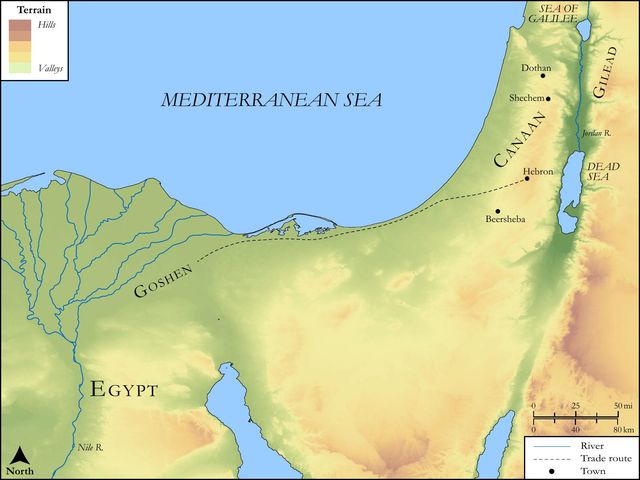
See on the biblical-era maps


Study this verse
Public-domain commentary
Matthew Henry
From his Commentary on the Whole Bible. Henry comments on passages, not single verses — this entry covers Genesis 43:11–14.
Observe here, I. Jacob's persuasibleness. He would be ruled by reason, though they were his inferiors that urged it. He saw the necessity of the case; and, since there was no remedy, he consented to yield to the necessity (Gen 43:11): "If it must be so now, take your brother. If no corn can be had but upon those terms, we may as well expose him to the perils of the journey as suffer ourselves and families, and Benjamin amongst the rest, to perish for want of bread." Skin for skin, and all that a man has, even a Benjamin, the dearest of all, will he give for his life. No death so dreadful as that by famine, Lam 4:9. Jacob had said (Gen 42:38), My son shall not go down; but now he is over-persuaded to consent. Note, It is no fault, but our wisdom and duty, to alter our purposes and resolutions when there is a good reason for our so doing. Constancy is a virtue, but obstinacy is not. It is God's prerogative not to repent, and to make unchangeable resolves.
II.Jacob's prudence and justice, which appeared in three things:
- 1. He sent back the money which they had found in the sacks' mouths, with this discreet construction of it, Peradventure it was an oversight. Note, Honesty obliges us to make restitution, not only of that which comes to us by our own fault, but of that which comes to us by the mistakes of others. Though we get it by oversight, if we keep it when the oversight is discovered, it is kept by deceit. In the stating of accounts, errors must be excepted, even those that make for us as well as those that make against us. Jacob's words furnish us with a favourable construction to put upon that which we are tempted to resent as an injury and affront; pass it by, and say, Peradventure it was an oversight. 2. He sent double money, as much again as they took the time before, upon supposition that the price of corn might have risen, - or to show a generous spirit, that they might be the more likely to find generous treatment with the man, the lord of the land. 3. He sent a present of such things as the land afforded, and as were scarce in Egypt - balm and honey, etc. (Gen 43:11), the commodities that Canaan exported, Gen 37:25. Note, (1.) Providence dispenses its gifts variously. Some countries produce one commodity, others another, that commerce may be preserved. (2.) Honey and spice will never make up the want of bread-corn. The famine was sore in Canaan, and yet they had balm and myrrh, etc. We may live well enough upon plain food without dainties; but we cannot live upon dainties without plain food. Let us thank God that that which is most needful and useful is generally most cheap and common. (3.) A gift in secret pacifies wrath, Pro 21:14. Jacob's sons were unjustly accused as spies, yet Jacob was willing to be at the expense of a present, to pacify the accuser. Sometimes we must not think it too much to buy peace even where we may justly demand it, and insist upon it as our right.
III.Jacob's piety appearing in his prayer:
God Almighty give you mercy before the man! Gen 43:14. Jacob had formerly turned an angry brother into a kind one with a present and a prayer; and here he betakes himself to the same tried method, and it sped well. Note, Those that would find mercy with men must seek it of God, who has all hearts in his hands, and turns them as he pleases.
IV.Jacob's patience.
He concludes all with this: "If I be bereaved of my children, I am bereaved; If I must part with them thus one after another, I must acquiesce, and say, The will of the Lord be done." Note, It is our wisdom to reconcile ourselves to the sorest afflictions, and make the best of them; for there is nothing got by striving with our Maker, Sa2 15:25, Sa2 15:26.
Continue studying Genesis 43:14 across the web’s major study libraries — every link below opens this exact verse, chapter, or book on the destination site.
Read & Compare
 BibleGatewayThis verse in more than 200 translations and 70 languages.
 Bible.comThe YouVersion reader — hundreds of translations, reading plans, and highlights.
 ESV.orgCrossway's official English Standard Version reader.
 NET BibleThe NET translation with 60,000+ translators' notes on every rendering decision.
 STEP BibleTyndale House's free study tool — original text, vocabulary, and scholarly resources.
 BibliaLogos Bible Software's free web reader.
 USCCBThe New American Bible (Revised Edition) with the U.S. bishops' study notes.
Commentaries
 BibleHub CommentariesDozens of classic commentaries on this verse, gathered on one page.
 StudyLightMore than 100 commentary sets — the largest collection on the web.
 BibleRefPlain-English commentary on what this verse means, verse by verse.
 Enduring WordDavid Guzik's free commentary on this chapter, widely used by Bible teachers.
 Bible Study ToolsVerse commentary alongside Greek and Hebrew study aids.
Original Language & Research
- BibleHub InterlinearThe verse word by word — original language, transliteration, and English.
- BibleHub LexiconEvery word's original-language definition and Strong's entry.
 Blue Letter BibleDeep-study tools — Strong's numbers, concordance, and word studies.
 SefariaThe Hebrew text with Rashi and centuries of Jewish commentary.
Sermons, Hymns & Audio


TrulyRandomVerse is not affiliated with these sites and doesn’t control their content. They’re linked because they’re genuinely useful.
Summary
Genesis 43:14 captures Jacob's poignant and deeply resigned prayer as his sons prepare to return to Egypt, compelled to bring his youngest son, Benjamin. Faced with the potential loss of Benjamin, Jacob surrenders to the divine will, invoking "God Almighty" for mercy and expressing a profound, almost fatalistic, acceptance of whatever outcome may come, trusting in God's providence even amidst overwhelming sorrow and fear.
Context
ShowHideLiterary Context
This verse is a pivotal moment in the unfolding drama of Jacob's family and their interactions with Egypt during a severe famine. It immediately follows Judah's impassioned plea and guarantee for Benjamin's safety, which finally persuades Jacob to send his youngest son. The preceding chapters detail the initial journey to Egypt, Joseph's disguised demands, the discovery of the money in their sacks, and Simeon's detainment (Genesis 42). Jacob's desperate prayer here marks his reluctant but ultimate submission to the seemingly impossible demands, setting the stage for the dramatic reunion and revelation that will follow in Genesis 44 and Genesis 45. His words reflect the culmination of his fear and grief, harkening back to his long-held sorrow over Joseph's presumed death.
Historical & Cultural Context
The narrative is set against the backdrop of a widespread famine, a common and devastating occurrence in the days of the patriarchs, which often forced migrations and desperate measures for survival. Egypt, with its predictable Nile floods, was a reliable source of grain, making it a natural destination for those suffering from drought. The concept of a powerful "governor" or "man" (Joseph) holding immense authority over life and death was typical of ancient monarchical systems. Jacob's deep attachment to Benjamin, as the last son of his beloved Rachel, reflects the patriarchal family structure where lineage and the preservation of the family line were paramount. The practice of holding a family member hostage to ensure compliance was also a known tactic, highlighting the precarious position of Jacob's sons.
Key Themes
ShowHideThis verse powerfully contributes to several overarching themes within the book of Genesis. It highlights Divine Sovereignty and Providence, demonstrating how God orchestrates events, even through human suffering and difficult choices, to fulfill His ultimate purposes, as Joseph himself later articulates in Genesis 50:20. The theme of Faith in Adversity is also central, as Jacob, despite his profound despair and resignation, still turns to "God Almighty" for intervention, revealing a deep, albeit struggling, reliance on God's power. Furthermore, the narrative explores the complexities of Family Reconciliation and Forgiveness, as Jacob's willingness to risk Benjamin ultimately paves the way for the healing of deep-seated family wounds and the preservation of the nascent nation of Israel. The poignant expression of Parental Grief is also a significant theme, echoing Jacob's earlier lament over Joseph's presumed death in Genesis 37:35.
Exposition and Analysis
ShowHideGenesis 43:14 encapsulates Jacob's profound emotional state and his ultimate reliance on God in a moment of extreme vulnerability and perceived powerlessness.
Key Word Analysis
ShowHideThis divine title combines H410 (ʼêl), meaning "strength" or "mighty," often referring to God, and H7706 (Shadday), meaning "the Almighty." Jacob's invocation of El Shaddai is highly significant. This name emphasizes God's omnipotence, self-sufficiency, and His ability to fulfill His covenant promises, particularly in situations that seem humanly impossible. It is the name by which God appeared to Abraham when establishing the covenant of fruitfulness and blessing (Genesis 17:1). By using this name, Jacob acknowledges God's absolute power to intervene, provide, and alter circumstances, even when all human options have been exhausted.
H7356 (racham) refers to compassion, tender love, or pity, often associated with the womb, implying a deep, visceral, and nurturing affection. Jacob's prayer for "mercy" before the "man" (Joseph) is a plea for divine favor and compassion to be extended to his sons. It's not just a request for a favorable outcome, but for a softening of the heart of the powerful Egyptian governor, hoping that this divine intervention will lead to the safe return of both Simeon and Benjamin.
H7921 (shâkôl) is a primitive root meaning "to miscarry," "suffer abortion," or by analogy, "to bereave (literally or figuratively)." It conveys the profound sorrow of losing children or being made childless. Jacob's repetition, "If I be bereaved, I am bereaved," uses this word to express an utter and complete resignation to an inevitable, painful outcome. It signifies a profound surrender to fate, acknowledging that all human efforts have failed and the situation is now entirely in God's hands, for better or worse.
Verse Breakdown
ShowHide"And God Almighty give you mercy before the man,"
Jacob, having been persuaded by Judah, turns to the only remaining source of hope: God. His address to "God Almighty" (El Shaddai) is a recognition of God's supreme power and ability to intervene in human affairs. The plea for "mercy" is directed towards the unknown Egyptian governor, Joseph, whom Jacob perceives as a harsh and demanding figure. Jacob's deepest desire is for divine favor to influence this powerful individual, ensuring his sons' safety and the release of Simeon.
"that he may send away your other brother, and Benjamin."
This clause specifies the precise outcome Jacob desperately seeks from God's intervention. "Your other brother" refers to Simeon, who was held captive in Egypt. The inclusion of "and Benjamin" highlights the immense emotional weight attached to his youngest son, the last remaining child of his beloved Rachel. This part of the prayer underscores the immediate and dire need of the family: the safe return of both brothers to prevent further dissolution of his lineage.
"If I be bereaved [of my children], I am bereaved."
This is a powerful Hebrew expression of utter and complete resignation to an inevitable, painful outcome. Having already experienced the presumed loss of Joseph and now facing the potential loss of Benjamin, Jacob declares that he has emotionally prepared himself for the worst possible scenario. It is a cry of deep anguish, yet also an act of releasing control to a higher power, acknowledging that human efforts have reached their limit and the situation is now entirely in God's hands, for better or worse.
Literary Devices
ShowHideThis is a powerful Hebrew Idiom (Im shakkolti shakkolti) expressing utter and complete resignation to an inevitable, painful outcome. It conveys Jacob's profound sense of Pathos and fatalistic acceptance. Having already experienced the presumed loss of Joseph and now facing the potential loss of Benjamin, Jacob declares that he has emotionally prepared himself for the worst possible scenario. It is a cry of deep anguish, yet also an act of releasing control to a higher power, acknowledging that human efforts have reached their limit and the situation is now entirely in God's hands, for better or worse. This statement is imbued with Dramatic Irony, as the reader knows that God's plan is not one of further bereavement but of reunion and salvation through Joseph.
THEOLOGICAL AND THEMATIC CONNECTIONS
ShowHideJacob's desperate prayer in Genesis 43:14 serves as a profound testament to the human condition grappling with divine sovereignty. Despite his deep anguish and perceived hopelessness, Jacob's turning to "God Almighty" demonstrates an enduring, albeit struggling, faith in God's ultimate control. This narrative powerfully illustrates God's providential hand guiding events, even through famine, separation, and Jacob's profound sorrow, to fulfill His purposes for the nascent nation of Israel. It underscores that even in moments of utter despair, prayer remains the believer's most vital recourse, a surrender of control to the One who holds all things in His hands.
Reflection and Application
ShowHideJacob's prayer and resignation in Genesis 43:14 offer a profound lesson for believers today. In moments of profound uncertainty, fear, or when circumstances seem utterly beyond our control, we are called to emulate Jacob's ultimate surrender. This means acknowledging God's absolute sovereignty, trusting that He is working all things for good, even when we cannot discern His plan or when the path ahead seems fraught with potential pain. Like Jacob, there are times when we must release our grip on desired outcomes and commit them to God, even if it means confronting potential loss or suffering. This act of surrender, though deeply challenging, can lead to a profound peace and a deeper reliance on God's unfailing providence, reminding us that prayer is our most powerful recourse, even when the situation appears hopeless. It teaches us that true faith is not the absence of fear or sorrow, but the ability to entrust our deepest fears and sorrows to the Almighty God.
Questions for Reflection
ShowHideFAQ
ShowHideWhat does 'If I be bereaved, I am bereaved' signify?
ShowHideThis Hebrew idiom, Im shakkolti shakkolti, expresses a profound and complete resignation to an inevitable, painful outcome. It signifies that Jacob has emotionally prepared himself for the worst-case scenario – the loss of Benjamin, his last remaining son by Rachel – and accepts that if this tragedy occurs, it is simply what will be. It is a declaration of deep sorrow and a surrender of control, acknowledging that all human efforts have reached their limit and the situation is now entirely in God's hands. It reflects a deep, almost fatalistic, acceptance of divine will, even in the face of immense personal grief. This phrase is a poignant expression of Jacob's despair, yet it simultaneously marks a turning point where he relinquishes his grip on the situation and entrusts it to God's providence, however painful that might prove to be.
Christ-Centered Fulfillment
ShowHideThe narrative of Joseph, culminating in Jacob's desperate prayer and eventual reunion with his lost sons, profoundly foreshadows the redemptive work of Christ. Jacob's willingness to "lose" Benjamin for the sake of his family's survival, and his deep suffering, mirrors the Father's ultimate sacrifice of His Son, Jesus, for the salvation of humanity. Joseph, who was rejected by his brothers, suffered, and was thought lost (Genesis 37:28), yet rose to a position of power to save his family from famine (Genesis 45:7-8), serves as a powerful type of Christ. Just as God used Joseph's suffering to bring about salvation for Israel, so too did God use Christ's suffering and death to bring about eternal salvation for all who believe (Romans 5:8). Jacob's ultimate surrender to God's will, even in the face of perceived loss, points to Christ's own surrender in Gethsemane, "Nevertheless, not my will, but yours, be done" (Luke 22:42), leading to the ultimate fulfillment of God's redemptive plan through the cross and resurrection, offering true mercy and deliverance from sin and death (Hebrews 9:12).