


Genesis 37:7
Bible text: King James Version (1769 Blayney text) · Public domain
Bible text: King James Version with Strong's numbers · Public domain
Bible text: Berean Standard Bible · Public domain
Bible text: American Standard Version (1901) · Public domain
Bible text: World English Bible, Messianic edition · Public domain
Bible text: Geneva Bible (1599) · Public domain
Bible text: Young's Literal Translation · Public domain
- וְהִנֵּהVe·hi·nehand there!H2009Conj-w ¦ PrtParticle Interjectionוְandהִנֵּהthere!
- אֲנַחְנוּ'a·Nach·nuweH587Pro-1cpPronoun Personal 1st Plural common gender
- מְאַלְּמִיםme·'a·le·Mim[were] bindingH481V-Piel-Prtcpl-mpVerb Piel Participle Plural Masculine Absolute
- אֲלֻמִּים'a·lu·MimsheavesH485N-mpNoun Plural Masculine Absolute
- בְּתוֹךְbe·Tokhin [the] middle ofH8432Prep-b ¦ N-mscNoun Singular Masculine Constructבְּinתוֹךְ[the] middle of
- הַשָּׂדֶהha·sa·Dehthe fieldH7704Art ¦ N-msNoun Singular Masculine Absoluteהַtheשָּׂדֶהfield
- וְהִנֵּהve·hi·Nehand there!H2009Conj-w ¦ PrtParticle Interjectionוְandהִנֵּהthere!
- קָמָהKa·mahit aroseH6965V-Qal-Perf-3fsVerb Qal Perfect 3rd Singular Feminine
- אֲלֻמָּתִי'a·lu·ma·Timy sheafH485N-fsc ¦ 1csNoun Singular Feminine Constructאֲלֻמָּתִsheafיmy
- וְגַםve·gamand alsoH1571Conj-w ¦ AdvAdverbוְandגַםalso
- נִצָּבָהni·Tza·vahit stood uprightH5324V-Niphal-Perf-3fsVerb Niphal Perfect 3rd Singular Feminine
- וְהִנֵּהve·hi·Nehand there!H2009Conj-w ¦ PrtParticle Interjectionוְandהִנֵּהthere!
- תְסֻבֶּינָהte·su·Bei·nahthey gathered roundH5437V-Qal-Imperf-3fpVerb Qal Imperfect 3rd Plural Feminine
- אֲלֻמֹּתֵיכֶם'a·lu·Mo·tei·Khemyour sheavesH485N-fpc ¦ 2mpNoun Plural Feminine Constructאֲלֻמֹּתֵיsheavesכֶםyour
- וַתִּשְׁתַּחֲוֶיןָva·tish·ta·cha·Vei·naand they bowed downH7812Conj-w ¦ V-Hishtaphel-ConsecImperf-3fpVerb Hishtaphel Consecutive Imperfect 3rd Plural Feminineוַandתִּשְׁתַּחֲוֶיןָthey bowed down
- לַאֲלֻמָּתִיla·'a·lu·ma·Tito my sheafH485Prep-l ¦ N-fsc ¦ 1csNoun Singular Feminine Constructלַtoאֲלֻמָּתִsheafיmy
English is a literal word-by-word gloss of the Hebrew, not the KJV's wording. Why?
This is the original text the KJV's translators worked from — each Hebrew word with its own literal English meaning in this verse, prepared by scholars at Tyndale House, Cambridge. The KJV translates whole sentences, not word by word, so its wording differs: one Hebrew word can become several English words, and the KJV may choose “the LORD” where the gloss reads “Yahweh”. Both are faithful — they answer different questions. For the KJV's own rendering, switch to the KJV text.
Details
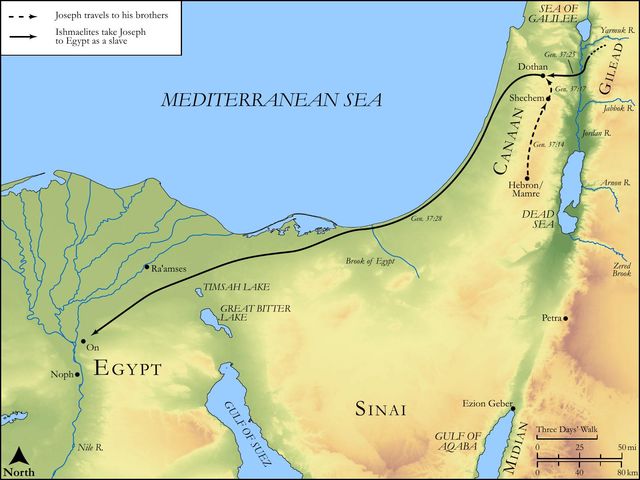
See on the biblical-era maps


Study this verse
Public-domain commentary
Matthew Henry
From his Commentary on the Whole Bible. Henry comments on passages, not single verses — this entry covers Genesis 37:5–11. His two-level outline is real structure in the source text, so it is rendered as structure.
Here, I. Joseph relates the prophetical dreams he had, Gen 37:6, Gen 37:7, Gen 37:9, Gen 37:10. Though he was now very young (about seventeen years old), yet he was pious and devout, and well-inclined, and this fitted him for God's gracious discoveries of himself to him. Joseph had a great deal of trouble before him, and therefore God gave him betimes this prospect of his advancement, to support and comfort him under the long and grievous troubles with which he was to be exercised. Thus Christ had a joy set before him, and so have Christians. Note, God has ways of preparing his people beforehand for the trials which they cannot foresee, but which he has an eye to in the comforts with which he furnishes them. His dreams were, 1. That his brethren's sheaves all bowed to his, intimating upon what occasion they should be brought to do homage to him, namely, in seeking to him for corn; their empty sheaves should bow to his full one. 2. That the sun, and moon, and eleven stars, did obeisance to him, Gen 37:9. Joseph was more of a prophet than a politician, else he would have kept this to himself, when he could not but know that his brethren did already hate him and that this would but the more exasperate them. But, if he told it in his simplicity, yet God directed it for the mortification of his brethren. Observe, Joseph dreamed of his preferment, but he did not dream of his imprisonment. Thus many young people, when they are setting out in the world, think of nothing but prosperity and pleasure, and never dream of trouble.
II.His brethren take it very ill, and are more and more enraged against him (Gen 37:8): Shalt thou indeed reign over us? See here,
1.How truly they interpreted his dream, that he should reign over them. Those become the expositors of his dream who were enemies to the accomplishment of it, as in Gideon's story (Jdg 7:13, Jdg 7:14); they perceived that he spoke of them, Mat 21:45. The event exactly answered to this interpretation, Gen 42:6, etc.
2.How scornfully they resented it: "Shalt thou, who are but one, reign over us, who are many? Thou, who are the youngest, over us who are older?" Note, The reign and dominion of Jesus Christ, our Joseph, have been, and are, despised and striven against by a carnal and unbelieving world, who cannot endure to think that this man should reign over them. The dominion also of the upright, in the morning of the resurrection, is thought of with the utmost disdain.
III.His father gives him a gentle rebuke for it, yet observes the saying, Gen 37:10, Gen 37:11.
Probably he checked him for it, to lessen the offence which his brethren would be apt to take at it; yet he took notice of it more than he seemed to do: he insinuated that it was but an idle dream, because his mother was brought in, who had been dead some time since; whereas the sun, moon, and eleven stars, signify no more than the whole family that should have a dependence upon him, and be glad to be beholden to him. Note, The faith of God's people in God's promises is often sorely shaken by their misunderstanding the promises and then suggesting the improbabilities that attend the performance; but God is doing his own work, and will do it, whether we understand him aright or no. Jacob, like Mary (Luk 2:51), kept these things in his heart, and no doubt remembered them long afterwards, when the event answered to the prediction.
Continue studying Genesis 37:7 across the web’s major study libraries — every link below opens this exact verse, chapter, or book on the destination site.
Read & Compare
 BibleGatewayThis verse in more than 200 translations and 70 languages.
 Bible.comThe YouVersion reader — hundreds of translations, reading plans, and highlights.
 ESV.orgCrossway's official English Standard Version reader.
 NET BibleThe NET translation with 60,000+ translators' notes on every rendering decision.
 STEP BibleTyndale House's free study tool — original text, vocabulary, and scholarly resources.
 BibliaLogos Bible Software's free web reader.
 USCCBThe New American Bible (Revised Edition) with the U.S. bishops' study notes.
Commentaries
 BibleHub CommentariesDozens of classic commentaries on this verse, gathered on one page.
 StudyLightMore than 100 commentary sets — the largest collection on the web.
 BibleRefPlain-English commentary on what this verse means, verse by verse.
 Enduring WordDavid Guzik's free commentary on this chapter, widely used by Bible teachers.
 Bible Study ToolsVerse commentary alongside Greek and Hebrew study aids.
Original Language & Research
- BibleHub InterlinearThe verse word by word — original language, transliteration, and English.
- BibleHub LexiconEvery word's original-language definition and Strong's entry.
 Blue Letter BibleDeep-study tools — Strong's numbers, concordance, and word studies.
 SefariaThe Hebrew text with Rashi and centuries of Jewish commentary.
Sermons, Hymns & Audio


TrulyRandomVerse is not affiliated with these sites and doesn’t control their content. They’re linked because they’re genuinely useful.
Summary
Genesis 37:7 records Joseph's inaugural prophetic dream, vividly depicting his sheaf of grain rising and standing upright while his brothers' sheaves encircled and bowed down to it. This potent agricultural imagery, immediately comprehensible within their agrarian society, served as a divine revelation foreshadowing Joseph's future preeminence and his family's eventual submission to his authority, thereby igniting profound sibling envy and setting in motion the intricate divine plan for his life and the preservation of the nascent nation of Israel.
Context
ShowHideLiterary Context
This verse is pivotal, introducing the first of two prophetic dreams that define Joseph's early life and set the stage for the dramatic narrative that follows in Genesis 37. Immediately preceding this dream, the narrative establishes Jacob's overt favoritism towards Joseph, gifting him a distinctive "coat of many colours" (Genesis 37:3), and Joseph's tendency to bring negative reports of his brothers' conduct to their father (Genesis 37:2). These elements had already fostered deep resentment among his brothers. Joseph's recounting of this dream, followed by a similar one involving celestial bodies (Genesis 37:9), directly escalates this animosity, leading to their plot against him (Genesis 37:18-28). The dream's fulfillment, decades later, forms the climax of the Joseph narrative in Genesis 42-45, where his brothers indeed bow before him.
Historical & Cultural Context
Dreams were widely regarded among the patriarchs and their neighbours as significant channels of divine communication, often conveying messages about the future or divine will. For a nomadic, pastoral, and increasingly agrarian society like Jacob's family, the imagery of "sheaves" and "binding in the field" would have been instantly recognizable and deeply meaningful. Agriculture was the bedrock of their economy and sustenance. The act of "making obeisance" (prostration or bowing low) was a common gesture of profound respect, submission, or worship, particularly towards a superior, a ruler, or a deity. In the patriarchal family structure, the younger son exercising authority over his elder brothers was a radical reversal of the customary order of primogeniture, making the dream's implications particularly offensive and threatening to Joseph's brothers.
Key Themes
ShowHideGenesis 37:7 powerfully contributes to several overarching themes within the book of Genesis and the broader biblical narrative. It highlights Divine Revelation, demonstrating God's sovereign communication of His plans through dreams, a recurring motif in the Joseph narrative and beyond. The dream underscores God's Sovereignty, revealing His predetermined purpose for Joseph's life, which would unfold despite immense human opposition and suffering, ultimately serving to preserve the covenant family of Israel (Genesis 50:20). It sets the stage for the theme of Sibling Rivalry and Conflict, a pervasive issue throughout Genesis, from Cain and Abel to Jacob and Esau, here exacerbated by favoritism and prophetic claims. Finally, it introduces the theme of Exaltation through Humiliation, foreshadowing how Joseph's initial suffering and imprisonment would paradoxically lead to his ultimate position of authority and the fulfillment of this very dream.
Exposition and Analysis
ShowHideKey Word Analysis
ShowHidePassive participle of a root meaning "to tie fast." It refers to something bound, specifically a bundle of cut grain stalks. In this dream, "sheaves" are not merely agricultural produce but symbolic representations of individuals or family units, specifically Joseph and his brothers. The imagery grounds the supernatural revelation in the tangible, everyday reality of their lives, making the symbolic action all the more striking and immediately interpretable by the family.
A primitive root meaning "to rise" in various applications—literal, figurative, intensive, and causative. It can imply getting up, standing up, establishing, confirming, or even enduring. Here, applied to Joseph's sheaf, it denotes an impossible, supernatural act of self-elevation and establishment, signifying Joseph's future prominence, stability, and divinely ordained authority.
A primitive root meaning "to depress," specifically to prostrate oneself, often reflexively, in homage to royalty or God. It signifies bowing down, crouching, falling flat, humbly beseeching, or doing reverence. In this context, it unequivocally communicates an act of profound submission and homage, indicating the brothers' future subservience to Joseph.
Verse Breakdown
ShowHide"For, behold, we [were] binding sheaves in the field"
This opening clause establishes the common, shared context of the dream: the brothers, including Joseph, engaged in the familiar agricultural labor of harvesting grain. "Binding sheaves" refers to gathering cut stalks into bundles, a communal activity that underscores their familial connection and shared livelihood. The setting, "in the field," emphasizes the mundane, everyday environment in which this extraordinary vision unfolds, making the subsequent supernatural events all the more jarring and significant.
"and, lo, my sheaf arose, and also stood upright"
This is the miraculous and pivotal moment of the dream. Joseph's sheaf, representing himself, performs an impossible feat for an inanimate object: it "arose" (came into being, stood up) and "stood upright" (maintained an erect, stable posture). This action symbolizes Joseph's future elevation to a position of prominence, authority, and unwavering stability. It suggests a divinely ordained rise above his peers, an inherent dignity and power that sets him apart.
"and, behold, your sheaves stood round about, and made obeisance to my sheaf"
This final clause depicts the reaction of the other sheaves, representing Joseph's brothers. They "stood round about," implying a surrounding, perhaps even encircling, posture that highlights their collective presence around Joseph's solitary, upright sheaf. The crucial action is "made obeisance," which signifies a deep, formal act of bowing down or prostration. This clearly and undeniably prophesies the future submission and homage that Joseph's brothers, and by extension his entire family, would render to him, acknowledging his superior position and authority.
Literary Devices
ShowHideThe dream in Genesis 37:7 is rich in Symbolism, where the ordinary elements of agrarian life—sheaves of grain—are imbued with profound meaning, representing individuals and their future relationships. The upright sheaf symbolizes Joseph's authority and prominence, while the bowing sheaves represent his brothers' submission. This serves as a clear instance of Foreshadowing, predicting future events in Joseph's life and the destiny of his family. As a Prophetic Dream, it functions as a divine revelation, communicating God's sovereign plan for Joseph and the lineage of Israel. There is also a subtle Irony at play: the very dream that provokes his brothers' jealousy and leads to Joseph's suffering ultimately sets in motion the events that bring about the dream's fulfillment, demonstrating God's ability to use human malice for His divine purposes.
Theological and Thematic Connections
ShowHideGenesis 37:7 serves as a foundational text for understanding God's sovereign hand in human history and individual lives. It reveals that God communicates His purposes and orchestrates events, often through unexpected means like dreams, to fulfill His ultimate plan. Despite the immediate human reactions of envy and hostility, the dream underscores God's unwavering commitment to His covenant promises, demonstrating that He can use the most challenging circumstances—even betrayal and imprisonment—to prepare and position His chosen instruments for their intended roles. Joseph's journey, initiated by this prophetic vision, illustrates that divine favor and future leadership often come with a costly process of refinement and suffering, ultimately leading to the preservation and flourishing of God's people.
Reflection and Application
ShowHideJoseph's dream in Genesis 37:7 offers profound insights into the nature of divine calling and the often-unforeseen path to its fulfillment. It reminds us that God has a sovereign plan for each of our lives, sometimes revealed in ways that defy immediate logic or provoke resistance from others. The initial revelation of a grand future can be met with misunderstanding, envy, or even hostility, as it was for Joseph. Yet, his story teaches us to trust in God's timing and His unwavering faithfulness, even when the journey involves profound suffering, betrayal, and long periods of waiting. We are called to recognize that God uses challenging circumstances, not to thwart His purposes, but to refine our character, deepen our faith, and prepare us for the very roles He has ordained. Ultimately, Joseph's experience encourages us to embrace God's sovereignty, understanding that He can orchestrate all things, even human evil, for the ultimate good of those who love Him and are called according to His purpose.
Questions for Reflection
ShowHideFAQ
ShowHideWhat is the significance of "sheaves" in this dream?
ShowHideIn an agrarian society like ancient Israel, sheaves (bundles of grain stalks) were fundamental symbols of harvest, sustenance, and the fruit of labor. In Joseph's dream, they transcend their literal meaning to become powerful symbols of individuals or family units. Joseph's single sheaf standing upright while the others bow down clearly depicts a future scenario where he would hold a position of authority and his family would be dependent on him and submit to his leadership. This agricultural imagery made the dream's message immediately comprehensible and impactful to his family.
Did Joseph fully understand the dream's implications when he recounted it?
ShowHideWhile Joseph likely grasped the dream's basic message of his future exaltation and his family's submission, it is improbable that he fully comprehended the complex and arduous path to its fulfillment. His youthful recounting of the dream, seemingly without sensitivity to his brothers' deep-seated resentment, suggests a lack of understanding regarding the immediate negative consequences and the long, painful journey of suffering, imprisonment, and separation that lay ahead before the dream would ultimately come to pass in Egypt.
Why did this dream provoke such a strong reaction from his brothers?
ShowHideThe dream confirmed and intensified the existing resentment his brothers harbored towards Joseph. This animosity was already fueled by Jacob's blatant favoritism, exemplified by the distinctive "coat of many colours" (Genesis 37:3). The idea of bowing down to their younger brother, who was already perceived as arrogant and a tattletale (Genesis 37:2), was an unbearable affront to their pride, their sense of seniority, and the established patriarchal order within the family. It directly challenged their aspirations for prominence and their rightful place in the family hierarchy.
Christ-Centered Fulfillment
ShowHideJoseph, in this dream and its subsequent fulfillment, serves as a profound type of Christ, foreshadowing the trajectory of the Messiah. Just as Joseph was rejected by his own brothers (Genesis 37:18-20), sold for a price (Genesis 37:28), and suffered unjustly in a foreign land (Genesis 39:20), so too was Christ rejected by His own people (John 1:11), betrayed for a price (Matthew 26:15), and suffered unjustly, ultimately unto death (1 Peter 2:21-23). Yet, through Joseph's suffering and his subsequent exaltation to a position of supreme authority in Egypt (Genesis 41:40-44), he became the means of salvation and sustenance for his family, who eventually bowed before him in humble submission and dependence (Genesis 42:6). Similarly, Christ, through His suffering, death, and resurrection, was highly exalted to the right hand of God (Philippians 2:9-11), becoming the ultimate source of salvation and life for all who come to Him (Acts 4:12). His authority, like Joseph's, is exercised not for personal gain, but for the preservation, reconciliation (2 Corinthians 5:18-19), and eternal blessing of His people, bringing them into a relationship of humble dependence and worship before the Lamb who was slain (Revelation 5:12-14).