


Genesis 37:8
Bible text: King James Version (1769 Blayney text) · Public domain
Bible text: King James Version with Strong's numbers · Public domain
Bible text: Berean Standard Bible · Public domain
Bible text: American Standard Version (1901) · Public domain
Bible text: World English Bible, Messianic edition · Public domain
Bible text: Geneva Bible (1599) · Public domain
Bible text: Young's Literal Translation · Public domain
- וַיֹּאמְרוּvai·Yo·me·ruand they saidH559Conj-w ¦ V-Qal-ConsecImperf-3mpVerb Qal Consecutive Imperfect 3rd Plural Masculineוַandיֹּאמְרוּthey said
- לוֹloto <the> himPrep-l ¦ 3msSuffix Personal 3rd Singular Masculineלto <the>וֹhim
- אֶחָיו'e·Chavhis brothersH251N-mpc ¦ 3msNoun Plural Masculine Constructאֶחָיbrothersוhis
- הֲמָלֹךְha·ma·Lokh¿ really <to reign>H4427Interrog ¦ V-Qal-InfAbsVerb Qal Infinitive Absoluteהֲ¿מָלֹךְreally <to reign>
- תִּמְלֹךְtim·loKhwill you reignH4427V-Qal-Imperf-2msVerb Qal Imperfect 2nd Singular Masculine
- עָלֵינוּ'a·Lei·nuover usH5921Prep ¦ 1cpPreposition Definiteעָלֵיoverנוּus
- אִם'imor?H518PrtParticle Conditional
- מָשׁוֹלma·Sholcertainly <to rule>H4910V-Qal-InfAbsVerb Qal Infinitive Absolute
- תִּמְשֹׁלtim·Sholwill you ruleH4910V-Qal-Imperf-2msVerb Qal Imperfect 2nd Singular Masculine
- בָּנוּBa·nuover <the> usPrep-b ¦ 1cpSuffix Personal 1st Plural common genderבָּover <the>נוּus
- וַיּוֹסִפוּvai·yo·Si·fuand they increasedH3254Conj-w ¦ V-Hiphil-ConsecImperf-3mpVerb Hiphil Consecutive Imperfect 3rd Plural Masculineוַandיּוֹסִפוּthey increased
- עוֹד'OdagainH5750Adj-msAdjective Numerical Singular Masculine Absolute
- שְׂנֹאse·No'to hateH8130V-Qal-InfVerb Qal Infinitive Construct
- אֹתוֹ'o·To<obj.> himH853DirObjM ¦ 3msParticle Object Indicatorאֹת<obj.>וֹhim
- עַל'alonH5921PrepPreposition
- חֲלֹמֹתָיוcha·lo·mo·Tavhis dreamsH2472N-fpc ¦ 3msNoun Plural Feminine Constructחֲלֹמֹתָיdreamsוhis
- וְעַלve·'aland onH5921Conj-w ¦ PrepPrepositionוְandעַלon
- דְּבָרָיוde·va·Ravhis wordsH1697N-mpc ¦ 3msNoun Plural Masculine Constructדְּבָרָיwordsוhis
English is a literal word-by-word gloss of the Hebrew, not the KJV's wording. Why?
This is the original text the KJV's translators worked from — each Hebrew word with its own literal English meaning in this verse, prepared by scholars at Tyndale House, Cambridge. The KJV translates whole sentences, not word by word, so its wording differs: one Hebrew word can become several English words, and the KJV may choose “the LORD” where the gloss reads “Yahweh”. Both are faithful — they answer different questions. For the KJV's own rendering, switch to the KJV text.
Details
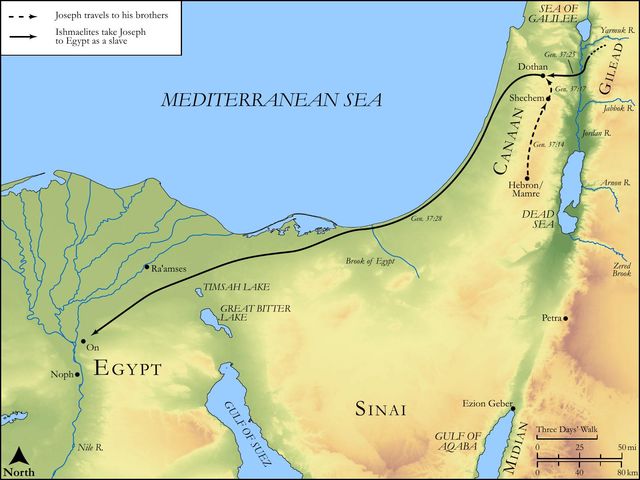
See on the biblical-era maps


Study this verse
Public-domain commentary
Matthew Henry
From his Commentary on the Whole Bible. Henry comments on passages, not single verses — this entry covers Genesis 37:5–11. His two-level outline is real structure in the source text, so it is rendered as structure.
Here, I. Joseph relates the prophetical dreams he had, Gen 37:6, Gen 37:7, Gen 37:9, Gen 37:10. Though he was now very young (about seventeen years old), yet he was pious and devout, and well-inclined, and this fitted him for God's gracious discoveries of himself to him. Joseph had a great deal of trouble before him, and therefore God gave him betimes this prospect of his advancement, to support and comfort him under the long and grievous troubles with which he was to be exercised. Thus Christ had a joy set before him, and so have Christians. Note, God has ways of preparing his people beforehand for the trials which they cannot foresee, but which he has an eye to in the comforts with which he furnishes them. His dreams were, 1. That his brethren's sheaves all bowed to his, intimating upon what occasion they should be brought to do homage to him, namely, in seeking to him for corn; their empty sheaves should bow to his full one. 2. That the sun, and moon, and eleven stars, did obeisance to him, Gen 37:9. Joseph was more of a prophet than a politician, else he would have kept this to himself, when he could not but know that his brethren did already hate him and that this would but the more exasperate them. But, if he told it in his simplicity, yet God directed it for the mortification of his brethren. Observe, Joseph dreamed of his preferment, but he did not dream of his imprisonment. Thus many young people, when they are setting out in the world, think of nothing but prosperity and pleasure, and never dream of trouble.
II.His brethren take it very ill, and are more and more enraged against him (Gen 37:8): Shalt thou indeed reign over us? See here,
1.How truly they interpreted his dream, that he should reign over them. Those become the expositors of his dream who were enemies to the accomplishment of it, as in Gideon's story (Jdg 7:13, Jdg 7:14); they perceived that he spoke of them, Mat 21:45. The event exactly answered to this interpretation, Gen 42:6, etc.
2.How scornfully they resented it: "Shalt thou, who are but one, reign over us, who are many? Thou, who are the youngest, over us who are older?" Note, The reign and dominion of Jesus Christ, our Joseph, have been, and are, despised and striven against by a carnal and unbelieving world, who cannot endure to think that this man should reign over them. The dominion also of the upright, in the morning of the resurrection, is thought of with the utmost disdain.
III.His father gives him a gentle rebuke for it, yet observes the saying, Gen 37:10, Gen 37:11.
Probably he checked him for it, to lessen the offence which his brethren would be apt to take at it; yet he took notice of it more than he seemed to do: he insinuated that it was but an idle dream, because his mother was brought in, who had been dead some time since; whereas the sun, moon, and eleven stars, signify no more than the whole family that should have a dependence upon him, and be glad to be beholden to him. Note, The faith of God's people in God's promises is often sorely shaken by their misunderstanding the promises and then suggesting the improbabilities that attend the performance; but God is doing his own work, and will do it, whether we understand him aright or no. Jacob, like Mary (Luk 2:51), kept these things in his heart, and no doubt remembered them long afterwards, when the event answered to the prediction.
Historical interpretation
Two Centuries of Reception
2 surviving comments on this verse. Each one is dated, so this reads as a timeline rather than a list.
Select a marker to jump to its quote. Markers stagger vertically where authors wrote within a few decades of each other.
Why do you envy and hate the righteous, if God revealed to him his own mysteries and made clear through visions what would have happened at the end of time? Why do you grieve at the sight of his embroidered tunic, if the just Father honored him by loving him more than everybody else, and sent him to visit you as a Shepherd among the shepherds, and presented to the world a trustworthy witness and a sheaf for his old age, and raised from the dead a holy firstborn as first fruits? Why do you get angry if the sun and the moon and the eleven stars worship him? They are there from the ancient times to prefigure him. And neither Jacob was called “sun,” nor Rachel was called “moon,” and the events did not happened in this manner.
Indeed, God’s grace shone on Joseph even in his boyhood. For he had a dream that when he was binding sheaves with his brothers—so it appeared to him in the vision—this sheaf rose up and stood straight, while the sheaves of his brothers turned and bowed down to his sheaf. Now in this the resurrection of the Lord Jesus that was to come was revealed. When they saw him at Jerusalem, the eleven disciples and all the saints bowed down; when they rise, they will bow down bearing the fruits of their good works, just as it is written, “Coming they shall come with joyfulness, carrying their sheaves.” Although his brothers disparaged the reliability of the dream out of their envy, still they expressed his interpretation of it in their own words when they replied, “Are you to be our king? Are you to rule over us?” For that vision indicated the King who was to come, and before him all human flesh would bow down with bended knee.
Continue studying Genesis 37:8 across the web’s major study libraries — every link below opens this exact verse, chapter, or book on the destination site.
Read & Compare
 BibleGatewayThis verse in more than 200 translations and 70 languages.
 Bible.comThe YouVersion reader — hundreds of translations, reading plans, and highlights.
 ESV.orgCrossway's official English Standard Version reader.
 NET BibleThe NET translation with 60,000+ translators' notes on every rendering decision.
 STEP BibleTyndale House's free study tool — original text, vocabulary, and scholarly resources.
 BibliaLogos Bible Software's free web reader.
 USCCBThe New American Bible (Revised Edition) with the U.S. bishops' study notes.
Commentaries
 BibleHub CommentariesDozens of classic commentaries on this verse, gathered on one page.
 StudyLightMore than 100 commentary sets — the largest collection on the web.
 BibleRefPlain-English commentary on what this verse means, verse by verse.
 Enduring WordDavid Guzik's free commentary on this chapter, widely used by Bible teachers.
 Bible Study ToolsVerse commentary alongside Greek and Hebrew study aids.
Original Language & Research
- BibleHub InterlinearThe verse word by word — original language, transliteration, and English.
- BibleHub LexiconEvery word's original-language definition and Strong's entry.
 Blue Letter BibleDeep-study tools — Strong's numbers, concordance, and word studies.
 SefariaThe Hebrew text with Rashi and centuries of Jewish commentary.
Sermons, Hymns & Audio


TrulyRandomVerse is not affiliated with these sites and doesn’t control their content. They’re linked because they’re genuinely useful.
Summary
Genesis 37:8 powerfully encapsulates the escalating tension and profound animosity within Jacob's family, detailing the brothers' visceral, sarcastic rejection of Joseph's prophetic dreams and the words by which he conveyed them. This verse marks a critical inflection point, revealing the depth of their resentment and setting the stage for the dramatic, divinely orchestrated events that follow, fueled by their disbelief and indignation at the very notion of Joseph's future authority over them.
Context
ShowHideLiterary Context
This verse immediately follows Joseph's recounting of his first dream, where his brothers' sheaves of grain bowed down to his own sheaf, a clear symbol of future subservience and authority. The preceding verses establish Joseph as Jacob's favored son, distinguished by the "coat of many colors" Genesis 37:3, which already fueled his brothers' profound envy and hatred. Joseph's dreams, rather than being kept private, are openly shared, intensifying the existing familial friction. This direct confrontation in Genesis 37:8 serves as the immediate catalyst for the brothers' plot against Joseph, culminating in his sale into slavery in Genesis 37:28, thus propelling the narrative forward toward the fulfillment of God's wider redemptive plan for the nascent nation of Israel.
Historical & Cultural Context
In the households of the patriarchs, birth order typically dictated authority and inheritance. Joseph, as the second youngest of Jacob's twelve sons (and the firstborn of his favored wife, Rachel), was an anomaly in receiving such overt favoritism and prophetic visions of leadership. Dreams were often considered significant divine communications, and a dream predicting one's rule over family members would be taken seriously, not as mere fantasy. The brothers' reaction reflects the intense competition for status, inheritance, and their father's blessing common in such family structures, where the idea of a younger brother reigning over older ones would be seen as a profound disruption of social and familial order, a direct challenge to their honor and future.
Key Themes
ShowHideGenesis 37:8 contributes significantly to several overarching themes within the book of Genesis and the broader biblical narrative. It highlights the recurring theme of sibling rivalry, often exacerbated by parental favoritism, as seen earlier with Cain and Abel Genesis 4:5 and Jacob and Esau Genesis 27. The verse also underscores the theme of divine sovereignty, demonstrating how God's purposes are revealed and ultimately fulfilled despite human resistance and sin. Joseph's dreams are a clear instance of prophetic revelation, foreshadowing his future role in preserving his family and the nation of Israel, a theme that echoes throughout the patriarchs' stories, where God's promises are gradually unfolded through their lives, often in unexpected ways, as seen in God's covenant with Abraham in Genesis 12:1-3.
Exposition and Analysis
ShowHideKey Word Analysis
ShowHideA primitive root meaning "to reign; inceptively, to ascend the throne; causatively, to induct into royalty; hence (by implication) to take counsel." The brothers' sarcastic question uses this term, indicating their clear understanding that Joseph's dream implied a kingly, authoritative rule over them, a notion they found utterly repulsive and challenging to their established familial hierarchy.
A primitive root meaning "to rule; (have, make to have) dominion, governor, [idiom] indeed, reign, (bear, cause to, have) rule(-ing, -r), have power." This word reinforces and intensifies the meaning of "reign," emphasizing the exercise of power and control. By using both terms, the brothers underscore their perception that Joseph's dreams were a direct claim to absolute authority over their lives and future.
A primitive root meaning "to hate (personally); enemy, foe, (be) hate(-ful, -r), odious, [idiom] utterly." This verb explicitly describes the brothers' deep-seated and personal animosity towards Joseph, which was not merely dislike but a profound, active hatred that would drive them to extreme actions.
Meaning "a dream; dream(-er)." This term refers to the divinely inspired visions Joseph received. For the brothers, these dreams were not innocent fantasies but perceived claims to superiority that directly threatened their status and future, serving as the primary catalyst for their intensified hatred.
Verse Breakdown
ShowHide"And his brethren said to him,"
This introduces the brothers' direct, confrontational response to Joseph's recounting of his dream. It highlights the immediate and personal nature of their reaction, indicating a collective and unified opposition.
"Shalt thou indeed reign over us? or shalt thou indeed have dominion over us?"
These rhetorical questions are laden with sarcasm, contempt, and disbelief. The repetition ("indeed reign... indeed have dominion") emphasizes their scorn and the perceived audacity of Joseph's claims. It reveals their deep-seated resentment at the idea of a younger brother, already favored by their father, exercising any form of authority over them, who were older and felt entitled to leadership.
"And they hated him yet the more for his dreams, and for his words."
This clause explicitly states the intensification of their existing animosity. Their hatred was not new, but Joseph's dreams, interpreted as arrogant claims to superiority, served as a potent catalyst. The phrase "and for his words" indicates that Joseph's straightforward, perhaps naive, manner of recounting these dreams further inflamed their anger, turning potential prophetic insight into perceived boastfulness. This dual cause—the content of the dreams and the manner of their telling—fueled their escalating malice.
Literary Devices
ShowHideGenesis 37:8 employs several potent literary devices to convey the escalating familial conflict. The brothers' rhetorical questions, "Shalt thou indeed reign over us? or shalt thou indeed have dominion over us?", are a clear example of Sarcasm, conveying their contempt and disbelief through an ironic tone. This is further amplified by Repetition of the emphatic "indeed" and the synonymous verbs "reign" and "have dominion," which underscore the perceived outrageousness of Joseph's claims and their utter rejection of such a possibility. The phrase "hated him yet the more" is a form of Hyperbole, emphasizing the extreme and growing nature of their animosity, suggesting their hatred reached new, dangerous levels. Furthermore, the entire verse functions as Foreshadowing, as the brothers' angry questions ironically anticipate the very future that will indeed come to pass, where Joseph will hold authority over them, demonstrating the narrative's underlying theme of divine providence.
Theological and Thematic Connections
ShowHideGenesis 37:8 serves as a stark illustration of the destructive power of human sin, particularly envy and pride, within the context of God's sovereign plan. The brothers' hatred, fueled by Jacob's favoritism and Joseph's perceived arrogance, highlights how unchecked resentment can fester and lead to extreme actions. Yet, even in this dark display of human malice, the narrative subtly points to God's overarching purpose. The dreams, though scorned, are divinely inspired, revealing a future that God intends to bring about. The brothers' sinful response, far from thwarting God's plan, unwittingly becomes a crucial step in its fulfillment, showcasing God's ability to orchestrate His will even through human rebellion and suffering. This tension between human responsibility and divine sovereignty is a foundational theological concept woven throughout the biblical narrative.
Reflection and Application
ShowHideGenesis 37:8 offers profound insights for contemporary life, serving as a powerful warning against the corrosive effects of envy, pride, and unchecked resentment within relationships, especially familial ones. The brothers' intense hatred, fueled by favoritism and a perceived threat to their status, reminds us that bitterness can fester into destructive actions if not confronted and repented of. This passage also challenges us to consider our own reactions when confronted with truths or circumstances that challenge our preconceived notions or threaten our comfort. Do we resist God's unfolding plan when it doesn't align with our expectations, or do we trust in His sovereign wisdom? Furthermore, while Joseph's dreams were divinely inspired, his youthful and perhaps tactless sharing of them exacerbated his brothers' animosity. This underscores the importance of wisdom, humility, and discernment in communicating truth, even when it is from God, recognizing that the manner of delivery can significantly impact reception. Ultimately, the narrative encourages us to trust in God's overarching providence, knowing that He can weave even the darkest threads of human sin and suffering into a tapestry of redemptive purpose.
Questions for Reflection
ShowHideFAQ
ShowHideWhy did Joseph's brothers react with such intense hatred?
ShowHideJoseph's brothers already harbored deep resentment due to their father Jacob's overt favoritism towards him, symbolized by the special "coat of many colors" Genesis 37:3. When Joseph recounted his dreams, which clearly depicted his future superiority and their subservience to him Genesis 37:7, they interpreted these as arrogant claims to authority and a direct challenge to their birthright and status. This perceived arrogance, combined with their existing envy and the cultural expectation of elder brother supremacy, ignited their hatred to an even greater degree, leading to their sarcastic questions and a desire to eliminate the perceived threat he represented.
Were Joseph's dreams truly prophetic, or just childish fantasies?
ShowHideJoseph's dreams were indeed divinely inspired and genuinely prophetic. They were not mere childish fantasies but direct revelations from God concerning His future plans for Joseph and his family. The subsequent narrative of Genesis meticulously confirms their prophetic nature, as they were fulfilled years later when Joseph rose to power in Egypt and his brothers, facing severe famine, came to him for aid and literally bowed down before him, just as the dreams foretold Genesis 42:6 and Genesis 43:26.
How does human hatred, like that of Joseph's brothers, fit into God's divine plan?
ShowHideThe Bible frequently illustrates how God, in His sovereign wisdom, can use human sin and malice to accomplish His righteous purposes, even without condoning or excusing the sin itself. In Joseph's case, the brothers' hatred and their subsequent actions (selling him into slavery) were integral parts of God's larger, redemptive plan to preserve the nascent nation of Israel during a severe famine and to elevate Joseph to a position where he could save many lives. Joseph himself later articulated this profound theological truth to his brothers, telling them, "As for you, you meant evil against me, but God meant it for good, to bring it about that many people should be kept alive, as they are today" Genesis 50:20.
Christ-Centered Fulfillment
ShowHideJoseph's story, particularly his rejection by his own brothers as depicted in Genesis 37:8, serves as a profound and multifaceted type of Christ. Like Joseph, Jesus was "despised and rejected by men" Isaiah 53:3, scorned by His own people, the very ones He came to save, who questioned His authority and kingship, asking, "Is not this the carpenter's son?" Matthew 13:55. Joseph's suffering, betrayal, and eventual exaltation to a position of power through which he saved his family from death, strikingly foreshadow Christ's suffering, crucifixion, and ultimate resurrection and exaltation. Through His rejection and sacrificial death, Jesus became the means of salvation for all humanity, bringing life out of death and reconciliation out of hostility, just as Joseph brought salvation and provision to his family despite their initial hatred and betrayal. This narrative beautifully illustrates how God uses the rejection of His chosen ones to bring about ultimate redemption, culminating in the saving work of the Lamb of God John 1:29.