


Genesis 37:9
Bible text: King James Version (1769 Blayney text) · Public domain
Bible text: King James Version with Strong's numbers · Public domain
Bible text: Berean Standard Bible · Public domain
Bible text: American Standard Version (1901) · Public domain
Bible text: World English Bible, Messianic edition · Public domain
Bible text: Geneva Bible (1599) · Public domain
Bible text: Young's Literal Translation · Public domain
- וַיַּחֲלֹםvai·ya·cha·Lomand he dreamedH2492Conj-w ¦ V-Qal-ConsecImperf-3msVerb Qal Consecutive Imperfect 3rd Singular Masculineוַandיַּחֲלֹםhe dreamed
- עוֹד'OdagainH5750Adj-msAdjective Numerical Singular Masculine Absolute
- חֲלוֹםcha·Loma dreamH2472N-msNoun Singular Masculine Absolute
- אַחֵר'a·CheranotherH312Adj-msAdjective Singular Masculine Absolute
- וַיְסַפֵּרvay·sa·Perand he recountedH5608Conj-w ¦ V-Piel-ConsecImperf-3msVerb Piel Consecutive Imperfect 3rd Singular Masculineוַandיְסַפֵּרhe recounted
- אֹתוֹ'o·To<obj.> itH853DirObjM ¦ 3msParticle Object Indicatorאֹת<obj.>וֹit
- לְאֶחָיוle·'e·Chavto his brothersH251Prep-l ¦ N-mpc ¦ 3msNoun Plural Masculine Constructלְtoאֶחָיbrothersוhis
- וַיֹּאמֶרvai·Yo·merand he saidH559Conj-w ¦ V-Qal-ConsecImperf-3msVerb Qal Consecutive Imperfect 3rd Singular Masculineוַandיֹּאמֶרhe said
- הִנֵּהhi·Nehhere!H2009PrtParticle Interjection
- חָלַמְתִּיcha·Lam·tiI have dreamedH2492V-Qal-Perf-1csVerb Qal Perfect 1st Singular common gender
- חֲלוֹםcha·lOma dreamH2472N-msNoun Singular Masculine Absolute
- עוֹדodagainH5750Adj-msAdjective Numerical Singular Masculine Absolute
- וְהִנֵּהve·hi·Nehand there!H2009Conj-w ¦ PrtParticle Interjectionוְandהִנֵּהthere!
- הַשֶּׁמֶשׁha·She·meshthe sunH8121Art ¦ N-csNoun Singular common gender Absoluteהַtheשֶּׁמֶשׁsun
- וְהַיָּרֵחַve·hai·ya·Re·achand the moonH3394Conj-w ¦ Art ¦ N-msNoun Singular Masculine Absoluteוְandהַtheיָּרֵחַmoon
- וְאַחַדve·'a·Chadand one [plus]H259Conj-w ¦ Adj-fscAdjective Numerical Singular Feminine Constructוְandאַחַדone [plus]
- עָשָׂר'a·SartenH6240Adj-csAdjective Numerical Singular common gender Absolute
- כּוֹכָבִיםko·kha·VimstarsH3556N-mpNoun Plural Masculine Absolute
- מִשְׁתַּחֲוִיםmish·ta·cha·Vim[were] bowing downH7812V-Hithpael-Prtcpl-mpVerb Hithpael Participle Plural Masculine Absolute
- לִיLito <the> mePrep-l ¦ 1csSuffix Personal 1st Singular common genderלִto <the>יme
English is a literal word-by-word gloss of the Hebrew, not the KJV's wording. Why?
This is the original text the KJV's translators worked from — each Hebrew word with its own literal English meaning in this verse, prepared by scholars at Tyndale House, Cambridge. The KJV translates whole sentences, not word by word, so its wording differs: one Hebrew word can become several English words, and the KJV may choose “the LORD” where the gloss reads “Yahweh”. Both are faithful — they answer different questions. For the KJV's own rendering, switch to the KJV text.
Details
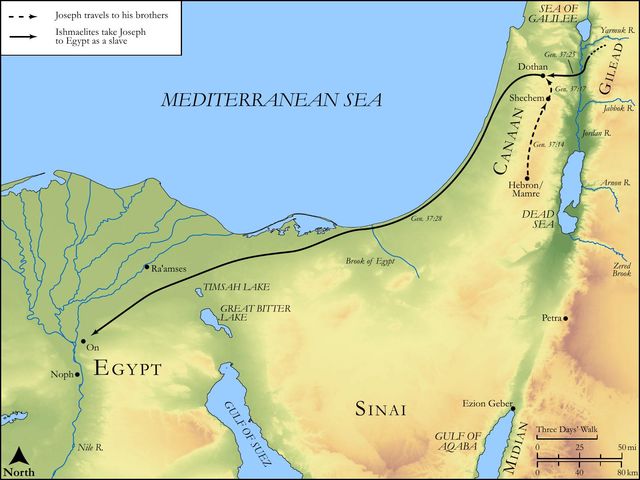
See on the biblical-era maps


Study this verse
Public-domain commentary
Matthew Henry
From his Commentary on the Whole Bible. Henry comments on passages, not single verses — this entry covers Genesis 37:5–11. His two-level outline is real structure in the source text, so it is rendered as structure.
Here, I. Joseph relates the prophetical dreams he had, Gen 37:6, Gen 37:7, Gen 37:9, Gen 37:10. Though he was now very young (about seventeen years old), yet he was pious and devout, and well-inclined, and this fitted him for God's gracious discoveries of himself to him. Joseph had a great deal of trouble before him, and therefore God gave him betimes this prospect of his advancement, to support and comfort him under the long and grievous troubles with which he was to be exercised. Thus Christ had a joy set before him, and so have Christians. Note, God has ways of preparing his people beforehand for the trials which they cannot foresee, but which he has an eye to in the comforts with which he furnishes them. His dreams were, 1. That his brethren's sheaves all bowed to his, intimating upon what occasion they should be brought to do homage to him, namely, in seeking to him for corn; their empty sheaves should bow to his full one. 2. That the sun, and moon, and eleven stars, did obeisance to him, Gen 37:9. Joseph was more of a prophet than a politician, else he would have kept this to himself, when he could not but know that his brethren did already hate him and that this would but the more exasperate them. But, if he told it in his simplicity, yet God directed it for the mortification of his brethren. Observe, Joseph dreamed of his preferment, but he did not dream of his imprisonment. Thus many young people, when they are setting out in the world, think of nothing but prosperity and pleasure, and never dream of trouble.
II.His brethren take it very ill, and are more and more enraged against him (Gen 37:8): Shalt thou indeed reign over us? See here,
1.How truly they interpreted his dream, that he should reign over them. Those become the expositors of his dream who were enemies to the accomplishment of it, as in Gideon's story (Jdg 7:13, Jdg 7:14); they perceived that he spoke of them, Mat 21:45. The event exactly answered to this interpretation, Gen 42:6, etc.
2.How scornfully they resented it: "Shalt thou, who are but one, reign over us, who are many? Thou, who are the youngest, over us who are older?" Note, The reign and dominion of Jesus Christ, our Joseph, have been, and are, despised and striven against by a carnal and unbelieving world, who cannot endure to think that this man should reign over them. The dominion also of the upright, in the morning of the resurrection, is thought of with the utmost disdain.
III.His father gives him a gentle rebuke for it, yet observes the saying, Gen 37:10, Gen 37:11.
Probably he checked him for it, to lessen the offence which his brethren would be apt to take at it; yet he took notice of it more than he seemed to do: he insinuated that it was but an idle dream, because his mother was brought in, who had been dead some time since; whereas the sun, moon, and eleven stars, signify no more than the whole family that should have a dependence upon him, and be glad to be beholden to him. Note, The faith of God's people in God's promises is often sorely shaken by their misunderstanding the promises and then suggesting the improbabilities that attend the performance; but God is doing his own work, and will do it, whether we understand him aright or no. Jacob, like Mary (Luk 2:51), kept these things in his heart, and no doubt remembered them long afterwards, when the event answered to the prediction.
Continue studying Genesis 37:9 across the web’s major study libraries — every link below opens this exact verse, chapter, or book on the destination site.
Read & Compare
 BibleGatewayThis verse in more than 200 translations and 70 languages.
 Bible.comThe YouVersion reader — hundreds of translations, reading plans, and highlights.
 ESV.orgCrossway's official English Standard Version reader.
 NET BibleThe NET translation with 60,000+ translators' notes on every rendering decision.
 STEP BibleTyndale House's free study tool — original text, vocabulary, and scholarly resources.
 BibliaLogos Bible Software's free web reader.
 USCCBThe New American Bible (Revised Edition) with the U.S. bishops' study notes.
Commentaries
 BibleHub CommentariesDozens of classic commentaries on this verse, gathered on one page.
 StudyLightMore than 100 commentary sets — the largest collection on the web.
 BibleRefPlain-English commentary on what this verse means, verse by verse.
 Enduring WordDavid Guzik's free commentary on this chapter, widely used by Bible teachers.
 Bible Study ToolsVerse commentary alongside Greek and Hebrew study aids.
Original Language & Research
- BibleHub InterlinearThe verse word by word — original language, transliteration, and English.
- BibleHub LexiconEvery word's original-language definition and Strong's entry.
 Blue Letter BibleDeep-study tools — Strong's numbers, concordance, and word studies.
 SefariaThe Hebrew text with Rashi and centuries of Jewish commentary.
Sermons, Hymns & Audio


TrulyRandomVerse is not affiliated with these sites and doesn’t control their content. They’re linked because they’re genuinely useful.
Summary
Genesis 37:9 records Joseph's second highly symbolic dream, a divine revelation in which the celestial bodies—the sun, moon, and eleven stars—bowed down to him. This vivid imagery directly foreshadowed his future preeminence and authority over his entire immediate family: his father, mother, and his eleven brothers. More explicit and encompassing than his first dream, this vision further intensified the deep-seated animosity and jealousy within his family, setting in motion the providential events that would lead to Joseph's suffering, eventual exaltation, and the preservation of his lineage.
Context
ShowHideLiterary Context
This verse is a pivotal moment within the larger narrative of Joseph, following closely on the heels of his first dream involving sheaves of grain (Genesis 37:7). The immediate literary context reveals a household already fractured by Jacob's overt favoritism towards Joseph, evidenced by the "coat of many colours" (Genesis 37:3). Joseph's innocent—or perhaps naive—recounting of his first dream had already provoked intense hatred from his brothers (Genesis 37:8). This second dream, however, escalates the conflict dramatically by explicitly including his parents in the act of obeisance, thereby challenging not just fraternal hierarchy but patriarchal authority itself. The dreams serve as divine pronouncements, setting the stage for Joseph's descent into slavery and subsequent rise to power, which ultimately fulfills these very visions.
Historical & Cultural Context
Dreams in the days of the patriarchs were often significant vehicles for divine communication, as when God came to Abimelech in a dream by night, conveying a message regarding future events or guidance. Rulers and individuals alike sought interpretations of their dreams, understanding them as omens or prophecies. In patriarchal society, the family structure was hierarchical, with the father holding ultimate authority, followed by the elder sons. Joseph, as a younger son, dreaming of his elders, including his father and mother, bowing to him was a profound inversion of this established social order, making his recounting of it particularly offensive and provocative within that cultural framework. The sun, moon, and stars were common ancient symbols for rulers, nations, or family heads, lending immediate symbolic weight to Joseph's vision.
Key Themes
ShowHideGenesis 37:9 contributes significantly to several overarching themes in the book of Genesis and the broader biblical narrative. It powerfully illustrates Divine Sovereignty and Providence, demonstrating God's active involvement in orchestrating future events, even through human sin and suffering. The dream is an instance of Prophetic Revelation, highlighting God's chosen method of communicating His will and future plans to His servants. It also underscores the destructive nature of Sibling Rivalry and Jealousy, a recurring motif in Genesis (Cain and Abel, Isaac and Ishmael, Jacob and Esau), showing how sin can corrupt family dynamics. Furthermore, it foreshadows themes of Exaltation Through Suffering and God's Faithfulness to His Promises, as Joseph's journey, though arduous, ultimately leads to the fulfillment of this very dream, positioning him to save his family and fulfill God's covenantal purposes for Israel.
Exposition and Analysis
ShowHideJoseph's recounting of his second dream in Genesis 37:9 is a profound moment of divine revelation, explicitly detailing his future position of authority over his entire family. He declares, "Behold, I have dreamed a dream more; and, behold, the sun and the moon and the eleven stars made obeisance to me." This vision, unlike the first, directly implicates the entire family unit, including his parents, through powerful celestial imagery.
Key Word Analysis
ShowHideFrom the root H2492 (châlam), meaning "to bind firmly" or "to dream." This word refers to a vision experienced during sleep, often understood as a means of divine communication in the days of the patriarchs. In Joseph's case, it signifies a divinely imparted message about his future, distinct from mere nocturnal imaginings, carrying prophetic weight.
H3556 (kôwkâb) refers to a star, which can figuratively represent a prince or a person of high standing. In this context, the "eleven stars" are a clear and direct symbol for Joseph's eleven brothers, indicating their future subservience or homage to him.
H7812 (shâchâh) is a primitive root meaning "to depress, i.e., prostrate (especially reflexive, in homage to royalty or God); bow (self) down, crouch, fall down (flat), humbly beseech, do (make) obeisance, do reverence, make to stoop, worship." In this specific context, the act of obeisance signifies profound respect, submission, and homage to a superior authority, not divine worship. It unequivocally points to a future position of humility and deference that Joseph's entire family would adopt towards him, indicating his superior status and authority.
Verse Breakdown
ShowHide"And he dreamed yet another dream, and told it his brethren, and said, Behold, I have dreamed a dream more;"
This opening clause emphasizes the repetition and significance of the divine communication. Joseph's act of telling his brothers, despite their previous animosity, highlights his youthful candor and perhaps a lack of social astuteness, but also serves God's purpose in provoking the very events that would lead to the dream's fulfillment. The phrase "a dream more" underscores its cumulative impact and heightened clarity.
"and, behold, the sun and the moon and the eleven stars made obeisance to me."
This is the core prophetic imagery. The "sun" is universally understood to represent his father, Jacob; the "moon" his mother (likely Leah, as Rachel was deceased, or a general matriarchal figure); and the "eleven stars" his eleven brothers. The act of "made obeisance" (Hebrew: shachah) signifies a future act of profound respect, submission, and homage, indicating Joseph's eventual position of authority and their deference to him. This direct and unmistakable symbolism leaves no room for misinterpretation regarding the dream's meaning.
Literary Devices
ShowHideThe verse employs several potent literary devices to convey its message. Symbolism is paramount, with the sun, moon, and stars serving as clear representations of Joseph's immediate family—his father, mother, and eleven brothers, respectively. This celestial imagery elevates the dream's significance, suggesting a divinely ordained order. The phrase "made obeisance" is a form of Metonymy, where the action (bowing) stands for the future relationship of submission and respect. The Repetition of "dreamed a dream" from the previous verse and within this verse ("dreamed yet another dream... dreamed a dream more") emphasizes the divine origin and importance of these revelations. Furthermore, the narrative uses Foreshadowing, as this dream explicitly prefigures Joseph's future rise to power and his family's eventual dependence on him, setting the stage for the dramatic unfolding of the Joseph narrative.
Theological and Thematic Connections
ShowHideJoseph's second dream is a powerful testament to God's sovereign control over human history and His unwavering commitment to His redemptive plan. It underscores that God's purposes will prevail, even when initiated through seemingly humble means and realized through immense human suffering and sin. The dream highlights the theme of divine election and the preordained path of God's chosen instruments, revealing that Joseph's destiny was not merely a result of his own actions but a part of God's larger design for the nascent nation of Israel. This dream, and its eventual fulfillment, serves as a foundational example of how God can use adversity and the wickedness of others to bring about His good and perfect will, ultimately preserving His covenant people.
Reflection and Application
ShowHideJoseph's second dream offers profound lessons on the nature of divine providence and the human response to it. For believers, it serves as a powerful reminder that God's plans are often far grander and more intricate than we can initially perceive, and they frequently unfold through unexpected and challenging circumstances. Just as Joseph endured years of hardship, betrayal, and imprisonment before his dream was fulfilled, we are called to cultivate unwavering trust in God's sovereign purposes, even when our present reality seems to contradict His promises. The narrative also provides a cautionary tale regarding the destructive power of envy and pride within relationships, particularly family. Joseph's youthful indiscretion in sharing such a provocative dream without wisdom reminds us of the importance of humility, discernment, and sensitivity in our interactions, especially when entrusted with insights or positions of potential influence. Our calling is to steward God's revelations with wisdom, seeking to build up rather than provoke, and to trust that God will bring His purposes to pass in His own perfect timing and way.
Questions for Reflection
ShowHideFAQ
ShowHideWhy did Joseph tell his family these dreams, knowing their animosity?
ShowHideJoseph's decision to recount his dreams, particularly the second one, likely stemmed from a combination of youthful naiveté, a lack of social wisdom, and perhaps a genuine, if tactless, desire to share what he believed to be a significant divine revelation. At 17 years old (Genesis 37:2), he was still immature, possibly unaware of the depth of his brothers' resentment, which was fueled by Jacob's blatant favoritism. His father's indulgence may have also contributed to Joseph's lack of discretion. While his actions certainly provoked his family and led to his suffering, from a theological perspective, this youthful indiscretion ultimately served God's sovereign plan, setting in motion the very events necessary for the dreams' fulfillment and the preservation of Jacob's family.
Does the dream imply Joseph would be worshipped by his family?
ShowHideNo, the term "made obeisance" (Hebrew shachah) in this context signifies profound respect, submission, and homage, not worship reserved for God alone. In the days of the patriarchs, bowing down was a common gesture of deference shown to kings, nobles, or those in positions of authority, as when Jacob bowed himself to the ground seven times before Esau. It indicates a recognition of superior status or power. This interpretation is confirmed by the dream's fulfillment years later in Egypt, when Joseph's family came to him for sustenance and bowed before him as a matter of custom and necessity, acknowledging his immense power as Pharaoh's second-in-command (Genesis 42:6). Their actions were an act of civil homage, not religious adoration.
Christ-Centered Fulfillment
ShowHideJoseph's second dream, and its subsequent fulfillment, serves as a profound type or foreshadowing of Jesus Christ. Like Joseph, Christ was the beloved Son, uniquely favored by His Father (Matthew 3:17). Joseph was rejected by his own brethren, who conspired against him and sold him into slavery (Genesis 37:28), much as Jesus was rejected by His own people, the Jewish nation, and betrayed by one of His disciples (John 1:11; Matthew 26:14-16). Yet, through Joseph's suffering and subsequent exaltation to a position of power in Egypt, he became the means of salvation for his family and many others from famine, providing physical sustenance. In a far greater sense, through Christ's suffering, death, and ultimate resurrection and exaltation to the right hand of God (Acts 2:33), He became the spiritual provider and deliverer, saving not only His spiritual family (the church) but all who believe from eternal death, offering the bread of life (John 6:35). The bowing of Joseph's family before him in Egypt (Genesis 42:6) powerfully prefigures the universal submission to Christ's ultimate authority, where one day "at the name of Jesus every knee should bow, in heaven and on earth and under the earth" (Philippians 2:10), acknowledging Him as Lord.