


Genesis 37:10
Bible text: King James Version (1769 Blayney text) · Public domain
Bible text: King James Version with Strong's numbers · Public domain
Bible text: Berean Standard Bible · Public domain
Bible text: American Standard Version (1901) · Public domain
Bible text: World English Bible, Messianic edition · Public domain
Bible text: Geneva Bible (1599) · Public domain
Bible text: Young's Literal Translation · Public domain
- וַיְסַפֵּרvay·sa·Perand he recounted [it]H5608Conj-w ¦ V-Piel-ConsecImperf-3msVerb Piel Consecutive Imperfect 3rd Singular Masculineוַandיְסַפֵּרhe recounted [it]
- אֶל'eltoH413PrepPreposition
- אָבִיו'a·Vivhis fatherH1N-msc ¦ 3msNoun Singular Masculine Constructאָבִיfatherוhis
- וְאֶלve·'eland toH413Conj-w ¦ PrepPrepositionוְandאֶלto
- אֶחָיו'e·Chavhis brothersH251N-mpc ¦ 3msNoun Plural Masculine Constructאֶחָיbrothersוhis
- וַיִּגְעַרvai·yig·'arand he rebukedH1605Conj-w ¦ V-Qal-ConsecImperf-3msVerb Qal Consecutive Imperfect 3rd Singular Masculineוַandיִּגְעַרhe rebuked
- בּוֹbo<in> <the> himPrep-b ¦ 3msSuffix Personal 3rd Singular Masculineבּ<in> <the>וֹhim
- אָבִיו'a·Vivhis fatherH1N-msc ¦ 3msNoun Singular Masculine Constructאָבִיfatherוhis
- וַיֹּאמֶרvai·Yo·merand he saidH559Conj-w ¦ V-Qal-ConsecImperf-3msVerb Qal Consecutive Imperfect 3rd Singular Masculineוַandיֹּאמֶרhe said
- לוֹloto <the> himPrep-l ¦ 3msSuffix Personal 3rd Singular Masculineלto <the>וֹhim
- מָהmahwhat?H4100InterrogPronoun Interrogative
- הַחֲלוֹםha·cha·Lom[is] the dreamH2472Art ¦ N-msNoun Singular Masculine Absoluteהַ[is] theחֲלוֹםdream
- הַזֶּהha·Zeh<the> thisH2088Art ¦ PrtParticle Demonstrativeהַ<the>זֶּהthis
- אֲשֶׁר'a·SherwhichH834RelParticle Relative
- חָלָמְתָּcha·La·me·tayou have dreamedH2492V-Qal-Perf-2msVerb Qal Perfect 2nd Singular Masculine
- הֲבוֹאha·Vo'¿ really <come>H935Interrog ¦ V-Qal-InfVerb Qal Infinitive Constructהֲ¿בוֹאreally <come>
- נָבוֹאna·Vo'will we comeH935V-Qal-Imperf-1cpVerb Qal Imperfect 1st Plural common gender
- אֲנִי'a·NiIH589Pro-1csPronoun Personal 1st Singular common gender
- וְאִמְּךָve·'i·me·Khaand your motherH517Conj-w ¦ N-fsc ¦ 2msNoun Singular Feminine Constructוְandאִמְּmotherךָyour
- וְאַחֶיךָve·'a·Chei·khaand your brothersH251Conj-w ¦ N-mpc ¦ 2msNoun Plural Masculine Constructוְandאַחֶיbrothersךָyour
- לְהִשְׁתַּחֲוֹתle·hish·ta·cha·Votto bow downH7812Prep-l ¦ V-Hishtaphel-InfVerb Hishtaphel Infinitive Constructלְtoהִשְׁתַּחֲוֹתbow down
- לְךָle·Khato <the> youPrep-l ¦ 2msSuffix Personal 2nd Singular Masculineלְto <the>ךָyou
- אָרְצָה'A·re·tzah[the] ground towardsH776N-fs ¦ SfxNoun Singular Feminine Absoluteאָרְצָ[the] groundהtowards
English is a literal word-by-word gloss of the Hebrew, not the KJV's wording. Why?
This is the original text the KJV's translators worked from — each Hebrew word with its own literal English meaning in this verse, prepared by scholars at Tyndale House, Cambridge. The KJV translates whole sentences, not word by word, so its wording differs: one Hebrew word can become several English words, and the KJV may choose “the LORD” where the gloss reads “Yahweh”. Both are faithful — they answer different questions. For the KJV's own rendering, switch to the KJV text.
Details
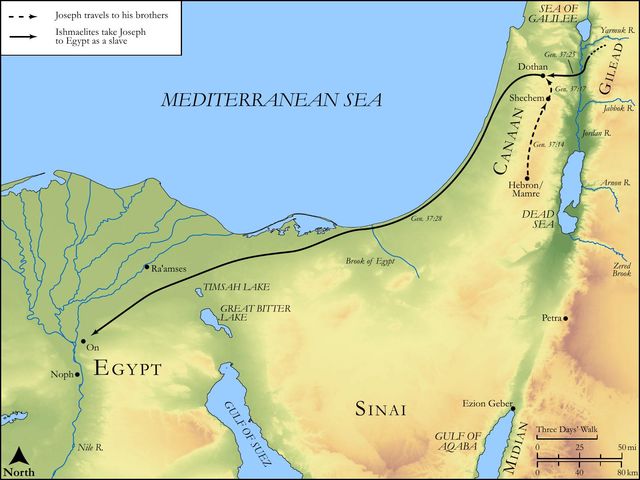
See on the biblical-era maps


Study this verse
Public-domain commentary
Matthew Henry
From his Commentary on the Whole Bible. Henry comments on passages, not single verses — this entry covers Genesis 37:5–11. His two-level outline is real structure in the source text, so it is rendered as structure.
Here, I. Joseph relates the prophetical dreams he had, Gen 37:6, Gen 37:7, Gen 37:9, Gen 37:10. Though he was now very young (about seventeen years old), yet he was pious and devout, and well-inclined, and this fitted him for God's gracious discoveries of himself to him. Joseph had a great deal of trouble before him, and therefore God gave him betimes this prospect of his advancement, to support and comfort him under the long and grievous troubles with which he was to be exercised. Thus Christ had a joy set before him, and so have Christians. Note, God has ways of preparing his people beforehand for the trials which they cannot foresee, but which he has an eye to in the comforts with which he furnishes them. His dreams were, 1. That his brethren's sheaves all bowed to his, intimating upon what occasion they should be brought to do homage to him, namely, in seeking to him for corn; their empty sheaves should bow to his full one. 2. That the sun, and moon, and eleven stars, did obeisance to him, Gen 37:9. Joseph was more of a prophet than a politician, else he would have kept this to himself, when he could not but know that his brethren did already hate him and that this would but the more exasperate them. But, if he told it in his simplicity, yet God directed it for the mortification of his brethren. Observe, Joseph dreamed of his preferment, but he did not dream of his imprisonment. Thus many young people, when they are setting out in the world, think of nothing but prosperity and pleasure, and never dream of trouble.
II.His brethren take it very ill, and are more and more enraged against him (Gen 37:8): Shalt thou indeed reign over us? See here,
1.How truly they interpreted his dream, that he should reign over them. Those become the expositors of his dream who were enemies to the accomplishment of it, as in Gideon's story (Jdg 7:13, Jdg 7:14); they perceived that he spoke of them, Mat 21:45. The event exactly answered to this interpretation, Gen 42:6, etc.
2.How scornfully they resented it: "Shalt thou, who are but one, reign over us, who are many? Thou, who are the youngest, over us who are older?" Note, The reign and dominion of Jesus Christ, our Joseph, have been, and are, despised and striven against by a carnal and unbelieving world, who cannot endure to think that this man should reign over them. The dominion also of the upright, in the morning of the resurrection, is thought of with the utmost disdain.
III.His father gives him a gentle rebuke for it, yet observes the saying, Gen 37:10, Gen 37:11.
Probably he checked him for it, to lessen the offence which his brethren would be apt to take at it; yet he took notice of it more than he seemed to do: he insinuated that it was but an idle dream, because his mother was brought in, who had been dead some time since; whereas the sun, moon, and eleven stars, signify no more than the whole family that should have a dependence upon him, and be glad to be beholden to him. Note, The faith of God's people in God's promises is often sorely shaken by their misunderstanding the promises and then suggesting the improbabilities that attend the performance; but God is doing his own work, and will do it, whether we understand him aright or no. Jacob, like Mary (Luk 2:51), kept these things in his heart, and no doubt remembered them long afterwards, when the event answered to the prediction.
Historical interpretation
Historical reception
2 surviving comments on this verse. Each one is dated, so this reads as a timeline rather than a list.
Select a marker to jump to its quote. Markers stagger vertically where authors wrote within a few decades of each other.
Moreover, Joseph saw another dream and told it to his father and brothers, that the sun and moon and eleven stars were bowing down to him. On this account his father reproved him and said, “What will be the meaning of this vision that you have dreamed? Can it be that I and your mother and your brothers will come and bow to the ground before you?” Who is he before whom parents and brothers bowed down to the ground but Jesus Christ? Joseph and his mother with the disciples bowed down before him and confessed the true God in that body, of whom alone it was said, “Praise him, sun and moon; praise him, all you stars and light.” Further, what is the meaning of the father’s reproach but the hardness of the people of Israel? Christ comes from them according to the flesh, but today they do not believe that he is God and are not willing to bow down to him as their Lord, because they know that he was born from among themselves. Accordingly they hear his replies, but they do not understand them. They themselves read that the sun and moon praise Christ, but they are unwilling to believe this was said with reference to Christ. Therefore Jacob is mistaken in regard to the symbol, which refers to another, but is not mistaken in the love, which is his own. In him paternal love did not go astray, but rather there is depicted an affection for a people that was going to go astray.
Moreover, Joseph had another dream in which the sun, the moon and eleven stars worshiped him. His father replied to him, “Can it be that I and your mother and your brothers will come to bow to the ground before you?” This could not be fulfilled in that Joseph; but in our true Joseph, that is, our Lord Jesus Christ, the mysteries of that dream were fulfilled. The sun, the moon and eleven stars worshiped him when after the resurrection holy Mary as the moon, blessed Joseph as the sun and eleven stars, that is, the blessed apostles, bent down and prostrated before him. Then was fulfilled the prophecy that said, “Praise him, sun and moon; praise him, all you shining stars.” The interpretation of this dream was not accomplished in that Joseph for the important reason that we read his mother had died many years before he saw the aforementioned dreams. Truly, how could it happen to his brothers that they should adore him like the stars, since the night of envy had made them obscure and gloomy? They had lost the brightness of the stars, because they had extinguished in themselves the light of charity. We truly believe that this was deservedly fulfilled in our Lord and Savior, for, as I already said, we read that blessed Joseph, blessed Mary and the eleven apostles worshiped him quite frequently. That the apostles possessed the light of the stars our Lord himself tells us in the Gospel: “You are the light of the world.” Again, he says concerning the same men and those who are similar: “When the just will shine forth like the sun in the kingdom of their Father.”
Continue studying Genesis 37:10 across the web’s major study libraries — every link below opens this exact verse, chapter, or book on the destination site.
Read & Compare
 BibleGatewayThis verse in more than 200 translations and 70 languages.
 Bible.comThe YouVersion reader — hundreds of translations, reading plans, and highlights.
 ESV.orgCrossway's official English Standard Version reader.
 NET BibleThe NET translation with 60,000+ translators' notes on every rendering decision.
 STEP BibleTyndale House's free study tool — original text, vocabulary, and scholarly resources.
 BibliaLogos Bible Software's free web reader.
 USCCBThe New American Bible (Revised Edition) with the U.S. bishops' study notes.
Commentaries
 BibleHub CommentariesDozens of classic commentaries on this verse, gathered on one page.
 StudyLightMore than 100 commentary sets — the largest collection on the web.
 BibleRefPlain-English commentary on what this verse means, verse by verse.
 Enduring WordDavid Guzik's free commentary on this chapter, widely used by Bible teachers.
 Bible Study ToolsVerse commentary alongside Greek and Hebrew study aids.
Original Language & Research
- BibleHub InterlinearThe verse word by word — original language, transliteration, and English.
- BibleHub LexiconEvery word's original-language definition and Strong's entry.
 Blue Letter BibleDeep-study tools — Strong's numbers, concordance, and word studies.
 SefariaThe Hebrew text with Rashi and centuries of Jewish commentary.
Sermons, Hymns & Audio


TrulyRandomVerse is not affiliated with these sites and doesn’t control their content. They’re linked because they’re genuinely useful.
Summary
Genesis 37:10 records the pivotal moment when Joseph shares his second prophetic dream with his father Jacob and his brothers, provoking a sharp rebuke from Jacob and intensifying the deep-seated family resentment. This audacious vision, in which the celestial bodies representing his entire family bow down to him, underscores the profound familial tensions and powerfully foreshadows the extraordinary divine plan that will unfold, bringing about God's purposes despite human disbelief and opposition.
Context
ShowHideLiterary Context
This verse is situated within the narrative of Joseph's early life, immediately following his first dream where his brothers' sheaves bowed to his own. The sharing of this second, even more audacious dream, involving the sun, moon, and eleven stars, escalates the already simmering animosity among Joseph's brothers, who deeply resent Jacob's overt favoritism towards Joseph, evidenced by the special tunic given to him, as noted in Genesis 37:3. Joseph's recounting of this dream directly precedes the brothers' conspiracy against him, leading to his eventual sale into slavery, thus setting in motion the dramatic events that will shape the destiny of Jacob's family and the nascent nation of Israel.
Historical & Cultural Context
In the patriarchal narratives, dreams were often regarded as significant channels of divine communication, as in Jacob's own vision at Bethel, carrying prophetic weight and authority. Rulers, patriarchs, and common people alike paid close attention to dreams, interpreting them as omens or messages from the gods. For Joseph to recount such a dream, implying his own future supremacy over his father, mother, and elder brothers, was not merely an act of youthful naiveté but a direct challenge to the established patriarchal hierarchy and social order. Such a claim, particularly from a younger son, would have been perceived as deeply provocative and even blasphemous, explaining the strong negative reactions from his family.
Key Themes
ShowHideGenesis 37:10 contributes significantly to several overarching themes within the book of Genesis and the broader biblical narrative. It highlights the theme of Divine Sovereignty and Providence, demonstrating God's ability to reveal and enact His plans, even through the most improbable and humanly resisted circumstances. The verse also vividly portrays the destructive power of Family Conflict and Jealousy, a recurring motif in Genesis, as seen in the stories of Cain and Abel, Isaac and Ishmael, and Jacob and Esau. Joseph's dreams, particularly this second one, serve as a catalyst for the brothers' envy and subsequent betrayal. Furthermore, it introduces the theme of Suffering as a Pathway to Exaltation, as Joseph's initial suffering and rejection, ironically triggered by these dreams, ultimately lead to his position of power and provision in Egypt, a fulfillment hinted at by Jacob's later "observing the saying" in Genesis 37:11.
Exposition and Analysis
ShowHideKey Word Analysis
ShowHideFrom the primitive root H1605, meaning "to chide; corrupt, rebuke, reprove." Jacob's "rebuke" here is not merely a mild correction but a sharp, authoritative reprimand, conveying his strong disapproval and concern over the implications of Joseph's dream. It reflects his attempt to "chide" Joseph out of what he perceives as arrogant presumption and a challenge to family order.
Meaning "a dream; dream(-er)." This word emphasizes the nature of the revelation Joseph received. In biblical contexts, dreams are often vehicles for divine communication, distinguishing them from mere nocturnal fantasies. The repetition of "dream that thou hast dreamed" underscores the direct and personal nature of this specific revelation to Joseph.
Meaning "to depress, i.e. prostrate (especially reflexive, in homage to royalty or God); bow (self) down, crouch, fall down (flat), humbly beseech, do (make) obeisance, do reverence, make to stoop, worship." This term signifies a profound act of homage, submission, and even worship, involving prostration to the ground. Jacob's incredulous question highlights the perceived impossibility of such an act from a patriarch and his family towards a younger son, yet it precisely describes the future fulfillment of the prophecy.
Verse Breakdown
ShowHide"And he told [it] to his father, and to his brethren:"
Joseph's act of recounting this dream, despite the previous negative reaction to his first dream, suggests either a profound naiveté regarding his family's feelings or an unwavering conviction in the dream's divine origin. His willingness to speak such a bold prophecy, which directly challenged the established family hierarchy, underscores the compelling nature of the divine communication he believed he had received.
"and his father rebuked him, and said unto him, What [is] this dream that thou hast dreamed?"
Jacob's response is immediate and sharp. His "rebuke" is a strong expression of incredulity and exasperation, reflecting his concern over the dream's implications for family hierarchy and harmony. Jacob, a man who had himself experienced divine dreams and wrestled with God, nonetheless struggles to accept the implications of this particular vision for his favored son, viewing it through a lens of human social order and potential disruption.
"Shall I and thy mother and thy brethren indeed come to bow down ourselves to thee to the earth?"
This rhetorical question from Jacob expresses the sheer impossibility, from a human perspective, of such an event. It highlights the perceived absurdity of the patriarch and his entire family bowing in profound submission to a younger son. The phrase "to the earth" signifies a deep, complete act of prostration and homage, typically reserved for kings or deities. This very scenario, however, would literally come to pass years later in Egypt, powerfully demonstrating God's sovereign ability to fulfill His purposes despite human resistance and the most improbable circumstances.
Literary Devices
ShowHideGenesis 37:10 employs several literary devices to convey its meaning and impact. The most prominent is Rhetorical Question, as Jacob's questions, "What [is] this dream that thou hast dreamed?" and "Shall I and thy mother and thy brethren indeed come to bow down ourselves to thee to the earth?", are not posed to elicit information but to express his strong disbelief, exasperation, and the perceived absurdity of Joseph's claim. This device effectively highlights the human perspective's inability to comprehend divine purposes. Furthermore, the entire verse functions as Foreshadowing, as Jacob's incredulous question ironically sets the stage for the literal fulfillment of the dream years later when his family, including himself, will indeed bow before Joseph in Egypt. This creates a powerful sense of Dramatic Irony, where the characters' present understanding and reactions stand in stark contrast to the audience's knowledge of the future events, underscoring God's ultimate control over human destiny.
Theological and Thematic Connections
ShowHideGenesis 37:10 is a crucial moment that underscores God's sovereign hand in human affairs, revealing His purposes through prophetic dreams despite human resistance and misunderstanding. Joseph's dreams are not mere fantasies but genuine divine revelations, foretelling his future position of authority and provision. This passage vividly illustrates the tension between human perception and divine reality, demonstrating that what seems impossible or absurd from a limited human viewpoint is precisely what God intends to bring about. It also highlights the destructive power of envy and familial strife, which, though seemingly derailing God's plan, ultimately become the very means through which His purposes are accomplished.
Reflection and Application
ShowHideThis passage offers profound insights for believers today, reminding us that God's divine plans often unfold in ways that are initially perplexing, challenging, or even offensive to human understanding. We are called to exercise patience and unwavering trust in God's perfect timing, even when circumstances appear to contradict His promises or when His revealed will seems utterly impossible from our limited perspective. The destructive power of envy and jealousy, so vividly illustrated in the brothers' reaction to Joseph's dreams, serves as a solemn cautionary tale, urging us to guard our hearts against such corrosive emotions that can fracture relationships and impede God's work. Ultimately, Joseph's arduous journey, initiated by these very dreams and the subsequent familial betrayal, stands as a powerful testament to God's unfailing ability to bring His sovereign purposes to fruition, even through human opposition, misunderstanding, and seemingly insurmountable obstacles, demonstrating His faithfulness to His word and His people.
Questions for Reflection
ShowHideFAQ
ShowHideWhy did Jacob rebuke Joseph if the dream was from God?
ShowHideJacob's rebuke stemmed from a human perspective of the dream's implications, rather than a disbelief in God's ability to communicate through dreams. While Jacob was a man of faith who had received divine revelations (e.g., Genesis 28:12-15), the idea of his entire family, including himself and Joseph's mother, bowing down to a younger son directly challenged the established patriarchal and social order of their time. His concern was likely for family harmony and the perceived arrogance or presumption of the dream, which seemed to upend natural authority. However, his subsequent "observing the saying" in Genesis 37:11 suggests that despite his initial human reaction, he pondered its deeper, potentially divine, significance.
Did Joseph's mother actually bow down to him, as the dream implied?
ShowHideJoseph's biological mother, Rachel, had tragically died giving birth to Benjamin (see Genesis 35:16-19). Therefore, she could not have physically bowed down to Joseph. The "mother" referred to in the dream and Jacob's question is generally understood to refer to Jacob's current living wife, Leah, or possibly a more symbolic representation of the matriarchal line of the family, representing the entire household. When the dream was fulfilled years later, the entire family, including Jacob and his sons (representing the lineage), did indeed bow before Joseph in Egypt, fulfilling the spirit and prophetic intent of the vision, even if Rachel herself was not physically present.
What is the significance of bowing "to the earth"?
ShowHideTo bow "to the earth" signifies a complete and utter act of prostration or homage. It denotes profound submission, deep respect, and often, worship. In the days of the patriarchs, such an act was typically performed before a king, a deity, or a superior authority, indicating complete deference and acknowledgment of another's power or status. In the context of Joseph's dream, it emphasizes the extraordinary, almost unthinkable, level of authority and reverence he would one day command, a position entirely contrary to his current status as a younger, favored son. This detail highlights the dramatic reversal of fortunes and the depth of the future submission.
Christ-Centered Fulfillment
ShowHideJoseph's story, initiated by these prophetic dreams and his family's rejection, serves as a profound type of Christ, foreshadowing the life and work of the Messiah. Like Joseph, Jesus was the beloved Son of His Father, yet He was rejected by His own brethren, the Jewish people, who conspired against Him and delivered Him up (see John 1:11 and Acts 2:23). Joseph's suffering, betrayal, and descent into Egypt ultimately led to his exaltation as a ruler who provided salvation and sustenance for his family and many nations during a time of famine. Similarly, Christ's suffering, crucifixion, and descent into death led to His glorious resurrection and exaltation to the right hand of God, becoming the ultimate provider of spiritual sustenance and eternal salvation for all who believe (see Philippians 2:8-9 and Hebrews 5:9). The bowing down of Joseph's family to him in Egypt, fulfilling the dream of Genesis 37:10, powerfully foreshadows the ultimate universal homage that will be paid to Christ, when "at the name of Jesus every knee should bow, of things in heaven, and things in earth, and things under the earth" (Philippians 2:10), and "every tongue confess that Jesus Christ is Lord, to the glory of God the Father" (Philippians 2:11). This divine pattern of suffering leading to glory, and rejection leading to universal acknowledgment of supreme authority, finds its ultimate and perfect fulfillment in Jesus Christ.