


Genesis 37:3
- וְיִשְׂרָאֵלve·Yis·ra·'Eland IsraelH3478Conj-w ¦ N-proper-mNoun Proper MasculineוְandיִשְׂרָאֵלIsrael
- אָהַב'a·Havhe lovedH157V-Qal-Perf-3msVerb Qal Perfect 3rd Singular Masculine
- אֶת'et<obj.>H853DirObjMParticle Object Indicator
- יוֹסֵףyo·SefJosephH3130N-proper-mNoun Proper Masculine
- מִכָּלmi·kolmore than allH3605Prep-m ¦ N-mscNoun Singular Masculine Constructמִmore thanכָּלall
- בָּנָיוba·Navhis sonsH1121N-mpc ¦ 3msNoun Plural Masculine Constructבָּנָיsonsוhis
- כִּיkiforH3588PrtParticle Conditional
- בֶןven[was] a son ofH1121N-mscNoun Singular Masculine Construct
- זְקֻנִיםze·ku·Nimold age<s>H2208N-mpNoun Plural Masculine Absolute
- הוּאhu'heH1931Pro-3msPronoun Personal 3rd Singular Masculine
- לוֹlofor <the> himPrep-l ¦ 3msSuffix Personal 3rd Singular Masculineלfor <the>וֹhim
- וְעָשָׂהve·'A·sahand he madeH6213Conj-w ¦ V-Qal-ConsecPerf-3msVerb Qal Consecutive Perfect 3rd Singular Masculineוְandעָשָׂהhe made
- לוֹlofor <the> himPrep-l ¦ 3msSuffix Personal 3rd Singular Masculineלfor <the>וֹhim
- כְּתֹנֶתke·To·neta long garment ofH3801N-fscNoun Singular Feminine Construct
- פַּסִּיםpa·Simpalms and solesH6446N-mpNoun Plural Masculine Absolute
English is a literal word-by-word gloss of the Hebrew, not the KJV's wording. Why?
This is the original text the KJV's translators worked from — each Hebrew word with its own literal English meaning in this verse, prepared by scholars at Tyndale House, Cambridge. The KJV translates whole sentences, not word by word, so its wording differs: one Hebrew word can become several English words, and the KJV may choose “the LORD” where the gloss reads “Yahweh”. Both are faithful — they answer different questions. For the KJV's own rendering, switch to the KJV text.
Details
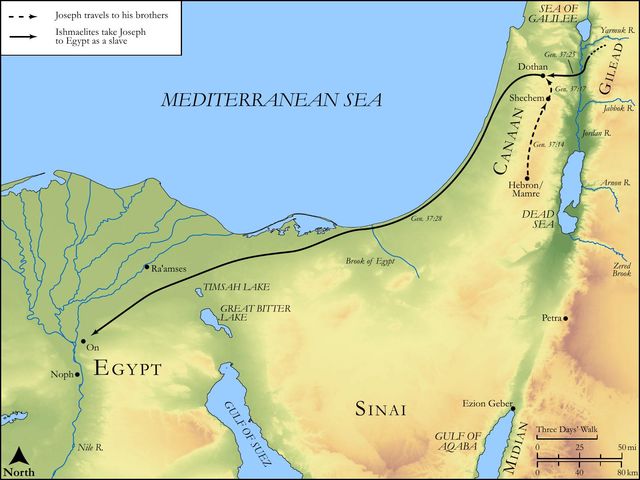
See on the biblical-era map


Study this verse
Public-domain commentary
Matthew Henry
From his Commentary on the Whole Bible. Henry comments on passages, not single verses — this entry covers Genesis 37:1–4.
Moses has no more to say of the Edomites, unless as they happen to fall in Israel's way; but now applies himself closely to the story of Jacob's family: These are the generations of Jacob. His is not a bare barren genealogy as that of Esau (Gen 36:1), but a memorable useful history. Here is, 1. Jacob a sojourner with his father Isaac, who has yet living, Gen 37:1. We shall never be at home, till we come to heaven. 2. Joseph, a shepherd, feeding the flock with his brethren, Gen 37:2. Though he was his father's darling, yet he was not brought up in idleness or delicacy. Those do not truly love their children that do not inure them to business, and labour, and mortification. The fondling of children is with good reason commonly called the spoiling of them. Those that are trained up to do nothing are likely to be good for nothing. 3. Joseph beloved by his father (Gen 37:3), partly for his dear mother's sake that was dead, and partly for his own sake, because he was the greatest comfort of his old age; probably he waited on him, and was more observant of him than the rest of his sons; he was the son of the ancient so some; that is, when he was a child, he was as grave and discreet as if he had been an old man, a child, but not childish. Jacob proclaimed his affection to him by dressing him finer than the rest of his children: He made him a coat of divers colours, which probably was significant of further honors intended him. Note, Though those children are happy that have that in them which justly recommends them to their parents' particular love, yet it is the prudence of parents not to make a difference between one child and another, unless there be a great and manifest cause given for it by the children's dutifulness or undutifulness; paternal government must be impartial, and managed with a steady hand. 4. Joseph hated by his brethren, (1.) Because his father loved him; when parents make a difference, children soon take notice of it, and it often occasions feuds and quarrels in families. (2.) Because he brought to his father their evil report. Jacob's sons did that, when they were from under his eye, which they durst not have done if they had been at home with him; but Joseph gave his father an account of their bad carriage, that he might reprove and restrain them; not as a malicious tale-bearer, to sow discord, but as a faithful brother, who, when he durst not admonish them himself, represented their faults to one that had authority to admonish them. Note, [1.] It is common for friendly monitors to be looked upon as enemies. Those that hate to be reformed hate those that would reform them, Pro 9:8. [2.] It is common for those that are beloved of God to be hated by the world; whom Heaven blesses, hell curses. To those to whom God speaks comfortably wicked men will not speak peaceably. It is said here of Joseph, the lad was with the sons of Bilhah; some read it, and he was servant to them, they made him their drudge.
Historical interpretation
Historical reception
6 surviving comments on this verse. Each one is dated, so this reads as a timeline rather than a list.
Select a marker to jump to its quote. Markers stagger vertically where authors wrote within a few decades of each other.
And so we are taught the proper nature of parental love and filial gratitude. It is pleasant to love one’s children and very pleasant to love them exceedingly, but often even parental love does harm to the children unless it is practiced with restraint; for it may give the beloved child free rein out of excessive indulgence or, by preference shown to one child, may alienate the others from the spirit of brotherly love. That son gains more who gains the love of his brothers. This is a more splendid manifestation of generosity on the part of the parents and a richer inheritance for the sons. Let the children be joined in a like favor, who have been joined in a like nature.…What wonder if quarrels arise among brothers over an estate or a house, when enmity blazed up among the sons of holy Jacob over a tunic? What then? Should we find fault with Jacob because he preferred the one son to the others? But we cannot take from parents their freedom to love the more those children whom they believe to be the more deserving, nor ought we to cut off the sons from their eager desire to be the more pleasing. To be sure, Jacob loved the more that son in whom he foresaw the greater marks of virtue; thus he would not appear to have shown preference so much as father to son but rather as prophet to a sacred sign. And Jacob was right to make for his son a tunic of many colors, to indicate by it that Joseph was to be preferred to his brothers with his clothing of manifold virtues.
What is meant by “he loved Joseph more than all his other sons, as he was a son of his old age”? Since he was born in Jacob’s old age, it is saying, toward the end of his life, on this account he loved Joseph more than all the others. You see, somehow the children born to one in old age seem particularly dear and manage to attract their father’s favor in greater measure. For us to learn, however, that this was not the only factor in winning his father and causing him to prefer him to his brothers, sacred Scripture teaches us that even after him another son was born. If the manifestation of love had proceeded according to natural inclination, that last son would have been loved more for being truly a son of his old age and born at the time the good man reached the end of his life. So what can we say it means? That it was a kind of grace from on high that made the young man amiable and rendered him preferable to all the others on account of the virtue of his soul.… In Scripture the reason is given as his being a son of his old age and on that account he loved him more, in case the real reason might increase the brothers’ envy.
(Chapter 37, Verse 3) And Israel loved Joseph more than all his sons, because he was the son of his old age: and he made him a coat of many colors. As for the coat of many colors, Aquila interprets it as a long-sleeved tunic, that is, a talar garment. Symmachus, a tunic with sleeves, or because it reached down to the ankles, and was distinguished by the wonderful variety of the craftsman's hands: or because it had sleeves: For the ancients used more often to wear woven garments.
Therefore, in order that our words do not wander from the right way, we say that the Immanuel was born to the Father as a Son of his old age, because he appeared in the latter times of the world, that is, in these times, and after him there will be no other. We expect to be saved in no one else. He alone is sufficient, because we say that the salvation and life of the world is placed in no one else. He shepherds us forever, according to the words of the psalmist, and we will be the subjects of him who is beloved, who appeared in the latter times of the world, as I just said, after he had assumed the flesh and who preexisted as God. In fact, we say that he is coeternal with the Father.
When the Christian people devoutly come to church, of what benefit is it that they hear how the holy patriarchs took their wives or begot their children, unless they perceive in a spiritual sense why these things happened or what the facts prefigured? Behold, we have heard that blessed Jacob begot a son and called his name Joseph and that he loved him more than the rest of his sons. In this place blessed Jacob prefigured God the Father; holy Joseph typified our Lord and Savior. Therefore Jacob loved his son because God the Father loved his only-begotten Son, as he himself said, “This is my beloved Son.”
According to a mystical or allegorical interpretation Joseph prefigured a type of our Lord. Now if we consider the actions of Joseph, at least in part, we clearly recognize in him an obvious figure of the Lord. Joseph had a multicolored tunic; our Lord and Savior is known to have had one also, since he took the church, which was composed of various nations, like the covering of a garment. The variety of this tunic, that is, of the church that Christ took, is of a different sort; the church has different, varied graces—the martyrs, confessors, priests, ministers, virgins, widows and those who perform works of justice. This variety of the church is not one of colors but of graces; for in this variety of his church our Lord and Savior shines with a multicolored, precious garment. Joseph was sold by his brothers and procured by the Ishmaelites; our Lord and Savior was sold by the Jews and acquired by the Gentiles. Moreover, the Ishmaelites who bought Joseph carried different kinds of perfumes with them; this was to show that the Gentiles who came to believe would be fragrant throughout the world with the different odors of justice.
Continue studying Genesis 37:3 across the web’s major study libraries — every link below opens this exact verse, chapter, or book on the destination site.
Read & Compare
 BibleGatewayThis verse in more than 200 translations and 70 languages.
 Bible.comThe YouVersion reader — hundreds of translations, reading plans, and highlights.
 ESV.orgCrossway's official English Standard Version reader.
 NET BibleThe NET translation with 60,000+ translators' notes on every rendering decision.
 STEP BibleTyndale House's free study tool — original text, vocabulary, and scholarly resources.
 BibliaLogos Bible Software's free web reader.
 USCCBThe New American Bible (Revised Edition) with the U.S. bishops' study notes.
Commentaries
 BibleHub CommentariesDozens of classic commentaries on this verse, gathered on one page.
 StudyLightMore than 100 commentary sets — the largest collection on the web.
 BibleRefPlain-English commentary on what this verse means, verse by verse.
 Enduring WordDavid Guzik's free commentary on this chapter, widely used by Bible teachers.
 Bible Study ToolsVerse commentary alongside Greek and Hebrew study aids.
Original Language & Research
- BibleHub InterlinearThe verse word by word — original language, transliteration, and English.
- BibleHub LexiconEvery word's original-language definition and Strong's entry.
 Blue Letter BibleDeep-study tools — Strong's numbers, concordance, and word studies.
 SefariaThe Hebrew text with Rashi and centuries of Jewish commentary.
Sermons, Hymns & Audio


TrulyRandomVerse is not affiliated with these sites and doesn’t control their content. They’re linked because they’re genuinely useful.
Summary
Genesis 37:3 vividly portrays Jacob's profound and open favoritism towards his son Joseph, a partiality rooted in Joseph's status as the cherished firstborn of Jacob's beloved Rachel and the "son of his old age." This deep affection was concretely manifested through the gift of a distinctive "coat of many colours," a garment that visibly set Joseph apart from his brothers and, tragically, became a potent symbol of division, fueling intense jealousy and laying the foundation for the dramatic family conflict that would shape Joseph's extraordinary life journey.
Context
ShowHideLiterary Context
This verse immediately follows the introduction of Joseph's dreams and his reporting of his brothers' misdeeds to Jacob, setting the stage for the intense sibling rivalry that dominates the initial chapters of the Joseph narrative. The preceding verses establish Jacob's large family, consisting of twelve sons from four different women, a complex family dynamic often marked by tension and competition. Jacob's overt favoritism towards Joseph, highlighted in Genesis 37:3, directly precipitates the brothers' hatred and their subsequent plot against Joseph in Genesis 37:4-28. This favoritism is a recurring motif in the patriarchal narratives, often leading to strife, as seen in the favoritism shown to Jacob over Esau by Rebekah and Isaac respectively in Genesis 25:28.
Historical & Cultural Context
In ancient Near Eastern patriarchal societies, the allocation of inheritance and status was often complex, particularly in polygamous households. While primogeniture (the right of the firstborn son to inherit the family estate) was common, it was not always strictly adhered to, and a father could, at times, designate a younger son for a position of prominence, as seen with Jacob himself over Esau. The concept of a "son of old age" carried particular significance, often implying a child born miraculously or unexpectedly late in life, thus holding a special place in the parents' affections. Garments, too, held significant symbolic weight, communicating status, wealth, and identity. A long, sleeved, or ornamented robe, unlike the simpler tunics worn by laborers, would signify leisure, distinction, and perhaps an heir-apparent status, making Jacob's gift to Joseph a highly visible and provocative statement of his preference.
Key Themes
ShowHideGenesis 37:3 contributes to several overarching themes within the book of Genesis and the broader biblical narrative. Firstly, it highlights the perils of favoritism and its destructive impact on family relationships, a theme that echoes throughout Jacob's own life and his family's history. Secondly, it underscores the theme of divine sovereignty working through human brokenness. While Jacob's actions are flawed, they unwittingly serve as a catalyst for God's larger redemptive plan for Joseph and the nascent nation of Israel, a plan that will ultimately preserve Jacob's family from famine and lead to their descent into Egypt, as later revealed in Genesis 50:20. Finally, the verse introduces the theme of sibling rivalry and jealousy, a pervasive human condition that finds its roots in the earliest narratives of Genesis, from Cain and Abel in Genesis 4 to Isaac and Ishmael in Genesis 21.
Exposition and Analysis
ShowHideKey Word Analysis
ShowHideFrom the primitive root H157, meaning to have affection for, whether sexually or otherwise. In this context, it denotes a deep, preferential emotional attachment Jacob had for Joseph, setting him apart from his other children. This "love" was not merely affection but a demonstrated favoritism that had tangible consequences for family dynamics.
Derived from H1121, meaning a son, as a builder of the family name. Here, it specifically refers to Joseph as Jacob's biological offspring, emphasizing his unique status as the "son of his old age" (H2208, zâqun), a child born in Jacob's advanced years. This late-life birth contributed significantly to Jacob's special affection and the perception of Joseph as particularly precious.
Meaning a shirt, coat, garment, or robe. This refers to the specific garment given to Joseph, which, combined with the descriptor "of many colours" (H6446, paç), signifies a distinctive, perhaps long-sleeved or ornamented, tunic. This was not a common working garment but one that marked Joseph as special, privileged, and perhaps designated for a non-laborious role or even as an heir.
Verse Breakdown
ShowHide"Now Israel loved Joseph more than all his children"
This opening clause immediately establishes the central conflict of the narrative: Jacob's overt and disproportionate affection for Joseph. The use of "Israel" (Jacob's new name, symbolizing his spiritual identity) highlights the profound nature of this love, yet it also underscores the human failing within the patriarch's family. This preferential love is presented as a stark contrast to his feelings for his other sons, creating an environment ripe for resentment and jealousy among the siblings.
"because he [was] the son of his old age"
This clause provides the primary reason for Jacob's intense favoritism. Joseph was the firstborn of Rachel, Jacob's beloved wife, and was born when Jacob was already advanced in years. This made Joseph particularly precious, a late-life blessing and a tangible link to Jacob's deepest affection for Rachel. This status as "son of his old age" conferred a unique tenderness and perhaps a sense of vulnerability or special destiny upon Joseph in Jacob's eyes.
"and he made him a coat of [many] colours"
This final clause describes the tangible manifestation of Jacob's favoritism. The "coat of many colours" (Hebrew: kethoneth passim) was a distinctive garment, likely a full-length, sleeved robe, perhaps richly ornamented. Unlike the simple, short tunics worn by shepherds and laborers, this garment symbolized status, leisure, and privilege, indicating Joseph was not expected to perform manual labor alongside his brothers. This highly visible symbol of Jacob's partiality served as a constant, infuriating reminder to Joseph's brothers of their father's preference, directly fueling their hatred and setting in motion the tragic events that follow.
Literary Devices
ShowHideThe verse employs several significant literary devices. Symbolism is paramount, with the "coat of many colours" serving as a powerful symbol of Jacob's favoritism, Joseph's elevated status, and the deep division within the family. It is a tangible representation of an intangible bias, immediately communicating its significance to the reader. Foreshadowing is also evident, as the coat, a mark of distinction, implicitly foreshadows Joseph's future elevation and suffering. Just as the coat sets him apart, so too will his dreams and divine favor set him apart, leading to his rejection by his brothers and subsequent exaltation in Egypt. The narrative also uses Contrast, highlighting the stark difference in Jacob's affection for Joseph versus his other sons, which sets up the dramatic tension and conflict that drives the subsequent plot.
Theological and Thematic Connections
ShowHideJacob's favoritism towards Joseph, epitomized by the special coat, serves as a poignant biblical lesson on the destructive nature of partiality within families. While born of deep love, this bias created an environment of intense jealousy and resentment among the brothers, ultimately leading to betrayal and suffering. The narrative, however, transcends a mere cautionary tale about family dysfunction; it also powerfully illustrates God's sovereign ability to work through human sin and brokenness to accomplish His redemptive purposes. Even the painful consequences of Jacob's favoritism became instrumental in God's plan to preserve the nascent nation of Israel, demonstrating that divine providence can weave even the darkest threads of human failing into a tapestry of ultimate good.
Reflection and Application
ShowHideThe story of Jacob, Joseph, and the coat of many colours offers timeless and profound lessons for contemporary relationships, particularly within families. Parents are called to exercise wisdom and impartiality, striving to affirm and cherish each child uniquely, recognizing their individual gifts and needs, rather than displaying overt favoritism that can sow seeds of resentment and division. This verse highlights how seemingly small acts of bias or preferential treatment can have profound and lasting negative impacts on relationships, breeding jealousy and conflict that can echo for generations. For individuals, it serves as a reminder to confront feelings of jealousy and resentment when they arise, recognizing their destructive potential. Ultimately, the broader narrative of Joseph encourages us to trust in God's overarching plan, even when human failings and painful circumstances seem to dominate. It assures us that God can sovereignly work through our brokenness and the brokenness of others to accomplish His divine purposes, transforming trials into triumphs and bringing good out of evil.
Questions for Reflection
ShowHideFAQ
ShowHideWhat does "son of his old age" imply about Joseph?
ShowHideThe phrase "son of his old age" (Hebrew: ben zequnim) implies that Joseph was born to Jacob when Jacob was already an old man. This status made Joseph particularly precious and cherished to Jacob, signifying a late-life blessing and perhaps a heightened sense of vulnerability or special destiny. It contributed significantly to the depth of Jacob's affection and favoritism towards him, setting him apart from his elder brothers who were born when Jacob was younger.
What was the significance of the "coat of many colours"?
ShowHideThe "coat of many colours" (Hebrew: kethoneth passim) was a garment of significant distinction. While its exact nature is debated (some scholars suggest a long, sleeved robe; others, a richly ornamented one), its primary significance lay in what it symbolized: Joseph's elevated status, privilege, and his father's overt special affection. Unlike the practical, short tunics worn by shepherds and laborers, this garment marked Joseph as someone not expected to perform manual labor, perhaps even signifying an heir-apparent or a favored son. Its visible nature made Jacob's favoritism undeniable to Joseph's brothers, fueling their intense jealousy and resentment, and becoming a key catalyst for the ensuing family drama that led to Joseph's betrayal and enslavement.
Christ-Centered Fulfillment
ShowHideJoseph, the beloved son of his father, uniquely favored and set apart by a special garment, yet rejected and betrayed by his own brothers, cast into a pit, and sold into slavery, serves as a profound type of Christ. Like Joseph, Jesus was the Father's beloved Son, uniquely chosen and affirmed (Matthew 3:17). He came to His own people, Israel, but was tragically rejected by them (John 1:11), suffered unjustly, and was seemingly abandoned in His death. Yet, through Joseph's suffering and subsequent exaltation to power in Egypt, he became the savior of his family and many nations, preserving them from famine. Similarly, through Christ's suffering, death, and resurrection, He was exalted to the right hand of God (Philippians 2:8-11), becoming the ultimate Savior who redeems not just one family, but all who believe, providing spiritual sustenance and eternal life through His intercession (Hebrews 7:25). Joseph's journey from pit to palace, from rejection to redemption, beautifully prefigures the redemptive work of Jesus Christ.