


Genesis 27:37
Bible text: King James Version (1769 Blayney text) · Public domain
Bible text: King James Version with Strong's numbers · Public domain
Bible text: Berean Standard Bible · Public domain
Bible text: American Standard Version (1901) · Public domain
Bible text: World English Bible, Messianic edition · Public domain
Bible text: Geneva Bible (1599) · Public domain
Bible text: Young's Literal Translation · Public domain
- וַיַּעַןvai·Ya·'anand he answeredH6030Conj-w ¦ V-Qal-ConsecImperf-3msVerb Qal Consecutive Imperfect 3rd Singular Masculineוַandיַּעַןhe answered
- יִצְחָקyitz·ChakIsaacH3327N-proper-mNoun Proper Masculine
- וַיֹּאמֶרvai·Yo·merand he saidH559Conj-w ¦ V-Qal-ConsecImperf-3msVerb Qal Consecutive Imperfect 3rd Singular Masculineוַandיֹּאמֶרhe said
- לְעֵשָׂוle·'e·Savto EsauH6215Prep-l ¦ N-proper-mNoun Proper MasculineלְtoעֵשָׂוEsau
- הֵןhenhere!H2005PrtParticle Interjection
- גְּבִירge·VirlordH1376N-msNoun Singular Masculine Absolute
- שַׂמְתִּיוsam·TivI have appointed himH7760V-Qal-Perf-1cs ¦ 3msVerb Qal Perfect 1st Singular common genderשַׂמְתִּיI have appointedוhim
- לָךְloKhto <the> youPrep-l ¦ 2msSuffix Personal 2nd Singular Masculineלָto <the>ךְyou
- וְאֶתve·'Etand <obj.>H853Conj-w ¦ DirObjMParticle Object Indicatorוְandאֶת<obj.>
- כָּלkolallH3605N-mscNoun Singular Masculine Construct
- אֶחָיו'e·Chavhis brothersH251N-mpc ¦ 3msNoun Plural Masculine Constructאֶחָיbrothersוhis
- נָתַתִּיna·Ta·tiI have givenH5414V-Qal-Perf-1csVerb Qal Perfect 1st Singular common gender
- לוֹloto <the> himPrep-l ¦ 3msSuffix Personal 3rd Singular Masculineלto <the>וֹhim
- לַעֲבָדִיםla·'a·va·Dimto servantsH5650Prep-l ¦ N-mpNoun Plural Masculine Absoluteלַtoעֲבָדִיםservants
- וְדָגָןve·da·Ganand grainH1715Conj-w ¦ N-msNoun Singular Masculine Absoluteוְandדָגָןgrain
- וְתִירֹשׁve·ti·Roshand new wineH8492Conj-w ¦ N-msNoun Singular Masculine Absoluteוְandתִירֹשׁnew wine
- סְמַכְתִּיוse·makh·TivI have sustained himH5564V-Qal-Perf-1cs ¦ 3msVerb Qal Perfect 1st Singular common genderסְמַכְתִּיI have sustainedוhim
- וּלְכָהu·le·Khahand for <the> youConj-w ¦ Prep-l ¦ 2msSuffix Personal 2nd Singular Masculineוּandלְfor <the>כָהyou
- אֵפוֹא'e·Fo'thenH645PrtParticle Interjection
- מָהmahwhat?H4100InterrogPronoun Interrogative
- אֶעֱשֶׂה'e·'e·Sehwill I doH6213V-Qal-Imperf-1csVerb Qal Imperfect 1st Singular common gender
- בְּנִיbe·Nimy O sonH1121N-msc ¦ 1csNoun Singular Masculine ConstructבְּנִO sonיmy
English is a literal word-by-word gloss of the Hebrew, not the KJV's wording. Why?
This is the original text the KJV's translators worked from — each Hebrew word with its own literal English meaning in this verse, prepared by scholars at Tyndale House, Cambridge. The KJV translates whole sentences, not word by word, so its wording differs: one Hebrew word can become several English words, and the KJV may choose “the LORD” where the gloss reads “Yahweh”. Both are faithful — they answer different questions. For the KJV's own rendering, switch to the KJV text.
Details
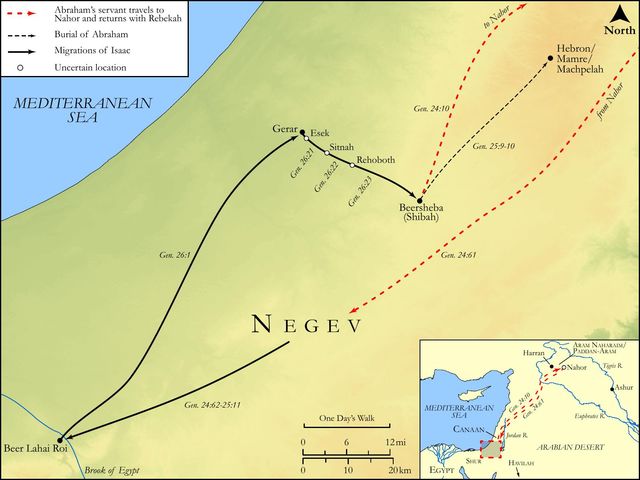
See on the biblical-era maps


Study this verse
Public-domain commentary
Matthew Henry
From his Commentary on the Whole Bible. Henry comments on passages, not single verses — this entry covers Genesis 27:30–40. His four-level outline is real structure in the source text, so it is rendered as structure.
Here is, I. The covenant-blessing denied to Esau. He that made so light of the birthright would now have inherited the blessing, but he was rejected, and found no place of repentance in his father, though he sought it carefully with tears, Heb 12:17. Observe, 1. How carefully he sought it. He prepared the savoury meat, as his father had directed him, and then begged the blessing which his father had encouraged him to expect, Gen 27:31. When he understood that Jacob had obtained it surreptitiously, he cried with a great and exceedingly bitter cry, Gen 27:34. No man could have laid the disappointment more to heart than he did; he made his father's tent to ring with his grief, and again (Gen 27:38) lifted up his voice and wept. Note, The day is coming when those that now make light of the blessings of the covenant, and sell their title to them for a thing of nought, will in vain be importunate for them. Those that will not so much as ask and seek now will knock shortly, and cry, Lord, Lord. Slighters of Christ will then be humble suitors to him. 2. How he was rejected. Isaac, when first made sensible of the imposition that had been practised on him, trembled exceedingly, Gen 27:33. Those that follow the choice of their own affections, rather than the dictates of the divine will, involve themselves in such perplexities as these. But he soon recovers himself, and ratifies the blessing he had given to Jacob: I have blessed him, and he shall be blessed; he might, upon very plausible grounds, have recalled it, but now, at last, he is sensible that he was in an error when he designed it for Esau. Either himself recollecting the divine oracle, or rather having found himself more than ordinarily filled with the Holy Ghost when he gave the blessing to Jacob, he perceived that God did, as it were, say Amen to it. Now, (1.) Jacob was hereby confirmed in his possession of the blessing, and abundantly satisfied of the validity of it, though he obtained it fraudulently; hence too he had reason to hope that God graciously overlooked and pardoned his misconduct. (2.) Isaac hereby acquiesced in the will of God, though it contradicted his own expectations and affection. He had a mind to give Esau the blessing, but, when he perceived the will of God was otherwise, he submitted; and this he did by faith (Heb 11:20), as Abraham before him, when he had solicited for Ishmael. May not God do what he will with his own? (3.) Esau hereby was cut off from the expectation of that special blessing which he thought to have preserved to himself when he sold his birthright. We, by this instance, are taught, [1.] That it is not of him that willeth, nor of him that runneth, but of God that showeth mercy, Rom 9:16. The apostle seems to allude to this story. Esau had a good will to the blessing, and ran for it; but God that showed mercy designed it for Jacob, that the purpose of God according to election might stand, Rom 9:11. The Jews, like Esau, hunted after the law of righteousness (Rom 9:31), yet missed of the blessing of righteousness, because they sought it by the works of the law (Rom 9:32); while the Gentiles, who, like Jacob, sought it by faith in the oracle of God, obtained it by force, with that violence which the kingdom of heaven suffers. See Mat 11:12. [2.] That those who undervalue their spiritual birthright, and can afford to sell it for a morsel of meat, forfeit spiritual blessings, and it is just with God to deny them those favours they were careless of. Those that will part with their wisdom and grace, with their faith and a good conscience, for the honours, wealth, or pleasures, of this world, however they may pretend a zeal for the blessing, have already judged themselves unworthy of it, and so shall their doom be. [3.] That those who lift up hands in wrath lift them up in vain. Esau, instead of repenting of his own folly, reproached his brother, unjustly charged him with taking away the birthright which he had fairly sold to him (Gen 27:36), and conceived malice against him for what he had now done, Gen 27:41. Those are not likely to speed in prayer who turn those resentments upon their brethren which they should turn upon themselves, and lay the blame of their miscarriages upon others, when they should take shame to themselves. [4.] That those who seek not till it is too late will be rejected. This was the ruin of Esau, he did not come in time. As there is an accepted time, a time when God will be found, so there is a time when he will not answer those that call upon him, because they neglected the appointed season. See Pro 1:28. The time of God's patience and our probation will not last always; the day of grace will come to an end, and the door will be shut. Then many that now despise the blessing will seek it carefully; for then they will know how to value it, and will see themselves undone, for ever undone, without it, but to no purpose, Luk 13:25-27. O that we would therefore, in this our day, know the things that belong to our peace!
II.Here is a common blessing bestowed upon Esau.
1.This he desired: Bless me also, Gen 27:34. Hast thou not reserved a blessing for me? Gen 27:36. Note,
(1.)The worst of men know how to wish well to themselves; and even those who profanely sell their birthright seem piously to desire the blessing. Faint desires of happiness, without a right choice of the end and a right use of the means, deceive many into their own ruin. Multitudes go to hell with their mouths full of good wishes. The desire of the slothful and unbelieving kills them. Many will seek to enter in, as Esau, who shall not be able, because they do not strive, Luk 13:24.
(2.)It is the folly of most men that they are willing to take up with any good (Psa 4:6), as Esau here, who desired but a second-rate blessing, a blessing separated from the birthright. Profane hearts think any blessing as good as that from God's oracle: Hast thou but one? As if he had said, "I will take up with any: though I have not the blessing of the church, yet let me have some blessing."
2.This he had; and let him make his best of it, Gen 27:39, Gen 27:40.
(1.)It was a good thing, and better than he deserved. It was promised him,
[1.]That he should have a competent livelihood - the fatness of the earth, and the dew of heaven. Note, Those that come short of the blessings of the covenant may yet have a very good share of outward blessings. God gives good ground and good weather to many that reject his covenant, and have no part nor lot in it.
[2.]That by degrees he should recover his liberty. If Jacob must rule (Gen 27:29), Esau must serve; but he has this to comfort him, he shall live by his sword. He shall serve, but he shall not starve; and, at length, after much skirmishing, he shall break the yoke of bondage, and wear marks of freedom. This was fulfilled (Kg2 8:20, Kg2 8:22) when the Edomites revolted.
(2.)Yet it was far short of Jacob's blessing. For him God had reserved some better thing.
[1.]In Jacob's blessing the dew of heaven is put first, as that which he most valued, and desired, and depended upon; in Esau's the fatness of the earth is put first, for it was this that he had the first and principal regard to.
[2.]Esau has these, but Jacob has them from God's hand: God give thee the dew of heaven, Gen 27:28. It was enough to Esau to have the possession; but Jacob desired it by promise, and to have it from covenant-love.
[3.]Jacob shall have dominion over his brethren: hence the Israelites often ruled over the Edomites. Esau shall have dominion, that is, he shall gain some power and interest, but shall never have dominion over his brother: we never find that the Jews were sold into the hands of the Edomites, or that they oppressed them. But the great difference in that there is nothing in Esau's blessing that points at Christ, nothing that brings him or his into the church and covenant of God, without which the fatness of the earth, and the plunder of the field, will stand him in little stead. Thus Isaac by faith blessed them both according as their lot should be. Some observe that Jacob was blessed with a kiss (Gen 27:27), so was not Esau.
Continue studying Genesis 27:37 across the web’s major study libraries — every link below opens this exact verse, chapter, or book on the destination site.
Read & Compare
 BibleGatewayThis verse in more than 200 translations and 70 languages.
 Bible.comThe YouVersion reader — hundreds of translations, reading plans, and highlights.
 ESV.orgCrossway's official English Standard Version reader.
 NET BibleThe NET translation with 60,000+ translators' notes on every rendering decision.
 STEP BibleTyndale House's free study tool — original text, vocabulary, and scholarly resources.
 BibliaLogos Bible Software's free web reader.
 USCCBThe New American Bible (Revised Edition) with the U.S. bishops' study notes.
Commentaries
 BibleHub CommentariesDozens of classic commentaries on this verse, gathered on one page.
 StudyLightMore than 100 commentary sets — the largest collection on the web.
 BibleRefPlain-English commentary on what this verse means, verse by verse.
 Enduring WordDavid Guzik's free commentary on this chapter, widely used by Bible teachers.
 Bible Study ToolsVerse commentary alongside Greek and Hebrew study aids.
Original Language & Research
- BibleHub InterlinearThe verse word by word — original language, transliteration, and English.
- BibleHub LexiconEvery word's original-language definition and Strong's entry.
 Blue Letter BibleDeep-study tools — Strong's numbers, concordance, and word studies.
 SefariaThe Hebrew text with Rashi and centuries of Jewish commentary.
Sermons, Hymns & Audio


TrulyRandomVerse is not affiliated with these sites and doesn’t control their content. They’re linked because they’re genuinely useful.
Summary
Genesis 27:37 captures Isaac's profound and sorrowful declaration to Esau, confirming the irreversible nature of the comprehensive patriarchal blessing he had mistakenly bestowed upon Jacob. In this poignant moment, Isaac articulates that Jacob has been established as lord over his brethren, granted dominion, and sustained with abundant provisions, leaving him with nothing comparable to offer his distraught elder son. This verse underscores the finality of Isaac's pronouncement and Esau's complete dispossession of the preeminent family inheritance.
Context
ShowHideLiterary Context
This verse immediately follows a pivotal and emotionally charged scene in the patriarchal narrative. Isaac, now blind and aged, had intended to bless his elder son, Esau, but was deceived by Rebekah and Jacob. Upon Esau's return from hunting, the truth of Jacob's deception is revealed, leading to Isaac's violent trembling and profound distress (as seen in Genesis 27:33). Genesis 27:37 is Isaac's direct response to Esau's anguished plea for a blessing, a response that solidifies the transfer of the primary blessing and highlights Isaac's inability to undo what has been spoken. It sets the stage for Esau's bitter cry and the subsequent deepening of familial discord, ultimately leading to Jacob's flight.
Historical & Cultural Context
In the family of Abraham, a father's deathbed blessing was not merely a wish but a legally and spiritually binding pronouncement, believed to carry divine power and determine the recipient's future destiny and status within the family and community. Such blessings often included elements of dominion, prosperity, and a special relationship with the family's deity. The concept of primogeniture, where the eldest son received the primary inheritance and leadership, was deeply ingrained. Isaac's declaration here reflects this cultural understanding: once a blessing of this magnitude was uttered, it was considered irrevocable, a testament to the spoken word's immense weight in that society. The mention of "corn and wine" speaks to the agricultural basis of their economy and the desire for material abundance as a sign of divine favor.
Key Themes
ShowHideGenesis 27:37 contributes significantly to several overarching themes within the book of Genesis and the broader biblical narrative. It powerfully illustrates the theme of divine sovereignty working through human imperfection and deception, as God's earlier prophecy to Rebekah that "the elder shall serve the younger" (Genesis 25:23) is ultimately fulfilled, albeit through problematic means. The verse also highlights the theme of the irrevocability of divine pronouncements and patriarchal blessings, emphasizing their binding nature once spoken. Furthermore, it underscores the painful consequences of deception and familial strife, showing how Jacob's actions, despite leading to the fulfillment of prophecy, resulted in profound anguish for Esau and a fractured family dynamic. This moment is a critical juncture in the lineage of the covenant promise, confirming Jacob as the inheritor of the Abrahamic blessing.
Exposition and Analysis
ShowHideKey Word Analysis
ShowHideMeaning "a master; lord." Isaac's declaration, "I have made him thy lord," signifies a complete transfer of authority and supremacy. Jacob is established as the one holding dominion, not just over Esau personally, but over his descendants, reflecting a position of power and leadership within the family and future nations. This term encapsulates the essence of the patriarchal blessing's conferral of preeminence.
Meaning "a servant; bondage, bondman, (bond-) servant, (man-) servant." When Isaac states, "all his brethren have I given to him for servants," he is defining the future relationship between Jacob's and Esau's lineages. This term denotes a state of subservience and dependency, directly contrasting with the position of "lord" and reinforcing the hierarchical shift initiated by the blessing. It implies a lasting subjugation of Esau's descendants to Jacob's.
Meaning "to prop (literally or figuratively); reflexively, to lean upon or take hold of (in a favorable or unfavorable sense); bear up, establish, (up-) hold, lay, lean, lie hard, put, rest self, set self, stand fast, stay (self), sustain." This word, used in "with corn and wine have I sustained him," speaks to the material and physical provision granted through the blessing. It signifies that Jacob would be upheld, supported, and provided for with abundance, symbolizing prosperity and divine favor that ensures well-being and flourishing.
Verse Breakdown
ShowHide"And Isaac answered and said unto Esau,"
This opening clause establishes the speaker and the recipient, setting the scene for Isaac's response to Esau's desperate plea. It highlights the direct confrontation and the emotional weight of the moment.
"Behold, I have made him thy lord,"
This is the core declaration of the blessing's effect. Isaac confirms that he has formally established Jacob in a position of authority and supremacy over Esau, signifying the transfer of the birthright's inherent power and leadership.
"and all his brethren have I given to him for servants;"
This expands on the previous statement, clarifying the scope of Jacob's dominion. It means that not only Esau but also his descendants (his "brethren" in a broader sense) would be subservient to Jacob and his lineage, fulfilling the earlier divine prophecy.
"and with corn and wine have I sustained him:"
This clause details the material prosperity and divine provision included in the blessing. "Corn and wine" are symbolic of agricultural abundance and sustenance, indicating a life of plenty and divine favor that would uphold Jacob.
"and what shall I do now unto thee, my son?"
This poignant rhetorical question underscores Isaac's profound despair, helplessness, and the finality of the blessing. It reveals his utter inability to bestow an equivalent or even a substantial blessing upon Esau, signifying that all the primary spiritual and material inheritance had been exhausted. It conveys a sense of irreversible loss and deep paternal sorrow.
Literary Devices
ShowHideThe passage employs several powerful literary devices. The most prominent is Rhetorical Question, found in Isaac's lament, "and what shall I do now unto thee, my son?" This question is not posed to elicit an answer but to convey Isaac's utter helplessness, despair, and the irreversible nature of his actions. It emphasizes the finality of the blessing given to Jacob and the complete lack of a comparable alternative for Esau. The use of Repetition of the theme of Jacob's ascendancy ("made him thy lord," "given to him for servants," "sustained him") serves to reinforce the comprehensive and binding nature of the blessing. Furthermore, the phrase "corn and wine" functions as Metonymy or Synecdoche, where specific agricultural products represent the broader concept of material prosperity, abundance, and divine sustenance. This concise phrasing effectively conveys the richness of the blessing's provision. The entire exchange is imbued with Pathos, evoking strong emotions of sorrow, regret, and finality, particularly through Isaac's anguished admission of his powerlessness.
Theological and Thematic Connections
ShowHideGenesis 27:37 stands as a powerful testament to the weight of spoken words, particularly within a covenantal framework. It highlights the ancient understanding that a patriarchal blessing, once pronounced, carried an inherent, almost tangible, spiritual and material force that could not be easily revoked. This narrative underscores the profound consequences of human choices, even when intertwined with divine purposes. While God's sovereignty is evident in the ultimate fulfillment of His plan for Jacob, the pain and discord that arise from Jacob's deception serve as a stark reminder that God does not condone sin, even when He works through it. The verse also implicitly points to the unique nature of the covenant blessing, which, once transferred, left no room for an equivalent, emphasizing its singular importance in God's redemptive plan.
Reflection and Application
ShowHideGenesis 27:37 offers profound lessons for contemporary believers. It serves as a stark reminder of the immense power and lasting impact of our words, particularly those spoken in positions of authority or influence within families, churches, or communities. Isaac's inability to retract his blessing underscores the importance of careful, prayerful consideration before making significant pronouncements or decisions, as some actions have irreversible consequences. The narrative also compels us to examine our own integrity. While God's sovereign plan ultimately prevailed, Jacob's deception caused immense pain and familial estrangement, demonstrating that "the end does not justify the means." We are called to trust in God's timing and methods, rather than resorting to manipulation or dishonesty to achieve desired outcomes. Ultimately, this passage invites us to reflect on the nature of true blessing – one that comes from God's unmerited favor, not human contrivance, and to seek reconciliation and healing in relationships fractured by past wrongs.
Questions for Reflection
ShowHideFAQ
ShowHideWhy was Isaac's blessing to Jacob irreversible?
ShowHideIn the patriarchal context of Genesis, a spoken blessing from a father, especially one of Isaac's stature and spiritual authority, was considered a binding and unalterable pronouncement. It was believed to carry divine power and could not be revoked or duplicated once given, as it was seen as a conduit for God's will and future destiny. Isaac had exhausted the primary, preeminent blessing, which conferred dominion, prosperity, and the covenantal inheritance, leaving nothing of comparable spiritual weight for Esau. This cultural understanding is echoed in Numbers 23:19, which speaks to the unchangeable nature of divine pronouncements.
Does Jacob's deception imply that God condones dishonest means to achieve His will?
ShowHideNo, the narrative clearly demonstrates that God does not condone deception, even though He ultimately works through it to achieve His sovereign purposes. While God had prophesied that the elder would serve the younger (Genesis 25:23), Jacob's method of obtaining the blessing through deceit led to immediate and lasting family strife, a lengthy separation from his family, and personal hardship. The story highlights God's ability to fulfill His plan despite human sin, not because of it, and underscores the painful consequences of choosing dishonest paths. The subsequent struggles in Jacob's life, including his own experiences with deception (e.g., Laban's trickery), serve as a testament to the repercussions of his initial actions.
Christ-Centered Fulfillment
ShowHideGenesis 27:37, with its themes of an irreversible blessing, the chosen lineage, and the transfer of dominion, finds profound Christ-centered fulfillment. While Jacob received a temporal blessing through deception, Christ is the true "firstborn" over all creation (Colossians 1:15) and the rightful heir of all things (Hebrews 1:2), inheriting not through cunning, but through His perfect obedience and sacrificial atonement. The spiritual blessings and eternal inheritance foreshadowed in the patriarchal promises are fully realized in Him, offered freely to all who believe, without deception or partiality (Ephesians 1:3-14). Through Christ, believers receive an unshakeable, eternal blessing that cannot be revoked, establishing them as co-heirs with Him in His kingdom (Romans 8:17), far surpassing any earthly dominion or material provision. He is the ultimate "Lord" and "Sustainer" who provides true spiritual sustenance, the "bread of life" and "living water" (John 6:35; John 4:10), securing for His people an inheritance that is imperishable, undefiled, and unfading (1 Peter 1:4).