


Isaiah 23:18
Bible text: King James Version (1769 Blayney text) · Public domain
Bible text: King James Version with Strong's numbers · Public domain
Bible text: Berean Standard Bible · Public domain
Bible text: American Standard Version (1901) · Public domain
Bible text: World English Bible, Messianic edition · Public domain
Bible text: Geneva Bible (1599) · Public domain
Bible text: Young's Literal Translation · Public domain
- וְהָיָהve·ha·Yahand it will beH1961Conj-w ¦ V-Qal-ConsecPerf-3msVerb Qal Consecutive Perfect 3rd Singular Masculineוְandהָיָהit will be
- סַחְרָהּsach·Rahits profitH5504N-msc ¦ 3fsNoun Singular Masculine Constructסַחְרָprofitהּits
- וְאֶתְנַנָּהּve·'et·na·Nahand its hireH868Conj-w ¦ N-msc ¦ 3fsNoun Singular Masculine Constructוְandאֶתְנַנָּhireהּits
- קֹדֶשׁKo·desha holy thingH6944N-msNoun Singular Masculine Absolute
- לַיהוָהla·Yah·wehto YahwehH3068Prep-l ¦ N-properNoun Proper TitleלַtoיהוָהYahweh
- לֹאlo'notH3808NegParticle Negative
- יֵאָצֵרye·'a·Tzerit will be stored upH686V-Niphal-Imperf-3msVerb Niphal Imperfect 3rd Singular Masculine
- וְלֹאve·Lo'and notH3808Conj-w ¦ NegParticle Negativeוְandלֹאnot
- יֵחָסֵןye·cha·Senit will be hoardedH2630V-Niphal-Imperf-3msVerb Niphal Imperfect 3rd Singular Masculine
- כִּיkiforH3588PrtParticle Conditional
- לַיֹּשְׁבִיםlai·yo·she·Vimto <the> [those who] dwellH3427Prep-l ¦ V-Qal-Prtcpl-mpVerb Qal Participle Plural Masculine Absoluteלַto <the>יֹּשְׁבִים[those who] dwell
- לִפְנֵיlif·Nei<to> beforeH6440Prep-l ¦ N-mpcNoun Plural Masculine Constructלִ<to>פְנֵיbefore
- יְהוָהYah·wehYahwehH3068N-properNoun Proper Title
- יִהְיֶהyih·Yehit will belongH1961V-Qal-Imperf-3msVerb Qal Imperfect 3rd Singular Masculine
- סַחְרָהּsach·Rahits profitH5504N-msc ¦ 3fsNoun Singular Masculine Constructסַחְרָprofitהּits
- לֶאֱכֹלle·'e·Kholfor eatingH398Prep-l ¦ V-Qal-InfVerb Qal Infinitive Constructלֶforאֱכֹלeating
- לְשָׂבְעָהle·sa·ve·'Ahto satietyH7654Prep-l ¦ N-fsNoun Singular Feminine Absoluteלְtoשָׂבְעָהsatiety
- וְלִמְכַסֶּהve·lim·kha·Sehand for coveringH4374Conj-w ¦ Prep-l ¦ N-msNoun Singular Masculine Absoluteוְandלִforמְכַסֶּהcovering
- עָתִיק'a·TikmagnificentH6266Adj-msAdjective Singular Masculine Absolute
English is a literal word-by-word gloss of the Hebrew, not the KJV's wording. Why?
This is the original text the KJV's translators worked from — each Hebrew word with its own literal English meaning in this verse, prepared by scholars at Tyndale House, Cambridge. The KJV translates whole sentences, not word by word, so its wording differs: one Hebrew word can become several English words, and the KJV may choose “the LORD” where the gloss reads “Yahweh”. Both are faithful — they answer different questions. For the KJV's own rendering, switch to the KJV text.
Details
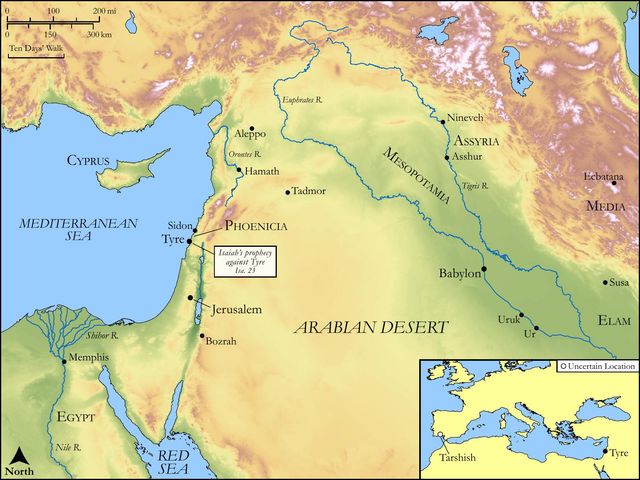
See on the biblical-era map
Study this verse
Public-domain commentary
Matthew Henry
From his Commentary on the Whole Bible. Henry comments on passages, not single verses — this entry covers Isaiah 23:15–18. His three-level outline is real structure in the source text, so it is rendered as structure.
Here is, I. The time fixed for the continuance of the desolations of Tyre, which were not to be perpetual desolations: Tyre shall be forgotten seventy years, Isa 23:15. So long it shall lie neglected and buried in obscurity. It was destroyed by Nebuchadnezzar much about the time that Jerusalem was, and lay as long as it did in its ruins. See the folly of that proud ambitious conqueror. What the richer, what the stronger, was he for making himself master of Tyre, when all the inhabitants were driven out of it and he had none of his own subjects to spare for the replenishing and fortifying of it? It is surprising to see what pleasure men could take in destroying cities and making their memorial perish with them, Psa 9:6. He trampled on the pride of Tyre, and therein served God's purpose; but with greater pride, for which God soon after humbled him.
II.A prophecy of the restoration of Tyre to its glory again:
After the end of seventy years, according to the years of one king, or one dynasty or family of kings, that of Nebuchadnezzar; when that expired, the desolations of Tyre came to an end. And we may presume that Cyrus at the same time when he released the Jews, and encouraged them to rebuild Jerusalem, released the Tyrians also, and encouraged them to rebuild Tyre. Thus the prosperity and adversity of places, as well as persons, are set the one over against the other, that the most glorious cities may not be secure nor the most ruinous despair. It is foretold,
1.That God's providence shall gain smile upon this ruined city (Isa 23:17): The Lord will visit Tyre in mercy; for, though he contend, he will not contend for ever. It is not said, Her old acquaintance shall visit her, the colonies she has planted, and the trading cities she has had correspondence with (they have forgotten her); but, The Lord shall visit her by some unthought-of turn; he shall cause his indignation towards her to cease, and then things will run of course in their former channel.
2.That she shall use her best endeavours to recover her trade again. She shall sing as a harlot, that has been some time under correction for her lewdness; but, when she is set at liberty (so violent is the bent of corruption), she will use her old arts of temptation. The Tyrians having returned from their captivity, and those that remained recovering new spirits thereupon, they shall contrive how to force a trade, shall procure the best choice of goods, under-sell their neighbours, and be obliging to all customers; as a harlot that has been forgotten, when she comes to be spoken of again, recommends herself to company by singing and playing, takes a harp, goes about the city, perhaps in the night, serenading, makes sweet melody, and sings many songs. These are innocent and allowable diversions, if soberly, and moderately, and modestly used; but those that value themselves upon their virtue should not be over-fond of them, nor ambitious to excel in them, because, whatever they are now, anciently they were some of the baits with which harlots used to entice fools. Tyre shall now by degrees come to be the mart of nations again; she shall return to her hire, to her traffic, and shall commit fornication (that is, she shall have dealings in trade, for the prophet carries on the similitude of a harlot) with all the kingdoms of the world that she had formerly traded with in her prosperity. The love of worldly wealth is a spiritual whoredom, and therefore covetous people are called adulterers and adulteresses (Jam 4:4), and covetousness is spiritual idolatry.
3.That, having recovered her trade again, she shall make a better use of it than she had done formerly; and this good she should get by her calamities (Isa 23:18): Her merchandise, and her hire, shall be holiness to the Lord. The trade of Tyre, and all the gains of her trade, shall be devoted to God and to his honour and employed in his service. It shall not be treasured and hoarded up, as formerly, to be the matter of their pride and the support of their carnal confidence; but it shall be laid out in acts of piety and charity. What they can spare from the maintenance of themselves and their families shall be for those that dwell before the Lord, for the priests, the Lord's ministers, that attend in his temple at Jerusalem; not to maintain them in pomp and grandeur, but that they and theirs may eat sufficiently, may have food convenient for them, with as little as may be of that care which would divert them from their ministration, and that they may have, not rich and fine clothing, but durable clothing, that which is strong and lasting, clothing for old men (so some read it), as if the priests, though they were young, must wear such plain grave clothing as old men used to wear. Now,
(1.)This supposes that religion should be set up in New Tyre, that they should come to the knowledge of the true God and into communion with the Israel of God. Perhaps their being fellow-captives with the Jews in Babylon (who had prophets with them there) disposed them to join with them in their worship there, and turned them from idols, as it cured the Jews of their idolatry: and when they were released with them, and as they had reason to believe for their sakes, when they were settled again in Tyre, they would send gifts and offerings to the temple, and presents to the priests. We find men of Tyre then dwelling in the land of Judah, Neh 13:16. Tyre and Sidon were better disposed to religion in Christ's time than the cities of Israel; for, if Christ had gone among them, they would have repented, Mat 11:21. And we meet with Christians at Tyre (Act 21:3, Act 21:4), and, many years after, did Christianity flourish there. Some of the rabbin refer this prophecy of the conversion of Tyre to the days of the Messiah.
(2.)It directs those that have estates to make use of them in the service of God and religion, and to reckon that best laid up which is so laid out. Both the merchandise of the tradesmen and the hire of the day-labourers shall be devoted to God. Both the merchandise (the employment we follow) and the hire (the gain of our employments) must be holiness to the Lord, alluding to the motto engraven on the frontlet of the high priest (Exo 39:30), and to the separation of the tithe under the law, Lev 27:30. See a promise like this referring to gospel times, Zac 14:20, Zac 14:21. We must first give up ourselves to be holiness to the Lord before what we do, or have, or get, can be so. When we abide with God in our particular callings, and do common actions after a godly sort - when we abound in works of piety and charity, are liberal in relieving the poor, and supporting the ministry, and encouraging the gospel - then our merchandise and our hire are holiness to the Lord, if we sincerely look at his glory in them. And our wealth need not be treasured and laid up on earth; for it is treasured and laid up in heaven, in bags that wax not old, Luk 12:33.
Historical interpretation
Historical reception
3 surviving comments on this verse. Each one is dated, so this reads as a timeline rather than a list.
Select a marker to jump to its quote. Markers stagger vertically where authors wrote within a few decades of each other.
To seek out the exact form of the reading, I gave my attention to the translation of Aquila, which says, “And it will happen that its commerce and wages are consecrated to the Lord.” Thus the Hebrew has, precisely, “commerce and wages” without the articles, not, according to the Septuagint, “the commerce and the wages,” by which it appears to mean all the commerce and all the wages. According to Aquila, “Its commerce and wages are consecrated to the Lord.” Not its whole commerce or its whole wages, but a part of the commerce and a part of the wages are consecrated to the Lord. And this is what has been fulfilled in our day. For the church of God is established in the city of Tyre, as indeed in the rest of the nations, and many of the wages in it and what is stored up for business are offered to the church and consecrated to the Lord. The things that people bring, they offer in piety, not for themselves in order to enjoy the gifts offered to God but “for those who dwell before the Lord.” (Namely, [these gifts are] for those who serve at the altar, “for the Lord had enjoined that those who preach the gospel should live by the gospel” and “those who serve at the altar share in the sacrificial offerings.”)
(Verse 18) And his business shall be holy to the Lord, and his wages shall be set apart for the Lord; they shall not be stored up or hoarded away. For those who dwell before the Lord, his business shall be to eat in plenty and be clothed until old age. These things, according to history, we have not yet discovered if they have been fulfilled, unless it is to be thought that after the rebuilding of Jerusalem and the restoration of Tyre, the two cities were friendly with each other and frequently sent gifts to the temple of God in Tyre. Just as we read in Ezra (Esdras 13:16) that he drove away the Tyrians who were selling fish on the Sabbath and did not allow them to enter the city, and it should be estimated from this example about other business dealings as well. The Jews delay their empty prayers for the future, stating that these will be fulfilled after the Antichrist in a thousand years. It is not surprising if they fabricate such things, as they have rejected the truth of Christ and are preparing to receive the Antichrist, the instrument of the devil. Even Christians who fall into Judaizing contend that these words refer to a thousand years of blessedness. However, I, in understanding the vision of Babylon as a type of its destruction, interpret it as the time of its fulfillment, and in Egypt, with its idols destroyed and the altar of the Lord erected, I refer it to the time of Christ. Likewise, in the vision of Moab, I recognize the throne of the Savior placed on his land, and in all the other visions of Damascus, I have no doubt that they are sacraments of our times. Thus, in the vision of Tyre, which is the most extreme, I interpret it as the time of Christian felicity: that after it is built and regains its former state, all merchants return to their ancient customs, entering its harbor, and their goods and labor are dedicated to the Lord. Let us consider the churches built in Tyre, let us think about the wealth of all, which is not stored up or hoarded, but given to those who live before the Lord, who, as altar servants, share with the altar (1 Corinthians 9). However, the Tyrians serve not for wealth, nor to accumulate the wealth of priests, but to provide for the necessary sustenance: so that, according to the Apostle, having food and clothing, we may be content with these (1 Timothy 6). And note that it did not say negotiations and goods of Tyre sanctified to be given to the Lord to those who dwell in Jerusalem as the Jews think, but to those who are before the Lord, who serve Him. For the Lord established it so that those who preach the Gospel should live from the Gospel (I Cor. IX). But to serve the Lord and to dwell before Him is not a matter of place, but of merit. Thus far we have discussed the visions of Isaiah, or the burdens that he imposed on certain nations, as you have commanded, and as we have been able to, following the historical interpretation, focusing only on the footsteps of Hebrew truth. The following things pertain to all nations, and generally to the completion of the whole world. About these things, neither did you ask me to write, nor was it a waste of time for me to dictate unasked and barely written about sought-after things.
(Verse 15 and following) And it shall come to pass in that day, that Tyre shall be forgotten seventy years, according to the days of one king: after the end of seventy years, Tyre shall sing as a harlot. Take a harp, go about the city, O harlot that has been forgotten; make sweet melody, sing many songs, that you may be remembered. After seventy years, the LORD will visit Tyre, and she shall return to her hire, and shall commit fornication with all the kingdoms of the world upon the face of the earth. And his merchandise shall be holy unto the Lord: it shall not be gathered nor laid up; for his merchandise shall be for them that dwell before the Lord, to eat sufficiently, and for durable clothing. This that is spoken of: a memorial before the Lord: and upon the face of the earth. And as the time of a man's life, which is not contained in the Hebrew, but is added in the Greek. And Tyre, after the seventy years of her captivity, shall return, and shall play the harlot with all the kingdoms of the world upon the face of the earth. And her merchandise and her hire shall be holiness to the Lord: it shall not be treasured nor laid up, for her merchandise shall be for them that dwell before the Lord, to eat sufficiently, and for durable clothing. The divine discourse exhorts Sidon and Tyre to repentance, and promises that his labors and rewards are to be sanctified by the Lord. Who does not have hope for salvation from sins, if indeed he has sung well, and all the strings of virtues, which were once slackened, are to be composed into praises of the Lord? We read in the forty-fourth psalm, which specifically pertains to the union of the bridegroom and the bride, that is, to God the Savior and the sacraments of the Church, it is said among other things: The daughters of Tyre will offer you gifts, the rich among the people will seek your favor (Ps. XLIV, 13). And the bridegroom himself speaks again to the Tyrian bride: Listen, daughter, and see, and incline your ear; and forget your people and your father's house, for the king desires your beauty. (Ibid. 11, 12). Hence, in the description of her beauty, it is said: The queen stands at your right hand, in a golden robe, adorned with various ornaments (Ibid., 10). And again: All the glory of the king's daughter is within (Ibid., 14). But if the king desires the beauty of penitent Tyre, and having the ornaments of various virtues, how much more will his reward and business be not in Tyre, where he does not dwell, but among those who live in the sight of the Lord! After they have repented, they will hear from the Lord and Savior: 'Eat, my friends, and drink, and be intoxicated, my beloved' (Song of Solomon 5:1). What it means to eat and drink, and be satisfied with the gathering of all virtues, the faithful reader understands. The temple was desolate for seventy years, as Jeremiah (Chapter 29), Daniel (Chapter 9), and Zechariah (Chapter 7) teach. And in Ezekiel (Chapter 16) we read about Sodom being restored to its former state, and about Egypt receiving its former abundance after the desolation and dryness of the land and the seven rivers. The number seventy signifies complete and perfect repentance, either in the span of seven days or in the completion of seven decades, so that just as Tyre, when the time of repentance is fulfilled, may return to its former state. Concerning this, I believe that the prostitute is referred to in the mystical language of Solomon's Proverbs: Do not look at the worst woman; for honey drips from the lips of the harlot, who fattens your throat for a short time, and afterwards you will find it bitter as gall (Prov. V, 2-4). For she peers through the window of her house onto the streets (Matth. VII): for the way that leads to death is wide and spacious, and she dares not tempt the wise, for she only lures the foolish, and she walks beside the corners, having lost the straight line: she talks to him in darkness and in gloom, and under the guise of pleasures she leads him like a victim to death. If she has been converted and has sung well, and has completed the time of perfect penance of years, she will eat and drink, and will be satisfied. Let Novatian hear, and let him be silent.
Continue studying Isaiah 23:18 across the web’s major study libraries — every link below opens this exact verse, chapter, or book on the destination site.
Read & Compare
 BibleGatewayThis verse in more than 200 translations and 70 languages.
 Bible.comThe YouVersion reader — hundreds of translations, reading plans, and highlights.
 ESV.orgCrossway's official English Standard Version reader.
 NET BibleThe NET translation with 60,000+ translators' notes on every rendering decision.
 STEP BibleTyndale House's free study tool — original text, vocabulary, and scholarly resources.
 BibliaLogos Bible Software's free web reader.
 USCCBThe New American Bible (Revised Edition) with the U.S. bishops' study notes.
Commentaries
 BibleHub CommentariesDozens of classic commentaries on this verse, gathered on one page.
 StudyLightMore than 100 commentary sets — the largest collection on the web.
 BibleRefPlain-English commentary on what this verse means, verse by verse.
 Enduring WordDavid Guzik's free commentary on this chapter, widely used by Bible teachers.
 Bible Study ToolsVerse commentary alongside Greek and Hebrew study aids.
Original Language & Research
- BibleHub InterlinearThe verse word by word — original language, transliteration, and English.
- BibleHub LexiconEvery word's original-language definition and Strong's entry.
 Blue Letter BibleDeep-study tools — Strong's numbers, concordance, and word studies.
 SefariaThe Hebrew text with Rashi and centuries of Jewish commentary.
Sermons, Hymns & Audio


TrulyRandomVerse is not affiliated with these sites and doesn’t control their content. They’re linked because they’re genuinely useful.
Summary
Isaiah 23:18 culminates a significant oracle against Tyre, a powerful maritime city, by prophesying a remarkable spiritual transformation. Following a period of divine judgment and subsequent restoration, the verse declares that Tyre's immense commercial success and accumulated wealth will no longer serve self-enrichment or worldly pride. Instead, these resources are to be consecrated as "holiness to the LORD," explicitly designated to provide sufficient food and durable clothing for those dedicated to God's service. This profound declaration signifies a radical repurposing of material prosperity, shifting its ultimate purpose from human gain to divine glory and the sustained provision of God's people.
Context
ShowHideLiterary Context
Isaiah 23 forms part of a larger collection of "burdens" or prophetic oracles against foreign nations found in Isaiah 13-23. The chapter specifically targets Tyre, a prominent Phoenician city. The oracle begins with a lament over Tyre's impending destruction and humiliation (Isaiah 23:1-14), depicting its fall as a source of dismay for its trading partners. A period of seventy years of desolation is prophesied (Isaiah 23:15), likened to the lifespan of a king or the duration of an empire. Following this period, Tyre is envisioned as returning to its commercial activities, but with a profoundly altered purpose. Verse 18 serves as the climactic and redemptive conclusion to this prophecy, shifting the focus from judgment and economic restoration to a radical reorientation of Tyre's very identity—its wealth and commerce—towards God. This transformation underscores God's ultimate sovereignty not only in judgment but also in His capacity to redeem and repurpose nations for His divine purposes.
Historical & Cultural Context
Tyre was an ancient Phoenician city-state, renowned as an island fortress and a dominant maritime power. Its vast wealth was derived from extensive trade networks that spanned the Mediterranean, and it was celebrated for its skilled artisans, particularly in the production of valuable purple dye, metalwork, and shipbuilding. Culturally, Tyre epitomized worldly prosperity, commercial pride, and self-sufficiency. The prophecies against Tyre in Isaiah likely allude to historical sieges, most notably by Nebuchadnezzar II of Babylon in the early 6th century BCE, which significantly diminished Tyre's power, and later by Alexander the Great in the late 4th century BCE. The "seventy years" mentioned in Isaiah 23:15 is often interpreted symbolically as a significant period of desolation or literally in connection with the Babylonian exile. The cultural significance of Tyre's "merchandise" and "hire" cannot be overstated; these represented the very core of its identity and power, making their consecration to the LORD a profound and unexpected reversal of its deeply ingrained worldly values.
Key Themes
ShowHideThis verse powerfully articulates several key themes pervasive throughout the book of Isaiah and broader prophetic literature. Firstly, it highlights Divine Sovereignty over all nations, demonstrating God's absolute authority to orchestrate the rise and fall of empires and to redirect their destinies according to His will. This is a consistent message throughout Isaiah, as seen in passages like Isaiah 40:23. Secondly, it introduces the theme of the Consecration of Wealth, challenging the common human tendency to hoard or misuse material prosperity for selfish ends. Here, Tyre's immense wealth is to be made "holiness to the LORD," transforming it from a source of pride and idolatry into an instrument for God's kingdom. This resonates deeply with the biblical principle that all resources ultimately belong to God and should be used for His glory, a truth echoed in Psalm 24:1. Thirdly, the verse emphasizes Provision for God's Servants, specifying that the consecrated wealth is for "them that dwell before the LORD," ensuring their sustenance and enabling their dedicated service. This theme of supporting those who minister is a consistent thread throughout Scripture, from the Old Testament Levitical system to the New Testament's directives for supporting gospel workers, as noted in 1 Timothy 5:18.
Exposition and Analysis
ShowHideKey Word Analysis
ShowHideMeaning "profit (from trade); merchandise." This term specifically refers to the commercial gains and economic profits derived from Tyre's extensive and lucrative trading activities. Its consecration implies that the very essence of Tyre's economic identity and worldly success is to be transformed and dedicated to God, signifying a radical shift from self-enrichment and pride to divine service and glory.
Meaning "a sacred place or thing; rarely abstract, sanctity; consecrated (thing), dedicated (thing), hallowed (thing), holiness." This word carries immense theological weight, denoting something set apart exclusively for God's use and purposes, implying a state of purity and separation from the common or profane. When applied to Tyre's merchandise, it signifies a complete spiritual transformation of its wealth from common, secular gain to something sacred and devoted entirely to the LORD, echoing the inscription "Holiness to the LORD" on the high priest's turban in Exodus 28:36.
Meaning "a primitive root; properly, to (be) compact; by implication, to hoard; lay up." This word, along with "treasured," describes the act of accumulating and storing wealth for personal security, future use, or selfish gain. The explicit prohibition against Tyre's consecrated wealth being "laid up" underscores that this transformed prosperity is not for hoarding or personal accumulation, but for immediate and active deployment in God's service, directly countering the materialistic mindset that previously defined Tyre.
Verse Breakdown
ShowHide"And her merchandise and her hire shall be holiness to the LORD:"
This opening declaration announces a radical and unexpected transformation of Tyre's commercial profits and earnings. Instead of being utilized for worldly accumulation, self-glorification, or the perpetuation of its own power, these resources are to be completely set apart and dedicated solely to God. This signifies a profound spiritual reorientation, where the very engine of Tyre's economy—its material wealth—is repurposed as an instrument for divine purposes rather than a source of human pride or idolatry.
"it shall not be treasured nor laid up;"
This negative injunction serves as a crucial clarification and emphatic prohibition. It explicitly states that the consecrated wealth is not to be hoarded, stored for personal security, or invested for selfish gain. The Hebrew terms for "treasured" (H686, 'âtsar') and "laid up" (H2630, châçan') both convey the idea of accumulating and preserving resources for future personal benefit or luxury. This prohibition underscores that this transformed wealth is intended for immediate and active deployment in God's service, preventing any return to the materialistic and self-serving mindset that previously characterized Tyre.
"for her merchandise shall be for them that dwell before the LORD, to eat sufficiently, and for durable clothing."
This final clause specifies the precise and practical purpose of the consecrated wealth. It is designated to provide for those who are dedicated to God's service, typically referring to priests, Levites, or other devout individuals who live in God's presence and serve Him. The provision is both essential and comprehensive: "to eat sufficiently" (H7654, sobʻâh', satiety) ensures their sustenance and freedom from want, while "durable clothing" (H6266, ʻâthîyq', antique/splendid; H4374, mᵉkaççeh', covering/garment) implies long-lasting and appropriate attire, enabling them to fulfill their sacred duties without material distractions or concerns. This highlights God's faithful care for His servants and the practical outworking of consecrated resources in supporting His kingdom work.
Literary Devices
ShowHideIsaiah 23:18 employs several powerful literary devices to convey its transformative message. Personification is evident in the portrayal of Tyre, a city-state, as possessing "merchandise" and "hire" that can be consecrated, thereby imbuing the city with a moral agency in its spiritual transformation. The central and most profound device is Symbolism, where Tyre's wealth, traditionally representing worldly pride, commercialism, and self-sufficiency, is dramatically transformed into "holiness to the LORD." This symbolizes a complete reorientation from the secular and self-serving to the sacred and divinely purposed. This transformation also presents a stark Antithesis between the former practice of "treasuring" and "laying up" wealth for selfish accumulation and the new, divinely ordained purpose of immediate, sufficient provision for God's dedicated servants. Furthermore, the phrase "holiness to the LORD" functions as a potent Allusion or Intertextuality, directly referencing the sacred inscription on the high priest's turban in Exodus 28:36, thereby elevating Tyre's consecrated wealth to a level of profound sacred dedication and divine ownership.
Theological and Thematic Connections
ShowHideIsaiah 23:18 offers a profound theological statement about God's redemptive power and His sovereign claim over all creation, including the wealth and resources of nations. It demonstrates that even the most worldly and self-serving resources can be transformed, sanctified, and repurposed for divine objectives. This vision challenges the notion of a strict dichotomy between the sacred and the secular, suggesting that all aspects of life, including economic activity and material prosperity, can ultimately be brought under God's dominion and consecrated for His glory. The verse also underscores God's unwavering commitment to providing for those who dedicate their lives to Him, ensuring that their material needs are met so they can focus wholeheartedly on their spiritual service and ministry without distraction. This divine provision empowers faithful service and underscores the interconnectedness of material resources and spiritual mission.
Reflection and Application
ShowHideIsaiah 23:18 serves as a powerful and enduring challenge for believers today, prompting us to critically re-evaluate our relationship with material possessions, professional endeavors, and financial stewardship. Just as Tyre's commercial profits were destined to be transformed from instruments of worldly pride into "holiness to the LORD," so too are we called to consecrate our own resources, talents, and even our careers to God's purposes. This means actively resisting the pervasive temptation to hoard wealth for personal security, luxury, or selfish accumulation. Instead, it compels us to actively seek ways to deploy our "merchandise and hire" for the advancement of God's kingdom, the support of His servants, the care of the vulnerable, and the spread of the Gospel. The verse reminds us that every aspect of our lives, including our economic activity and vocational pursuits, can be redeemed and utilized for divine glory, becoming a conduit for God's provision and a living testament to His transformative power in a world often consumed by materialism.
Questions for Reflection
ShowHideFAQ
ShowHideWho are "them that dwell before the LORD" in this verse?
ShowHideIn the Old Testament context, "them that dwell (H3427, yâshab') before (H6440, pânîym') the LORD" typically refers to those who are dedicated to God's service and live in His immediate presence. This primarily includes the priests and Levites who ministered in the Tabernacle or Temple, as well as other devout individuals who committed their lives to serving God and His people. These individuals were set apart for spiritual duties and often relied on the offerings, tithes, and provisions from the community for their sustenance. The verse implies that Tyre's transformed wealth would contribute directly to the material provision of these dedicated servants, enabling them to continue their sacred calling without material distraction or want.
What is the significance of the wealth "not being treasured nor laid up"?
ShowHideThe phrase "it shall not be treasured (H686, 'âtsar') nor laid up (H2630, châçan')" carries profound significance. It explicitly emphasizes that the consecrated wealth is not intended for personal accumulation, hoarding, or selfish investment. Both Hebrew terms denote storing away resources for future security, personal luxury, or the building of personal empires. By prohibiting this, the prophecy underscores a radical departure from Tyre's previous materialistic values and its self-serving economic practices. The wealth, once sanctified, is to be used actively and immediately for God's purposes, specifically for the sustenance of His servants, rather than becoming a source of pride, covetousness, or a means of human power. It signifies a complete redirection of purpose from self-serving gain to selfless devotion and active deployment for divine ends.
Christ-Centered Fulfillment
ShowHideIsaiah 23:18, with its vision of a worldly nation's wealth being consecrated to the LORD and used to sustain His people, finds its ultimate and most profound fulfillment in Jesus Christ and the establishment of His kingdom. Christ's redemptive work transforms not only individual hearts but also the very fabric of society and its resources, bringing all things under His benevolent reign. The "merchandise and hire" of the nations, once devoted to idolatry, self-aggrandizement, and worldly pursuits, are ultimately brought into submission to the King of Kings and Lord of Lords. Through the power of the Gospel, individuals from every tribe, tongue, and nation are redeemed, and their talents, wealth, and influence are now made available for the advancement of God's kingdom on earth. The New Testament church, empowered by the Holy Spirit, embodies this principle as believers willingly share their resources to provide for the needs of the saints and to spread the good news, as vividly depicted in the communal life described in Acts 2:44-45 and Acts 4:34-35. Ultimately, this prophecy points forward to the eschatological reality where the "kings of the earth" bring their glory and honor into the New Jerusalem, signifying a complete and universal consecration of all earthly power and wealth to God's eternal reign, all made possible through the atoning work, triumphant resurrection, and glorious reign of Christ.