


Deuteronomy 2:8
Bible text: King James Version (1769 Blayney text) · Public domain
Bible text: King James Version with Strong's numbers · Public domain
Bible text: Berean Standard Bible · Public domain
Bible text: American Standard Version (1901) · Public domain
Bible text: World English Bible, Messianic edition · Public domain
Bible text: Geneva Bible (1599) · Public domain
Bible text: Young's Literal Translation · Public domain
- וַנַּעֲבֹרva·na·'a·Vorand we passed awayH5674Conj-w ¦ V-Qal-ConsecImperf-1cpVerb Qal Consecutive Imperfect 1st Plural common genderוַandנַּעֲבֹרwe passed away
- מֵאֵתme·'Etfrom withH854Prep-m ¦ PrepPrepositionמֵfromאֵתwith
- אַחֵינוּ'a·Chei·nuour relativesH251N-mpc ¦ 1cpNoun Plural Masculine Constructאַחֵיrelativesנוּour
- בְנֵיve·nei[the] descendants ofH1121N-mpcNoun Plural Masculine Construct
- עֵשָׂו'e·SavEsauH6215N-proper-mNoun Proper Masculine
- הַיֹּשְׁבִיםhai·yo·she·Vimwho were dwellingH3427Art ¦ V-Qal-Prtcpl-mpVerb Qal Participle Plural Masculine Absoluteהַwhoיֹּשְׁבִיםwere dwelling
- בְּשֵׂעִירbe·se·'Irin SeirH8165Prep-b ¦ N-properNoun Proper LocationבְּinשֵׂעִירSeir
- מִדֶּרֶךְmi·De·rekhfrom [the] way ofH1870Prep-m ¦ N-cscNoun Singular common gender Constructמִfromדֶּרֶךְ[the] way of
- הָעֲרָבָהha·'a·ra·Vahthe desert plainH6160Art ¦ N-properNoun Proper Locationהָtheעֲרָבָהdesert plain
- מֵאֵילַתme·'ei·Latfrom ElathH359Prep-m ¦ N-properNoun Proper LocationמֵfromאֵילַתElath
- וּמֵעֶצְיֹןu·me·'etz·Yonand from EzionH6100Conj-w ¦ Prep-m ¦ N-properNoun Proper LocationוּandמֵfromעֶצְיֹןEzion
- גָּבֶרGa·verGeberH6100N-properNoun Proper Location
- וַנֵּפֶןva·Ne·fenand we turnedH6437Conj-w ¦ V-Qal-ConsecImperf-1cpVerb Qal Consecutive Imperfect 1st Plural common genderוַandנֵּפֶןwe turned
- וַנַּעֲבֹרva·na·'a·Vorand we passed alongH5674Conj-w ¦ V-Qal-ConsecImperf-1cpVerb Qal Consecutive Imperfect 1st Plural common genderוַandנַּעֲבֹרwe passed along
- דֶּרֶךְDe·rekh[the] way ofH1870N-cscNoun Singular common gender Construct
- מִדְבַּרmid·Bar[the] wilderness ofH4057N-mscNoun Singular Masculine Construct
- מוֹאָבmo·'AvMoabH4124N-properNoun Proper Location
English is a literal word-by-word gloss of the Hebrew, not the KJV's wording. Why?
This is the original text the KJV's translators worked from — each Hebrew word with its own literal English meaning in this verse, prepared by scholars at Tyndale House, Cambridge. The KJV translates whole sentences, not word by word, so its wording differs: one Hebrew word can become several English words, and the KJV may choose “the LORD” where the gloss reads “Yahweh”. Both are faithful — they answer different questions. For the KJV's own rendering, switch to the KJV text.
Details
See on the biblical-era maps
Study this verse
Public-domain commentary
Matthew Henry
From his Commentary on the Whole Bible. Henry comments on passages, not single verses — this entry covers Deuteronomy 2:8–23. His three-level outline is real structure in the source text, so it is rendered as structure.
It is observable here that Moses, speaking of the Edomites (Deu 2:8), calls them, "our brethren, the children of Esau." Though they had been unkind to Israel, in refusing them a peaceable passage through their country, yet he calls them brethren. For, though our relations fail in their duty to us, we must retain a sense of the relation, and not be wanting in our duty to them, as there is occasion. Now in these verses we have,
I.The account which Moses gives of the origin of the nations of which he had here occasion to speak, the Moabites, Edomites, and Ammonites.
We know very well, from other parts of his history, whose posterity they were; but here he tells us how they came to those countries in which Israel found them; they were not the aborigines, or first planters. But,
1.The Moabites dwelt in a country which had belonged to a numerous race of giants, called Emim (that is, terrible ones), as tall as the Anakim, and perhaps more fierce, Deu 2:10, Deu 2:11.
2.The Edomites in like manner dispossessed the Horim from Mount Seir, and took their country (Deu 2:12. and again Deu 2:22), of which we read, Gen 36:20.
3.The Ammonites likewise got possession of a country that had formerly been inhabited by giants, called Zamzummim, crafty men, or wicked men (Deu 2:20, Deu 2:21), probably the same that are called Zuzim, Gen 14:5. He illustrates these remarks by an instance older than any of these; the Caphtorim (who were akin to the Philistines, Gen 10:14) drove the Avim out of their country, and took possession of it, Deu 2:23. The learned bishop Patrick supposes these Avites, being expelled hence, to have settled in Assyria, and to be the same people we read of under that name, Kg2 17:31. Now these revolutions are recorded,
(1.)To show how soon the world was peopled after the flood, so well peopled that, when a family grew numerous, they could not find a place to settle in, at least in that part of the world, but they must drive out those that were already settled.
(2.)To show that the race is not to the swift, nor the battle to the strong. Giants were expelled by those of ordinary stature; for probably these giants, like those before the flood (Gen 6:4), were notorious for impiety and oppression, which brought the judgments of God upon them, against which their great strength would be on defence.
(3.)To show what uncertain things worldly possessions are, and how often they change their owners; it was so of old, and ever will be so. Families decline, and from them estates are transferred to families that increase; so little constancy or continuance is there in these things.
(4.)To encourage the children of Israel, who were now going to take possession of Canaan, against the difficulties they would meet with, and to show the unbelief of those that were afraid of the sons of Anak, to whom the giants, here said to be conquered, are compared, Deu 2:11, Deu 2:21. If the providence of God had done this for the Moabites and Ammonites, much more would his promise do it for Israel his peculiar people.
II.The advances which Israel made towards Canaan.
They passed by the way of the wilderness of Moab (Deu 2:8), and then went over the brook or vale of Zered (Deu 2:13), and there Moses takes notice of the fulfilling of the word which God had spoken concerning them, that none of those that were numbered at Mount Sinai should see the land that God had promised, Num 14:23. According to that sentence, now that they began to set their faces towards Canaan, and to have it in their eye, notice is taken of their being all destroyed and consumed, and not a man of them left, Deu 2:14. Common providence, we may observe, in about thirty-eight years, ordinarily raises a new generation, so that in that time few remain of the old one; but here it was entirely new, and none at all remained but Caleb and Joshua: for indeed the hand of the Lord was against them, v. 15. Those cannot but waste, until they were consumed, who have the hand of God against them. Observe, Israel is not called to engage with the Canaanites till all the men of war, the veteran regiments, that had been used to hardship, and had learned the art of war from the Egyptians, were consumed and dead from among the people (v. 16), that the conquest of Canaan, being effected by a host of new-raised men, trained up in a wilderness, the excellency of the power might the more plainly appear to be of God and not of men.
III.The caution given them not to meddle with the Moabites or Ammonites, whom they must not disseize, nor so much as disturb in their possessions: Distress them not, nor contend with them, v. 9. Though the Moabites aimed to ruin Israel (Num 22:6), yet Israel must not aim to ruin them. If others design us a mischief, this will not justify us in designing them a mischief. But why must not the Moabites and Ammonites be meddled with? 1. Because they were the children of Lot (v. 9, 19), righteous Lot, who kept his integrity in Sodom. Note, Children often fare the better in this world for the piety of their ancestors: the seed of the upright, though they degenerate, yet are blessed with temporal good things. 2. Because the land they were possessed of was what God had given them, and he did not design it for Israel. Even wicked men have a right to their worldly possessions, and must not be wronged. The tares are allowed their place in the field, and must not be rooted out until the harvest. God gives and preserves outward blessings to wicked men, to show that these are not the best things, but he has better in store for his own children.
Continue studying Deuteronomy 2:8 across the web’s major study libraries — every link below opens this exact verse, chapter, or book on the destination site.
Read & Compare
 BibleGatewayThis verse in more than 200 translations and 70 languages.
 Bible.comThe YouVersion reader — hundreds of translations, reading plans, and highlights.
 ESV.orgCrossway's official English Standard Version reader.
 NET BibleThe NET translation with 60,000+ translators' notes on every rendering decision.
 STEP BibleTyndale House's free study tool — original text, vocabulary, and scholarly resources.
 BibliaLogos Bible Software's free web reader.
 USCCBThe New American Bible (Revised Edition) with the U.S. bishops' study notes.
Commentaries
 BibleHub CommentariesDozens of classic commentaries on this verse, gathered on one page.
 StudyLightMore than 100 commentary sets — the largest collection on the web.
 BibleRefPlain-English commentary on what this verse means, verse by verse.
 Enduring WordDavid Guzik's free commentary on this chapter, widely used by Bible teachers.
 Bible Study ToolsVerse commentary alongside Greek and Hebrew study aids.
Original Language & Research
- BibleHub InterlinearThe verse word by word — original language, transliteration, and English.
- BibleHub LexiconEvery word's original-language definition and Strong's entry.
 Blue Letter BibleDeep-study tools — Strong's numbers, concordance, and word studies.
 SefariaThe Hebrew text with Rashi and centuries of Jewish commentary.
Sermons, Hymns & Audio


TrulyRandomVerse is not affiliated with these sites and doesn’t control their content. They’re linked because they’re genuinely useful.
Summary
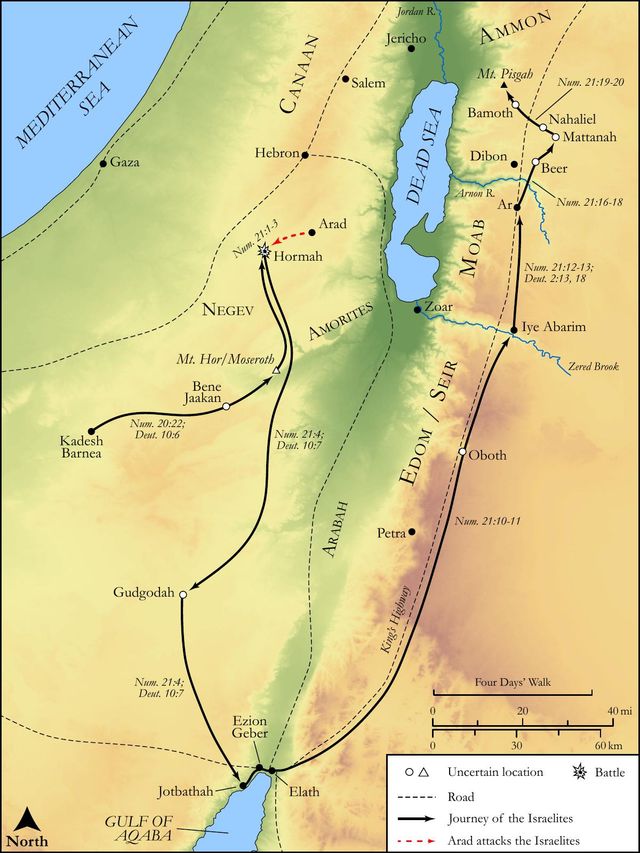
Deuteronomy 2:8 meticulously details a specific segment of Israel's wilderness journey, recounting their respectful detour around the Edomite territory. This verse, situated within Moses' historical recounting, highlights the Israelites' obedience to God's command to avoid conflict with the "children of Esau" (Edomites), who dwelt in Seir. It precisely traces their route from Elath and Eziongaber, ancient port cities on the Gulf of Aqaba, as they turned away from Edomite land and proceeded into the wilderness of Moab, demonstrating God's sovereign guidance and Israel's adherence to divine directives regarding national boundaries.
Context
ShowHideLiterary Context
Deuteronomy 2:8 is an integral part of Moses' extensive historical prologue (Deuteronomy 1-3), delivered to the new generation of Israelites on the plains of Moab. This section serves as a crucial reminder of God's unwavering faithfulness and Israel's past experiences during the forty years of wilderness wandering. Moses recounts the divine instructions and the people's responses, emphasizing the profound lessons learned from their journey. Specifically, verses 1-8 detail the journey from Kadesh-barnea, where the previous generation failed due to disobedience, up to the point of preparing to enter the Promised Land. The preceding verses Deuteronomy 2:4-7 explicitly lay out God's command not to provoke the Edomites, as He had given Mount Seir to Esau as their inheritance. Thus, verse 8 shows the direct fulfillment of this divine directive, demonstrating Israel's obedience in navigating around a kindred nation rather than through it, despite the Edomites' earlier refusal of passage (as noted in Numbers 20:18). This narrative thread reinforces the theme of God's meticulous guidance and Israel's responsibility to obey.
Historical & Cultural Context
The "children of Esau," or Edomites, were descendants of Esau, Jacob's twin brother, establishing a distant but significant familial relationship with the Israelites. Their territory, Seir, was a rugged, mountainous region situated south of the Dead Sea. The mention of Elath and Eziongaber is historically and geographically significant, as these were ancient port cities located at the northern tip of the Gulf of Aqaba, an arm of the Red Sea. This indicates that Israel's journey took them along a major trade route, likely skirting the "King's Highway," but they had to deviate from it to respect Edomite sovereignty. The cultural norm of respecting tribal or national boundaries, especially when divinely ordained, was paramount in Israel. God's command to not dispossess or provoke the Edomites underscored His sovereign distribution of land to all peoples, not just Israel, and His desire for peace, even with those who might be hostile or uncooperative. This historical event sets a precedent for how Israel was to interact with other nations, balancing their unique covenant relationship with God's universal sovereignty.
Key Themes
ShowHideThis verse contributes significantly to several overarching themes prominent in Deuteronomy and the Pentateuch. Primarily, it underscores Divine Guidance and Obedience, showcasing Israel's faithful adherence to God's specific command to avoid conflict with the Edomites. This highlights the critical importance of following God's directives, even when they might seem inconvenient or when dealing with those who are less than hospitable, reinforcing the theme of trusting God's wisdom over human expedience. Secondly, it emphasizes Respect for National Boundaries and God's Sovereignty, illustrating that God, as the supreme ruler, had allotted specific territories to different peoples, including the descendants of Esau (as explicitly stated in Deuteronomy 2:5). This principle of respecting established boundaries and God's sovereign distribution of land is a crucial theological point. Finally, it subtly points to God's Provision and Protection, as the successful and peaceful passage around Edom, utilizing routes through Elath and Eziongaber, implicitly speaks to God's continued care for His people, enabling them to navigate complex geopolitical landscapes without unnecessary conflict. This aligns with the broader theme of God's miraculous care throughout their forty years, where their clothing and sandals did not wear out (Deuteronomy 2:7).
Exposition and Analysis
ShowHideKey Word Analysis
ShowHideThis primitive root means "to cross over," encompassing a wide range of transitions, both literal and figurative. In this context, it signifies Israel's physical movement, specifically their "passing by" or "going over" the designated route. The term emphasizes the dynamic nature of their journey and the deliberate act of transition around Edomite territory, rather than through it, in obedience to God's command.
This primitive word denotes a "brother," used in the widest sense of literal relationship and metaphorical affinity. Here, it highlights the familial connection between the Israelites (descendants of Jacob) and the Edomites (descendants of Esau). Despite the often-strained relationship, Moses' use of "brethren" underscores God's command for Israel to treat them with a degree of respect and avoid aggression, acknowledging their shared ancestry.
This proper noun refers to a mountainous region. The name itself is formed like a word meaning "rough" or "hairy," perhaps describing the rugged terrain of the region or alluding to Esau's own hairy appearance. Seir was the traditional homeland of the Edomites, descendants of Esau. Its mention firmly grounds the narrative geographically and precisely identifies the territory and people Israel was commanded to avoid provoking.
Verse Breakdown
ShowHide"And when we passed by from our brethren the children of Esau, which dwelt in Seir"
This opening clause establishes the primary action and its context. The "we" refers to the Israelites under Moses' leadership. The phrase "our brethren the children of Esau" underscores the familial, though often contentious, relationship between the Israelites and the Edomites. The specific mention of "Seir" precisely locates the Edomites' dwelling, emphasizing the distinct territory Israel was commanded to circumvent, highlighting their obedience to God's non-aggression directive.
"through the way of the plain from Elath, and from Eziongaber"
This segment specifies the precise geographical route Israel took. "The way of the plain" most likely refers to the Arabah, the arid valley extending from the Dead Sea southward to the Gulf of Aqaba. Elath and Eziongaber were crucial port cities situated at the northern tip of the Gulf of Aqaba, an arm of the Red Sea. Their inclusion indicates that Israel skirted the eastern flank of the Edomite territory, along the coast, rather than attempting to cut directly through the heart of Edom. This detail confirms their meticulous adherence to God's command to avoid direct confrontation.
"we turned and passed by the way of the wilderness of Moab"
This final clause describes the change in direction and the next stage of their journey. After successfully navigating around Edomite territory, the Israelites turned northward, heading into the wilderness bordering Moab. This signifies their continued progress towards the Promised Land, demonstrating God's faithful guidance in leading them through complex and potentially dangerous regions without unnecessary conflict, all while respecting the boundaries God had set for other nations.
Literary Devices
ShowHideThe verse primarily employs Geographical Precision and Historical Recounting. The meticulous naming of specific locations such as Seir, Elath, Eziongaber, and the wilderness of Moab serves to anchor the narrative in a tangible, verifiable reality, lending significant credibility and authenticity to Moses' account. This precision is not merely descriptive but serves a profound theological purpose, demonstrating God's detailed and sovereign guidance over Israel's journey and their exact obedience to His commands regarding specific territories and national boundaries. The entire chapter, including this verse, functions as a Retrospective Narrative, where Moses looks back on past events to instruct, encourage, and admonish the present generation of Israelites on the plains of Moab. This recounting emphasizes the vital lessons of obedience, divine provision, and the consequences of disobedience, thereby preparing the people for the impending challenges of entering and possessing the Promised Land. The consistent use of the first-person plural "we" ("when we passed by") involves Moses directly in the experience, adding a personal, authoritative, and eyewitness tone to the historical record, reinforcing its veracity and immediate relevance.
Theological and Thematic Connections
ShowHideDeuteronomy 2:8 profoundly illustrates God's sovereign control over all nations and His meticulous guidance of His covenant people. It highlights the principle that God has established boundaries and inheritances for all peoples, not just Israel, and that His people are called to respect these divine decrees, even when dealing with nations that may be hostile or uncooperative. This act of peaceful circumvention, rather than forceful conquest, demonstrates a profound trust in God's timing and methods, emphasizing that the Promised Land would be inherited through divine power and not human aggression against those God had not appointed for Israel to conquer. It sets a precedent for responsible international relations rooted in divine command, showcasing God's universal justice and His desire for peace, even among nations.
Reflection and Application
ShowHideDeuteronomy 2:8 offers a powerful and enduring lesson in obedience, patience, and respecting God's sovereignty, even when faced with difficult circumstances or uncooperative people. Just as Israel had a divinely appointed route that included necessary detours around potential conflicts, believers today are called to seek and faithfully follow God's specific guidance in their lives. Sometimes, God's path for us involves patience, avoiding unnecessary confrontations, or taking a longer, less direct route to achieve His purposes. This verse reminds us that true strength and faithfulness lie not in asserting our rights or forcing our way through situations, but in humbly submitting to God's superior wisdom and respecting the boundaries He has set, whether for nations, individuals, or in our own personal relationships and endeavors. It encourages us to trust implicitly that God's chosen path, though sometimes circuitous or seemingly inconvenient, is always the best, the safest, and ultimately leads to His intended destination and abundant blessing. Our willingness to "pass by" rather than "pass through" demonstrates a deep reliance on His perfect plan.
Questions for Reflection
ShowHideFAQ
ShowHideWhy did Israel have to go around Edom, especially since they were "brethren"?
ShowHideDespite the familial ties between the Israelites (descendants of Jacob) and the Edomites (descendants of Esau), God explicitly commanded Israel not to provoke them or take their land. Deuteronomy 2:4-5 states that God had given Mount Seir to Esau as their possession, and Israel was not to dispossess them. This command demonstrated God's sovereignty over all nations and His right to allot territories as He saw fit, even to those outside the Abrahamic covenant. It also served as a test of Israel's obedience and a profound lesson in respecting divine boundaries and seeking peace, even when faced with the Edomites' earlier refusal to grant passage (as seen in Numbers 20:18-21). Israel's obedience prioritized God's command over their own convenience or perceived right.
What is the significance of Elath and Eziongaber being mentioned?
ShowHideThe mention of Elath and Eziongaber provides crucial geographical precision to Israel's journey, validating the historical accuracy of Moses' account. These were ancient port cities located at the northern tip of the Gulf of Aqaba, an arm of the Red Sea. Their inclusion indicates that Israel's route took them along the eastern edge of the Edomite territory, specifically skirting the mountainous region of Seir by following the Arabah valley towards the Red Sea coast before turning north into the wilderness of Moab. This detailed itinerary confirms that Israel meticulously followed God's command to avoid direct confrontation and passage through Edomite land, demonstrating their obedience and the divine guidance of their entire journey. It highlights God's specific and practical direction for His people.
Christ-Centered Fulfillment
ShowHideWhile Deuteronomy 2:8 describes a specific historical event of Israel's wilderness journey, its underlying principles find profound Christ-centered fulfillment. Israel's obedience to God's command to take a circuitous route, avoiding conflict and respecting divinely ordained boundaries, foreshadows Christ's ultimate path of humility and self-sacrifice. Unlike a conquering king who might force passage or assert immediate dominion, Jesus, the true Israel and the perfect Son, did not come to assert His earthly rights or provoke conflict through worldly power, but to fulfill God's will through a path of suffering and servanthood (as prophesied in Isaiah 53:7). His journey to the cross was, in a sense, a "detour" from what might have seemed a more direct path to glory, yet it was the divinely appointed and necessary way to achieve salvation for humanity (see Philippians 2:5-8). Furthermore, God's sovereignty in allotting land to Esau, even a non-covenant people, points to Christ's universal Lordship, where He is not just King of Israel but "Lord of all" (Acts 10:36), establishing a new covenant that transcends national and ethnic boundaries and invites all peoples into His kingdom (Galatians 3:28). Thus, Israel's journey in Deuteronomy 2:8, marked by obedience and respect for God's broader purposes, subtly anticipates the humble, boundary-transcending, and ultimately redemptive journey of Christ, who perfectly embodied submission to divine will for the sake of all humanity.