


Deuteronomy 2:7
Bible text: King James Version (1769 Blayney text) · Public domain
Bible text: King James Version with Strong's numbers · Public domain
Bible text: Berean Standard Bible · Public domain
Bible text: American Standard Version (1901) · Public domain
Bible text: World English Bible, Messianic edition · Public domain
Bible text: Geneva Bible (1599) · Public domain
Bible text: Young's Literal Translation · Public domain
- כִּיkiforH3588PrtParticle Conditional
- יְהוָהYah·wehYahwehH3068N-properNoun Proper Title
- אֱלֹהֶיךָ'e·lo·Hei·khayour GodH430N-mpc ¦ 2msNoun Plural Masculine ConstructאֱלֹהֶיGodךָyour
- בֵּרַכְךָbe·rakh·Khahe has blessed youH1288V-Piel-Perf-3ms ¦ 2msVerb Piel Perfect 3rd Singular Masculineבֵּרַכְhe has blessedךָyou
- בְּכֹלbe·Kholin allH3605Prep-b ¦ N-mscNoun Singular Masculine Constructבְּinכֹלall
- מַעֲשֵׂהma·'a·Seh[the] work ofH4639N-mscNoun Singular Masculine Construct
- יָדֶךָya·De·khayour handH3027N-csc ¦ 2msNoun Singular common gender Constructיָדֶhandךָyour
- יָדַעya·Da'he has knownH3045V-Qal-Perf-3msVerb Qal Perfect 3rd Singular Masculine
- לֶכְתְּךָlekh·te·Khawalking youH1980V-Qal-Inf ¦ 2msVerb Qal Infinitive Constructלֶכְתְּwalkingךָyou
- אֶת'et<obj.>H853DirObjMParticle Object Indicator
- הַמִּדְבָּרha·mid·Barthe wildernessH4057Art ¦ N-msNoun Singular Masculine Absoluteהַtheמִּדְבָּרwilderness
- הַגָּדֹלha·ga·Dol<the> greatH1419Art ¦ Adj-msAdjective Singular Masculine Absoluteהַ<the>גָּדֹלgreat
- הַזֶּהha·Zeh<the> thisH2088Art ¦ PrtParticle Demonstrativeהַ<the>זֶּהthis
- זֶהzehthisH2088PrtParticle Demonstrative
- אַרְבָּעִים'ar·ba·'ImfortyH705N-mpNoun Plural Masculine Absolute
- שָׁנָהsha·Nahyear[s]H8141N-fsNoun Singular Feminine Absolute
- יְהוָהYah·wehYahwehH3068N-properNoun Proper Title
- אֱלֹהֶיךָ'e·lo·Hei·khayour GodH430N-mpc ¦ 2msNoun Plural Masculine ConstructאֱלֹהֶיGodךָyour
- עִמָּךְ'i·Makh[has been] with youH5973Prep ¦ 2msPrepositionעִמָּ[has been] withךְyou
- לֹאlo'notH3808NegParticle Negative
- חָסַרְתָּcha·Sar·tayou have lackedH2637V-Qal-Perf-2msVerb Qal Perfect 2nd Singular Masculine
- דָּבָרda·VaranythingH1697N-msNoun Singular Masculine Absolute
English is a literal word-by-word gloss of the Hebrew, not the KJV's wording. Why?
This is the original text the KJV's translators worked from — each Hebrew word with its own literal English meaning in this verse, prepared by scholars at Tyndale House, Cambridge. The KJV translates whole sentences, not word by word, so its wording differs: one Hebrew word can become several English words, and the KJV may choose “the LORD” where the gloss reads “Yahweh”. Both are faithful — they answer different questions. For the KJV's own rendering, switch to the KJV text.
Details
See on the biblical-era maps
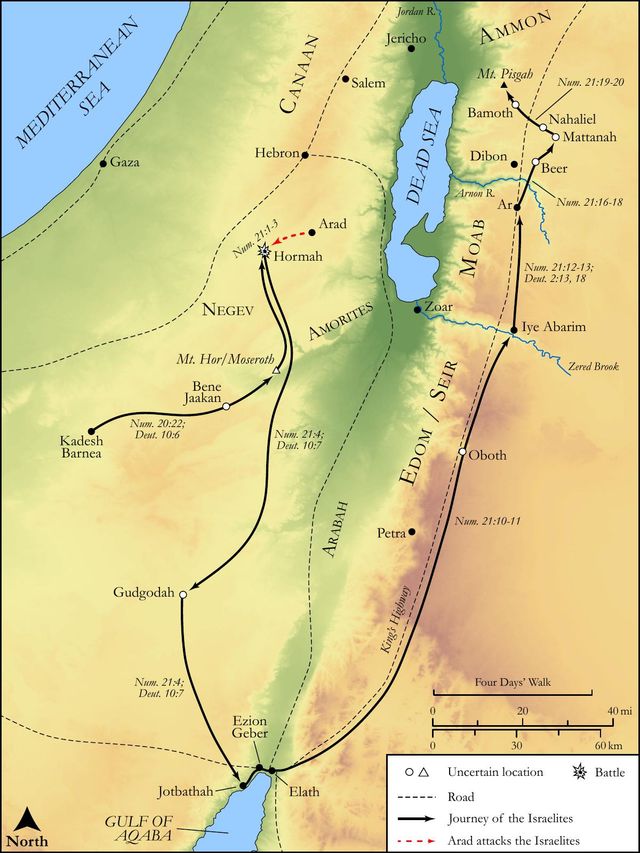
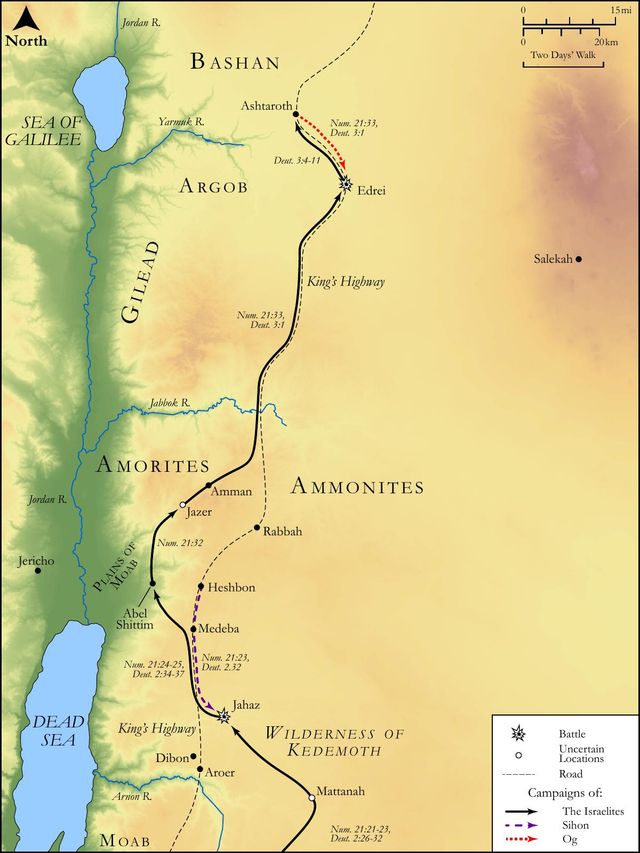
Study this verse
Public-domain commentary
Matthew Henry
From his Commentary on the Whole Bible. Henry comments on passages, not single verses — this entry covers Deuteronomy 2:1–7. His three-level outline is real structure in the source text, so it is rendered as structure.
Here is, I. A short account of the long stay of Israel in the wilderness: We compassed Mount Seir many days, Deu 2:1. Nearly thirty-eight years they wandered in the deserts of Seir; probably in some of their rests they staid several years, and never stirred; God by this not only chastised them for their murmuring and unbelief, but, 1. Prepared them for Canaan, by humbling them for sin, teaching them to mortify their lusts, to follow God, and to comfort themselves in him. It is a work of time to make souls meet for heaven, and it must be done by a long train of exercises. 2. He prepared the Canaanites for destruction. All this time the measure of their iniquity was filling up; and, though it might have been improved by them as a space to repent in, it was abused by them to the hardening of their hearts. Now that the host of Israel was once repulsed, and after that was so long entangled and seemingly lost in the wilderness, they were secure, and thought the danger was over from that quarter, which would make the next attempt of Israel upon them the more dreadful.
II.Orders given them to turn towards Canaan.
Though God contend long, he will not contend for ever. Though Israel may be long kept waiting for deliverance or enlargement, it will come at last: The vision is for an appointed time, and at the end it shall speak, and not lie.
III.A charge given them not to annoy the Edomites.
1.They must not offer any hostility to them as enemies: Meddle not with them, Deu 2:4, Deu 2:5.
(1.)They must not improve the advantage they had against them, by the fright they would be put into upon Israel's approach: "They shall be afraid of you, knowing your strength and numbers, and the power of God engaged for you; but think not that, because their fears make them an easy prey, you may therefore prey upon them; no, take heed to yourselves." There is need of great caution and a strict government of our own spirits, to keep ourselves from injuring those against whom we have an advantage. Or this caution is given to the princes; they must not only not meddle with the Edomites themselves, but not permit any of the soldiers to meddle with them.
(2.)They must not avenge upon the Edomites the affront they gave them in refusing them passage through their country, Num 20:21. Thus, before God brought Israel to destroy their enemies in Canaan, he taught them to forgive their enemies in Edom.
(3.)They must not expect to have any part of their land given them for a possession: Mount Seir was already settled upon the Edomites, and they must not, under pretence of God's covenant and conduct, think to seize for themselves all they could lay hands on. Dominion is not founded in grace. God's Israel shall be well placed, but must not expect to be placed alone in the midst of the earth, Isa 5:8.
2.They must trade with them as neighbours, buy meat and water of them, and pay for what they bought, Deu 2:6. Religion must never be made a cloak for injustice. The reason given (Deu 2:7), is, "God hath blessed thee, and hitherto thou hast lacked nothing; and therefore," (1.) "Thou needest not beg; scorn to be beholden to Edomites, when thou hast a God all-sufficient to depend upon. Thou hast wherewithal to pay for what thou callest for (thanks to the divine blessing!); use therefore what thou hast, use it cheerfully, and do not sponge upon the Edomites." (2.) "Therefore thou must not steal. Thou hast experienced the care of the divine providence concerning thee, in confidence of which for the future, and in a firm belief of its sufficiency, never use any indirect methods for thy supply. Live by the faith and not by thy sword."
Continue studying Deuteronomy 2:7 across the web’s major study libraries — every link below opens this exact verse, chapter, or book on the destination site.
Read & Compare
 BibleGatewayThis verse in more than 200 translations and 70 languages.
 Bible.comThe YouVersion reader — hundreds of translations, reading plans, and highlights.
 ESV.orgCrossway's official English Standard Version reader.
 NET BibleThe NET translation with 60,000+ translators' notes on every rendering decision.
 STEP BibleTyndale House's free study tool — original text, vocabulary, and scholarly resources.
 BibliaLogos Bible Software's free web reader.
 USCCBThe New American Bible (Revised Edition) with the U.S. bishops' study notes.
Commentaries
 BibleHub CommentariesDozens of classic commentaries on this verse, gathered on one page.
 StudyLightMore than 100 commentary sets — the largest collection on the web.
 BibleRefPlain-English commentary on what this verse means, verse by verse.
 Enduring WordDavid Guzik's free commentary on this chapter, widely used by Bible teachers.
 Bible Study ToolsVerse commentary alongside Greek and Hebrew study aids.
Original Language & Research
- BibleHub InterlinearThe verse word by word — original language, transliteration, and English.
- BibleHub LexiconEvery word's original-language definition and Strong's entry.
 Blue Letter BibleDeep-study tools — Strong's numbers, concordance, and word studies.
 SefariaThe Hebrew text with Rashi and centuries of Jewish commentary.
Sermons, Hymns & Audio


TrulyRandomVerse is not affiliated with these sites and doesn’t control their content. They’re linked because they’re genuinely useful.
Summary
Deuteronomy 2:7 serves as a profound declaration of God's steadfast faithfulness and comprehensive provision for the Israelites during their arduous forty-year journey through the wilderness. Moses, addressing the new generation on the brink of entering the Promised Land, powerfully recounts the Lord's intimate awareness of their every step, His unwavering companionship, and His miraculous sustenance, ensuring that despite the harsh and desolate environment, they experienced no lack. This verse encapsulates the divine commitment to His covenant people, transforming a period of discipline and testing into a vivid display of His boundless grace and sovereign care.
CONTEXT
ShowHideLiterary Context: Deuteronomy 2:7 is situated within Moses' second major discourse in the book of Deuteronomy, delivered on the plains of Moab to the generation prepared to enter Canaan. This section, specifically Deuteronomy 1:6-3:29, provides a historical recounting of Israel's journey from Mount Horeb (Sinai) up to their current encampment. More precisely, Deuteronomy 2:1-23 details their circuitous route around the territories of Edom, Moab, and Ammon, nations with whom God explicitly commanded Israel not to engage in conflict due to their ancestral ties to Abraham and Lot. Within this historical recap, verse 7 functions as a crucial theological interjection, offering the divine rationale and assurance that underpinned their successful, albeit prolonged, wilderness trek. It serves as a powerful reminder of God's consistent guidance as they stand on the precipice of conquest.
Historical & Cultural Context: The historical backdrop is the culmination of forty years of wilderness wandering, a period primarily ordained as divine discipline for the previous generation's rebellion and disobedience at Kadesh-barnea (Numbers 14). This new generation, having known only a nomadic existence, would have been intimately familiar with the harsh realities of desert life. Culturally, nomadic survival was inherently precarious, marked by scarcity and absolute dependence on limited natural resources, making the assertion of "lacking nothing" a truly miraculous and counter-intuitive claim. The "works of thy hand" would have encompassed their daily labors: tending flocks, setting up and breaking down camp, maintaining community order, and any simple efforts to sustain themselves in a barren land. The wilderness itself was a crucible, a place of profound testing and purification, designed to strip away self-reliance and compel Israel to depend solely on Yahweh.
Key Themes:
Exposition and Analysis
ShowHideKey Word Analysis
ShowHideThis primitive root means "to kneel," and by implication, "to bless God (as an act of adoration)" or "man (as a benefit)." In this context, it signifies God bestowing favor, prosperity, and comprehensive well-being upon Israel. The blessing was not merely a good wish but an active, divine empowerment that ensured fruitfulness and success in all their undertakings, transforming their efforts into sustainable outcomes despite the harsh environment.
Derived from a root meaning "to grow, to be great," this adjective describes something large, mighty, or significant in any sense. Here, "great wilderness" emphasizes the vastness, formidable nature, and inherent dangers of the desert through which Israel traveled. It highlights the magnitude of the challenge and, by contrast, the even greater magnitude of God's sustaining power.
Used in the negative ("thou hast lacked nothing"), this word means "to be diminished, to fail, to be in want, or to be deficient." Its negation here powerfully conveys a state of complete sufficiency and divine abundance. It emphasizes that God's provision was perfect, comprehensive, and left no essential need unmet, despite the inherent scarcity of the wilderness environment. It speaks to a supernatural provision that transcended natural limitations.
Verse Breakdown
ShowHide"For the LORD thy God hath blessed thee in all the works of thy hand"
This clause establishes the foundational premise of God's active and comprehensive benevolence. It declares that divine blessing was not passive but directly empowered and made fruitful every endeavor, however humble, undertaken by the Israelites during their wilderness journey. It highlights God's comprehensive favor extending to their daily labor and sustenance, ensuring their efforts were not futile.
"he knoweth thy walking through this great wilderness"
This phrase emphasizes God's intimate, personal, and experiential awareness of their entire forty-year journey. The "great wilderness" signifies a vast, dangerous, and challenging environment, yet God's knowledge (yada') was not distant or abstract but deeply relational, implying His constant observation and understanding of their every step, struggle, and need. He was not merely aware of their route but intimately acquainted with their experience.
"these forty years the LORD thy God [hath been] with thee"
This declaration underscores the continuous and unwavering presence of God throughout the entire period of their wilderness sojourn. The "forty years" represent a significant epoch of testing, discipline, and formation, yet through it all, God's covenantal presence and companionship remained steadfast, providing guidance, protection, and sustenance, demonstrating His enduring commitment.
"thou hast lacked nothing"
This climactic statement serves as the ultimate proof and summary of God's perfect and miraculous provision. Despite the inherent desolation and dangers of the wilderness, Israel experienced no fundamental deficiency in essential needs. This speaks to a supernatural supply that transcended natural limitations, ensuring their complete sufficiency in food, water, clothing, and all essential requirements for survival and flourishing.
Literary Devices
ShowHideDeuteronomy 2:7 employs several powerful literary devices to convey its profound message. Hyperbole is evident in the phrase "thou hast lacked nothing," which, while literally true regarding essential needs, emphasizes the miraculous and extraordinary nature of God's provision in an otherwise barren and inhospitable land. This intentional overstatement underscores the totality and completeness of God's care. Personification is subtly present in "he knoweth thy walking," attributing to God an intimate, experiential knowledge and understanding akin to a human companion who walks alongside and comprehends every step of a journey. The repeated use of "the LORD thy God" throughout the verse functions as a form of anaphora and emphasis, powerfully reinforcing the covenantal relationship between Yahweh and Israel, and highlighting the specific identity of their faithful provider. The verse itself functions as a concise summary statement, encapsulating the entire forty-year period of divine faithfulness into a single, memorable declaration, serving as both a historical testimony and a theological assurance for the new generation.
Theological and Thematic Connections
ShowHideDeuteronomy 2:7 powerfully articulates the theological truth of God's sovereign care and comprehensive provision for His covenant people. It demonstrates that divine faithfulness is not contingent on human merit or ideal circumstances, but flows solely from God's unchanging character and His unwavering commitment to His promises. The "forty years" in the wilderness, often viewed as a period of punishment and testing, is here profoundly reframed as a testament to God's sustaining grace, transforming a place of desolation and hardship into a classroom for dependence and a vivid display of divine sufficiency. This verse lays a foundational principle: when God is intimately "with" His people, they will "lack nothing" essential for their journey and purpose, underscoring His omnipotence, benevolence, and meticulous oversight. It teaches that true security and provision come from God alone, not from human ingenuity or worldly resources.
Reflection and Application
ShowHideDeuteronomy 2:7 offers profound encouragement and a powerful invitation to trust for believers navigating their own "wilderness" seasons. Life often presents periods of uncertainty, scarcity, and apparent desolation, whether in finances, relationships, health, or spiritual growth. This verse reminds us that even in such challenging environments, God's intimate knowledge of our journey, His constant presence, and His comprehensive provision remain unwavering. We are called to reflect on God's past faithfulness in our lives, recognizing how He has sustained us through difficult times and provided for our needs in unexpected ways. This reflection should cultivate a confident dependence on Him for future needs. Just as Israel learned to rely solely on manna and water in the desert, we are encouraged to seek God's kingdom first, trusting that He knows our needs and will supply them according to His divine wisdom and boundless resources. This truth liberates us from anxiety and empowers us to walk in faith, knowing that our "God shall supply all your need according to his riches in glory by Christ Jesus."
Questions for Reflection
ShowHideFAQ
ShowHideWas Israel truly without any needs during the 40 years, or does "lacked nothing" mean something else?
ShowHideThe phrase "lacked nothing" (Hebrew: chasar) in Deuteronomy 2:7 refers to Israel's essential needs for survival and flourishing in the wilderness. It does not imply a life of luxury, comfort, or freedom from all discomforts, but rather a miraculous and comprehensive provision of fundamental necessities such as food, water, shelter, and even clothing and footwear that did not wear out (Deuteronomy 8:4). Despite the barren and hostile environment, God supernaturally ensured they had precisely what was necessary to sustain life and continue their journey towards the Promised Land. This was a direct testament to His supernatural care, distinguishing their experience from what would be naturally possible in such a desolate region. It emphasizes God's perfect sufficiency and unwavering faithfulness to His covenant promises, ensuring His people were not diminished or defeated by the harsh conditions.
How does this verse relate to the idea of God testing Israel in the wilderness?
ShowHideDeuteronomy 2:7 reveals a crucial paradox within the wilderness experience: while God indeed tested Israel for forty years (Deuteronomy 8:2), this testing was not designed to destroy them but to humble them, prove their hearts, and teach them absolute dependence on Him. The very fact that they "lacked nothing" despite the rigorous testing demonstrates God's underlying grace and profound commitment to their well-being even during periods of discipline. The testing was a pedagogical tool, revealing their hearts and teaching them that "man does not live on bread alone but on every word that comes from the mouth of the LORD" (Deuteronomy 8:3). Thus, the constant provision was an integral part of the testing, showing that God's faithfulness endured even when Israel's did not, and that His ultimate purpose was their spiritual formation and good.
Does "blessed thee in all the works of thy hand" mean God will bless all my efforts today, regardless of their nature?
ShowHideThe phrase "blessed thee in all the works of thy hand" in Deuteronomy 2:7 speaks to God's favor upon the legitimate, God-ordained efforts of His covenant people. For ancient Israel, this primarily referred to their daily tasks of survival, tending flocks, and maintaining community within the context of their wilderness journey and adherence to God's commands. For believers today, this principle suggests that God's blessing extends to our diligent and righteous labor undertaken in obedience to His will and for His glory. It does not imply a blanket endorsement of all human endeavors, especially those contrary to biblical principles or motivated by selfish ambition. Rather, it assures us that when we commit our work to the Lord and strive to honor Him in our vocations, He is intimately involved and can bring fruitfulness and provision even in challenging circumstances (Colossians 3:23). It encourages a mindset of faithful stewardship and humble dependence, recognizing that true and lasting blessing comes from God's hand alone.
Christ-Centered Fulfillment
ShowHideDeuteronomy 2:7 finds its ultimate and most profound fulfillment in the person and work of Jesus Christ, who perfectly embodies God's provision, presence, and purpose. While the verse speaks of God's miraculous sustenance of Israel in a physical wilderness, Christ is the spiritual manna, the true "bread of life" who ensures that those who come to Him "shall never hunger" (John 6:35). He is the living water, from whom those who believe "will never thirst" (John 4:14). The intimate knowledge and constant presence of God with Israel, "He knoweth thy walking through this great wilderness: these forty years the LORD thy God hath been with thee," powerfully foreshadow the Incarnation, where God literally "dwelt among us" in the person of Jesus Christ (John 1:14). Furthermore, the promise that Israel "lacked nothing" points to the complete spiritual sufficiency found in Christ; in Him, believers are "complete" (Colossians 2:10), lacking nothing essential for salvation, sanctification, and eternal life. He is the Good Shepherd who ensures His sheep "shall not want" (Psalm 23:1, echoed in John 10:11). Thus, Deuteronomy 2:7 serves as a powerful Old Testament shadow, revealing the character of the God who, through His Son, provides all that we truly need, both physically and spiritually, for our journey through the wilderness of this world to the promised eternal rest.