


Acts 10:36
- τὸνtontheG3588T-ASMDefinite article Accusative Singular Masculine
- λόγονlogonwordG3056N-ASMNoun Accusative Singular Masculine
- ὃνhonthatG3739R-ASMRelative pronoun Accusative Singular Masculine
- ἀπέστειλενapesteilenHe sentG649V-AAI-3SVerb Aorist Active Indicative 3rd Singular
- τοῖςtoisto theG3588T-DPMDefinite article Dative Plural Masculine
- υἱοῖςhuioissonsG5207N-DPMNoun Dative Plural Masculine
- ἸσραὴλIsraēlof IsraelG2474N-GSM-LNoun Genitive Singular Masculine Location
- εὐαγγελιζόμενοςeuangelizomenosevangelising [about]G2097V-PMP-NSMVerb Present Middle Participle Nominative Singular Masculine
- εἰρήνηνeirēnēnpeaceG1515N-ASFNoun Accusative Singular Feminine
- διὰdiathroughG1223PREPPreposition
- ἸησοῦIēsouJesusG2424N-GSM-PNoun Genitive Singular Masculine Individual
- ΧριστοῦChristouChrist —G5547N-GSM-TNoun Genitive Singular Masculine Title
- οὗτόςhoutosHeG3778D-NSMDemonstrative pronoun Nominative Singular Masculine
- ἐστινestinisG1510V-PAI-3SVerb Present Active Indicative 3rd Singular
- πάντωνpantōnof allG3956A-GPMAdjective Genitive Plural Masculine
- κύριοςkuriosLordG2962N-NSM-TNoun Nominative Singular Masculine Title
English is a literal word-by-word gloss of the Greek, not the KJV's wording. Why?
This is the original text the KJV's translators worked from — each Greek word with its own literal English meaning in this verse, prepared by scholars at Tyndale House, Cambridge. The KJV translates whole sentences, not word by word, so its wording differs: one Greek word can become several English words, and the KJV may choose “charity” where the gloss reads “love”. Both are faithful — they answer different questions. For the KJV's own rendering, switch to the KJV text.
Details
See on the biblical-era map
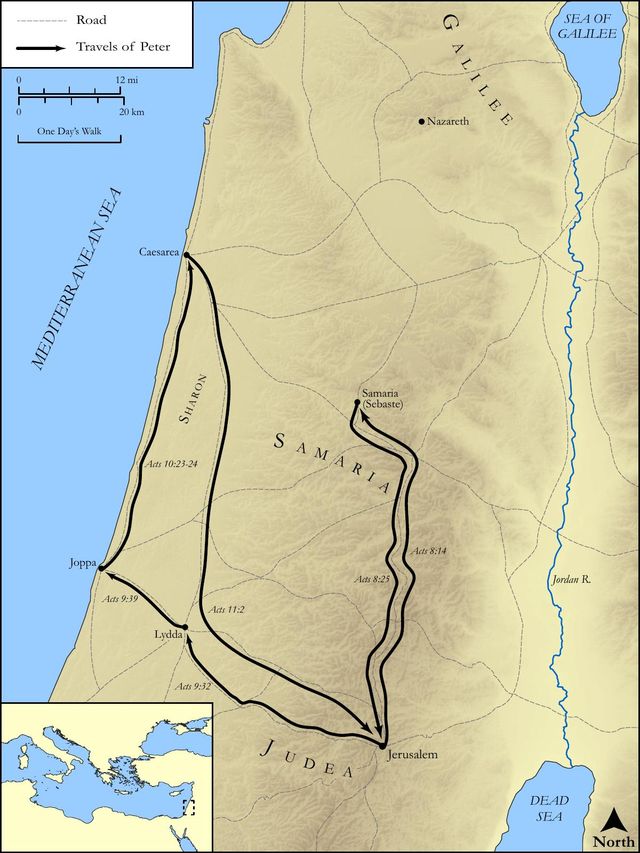
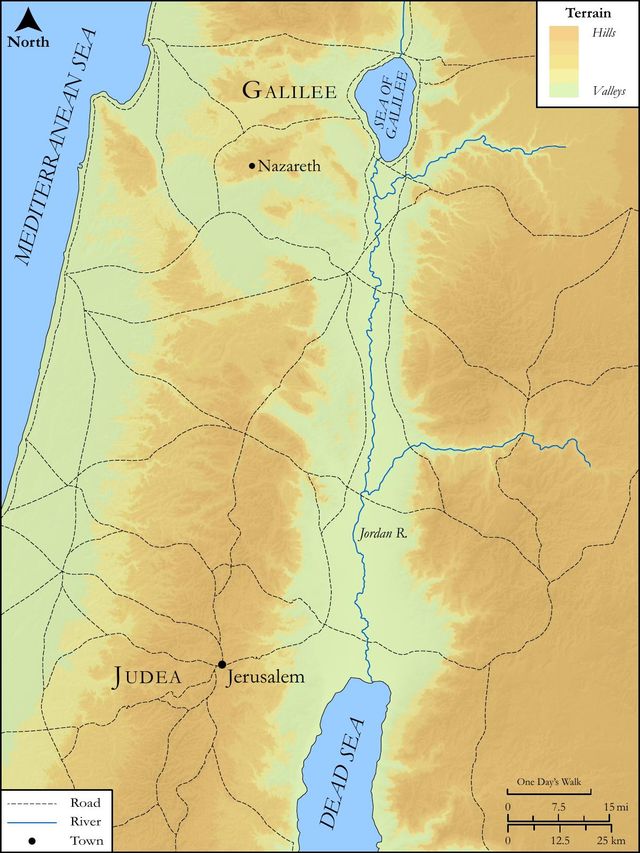
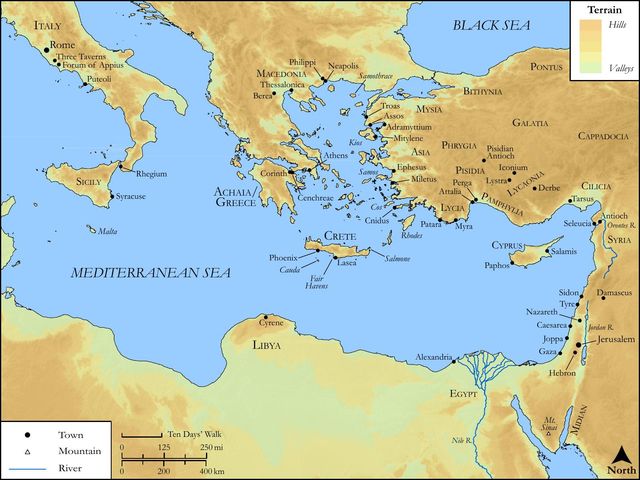
Study this verse
Public-domain commentary
Matthew Henry
From his Commentary on the Whole Bible. Henry comments on passages, not single verses — this entry covers Acts 10:34–43. His three-level outline is real structure in the source text, so it is rendered as structure.
We have here Peter's sermon preached to Cornelius and his friends: that is, an abstract or summary of it; for we have reason to think that he did with many other words testify and exhort to this purport. It is intimated that he expressed himself with a great deal of solemnity and gravity, but with freedom and copiousness, in that phrase, he opened his mouth, and spoke, Act 10:34. O ye Corinthians, our mouth is open to you, saith Paul, Co2 6:11. "You shall find us communicative, if we but find you inquisitive." Hitherto the mouths of the apostles had been shut to the uncircumcised Gentiles, they had nothing to say to them; but now God gave unto them, as he did to Ezekiel, the opening of the mouth. This excellent sermon of Peter's is admirably suited to the circumstances of those to whom he preached it; for it was a new sermon.
I.Because they were Gentiles to whom he preached.
He shows that, notwithstanding this, they were interested in the gospel of Christ, which he had to preach, and entitled to the benefit of it, upon an equal footing with the Jews. It was necessary that this should be cleared, or else with what comfort could either he preach or they hear? He therefore lays down this as an undoubted principle, that God is no respecter of persons; doth not know favour in judgment, as the Hebrew phrase is; which magistrates are forbidden to do (Deu 1:17; Deu 16:19; Pro 24:23), and are blamed for doing, Psa 82:2. And it is often said of God that he doth not respect persons, Deu 10:17; Ch2 19:7; Job 34:19; Rom 2:11; Col 3:25; Pe1 1:17. He doth not give judgment in favour of a man for the sake of any external advantage foreign to the merits of the cause. God never perverts judgment upon personal regards and considerations, nor countenances a wicked man in a wicked thing for the sake of his beauty, or stature, his country, parentage, relations, wealth, or honour in the world. God, as a benefactor, gives favours arbitrarily and by sovereignty (Deu 7:7, Deu 7:8; Deu 9:5, Deu 9:6; Mat 20:10); but he does not, as a judge, so give sentence; but in every nation, and under ever denomination, he that fears God and works righteousness is accepted of him, Act 10:35. The case is plainly thus -
1.God never did, nor ever will, justify and save a wicked Jew that lived and died impenitent, though he was of the seed of Abraham, and a Hebrew of the Hebrews, and had all the honour and advantages that attended circumcision. He does and will render indignation and wrath, tribulation and anguish, upon every soul of man that doeth evil; and of the Jew first, whose privileges and professions, instead of screening him from the judgment of God, will but aggravate his guilt and condemnation. See Rom 2:3, Rom 2:8, Rom 2:9, Rom 2:17. Though God has favoured the Jews, above other nations, with the dignities of visible church-membership, yet he will not therefore accept of any particular persons of that dignity, if they allow themselves in immoralities contradictory to their profession; and particularly in persecution, which was now, more than any other, the national sin of the Jews.
2.He never did, nor ever will, reject or refuse an honest Gentile, who, though he has not the privileges and advantages that the Jews have, yet, like Cornelius, fears God, and worships him, and works righteousness, that is, is just and charitable towards all men, who lives up to the light he has, both in a sincere devotion and in a regular conversation. Whatever nation he is of, though ever so far remote from kindred to the seed of Abraham, though ever so despicable, nay, though in ever so ill a name, that shall be no prejudice to him. God judges of men by their hearts, not by their country or parentage; and, wherever he finds an upright man, he will be found an upright God, Psa 18:25. Observe, Fearing God, and working righteousness, must go together; for, as righteousness towards men is a branch of true religion, so religion towards God is a branch of universal righteousness. Godliness and honesty must go together, and neither will excuse for the want of the other. But, where these are predominant, no doubt is to be made of acceptance with God. Not that any man, since the fall, can obtain the favour of God otherwise than through the mediation of Jesus Christ, and by the grace of God in him; but those that have not the knowledge of him, and therefore cannot have an explicit regard to him, may yet receive grace from God for his sake, to fear God and to work righteousness; and wherever God gives grace to do so, as he did to Cornelius, he will, through Christ, accept the work of his own hands. Now,
(1.)This was always a truth, before Peter perceived it, that God respecteth no man's person; it was the fixed rule of judgment from the beginning: If thou doest well, shalt thou not be accepted? And, if not well, sin, and the punishment of it, lie at the door, Gen 4:7. God will not ask in the great day what country men were of, but what they were, what they did, and how they stood affected towards him and towards their neighbours; and, if men's personal characters received neither advantage nor disadvantage from the great difference that existed between Jews and Gentiles, much less from any less difference of sentiments and practices that may happen to be among Christians themselves, as those about meats and days, Rom. 14. It is certain the kingdom of God is not meat and drink, but righteousness, and peace, and joy in the Holy Ghost; and he that in these things serveth Christ is accepted of God, and ought to be approved of men; for dare we reject those whom God doth not?
(2.)Yet now it was made more clear than it had been; this great truth had been darkened by the covenant of peculiarity made with Israel, and the badges of distinction put upon them; the ceremonial law was a wall of partition between them and other nations; it is true that in it God favoured that nation (Rom 3:1, Rom 3:2; Rom 9:4), and thence particular persons among them were ready to infer that they were sure of God's acceptance, though they lived as they listed, and that no Gentile could possibly be accepted of God. God had said a great deal by the prophets to prevent and rectify this mistake, but now at length he doth it effectually, by abolishing the covenant of peculiarity, repealing the ceremonial law, and so setting the matter at large, and placing both Jew and Gentile upon the same level before God; and Peter is here made to perceive it, by comparing the vision which he had with that which Cornelius had. Now in Christ Jesus, it is plain, neither circumcision availeth any thing, nor uncircumcision, Gal 5:6; Col 3:11.
II.Because they were Gentiles inhabiting a place within the confines of the land of Israel, he refers them to what they themselves could not but know concerning the life and doctrine, the preaching and miracles, the death and sufferings of our Lord Jesus: for these were things the report of which spread into every corner of the nation, Act 10:37, etc. It facilitates the work of ministers, when they deal with such as have some knowledge of the things of God, to which they may appeal, and on which they may build.
1.They knew in general, the word, that is, the gospel, which God sent to the children of Israel: That word, I say, you know, Act 10:37. Though the Gentiles were not admitted to hear it (Christ and his disciples were not sent but to the lost sheep of the house of Israel), yet they could not but hear of it: it was all the talk both of city and country. We are often told in the gospels how the fame of Christ went into all parts of Canaan, when he was on earth, as afterwards the fame of his gospel went into all parts of the world, Rom 10:18. That word, that divine word, that word of power and grace, you know.
(1.)What the purport of this word was. God by it published the glad tidings of peace by Jesus Christ, so it should be read - euangelizomenos eirēnēn. It is God himself that proclaims peace, who justly might have proclaimed war. He lets the world of mankind know that he is willing to be at peace with them through Jesus Christ; in him he was reconciling the world to himself.
(2.)To whom it was sent - to the children of Israel, in the first place. The prime offer is made to them; this all their neighbours heard of, and were ready to envy them those advantages of the gospel, more than they ever envied them those of their law. Then said they among the heathen, The Lord hath done great things for them, Psa 126:2.
2.They knew the several matters of fact relating to this word of the gospel sent to Israel.
(1.)They knew the baptism of repentance which John preached by way of introduction to it, and in which the gospel first began, Mar 1:1. They knew what an extraordinary man John was, and what a direct tendency his preaching had to prepare the way of the Lord. They knew what great flocking there was to his baptism, what an interest he had, and what he did.
(2.)They knew that immediately after John's baptism the gospel of Christ, that word of peace, was published throughout all Judea, and that it took its rise from Galilee. The twelve apostles, and seventy disciples, and our Master himself, published these glad tidings in all parts of the land; so that we may suppose there was not a town or village in all the land of Canaan but had had the gospel preached in it.
(3.)They knew that Jesus of Nazareth, when he was here upon earth, went about doing good. They knew what a benefactor he was to that nation, both to the souls and the bodies of men; how he made it his business to do good to all, and never did hurt to any. He was not idle, but still doing; not selfish, but doing good; did not confine himself to one place, nor wait till people came to him to seek his help, but went to them, went about from place to place, and wherever he came he was doing good. Hereby he showed that he was sent of God, who is good and does good; and does good because he is good: and who hereby left not himself without witness to the world, in that he did good, Act 14:17. And in this he hath set us an example of indefatigable industry in serving God and our generation; for we came into the world that we might do all the good we can in it; and therein, like Christ, we must always abide and abound.
(4.)They knew more particularly that he healed all that were oppressed of the devil, and helped them from under his oppressing power. By this it appeared not only that he was sent of God, as it was a kindness to men, but that he was sent to destroy the works of the devil; for thus he obtained many a victory over him.
(5.)They knew that the Jews put him to death; they slew him by hanging him on a tree. When Peter preached to the Jews, he said whom you slew; but now that he preached to the Gentiles it is whom they slew; they, to whom he had done and designed so much good. All this they knew; but lest they should think it was only a report, and was magnified, as reports usually are, more than the truth, Peter, for himself and the rest of the apostles, attested it (Act 10:39): We are witnesses, eye-witnesses, of all things which he did; and ear-witnesses of the doctrine which he preached, both in the land of the Jews and in Jerusalem, in city and country.
3.They did know, or might know, by all this, that he had a commission from heaven to preach and act as he did. This he still harps upon in his discourse, and takes all occasions to hint it to them. Let them know,
(1.)That this Jesus is Lord of all; it comes in in a parenthesis, but is the principal proposition intended to be proved, that Jesus Christ, by whom peace is made between God and man, is Lord of all; not only as God over all blessed for evermore, but as Mediator, all power both in heaven and on earth is put into his hand, and all judgment committed to him. He is Lord of angels; they are all his humble servants. He is Lord of the powers of darkness, for he hath triumphed over them. He is king of nations, has a power over all flesh. He is king of saints, all the children of God are his scholars, his subjects, his soldiers.
(2.)That God anointed him with the Holy Ghost and with power; he was both authorized and enabled to do what he did by a divine anointing, whence he was called Christ - the Messiah, the anointed One. The Holy Ghost descended upon him at his baptism, and he was full of power both in preaching and working miracles, which was the seal of a divine mission.
(3.)That God was with him, Act 10:38. His works were wrought in God. God not only sent him, but was present with him all along, owned him, stood by him, and carried him on in all his services and sufferings. Note, Those whom God anoints he will accompany; he will himself be with those to whom he has given his Spirit.
III.Because they had had no more certain information concerning this Jesus, Peter declares to them his resurrection from the dead, and the proofs of it, that they might not think that when he was slain there was an end of him. Probably, they had heard at Cesarea some talk of his having risen from the dead; but the talk of it was soon silenced by that vile suggestion of the Jews, that his disciples came by night and stole him away. And therefore Peter insists upon this as the main support of that word which preacheth peace by Jesus Christ.
1.The power by which he arose is incontestably divine (Act 10:40): Him God raised up the third day, which not only disproved all the calumnies and accusations he was laid under by men, but effectually proved God's acceptance of the satisfaction he made for the sin of man by the blood of his cross. He did not break prison, but had a legal discharge. God raised him up.
2.The proofs of his resurrection were incontestably clear; for God showed him openly. He gave him to be made manifest - edōken auton emphanē genesthaî to be visible, evidently so; so he appears, as that it appears beyond contradiction to be him, and not another. It was such a showing of him as amounted to a demonstration of the truth of his resurrection. He showed him not publicly indeed (it was not open in this sense), but evidently; not to all the people, who had been the witnesses of his death. By resisting all the evidences he had given them of his divine mission in his miracles, they had forfeited the favour of being eye-witnesses of this great proof of it. Those who immediately forged and promoted that lie of his being stolen away were justly given up to strong delusions to believe it, and not suffered to be undeceived by his being shown to all the people; and so much the greater shall be the blessedness of those who have not seen, and yet have believed - Nec ille se in vulgus edixit, ne impii errore, liberarentur; ut et fides non praemio mediocri destinato difficultate constaret - He showed not himself to the people at large, lest the impious among them should have been forthwith loosed from their error, and that faith, the reward of which is so ample, might be exercised with a degree of difficulty. - Tertul. Apol. cap. 11. But, though all the people did not see him, a sufficient number saw him to attest the truth of his resurrection. The testator's declaring his last will and testament needs not to be before all the people; it is enough that it be done before a competent number of credible witnesses; so the resurrection of Christ was proved before sufficient witnesses.
(1.)They were not so by chance, but they were chosen before of God to be witnesses of it, and, in order to this, had their education under the Lord Jesus, and intimate converse with him, that, having known him so intimately before, they might the better be assured it was he.
(2.)They had not a sudden and transient view of him, but a great deal of free conversation with him: They did eat and drink with him after he rose from the dead. This implies that they saw him eat and drink, witness their dining with him at the sea of Tiberias, and the two disciples supping with him at Emmaus; and this proved that he had a true and real body. But this was not all; they saw him without any terror or consternation, which might have rendered them incompetent witnesses, for they saw him so frequently, and he conversed with them so familiarly, that they did eat and drink with him. It is brought as a proof of the clear view which the nobles of Israel had of the glory of God (Exo 24:11), that they saw God, and did eat and drink.
IV.He concludes with an inference from all this, that therefore that which they all ought to do was to believe in this Jesus:
he was sent to tell Cornelius what he must do, and it is this; his praying and his giving alms were very well, but one thing he lacked, he must believe in Christ. Observe,
1.Why he must believe in him. Faith has reference to a testimony, and the Christian faith is built upon the foundation of the apostles and prophets, it is built upon the testimony given by them.
(1.)By the apostles. Peter as foreman speaks for the rest, that God commanded them, and gave them in charge, to preach to the people, and to testify concerning Christ; so that their testimony was not only credible, but authentic, and what we may venture upon. Their testimony is God's testimony; and they are his witnesses to the world. They do not only say it as matter of news, but testify it as matter of record, by which men must be judged.
(2.)By the prophets of the Old Testament, whose testimony beforehand, not only concerning his sufferings, but concerning the design and intention of them, very much corroborates the apostles' testimony concerning them (Act 10:43): To him give all the prophets witness. We have reason to think that Cornelius and his friends were no strangers to the writings of the prophets. Out of the mouth of these two clouds of witnesses, so exactly agreeing, this word is established.
2.What they must believe concerning him.
(1.)That we are all accountable to Christ as our Judge; this the apostles were commanded to testify to the world, that this Jesus is ordained of God to be the Judge of the quick and dead, Act 10:42. He is empowered to prescribe the terms of salvation, that rule by which we must be judged, to give laws both to quick and dead, both to Jew and Gentile; and he is appointed to determine the everlasting condition of all the children of men at the great day, of those that shall be found alive and of those that shall be raised from the dead. He hath assured us of this, in that he hath raised him from the dead (Act 17:31), so that it is the great concern of every one of us, in the belief of this, to seek his favour, and to make him our friend.
(2.)That if we believe in him we shall all be justified by him as our righteousness, Act 10:43. The prophets, when they spoke of the death of Christ, did witness this, that through his name, for his sake, and upon the account of his merit, whosoever believeth in him, Jew or Gentile, shall receive remission of sins. This is the great thing we need, without which we are undone, and which the convinced conscience is most inquisitive after, which the carnal Jews promised themselves from their ceremonial sacrifices and purifications, yea, and the heathen too from their atonements, but all in vain; it is to be had only through the name of Christ, and only by those that believe in his name; and those that do so may be assured of it; their sins shall be pardoned, and there shall be no condemnation to them. And the remission of sins lays a foundation for all other favours and blessings, by taking that out of the way which hinders them. If sin be pardoned, all is well, and shall end everlastingly well.
Historical interpretation
Five Centuries of Reception
3 surviving comments on this verse. Each one is dated, so this reads as a timeline rather than a list.
Select a marker to jump to its quote. Markers stagger vertically where authors wrote within a few decades of each other.
And that He was sent Peter testifies, when he says to the centurion Cornelius: "God sent His Word unto the children of Israel by the preaching of Jesus Christ. This is the God who is Lord of all."
"The word which He sent unto the children of Israel, preaching peace by Jesus Christ: He is Lord of all." This he says also for the sake of those present, of the Jews, that He may persuade them also: this is why he forces Cornelius to speak. "He," saith he, "is Lord of all." But observe at the very outset, "The word," says he, "which He sent unto the children of Israel;" he gives them the preeminence.
First he discourses of His being Lord and in exceeding elevated terms, seeing he had to deal with a soul more than commonly elevated, and that took all in with ardor. Then he reserves for the Jews the privilege of their birth. "The word," he says, "which He sent unto the children of Israel, preaching peace," not bringing judgment. He is sent to the Jews also: yet for all this He did not spare them. "Preaching peace through Jesus Christ. He is Lord of all."
He sent the word to the children of Israel, announcing peace through Jesus Christ, who is Lord of all. It appears (he says) that God is no respecter of persons, because He sent His only begotten Son, who is the Lord and Creator of all, to make peace with the human race, in whose name, as the Prophets attest, the remission of sins should be received not only by the Jews but by all who believe.
Continue studying Acts 10:36 across the web’s major study libraries — every link below opens this exact verse, chapter, or book on the destination site.
Read & Compare
 BibleGatewayThis verse in more than 200 translations and 70 languages.
 Bible.comThe YouVersion reader — hundreds of translations, reading plans, and highlights.
 ESV.orgCrossway's official English Standard Version reader.
 NET BibleThe NET translation with 60,000+ translators' notes on every rendering decision.
 STEP BibleTyndale House's free study tool — original text, vocabulary, and scholarly resources.
 BibliaLogos Bible Software's free web reader.
 USCCBThe New American Bible (Revised Edition) with the U.S. bishops' study notes.
Commentaries
 BibleHub CommentariesDozens of classic commentaries on this verse, gathered on one page.
 StudyLightMore than 100 commentary sets — the largest collection on the web.
 BibleRefPlain-English commentary on what this verse means, verse by verse.
 Enduring WordDavid Guzik's free commentary on this chapter, widely used by Bible teachers.
 Bible Study ToolsVerse commentary alongside Greek and Hebrew study aids.
Original Language & Research
- BibleHub InterlinearThe verse word by word — original language, transliteration, and English.
- BibleHub LexiconEvery word's original-language definition and Strong's entry.
 Blue Letter BibleDeep-study tools — Strong's numbers, concordance, and word studies.
 CNTR CollationThe earliest Greek manuscripts of this verse, collated letter by letter.
Sermons, Hymns & Audio


TrulyRandomVerse is not affiliated with these sites and doesn’t control their content. They’re linked because they’re genuinely useful.
Summary
Acts 10:36 encapsulates a pivotal theological truth unveiled in Peter's sermon to Cornelius's household: the divine message, initially directed to Israel, is one of profound peace, universally extended through Jesus Christ, who is sovereign Lord over all humanity and creation. This verse serves as a concise summary of the Gospel's expansive nature and the ultimate authority of Jesus, laying the groundwork for the inclusion of Gentiles into God's redemptive plan.
Context
ShowHideLiterary Context
Acts 10:36 is part of Peter's sermon to Cornelius and his household, a groundbreaking event in the book of Acts. This sermon begins in Acts 10:34 with Peter's realization that "God shows no partiality." The verses immediately preceding this, Acts 10:1-33, describe Cornelius's vision, Peter's own transformative vision of the sheet with unclean animals, and the divine instruction for Peter to go to Caesarea. Peter's words in verse 36 set the stage for the core message of the Gospel he is about to proclaim, emphasizing its divine origin and universal scope, leading to the dramatic outpouring of the Holy Spirit on the Gentiles in Acts 10:44-48.
Historical & Cultural Context
The early church, predominantly Jewish, struggled with the inclusion of Gentiles. Jewish law and custom, particularly dietary laws and circumcision, created significant barriers between Jews and non-Jews. The events of Acts 10, culminating in Peter's sermon, directly challenge these deeply ingrained cultural and religious norms. Caesarea, a Roman city and the administrative capital of Judea, was a Gentile stronghold, making Cornelius's conversion particularly symbolic. This moment represents a radical paradigm shift, moving the church beyond its ethnocentric origins towards a truly global mission, reflecting God's ancient promises to bless all nations through Abraham's seed, as seen in Genesis 12:3.
Key Themes
ShowHideThis verse contributes significantly to several major themes in Acts and the broader New Testament. Foremost is the universal scope of the Gospel, demonstrating that God's salvation is not limited to Israel but extends to all peoples, breaking down ethnic and cultural barriers, a theme further developed in Acts 11:1-18. It also highlights the theme of divine initiative, as God "sent" His word and orchestrated the encounter between Peter and Cornelius. The message of peace through Jesus Christ is central, emphasizing reconciliation with God and holistic well-being. Finally, the declaration that Jesus "is Lord of all" underscores His supreme authority and universal dominion, a foundational Christological truth that permeates the apostolic preaching and is echoed in passages like Philippians 2:9-11.
Exposition and Analysis
ShowHideKey Word Analysis
ShowHideWhile often referring to spoken or written communication, lógos here signifies more than just a message; it embodies the divine utterance, the very substance of God's revelation and redemptive plan. In a profound sense, it points to the active, living truth that God has sent, which ultimately finds its fullest expression in Christ Himself, as seen in John 1:1.
This verb means "to announce good news" or "to evangelize." It denotes the active proclamation of the Gospel, not merely sharing information but declaring a transformative message of glad tidings. The use of this word emphasizes that the "word" sent by God is inherently good news, specifically the saving message of Jesus Christ.
This term denotes supreme authority and sovereignty, often used to refer to God in the Old Testament (Septuagint translation of YHWH). Applying kýrios to Jesus is a profound theological statement, asserting His divine status and ultimate dominion. When Peter declares Jesus as "Lord of all," he is proclaiming His universal, cosmic authority, transcending all human distinctions and earthly powers.
Verse Breakdown
ShowHide"The word which God sent unto the children of Israel,"
This clause establishes the divine origin and initial historical trajectory of the Gospel message. It was God's initiative to send this "word," and historically, it was first revealed and offered to the Jewish people, the covenant nation. This acknowledges the historical reality of salvation history, where God chose Israel as the channel through which His redemptive plan would unfold, as promised in the Old Testament.
"preaching peace by Jesus Christ:"
This is the core content and means of the "word." The message is one of "peace" (eirḗnē), which in biblical terms signifies not merely the absence of conflict but a holistic state of well-being, wholeness, reconciliation with God, and harmony. This profound peace is not achieved through human effort or religious ritual but is uniquely mediated "by Jesus Christ," highlighting His indispensable role as the bringer and embodiment of this reconciliation.
"(he is Lord of all:)"
This parenthetical statement is a powerful theological declaration, serving as the climax of the verse. It asserts Jesus's supreme and universal authority. "Lord of all" means He is sovereign over all people, all nations, all creation, and all spiritual powers. This truth underpins the universal scope of the Gospel, justifying its proclamation to Gentiles, as His Lordship extends beyond the boundaries of Israel to encompass the entire world.
Literary Devices
ShowHideActs 10:36 employs several significant literary devices. The most prominent is a Parenthetical Statement ("he is Lord of all:"), which serves to emphasize and elevate the theological significance of Jesus's identity. This seemingly incidental remark is, in fact, the theological linchpin of Peter's argument, providing the ultimate justification for the Gospel's universal reach. There is also a clear Progression from the "children of Israel" to "Lord of all," subtly highlighting the expansion of God's redemptive plan from a particular people to all humanity. This progression anticipates the breaking down of barriers that the rest of the narrative in Acts 10-11 describes. Furthermore, the use of the title "Lord of all" functions as a powerful Epithet, concisely encapsulating Jesus's divine authority and universal dominion, a central tenet of early Christian proclamation.
Theological and Thematic Connections
ShowHideActs 10:36 is a theological cornerstone, bridging the Old Testament's particularistic focus on Israel with the New Testament's universal embrace of all humanity. It underscores that God's plan of salvation, though historically initiated with Israel, was always intended to extend globally. The "peace" offered through Jesus Christ is the ultimate reconciliation between God and humanity, and between previously alienated groups, fulfilling ancient prophecies of a new covenant that would bring all nations to God. This peace is a comprehensive shalom, restoring broken relationships and bringing wholeness. The declaration of Jesus as "Lord of all" is the theological bedrock for the church's global mission, asserting His ultimate authority over every sphere of existence and every person, regardless of their background.
Reflection and Application
ShowHideActs 10:36 calls us to embrace an open to all understanding of God's love and the Gospel's reach. Just as Peter's worldview was expanded, so too must ours be challenged to see beyond our own cultural, ethnic, or social boundaries. This verse reminds us that the message of peace in Jesus Christ is for everyone, regardless of their background or past. It compels us to recognize and submit to Jesus's universal Lordship, allowing His authority to permeate every area of our lives, our communities, and our engagement with the world. Practically, it means actively seeking to break down barriers that divide people, advocating for reconciliation, and faithfully proclaiming the holistic peace found only in Christ to a world desperately fragmented and in need of true shalom. Our mission, like Peter's, is to be ambassadors of this glorious, all-encompassing peace.
Questions for Reflection
ShowHideFAQ
ShowHideWhy was the "word" sent "unto the children of Israel" if Jesus is "Lord of all"?
ShowHideThe "word" was indeed initially sent to the children of Israel because God had chosen them as His covenant people through whom He would reveal Himself and His redemptive plan to the world. This established a historical and theological lineage for the Messiah. However, this particularistic focus was always intended to have a universal outcome. As the Old Testament prophecies indicate (e.g., Isaiah 49:6), Israel was meant to be a light to the nations. Peter's sermon to Cornelius's household in Acts 10 marks the pivotal moment where the Gospel explicitly and undeniably extends beyond ethnic Israel, demonstrating that while the message originated with them, its ultimate recipient is "all" humanity, because Jesus is "Lord of all."
What kind of "peace" is being preached here?
ShowHideThe "peace" (Greek: eirḗnē) preached by Jesus Christ is far more comprehensive than merely the absence of conflict. It echoes the Hebrew concept of shalom, signifying a holistic state of well-being, wholeness, prosperity, and reconciliation. This peace primarily refers to reconciliation with God, restoring the broken relationship between humanity and its Creator through Christ's atoning work. It also encompasses inner peace, harmony within oneself, and peace among people, breaking down the dividing walls of hostility, as profoundly articulated in Ephesians 2:14-18. It's a spiritual, relational, and existential peace that transforms every aspect of life.
What are the implications of Jesus being "Lord of all"?
ShowHideThe declaration that Jesus is "Lord of all" has profound implications. First, it asserts His divine nature and supreme authority, equating Him with God Himself (as Kyrios was used for YHWH in the Septuagint). Second, it signifies His universal dominion, meaning His authority extends over all creation, all nations, all people, and all spiritual powers, leaving no sphere outside of His rightful rule. This universal Lordship provides the theological mandate for global evangelism, as the good news must be proclaimed to everyone over whom He reigns. It implies that all humanity is accountable to Him and that salvation is available to all who acknowledge His Lordship, as seen in Romans 10:9-13.
Christ-Centered Fulfillment
ShowHideActs 10:36 finds its profound Christ-centered fulfillment in Jesus Himself, who is the very embodiment of the "word" that God sent. He is the living lógos of God, through whom all things were created and through whom God's ultimate revelation and redemption are accomplished, as beautifully articulated in John 1:1-3 and Hebrews 1:1-3. Jesus is not merely the preacher of peace but the Prince of Peace (Isaiah 9:6), who secured true peace through His sacrificial death on the cross, reconciling humanity to God and breaking down the dividing wall between Jew and Gentile (Colossians 1:20 and Ephesians 2:14). The climactic declaration, "he is Lord of all," is fulfilled in His resurrection and ascension, where God exalted Him to the highest place, granting Him a name above every name, so that at the name of Jesus every knee should bow, in heaven and on earth and under the earth, and every tongue confess that Jesus Christ is Lord, to the glory of God the Father (Philippians 2:9-11). Thus, Acts 10:36 is not just a statement about Jesus but a direct consequence and proclamation of His person and redemptive work.