


1 Corinthians 15:27
- πάνταpantaAll thingsG3956A-APNAdjective Accusative Plural Neuter
- γὰρgarforG1063CONJConjunction
- ὑπέταξενhupetaxenHe has put in subjectionG5293V-2AAI-3SVerb 2nd Aorist Active Indicative 3rd Singular
- ὑπὸhupounderG5259PREPPreposition
- τοὺςtoustheG3588T-APMDefinite article Accusative Plural Masculine
- πόδαςpodasfeetG4228N-APMNoun Accusative Plural Masculine
- αὐτοῦ·autouof HimG846P-GSMPersonal pronoun Genitive Singular Masculine
- ὅτανhotanWhenG3752CONJConjunction
- δὲdehoweverG1161CONJConjunction
- εἴπῃeipēit may be saidG2036V-2AAS-3SVerb 2nd Aorist Active Subjunctive 3rd Singular
- ὅτιhotithatG3754CONJConjunction
- πάνταpantaall thingsG3956A-NPNAdjective Nominative Plural Neuter
- ὑποτέτακταιhupotetaktaihave been put in subjectionG5293V-RPI-3SVerb Perfect Passive Indicative 3rd Singular
- δῆλονdēlon[it is] evidentG1212A-NSNAdjective Nominative Singular Neuter
- ὅτιhotithatG3754CONJConjunction
- ἐκτὸςektos[is] exceptedG1622PREPPreposition
- τοῦtouthe [One who]G3588T-GSMDefinite article Genitive Singular Masculine
- ὑποτάξαντοςhupotaxantoshaving put in subjectionG5293V-2AAP-GSMVerb 2nd Aorist Active Participle Genitive Singular Masculine
- αὐτῷautōto HimG846P-DSMPersonal pronoun Dative Singular Masculine
- τὰta<the>G3588T-APNDefinite article Accusative Plural Neuter
- πάντα·pantaall thingsG3956A-APNAdjective Accusative Plural Neuter
English is a literal word-by-word gloss of the Greek, not the KJV's wording. Why?
This is the original text the KJV's translators worked from — each Greek word with its own literal English meaning in this verse, prepared by scholars at Tyndale House, Cambridge. The KJV translates whole sentences, not word by word, so its wording differs: one Greek word can become several English words, and the KJV may choose “charity” where the gloss reads “love”. Both are faithful — they answer different questions. For the KJV's own rendering, switch to the KJV text.
Details
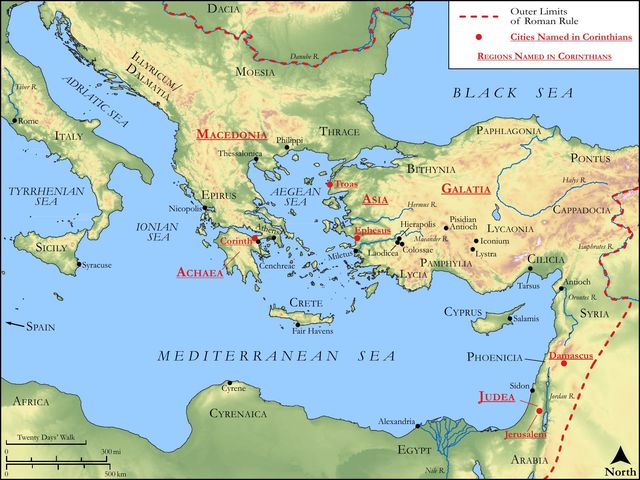
See on the biblical-era map

Study this verse
Public-domain commentary
Matthew Henry
From his Commentary on the Whole Bible. Henry comments on passages, not single verses — this entry covers 1 Corinthians 15:20–34. His three-level outline is real structure in the source text, so it is rendered as structure.
In this passage the apostle establishes the truth of the resurrection of the dead, the holy dead, the dead in Christ,
I.On the resurrection of Christ.
1.Because he is indeed the first-fruits of those that slept, Co1 15:20. He has truly risen himself, and he has risen in this very quality and character, as the first-fruits of those who sleep in him. As he has assuredly risen, so in his resurrection there is as much an earnest given that the dead in him shall rise as there was that the Jewish harvest in general should be accepted and blessed by the offering and acceptance of the first-fruits. The whole lump was made holy by the consecration of the first-fruits (Rom 11:16), and the whole body of Christ, all that are by faith united to him, are by his resurrection assured of their own. As he has risen, they shall rise; just as the lump is holy because the first fruits are so. He has not risen merely for himself, but as head of the body, the church; and those that sleep in him God will bring with him, Th1 4:14. Note, Christ's resurrection is a pledge and earnest of ours, if we are true believers in him; because he has risen, we shall rise. We are a part of the consecrated lump, and shall partake of the acceptance and favour vouchsafed the first-fruits. This is the first argument used by the apostle in confirmation of the truth; and it is,
2.Illustrated by a parallel between the first and second Adam. For, since by man came death, it was every way proper that by man should come deliverance from it, or, which is all one, a resurrection, Co1 15:21. And so, as in Adam all die, in Christ shall all be made alive; as through the sin of the first Adam all men became mortal, because all derived from him the same sinful nature, so through the merit and resurrection of Christ shall all who are made to partake of the Spirit, and the spiritual nature, revive, and become immortal. All who die die through the sin of Adam; all who are raised, in the sense of the apostle, rise through the merit and power of Christ. But the meaning is not that, as all men died in Adam, so all men, without exception, shall be made alive in Christ; for the scope of the apostle's argument restrains the general meaning. Christ rose as the first-fruits; therefore those that are Christ's (Co1 15:23) shall rise too. Hence it will not follow that all men without exception shall rise too; but it will fitly follow that all who thus rise, rise in virtue of Christ's resurrection, and so that their revival is owing to the man Christ Jesus, as the mortality of all mankind was owing to the first man; and so, as by man came death, by man came deliverance. Thus it seemed fit to the divine wisdom that, as the first Adam ruined his posterity by sin, the second Adam should raise his seed to a glorious immortality.
3.Before he leaves the argument he states that there will be an order observed in their resurrection. What that precisely will be we are nowhere told, but in the general only here that there will be order observed. Possibly those may rise first who have held the highest rank, and done the most eminent service, or suffered the most grievous evils, or cruel deaths, for Christ's sake. It is only here said that the first-fruits are supposed to rise first, and afterwards all who are Christ's, when he shall come again. Not that Christ's resurrection must in fact go before the resurrection of any of his, but it must be laid as the foundation: as it was not necessary that those who lived remote from Jerusalem must go thither and offer the first-fruits before they could account the lump holy, yet they must be set apart for this purpose, till they could be offered, which might be done at any time from pentecost till the feast of dedication. See Bishop Patrick on Num 24:2. The offering of the first-fruits was what made the lump holy; and the lump was made holy by this offering, though it was not made before the harvest was gathered in, so it were set apart for that end, and duly offered afterwards. So Christ's resurrection must, in order of nature, precede that of his saints, though some of these might rise in order of time before him. It is because he has risen that they rise. Note, Those that are Christ's must rise, because of their relation to him.
II.He argues from the continuance of the mediatorial kingdom till all Christ's enemies are destroyed, the last of which is death, Co1 15:24-26.
He has risen, and, upon his resurrection, was invested with sovereign empire, had all power in heaven and earth put into his hands (Mat 28:18), had a name given him above every name, that every knee might bow to him, and every tongue confess him Lord. Phi 2:9-11. And the administration of this kingdom must continue in his hands till all opposing power, and rule, and authority, be put down (Co1 15:24), till all enemies are put under his feet (Co1 15:25), and till the last enemy is destroyed, which is death, Co1 15:26.
1.This argument implies in it all these particulars: - (1.) That our Saviour rose from the dead to have all power put into his hands, and have and administer a kingdom, as Mediator: For this end he died, and rose, and revived, that he might be Lord both of the dead and living, Rom 14:9. (2.) That this mediatorial kingdom is to have an end, at least as far as it is concerned in bringing his people safely to glory, and subduing all his and their enemies: Then cometh the end, Co1 15:24. (3.) That it is not to have an end till all opposing power be put down, and all enemies brought to his feet, Co1 15:24, Co1 15:25. (4.) That, among other enemies, death must be destroyed (Co1 15:26) or abolished; its powers over its members must be disannulled. Thus far the apostle is express; but he leaves us to make the inference that therefore the saints must rise, else death and the grave would have power over them, nor would our Saviour's kingly power prevail against the last enemy of his people and annul its power. When saints shall live again, and die no more, then, and not till then, will death be abolished, which must be brought about before our Saviour's mediatorial kingdom is delivered up, which yet must be in due time. The saints therefore shall live again and die no more. This is the scope of the argument; but,
2.The apostle drops several hints in the course of it which it will be proper to notice: as,
(1.)That our Saviour, as man and mediator between God and man, has a delegated royalty, a kingdom given: All things are put under him, he excepted that did put all things under him, Co1 15:27. As man, all his authority must be delegated. And, though his mediation supposes his divine nature, yet as Mediator he does not so explicitly sustain the character of God, but a middle person between God and man, partaking of both natures, human and divine, as he was to reconcile both parties, God and man, and receiving commission and authority from God the Father to act in this office. The Father appears, in this whole dispensation, in the majesty and with the authority of God: the Son, made man, appears as the minister of the Father, though he is God as well as the Father. Nor is this passage to be understood of the eternal dominion over all his creatures which belongs to him as God, but of a kingdom committed to him as Mediator and God-man, and that chiefly after his resurrection, when, having overcome, he sat down with his Father on his throne, Rev 3:21. Then was the prediction verified, I have set my king upon my holy hill of Zion (Psa 2:6), placed him on his throne. This is meant by the phrase so frequent in the writings of the New Testament, of sitting at the right hand of God (Mar 16:19; Rom 8:34; Col 3:1 etc.), on the right hand of power (Mar 14:62; Luk 22:69), on the right hand of the throne of God (Heb 12:2), on the right hand of the throne of the Majesty in the heavens, Heb 8:1. Sitting down in this seat is taking upon him the exercise of his mediatorial power and royalty, which was done upon his ascension into heaven, Mar 16:19. And it is spoken of in scripture as a recompence made him for his deep humiliation and self-abasement, in becoming man, and dying for man the accursed death of the cross, Phi 2:6-12. Upon his ascension, he was made head over all things to the church, had power given him to govern and protect it against all its enemies, and in the end destroy them and complete the salvation of all that believe in him. This is not a power appertaining to Godhead as such; it is not original and unlimited power, but power given and limited to special purposes. And though he who has it is God, yet, inasmuch as he is somewhat else besides God, and in this whole dispensation acts not as God, but as Mediator, not as the offended Majesty, but as one interposing in favour of his offending creatures, and this by virtue of his consent and commission who acts and appears always in that character, he may properly be said to have this power given him; he may reign as God, with power unlimited, and yet may reign as Mediator, with a power delegated, and limited to these particular purposes.
(2.)That this delegated royalty must at length be delivered up to the Father, from whom it was received (Co1 15:24); for it is a power received for particular ends and purposes, a power to govern and protect his church till all the members of it be gathered in, and the enemies of it for ever subdued and destroyed (Co1 15:25, Co1 15:26), and when these ends shall be obtained the power and authority will not need to be continued. The Redeemer must reign till his enemies be destroyed, and the salvation of his church and people accomplished; and, when this end is attained, then will he deliver up the power which he had only for this purpose, though he may continue to reign over his glorified church and body in heaven; and in this sense it may notwithstanding be said that he shall reign for ever and ever (Rev 11:15), that he shall reign over the house of Jacob for ever, and of his kingdom there shall be no end (Luk 1:33), that his dominion is an everlasting dominion, which shall not pass away, Dan 7:14. See also Mic 4:7.
(3.)The Redeemer shall certainly reign till the last enemy of his people be destroyed, till death itself be abolished, till his saints revive and recover perfect life, never to be in fear and danger of dying any more. He shall have all power in heaven and earth till then - he who loved us, and gave himself for us, and washed us from our sins in his own blood - he who is so nearly related to us, and so much concerned for us. What support should this be to his saints in every hour of distress and temptation! He is alive who was dead, and liveth for ever, and doth reign, and will continue to reign, till the redemption of his people be completed, and the utter ruin of their enemies effected.
(4.)When this is done, and all things are put under his feet, then shall the Son become subject to him that put all things under him, that God may be all in all, Co1 15:28. The meaning of this I take to be that then the man Christ Jesus, who hath appeared in so much majesty during the whole administration of his kingdom, shall appear upon giving it up to be a subject of the Father. Things are in scripture many times said to be when they are manifested and made to appear; and this delivering up of the kingdom will make it manifest that he who appeared in the majesty of the sovereign king was, during this administration, a subject of God. The glorified humanity of our Lord Jesus Christ, with all the dignity and power conferred on it, was no more than a glorious creature. This will appear when the kingdom shall be delivered up; and it will appear to the divine glory, that God may be all in all, that the accomplishment of our salvation may appear altogether divine, and God alone may have the honour of it. Note, Though the human nature must be employed in the work of our redemption, yet God was all in all in it. It was the Lord's doing and should be marvellous in our eyes.
III.He argues for the resurrection, from the case of those who were baptized for the dead (Co1 15:29):
What shall those do who are baptized for the dead, if the dead rise not at all? Why are they baptized for the dead? What shall they do if the dead rise not? What have they done? How vain a thing hath their baptism been! Must they stand by it, or renounce it? why are they baptized for huper the dead, if the dead rise not? tō nekrōn. But what is this baptism for the dead? It is necessary to be known, that the apostle's argument may be understood; whether it be only argumentum ad hominem, or ad rem; that is, whether it conclude for the thing in dispute universally, or only against the particular persons who were baptized for the dead. But who shall interpret this very obscure passage, which, though it consists of no more than three words, besides the articles, has had more than three times three senses put on it by interpreters? It is not agreed what is meant by baptism, whether it is to be taken in a proper or figurative sense, and, if in a proper sense, whether it is to be understood or Christian baptism properly so called, or some other ablution. And as little is it agreed who are the dead, or in what sense the preposition huper is to be taken. Some understand the dead of our Saviour himself; vide Whitby in loc. Why are persons baptized in the name of a dead Saviour, a Saviour who remains among the dead, if the dead rise not? But it is, I believe, and instance perfectly singular for hoi nekroi to mean no more than one dead person; it is a signification which the words have nowhere else. And the hoi baptizomenoi (the baptized) seem plainly to mean some particular persons, not Christians in general, which yet must be the signification if the hoi nekroi (the dead) be understood of our Saviour. Some understand the passage of the martyrs: Why do they suffer martyrdom for their religion? This is sometimes called the baptism of blood by ancients, and, by our Saviour himself, baptism indefinitely, Mat 20:22; Luk 12:50. But in what sense can those who die martyrs for their religion be said to be baptized (that is, die martyrs) for the dead? Some understand it of a custom that was observed, as some of the ancients tell us, among many who professed the Christian name in the first ages, of baptizing some in the name and stead of catechumens dying without baptism. But this savoured of such superstition that, if the custom had prevailed in the church so soon, the apostle would hardly have mentioned it without signifying a dislike of it. Some understand it of baptizing over the dead, which was a custom, they tell us, that early obtained; and this to testify their hope of the resurrection. This sense is pertinent to the apostle's argument, but it appears not that any such practice was in use in the apostle's time. Others understand it of those who have been baptized for the sake, or on occasion, of the martyrs, that is, the constancy with which they died for their religion. Some were doubtless converted to Christianity by observing this: and it would have been a vain thing for persons to have become Christians upon this motive, if the martyrs, by losing their lives for religion, became utterly extinct, and were to live no more. But the church at Corinth had not, in all probability, suffered much persecution at this time, or seem many instances of martyrdom among them, nor had many converts been made by the constancy and firmness which the martyrs discovered. Not to observe that hoi nekroi seems to be too general an expression to mean only the martyred dead. It is as easy an explication of the phrase as any I have met with, and as pertinent to the argument, to suppose the hoi nekroi to mean some among the Corinthians, who had been taken off by the hand of God. We read that many were sickly among them, and many slept (Co1 11:30), because of their disorderly behaviour at the Lord's table. These executions might terrify some into Christianity; as the miraculous earthquake did the jailer, Act 16:29, Act 16:30, etc. Persons baptized on such an occasion might be properly said to be baptized for the dead, that is, on their account. And the hoi baptizomenoi (the baptized) and the hoi nekroi (the dead) answer to one another; and upon this supposition the Corinthians could not mistake the apostle's meaning. "Now," says he, "what shall they do, and why were they baptized, if the dead rise not? You have a general persuasion that these men have done right, and acted wisely, and as they ought, on this occasion; but why, if the dead rise not, seeing they may perhaps hasten their death, by provoking a jealous God, and have no hopes beyond it?" But whether this be the meaning, or whatever else be, doubtless the apostle's argument was good and intelligible to the Corinthians. And his next is as plain to us.
IV.He argues from the absurdity of his own conduct and that of other Christians upon this supposition,
1.It would be a foolish thing for them to run so many hazards (Co1 15:30): "Why stand we in jeopardy every hour? Why do we expose ourselves to continual peril - we Christians, especially we apostles?" Every one knows that it was dangerous being a Christian, and much more a preacher and an apostle, at that time. "Now," says the apostle, "what fools are we to run these hazards, if we have no better hopes beyond death, if when we die we die wholly, and revive no more!" Note, Christianity were a foolish profession if it proposed no hopes beyond this life, at least in such hazardous times as attended the first profession of it; it required men to risk all the blessings and comforts of this life, and to face and endure all the evils of it, without any future prospects. And is this a character of his religion fit for a Christian to endure? And must he not fix this character on it if he give up his future hopes, and deny the resurrection of the dead? This argument the apostle brings home to himself: "I protest," says he, "by your rejoicing in Jesus Christ, by all the comforts of Christianity, and all the peculiar succours and supports of our holy faith, that I die daily," Co1 15:31. He was in continual danger of death, and carried his life, as we say, in his hand. And why should he thus expose himself, if he had no hopes after life? To live in daily view and expectation of death, and yet have no prospect beyond it, must be very heartless and uncomfortable, and his case, upon this account, a very melancholy one. He had need be very well assured of the resurrection of the dead, or he was guilty of extreme weakness, in hazarding all that was dear to him in this world, and his life into the bargain. He had encountered very great difficulties and fierce enemies; he had fought with beasts at Ephesus (Co1 15:32), and was in danger of being pulled to pieces by an enraged multitude, stirred up by Demetrius and the other craftsmen (Act 19:24, etc.), though some understand this literally of Paul's being exposed to fight with wild beasts in the amphitheatre, at a Roman show in that city. And Nicephorus tells a formal story to this purport, and of the miraculous complaisance of the lions to him when they came near him. But so remarkable a trial and circumstance of his life, methinks, would not have been passed over by Luke, and much less by himself, when he gives us so large and particular a detail of his sufferings, Co2 11:24, ad fin. When he mentioned that he was five times scourged of the Jews, thrice beaten with rods, once stoned, thrice shipwrecked, it is strange that he should not have said that he was once exposed to fight with the beasts. I take it, therefore, that this fighting with beasts is a figurative expression, that the beasts intended were men of a fierce and ferine disposition, and that this refers to the passage above cited. "Now," says he, "what advantage have I from such contests, if the dead rise not? Why should I die daily, expose myself daily to the danger of dying by violent hands, if the dead rise not? And if post mortem nihil - if I am to perish by death, and expect nothing after it, could any thing be more weak?" Was Paul so senseless? Had he given the Corinthians any ground to entertain such a thought of him? If he had not been well assured that death would have been to his advantage, would he, in this stupid manner, have thrown away his life? Could any thing but the sure hopes of a better life after death have extinguished the love of life in him to this degree? "What advantageth it me, if the dead rise not? What can I propose to myself?" Note, It is very lawful and fit for a Christian to propose advantage to himself by his fidelity to God. Thus did Paul. Thus did our blessed Lord himself, Heb 12:2. And thus we are bidden to do after his example, and have our fruit to holiness, that our end may be everlasting life. This is the very end of our faith, even the salvation of our souls (Pe1 1:9), not only what it will issue in, but what we should aim at.
2.It would be a much wiser thing to take the comforts of this life: Let us eat and drink, for tomorrow we die (Co1 15:32); let us turn epicures. Thus this sentence means in the prophet, Isa 22:13. Let us even live like beasts, if we must die like them. This would be a wiser course, if there were no resurrection, no after-life or state, than to abandon all the pleasures of life, and offer and expose ourselves to all the miseries of life, and live in continual peril of perishing by savage rage and cruelty. This passage also plainly implies, as I have hinted above, that those who denied the resurrection among the Corinthians were perfect Sadducees, of whose principles we have this account in the holy writings, that they say, There is no resurrection, neither angel nor spirit (Act 23:8), that is, "Man is all body, there is nothing in him to survive the body, nor will that, when once he is dead, ever revive again." Such Sadducees were the men against whom the apostle argued; otherwise his arguments had no force in them; for, though the body should never revive, yet, as long as the mind survived it, he might have much advantage from all the hazards he ran for Christ's sake. Nay, it is certain that the mind is to be the principal seat and subject of the heavenly glory and happiness. But, if there were no hopes after death, would not every wise man prefer an easy comfortable life before such a wretched one as the apostle led; nay, and endeavour to enjoy the comforts of life as fast as possible, because the continuance of it is short? Note, Nothing but the hopes of better things hereafter can enable a man to forego all the comforts and pleasures here, and embrace poverty, contempt, misery, and death. Thus did the apostles and primitive Christians; but how wretched was their case, and how foolish their conduct, if they deceived themselves, and abused the world with vain and false hopes!
V.The apostle closes his argument with a caution, exhortation, and reproof.
1.A caution against the dangerous conversation of bad men, men of loose lives and principles: Be not deceived, says he; evil communications corrupt good manners, Co1 15:33. Possibly, some of those who said that there was no resurrection of the dead were men of loose lives, and endeavoured to countenance their vicious practices by so corrupt a principle; and had that speech often in their mouths Let us eat and drink, for tomorrow we die. Now, the apostle grants that their talk was to the purpose if there was no future state. But, having confuted their principle, he now warns the Corinthians how dangerous such men's conversation must prove. He tells them that they would probably be corrupted by them, and fall in with their course of life, if they gave into their evil principles. Note, Bad company and conversation are likely to make bad men. Those who would keep their innocence must keep good company. Error and vice are infectious: and, if we would avoid the contagion, we must keep clear of those who have taken it. He that walketh with wise men shall be wise; but a companion of fools shall be destroyed, Pro 13:20.
2.Here is an exhortation to break off their sins, and rouse themselves, and lead a more holy and righteous life (Co1 15:34): Awake to righteousness, or awake righteously, eknēpsate dikaiōs, and sin not, or sin no more. "Rouse yourselves, break off your sins by repentance: renounce and forsake every evil way, correct whatever is amiss, and do not, by sloth and stupidity, be led away into such conversation and principles as will sap your Christian hopes, and corrupt your practice." The disbelief of a future state destroys all virtue and piety. But the best improvement to be made of the truth is to cease from sin, and set ourselves to the business of religion, and that in good earnest. If there will be a resurrection and a future life, we should live and act as those who believe it, and should not give into such senseless and sottish notions as will debauch our morals, and render us loose and sensual in our lives.
3.Here is a reproof, and a sharp one, to some at least among them: Some of you have not the knowledge of God; I speak this to your shame. Note, It is a shame in Christians not to have the knowledge of God. The Christian religion gives the best information that can be had about God, his nature, and grace, and government. Those who profess this religion reproach themselves, by remaining without the knowledge of God; for it must be owing to their own sloth, and slight of God, that they are ignorant of him. And is it not a horrid shame for a Christian to slight God, and be so wretchedly ignorant in matters that so nearly and highly concern him? Note, also, It must be ignorance of God that leads men into the disbelief of a resurrection and future life. Those who know God know that he will not abandon his faithful servants, nor leave them exposed to such hardships and sufferings without any recompence or reward. They know he is not unfaithful nor unkind, to forget their labour and patience, their faithful services and cheerful sufferings, or let their labour be in vain. But I am apt to think that the expression has a much stronger meaning; that there were atheistical people among them who hardly owned a God, or one who had any concern with or took cognizance of human affairs. These were indeed a scandal and shame to any Christian church. Note, Real atheism lies at the bottom of men's disbelief of a future state. Those who own a God and a providence, and observe how unequal the distributions of the present life are, and how frequently the best men fare worst, can hardly doubt an after state, where every thing will be set to rights.
Historical interpretation
Nine Centuries of Reception
9 surviving comments on this verse. Each one is dated, so this reads as a timeline rather than a list.
Select a marker to jump to its quote. Markers stagger vertically where authors wrote within a few decades of each other.
And when all things shall be subdued unto Him, then shall the Son also Himself be subject unto Him that put all things under Him, that God may be all in all."
And when all things shall be subdued unto Him, then shall the Son also Himself be subject unto Him who put all things under Him, that God may be all in all."
"When, however, all things shall be subdued to Him, (with the exception of Him who did put all things under Him, ) then shall the Son also Himself be subject unto Him who put all things under Him, that God may be all in all." We thus see that the Son is no obstacle to the Monarchy, although it is now administered by the Son; because with the Son it is still in its own state, and with its own state will be restored to the Father by the Son.
Christ the Lord himself will instruct those who are able to receive him in his character of wisdom, after their preliminary training in his holy virtues, and will reign with them until such time as he subjects them to the Father who subjected all things to him. When they have been rendered capable of receiving God, then God will be to them “all in all.”
Hence the first step in the mystery is that all things have been made subject to him, and then he himself becomes subject to the One who subjects all things to himself. Just as we subject ourselves to the glory of his reigning body, the Lord himself in the same mystery subjects himself in the glory of his body to the One who subjects all things to himself. We are made subject to the glory of his body in order that we may possess the glory with which he reigns in the body, because we shall be conformable to his body.
He makes your subjection his own, and because of your struggle against virtue, he calls himself subjected.… He calls himself naked, if any of you are naked.… When one is in prison, he said that he himself was the one imprisoned. For he himself took up our infirmities and bore the burden of our ills. And one of our infirmities is insubordination, and this he also bore. Therefore, even the adversities which happen to us the Lord makes his own, taking upon himself our sufferings because of his fellowship with us.
"For He hath put all things in subjection under His feet. But when He saith, All things are put in subjection, it is manifest that He is excepted who did subject all things unto Him."
"And when all things have been subjected unto Him, then shall the Son also Himself be subjected unto Him that did subject all things unto Him."
And yet before he said not that it was the Father who "put things under Him," but He Himself who "abolishes." For "when He shall have abolished," saith he, "all rule and authority:" and again, "for He must reign until He hath put all His enemies under His feet." How then doth he here say, "the Father?"
And not only is there this apparent perplexity, but also that he is afraid with a very unaccountable fear, and uses a correction, saying, "He is excepted, who did subject all things unto Him," as though some would suspect, whether the Father might Himself not be subject unto the Son; than which what can be more irrational? nevertheless, he fears this.
How then is it? for in truth there are many questions following one upon another. Well, give me then your earnest attention; since in fact it is necessary for us first to speak of the scope of Paul and his mind, which one may find everywhere shining forth, and then to subjoin our solution: this being itself an ingredient in our solution.
What then is Paul's mind, and what is his custom? He speaks in one way when he discourses of the Godhead alone, and in another when he falls into the argument of the economy. Thus having once taken hold of our Lord's Flesh, he freely thereafter uses all the sayings that humiliate Him; without fear as though that were able to bear all such expressions. Let us see therefore here also, whether his discourse is of the simple Godhead, or whether in view of the incarnation he asserts of Him those things which he saith: or rather let us first point out where he did this of which I have spoken.
Then also he uses a correction, saying, "But when He saith, all things are put in subjection, it is evident that He is excepted who did subject all things unto Him," testifying even thence no small glory to the Only-Begotten. For if He were less and much inferior, this fear would never have been entertained by him. Neither is he content with this, but also adds another thing, as follows. I say, lest any should doubtingly ask, "And what if the Father hath not been 'put under Him?' this doth not at all hinder the Son from being the more mighty;" fearing this impious supposition, because that expression was not sufficient to point out this also, he added, going very much beyond it, "But when all things have been subjected unto Him, then shall the Son also Himself be subjected;" showing His great concord with the Father, and that He is the principle of all other good things and the first Cause, who hath begotten One so great in power and in achievements.
And that thou mayest learn that this is the reason of the things spoken, I would ask thee this question: Doth an additional "subjection" at that time befal the Son? And how can this be other than impious and unworthy of God? For the greatest subjection and obedience is this, that He who is God took the form of a servant. How then will He be "subjected?" Seest thou, that to take away the impious notion, he used this expression? and this too in a suitable though reserved sense? For he becomes a Son and a divine Person, so He obeys; not humanly, but as one acting freely and having all authority. Otherwise how is he co-enthroned? How, "as the Father raiseth up, even so He, whom He will?" How are "all things that the Father hath His," and all that He hath, the Father's? For these phrases indicate to us an authority exactly measured by that of Him that begat Him.
But what is this, "When He shall deliver up the kingdom?" The Scripture acknowledges two kingdoms of God, the one by appropriation, the other by creation. Thus, He is King over all, both Greeks and Jews and devils and His adversaries, in respect of His creation: but He is King of the faithful and willing and subject, in respect of His making them His own. This is the kingdom which is said also to have a beginning. For concerning this He saith also in the second Psalm, "Ask of Me, and I shall give Thee the heathen for Thine inheritance." Touching this also, He Himself said to His disciples, "All authority hath been given unto Me by My father," referring all to Him that begat Him, not as though of Himself He were not sufficient, but to signify that He is a Son, and not unbegotten. This kingdom then He doth "deliver up," i.e., "bring to a right end."
"What then," saith one, "can be the reason why He spake nothing of the Spirit?" Because of Him he was not discoursing now, nor doth he confound all things together. Since also where he saith, "There is one God the Father, and one Lord Jesus," undoubtedly not as allowing the Spirit to be inferior, is he therefore silent, but because for the time it was not urgent, he so expressed himself. For he is wont also to make mention of the Father only, yet we must not therefore cast out the Son: he is wont to speak also of the Son and of the Spirit only, yet not for this are we to deny the Father.
But what is, "that God may be all in all?" That all things may be dependent upon Him, that none may suppose two authorities without a beginning, nor another kingdom separated off; that nothing may exist independent of him. For when the enemies shall be lying under the feet of the Son, and He having them cast under His feet be at no variance with His Father, but at concord with Him in entire perfection, then He shall Himself "be all in all."
But some say that he spake this to declare the removal of wickedness, as though all would yield thenceforth and none would resist nor do iniquity. For when there is no sin, it is evident that "God shall be all in all."
The Arians and the Eunomians love to play with this and the next verse, claiming that it proves that Christ is not God. But here they are confusing two different things. The apostle is not speaking about Christ in his divinity but about his humanity, since the whole discussion is about the resurrection of the flesh. It is in his humanity that he will be subject, because all humanity is subject to the divine.
Paul is writing to converted Greeks, because the Greeks worshiped Zeus, who revolted against his own father in order to seize his kingdom. He was concerned lest they should imagine something similar in the case of Christ and his Father.
Continue studying 1 Corinthians 15:27 across the web’s major study libraries — every link below opens this exact verse, chapter, or book on the destination site.
Read & Compare
 BibleGatewayThis verse in more than 200 translations and 70 languages.
 Bible.comThe YouVersion reader — hundreds of translations, reading plans, and highlights.
 ESV.orgCrossway's official English Standard Version reader.
 NET BibleThe NET translation with 60,000+ translators' notes on every rendering decision.
 STEP BibleTyndale House's free study tool — original text, vocabulary, and scholarly resources.
 BibliaLogos Bible Software's free web reader.
 USCCBThe New American Bible (Revised Edition) with the U.S. bishops' study notes.
Commentaries
 BibleHub CommentariesDozens of classic commentaries on this verse, gathered on one page.
 StudyLightMore than 100 commentary sets — the largest collection on the web.
 BibleRefPlain-English commentary on what this verse means, verse by verse.
 Enduring WordDavid Guzik's free commentary on this chapter, widely used by Bible teachers.
 Bible Study ToolsVerse commentary alongside Greek and Hebrew study aids.
Original Language & Research
- BibleHub InterlinearThe verse word by word — original language, transliteration, and English.
- BibleHub LexiconEvery word's original-language definition and Strong's entry.
 Blue Letter BibleDeep-study tools — Strong's numbers, concordance, and word studies.
 CNTR CollationThe earliest Greek manuscripts of this verse, collated letter by letter.
Sermons, Hymns & Audio


TrulyRandomVerse is not affiliated with these sites and doesn’t control their content. They’re linked because they’re genuinely useful.
Summary
1 Corinthians 15:27 functions as a crucial theological clarification within Paul's comprehensive argument for the resurrection. It asserts the universal dominion granted to Jesus Christ, declaring that "all things" have been subjected to His authority. However, it immediately qualifies this assertion by explicitly stating that God the Father, who is the one doing the subjecting, is inherently excepted from this subjugation, thereby safeguarding the Father's ultimate and supreme sovereignty within the divine economy. This verse underscores both Christ's exalted position as victor over all creation and the ongoing, ultimate authority of God the Father.
Context
ShowHideLiterary Context
This verse is embedded within 1 Corinthians 15, which stands as the most extensive and systematic treatment of the resurrection in the New Testament. Paul is addressing a significant theological issue in the Corinthian church: the denial of the resurrection of the dead by some members. He meticulously builds his argument, moving from the historical fact of Christ's resurrection (verses 1-11) to its implications for believers' own resurrection (verses 12-19). Verses 20-28 then describe the cosmic scope of Christ's resurrection, portraying Him as the "firstfruits" and outlining the sequence of events leading to the final defeat of death and the ultimate subjection of all things to Christ. Verse 27 specifically clarifies the nature of this "subjection," ensuring that the Father's ultimate authority is preserved, setting the stage for the climactic declaration in 1 Corinthians 15:28.
Historical & Cultural Context
The Corinthian church was a diverse community grappling with various philosophical and cultural influences, including Greek thought that often viewed the body and material world as inferior, making the concept of bodily resurrection problematic. Paul's emphasis on the physical resurrection of Christ directly challenges such dualistic perspectives. Furthermore, the concept of "putting all things under one's feet" was a common ancient Near Eastern and Greco-Roman idiom signifying complete conquest, dominion, and authority. Rulers would literally place their feet on the necks of defeated enemies. Paul draws on this powerful imagery to convey Christ's total victory, while simultaneously navigating the theological complexities of divine authority within the early Christian understanding of God.
Key Themes
ShowHide1 Corinthians 15 is rich with theological themes that converge in verse 27. Christ's Universal Dominion is a central theme, asserting His absolute authority over all creation and all opposing forces, including sin and death. This dominion is a direct result of His resurrection and exaltation. Another critical theme is the Sovereignty of God the Father, which is carefully maintained even as immense authority is delegated to the Son. The verse underscores the distinct yet harmonious roles within the Godhead. Finally, the theme of Victory Over Death is paramount; as Paul states in 1 Corinthians 15:26, death is the last enemy to be destroyed, and Christ's dominion ensures its ultimate defeat.
Exposition and Analysis
ShowHideKey Word Analysis
ShowHideThis verb means "to subordinate," "to subject," or "to place in order under." It is a military term implying complete conquest and control, signifying a hierarchical arrangement where one entity is placed under the authority or power of another. In this context, it describes God the Father's sovereign act of placing all things under the authority of Christ.
This word signifies "all," "every," or "the whole." Its use here emphasizes the comprehensive and universal scope of Christ's dominion. It leaves no entity, power, or authority outside of His ultimate reign, except for the one explicitly stated in the subsequent clause.
Derived from a word meaning "the exterior" or "outside," this term functions as a preposition meaning "aside from," "besides," or "unless." Its inclusion in this verse is crucial for theological precision, serving as a vital qualifier that explicitly excludes God the Father from the "all things" subjected to Christ, thereby preserving the Father's unique and ultimate position as the source of all authority.
Verse Breakdown
ShowHide"For he hath put all things under his feet."
This opening clause establishes the universal dominion of Christ. The phrase "under his feet" is an idiom signifying complete conquest, authority, and subjugation. It declares that God the Father has actively and completely placed every aspect of creation, every power, and every authority under the ultimate control and rule of Jesus Christ. This is a statement of Christ's exalted status and comprehensive victory, particularly in light of His resurrection.
"But when he saith all things are put under [him, it is] manifest that he is excepted, which did put all things under him."
This second clause introduces a critical theological clarification. The conjunction "But" signals a necessary distinction. Paul anticipates a potential misunderstanding: if "all things" are subjected to Christ, does that include God the Father? The answer is a resounding no. It is "manifest" (clear, evident) that the one who performs the act of subjection—God the Father—is logically and necessarily "excepted" from being subjected Himself. This preserves the Father's ultimate, unchallengeable sovereignty and affirms the internal divine order of the Trinity, where the Father remains the ultimate source of authority.
Literary Devices
ShowHidePaul employs several powerful Literary Devices in this verse. The most prominent is Metaphor, specifically the idiom "put all things under his feet." This vivid imagery, drawn from ancient military and royal practices of placing a foot on a conquered enemy, powerfully conveys absolute dominion, triumph, and complete subjugation. It's a visual shorthand for total victory. Secondly, there is a clear use of Clarification or Qualification. Paul's immediate follow-up, "But when he saith all things are put under him, it is manifest that he is excepted, which did put all things under him," demonstrates his precise theological thinking. He introduces a necessary logical exception to prevent any misinterpretation of Christ's authority diminishing the Father's ultimate sovereignty. This serves as a crucial Distinction, carefully delineating the roles within the Godhead while affirming Christ's exalted status.
Theological and Thematic Connections
ShowHide1 Corinthians 15:27 is a pivotal verse for understanding the cosmic scope of Christ's redemptive work and the intricate dynamics of the Trinity. It affirms Christ's absolute authority over all creation, a dominion granted by the Father as a consequence of His obedient life, atoning death, and glorious resurrection. This authority is not self-derived but is bestowed by the Father, highlighting the Father's ultimate sovereignty as the source of all power and authority. The necessary exception of the Father from being subjected to the Son is crucial for maintaining orthodox Trinitarian theology, preventing any notion of the Son's authority superseding or encompassing the Father's. This verse thus beautifully balances the exaltation of Christ with the supreme, originating authority of God the Father, setting the stage for the eschatological reality where all things are ultimately reconciled to God.
Reflection and Application
ShowHideThe truth of 1 Corinthians 15:27 offers profound comfort and unwavering assurance to believers. In a world often characterized by chaos, uncertainty, and the apparent triumph of evil, this verse declares that ultimate control rests not with human powers, societal trends, or even the formidable reality of death, but with the resurrected Christ. Knowing that "all things" are under His feet means that no circumstance, no enemy, and no spiritual force can ultimately thwart God's sovereign plan or overcome those who are united with Christ. This truth should inspire courageous living, steadfast faith in the face of adversity, and a confident hope in the ultimate victory of God's kingdom. It also reminds us that while Christ is exalted, His ultimate purpose is to fulfill the Father's will, leading to the glorious consummation where God will be "all in all." Our lives, therefore, should be lived in humble submission to Christ's Lordship, trusting in His comprehensive dominion over every aspect of existence.
Questions for Reflection
ShowHideFAQ
ShowHideDoes this verse imply that Jesus is somehow less than God, since the Father is "excepted" from being subjected to Him?
ShowHideNo, this verse does not imply that Jesus is less than God. Instead, it carefully clarifies the distinct roles and relationships within the Godhead, particularly concerning ultimate authority and origin. The Father is the one who "put all things under" the Son, indicating that the Father is the ultimate source of this delegated authority. The exception clause ("he is excepted, which did put all things under him") maintains the Father's unique position as the unoriginated, supreme sovereign. It's about divine order and relationship, not inferiority. Christ's full deity is affirmed throughout Scripture (e.g., John 1:1, Colossians 2:9), and His subjection to the Father in 1 Corinthians 15:28 is an act of voluntary, loving obedience within the Trinity, not a sign of lesser divinity.
Christ-Centered Fulfillment
ShowHide1 Corinthians 15:27 finds its profound Christ-centered fulfillment in the ultimate authority and cosmic reign of Jesus Christ, established through His resurrection and ascension. This verse echoes prophecies of a coming Messiah who would rule with absolute dominion, such as Psalm 110:1, which is frequently applied to Christ in the New Testament. Christ's victory over sin, death, and all spiritual powers (as detailed in Colossians 2:15) culminates in His exaltation to the right hand of God, where He exercises universal Lordship. This is the very essence of the gospel: the crucified and resurrected Jesus is now Lord of "all things," a truth proclaimed in passages like Philippians 2:9-11, where every knee will bow and every tongue confess His Lordship. The exception of the Father from this subjection highlights that Christ's reign is not independent but is the Father's sovereign plan, executed through the Son, leading to the ultimate glory of God, where He will be "all in all" (1 Corinthians 15:28). Thus, this verse points to Christ as the divinely appointed King, whose dominion guarantees the final victory of God's kingdom and the ultimate restoration of all creation.