


Acts 23:8
Bible text: King James Version (1769 Blayney text) · Public domain
Bible text: Berean Standard Bible · Public domain
Bible text: American Standard Version (1901) · Public domain
Bible text: World English Bible, Messianic edition · Public domain
Bible text: Geneva Bible (1599) · Public domain
Bible text: Young's Literal Translation · Public domain
- ΣαδδουκαῖοιSaddoukaioiSadduceesG4523N-NPM-TNoun Nominative Plural Masculine Title
- μὲνmenindeedG3303PRTParticle or Disjunctive
- γὰρgarforG1063CONJConjunction
- λέγουσινlegousinsayG3004V-PAI-3PVerb Present Active Indicative 3rd Plural
- μὴmēnotG3361PRT-NNegative Particle Negative
- εἶναιeinaithere to beG1511V-PANVerb Present Active Infinitive
- ἀνάστασινanastasinresurrectionG386N-ASFNoun Accusative Singular Feminine
- μήτεmēteneither [to be]G3383CONJ-NConjunction Negative
- ἄγγελονangelonangelG32N-ASMNoun Accusative Singular Masculine
- μήτεmētenor [to be]G3383CONJ-NConjunction Negative
- πνεῦμα·pneumaspiritG4151N-ASNNoun Accusative Singular Neuter
- ΦαρισαῖοιPharisaioiPhariseesG5330N-NPM-TNoun Nominative Plural Masculine Title
- δὲdehoweverG1161CONJConjunction
- ὁμολογοῦσινhomologousinconfessG3670V-PAI-3PVerb Present Active Indicative 3rd Plural
- τὰta<the>G3588T-APNDefinite article Accusative Plural Neuter
- ἀμφότεραamphoterabothG297A-APNAdjective Accusative Plural Neuter
English is a literal word-by-word gloss of the Greek, not the KJV's wording. Why?
This is the original text the KJV's translators worked from — each Greek word with its own literal English meaning in this verse, prepared by scholars at Tyndale House, Cambridge. The KJV translates whole sentences, not word by word, so its wording differs: one Greek word can become several English words, and the KJV may choose “charity” where the gloss reads “love”. Both are faithful — they answer different questions. For the KJV's own rendering, switch to the KJV text.
Details
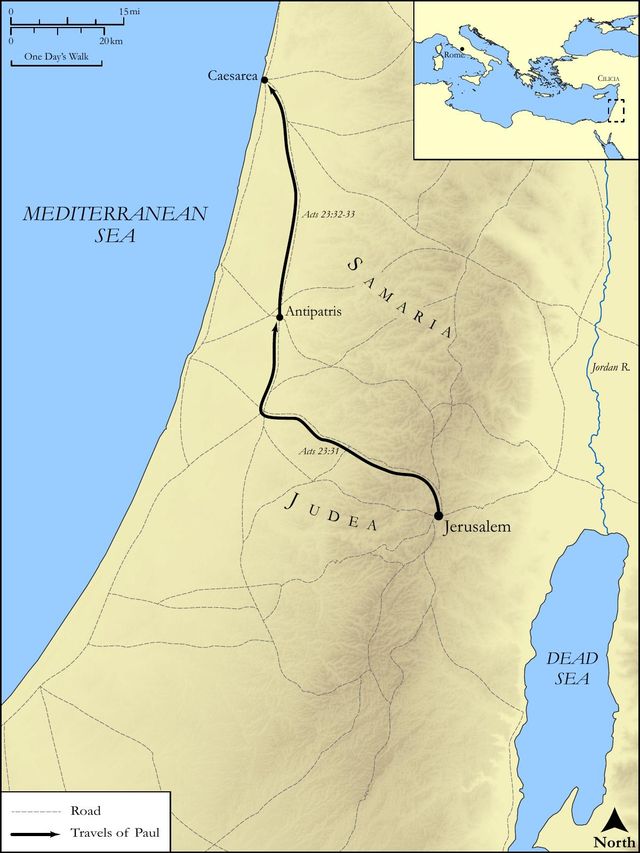
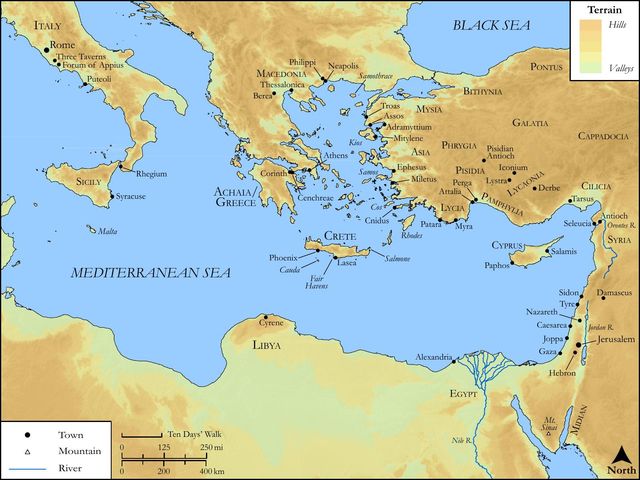
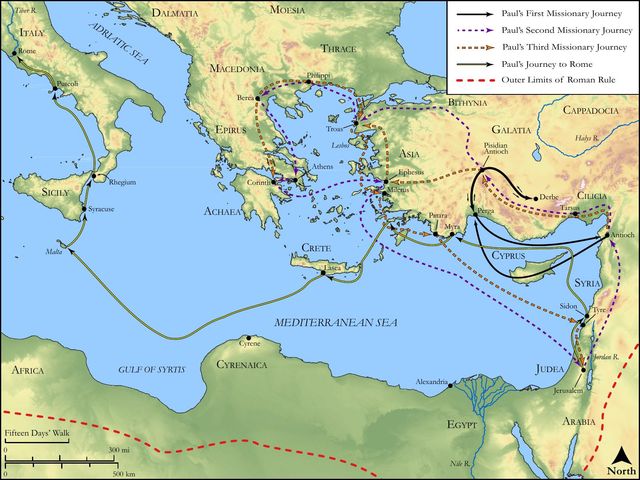
See on the biblical-era maps
Study this verse
Public-domain commentary
Matthew Henry
From his Commentary on the Whole Bible. Henry comments on passages, not single verses — this entry covers Acts 23:6–11. His four-level outline is real structure in the source text, so it is rendered as structure.
Many are the troubles of the righteous, but some way or other the Lord delivereth them out of them all. Paul owned he had experienced the truth of this in the persecutions he had undergone among the Gentiles (see Ti2 3:11): Out of them all the Lord delivered me. And now he finds that he who has delivered does and will deliver. He that delivered him in the foregoing chapter from the tumult of the people here delivers him from that of the elders.
I.His own prudence and ingenuity stand him in some stead, and contribute much to his escape.
Paul's greatest honour, and that upon which he most valued himself, was that he was a Christian, and an apostle of Christ; and all his other honours he despised and made nothing of, in comparison with this, counting them but dung, that he might win Christ; and yet he had sometimes occasion to make use of his other honours, and they did him service. His being a citizen of Rome saved him in the foregoing chapter from his being scourged by the chief captain as a vagabond, and here his being a Pharisee saved him from being condemned by the sanhedrim, as an apostate from the faith and worship of the God of Israel. It will consist very well with our willingness to suffer for Christ to use all lawful methods, nay, and arts too, both to prevent suffering and to extricate ourselves out of it. The honest policy Paul used here for his own preservation was to divide his judges, and to set them at variance one with another about him; and, by incensing one part of them more against him, to engage the contrary part for him.
1.The great council was made up of Sadducees and Pharisees, and Paul perceived it. He knew the characters of many of them ever since he lived among them, and saw those among them whom he knew to be Sadducees, and others whom he knew to be Pharisees (Act 23:6): One part were Sadducees and the other Pharisees, and perhaps nearly an equal part. Now these differed very much from one another, and yet they ordinarily agreed well enough to do the business of the council together.
(1.)The Pharisees were bigots, zealous for the ceremonies, not only those which God had appointed, but those which were enjoined by the tradition of the elders. They were great sticklers for the authority of the church, and for enforcing obedience to its injunctions, which occasioned many quarrels between them and our Lord Jesus; but at the same time they were very orthodox in the faith of the Jewish church concerning the world of spirits, the resurrection of the dead, and the life of the world to come.
(2.)The Sadducees were deists - no friends to the scripture, or divine revelation. The books of Moses they admitted as containing a good history and a good law, but had little regard to the other books of the Old Testament; see Mat 22:23. The account here given of these Sadducees is,
[1.]That they deny the resurrection; not only the return of the body to life, but a future state of rewards and punishments. They had neither hope of eternal happiness nor dread of eternal misery, nor expectation of any thing on the other side death; and it was upon these principles that they said, It is in vain to serve God, and called the proud happy, Mal 3:14, Mal 3:15.
[2.]That they denied the existence of angels and spirits, and allowed of no being but matter. They thought that God himself was corporeal, and had parts and members as we have. When they read of angels in the Old Testament, they supposed them to be messengers that God made and sent on his errands as there was occasion, or that they were impressions on the fancies of those they were sent to, and no real existences - that they were this, or that, or any thing rather than what they were. And, as for the souls of men, they looked upon them to be nothing else but the temperament of the humours of the body, or the animal spirits, but denied their existence in a state of separation from the body, and any difference between the soul of a man and of a beast. These, no doubt, pretended to be free-thinkers, but really thought as meanly, absurdly, and slavishly, as possible. It is strange how men of such corrupt and wicked principles could come into office, and have a place in the great sanhedrim; but many of them were of quality and estate, and they complied with the public establishment, and so got in and kept in. But they were generally stigmatized as heretics, were ranked with the Epicureans, and were prayed against and excluded from eternal life. The prayer which the modern Jews use against Christians, Witsius thinks, was designed by Gamaliel, who made it, against the Sadducees; and that they meant them in their usual imprecation, Let the name of the wicked rot. But how degenerate was the character and how miserable the state of the Jewish church, when such profane men as these were among their rulers!
2.In this matter of difference between the Pharisees and Sadducees Paul openly declared himself to be on the Pharisees' side against the Sadducees (Act 23:6): He cried out, so as to be heard by all, "I am a Pharisee, was bred a Pharisee, nay, I was born one, in effect, for I was the son of a Pharisee, my father was one before me, and thus far I am still a Pharisee that I hope for the resurrection of the dead, and I may truly say that, if the matter were rightly understood, it would be found that this is it for which I am now called in question." When Christ was upon earth the Pharisees set themselves most against him, because he witnessed against their traditions and corrupt glosses upon the law; but, after his ascension, the Sadducees set themselves most against his apostles, because they preached through Jesus the resurrection of the dead, Act 4:1, Act 4:2. And it is said (Act 5:17) that they were the sect of the Sadducees that were filled with indignation at them, because they preached that life and immortality which is brought to light by the gospel. Now here,
(1.)Paul owns himself a Pharisee, so far as the Pharisees were in the right. Though as Pharisaism was opposed to Christianity he set himself against it, and against all its traditions that were set up in competition with the law of God or in contradiction to the gospel of Christ, yet, as it was opposed to Sadducism, he adhered to it. We must never think the worse of any truth of God, nor be more shy of owning it, for its being held by men otherwise corrupt. If the Pharisees will hope for the resurrection of the dead, Paul will go along with them in that hope, and be one of them, whether they will or no.
(2.)He might truly say that being persecuted, as a Christian, this was the thing he was called in question for. Perhaps he knew that the Sadducees, though they had not such an interest in the common people as the Pharisees had, yet had underhand incensed the mob against him, under pretence of his having preached to the Gentiles, but really because he had preached the hope of the resurrection. However, being called in question for his being a Christian, he might truly say he was called in question for the hope of the resurrection of the dead, as he afterwards pleaded, Act 24:15, and Act 26:6, Act 26:7. Though Paul preached against the traditions of the elders (as his Master had done), and therein opposed the Pharisees, yet he valued himself more upon his preaching the resurrection of the dead, and a future state, in which he concurred with the Pharisees.
3.This occasioned a division in the council. It is probable that the high priest sided with the Sadducees (as he had done Act 5:17, and made it to appear by his rage at Paul, Act 23:2), which alarmed the Pharisees so much the more; but so it was, there arose a dissension between the Pharisees and the Sadducees (Act 23:7), for this word of Paul's made the Sadducees more warm and the Pharisees more cool in the prosecution of him; so that the multitude was divided; eschisthē - there was a schism, a quarrel among them, and the edge of their zeal began to turn from Paul against one another; nor could they go on to act against him when they could not agree among themselves, or prosecute him for breaking the unity of the church when there was so little among them of the unity of the spirit. All the cry had been against Paul, but now there arose a great cry against one another, Act 23:9. So much did a fierce furious spirit prevail among all orders of the Jews at this time that every thing was done with clamour and noise; and in such a tumultuous manner were the great principles of their religion stickled for, by which they received little service, for the wrath of man worketh not the righteousness of God. Gainsayers may be convinced by fair reasoning, but never by a great cry.
4.The Pharisees hereupon (would one think it?) took Paul's part (Act 23:9): They strove, diemachonto - They fought, saying, We find no evil in this man. He had conducted himself decently and reverently in the temple, and had attended the service of the church; and, though it was but occasionally, yet it showed that he was not such an enemy to it as he was said to be. He had spoken very handsomely in his own defence, and given a good account of himself, and had now declared himself orthodox in the great principles of religion, as well as regular and conscientious in his conversation; and therefore they cannot see that he has done any thing worthy of death of bonds. Nay, they go further, "If a spirit or an angel hath spoken to him concerning Jesus, and put him upon preaching as he does, though we may not be so far satisfied as to give credit to him, yet we ought to be cautioned not to oppose him, lest we be found fighting against God;" as Gamaliel, who was himself a Pharisee, had argued, Act 5:39. Now here,
(1.)We may observe, to the honour of the gospel, that it was witnessed to even by its adversaries, and confessions, not only of its innocency, but of its excellency, were extorted sometimes by the power of truth even from those that persecuted it. Pilate found no fault in Christ though he put him to death, nor Festus in Paul though he detained him in bonds; and the Pharisees here supposed it possible that Paul might have a commission sent him for heaven by an angel to do what he did; and yet it should seem, as elders, they after this joined with the high priest in prosecuting him, Act 24:1. They sinned against the knowledge which they not only had, but sometimes owned, as Christ had said of them, They have both seen and hated both me and my Father, Joh 15:24. Yet,
(2.)We will hope that some of them at least did henceforward conceive a better opinion of Paul than they had had, and were favourable to him, having had such a satisfactory account both of his conversation in all good conscience and of his faith touching another world; and then it must be observed to their honour that their zeal for the traditions of the elders, which Paul had departed fRom. was so far swallowed up in a zeal for the great and fundamental doctrines of religion, to which Paul still adhered, that if he will heartily join with them against the Sadducees, and adhere to the hope of the resurrection of the dead, they will not think his shaking off the ceremonial law to be an evil in him, but charitably hope that he walks according to the light God has given him by some angel or spirit, and are so far from persecuting him that they are ready to patronize and protect him. The persecuting Pharisees of the church of Rome are not of this spirit: for let a man be ever so sincere and zealous for all the articles of the Christian faith, yet, if he lay not his neck under the yoke of their church's authority, they find evil enough in him to persecute him unto the death.
II.The chief captain's care and conduct stand him in more stead; for when he has thrown this bone of contention between the Pharisees and Sadducees (which set them together by the ears, and gained a fair testimony from the Pharisees), yet he is never the nearer, but is in danger of being pulled in pieces by them - the Pharisees pulling to have him set at liberty, and the Sadducees pulling to have him put to death, or thrown to the people, like Daniel into the den of lions; so that the chief captain is forced to come with his soldiers and rescue him, as he had done, Act 21:32, and Act 22:24.
1.See here Paul's danger. Between his friends and his enemies he had like to have been pulled to pieces, the one hugging him to death, the other crushing him to death, such violences are those liable to that are eminent, and that are become remarkable, as Paul was, who was by some so much beloved and by others so much maligned.
2.His deliverance: The chief captain ordered his soldiers to go down from the upper wards, and to take them by force from among them, out of that apartment in the temple where he had ordered the council to meet, and to bring him into the castle, or tower of Antonio; for he saw he could make nothing of them towards the understanding of the merits of his cause.
III.Divine consolations stood him in most stead of all.
The chief captain had rescued him out of the hands of cruel men, but still he had him in custody, and what might be the issue he could not tell. The castle was indeed a protection to him, but withal it was a confinement; and, as it was now his preservation from so great a death, it might be his reservation for a greater. We do not find that any of the apostles or elders at Jerusalem came to him; either they had not courage or they had not admission. Perhaps, in the night following, Paul was full of thoughts and cares what should become of him, and how his present troubles might be turned to answer some good purpose. Then did the Lord Jesus make him a kind visit, and, thought at midnight, yet a very seasonable one (Act 23:11): The Lord stood by him, came to his bed-side, though perhaps it was but a bed of straw, to show him that he was all the day long with him really as sure as he was in the night with him visibly. Note, Whoever is against us, we need not fear if the Lord stand by us; if he undertake our protection, we may set those that seek our ruin at defiance. The Lord is with those that uphold my soul, and then nothing can come amiss.
1.Christ bids him have a good heart upon it: "Be of good cheer, Paul; be not discouraged; let not what has happened sadden thee, nor let what may yet be before thee frighten thee." Note, It is the will of Christ that his servants who are faithful should be always cheerful. Perhaps Paul, in the reflection, began to be jealous of himself whether he had done well in what he said to the council the day before; but Christ, by his word, satisfies him that God approved of his conduct. Or, perhaps, it troubled him that his friends did not come to him; but Christ's visit did itself speak, though he had not said, Be of good cheer, Paul.
2.It is a strange argument which he makes use of to encourage him: As thou hast testified of me in Jerusalem, so must thou bear witness also at Rome. One would think this was but cold comfort: "As thou hast undergone a great deal of trouble for me so thou must undergo a great deal more;" and yet this was designed to encourage him; for hereby he is given to understand,
(1.)That he had been serving Christ as a witness for him in what he had hitherto endured. It was for no fault that he was buffeted, and it was not his former persecuting of the church that was now remembered against him, however he might remember it against himself, but he was still going on with his work.
(2.)That he had not yet finished his testimony, nor was, by his imprisonment, laid aside as useless, but was only reserved for further service. Nothing disheartened Paul so much as the thought of being taken off from doing service to Christ and good to souls: Fear not, says Christ, I have not done with thee,
(3.)Paul seems to have had a particular fancy, and an innocent one, to go to Rome, to preach the gospel there, though it was already preached, and a church planted there; yet, being a citizen of Rome, he longed for a journey thither, and had designed it (Act 19:21): After I have been at Jerusalem, I must also see Rome. And he had written to the Romans some time ago that he longed to see them, Rom 1:11. Now he was ready to conclude that this had broken his measures, and he should never see Rome; but even in that Christ tells him he should be gratified, since he desired it for the honour of Christ and to do good.
Historical interpretation
Two Centuries of Reception
3 surviving comments on this verse. Each one is dated, so this reads as a timeline rather than a list.
Select a marker to jump to its quote. Markers stagger vertically where authors wrote within a few decades of each other.
Of the Sadducees I am silent, who, springing from the root of this error, had the hardihood to adjoin to this heresy the denial likewise of the resurrection of the flesh. The Pharisees I pretermit, who were "divided" from the Jews by their superimposing of certain additaments to the law, which fact likewise made them worthy of receiving this very name; and, together with them, the Herodians likewise, who said that Herod was Christ.
"For the Sadducees indeed," etc. The Sadducees have no knowledge of anything incorporeal, perhaps not even God; so gross are they: whence neither do they choose to believe that there is a Resurrection.
"But the Pharisees," it says, "confess both." And yet there are three things: how then does he say both? "Spirit and Angel" is put as one. When he is on their side, then they plead for him.
Continue studying Acts 23:8 across the web’s major study libraries — every link below opens this exact verse, chapter, or book on the destination site.
Read & Compare
 BibleGatewayThis verse in more than 200 translations and 70 languages.
 Bible.comThe YouVersion reader — hundreds of translations, reading plans, and highlights.
 ESV.orgCrossway's official English Standard Version reader.
 NET BibleThe NET translation with 60,000+ translators' notes on every rendering decision.
 STEP BibleTyndale House's free study tool — original text, vocabulary, and scholarly resources.
 BibliaLogos Bible Software's free web reader.
 USCCBThe New American Bible (Revised Edition) with the U.S. bishops' study notes.
Commentaries
 BibleHub CommentariesDozens of classic commentaries on this verse, gathered on one page.
 StudyLightMore than 100 commentary sets — the largest collection on the web.
 BibleRefPlain-English commentary on what this verse means, verse by verse.
 Enduring WordDavid Guzik's free commentary on this chapter, widely used by Bible teachers.
 Bible Study ToolsVerse commentary alongside Greek and Hebrew study aids.
Original Language & Research
- BibleHub InterlinearThe verse word by word — original language, transliteration, and English.
- BibleHub LexiconEvery word's original-language definition and Strong's entry.
 Blue Letter BibleDeep-study tools — Strong's numbers, concordance, and word studies.
 CNTR CollationThe earliest Greek manuscripts of this verse, collated letter by letter.
Sermons, Hymns & Audio


TrulyRandomVerse is not affiliated with these sites and doesn’t control their content. They’re linked because they’re genuinely useful.
Summary
Acts 23:8 succinctly encapsulates the profound theological chasm separating the Sadducees and the Pharisees, two influential Jewish factions during the first century. This verse appears within the narrative of Paul's appearance before the Sanhedrin, where his astute awareness of these doctrinal differences allows him to strategically divide the council, turning their internal disagreements into an opportunity for his defense. It highlights their fundamental disagreements concerning eschatology and the nature of the spiritual realm, specifically regarding the resurrection of the dead, the existence of angels, and the continuation of the human spirit.
Context
ShowHideLiterary Context
This verse is strategically placed within the account of Paul's trial before the Sanhedrin, following his arrest in Jerusalem. Having been brought before the Jewish high council, Paul, a former Pharisee, shrewdly recognizes the composition of his judges. In Acts 23:6, he declares himself to be on trial concerning the "hope and resurrection of the dead." This declaration, as Acts 23:7 immediately reveals, directly exploits the deep-seated theological division described in Acts 23:8. The verse thus serves as a crucial explanatory note, clarifying why Paul's statement was so effective in fracturing the Sanhedrin into a heated dispute between its Sadducean and Pharisaic members, thereby diverting attention from Paul himself.
Historical & Cultural Context
First-century Judaism was not monolithic but comprised various sects with distinct beliefs and practices. The Sadducees were primarily an aristocratic, priestly class, often wealthy landowners, who held significant power within the Temple establishment and the Sanhedrin. Their theology was highly conservative, accepting only the written Torah (the Pentateuch) as divinely authoritative. Consequently, they rejected doctrines not explicitly stated therein, such as the resurrection of the dead, the existence of angels, and the immortality of the soul. They generally sought to maintain the status quo and often collaborated with the Roman authorities to preserve their influence. In contrast, the Pharisees were a more popular movement, widely respected by the common people. They accepted the entire Old Testament (Torah, Prophets, and Writings) as scripture and, crucially, also upheld a vast body of oral tradition, which they believed to be divinely revealed alongside the written law. This broader theological framework led them to affirm the resurrection, the existence of angels, and the continuation of the spirit after death. Their commitment to the Law and traditions often put them at odds with both the Sadducees and the Roman occupation.
Key Themes
ShowHideThe central theme highlighted in Acts 23:8 is the profound theological division within first-century Judaism, particularly concerning eschatology and the spiritual realm. The resurrection of the dead stands out as the most contentious point. For the Pharisees, belief in a future bodily resurrection was a cornerstone of their hope and a key aspect of divine justice, as seen in passages like Daniel 12:2. This belief would later become the foundational truth of Christianity, centered on the resurrection of Jesus Christ. Another significant theme is the existence of spiritual beings, namely angels and spirits. While the Sadducees denied their reality, the Pharisees affirmed the active presence of angels in divine providence, as ministering spirits (Hebrews 1:14), and believed in the continuation of the human spirit beyond physical death. This verse underscores how deeply these distinct theological commitments shaped the worldview and political alignments of these two powerful groups.
Exposition and Analysis
ShowHideKey Word Analysis
ShowHideMeaning "a standing up again," specifically referring to a resurrection from death. Its denial by the Sadducees highlights their materialistic and temporal worldview, contrasting sharply with the spiritual hope of the Pharisees and, supremely, the Christian message.
Meaning "a messenger," especially a divine messenger or celestial being. The Sadducees' rejection of angels signifies their limited understanding of the unseen spiritual realm, insisting on a reality confined to the tangible and empirically verifiable.
Meaning "a current of air, breath," but by analogy or figuratively, "a spirit," including the rational soul, vital principle, or superhuman beings (angels, demons), or the divine Spirit. The Sadducees' denial of "spirit" encompassed both the concept of disembodied human spirits after death and the broader reality of non-physical spiritual entities, reflecting their rejection of an afterlife and an active spiritual dimension beyond the physical.
Verse Breakdown
ShowHide"For the Sadducees say that there is no resurrection"
This clause directly states the Sadducees' fundamental theological tenet regarding the afterlife. Their rejection of the resurrection was rooted in their adherence solely to the Pentateuch, where explicit references to a bodily resurrection are less prominent than in other Old Testament books (e.g., Daniel, Isaiah). They interpreted passages like Exodus 3:6 in a way that denied a future bodily resurrection, leading to their famous challenge to Jesus in Matthew 22:23-33.
"neither angel, nor spirit"
This expands on the Sadducees' materialistic worldview. Their denial extended beyond the resurrection to include all spiritual entities—both celestial beings (angels) and the concept of an immaterial human spirit that survives death. This reflects a rationalistic approach that dismissed anything not directly observable or explicitly detailed in their narrow interpretation of the Torah.
"but the Pharisees confess both"
In stark contrast, this clause highlights the Pharisees' affirmation of all the doctrines denied by the Sadducees. Their belief system, which embraced the entire Old Testament and oral traditions, included a robust understanding of the resurrection of the dead, the active role of angels in God's plan, and the enduring nature of the human spirit. This comprehensive theological framework provided a richer and more expansive view of God's interaction with humanity and the spiritual dimension of existence.
Literary Devices
ShowHideThe primary literary device at play in Acts 23:8 is Contrast, which is powerfully employed through Juxtaposition. The verse directly places the beliefs of the Sadducees against those of the Pharisees, using the conjunction "but" (Greek: dé, G1161) to emphasize their opposing views. This stark contrast highlights the irreconcilable nature of their theological positions on crucial doctrines such as the resurrection, the existence of angels, and the concept of spirit. The Conciseness of the verse also serves to make this theological divide clear and impactful, presenting a summary statement that explains the immediate narrative tension in the Sanhedrin. By presenting these opposing viewpoints side-by-side, Luke effectively clarifies the deep-seated ideological schism that Paul so skillfully exploited.
Theological and Thematic Connections
ShowHideActs 23:8 underscores the critical importance of core theological doctrines, particularly regarding eschatology and the nature of reality. The Sadducees' rejection of the resurrection, angels, and spirit reveals a limited, earth-bound understanding of God's power and His interaction with the world. Their focus on the temporal and the material stands in stark opposition to the biblical narrative's consistent affirmation of a spiritual realm, divine intervention through angels, and the ultimate hope of resurrection. The Pharisees, in contrast, held a more complete and biblically aligned view, recognizing the breadth of God's revelation and the future hope it entails. This ancient division foreshadows ongoing debates within religious thought about the nature of the afterlife, the spiritual dimension, and the extent of divine revelation, reminding us that what we believe about these matters profoundly shapes our worldview and hope.
Reflection and Application
ShowHideThe theological dispute between the Sadducees and Pharisees concerning the resurrection, angels, and spirit serves as a powerful reminder that core doctrines are not mere intellectual exercises but foundational truths that shape our understanding of God, humanity, and our ultimate destiny. Our beliefs about the afterlife, the spiritual realm, and divine interaction profoundly impact our hope, our ethics, and our response to suffering. Like the Sadducees, we can sometimes be tempted to limit God's power and reality to what we can empirically observe or rationally explain, thereby diminishing the vastness of His creation and His redemptive plan. Conversely, embracing the full scope of biblical truth, as the Pharisees did regarding these specific points, opens us to a richer and more hopeful spiritual reality. This passage challenges us to examine our own theological foundations, ensuring they are rooted in the entirety of God's revealed Word, rather than selectively adhering to what feels comfortable or comprehensible. It also illustrates how deeply held convictions, even within a shared religious heritage, can lead to significant division, underscoring the importance of discerning essential from non-essential doctrines and pursuing unity in truth.
Questions for Reflection
ShowHideFAQ
ShowHideWhy was the resurrection such a point of contention between the Sadducees and the Pharisees?
ShowHideThe core of the disagreement lay in their differing interpretations of scripture and their acceptance of tradition. The Sadducees recognized only the Pentateuch (the first five books of Moses) as authoritative scripture. Since the Pentateuch does not explicitly detail a bodily resurrection, they rejected the doctrine. For them, life was solely in the present. The Pharisees, however, accepted the entire Old Testament (Torah, Prophets, and Writings) as divinely inspired, and in books like Daniel 12:2 and Isaiah 26:19, the concept of a future resurrection is clearly present. They also held to a robust body of oral tradition that affirmed the resurrection. This difference was fundamental, impacting their views on divine justice, the afterlife, and the ultimate hope for humanity.
What was the significance of Paul exploiting this division within the Sanhedrin?
ShowHidePaul, being a former Pharisee (as he states in Acts 23:6), fully understood the deep theological chasm between the Sadducees and Pharisees. By declaring that he was on trial "concerning the hope and resurrection of the dead," he skillfully shifted the focus from his alleged transgressions against Jewish law or the Temple to a doctrinal dispute that was already a major point of contention within the Sanhedrin itself. This declaration immediately ignited a fierce argument between the two factions (Acts 23:7), effectively neutralizing the council's ability to present a unified front against him. It highlights Paul's strategic brilliance and his willingness to use his intimate knowledge of Jewish sects to his advantage for the sake of the Gospel.
Christ-Centered Fulfillment
ShowHideActs 23:8, while detailing an ancient Jewish theological dispute, finds its ultimate resolution and fulfillment in the person and work of Jesus Christ. The Sadducees' denial of the resurrection, angels, and spirit stands in stark contrast to the reality unveiled by Christ. Jesus himself directly refuted the Sadducees' flawed understanding of the resurrection, declaring in John 11:25, "I am the resurrection and the life." His own bodily resurrection from the dead, attested to by numerous witnesses and foundational to the Christian faith (1 Corinthians 15:3-4), definitively proves the reality of the resurrection, transcending the Pharisaic belief from a future hope to a present reality in Him. Furthermore, Jesus frequently interacted with angels (Matthew 4:11) and taught extensively about the spiritual realm, including the Holy Spirit (John 14:26) and the human spirit's eternal destiny. Through His triumph over death and His revelation of the spiritual world, Christ not only validates the Pharisaic belief in these matters but elevates them, offering a living hope and a deeper understanding of God's eternal plan for humanity, where believers are promised a future resurrection and eternal life in His presence (Romans 8:11).