


Acts 24:1
Bible text: King James Version (1769 Blayney text) · Public domain
Bible text: King James Version with Strong's numbers · Public domain
Bible text: Berean Standard Bible · Public domain
Bible text: American Standard Version (1901) · Public domain
Bible text: World English Bible, Messianic edition · Public domain
Bible text: Geneva Bible (1599) · Public domain
Bible text: Young's Literal Translation · Public domain
- ΜετὰMetaAfterG3326PREPPreposition
- δὲdethenG1161CONJConjunction
- πέντεpentefiveG4002A-NUIAdjective
- ἡμέραςhēmerasdaysG2250N-APFNoun Accusative Plural Feminine
- κατέβηkatebēcame downG2597V-2AAI-3SVerb 2nd Aorist Active Indicative 3rd Singular
- ὁhotheG3588T-NSMDefinite article Nominative Singular Masculine
- ἀρχιερεὺςarchiereushigh priestG749N-NSMNoun Nominative Singular Masculine
- ἉνανίαςHananiasAnaniasG367N-NSM-PNoun Nominative Singular Masculine Individual
- μετὰmetawithG3326PREPPreposition
- τῶνtōnof theG3588T-GPMDefinite article Genitive Plural Masculine
- πρεσβυτέρωνpresbuterōneldersG4245N-GPMNoun Genitive Plural Masculine
- καὶkaiandG2532CONJConjunction
- ῥήτοροςrhētorosan oratorG4489N-GSMNoun Genitive Singular Masculine
- ΤερτύλλουTertullouTertullusG5061N-GSM-PNoun Genitive Singular Masculine Individual
- τινόςtinoscertainG5100X-GSMIndefinite pronoun Genitive Singular Masculine
- οἵτινεςoitineswhoG3748R-NPMRelative pronoun Nominative Plural Masculine
- ἐνεφάνισανenephanisanmade a representationG1718V-AAI-3PVerb Aorist Active Indicative 3rd Plural
- τῷtōto theG3588T-DSMDefinite article Dative Singular Masculine
- ἡγεμόνιhēgemonigovernorG2232N-DSMNoun Dative Singular Masculine
- κατὰkataagainstG2596PREPPreposition
- τοῦtou<the>G3588T-GSMDefinite article Genitive Singular Masculine
- ΠαύλουPaulouPaulG3972N-GSM-PNoun Genitive Singular Masculine Individual
English is a literal word-by-word gloss of the Greek, not the KJV's wording. Why?
This is the original text the KJV's translators worked from — each Greek word with its own literal English meaning in this verse, prepared by scholars at Tyndale House, Cambridge. The KJV translates whole sentences, not word by word, so its wording differs: one Greek word can become several English words, and the KJV may choose “charity” where the gloss reads “love”. Both are faithful — they answer different questions. For the KJV's own rendering, switch to the KJV text.
Details
See on the biblical-era maps
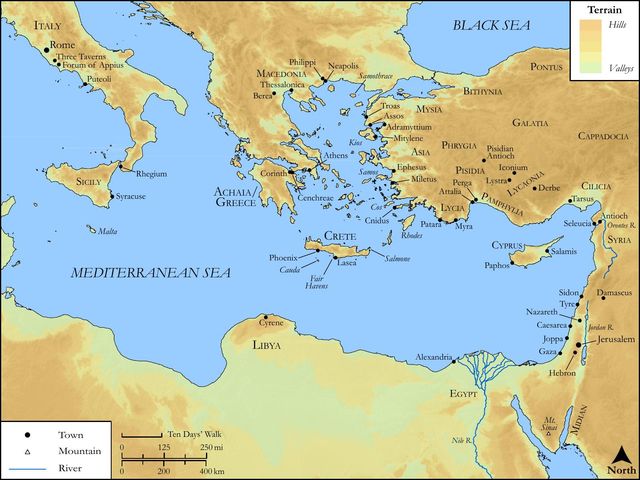
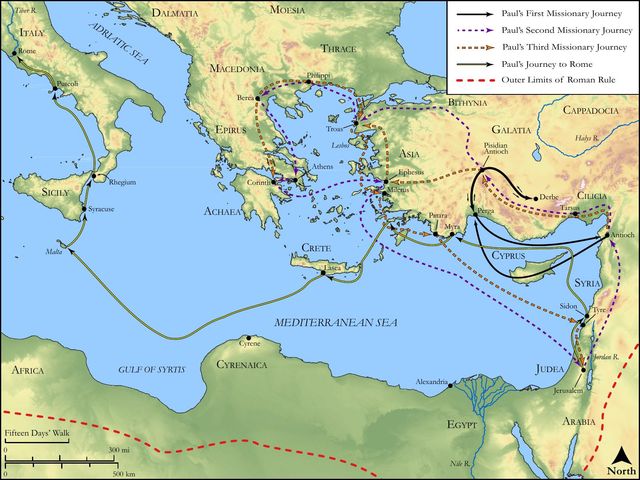
Study this verse
Public-domain commentary
Matthew Henry
From his Commentary on the Whole Bible. Henry comments on passages, not single verses — this entry covers Acts 24:1–9. His four-level outline is real structure in the source text, so it is rendered as structure.
We must suppose that Lysias, the chief captain, when he had sent away Paul to Caesarea, gave notice to the chief priests, and others that had appeared against Paul, that if they had any thing to accuse him of they must follow him to Caesarea, and there they would find him, and a judge ready to hear them - thinking, perhaps, they would not have given themselves so much trouble; but what will not malice do?
I.We have here the cause followed against Paul, and it is vigorously carried on.
1.Here is no time lost, for they are ready for a hearing after five days; all other business is laid aside immediately, to prosecute Paul; so intent are evil men to do evil! Some reckon these five days from Paul's being first seized, and with most probability, for he says here (Act 24:11) that it was but twelve days since he came up to Jerusalem, and he had spent seven in his purifying the temple, so that these five must be reckoned from the last of those.
2.Those who had been his judges do themselves appear here as his prosecutors. Ananias himself the high priest, who had sat to judge him, now stands to inform against him. One would wonder,
(1.)That he should thus disparage himself, and forget the dignity of his place. She the high priest turn informer, and leave all his business in the temple at Jerusalem, to go to be called as a prosecutor in Herod's judgment-hall? Justly did God make the priests contemptible and base, when they made themselves so, Mal 2:9.
(2.)That he should thus discover himself and his enmity against Paul!. If men of the first rank have a malice against any, they think it policy to employ others against them, and to play least in sight themselves, because of the odium that commonly attends it; but Ananias is not shamed to own himself a sworn enemy to Paul. The elders attended him, to signify their concurrence with him, and to invigorate the prosecution; for they could not find any attorneys or solicitors that would follow it with so much violence as they desired. The pains that evil men take in an evil matter, their contrivances, their condescensions, and their unwearied industry, should shame us out of our coldness and backwardness, and out indifference in that which is good.
II.We have here the cause pleaded against Paul.
The prosecutors brought with them a certain orator named Tertullus, a Roman, skilled in the Roman law and language, and therefore fittest to be employed in a cause before the Roman governor, and most likely to gain favour. The high priest, and elders, though they had their own hearts spiteful enough, did not think their own tongues sharp enough, and therefore retained Tertullus, who probably was noted for a satirical wit, to be of counsel for them; and, no doubt, they gave him a good fee, probably out of the treasury of the temple, which they had the command of, it being a cause wherein the church was concerned and which therefore must not be starved. Paul is set to the bas before Felix the governor: He was called forth, Act 24:2. Tertullus's business is, on the behalf of the prosecutors, to open the information against him, and he is a man that will say any thing for his fee; mercenary tongues will do so. No cause so unjust but can find advocates to plead it; and yet we hope many advocates are so just as not knowingly to patronise an unrighteous cause, but Tertullus was none of these: his speech (or at least an abstract of it, for it appears, by Tully's orations, that the Roman lawyers, on such occasions, used to make long harangues) is here reported, and it is made up of flattery and falsehood; it calls evil good, and good evil.
1.One of the worst of men is here applauded as one of the best of benefactors, only because he was the judge. Felix is represented by the historians of his own nation, as well as by Josephus the Jew, as a very bad man, who, depending upon his interest in the court, allowed himself in all manner of wickedness, was a great oppressor, very cruel, and very covetous, patronising and protecting assassins. - Joseph. Antiq. 20.162-165. And yet Tertullus here, in the name of the high priest and elders, and probably by particular directions from them and according to the instructions of his breviate, compliments him, and extols him to the sky, as if he were so good a magistrate as never was the like: and this comes the worse from the high priest and the elders, because he had given a late instance of his enmity to their order; for Jonathan the high priest, or one of the chief priests, having offended him by too free an invective against the tyranny of his government, he had him murdered by some villains whom he hired for that purpose who afterwards did the like for others, as they were hired: Cujus facinoris quia nemo ultor extitit, invitati hac licentia sicarii multos confodiebant, alios propter privatas inimicitias, alios conducti pecunia, etiam in ipso templo - No one being found to punish such enormous wickedness, the assassins, encouraged by this impunity, stabbed several persons, some from personal malice, some for hire, and that even in the temple itself. An yet, to engage him to gratify their malice against Paul, and to return them that kindness for their kindness in overlooking all this, they magnify him as the greatest blessing to their church and nation that ever came among them.
(1.)They are very ready to own it (Act 24:2): "By thee we, of the church, enjoy great quietness, and we look upon thee as our patron and protector, and very worthy deeds are done, from time to time, to the whole nation of the Jews, by thy providence - thy wisdom, and care, and vigilance." To give him his due, he had been instrumental to suppress the insurrection of that Egyptian of whom the chief captain spoke (Act 21:38); but will the praise of that screen him from the just reproach of his tyranny and oppression afterwards? See here,
[1.]The unhappiness of great men, and a great unhappiness it is, to have their services magnified beyond measure, and never to be faithfully told of their faults; and hereby they are hardened and encouraged in evil.
[2.]The policy of bad men, by flattering princes in what they do amiss to draw them in to do worse. The bishops of Rome got themselves confirmed in their exorbitant church power, and have been assisted in persecuting the servants of Christ, by flattering and caressing usurpers and tyrants, and so making them the tools of their malice, as the high priest, by his compliments, designed to make Felix here.
(2.)They promise to retain a grateful sense of it (Act 24:3): "We accept it always, and in all places, every where and at all times we embrace it, we admire it, most noble Felix, with all thankfulness. We will be ready, upon any occasion, to witness for thee, that thou art a wise and good governor, and very serviceable to the country." And, if it had been true that he was such a governor, it had been just that they should thus accept his good offices with all thankfulness. The benefits which we enjoy by government, especially by the administration of wise and good governors, are what we ought to be thankful for, both to God and man. This is part of the honour due to magistrates, to acknowledge the quietness we enjoy under their protection, and the worthy deeds done by their prudence.
(3.)They therefore expect his favour in this cause, Act 24:4. They pretend a great care not to intrench upon his time: We will not be further tedious to thee; and yet to be very confident of his patience: I pray thee that thou wouldest hear us of thy clemency a few words. All this address is only ad captandam benefolentia - To induce him to give countenance to their cause; and they were so conscious to themselves that it would soon appear to have more malice than matter in it that they found it necessary thus to insinuate themselves into his favour. Every body knew that the high priest and the elders were enemies to the Roman government, and were uneasy under all the marks of that yoke, and therefore, in their hearts, hated Felix; and yet, to gain their ends against Paul, they, by their counsel, show him all this respect, as they did to Pilate and Caesar when they were persecuting our Saviour. Princes cannot always judge of the affections of their people by their applauses; flattery is one thing, and true loyalty is another.
2.One of the best of men is here accused as one of the worst of malefactors, only because he was the prisoner. After a flourish of flattery, in which you cannot see matter for words, he comes to his business, and it is to inform his excellency concerning the prisoner at the bar; and this part of his discourse is as nauseous for its raillery as the former part is for its flattery. I pity the man, and believe he has no malice against Paul, nor does he think as he speaks in calumniating him, any more than he did in courting Felix; but, a I cannot but be sorry that a man of wit and sense should have such a saleable tongue (as one calls it), so I cannot but be angry at those dignified men that had such malicious hearts as to put such words into his mouth. Two things Tertullus here complains of to Felix, in the name of the high priest and the elders: -
(1.)That the peace of the nation was disturbed by Paul. They could not have baited Christ's disciples if they had not first dressed them up in the skins of wild beasts, nor have given them as they did the vilest of treatment if they had not first represented them as the vilest of men, though the characters they gave of them were absolutely false and there was not the least colour nor foundation for them. Innocence, may excellence and usefulness, are no fence against calumny, no, nor against the impressions of calumny upon the minds both of magistrates and multitudes to excite their fury and jealousy; for, be the representation ever so unjust, when it is enforced, as here it was, with gravity and pretence of sanctity, and with assurance and noise, something will stick. The old charge against God's prophets was that they were the troublers of the land, and against God's Jerusalem that it was a rebellious city, hurtful to kings and provinces (Ezr 4:15, Ezr 4:19), and against our Lord Jesus that he perverted the nation, and forbade to give tribute to Caesar. It is the very same against Paul here; and, though utterly false, is averred with all the confidence imaginable. They do not say, "We suspect him to be a dangerous man, and have taken him up upon that suspicion;" but, as if the thing were past dispute, "We have found him to be so; we have often and long found him so;" as if he were a traitor and rebel already convicted. And yet, after all, there is not a word of truth in this representation; but, if Paul's just character be enquired into, it will be found directly the reverse of this.
[1.]Paul was a useful man, and a great blessing to his country, a man of exemplary candour and goodness, blessing to all, and provoking to none; and yet he is here called a pestilent fellow (Act 24:5): "We have found him, loimon - pestem - the plague of the nation, a walking pestilence, which supposes him to be a man of a turbulent spirit, malicious and ill-natured, and one that threw all things in disorder wherever he came." They would have it thought that he had dome a more mischief in his time than a plague could do, - that the mischief he did was spreading and infectious, and that he made others as mischievous as himself, - that it was of as fatal consequence as the plague is, killing and destroying, and laying all waste, - that it was as much to be dreaded and guarded against as a plague is. Many a good sermon he had preached, and many a good work he had done, and for these he is called a pestilent fellow.
[2.]Paul was a peace-maker, was a preacher of that gospel which has a direct tendency to slay all enmities, and to establish true and lasting peace; he lived peaceably and quietly himself, and taught others to do so too, and yet is here represented as a mover of sedition among all the Jews throughout all the world. The Jews were disaffected to the Roman government; those of them that were most bigoted were the most so. This Felix knew, and had therefore a watchful eye upon them. Now they would fain make him believe that this Paul was the man that made them so, whereas they themselves were the men that sowed the seeds of faction and sedition among them: and they knew it; and the reason why they hated Christ and his religion was because he did not go about to head them in a opposition to the Romans. The Jews were every where much set against Paul, and stirred up the people to clamour against him; they moved sedition in all places where he came, and then cast the blame unjustly upon him as if he had been the mover of the sedition; as Nero not long after set Rome on fire, and then said the Christians did it.
[3.]Paul was a man of catholic charity, who did not affect to be singular, but made himself the servant of all for their good; and yet he is here charged as being a ringleader of the sect of the Nazarenes, a standard-bearer of that sect, so the word signifies. When Cyprian was condemned to die for being a Christian, this was inserted in hi sentence, that he was auctor iniqui nominis et signifer - The author and standard-bearer of a wicked cause. Now it was true that Paul was an active leading man in propagating Christianity. But, First, It was utterly false that this was a sect; he did not draw people to a party or private opinion, nor did he make his own opinions their rule. True Christianity establishes that which is of common concern to all mankind, publishes good-will to men, and shows us God in Christ reconciling the world to himself, and therefore cannot be thought to take its rise from such narrow opinions and private interests as sects owe their origin to. True Christianity has a direct tendency to the uniting of the children of men, and the gathering of them together in one; and, as far as it obtains its just power and influence upon the minds of men, will make them meek and quiet, and peaceable and loving, and every way easy, acceptable, and profitable one to another, and therefore is far from being a sect, which is supposed to lead to division and to sow discord. True Christianity aims at no worldly benefit or advantage, and therefore must by no means be called a sect. Those that espouse a sect are governed in it by their secular interest, they aim at wealth and honour; but the professors of Christianity are so far from this that they expose themselves thereby to the loss and ruin of all that is dear to them in this world. Secondly, It is invidiously called the sect of the Nazarenes, by which Christ was represented as of Nazareth, whence no good thing was expected to arise; whereas he was of Bethlehem, where the Messiah was to be born. Yet he was pleased to call himself, Jesus of Nazareth, ch. 22:8. And the scripture has put an honour on the name, Mat 2:23. And therefore, though intended for a reproach, the Christians had not reason to be ashamed of sharing with their Master in it. Thirdly, It was false that Paul was the author of standard-bearer of this sect; for he did not draw people to himself, but to Christ - did not preach himself, but Christ Jesus.
[4.]Paul had a veneration for the temple, as it was the place which God had chosen to put his name there, and had lately himself with reverence attended the temple-service; and yet it is here charged upon him that he went about to profane the temple, and that he designedly put contempt upon it, and violated the laws of it, Act 24:6. Their proof of this failed; for that they alleged as matter of act was utterly false, and they knew it, Act 21:29.
(2.)That the course of justice against Paul was obstructed by the chief captain.
[1.]They pleaded that they took him, and would have judged him according to their law. This was false; they did not go about to judge him according to their law, but, contrary to all law and equity, went about to beat him to death or to pull him to pieces, without hearing what he had to say for himself - went about, under pretence of having him into their court, to throw him into the hands of ruffians that lay in wait to destroy him. Was this judging him according to their law? It is easy for men, when they know what they should have done, to say, this they would have done, when they meant nothing less.
[2.]They reflected upon the chief captain as having done them an injury in rescuing Paul out of their hands; whereas he therein not only did him justice, but them the greatest kindness that could be, in preventing the guilt they were bringing upon themselves: The chief captain Lysias came upon us and with great violence (but really no more than was necessary) took him out of our hands, Act 24:7. See how persecutors are enraged at their disappointments, which they ought to e thankful for. When David in a heat of passion was going upon a bloody enterprise, he thanked Abigail for stopping him, and God for sending her to do it, so soon did he correct and recover himself. But these cruel men justify themselves, and reckon him their enemy who kept them (as David there speaks) from shedding blood with their own hands.
[3.]They referred the matter to Felix and his judgment, yet seeming uneasy that they were under a necessity of doing so, the chief captain having obliged them to it (Act 24:8): "It was he that forced us to give your excellency this trouble, and ourselves too; for," First, "He commanded his accusers to come to thee, that though mightest hear the charge, when it might as well have been ended in the inferior court." Secondly, "He has left it to thee to examine him, and try what thou canst get out of him, and whether thou canst by his confession come to the knowledge of those things which we lay to his charge."
III.The assent of the Jews to this charge which Tertullus exhibited (Act 24:9): They confirmed it, saying that those things were so.
1.Some think this expresses the proof of their charge by witnesses upon oath, that were examined as to the particulars of it, and attested them. And no wonder if, when they had found an orator that would say it, they found witnesses that would swear it, for money.
2.It rather seems to intimate the approbation which the high priest and the elders gave to what Tertullus said. Felix asked them, "Is this your sense, and is it all that you have to say?" And they answered, "Yes it is;" and so they made themselves guilty of all the falsehood that was in his speech. Those that have not the wit and parts to do mischief with that some others have, that cannot make speeches and hold disputes against religion, yet make themselves guilty of the mischiefs others do, by assenting to that which others do, and saying, These things are so, repeating and standing by what is said, to pervert the right ways of the Lord. Many that have not learning enough to plead for Baal yet have wickedness enough to vote for Baal.
Historical interpretation
Two Centuries of Reception
2 surviving comments on this verse. Each one is dated, so this reads as a timeline rather than a list.
Select a marker to jump to its quote. Markers stagger vertically where authors wrote within a few decades of each other.
And after five days came down the high priest Ananias with the elders. See how for all this they do not desist; hindered as they were by obstacles without number, nevertheless they come, only to be put to shame here also. And with an orator, one Tertullus. And what need was there of an orator? Which persons also informed the governor against Paul.
"And after five days the high priest Ananias came down," etc. After five days, the Jews came to the judge Felix against Paul, with the orator Tertullus […] Then, the parties having been presented, the orator Tertullus, overconfident in human eloquence, began maliciously to attack Paul: the latter, he said, wanted to cause disorder among peaceful Jews around the world with new preachings. They had arrested him and wanted immediately to punish that great crime according to their law; but Lysias the tribune, as they all knew, had taken him away and sent him to be judged by Felix. The rest of the Jews testified in a dreadful-sounding voice that the things just said were so.
Continue studying Acts 24:1 across the web’s major study libraries — every link below opens this exact verse, chapter, or book on the destination site.
Read & Compare
 BibleGatewayThis verse in more than 200 translations and 70 languages.
 Bible.comThe YouVersion reader — hundreds of translations, reading plans, and highlights.
 ESV.orgCrossway's official English Standard Version reader.
 NET BibleThe NET translation with 60,000+ translators' notes on every rendering decision.
 STEP BibleTyndale House's free study tool — original text, vocabulary, and scholarly resources.
 BibliaLogos Bible Software's free web reader.
 USCCBThe New American Bible (Revised Edition) with the U.S. bishops' study notes.
Commentaries
 BibleHub CommentariesDozens of classic commentaries on this verse, gathered on one page.
 StudyLightMore than 100 commentary sets — the largest collection on the web.
 BibleRefPlain-English commentary on what this verse means, verse by verse.
 Enduring WordDavid Guzik's free commentary on this chapter, widely used by Bible teachers.
 Bible Study ToolsVerse commentary alongside Greek and Hebrew study aids.
Original Language & Research
- BibleHub InterlinearThe verse word by word — original language, transliteration, and English.
- BibleHub LexiconEvery word's original-language definition and Strong's entry.
 Blue Letter BibleDeep-study tools — Strong's numbers, concordance, and word studies.
 CNTR CollationThe earliest Greek manuscripts of this verse, collated letter by letter.
Sermons, Hymns & Audio


TrulyRandomVerse is not affiliated with these sites and doesn’t control their content. They’re linked because they’re genuinely useful.
Summary
Acts 24:1 marks the formal commencement of the legal proceedings against the Apostle Paul in Caesarea, the Roman provincial capital. Following his swift transfer from Jerusalem to escape a Jewish assassination plot, this verse details the arrival of his formidable accusers: Ananias the high priest, accompanied by influential elders of the Sanhedrin, and a professional Roman orator named Tertullus. Their presence underscores the gravity and official nature of the charges they were prepared to levy against Paul before Governor Felix, setting the stage for a series of trials that would significantly shape the trajectory of Paul's ministry.
Context
ShowHideLiterary Context
Acts 24:1 immediately follows the dramatic events of Acts 23, where Paul was rescued from a murderous plot by over forty Jewish conspirators in Jerusalem. Under the protective escort of 470 Roman soldiers, Paul was transferred by night to Caesarea, the seat of the Roman procurator Felix. The previous chapter concludes with Paul's safe arrival and Felix's promise to hear his case once his accusers arrived from Jerusalem (Acts 23:31-35). Thus, Acts 24:1 initiates the anticipated legal confrontation, highlighting the relentless pursuit of Paul by the Jewish authorities and setting the scene for Paul's defense.
Historical & Cultural Context
Caesarea Maritima served as the Roman administrative capital of Judea, making it the appropriate venue for a trial involving Roman citizens or those accused of crimes against Roman law. Governor Felix, a procurator appointed by Rome, held significant judicial and executive power. The Jewish high priest, Ananias, was the head of the Sanhedrin, the supreme Jewish religious and judicial council. His personal descent from Jerusalem, along with "elders" (likely representatives from the Sanhedrin), demonstrated the official and collective resolve of the Jewish leadership to condemn Paul. The inclusion of Tertullus, a professional "orator" (rhetor), was a strategic move. Roman courts operated on principles of rhetoric and legal argument, and hiring a skilled advocate, possibly a Roman citizen or one well-versed in Roman law, was crucial for presenting a compelling case against Paul in a foreign legal system. This highlights the sophisticated and determined nature of the opposition Paul faced.
Key Themes
ShowHideThis verse powerfully contributes to several overarching themes in the book of Acts. Firstly, it exemplifies the persistent opposition to the Gospel and its messengers, particularly from established religious authorities who perceived Christianity as a threat to their traditions and power. This mirrors the opposition Jesus Himself faced from the religious elite, as seen in passages like Matthew 23:13-39. Secondly, it underscores God's sovereignty in the midst of adversity and legal processes. Despite the formidable legal and political machinery arrayed against him, Paul's trials consistently provided him with platforms to bear witness to Christ before powerful rulers, fulfilling the prophetic words of Acts 9:15. Finally, it highlights the clash between Jewish law and Roman justice, as Jewish religious grievances are translated into accusations that could be prosecuted under Roman jurisdiction, often blurring the lines between religious and civil offenses.
Exposition and Analysis
ShowHideKey Word Analysis
ShowHideThis word (G1718) means "to exhibit (in person) or disclose (by words)," "to appear, declare (plainly), inform, manifest, shew, signify." In this context, it signifies the formal act of presenting a clear, explicit accusation or charge against Paul to the governor. It implies a public and official declaration, not merely a casual conversation, underscoring the legal formality of the proceedings.
This term (G2232) refers to "a leader, i.e., chief person (or figuratively, place) of a province," specifically a "governor, prince, ruler." Here, it denotes Felix, the Roman procurator of Judea, who held supreme administrative and judicial authority in the province. The accusers were not merely complaining but were bringing their case before the highest Roman legal authority available to them in the region.
This word (G4489) literally means "a speaker," but specifically refers to a "forensic advocate" or "lawyer." Tertullus was not just a good speaker; he was a professional legal representative, skilled in rhetoric and the intricacies of Roman law. His presence indicates the Jewish leaders' serious intent to prosecute Paul effectively within the Roman legal framework, moving beyond a purely religious dispute to a formal legal challenge.
Verse Breakdown
ShowHide"And after five days"
This phrase indicates the swiftness with which Paul's accusers followed him to Caesarea. The "five days" likely refers to the period after Paul's arrival in Caesarea, demonstrating the urgency and determination of the Jewish high priest and elders to press their case against him without delay.
"Ananias the high priest descended with the elders"
This signifies the official and authoritative nature of the delegation. Ananias, as the head of the Sanhedrin, represented the highest Jewish religious authority. His personal presence, along with "the elders" (likely leading members of the Sanhedrin), underscores the collective and institutional resolve of the Jewish leadership to prosecute Paul, reflecting the deep animosity they held towards him and the burgeoning Christian movement.
"and with a certain orator named Tertullus"
The inclusion of Tertullus, a professional advocate, highlights the strategic and legalistic approach taken by Paul's accusers. They understood the necessity of presenting their case effectively within the Roman legal system, which valued skilled rhetoric and formal legal arguments. Tertullus's expertise was intended to translate their religious grievances into actionable charges under Roman law.
"who informed the governor against Paul"
This clause states the explicit purpose of their journey and presence: to formally accuse Paul before Governor Felix. The word "informed" (emphanízō) implies a clear and public presentation of charges, initiating the legal process. This was not a casual complaint but a deliberate and formal legal accusation designed to secure Paul's condemnation.
Literary Devices
ShowHideThe verse employs Foreshadowing, setting the stage for the extended period of Paul's imprisonment and trials that will dominate the remainder of Acts. The arrival of the high priest and a professional orator signals the formidable nature of the opposition Paul faces, hinting at the prolonged legal battles to come. There is also an element of Irony in the Jewish religious leaders, who often resisted Roman authority, now eagerly utilizing the Roman legal system and a Roman advocate to achieve their religious ends. This highlights their desperation and the lengths to which they would go to silence Paul. Finally, the scene presents a subtle Antithesis between the simple, truthful message Paul represents and the elaborate, calculated legal strategy employed by his accusers, emphasizing the spiritual conflict at play beneath the legal surface.
Theological and Thematic Connections
ShowHideActs 24:1 serves as a stark reminder that faithfulness to Christ and the proclamation of His Gospel often invite opposition, particularly from those whose systems or traditions are challenged by its truth. The relentless pursuit of Paul by the Jewish authorities, culminating in a formal legal accusation before a Roman governor, illustrates the deep-seated resistance encountered by the early church. Theologically, this event aligns with the biblical pattern of righteous suffering and divine providence. Just as Jesus was unjustly accused and tried by both Jewish and Roman authorities, Paul's experience here foreshadows the suffering that disciples must endure for the sake of the Gospel, yet it also demonstrates God's sovereign hand in using even such trials to advance His purposes and provide platforms for witness.
Reflection and Application
ShowHideActs 24:1 provides a powerful lens through which to view the challenges and opportunities inherent in living out one's faith in a hostile world. For believers today, this verse underscores the reality that commitment to Christ may lead to misunderstanding, false accusations, and formal opposition, even from those who claim religious authority. Paul's unwavering stance in the face of such formidable adversaries serves as an enduring example of perseverance and integrity. It calls us to examine our own readiness to stand for truth, even when it is costly, and to trust in God's ultimate sovereignty over all legal, political, and social systems. Just as Paul's trials became platforms for Gospel proclamation, our own difficulties can be transformed into opportunities for God's glory and the advancement of His kingdom. We are encouraged to be discerning about the tactics of opposition and to rely on divine wisdom and strength when navigating complex or unjust situations.
Questions for Reflection
ShowHideFAQ
ShowHideWhy did Ananias and the elders travel from Jerusalem to Caesarea?
ShowHideAnanias the high priest and the elders traveled from Jerusalem to Caesarea to formally accuse the Apostle Paul before Governor Felix. Their journey underscored the gravity and official nature of their charges. As the supreme Jewish religious and judicial body, the Sanhedrin, led by Ananias, had a vested interest in seeing Paul condemned, viewing him as a disruptive force and a threat to their religious traditions and authority. Caesarea was the Roman provincial capital, making it the appropriate venue for a trial under Roman jurisdiction, especially since Paul had been transferred there by Roman military escort after a plot to assassinate him in Jerusalem was uncovered (Acts 23:31-35).
Who was Tertullus and what was his role?
ShowHideTertullus was a professional "orator" or advocate, likely a Roman citizen or someone well-versed in Roman law and rhetoric, hired by Ananias and the elders to present their case against Paul. His role was to articulate the charges in a persuasive and legally sound manner before Governor Felix. The Jewish leaders understood that to succeed in a Roman court, they needed someone skilled in Roman legal procedures and rhetorical conventions, as their grievances were primarily religious but needed to be framed as civil or political offenses to be actionable under Roman law. His involvement signifies the strategic and formal nature of the prosecution.
What was the significance of the 'five days'?
ShowHideThe phrase "after five days" refers to the relatively short period following Paul's arrival in Caesarea before his accusers arrived from Jerusalem. This detail highlights the urgency and determination of Ananias and the Sanhedrin to pursue their case against Paul. It demonstrates their unwavering resolve and the speed with which they mobilized their legal strategy, indicating the high priority they placed on seeing Paul brought to justice according to their understanding. This swift action also sets the immediate stage for the beginning of Paul's extended period of trials and imprisonment.
Christ-Centered Fulfillment
ShowHideActs 24:1, detailing Paul's formal accusation, deeply resonates with the Christ-centered narrative of the Gospel. Just as Paul faced a concerted effort by religious authorities and a professional advocate to condemn him before a Roman governor, so too did Jesus stand accused before the Jewish Sanhedrin and the Roman procurator Pontius Pilate. The high priest Ananias's presence and the strategic use of an orator like Tertullus echo the unjust trials of Christ, where religious leaders sought to manipulate legal systems to achieve their desired outcome (John 18:28-40). Paul's suffering and legal battles are not merely historical events but a participation in the suffering of Christ, who endured false accusations and judicial injustice for the sake of humanity's redemption (1 Peter 2:21-23). Ultimately, Paul's trials, though fraught with human malice, were providentially used by God to advance the Gospel, bringing the message of Christ before governors and kings, much as Christ's own crucifixion, seemingly a defeat, became the ultimate victory over sin and death. Thus, Paul's experience in Acts 24:1 serves as a powerful testament to the enduring truth that even in the face of formidable opposition, the power of Christ's cross and resurrection continues to triumph, transforming trials into opportunities for His name to be proclaimed (Philippians 1:12-14).