


Acts 21:27
- ὡςhōsWhenG5613PRTParticle or Disjunctive
- δὲdenowG1161CONJConjunction
- ἔμελλονemellonwere aboutG3195V-IAI-3PVerb Imperfect Active Indicative 3rd Plural
- αἱhaitheG3588T-NPFDefinite article Nominative Plural Feminine
- ἑπτὰheptasevenG2033A-NUIAdjective
- ἡμέραιhēmeraidaysG2250N-NPFNoun Nominative Plural Feminine
- συντελεῖσθαιsunteleisthaito be completedG4931V-PPNVerb Present Passive Infinitive
- οἱhoitheG3588T-NPMDefinite article Nominative Plural Masculine
- ἀπὸapofromG575PREPPreposition
- τῆςtēs<the>G3588T-GSFDefinite article Genitive Singular Feminine
- ἈσίαςAsiasAsiaG773N-GSF-LNoun Genitive Singular Feminine Location
- ἸουδαῖοιIoudaioiJewsG2453N-NPM-PGNoun Nominative Plural Masculine Person Gentilic
- θεασάμενοιtheasamenoihaving seenG2300V-ADP-NPMVerb Aorist Middle Deponent Participle Nominative Plural Masculine
- αὐτὸνautonhimG846P-ASMPersonal pronoun Accusative Singular Masculine
- ἐνeninG1722PREPPreposition
- τῷtōtheG3588T-DSNDefinite article Dative Singular Neuter
- ἱερῷhi'erōtempleG2411N-DSNNoun Dative Singular Neuter
- συνέχεονsunecheonwere stirring upG4797V-IAI-3PVerb Imperfect Active Indicative 3rd Plural
- πάνταpantaallG3956A-ASMAdjective Accusative Singular Masculine
- τὸνtontheG3588T-ASMDefinite article Accusative Singular Masculine
- ὄχλονochloncrowdG3793N-ASMNoun Accusative Singular Masculine
- καὶkaiandG2532CONJConjunction
- ἐπέβαλονepebalonlaidG1911V-2AAI-3PVerb 2nd Aorist Active Indicative 3rd Plural
- ἐπ᾽ep᾽uponG1909PREPPreposition
- αὐτὸνautonhimG846P-ASMPersonal pronoun Accusative Singular Masculine
- τὰςtas<the>G3588T-APFDefinite article Accusative Plural Feminine
- χεῖραςcheirashandsG5495N-APFNoun Accusative Plural Feminine
English is a literal word-by-word gloss of the Greek, not the KJV's wording. Why?
This is the original text the KJV's translators worked from — each Greek word with its own literal English meaning in this verse, prepared by scholars at Tyndale House, Cambridge. The KJV translates whole sentences, not word by word, so its wording differs: one Greek word can become several English words, and the KJV may choose “charity” where the gloss reads “love”. Both are faithful — they answer different questions. For the KJV's own rendering, switch to the KJV text.
Details
See on the biblical-era map
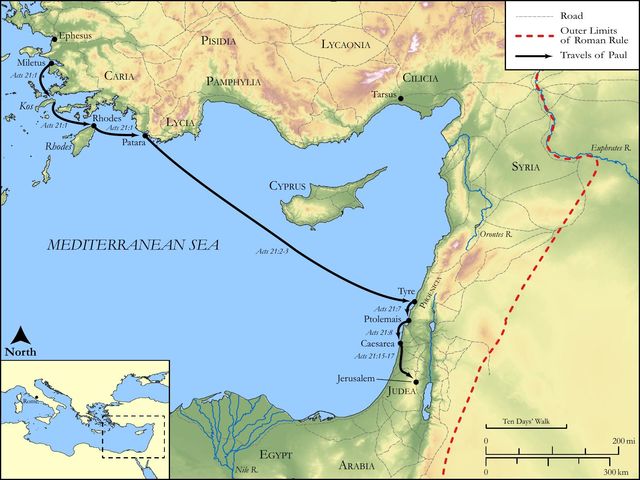
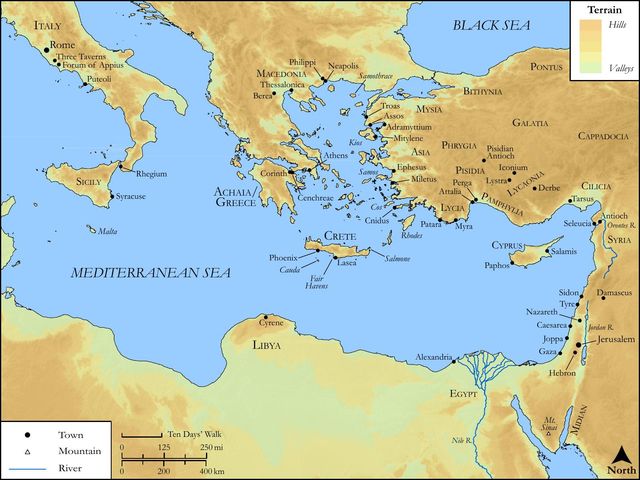
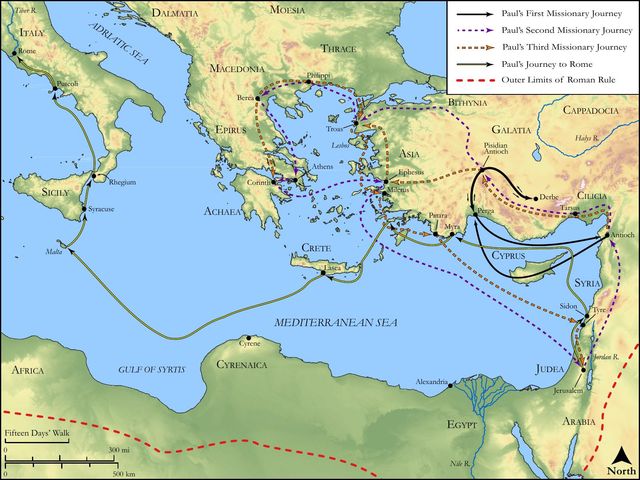
Study this verse
Public-domain commentary
Matthew Henry
From his Commentary on the Whole Bible. Henry comments on passages, not single verses — this entry covers Acts 21:27–40. His four-level outline is real structure in the source text, so it is rendered as structure.
We have here Paul brought into a captivity which we are not likely to see the end of; for after this he is either hurried from one bar to another, or lies neglected, first in one prison and then in another, and can neither be tried nor bailed. When we see the beginning of a trouble, we know not either how long it will last or how it will issue.
I.We have here Paul seized, and laid hold on.
1.He was seized in the temple, when he was there attending the days of his purifying, and the solemn services of those days, Act 21:27. Formerly he had been well known in the temple, but now he had been so long in his travels abroad that he had become a stranger there; so that it was not till the seven days were almost ended that he was taken notice of by those that had an evil eye towards him. In the temple, where he should have been protected, as in a sanctuary, he was most violently set upon by those who did what they could to have his blood mingled with his sacrifices - in the temple, where he should have been welcomed as one of the greatest ornaments of it that ever had been there since the Lord of the temple left it. The temple, which they themselves pretended such a mighty zeal for, yet did they themselves thus profane. Thus is the church polluted by none more than by popish persecutors, under the colour of the church's name and interest.
2.The informers against him were the Jews of Asia, not those of Jerusalem - the Jews of the dispersion, who knew him best, and who were most exasperated against him. Those who seldom came up to worship at the temple in Jerusalem themselves, but contentedly lived at a distance from it, in pursuit of their private advantages, yet appeared most zealous for the temple, as if thereby they would atone for their habitual neglect of it.
3.The method they took was to raise the mob, and to incense them against him. They did not go to the high priest, or the magistrates of the city, with their charge (probably because they expected not to receive countenance from them), but they stirred up all the people, who were at this time more than ever disposed to any thing that was tumultuous and seditious, riotous and outrageous. Those are fittest to be employed against Christ and Christianity that are governed least by reason and most by passion; therefore Paul described the Jewish persecutors to be not only wicked, but absurd unreasonable men.
4.The arguments wherewith they exasperated the people against him were popular, but very false and unjust. They cried out, "Men of Israel, help. If you are indeed men of Israel, true-born Jews, that have a concern for your church and your country, now is your time to show it, by helping to seize an enemy to both." Thus they cried after him as after a thief (Job 30:5), or after a mad dog. Note, The enemies of Christianity, since they could never prove it to be an ill thing, have been always very industrious, right or wrong, to put it into an ill name, and so run it down by outrage and outcry. It had become men of Israel to help Paul, who preached up him who was so much the glory of his people Israel; yet here the popular fury will not allow them to be men of Israel, unless they will help against him. This was like, Stop thief, or Athaliah's cry, Treason, treason; what is wanting in right is made up in noise.
5.They charge upon him both bad doctrine and bad practice, and both against the Mosaic ritual.
(1.)They charge upon him bad doctrine; not only that he holds corrupt opinions himself, but that he vents and publishes them, though not here at Jerusalem, yet in other places, nay in all places, he teaches all men, every where; so artfully is the crime aggravated, as if, because he was an itinerant, he was a ubiquitary: "He spreads to the utmost of his power certain damnable and heretical positions," [1.] Against the people of the Jews. He had taught that Jews and Gentiles stand on the same level before God, and neither circumcision avails any thing nor uncircumcision; nay, he had taught against the unbelieving Jews that they were rejected (and therefore had separated from them and their synagogues), and this is interpreted to be speaking against the whole nation, as if no doubt but they were the people, and wisdom must die with them (Job 12:2), whereas God, though he had cast them off, yet had not cast away his people, Rom 11:1. They were Lo-ammi, not a people (Hos 1:9), and yet pretended to be the only people. Those commonly seem most jealous for the church's name that belong to it in name only. [2.] Against the law. His teaching men to believe the gospel as the end of the law, and the perfection of it, was interpreted his preaching against the law; whereas it was so far from making void the law that it established it, Rom 3:31. [3.] Against this place, the temple. Because he taught men to pray every where, he was reproached as an enemy to the temple, and perhaps because he sometimes mentioned the destruction of Jerusalem and the temple, and of the Jewish nation, which his Master had foretold. Paul had himself been active in persecuting Stephen, and putting him to death for words spoken against this holy place, and now the same thing is laid to his charge. He that was then made use of as the tool is now set up as the butt of Jewish rage and malice.
(2.)They charge upon him bad practices. To confirm their charge against him, as teaching people against this holy place, they charge it upon him that he had himself polluted it, and by an overt-act showed his contempt of it, and a design to make it common. He has brought Gentiles also into the temple, into the inner court of the temple, which none that were uncircumcised were admitted, under any pretence, to come into; there was written upon the wall that enclosed this inner court, in Greek and Latin, It is a capital crime for strangers to enter. - Josephus Antiq. 15.417. Paul was himself a Jew, and had right to enter into the court of the Jews. And they, seeing some with him there that joined with him in his devotions, concluded that Trophimus an Ephesian, who was a Gentile, was one of them. Why? Did they see him there? Truly no; but they had seen him with Paul in the streets of the city, which was no crime at all, and therefore they affirm that he was with Paul in the inner court of the temple, which was a heinous crime. They had seen him with him in the city, and therefore they supposed that Paul had brought him with him into the temple, which was utterly false. See here,
[1.]Innocency is no fence against calumny and false accusation. It is no new thing for those that mean honestly, and act regularly, to have things laid to their charge which they know not, nor ever thought of.
[2.]Evil men dig up mischief, and go far to seek proofs of their false accusations, as they did here, who, because they saw a Gentile with Paul in the city, will thence infer that he was with him in the temple. This was a strained innuendo indeed, yet by such unjust and groundless suggestions have wicked men thought to justify themselves in the most barbarous outrages committed upon the excellent ones of the earth.
[3.]It is common for malicious people to improve that against those that are wise and good with which they thought to have obliged them and ingratiated themselves with them. Paul thought to recommend himself to their good opinion by going into the temple, he had not been so maligned by them. This is the genius of ill-nature; for my love, they are my adversaries, Psa 109:4; Psa 69:10.
We have Paul in danger of being pulled in pieces by the rabble. They will not be at the pains to have him before the high priest, or the sanhedrim; that is a roundabout way: the execution shall be of a piece with the prosecution, all unjust and irregular. They cannot prove the crime upon him, and therefore dare not bring him upon a fair trial; nay, so greedily do they thirst after his blood that they have not patience to proceed against him by a due course of law, though they were ever so sure to gain their point; and therefore, as those who neither feared God nor regarded man, they resolved to knock him on the head immediately.
1.All the city was in an uproar, Act 21:30. The people, who though they had little holiness themselves, yet had a mighty veneration for the holy place, when they heard a hue-and-cry from the temple, were up in arms presently, being resolved to stand by that with their lives and fortunes. All the city was moved, when they were called to from the temple, Men of Israel, help, with as much violence as if the old complaint were revived (Psa 79:1), O God, the heathen are come into thine inheritance, thy holy temple have they defiled. Just such a zeal the Jews here show for God's temple as the Ephesians did for Diana's temple, when Paul was informed against as an enemy to that (Act 19:29): The whole city was full of confusion. But God does not reckon himself at all honoured by those whose zeal for him transports them to such irregularities, and who, while they pretend to act for him, act in such a brutish barbarous manner.
2.They drew Paul out of the temple, and shut the doors between the outer and inner court of the temple, or perhaps the doors of the outer court. In dragging him furiously out of the temple,
(1.)They showed a real detestation of him as one not fit to be suffered in the temple, nor to worship there, nor to be looked upon as a member of the Jewish nation; as if his sacrifice had been an abomination.
(2.)They pretended a veneration for the temple; like that of good Jehoiada, who would not have Athaliah to be slain in the house of the Lord, Kg2 11:15. See how absurd these wicked men were; they condemned Paul for drawing people from the temple, and yet, when he himself was very devoutly worshipping in the temple, they drew him out of it. The officers of the temple shut the doors, either,
[1.]Lest Paul should find means to get back and take hold of the horns of the altar, and so protect himself by that sanctuary from their rage. Or rather,
[2.]Lest the crowd should by the running in of more to them be thrust back into the temple, and some outrage should be committed, to the profanation of that holy place. Those that made no conscience of doing so ill a thing as the murdering of a good man for well-doing, yet would be thought to scruple doing it in a holy place, or at a holy time: Not in the temple, as Not on the feast-day.
3.They went about to kill him (Act 21:31), for they fell a beating him (Act 21:32), resolving to beat him to death by blows without number, a punishment which the Jewish doctors allowed in some cases (not at all to the credit of their nation), and called the beating of the rebels. Now was Paul, like a lamb, thrown into a den of lions, and made an easy prey to them, and, no doubt, he was still of the same mind as when he said, I am ready not only to be bound, but to die at Jerusalem, to die so great a death.
III.We have here Paul rescued out of the hands of his Jewish enemies by a Roman enemy.
1.Tidings were brought of the tumult, and that the mob was up, to the chief captain of the band, the governor of the castle, or, whoever he was, the now commander-in-chief of the Roman forces that were quartered in Jerusalem. Somebody that was concerned not for Paul, but for the public peace and safety, gave this information to the colonel, who had always a jealous and watchful eye upon these tumultuous Jews, and he is the man that must be instrumental to save Paul's life, when never a friend he had was capable of doing him any service.
2.The tribune, or chief captain, got his forces together with all possible expedition, and went to suppress the mob: He took soldiers and centurions, and ran down to them. Now at the feast, as at other such solemn times, the guards were up, and the militia more within call than at other times, and so he had them near at hand, and he ran down unto the multitude; for at such times delays are dangerous. Sedition must be crushed at first, lest it grow headstrong.
3.The very sight of the Roman general frightened them from beating Paul; for they knew they were doing what they could not justify, and were in danger of being called in question for this day's uproar, as the town clerk told the Ephesians. They were deterred from that by the power of the Romans from which they ought to have been restrained by the justice of God and the dread of his wrath. Note, God often makes the earth to help the woman (Rev 12:16), and those to be a protection to his people who yet have no affection for his people; they have only a compassion for sufferers, and are zealous for the public peace. The shepherd makes use even of his dogs for the defence of his sheep. It is Streso's comparison here. See here how these wicked people were frightened away at the very sight of the chief captain; for the king that sitteth on the throne of judgment scattereth away all evil with his eyes. The governor takes him into custody. He rescued him, not out of a concern for him, because he thought him innocent, but out of a concern for justice, because he ought not to be put to death without trial; and because he knew not how dangerous the consequence might be to the Roman government of such tumultuous proceedings were not timely suppressed, nor what such an outrageous people might do if once they knew their own strength: he therefore takes Paul out of the hands of the mob into the hands of the law (v. 33): He took him, and commanded him to be bound with two chains, that the people might be satisfied he did not intend to discharge him, but to examine him, for he demanded of those who were so eager against him who he was, and what he had done. This violent taking of him out of the hands of the multitude, though there was all the reason in the world for it, yet they laid to the charge of the chief captain as his crime (Act 24:7): The chief captain Lysias came with great violence, and took him out of our hands, which refers to this rescue as appears by comparing Act 23:27, Act 23:28, where the chief captain gives an account of it to Felix.
IV.The provision which the chief captain made, with much ado, to bring Paul to speak for himself.
One had almost as good enter into a struggle with the winds and the waves, as with such a mob as was here got together; and yet Paul made a shift to get liberty of speech among them.
1.There was no knowing the sense of the people; for when the chief captain enquired concerning Paul, having perhaps never heard of his name before (such strangers were the great ones to the excellent ones of the earth, and affected to be so), some cried one thing, and some another, among the multitude; so that it was impossible for the chief captain to know their mind, when really they knew not either one another's mind or their own, when every one pretended to give the sense of the whole body. Those that will hearken to the clamours of the multitude will know nothing for a certainty, any more than the builders of Babel, when their tongues were confounded.
2.There was no quelling the rage and fury of the people; for when the chief captain commanded that Paul should be carried into the castle, the tower of Antonia, where the Roman soldiers kept garrison, near the temple, the soldiers themselves had much ado to get him safely thither out of the noise, the people were so violent (Act 21:35): When he came upon the stairs, leading up to the castle, the soldiers were forced to take him up in their arms, and carry him (which they might easily do, for he was a little man, and his bodily presence weak), to keep him from the people, who would have pulled him limb from limb if they could. When they could not reach him with their cruel hands, they followed him with their sharp arrows, even bitter words: They followed, crying, Away with him, Act 21:36. See how the most excellent persons and things are often run down by a popular clamour. Christ himself was so, with, Crucify him, crucify him, though they could not say what evil he had done. Take him out of the land of the living (so the ancients expound it), chase him out of the world.
3.Paul at length begged leave of the chief captain to speak to him (Act 21:37): As he was to be led into the castle, with a great deal of calmness and composedness in himself, and a great deal of mildness and deference to those about him, he said unto the chief captain, "May I speak unto thee? Will it be no offence, nor construed as a breach of rule, if I give thee some account of myself, since my persecutors can give no account of me?" What a humble modest question was this! Paul knew how to speak to the greatest of men, and had many a time spoken to his betters, yet he humbly begs to leave to speak to this commander, and will not speak till he has obtained leave: May I speak unto thee?
4.The chief captain tells him what notion he had of him: Canst thou speak Greek? I am surprised to hear thee speak a learned language; for, Art not thou that Egyptian who made an uproar? The Jews made the uproar, and then would have it thought that Paul had given them occasion for it, by beginning first; for probably some of them whispered this in the ear of the chief captain. See what false mistaken notions of good people and good ministers many run away with, and will not be at the pains to have the mistake rectified. It seems, there had lately been an insurrection somewhere in that country, headed by an Egyptian, who took on him to be a prophet. Josephus mentions this story, that "an Egyptian raised a seditious party, promised to show them the fall of the walls of Jerusalem from the mount of Olives, and that they should enter the city upon the ruins." The captain here says that he led out into the wilderness four thousand men that were murderers - desperadoes, banditti, raparees, cut-throats. What a degeneracy was there in the Jewish nation, when there were found there so many that had such a character, and could be drawn into such an attempt upon the public peace! But Josephus says that "Felix the Roman president went out against them, killed four hundred, and took two hundred prisoners, and the rest were dispersed." - Antiq. 20.171; Wars 2.263. And Eusebius speaks of it, Hist. 2:20. It happened in the thirteenth year of Claudius, a little before those days, about three years ago. The ringleader of this rebellion, it seems, had made his escape, and the chief captain concluded that one who lay under so great an odium as Paul seemed to lie under, and against whom there was so great an outcry, could not be a criminal of less figure than this Egyptian. See how good men are exposed to ill-will by mistake.
5.Paul rectifies his mistake concerning him, by informing him particularly what he was; not such a vagabond, a scoundrel, a rake, as that Egyptian, who could give no good account of himself. No: I am a man who is a Jew originally, and no Egyptian - a Jew both by nation and religion; I am of Tarsus, a city of Cilicia, of honest parents and a liberal education (Tarsus was a university), and, besides that, a citizen of no mean city. Whether he means Tarsus or Rome is not certain; they were neither of them mean cities, and he was a freeman of both. Though the chief captain had put him under such an invidious suspicion, that he was that Egyptian, he kept his temper, did not break out into any passionate exclamations against the times he lived in or the men he had to do with, did not render railing for railing, but mildly denied the charge, and owned what he was.
6.He humbly desired a permission from the chief captain, whose prisoner he now was, to speak to the people. He does not demand it as a debt, though he might have done so, but sues for it as a favour, which he will be thankful for: I beseech thee, suffer me to speak to the people. The chief captain rescued him with no other design than to give him a fair hearing. Now, to show that his cause needs no art to give it a plausible colour, he desires he may have leave immediately to defend himself; for it needed no more than to be set in a true light; nor did he depend only on the goodness of his cause, but upon the goodness and fidelity of his patron, and that promise of his to all his advocates, that it should be given them in that same hour what they should speak.
7.He obtained leave to plead his own cause, for he needed not to have counsel assigned him, when the Spirit of the Father was ready to dictate to him, Mat 10:20. The chief captain gave him license (Act 21:40), so that now he could speak with a good grace, and with the more courage; he had, I will not say that favour, but that justice, done him by the chief captain, which he could not obtain from his countrymen the Jews; for they would not hear him, but the captain would, though it were but to satisfy his curiosity. This licence being obtained,
(1.)The people were attentive to hear: Paul stood on the stairs, which gave a little man like Zaccheus some advantage, and consequently some boldness, in delivering himself. A sorry pulpit it was, and yet better than none; it served the purpose, though it was not, like Ezra's pulpit of wood, made for the purpose. There he beckoned with the hand unto the people, made signs to them to be quiet and to have a little patience, for he had something to say to them; and so far he gained his point that every one cried hush to his neighbour, and there was made a profound silence. Probably the chief captain also intimated his charge to all manner of people to keep silence; if the people were not required to give audience, it was to no purpose at all that Paul was allowed to speak. When the cause of Christ and his gospel is to be pleaded, there ought to be a great silence, that we may give the more earnest heed, and all little enough.
(2.)Paul addressed himself to speak, well assured that he was serving the interest of Christ's kingdom as truly and effectually as if he had been preaching in the synagogue: he spoke unto them in the Hebrew tongue, that is, in their own vulgar tongue, which was the language of their country, to which he hereby owned not only an abiding relation, but an abiding respect.
Historical interpretation
Three Centuries of Reception
2 surviving comments on this verse. Each one is dated, so this reads as a timeline rather than a list.
Select a marker to jump to its quote. Markers stagger vertically where authors wrote within a few decades of each other.
"And when the seven days were about to be completed, the Jews from Asia" - for his arrival most keeps times with theirs - "when they saw him in the temple, stirred up all the people, and laid hands on him, crying out, Men of Israel, help: This is the man, that teacheth all men everywhere against the people, and the law, and this place: and further brought Greeks also into the temple, and hath polluted this holy place." Mark their habitual conduct, how turbulent we everywhere find it, how men who with or without reason make a clamor in the midst.
"Jews from Asia having seen him," for it was natural that they were spending some days there, "in the Temple." Mark the economy of Providence that appeared in this. After the believing Jews had been persuaded concerning him, then it is that those Jews of Asia set upon him in order that those believing Jews may not also set upon him. "Help," say they, "ye men of Israel!" as though it were some monster difficult to be caught, and hard to be overcome, that has fallen into their hands. "All men," they say, "everywhere, he ceaseth not to teach;" not here only. And then the accusation is more aggravated by the present circumstances. "And yet more," say they, "he has polluted the temple, having brought into it men who are Greeks." And yet in Christ's time there "came up Greeks to worship": true, but here it speaks of Greeks who had no mind to worship.
And when the seven days were nearly completed. These days were not yet completed, but their course was ongoing, the completion was awaited. Hence it is more clearly said in Greek: When the seven days were beginning to be completed. Otherwise, the statement he made after five days of being in Caesarea to the governor cannot stand: For it is not more than twelve days since I went up to worship in Jerusalem. For if you add these seven days and those five days of the council in which he dissociated the Pharisees and Sadducees, and that in which the Jews vowed to kill him, undoubtedly more than twelve days will be found there.
Continue studying Acts 21:27 across the web’s major study libraries — every link below opens this exact verse, chapter, or book on the destination site.
Read & Compare
 BibleGatewayThis verse in more than 200 translations and 70 languages.
 Bible.comThe YouVersion reader — hundreds of translations, reading plans, and highlights.
 ESV.orgCrossway's official English Standard Version reader.
 NET BibleThe NET translation with 60,000+ translators' notes on every rendering decision.
 STEP BibleTyndale House's free study tool — original text, vocabulary, and scholarly resources.
 BibliaLogos Bible Software's free web reader.
 USCCBThe New American Bible (Revised Edition) with the U.S. bishops' study notes.
Commentaries
 BibleHub CommentariesDozens of classic commentaries on this verse, gathered on one page.
 StudyLightMore than 100 commentary sets — the largest collection on the web.
 BibleRefPlain-English commentary on what this verse means, verse by verse.
 Enduring WordDavid Guzik's free commentary on this chapter, widely used by Bible teachers.
 Bible Study ToolsVerse commentary alongside Greek and Hebrew study aids.
Original Language & Research
- BibleHub InterlinearThe verse word by word — original language, transliteration, and English.
- BibleHub LexiconEvery word's original-language definition and Strong's entry.
 Blue Letter BibleDeep-study tools — Strong's numbers, concordance, and word studies.
 CNTR CollationThe earliest Greek manuscripts of this verse, collated letter by letter.
Sermons, Hymns & Audio


TrulyRandomVerse is not affiliated with these sites and doesn’t control their content. They’re linked because they’re genuinely useful.
Summary
Acts 21:27 describes the dramatic culmination of Paul's purification ritual in the Jerusalem Temple, where Jews from the Roman province of Asia, recognizing him, falsely accused him of defiling the sacred space and incited a riot among the people, leading to his violent apprehension. This incident marks a critical turning point in Paul's ministry, initiating a prolonged period of imprisonment and trials, ultimately leading to his journey to Rome.
Context
ShowHideLiterary Context
This verse immediately follows Paul's decision, on the advice of James and the elders in Jerusalem, to participate in a Nazirite vow purification ritual with four other men (Acts 21:20-26). This act was intended to demonstrate Paul's continued respect for Jewish law and customs, thereby refuting widespread rumors that he taught Jews to forsake Moses and the Law (Acts 21:21). The "seven days" mentioned in the verse refer to the completion of this purification period, during which Paul was present in the temple. The events of Acts 21:27 directly precipitate Paul's arrest, which then leads to his defense before various authorities, setting the stage for the remainder of the book of Acts, chronicling his appeals and journey to Rome.
Historical & Cultural Context
Jerusalem in the mid-1st century AD was a highly charged environment, especially during major festivals like Pentecost (implied by the timing of Paul's arrival in Acts 20:16), which drew Jews from across the Roman Empire. The Temple was the epicenter of Jewish religious life, and any perceived defilement was met with extreme outrage, often leading to mob violence, which Roman authorities struggled to control. The "Jews which were of Asia" refers to individuals from the Roman province of Asia Minor, where Paul had conducted extensive missionary work, particularly in Ephesus (Acts 19:10). These individuals would have been familiar with Paul's ministry to Gentiles and likely held deep-seated animosity towards him, interpreting his message as a betrayal of Jewish tradition. Their presence in Jerusalem for the festival provided the opportunity for a confrontation.
Key Themes
ShowHideThis verse powerfully illustrates several recurring themes in Acts. Firstly, the theme of Opposition to the Gospel and its messengers is prominent, as Paul consistently faces hostility, particularly from Jewish factions who reject his message about Jesus as the Messiah and the inclusion of Gentiles (Acts 13:45, Acts 17:5). Secondly, the theme of False Accusations and Misunderstanding is central; Paul's actions, intended to show respect for Jewish customs, are twisted into charges of defiling the Temple and teaching against the Law (Acts 21:28). Thirdly, the Volatility of Crowds and the danger of mob mentality are starkly displayed, as a few individuals quickly "stirred up all the people" into a violent frenzy, highlighting how easily public opinion can be swayed by misinformation and passionate rhetoric.
Exposition and Analysis
ShowHideKey Word Analysis
ShowHideThis verb means "to complete entirely" or "to execute." In this context, it signifies the near completion of the seven-day purification ritual Paul was undertaking. The fact that the events unfolded "when the seven days were almost ended" adds a layer of dramatic irony, as Paul's attempt to fulfill a religious obligation and appease Jewish believers was violently interrupted just before its conclusion, preventing him from fully achieving his intended reconciliation.
This term refers to the entire sacred precinct of the Jerusalem Temple, including its courtyards and porticos, as opposed to the inner sanctuary or Holy of Holies (naos). Paul's presence in the hierón was permissible for a Jew undergoing purification. The accusation that he brought Gentiles into this sacred area (mentioned in the subsequent verse, Acts 21:28) was a grave charge, punishable by death, and served as the immediate catalyst for the mob's fury. The location underscores the religious nature of the conflict and the profound reverence Jews held for this holy site.
Meaning "to commingle promiscuously," "to throw into disorder," or "to perplex the mind," this word vividly describes the actions of the Jews from Asia. They did not merely inform or accuse; they actively incited chaos and confusion, transforming a public space into a riotous scene. This term highlights the deliberate and effective manipulation of the crowd, turning a potentially orderly situation into a violent uproar through the spread of false information and passionate agitation.
Verse Breakdown
ShowHide"And when the seven days were almost ended"
This clause sets the temporal context, indicating that Paul's purification ritual, undertaken to demonstrate his adherence to Jewish customs and quell rumors, was nearing its completion. The timing is crucial, as it suggests Paul was diligently fulfilling his commitment within the Temple.
"the Jews which were of Asia"
These were not local Jerusalemites but Jews from the Roman province of Asia, where Paul had extensively preached the Gospel, often facing significant opposition. Their presence in Jerusalem, likely for a pilgrimage festival, meant they recognized Paul and carried pre-existing animosity and false impressions of his ministry.
"when they saw him in the temple"
This emphasizes the direct recognition and the specific location of the confrontation. Paul was in a public, sacred space where his presence was legitimate for a Jew. Their seeing him was the immediate trigger for their actions, fueled by their prior encounters and prejudices.
"stirred up all the people"
This describes the active incitement of a general populace. The Jews from Asia did not merely report; they agitated and inflamed the emotions of the crowd, leveraging the sanctity of the Temple and the prevailing anti-Gentile sentiment to provoke a violent reaction against Paul.
"and laid hands on him"
This signifies the physical assault and apprehension of Paul. It marks the transition from verbal accusation and incitement to direct physical violence, indicating the mob's intent to seize and harm him, effectively initiating his arrest and subsequent trials.
Literary Devices
ShowHideThe verse employs Dramatic Irony, as Paul's very presence in the Temple, intended to demonstrate his fidelity to Jewish law and reconcile with Jewish believers, becomes the catalyst for his violent seizure by those who falsely accuse him of violating that law. There is also strong Foreshadowing, as this incident marks the beginning of Paul's long period of imprisonment and trials, setting the stage for the remainder of Acts and his eventual journey to Rome. The phrase "stirred up all the people" is an example of Hyperbole or Synecdoche, representing a significant portion of the crowd rather than every single individual, vividly conveying the widespread and rapid spread of agitation. The Temple itself functions as Symbolism, representing not only a place of worship but also a flashpoint for religious and political tensions, where perceived desecration could ignite immediate and severe reactions.
Theological and Thematic Connections
ShowHideActs 21:27 powerfully illustrates the persistent theme of suffering for the sake of the Gospel, echoing Christ's own experiences of rejection and false accusation. Paul, like his Lord, faced intense hostility not primarily from pagans, but from within his own religious community, driven by misunderstanding, zeal without knowledge, and a rigid adherence to tradition that blinded them to God's new work in Christ. This incident underscores that faithfulness to God's progressive revelation can often lead to conflict with established religious norms, even when one attempts to bridge divides. It also highlights the dangerous power of misinformation and mob mentality, capable of overriding reason and justice, a pattern seen throughout biblical history and relevant to contemporary challenges to truth and reconciliation.
Reflection and Application
ShowHideActs 21:27 serves as a profound reminder that commitment to Christ and His mission often involves facing opposition, even from unexpected sources or within religious contexts. Paul's experience teaches us that attempts at reconciliation or demonstrating good faith may not always be met with understanding, especially when deep-seated prejudices or false narratives are at play. Believers today must be prepared for misrepresentation and hostility when living out their faith, particularly in a world often quick to judge or condemn based on incomplete information or preconceived notions. This passage calls us to cultivate discernment, to remain steadfast in truth even when slandered, and to resist the temptation to join or be swayed by a mob mentality. It challenges us to examine our own hearts for any seeds of prejudice or quick judgment, and to pray for those who, out of zeal, may oppose the very truth they claim to uphold.
Questions for Reflection
ShowHideFAQ
ShowHideWhy were the Jews from Asia so hostile towards Paul, even though he was a Jew himself?
ShowHideThe Jews from the Roman province of Asia, particularly from cities like Ephesus where Paul had spent considerable time (Acts 19:10), were likely familiar with his teaching that Gentiles could be saved and included in God's people without fully converting to Judaism or strictly observing all Mosaic laws. This message, while liberating for Gentiles, was perceived by many zealous Jews as a betrayal of their heritage and a defilement of their sacred traditions. They viewed Paul as an apostate who undermined the Law and the Temple, especially because he ministered extensively to Gentiles. Their hostility stemmed from a deep-seated conviction that Paul was leading Jews astray and bringing "unclean" Gentiles into the holy precincts, even though the specific accusation in Acts 21:28 about Trophimus was false. Their religious zeal, combined with a misunderstanding of the Gospel's inclusive nature, fueled their intense animosity.
Christ-Centered Fulfillment
ShowHideActs 21:27, detailing Paul's unjust seizure in the Temple, powerfully echoes the pattern of Christ's own suffering and rejection. Just as Jesus, the true Temple (John 2:19-21), was falsely accused, misunderstood, and violently apprehended by zealous religious leaders and an incited crowd (Matthew 26:57-68), so too is Paul, His faithful apostle. Paul's attempt to reconcile with his Jewish brethren through a purification vow ultimately backfired, leading to his arrest, mirroring how Christ's ministry of reconciliation led to His crucifixion. This incident underscores that the path of following Christ often involves sharing in His sufferings (Philippians 3:10), facing opposition from those who reject God's redemptive plan. Paul's subsequent trials and journey to Rome, initiated by this very event, become a means for the Gospel to advance, demonstrating that even human hostility and injustice cannot thwart God's sovereign purposes for His Son and His kingdom (Acts 28:30-31).