


Acts 23:6
Bible text: King James Version (1769 Blayney text) · Public domain
Bible text: King James Version with Strong's numbers · Public domain
Bible text: Berean Standard Bible · Public domain
Bible text: American Standard Version (1901) · Public domain
Bible text: World English Bible, Messianic edition · Public domain
Bible text: Geneva Bible (1599) · Public domain
Bible text: Young's Literal Translation · Public domain
- ΓνοὺςGnousHaving knownG1097V-2AAP-NSMVerb 2nd Aorist Active Participle Nominative Singular Masculine
- δὲdethenG1161CONJConjunction
- ὁho<the>G3588T-NSMDefinite article Nominative Singular Masculine
- ΠαῦλοςPaulosPaulG3972N-NSM-PNoun Nominative Singular Masculine Individual
- ὅτιhotithatG3754CONJConjunction
- τὸtotheG3588T-NSNDefinite article Nominative Singular Neuter
- ἓνhenoneG1520A-NSNAdjective Nominative Singular Neuter
- μέροςmerospartG3313N-NSNNoun Nominative Singular Neuter
- ἐστὶνestinconsistsG1510V-PAI-3SVerb Present Active Indicative 3rd Singular
- ΣαδδουκαίωνSaddoukaiōnof SadduceesG4523N-GPM-TNoun Genitive Plural Masculine Title
- τὸto<the>G3588T-NSNDefinite article Nominative Singular Neuter
- δὲdebutG1161CONJConjunction
- ἕτερονheteronthe otherG2087A-NSNAdjective Nominative Singular Neuter
- ΦαρισαίωνPharisaiōnof PhariseesG5330N-GPM-TNoun Genitive Plural Masculine Title
- ἔκραζενekrazenhe was crying outG2896V-IAI-3SVerb Imperfect Active Indicative 3rd Singular
- ἐνeninG1722PREPPreposition
- τῷtōtheG3588T-DSNDefinite article Dative Singular Neuter
- συνεδρίῳ·sunedriōCouncilG4892N-DSNNoun Dative Singular Neuter
- ἄνδρεςandresMenG435N-VPMNoun Vocative Plural Masculine
- ἀδελφοίadelphoibrothersG80N-VPMNoun Vocative Plural Masculine
- ἐγὼegōI myselfG1473P-1NSPersonal pronoun Nominative 1st Singular
- ΦαρισαῖόςPharisaiosa PhariseeG5330N-NSM-TNoun Nominative Singular Masculine Title
- εἰμιeimiamG1510V-PAI-1SVerb Present Active Indicative 1st Singular
- υἱὸςhuios[the] sonG5207N-NSMNoun Nominative Singular Masculine
- Φαρισαίων·Pharisaiōnof PhariseesG5330N-GPM-TNoun Genitive Plural Masculine Title
- περὶpericoncerningG4012PREPPreposition
- ἐλπίδοςelpidos[the] hopeG1680N-GSFNoun Genitive Singular Feminine
- καὶkaiandG2532CONJConjunction
- ἀναστάσεωςanastaseōsresurrectionG386N-GSFNoun Genitive Singular Feminine
- νεκρῶνnekrōnof [the] deadG3498A-GPMAdjective Genitive Plural Masculine
- ἐγὼegōI myselfG1473P-1NSPersonal pronoun Nominative 1st Singular
- κρίνομαιkrinomaiam judgedG2919V-PPI-1SVerb Present Passive Indicative 1st Singular
English is a literal word-by-word gloss of the Greek, not the KJV's wording. Why?
This is the original text the KJV's translators worked from — each Greek word with its own literal English meaning in this verse, prepared by scholars at Tyndale House, Cambridge. The KJV translates whole sentences, not word by word, so its wording differs: one Greek word can become several English words, and the KJV may choose “charity” where the gloss reads “love”. Both are faithful — they answer different questions. For the KJV's own rendering, switch to the KJV text.
Details
See on the biblical-era maps
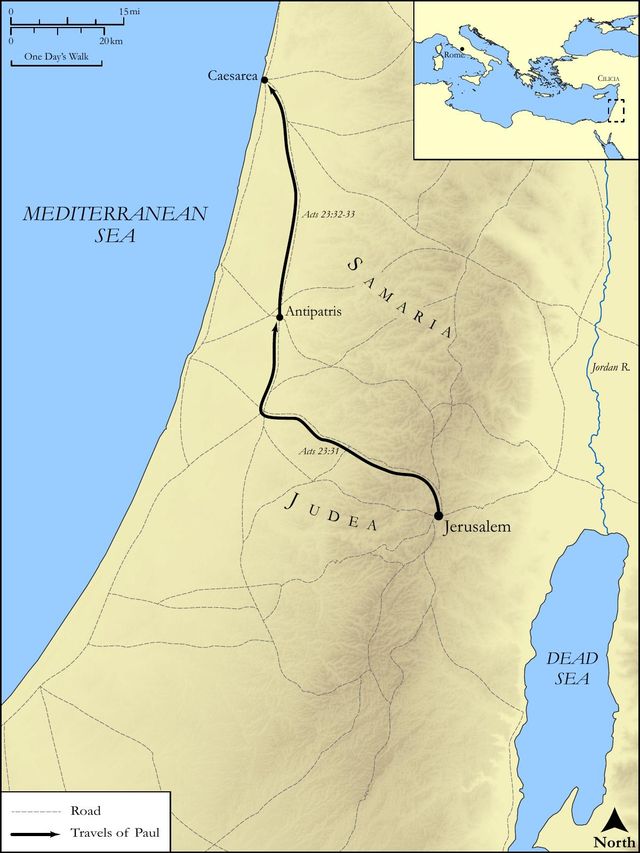
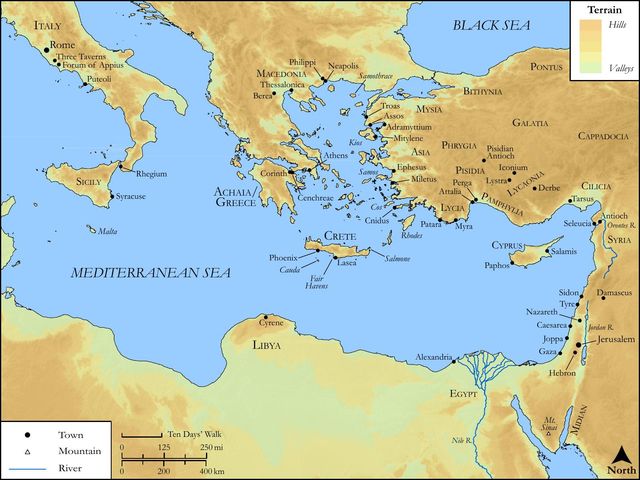
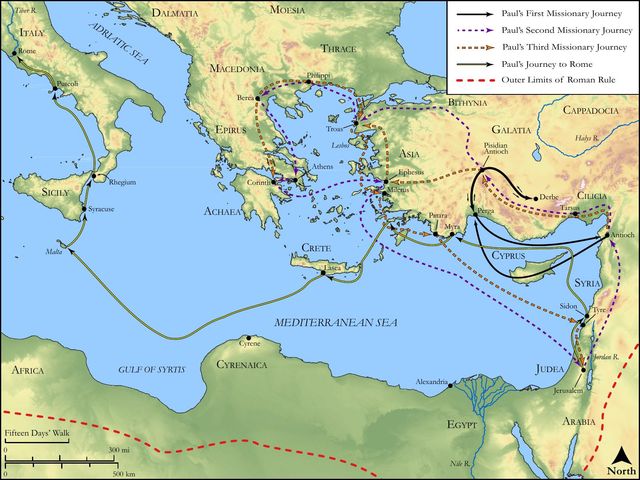
Study this verse
Public-domain commentary
Matthew Henry
From his Commentary on the Whole Bible. Henry comments on passages, not single verses — this entry covers Acts 23:6–11. His four-level outline is real structure in the source text, so it is rendered as structure.
Many are the troubles of the righteous, but some way or other the Lord delivereth them out of them all. Paul owned he had experienced the truth of this in the persecutions he had undergone among the Gentiles (see Ti2 3:11): Out of them all the Lord delivered me. And now he finds that he who has delivered does and will deliver. He that delivered him in the foregoing chapter from the tumult of the people here delivers him from that of the elders.
I.His own prudence and ingenuity stand him in some stead, and contribute much to his escape.
Paul's greatest honour, and that upon which he most valued himself, was that he was a Christian, and an apostle of Christ; and all his other honours he despised and made nothing of, in comparison with this, counting them but dung, that he might win Christ; and yet he had sometimes occasion to make use of his other honours, and they did him service. His being a citizen of Rome saved him in the foregoing chapter from his being scourged by the chief captain as a vagabond, and here his being a Pharisee saved him from being condemned by the sanhedrim, as an apostate from the faith and worship of the God of Israel. It will consist very well with our willingness to suffer for Christ to use all lawful methods, nay, and arts too, both to prevent suffering and to extricate ourselves out of it. The honest policy Paul used here for his own preservation was to divide his judges, and to set them at variance one with another about him; and, by incensing one part of them more against him, to engage the contrary part for him.
1.The great council was made up of Sadducees and Pharisees, and Paul perceived it. He knew the characters of many of them ever since he lived among them, and saw those among them whom he knew to be Sadducees, and others whom he knew to be Pharisees (Act 23:6): One part were Sadducees and the other Pharisees, and perhaps nearly an equal part. Now these differed very much from one another, and yet they ordinarily agreed well enough to do the business of the council together.
(1.)The Pharisees were bigots, zealous for the ceremonies, not only those which God had appointed, but those which were enjoined by the tradition of the elders. They were great sticklers for the authority of the church, and for enforcing obedience to its injunctions, which occasioned many quarrels between them and our Lord Jesus; but at the same time they were very orthodox in the faith of the Jewish church concerning the world of spirits, the resurrection of the dead, and the life of the world to come.
(2.)The Sadducees were deists - no friends to the scripture, or divine revelation. The books of Moses they admitted as containing a good history and a good law, but had little regard to the other books of the Old Testament; see Mat 22:23. The account here given of these Sadducees is,
[1.]That they deny the resurrection; not only the return of the body to life, but a future state of rewards and punishments. They had neither hope of eternal happiness nor dread of eternal misery, nor expectation of any thing on the other side death; and it was upon these principles that they said, It is in vain to serve God, and called the proud happy, Mal 3:14, Mal 3:15.
[2.]That they denied the existence of angels and spirits, and allowed of no being but matter. They thought that God himself was corporeal, and had parts and members as we have. When they read of angels in the Old Testament, they supposed them to be messengers that God made and sent on his errands as there was occasion, or that they were impressions on the fancies of those they were sent to, and no real existences - that they were this, or that, or any thing rather than what they were. And, as for the souls of men, they looked upon them to be nothing else but the temperament of the humours of the body, or the animal spirits, but denied their existence in a state of separation from the body, and any difference between the soul of a man and of a beast. These, no doubt, pretended to be free-thinkers, but really thought as meanly, absurdly, and slavishly, as possible. It is strange how men of such corrupt and wicked principles could come into office, and have a place in the great sanhedrim; but many of them were of quality and estate, and they complied with the public establishment, and so got in and kept in. But they were generally stigmatized as heretics, were ranked with the Epicureans, and were prayed against and excluded from eternal life. The prayer which the modern Jews use against Christians, Witsius thinks, was designed by Gamaliel, who made it, against the Sadducees; and that they meant them in their usual imprecation, Let the name of the wicked rot. But how degenerate was the character and how miserable the state of the Jewish church, when such profane men as these were among their rulers!
2.In this matter of difference between the Pharisees and Sadducees Paul openly declared himself to be on the Pharisees' side against the Sadducees (Act 23:6): He cried out, so as to be heard by all, "I am a Pharisee, was bred a Pharisee, nay, I was born one, in effect, for I was the son of a Pharisee, my father was one before me, and thus far I am still a Pharisee that I hope for the resurrection of the dead, and I may truly say that, if the matter were rightly understood, it would be found that this is it for which I am now called in question." When Christ was upon earth the Pharisees set themselves most against him, because he witnessed against their traditions and corrupt glosses upon the law; but, after his ascension, the Sadducees set themselves most against his apostles, because they preached through Jesus the resurrection of the dead, Act 4:1, Act 4:2. And it is said (Act 5:17) that they were the sect of the Sadducees that were filled with indignation at them, because they preached that life and immortality which is brought to light by the gospel. Now here,
(1.)Paul owns himself a Pharisee, so far as the Pharisees were in the right. Though as Pharisaism was opposed to Christianity he set himself against it, and against all its traditions that were set up in competition with the law of God or in contradiction to the gospel of Christ, yet, as it was opposed to Sadducism, he adhered to it. We must never think the worse of any truth of God, nor be more shy of owning it, for its being held by men otherwise corrupt. If the Pharisees will hope for the resurrection of the dead, Paul will go along with them in that hope, and be one of them, whether they will or no.
(2.)He might truly say that being persecuted, as a Christian, this was the thing he was called in question for. Perhaps he knew that the Sadducees, though they had not such an interest in the common people as the Pharisees had, yet had underhand incensed the mob against him, under pretence of his having preached to the Gentiles, but really because he had preached the hope of the resurrection. However, being called in question for his being a Christian, he might truly say he was called in question for the hope of the resurrection of the dead, as he afterwards pleaded, Act 24:15, and Act 26:6, Act 26:7. Though Paul preached against the traditions of the elders (as his Master had done), and therein opposed the Pharisees, yet he valued himself more upon his preaching the resurrection of the dead, and a future state, in which he concurred with the Pharisees.
3.This occasioned a division in the council. It is probable that the high priest sided with the Sadducees (as he had done Act 5:17, and made it to appear by his rage at Paul, Act 23:2), which alarmed the Pharisees so much the more; but so it was, there arose a dissension between the Pharisees and the Sadducees (Act 23:7), for this word of Paul's made the Sadducees more warm and the Pharisees more cool in the prosecution of him; so that the multitude was divided; eschisthē - there was a schism, a quarrel among them, and the edge of their zeal began to turn from Paul against one another; nor could they go on to act against him when they could not agree among themselves, or prosecute him for breaking the unity of the church when there was so little among them of the unity of the spirit. All the cry had been against Paul, but now there arose a great cry against one another, Act 23:9. So much did a fierce furious spirit prevail among all orders of the Jews at this time that every thing was done with clamour and noise; and in such a tumultuous manner were the great principles of their religion stickled for, by which they received little service, for the wrath of man worketh not the righteousness of God. Gainsayers may be convinced by fair reasoning, but never by a great cry.
4.The Pharisees hereupon (would one think it?) took Paul's part (Act 23:9): They strove, diemachonto - They fought, saying, We find no evil in this man. He had conducted himself decently and reverently in the temple, and had attended the service of the church; and, though it was but occasionally, yet it showed that he was not such an enemy to it as he was said to be. He had spoken very handsomely in his own defence, and given a good account of himself, and had now declared himself orthodox in the great principles of religion, as well as regular and conscientious in his conversation; and therefore they cannot see that he has done any thing worthy of death of bonds. Nay, they go further, "If a spirit or an angel hath spoken to him concerning Jesus, and put him upon preaching as he does, though we may not be so far satisfied as to give credit to him, yet we ought to be cautioned not to oppose him, lest we be found fighting against God;" as Gamaliel, who was himself a Pharisee, had argued, Act 5:39. Now here,
(1.)We may observe, to the honour of the gospel, that it was witnessed to even by its adversaries, and confessions, not only of its innocency, but of its excellency, were extorted sometimes by the power of truth even from those that persecuted it. Pilate found no fault in Christ though he put him to death, nor Festus in Paul though he detained him in bonds; and the Pharisees here supposed it possible that Paul might have a commission sent him for heaven by an angel to do what he did; and yet it should seem, as elders, they after this joined with the high priest in prosecuting him, Act 24:1. They sinned against the knowledge which they not only had, but sometimes owned, as Christ had said of them, They have both seen and hated both me and my Father, Joh 15:24. Yet,
(2.)We will hope that some of them at least did henceforward conceive a better opinion of Paul than they had had, and were favourable to him, having had such a satisfactory account both of his conversation in all good conscience and of his faith touching another world; and then it must be observed to their honour that their zeal for the traditions of the elders, which Paul had departed fRom. was so far swallowed up in a zeal for the great and fundamental doctrines of religion, to which Paul still adhered, that if he will heartily join with them against the Sadducees, and adhere to the hope of the resurrection of the dead, they will not think his shaking off the ceremonial law to be an evil in him, but charitably hope that he walks according to the light God has given him by some angel or spirit, and are so far from persecuting him that they are ready to patronize and protect him. The persecuting Pharisees of the church of Rome are not of this spirit: for let a man be ever so sincere and zealous for all the articles of the Christian faith, yet, if he lay not his neck under the yoke of their church's authority, they find evil enough in him to persecute him unto the death.
II.The chief captain's care and conduct stand him in more stead; for when he has thrown this bone of contention between the Pharisees and Sadducees (which set them together by the ears, and gained a fair testimony from the Pharisees), yet he is never the nearer, but is in danger of being pulled in pieces by them - the Pharisees pulling to have him set at liberty, and the Sadducees pulling to have him put to death, or thrown to the people, like Daniel into the den of lions; so that the chief captain is forced to come with his soldiers and rescue him, as he had done, Act 21:32, and Act 22:24.
1.See here Paul's danger. Between his friends and his enemies he had like to have been pulled to pieces, the one hugging him to death, the other crushing him to death, such violences are those liable to that are eminent, and that are become remarkable, as Paul was, who was by some so much beloved and by others so much maligned.
2.His deliverance: The chief captain ordered his soldiers to go down from the upper wards, and to take them by force from among them, out of that apartment in the temple where he had ordered the council to meet, and to bring him into the castle, or tower of Antonio; for he saw he could make nothing of them towards the understanding of the merits of his cause.
III.Divine consolations stood him in most stead of all.
The chief captain had rescued him out of the hands of cruel men, but still he had him in custody, and what might be the issue he could not tell. The castle was indeed a protection to him, but withal it was a confinement; and, as it was now his preservation from so great a death, it might be his reservation for a greater. We do not find that any of the apostles or elders at Jerusalem came to him; either they had not courage or they had not admission. Perhaps, in the night following, Paul was full of thoughts and cares what should become of him, and how his present troubles might be turned to answer some good purpose. Then did the Lord Jesus make him a kind visit, and, thought at midnight, yet a very seasonable one (Act 23:11): The Lord stood by him, came to his bed-side, though perhaps it was but a bed of straw, to show him that he was all the day long with him really as sure as he was in the night with him visibly. Note, Whoever is against us, we need not fear if the Lord stand by us; if he undertake our protection, we may set those that seek our ruin at defiance. The Lord is with those that uphold my soul, and then nothing can come amiss.
1.Christ bids him have a good heart upon it: "Be of good cheer, Paul; be not discouraged; let not what has happened sadden thee, nor let what may yet be before thee frighten thee." Note, It is the will of Christ that his servants who are faithful should be always cheerful. Perhaps Paul, in the reflection, began to be jealous of himself whether he had done well in what he said to the council the day before; but Christ, by his word, satisfies him that God approved of his conduct. Or, perhaps, it troubled him that his friends did not come to him; but Christ's visit did itself speak, though he had not said, Be of good cheer, Paul.
2.It is a strange argument which he makes use of to encourage him: As thou hast testified of me in Jerusalem, so must thou bear witness also at Rome. One would think this was but cold comfort: "As thou hast undergone a great deal of trouble for me so thou must undergo a great deal more;" and yet this was designed to encourage him; for hereby he is given to understand,
(1.)That he had been serving Christ as a witness for him in what he had hitherto endured. It was for no fault that he was buffeted, and it was not his former persecuting of the church that was now remembered against him, however he might remember it against himself, but he was still going on with his work.
(2.)That he had not yet finished his testimony, nor was, by his imprisonment, laid aside as useless, but was only reserved for further service. Nothing disheartened Paul so much as the thought of being taken off from doing service to Christ and good to souls: Fear not, says Christ, I have not done with thee,
(3.)Paul seems to have had a particular fancy, and an innocent one, to go to Rome, to preach the gospel there, though it was already preached, and a church planted there; yet, being a citizen of Rome, he longed for a journey thither, and had designed it (Act 19:21): After I have been at Jerusalem, I must also see Rome. And he had written to the Romans some time ago that he longed to see them, Rom 1:11. Now he was ready to conclude that this had broken his measures, and he should never see Rome; but even in that Christ tells him he should be gratified, since he desired it for the honour of Christ and to do good.
Historical interpretation
Five Centuries of Reception
4 surviving comments on this verse. Each one is dated, so this reads as a timeline rather than a list.
Select a marker to jump to its quote. Markers stagger vertically where authors wrote within a few decades of each other.
You find Paul confessing his faith before the chief priests, under the shelter of the chief captain, among the Sadducees and the Pharisees: "Men and brethren," he says, "I am a Pharisee, the son of a Pharisee; of the hope and resurrection of the dead I am now called in question by you," -referring, of course, to the nation's hope; in order to avoid, in his present condition, as an apparent transgressor of the law, being thought to approach to the Sadducees in opinion on the most important article of the faith-even the resurrection.
"I," he says, "am a Pharisee:" then, that he may not seem to pay court, he adds, "Of the hope and resurrection of the dead it is, that I am called in question." From this charge and calumny he commends himself.
Again he discourses simply as man, and he does not on all occasions alike enjoy the benefit of supernatural aid. "I am a Pharisee, the son of a Pharisee:" both in this, and in what comes after it, he wished to divide the multitude, which had an evil unanimity against him. And he does not speak a falsehood here either: for he was a Pharisee by descent from his ancestors. "Of the hope and resurrection of the dead I am called in question." For since they would not say for what reason they arraigned him, he is compelled therefore to declare it himself.
Brothers, I am a Pharisee, etc. Just as the unity of the good is always useful, so the unity of the wicked is always harmful to the good. Therefore, now the Apostle strives to dissociate his persecutors so that they, united, would surround him, but divided, would release him. Thus the Red Sea, which as solid had confined the children of Israel, when divided, freed them from Egypt. But that he attests to being a son of Pharisees, or, according to the Greek, a son of a Pharisee, is what above he glories in, having learned the law and the prophets at the feet of Gamaliel, who is read to be a Pharisee.
Continue studying Acts 23:6 across the web’s major study libraries — every link below opens this exact verse, chapter, or book on the destination site.
Read & Compare
 BibleGatewayThis verse in more than 200 translations and 70 languages.
 Bible.comThe YouVersion reader — hundreds of translations, reading plans, and highlights.
 ESV.orgCrossway's official English Standard Version reader.
 NET BibleThe NET translation with 60,000+ translators' notes on every rendering decision.
 STEP BibleTyndale House's free study tool — original text, vocabulary, and scholarly resources.
 BibliaLogos Bible Software's free web reader.
 USCCBThe New American Bible (Revised Edition) with the U.S. bishops' study notes.
Commentaries
 BibleHub CommentariesDozens of classic commentaries on this verse, gathered on one page.
 StudyLightMore than 100 commentary sets — the largest collection on the web.
 BibleRefPlain-English commentary on what this verse means, verse by verse.
 Enduring WordDavid Guzik's free commentary on this chapter, widely used by Bible teachers.
 Bible Study ToolsVerse commentary alongside Greek and Hebrew study aids.
Original Language & Research
- BibleHub InterlinearThe verse word by word — original language, transliteration, and English.
- BibleHub LexiconEvery word's original-language definition and Strong's entry.
 Blue Letter BibleDeep-study tools — Strong's numbers, concordance, and word studies.
 CNTR CollationThe earliest Greek manuscripts of this verse, collated letter by letter.
Sermons, Hymns & Audio


TrulyRandomVerse is not affiliated with these sites and doesn’t control their content. They’re linked because they’re genuinely useful.
Summary
In Acts 23:6, facing a hostile Sanhedrin divided into Sadducees and Pharisees, the Apostle Paul strategically declares his identity as a Pharisee and asserts that he is on trial concerning the "hope and resurrection of the dead." This declaration masterfully exploits the deep theological rift between the two dominant Jewish factions, effectively shifting the focus of the accusation from his alleged profanation of the temple to a fundamental tenet of Jewish belief, thereby creating dissension among his accusers and highlighting the true spiritual nature of his persecution.
Context
ShowHideLiterary Context
This verse immediately follows Paul's tumultuous appearance before the Sanhedrin, convened by the Roman commander Lysias after Paul's arrest in Jerusalem (Acts 22:30). Paul's initial attempt to defend himself was met with violence and an order from the High Priest Ananias to strike him (Acts 23:1-5). Recognizing the futility of a direct defense before a unified, hostile council, Paul observes the composition of the Sanhedrin—a mix of Sadducees and Pharisees—and seizes a strategic opportunity to divide his opponents by appealing to their core theological disagreements, particularly regarding the resurrection, a theme central to his gospel message. The ensuing chaos (Acts 23:7-10) demonstrates the immediate effectiveness of his tactic.
Historical & Cultural Context
The Sanhedrin was the supreme Jewish judicial and legislative body in Jerusalem during the Second Temple period, comprising 71 members, including the High Priest, elders, and scribes. It was notoriously split between two major parties: the Sadducees and the Pharisees. The Sadducees, largely from the priestly and aristocratic elite, adhered strictly to the written Torah and rejected the oral law, the resurrection of the dead, the existence of angels, and spirits (as explicitly stated in Acts 23:8). They were generally more Hellenized and pragmatic, often collaborating with Roman authorities to maintain their power. The Pharisees, on the other hand, were a more popular, pious, and nationalistic party, emphasizing meticulous observance of both written and oral law, and crucially, they believed in the resurrection, angels, and spirits. Paul, having been educated as a Pharisee under Gamaliel (Acts 22:3), was intimately familiar with these distinctions and the deep animosity between the two groups.
Key Themes
ShowHideActs 23:6 contributes to several key themes within the book of Acts and Paul's ministry. Firstly, it highlights Paul's strategic acumen and quick thinking in moments of crisis, demonstrating his ability to navigate complex political and religious landscapes for the sake of the gospel. Secondly, it underscores the centrality of the resurrection to both Jewish belief (for the Pharisees) and Christian theology, revealing that Paul's "new" message was, in fact, the fulfillment of ancient Jewish hope, particularly the hope of the resurrection, as argued in Acts 24:15. Thirdly, the verse vividly portrays the theological divisions within Judaism itself, showing that not all Jewish leaders were united against Paul, and that his message resonated with certain foundational Jewish beliefs. Finally, it reinforces the theme of persecution for the gospel's sake, indicating that Paul's suffering was not for criminal acts but for his unwavering proclamation of the resurrected Christ.
Exposition and Analysis
ShowHideKey Word Analysis
ShowHideThis verb signifies more than mere observation; it implies a deep understanding, a recognition of the underlying reality or truth. Paul "knew" or "understood" the composition of the council, allowing him to discern the strategic opportunity presented by their internal divisions. It speaks to his spiritual and intellectual insight.
This word describes a loud, emphatic utterance, often conveying urgency, passion, or even a public proclamation. Paul's declaration was not a quiet whisper but a forceful shout, designed to be heard by the entire council and to immediately ignite the latent conflict between the two factions.
In this context, "hope" refers to a confident expectation, particularly concerning future events, and here, specifically the resurrection. For the Pharisees, this was a foundational belief in God's future action to raise the dead. For Paul, this hope was now realized and guaranteed in the resurrection of Jesus Christ, making his message a fulfillment, not a contradiction, of this ancient Jewish expectation.
Verse Breakdown
ShowHide"But when Paul perceived that the one part were Sadducees, and the other Pharisees,"
This clause reveals Paul's keen observation and strategic insight. He quickly assessed the composition of the Sanhedrin, recognizing the fundamental theological divide between the two dominant factions. This perception was crucial for his subsequent tactical maneuver.
"he cried out in the council, Men and brethren, I am a Pharisee, the son of a Pharisee:"
Paul's loud declaration is a direct and forceful appeal to his heritage and identity. By proclaiming himself a Pharisee, he immediately aligns himself with one major party, invoking a sense of shared identity and theological common ground, while simultaneously highlighting his deep roots within Jewish tradition. The address "Men and brethren" seeks to establish a connection, despite the adversarial context.
"of the hope and resurrection of the dead I am called in question."
This is the crux of Paul's strategic move. He reframes the entire accusation, shifting it from alleged temple desecration or sedition to a theological dispute concerning the resurrection. This was the very point on which Sadducees and Pharisees fundamentally disagreed, ensuring that his statement would provoke immediate and intense division within the council, thereby diverting attention from himself and his Christian message to their internal conflict.
Literary Devices
ShowHidePaul's declaration in Acts 23:6 masterfully employs several literary and rhetorical devices. Anaphora is evident in the repetition of "Pharisee," emphasizing his identity and lineage, which would resonate strongly with the Pharisaic members of the council. This also serves as a form of identification, where Paul strategically aligns himself with a specific group to gain their sympathy and support. The entire statement functions as a powerful example of rhetorical strategy, where Paul, under immense pressure, uses his knowledge of his audience's internal dynamics to his advantage, turning their division into his defense. His "crying out" (krázō) suggests dramatic emphasis, ensuring his words cut through the tension and immediately command attention, setting the stage for the ensuing chaos.
Theological and Thematic Connections
ShowHidePaul's declaration in Acts 23:6 profoundly connects the Christian message to the core hopes of faithful Judaism, particularly through the doctrine of the resurrection. For Paul, the resurrection of Jesus Christ was not a deviation from Jewish belief but its ultimate fulfillment, the very "hope" that many Jews, especially the Pharisees, had long awaited. His trial, therefore, was not about a new, foreign religion, but about the culmination of God's redemptive plan, centered on the bodily resurrection of the Messiah. This highlights that the gospel is deeply rooted in the Old Testament promises and Jewish expectation, presenting Jesus as the one who brings the long-anticipated hope of resurrection to fruition.
Reflection and Application
ShowHidePaul's actions in Acts 23:6 offer profound lessons for believers today, particularly regarding wisdom, conviction, and discerning the true nature of opposition. Paul did not compromise his message, but he wisely understood his audience and strategically presented the truth in a way that exposed the underlying spiritual issues. This teaches us the importance of being "wise as serpents and innocent as doves" (Matthew 10:16)—to be discerning and strategic in our engagement with a skeptical or hostile world, without resorting to deception. Our conviction in the core tenets of faith, especially the resurrection of Christ, should be unwavering, for it is the foundation of our hope and the power of our witness. Furthermore, Paul's experience reminds us that opposition to the gospel often stems from deeper theological or spiritual disagreements, even when presented as moral or social accusations. We must learn to identify the true heart of the matter and boldly declare the truth, trusting God to vindicate His word.
Questions for Reflection
ShowHideFAQ
ShowHideWas Paul being deceptive by calling himself a Pharisee, given his conversion to Christianity?
ShowHideNo, Paul was not being deceptive. While Paul had converted to faith in Jesus as the Messiah, he genuinely remained a Pharisee in his theological convictions regarding the resurrection of the dead, the existence of angels, and the authority of God's law. His Christian faith was, for him, the fulfillment of true Pharisaic hope, not its abandonment. He continued to uphold the Old Testament scriptures and the belief in a future resurrection, which he now understood was inaugurated by Jesus' own resurrection. His declaration was a statement of his true background and his continued adherence to a core Pharisaic doctrine, which distinguished him from the Sadducees. As he later states in Acts 24:14, he worshipped the God of his fathers, believing "all things which are written in the law and in the prophets."
Christ-Centered Fulfillment
ShowHideActs 23:6, with Paul's bold declaration, finds its ultimate Christ-centered fulfillment in the person and work of Jesus Christ, particularly His resurrection. Paul's assertion that he was on trial "of the hope and resurrection of the dead" directly points to the pivotal event of Christian faith: the bodily resurrection of Jesus. For Paul, the "hope" of Israel, long anticipated by the prophets and believed by the Pharisees, was not merely a future event but had decisively broken into history through Christ. Jesus is the "firstfruits of those who are asleep" (1 Corinthians 15:20), guaranteeing the future resurrection of all who believe in Him. Paul's trial, therefore, was not merely a dispute over an abstract doctrine but a confrontation over the living reality of the resurrected Messiah, who had transformed his life and was the very embodiment of the hope for which he was being persecuted. The "hope and resurrection of the dead" finds its complete and glorious realization in Jesus, the Lord of life, who conquered death and offers eternal life to all who call upon His name (Romans 6:4).