


Acts 22:24
- ἐκέλευσενekeleusenOrderedG2753V-AAI-3SVerb Aorist Active Indicative 3rd Singular
- ὁhotheG3588T-NSMDefinite article Nominative Singular Masculine
- χιλίαρχοςchiliarchoscommanderG5506N-NSMNoun Nominative Singular Masculine
- εἰσάγεσθαιeisagesthaito be brought inG1521V-PPNVerb Present Passive Infinitive
- αὐτὸνautonhimG846P-ASMPersonal pronoun Accusative Singular Masculine
- εἰςeisintoG1519PREPPreposition
- τὴνtēntheG3588T-ASFDefinite article Accusative Singular Feminine
- παρεμβολὴνparembolēnbarracksG3925N-ASFNoun Accusative Singular Feminine
- εἴπαςeipashaving directedG2036V-2AAP-NSMVerb 2nd Aorist Active Participle Nominative Singular Masculine
- μάστιξινmastixinby floggingG3148N-DPFNoun Dative Plural Feminine
- ἀνετάζεσθαιanetazesthaito be examinedG426V-PPNVerb Present Passive Infinitive
- αὐτόνautonhimG846P-ASMPersonal pronoun Accusative Singular Masculine
- ἵναinaso thatG2443CONJConjunction
- ἐπιγνῷepignōhe may knowG1921V-2AAS-3SVerb 2nd Aorist Active Subjunctive 3rd Singular
- δι᾽di᾽forG1223PREPPreposition
- ἣνhēnwhatG3739R-ASFRelative pronoun Accusative Singular Feminine
- αἰτίανaitiancauseG156N-ASFNoun Accusative Singular Feminine
- οὕτωςhoutōslike thisG3779ADVAdverb
- ἐπεφώνουνepephōnounthey were crying outG2019V-IAI-3PVerb Imperfect Active Indicative 3rd Plural
- αὐτῷautōagainst himG846P-DSMPersonal pronoun Dative Singular Masculine
English is a literal word-by-word gloss of the Greek, not the KJV's wording. Why?
This is the original text the KJV's translators worked from — each Greek word with its own literal English meaning in this verse, prepared by scholars at Tyndale House, Cambridge. The KJV translates whole sentences, not word by word, so its wording differs: one Greek word can become several English words, and the KJV may choose “charity” where the gloss reads “love”. Both are faithful — they answer different questions. For the KJV's own rendering, switch to the KJV text.
Details
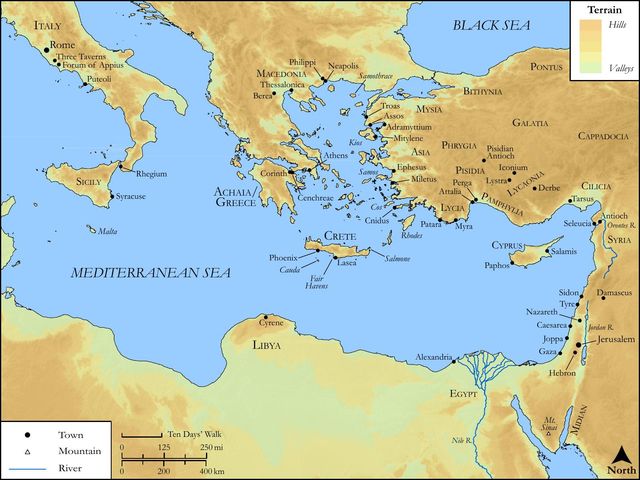
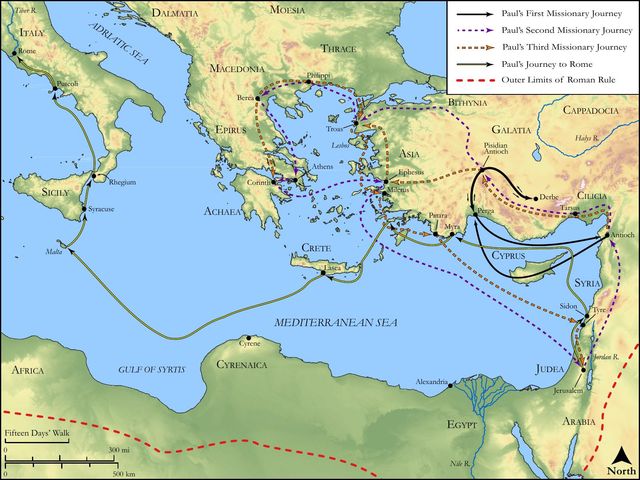
See on the biblical-era map
Study this verse
Public-domain commentary
Matthew Henry
From his Commentary on the Whole Bible. Henry comments on passages, not single verses — this entry covers Acts 22:22–30. His three-level outline is real structure in the source text, so it is rendered as structure.
Paul was going on with this account of himself, had shown them his commission to preach among the Gentiles without any peevish reflections upon the Jews, and we may suppose designed next to show how he was afterwards, by a special direction of the Holy Ghost at Antioch, separated to this service, how tender he was of the Jews, how respectful to them, and how careful to give them the precedency in all places whither he came, and to unite Jews and Gentiles in one body; and then to show how wonderfully God had owned him, and what good service had been done to the interest of God's kingdom among men in general, without damage to any of the true interests of the Jewish church in particular. But, whatever he designs to say, they resolve he shall say no more to them: They gave him audience to this word. Hitherto they had heard him with patience and some attention. But when he speaks of being sent to the Gentiles, though it was what Christ himself said to him, they cannot bear it, not so much as to hear the Gentiles named, such an enmity had they to them, and such a jealousy of them. Upon the mention of this, they have no manner of patience, but forget all rules of decency and equity; thus were they provoked to jealousy by those that were no people, Rom 10:19.
Now here we are told how furious and outrageous the people were against Paul, for mentioning the Gentiles as taken into the cognizance of divine grace, and so justifying his preaching among them.
I.They interrupted him, by lifting up their voice, to put him into confusion, and that nobody might hear a word he said.
Galled consciences kick at the least touch; and those who are resolved not to be rules by reason commonly resolve not to hear it if they can help it. And the spirit of enmity against the gospel of Christ commonly shows itself in silencing the ministers of Christ and his gospel, and stopping their mouths, as the Jews did Paul's here. Their fathers had said to the best of seers, See not, Isa 30:10. And so they to the best of speakers, Speak not. Forbear, wherefore shouldst thou be smitten? Ch2 25:16.
II.They clamoured against him as one that was unworthy of life, much more of liberty.
Without weighing the arguments he had urged in his own defence, or offering to make any answer to them, they cried out with a confused noise, "Away with such a fellow as this from the earth, who pretends to have a commission to preach to the Gentiles; why, it is not fit that he should live." Thus the men that have been the greatest blessings of their age have been represented not only as the burdens of the earth, but the plague of their generation. He that was worthy of the greatest honours of life is condemned as not worthy of life itself. See what different sentiments God and men have of good men, and yet they both agree in this that they are not likely to live long in this world. Paul says of the godly Jews that they were men of whom the world was not worthy, Heb 11:38. And therefore they must be removed, that the world may be justly punished with the loss of them. The ungodly Jews here say of Paul that it was not fit he should live; and therefore he must be removed, that the world may be eased of the burden of him, as of the two witnesses, Rev 11:10.
III.They went stark mad against Paul, and against the chief captain for not killing him immediately at their request, or throwing him as a pry into their teeth, that they might devour him (Act 22:23); as men whose reason was quite lost in passion, they cried out like roaring lions or raging bears, and howled like the evening wolves; they cast off their clothes with fury and violence, as much as to say that thus they would tear him if they could but come at him. Or, rather, they thus showed how ready they were to stone him; those that stoned Stephen threw off their clothes, Act 22:20. Or, they rent their clothes, as if he had spoken blasphemy; and threw dust into the air, in detestation of it; or signifying how ready they were to throw stones at Paul, if the chief captain would have permitted them. But why should we go about to give a reason for these experiences of fury, which they themselves could not account for? All they intended was to make the chief captain sensible how much they were enraged and exasperated at Paul, so that he could not do any thing to gratify them more than to let them have their will against him.
IV.The chief captain took care for his safety, by ordering him to be brought into the castle, Act 22:24.
A prison sometimes has been a protection to good men from popular rage. Paul's hour was not yet come, he had not finished his testimony, and therefore God raised up one that took care of him, when none of his friends durst appear on his behalf. Grant not, O Lord, the desire of the wicked.
V.He ordered him the torture, to force from him a confession of some flagrant crimes which had provoked the people to such an uncommon violence against him. He ordered that he should be examined by scourging (as now in some countries by the rack), that he might know wherefore they cried so against him. Herein he did not proceed fairly; he should have singled out some of the clamorous tumultuous complainants, and taken them into the castle as breakers of the peace, and should have examined them, and by scourging too, what they had to lay to the charge of a man that could give so good an account of himself, and did not appear to have done any thing worthy of death or of bonds. It was proper to ask them, but not at all proper to ask Paul, wherefore they cried so against him. He could tell that he had given them no just cause to do it; if there were any cause, let them produce it. No man is bound to accuse himself, though he be guilty, much less ought he to be compelled to accuse himself when he is innocent. Surely the chief captain did not know the Jewish nation when he concluded that he must needs have done something very bad whom they cried out against. Had they not just thus cried out against our Lord Jesus, Crucify him, crucify him, when they had not one word to say in answer to the judge's question, Why, what evil has he done? Is this a fair or just occasion to scourge Paul, that a rude tumultuous mob cry out against him, but cannot tell why or wherefore, and therefore he must be forced to tell?
VI.Paul pleaded his privilege as a Roman citizen, by which he was exempted from all trials and punishments of this nature (Act 22:25):
As they bound him with thongs, or leathern bands, to the whipping post, as they used to bind the vilest of malefactors in bridewell from whom they would extort a confession, he made no outcry against the injustice of their proceedings against an innocent man, but very mildly let them understand the illegality of their proceedings against him as a citizen of Rome, which he had done once before at Philippi after he had been scourged (Act 16:37), but here he makes use of it for prevention. He said to the centurion that stood by, "You know the law; pray is it lawful for you who are yourselves Romans to scourge a man that is a Roman, and uncondemned?" The manner of his speaking plainly intimates what a holy security and serenity of mind this good man enjoyed, not disturbed either with anger or fear in the midst of all those indignities that were done him, and the danger he was in. The Romans had a law (it was called lex Sempronia), that if any magistrate did chastise or condemn a freeman of Rome, indicta causa - without hearing him speak for himself, and deliberating upon the whole of his case, he should be liable to the sentence of the people, who were very jealous of their liberties. It is indeed the privilege of every man not to have wrong done him, except it be proved he has done wrong; as it is of every Englishman by Magna Charta not to be dis-seized of his life or freehold, but by a verdict of twelve men of his peers.
VII.The chief captain was surprised at this, and put into a fright.
He had taken Paul to be a vagabond Egyptian, and wondered he could speak Greek (ch. 21:37), but is much more surprised now he finds that he is as good a gentleman as himself. How many men of great worth and merit are despised because they are not known, are looked upon and treated as the offscouring of all things, when those that count them so, if they knew their true character, would own them to be of the excellent ones of the earth! The chief captain had centurions, under-officers, attending him, ch. 21:32. One of these reports this matter to the chief captain (Act 22:26): Take heed what thou doest, for this man is a Roman, and what indignity is done to him will be construed an offence against the majesty of the Roman people, as they loved to speak. They all knew what a value was put upon this privilege of the Roman citizens. Tully extols it in one of his orations against Verres, O nomen dulce libertatis, O jus eximium nostrae civitatis! O lex Porcia! O leges Semproniae; facinus est vincere Romanum civem, scelus verberare - O Liberty! I love thy charming name; and these our Porcian and Sempronian laws, how admirable! It is a crime to bind a Roman citizen, but an unpardonable one to beat him. "Therefore" (says the centurion) "let us look to ourselves; if this man be a Roman, and we do him any indignity, we shall be in danger to lose our commissions at least." Now,
1.The chief captain would be satisfied of the truth of this from his own mouth (Act 22:27): "Tell me, art thou a Roman? Art thou entitled to the privileges of a Roman citizen?" "Yes," says Paul, "I am;" and perhaps produced some ticket or instrument which proved it; for otherwise they would scarcely have taken his word.
2.The chief captain very freely compares notes with him upon this matter, and it appears that the privilege Paul had as a Roman citizen was of the two more honourable than the colonel's; for the colonel owns that his was purchased: "I am a freeman of Rome; but with a great sum obtained I this freedom, it cost me dear, how came you by it?" "Why truly," says Paul, "I was free-born." Some think he became entitled to this freedom by the place of his birth, as a native of Tarsus, a city privileged by the emperor with the same privileges that Rome itself enjoyed; others rather think it was by his father or grandfather having served in the war between Caesar and Antony, or some other of the civil wars of Rome, and being for some signal piece of service rewarded with a freedom of the city, and so Paul came to be free-born; and here he pleads it for his own preservation, for which end not only we may but we ought to use all lawful means.
3.This put an immediate stop to Paul's trouble. Those that were appointed to examine him by scourging quitted the spot; they departed from him (Act 22:29), lest they should run themselves into a snare. Nay, and the colonel himself, though we may suppose him to have a considerable interest, was afraid when he heard he was a Roman, because, though he had not beaten him, yet he had bound him in order to his being beaten. Thus many are restrained from evil practices by the fear of man who would not be restrained from them by the fear of God. See here the benefit of human laws and magistracy, and what reason we have to be thankful to God for them; for even when they have given no countenance nor special protection to God's people and ministers, yet, by the general support of equity and fair dealing between man and man, they have served to check the rage of wicked and unreasonable illegal men, who otherwise would know no bounds, and to say, Hitherto it shall come, but no further; here shall its proud waves by stayed. And therefore this service we owe to all in authority, to pray for them, because this benefit we have reason to expect from them, whether we have it or no, as long as we are quiet and peaceable - to live quiet and peaceable lives in all godliness and honesty, Ti1 2:1, Ti1 2:2.
4.The governor, the next day, brought Paul before the sanhedrim, Act 22:30. He first loosed him from his bands, that those might not prejudge his cause, and that he might not be charged with having pinioned a Roman citizen, and then summoned the chief priests and all their council to come together to take cognizance of Paul's case, for he found it to be a matter of religion, and therefore looked upon them to be the most proper judges of it. Gallio in this case discharged Paul; finding it to be a matter of their law, he drove the prosecutors from the judgement-seat (Act 18:16), and would not concern himself at all in it; but this Roman, who was a military man, kept Paul in custody, and appealed from the rabble to the general assembly. Now,
(1.)We may hope that hereby he intended Paul's safety, as thinking, if he were an innocent and inoffensive man, though the multitude might be incensed against him, yet the chief priests and elders would do him justice, and clear him; for they were, or should be, men of learning and consideration, and their court governed by rules of equity. When the prophet could find no good among the poorer sort of people, he concluded that it was because they knew not the way of the Lord, nor the judgments of their God, and promised himself that he should speed better among the great men, as the chief captain here did, but soon found himself disappointed there: these have altogether broken the yoke, and burst the bonds, Jer 5:4, Jer 5:5. But,
(2.)That which he is here said to aim at is the gratifying of his own curiosity: He would have known the certainty wherefore he was accused of the Jews. Had he sent for Paul to his own chamber, and talked freely with him, he might soon have learned from him that which would have done more than satisfy his enquiry, and which might have persuaded him to be a Christian. But it is too common for great men to affect to set that at a distance from them which might awaken their consciences, and to desire to have no more of the knowledge of God's ways than may serve them to talk of.
Historical interpretation
Historical reception
1 surviving comment on this verse from the historical church.
"And shaking out their clothes," it says, "they threw dust into the air," to make insurrection more fierce, because they wished to frighten the governor. And observe; they do not say what the charge was, as in fact they had nothing to allege, but only think to strike terror by their shouting. "The tribune commanded," etc. and yet he ought to have learnt from the accusers, "wherefore they cried so against him."
Whereas both the tribune ought to have examined whether these things were so-yes, and the Jews themselves too-or, if they were not so, to have ordered him to be scourged, he "bade examine him by scourging, that he might know for what cause they so clamored against him." And yet he ought to have learnt from those clamorers, and to have asked whether they laid hold upon aught of the things spoken: instead of that, without more ado he indulges his arbitrary will and pleasure, and acts with a view to gratify them: for he did not look to this, how he should do a righteous thing, but only how he might stop their rage unrighteous as it was.
Continue studying Acts 22:24 across the web’s major study libraries — every link below opens this exact verse, chapter, or book on the destination site.
Read & Compare
 BibleGatewayThis verse in more than 200 translations and 70 languages.
 Bible.comThe YouVersion reader — hundreds of translations, reading plans, and highlights.
 ESV.orgCrossway's official English Standard Version reader.
 NET BibleThe NET translation with 60,000+ translators' notes on every rendering decision.
 STEP BibleTyndale House's free study tool — original text, vocabulary, and scholarly resources.
 BibliaLogos Bible Software's free web reader.
 USCCBThe New American Bible (Revised Edition) with the U.S. bishops' study notes.
Commentaries
 BibleHub CommentariesDozens of classic commentaries on this verse, gathered on one page.
 StudyLightMore than 100 commentary sets — the largest collection on the web.
 BibleRefPlain-English commentary on what this verse means, verse by verse.
 Enduring WordDavid Guzik's free commentary on this chapter, widely used by Bible teachers.
 Bible Study ToolsVerse commentary alongside Greek and Hebrew study aids.
Original Language & Research
- BibleHub InterlinearThe verse word by word — original language, transliteration, and English.
- BibleHub LexiconEvery word's original-language definition and Strong's entry.
 Blue Letter BibleDeep-study tools — Strong's numbers, concordance, and word studies.
 CNTR CollationThe earliest Greek manuscripts of this verse, collated letter by letter.
Sermons, Hymns & Audio


TrulyRandomVerse is not affiliated with these sites and doesn’t control their content. They’re linked because they’re genuinely useful.
Summary
Acts 22:24 captures a critical juncture in the Apostle Paul's arrest in Jerusalem, where the Roman chief captain, Claudius Lysias, in his attempt to quell a riot and understand the fervent Jewish outcry against Paul, commands that Paul be subjected to scourging. This brutal interrogation method was intended to extract information from non-Roman citizens, revealing the captain's bewilderment at the religious complexities driving the mob's fury and his pragmatic, albeit harsh, approach to maintaining order.
Context
ShowHideLiterary Context
This verse immediately follows Paul's impassioned defense before the Jewish crowd from the steps of the Antonia Fortress. He had recounted his dramatic conversion and his divine commission, culminating in the controversial declaration that God had sent him "far hence unto the Gentiles" (Acts 22:21). This mention of Gentiles, particularly in the sacred context of the Temple, provoked an immediate and violent uproar, with the crowd crying out for Paul's death and throwing off their clothes and dust into the air (Acts 22:22-23). The chief captain, having witnessed the escalating chaos and unable to comprehend the Hebrew or Aramaic spoken by Paul and the crowd, resorted to a standard Roman procedure for investigation.
Historical & Cultural Context
The chief captain, Claudius Lysias (Acts 23:26), was the Roman military commander stationed in Jerusalem. His headquarters were in the Antonia Fortress, which overlooked the Temple courts, allowing for swift intervention in disturbances. Roman law distinguished sharply between citizens and non-citizens; while citizens had certain protections, non-citizens could be subjected to severe interrogation methods, including scourging, to extract confessions or information. Scourging (Latin: flagellatio) was a brutal form of corporal punishment using a whip (a flagellum) often embedded with bone or metal, designed to tear flesh. It was a common prelude to crucifixion and a routine investigative tool, especially when dealing with sedition or riot, as the Romans perceived the situation. The chief captain's action reflects Roman pragmatism: when faced with an incomprehensible religious dispute, he sought a quick, albeit violent, means to ascertain the "cause" or "crime" that provoked such a strong public reaction.
Key Themes
ShowHideActs 22:24 contributes to several key themes within the book of Acts. Firstly, it highlights the clash of cultures and legal systems—Roman order attempting to impose itself upon Jewish religious fervor, often leading to profound misunderstanding. The chief captain's inability to grasp the spiritual nature of the conflict underscores this. Secondly, it emphasizes Paul's suffering for the gospel and the constant opposition he faced, a theme prevalent throughout his ministry, as seen in his own testimonies of hardship (2 Corinthians 11:23-27). Thirdly, and perhaps most significantly, this command, though intended for harm, becomes an unexpected catalyst for divine providence. It directly sets the stage for Paul to assert his Roman citizenship (Acts 22:25), a pivotal moment that grants him legal protection, prevents the scourging, and ultimately shapes the trajectory of his appeals and journey to Rome, facilitating the spread of the gospel to the imperial capital.
Exposition and Analysis
ShowHideKey Word Analysis
ShowHideThis term refers to a military commander of a thousand soldiers, equivalent to a colonel in modern terms. In this context, it designates Claudius Lysias, the Roman tribune in charge of the cohort stationed in Jerusalem. His authority was significant, responsible for maintaining peace and order in a volatile province. His command here underscores the full weight of Roman military and legal power brought to bear on Paul.
Derived from a word meaning "a whip," this noun refers to the severe punishment of flogging or beating with a lash. It was a brutal and often life-threatening form of corporal punishment, typically inflicted with a flagellum designed to tear the flesh. The chief captain's intention was not merely to inflict pain but to use this extreme measure as a means of interrogation, believing it would compel Paul to reveal the "truth" behind the commotion.
This verb means "to know upon some mark," "to recognize," or "to become fully acquainted with." It implies a deeper, more complete understanding than mere superficial knowledge. The chief captain's desire was not just to hear something from Paul, but to fully comprehend the underlying cause and nature of the intense public outcry against him, which from his Roman perspective, seemed utterly baffling.
Verse Breakdown
ShowHide"The chief captain commanded him to be brought into the castle"
Following the riot, Paul is to be removed from the public eye and taken into the secure confines of the Antonia Fortress. This command signifies the chief captain's immediate priority: to control the volatile situation and secure the prisoner, moving him from the chaotic public space to a controlled environment for private interrogation.
"and bade that he should be examined by scourging"
This is the core of the chief captain's investigative strategy. Unable to understand the language or the religious nuances of the Jewish crowd's accusations, he resorts to a standard, albeit brutal, Roman method of obtaining information. The command to "examine by scourging" reveals his desperation and the harsh realities of Roman justice for non-citizens.
"that he might know wherefore they cried so against him"
This clause explicitly states the chief captain's motivation. He seeks to ascertain the "cause" or "reason" (Greek: aitía) for the intense, violent outcry against Paul. From a Roman perspective, such a public disturbance required a clear, actionable cause, and he believed that scourging would force Paul to divulge it, allowing him to restore order and understand the legal basis (or lack thereof) for the mob's fury.
Literary Devices
ShowHideThe passage employs Irony and Foreshadowing. The primary irony lies in the chief captain's attempt to use a brutal, physical method (scourging) to understand a deeply spiritual and theological conflict. He seeks a legal or criminal "cause" for the uproar, completely missing the profound religious and cultural animosity ignited by Paul's mission to the Gentiles. This highlights the chasm between Roman pragmatic governance and Jewish religious zeal. Furthermore, the command to scourge serves as powerful Foreshadowing. While intended to break Paul, it inadvertently sets the stage for Paul's assertion of his Roman citizenship in the very next verse (Acts 22:25), a revelation that dramatically alters his circumstances, protects him from the scourging, and ultimately ensures his safe passage through subsequent trials, paving the way for his journey to Rome and the spread of the gospel to the heart of the empire.
Theological and Thematic Connections
ShowHideActs 22:24 powerfully illustrates the sovereignty of God even amidst human injustice and suffering. The chief captain's command, born of confusion and a desire for control, seems to place Paul in extreme peril. Yet, this very act of attempted coercion becomes a divine catalyst, setting in motion a chain of events that ultimately protects Paul and advances God's redemptive purposes. It reminds us that God's plans are not thwarted by human schemes or even by severe adversity; rather, He often uses such circumstances as instruments to achieve His will, providing unexpected avenues for His servants and His message. Paul's willingness to suffer for the gospel, even to the point of potentially enduring scourging, underscores the depth of his commitment and the divine protection that often accompanied his ministry.
Reflection and Application
ShowHideIn a world that often struggles to understand and tolerate differing beliefs, Acts 22:24 offers profound lessons. Like the chief captain, we may find ourselves bewildered by conflicts rooted in deep-seated convictions, or we may face situations where our own faith is misunderstood or even vilified. This passage encourages us to trust in God's overarching plan, even when circumstances appear dire or unjust. Paul's willingness to endure suffering for the sake of the gospel, and God's subsequent intervention, reminds us that faithfulness in adversity is never in vain. We are called to stand firm in our convictions, knowing that God can use even the most challenging and seemingly negative events to further His kingdom and protect His people. Our trials, like Paul's, can become unexpected opportunities for God to demonstrate His power and presence.
Questions for Reflection
ShowHideFAQ
ShowHideWho was the chief captain mentioned in Acts 22:24?
ShowHideThe chief captain was Claudius Lysias, the Roman tribune (commander of a thousand soldiers) in charge of the Roman cohort stationed in Jerusalem. His primary responsibility was to maintain peace and order in the city, especially during festivals when tensions between the Jewish population and Roman authority often ran high. He is further identified by name in Acts 23:26 in a letter he writes concerning Paul.
What exactly was "scourging" and why was it used?
ShowHideScourging (Greek: mástix) was a severe form of Roman corporal punishment, involving brutal flogging with a whip (a flagellum). This whip often had pieces of bone or metal embedded in its leather thongs, designed to tear the flesh. It was used for two main purposes: as a preliminary punishment before crucifixion, and as a method of interrogation, particularly for non-Roman citizens, to extract confessions or information. The chief captain ordered it for Paul because he was baffled by the Jewish crowd's intense outcry and sought to discover the "cause" of the disturbance through this brutal means.
Why didn't Paul reveal his Roman citizenship earlier to avoid the initial arrest or the riot?
ShowHidePaul's actions throughout Acts often demonstrate a strategic discernment regarding when and how to reveal his Roman citizenship. In this instance, he had just concluded a defense before the Jewish crowd, which had erupted into a riot after he mentioned his mission to the Gentiles. The chief captain intervened to rescue him from the mob, not initially to arrest him for a specific crime. Paul's immediate concern was to address the crowd. It was only when the chief captain commanded the brutal interrogation by scourging, a punishment illegal for Roman citizens, that Paul strategically revealed his citizenship (Acts 22:25). This timing was crucial, as it prevented the torture, gained him legal protection, and set the stage for his subsequent appeals to Caesar, which ultimately facilitated his journey to Rome to preach the gospel.
Christ-Centered Fulfillment
ShowHideActs 22:24, though describing Paul's suffering, powerfully echoes the unjust suffering and scourging of Christ, foreshadowing the path of His followers. Just as Paul was commanded to be examined by scourging to ascertain the "cause" of the uproar against him, Jesus, the perfect Lamb of God, was delivered to be scourged by Pilate (Matthew 27:26) without legitimate cause, bearing the sins of the world. The chief captain's bewilderment at the Jewish outcry against Paul mirrors the world's incomprehension of the spiritual truth that led to Christ's crucifixion—a divine plan for redemption, not a criminal act. Paul's experience, though horrific, ultimately served God's sovereign purpose to advance the gospel to the Gentiles and to Rome, just as Christ's suffering and death were the ultimate means by which salvation was secured for all humanity (John 3:16). In Paul's willingness to endure such injustice for the sake of his mission, we see a profound reflection of Christ's perfect obedience and self-sacrifice, reminding us that suffering endured for Christ's sake is never in vain but participates in His redemptive work (Philippians 3:10).