


Acts 23:10
Bible text: King James Version (1769 Blayney text) · Public domain
Bible text: King James Version with Strong's numbers · Public domain
Bible text: Berean Standard Bible · Public domain
Bible text: American Standard Version (1901) · Public domain
Bible text: World English Bible, Messianic edition · Public domain
Bible text: Geneva Bible (1599) · Public domain
Bible text: Young's Literal Translation · Public domain
- πολλῆςpollēsgreatG4183A-GSFAdjective Genitive Singular Feminine
- δὲdethenG1161CONJConjunction
- γινομένηςginomenēsis becomingG1096V-PNP-GSFVerb Present Middle Or Passive Deponent Participle Genitive Singular Feminine
- στάσεωςstaseōsdissensionG4714N-GSFNoun Genitive Singular Feminine
- φοβηθεὶςphobētheishaving fearedG5399V-AOP-NSMVerb Aorist Passive Deponent Participle Nominative Singular Masculine
- ὁhotheG3588T-NSMDefinite article Nominative Singular Masculine
- χιλίαρχοςchiliarchoscommanderG5506N-NSMNoun Nominative Singular Masculine
- μὴmēlestG3361PRT-NNegative Particle Negative
- διασπασθῇdiaspasthēamay be torn to piecesG1288V-APS-3SVerb Aorist Passive Subjunctive 3rd Singular
- ὁho<the>G3588T-NSMDefinite article Nominative Singular Masculine
- ΠαῦλοςPaulosPaulG3972N-NSM-PNoun Nominative Singular Masculine Individual
- ὑπ᾽hup᾽byG5259PREPPreposition
- αὐτῶνautōnthemG846P-GPMPersonal pronoun Genitive Plural Masculine
- ἐκέλευσενekeleusenhe commandedG2753V-AAI-3SVerb Aorist Active Indicative 3rd Singular
- τὸtotheG3588T-ASNDefinite article Accusative Singular Neuter
- στράτευμαstrateumatroopG4753N-ASNNoun Accusative Singular Neuter
- καταβὰνkatabanhaving gone downG2597V-2AAP-ASNVerb 2nd Aorist Active Participle Accusative Singular Neuter
- καὶkaiandG2532CONJConjunction
- ἁρπάσαιharpasaito take by forceG726V-AANVerb Aorist Active Infinitive
- αὐτὸνautonhimG846P-ASMPersonal pronoun Accusative Singular Masculine
- ἐκekfromG1537PREPPreposition
- μέσουmesoumidstG3319A-GSNAdjective Genitive Singular Neuter
- αὐτῶνautōnof themG846P-GPMPersonal pronoun Genitive Plural Masculine
- ἄγεινageinto bring [him]G71V-PANVerb Present Active Infinitive
- τεtethenG5037CONJConjunction
- εἰςeisintoG1519PREPPreposition
- τὴνtēntheG3588T-ASFDefinite article Accusative Singular Feminine
- παρεμβολήνparembolēnbarracksG3925N-ASFNoun Accusative Singular Feminine
English is a literal word-by-word gloss of the Greek, not the KJV's wording. Why?
This is the original text the KJV's translators worked from — each Greek word with its own literal English meaning in this verse, prepared by scholars at Tyndale House, Cambridge. The KJV translates whole sentences, not word by word, so its wording differs: one Greek word can become several English words, and the KJV may choose “charity” where the gloss reads “love”. Both are faithful — they answer different questions. For the KJV's own rendering, switch to the KJV text.
Details
See on the biblical-era maps
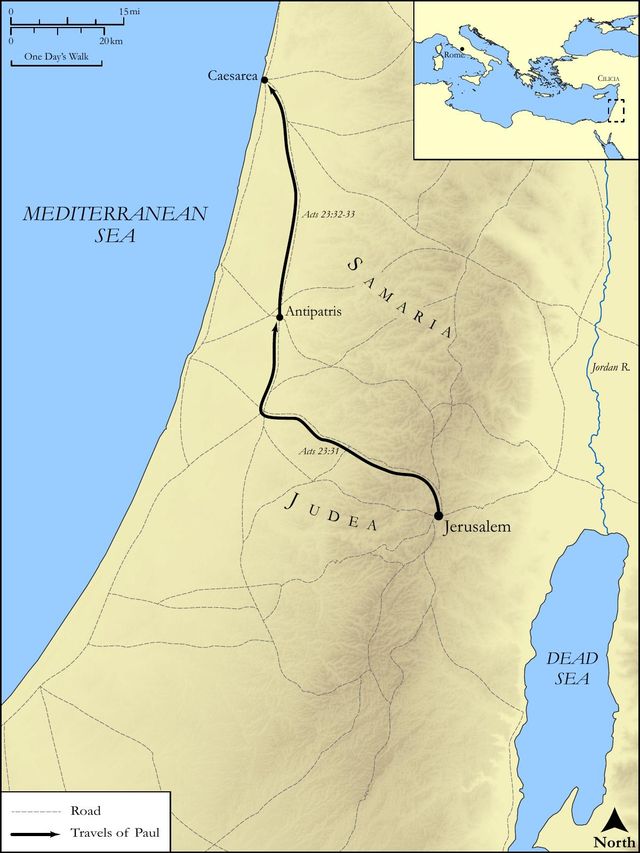
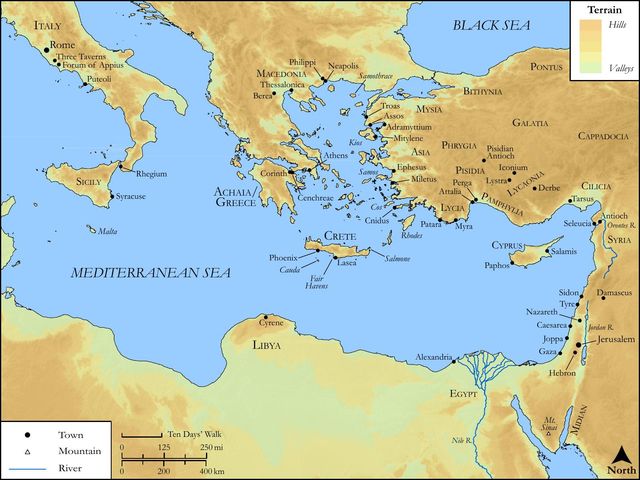
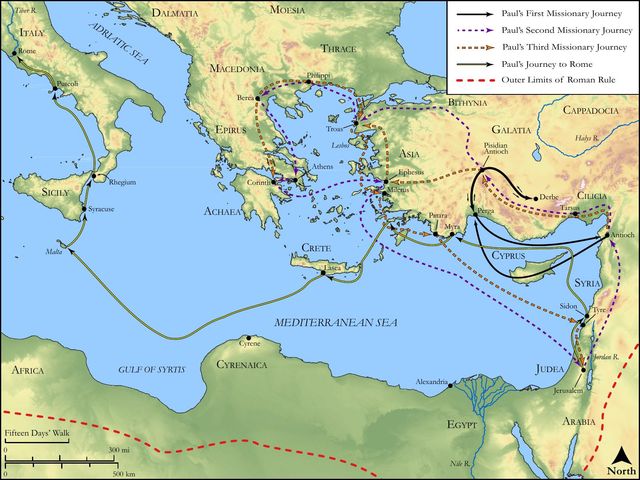
Study this verse
Public-domain commentary
Matthew Henry
From his Commentary on the Whole Bible. Henry comments on passages, not single verses — this entry covers Acts 23:6–11. His four-level outline is real structure in the source text, so it is rendered as structure.
Many are the troubles of the righteous, but some way or other the Lord delivereth them out of them all. Paul owned he had experienced the truth of this in the persecutions he had undergone among the Gentiles (see Ti2 3:11): Out of them all the Lord delivered me. And now he finds that he who has delivered does and will deliver. He that delivered him in the foregoing chapter from the tumult of the people here delivers him from that of the elders.
I.His own prudence and ingenuity stand him in some stead, and contribute much to his escape.
Paul's greatest honour, and that upon which he most valued himself, was that he was a Christian, and an apostle of Christ; and all his other honours he despised and made nothing of, in comparison with this, counting them but dung, that he might win Christ; and yet he had sometimes occasion to make use of his other honours, and they did him service. His being a citizen of Rome saved him in the foregoing chapter from his being scourged by the chief captain as a vagabond, and here his being a Pharisee saved him from being condemned by the sanhedrim, as an apostate from the faith and worship of the God of Israel. It will consist very well with our willingness to suffer for Christ to use all lawful methods, nay, and arts too, both to prevent suffering and to extricate ourselves out of it. The honest policy Paul used here for his own preservation was to divide his judges, and to set them at variance one with another about him; and, by incensing one part of them more against him, to engage the contrary part for him.
1.The great council was made up of Sadducees and Pharisees, and Paul perceived it. He knew the characters of many of them ever since he lived among them, and saw those among them whom he knew to be Sadducees, and others whom he knew to be Pharisees (Act 23:6): One part were Sadducees and the other Pharisees, and perhaps nearly an equal part. Now these differed very much from one another, and yet they ordinarily agreed well enough to do the business of the council together.
(1.)The Pharisees were bigots, zealous for the ceremonies, not only those which God had appointed, but those which were enjoined by the tradition of the elders. They were great sticklers for the authority of the church, and for enforcing obedience to its injunctions, which occasioned many quarrels between them and our Lord Jesus; but at the same time they were very orthodox in the faith of the Jewish church concerning the world of spirits, the resurrection of the dead, and the life of the world to come.
(2.)The Sadducees were deists - no friends to the scripture, or divine revelation. The books of Moses they admitted as containing a good history and a good law, but had little regard to the other books of the Old Testament; see Mat 22:23. The account here given of these Sadducees is,
[1.]That they deny the resurrection; not only the return of the body to life, but a future state of rewards and punishments. They had neither hope of eternal happiness nor dread of eternal misery, nor expectation of any thing on the other side death; and it was upon these principles that they said, It is in vain to serve God, and called the proud happy, Mal 3:14, Mal 3:15.
[2.]That they denied the existence of angels and spirits, and allowed of no being but matter. They thought that God himself was corporeal, and had parts and members as we have. When they read of angels in the Old Testament, they supposed them to be messengers that God made and sent on his errands as there was occasion, or that they were impressions on the fancies of those they were sent to, and no real existences - that they were this, or that, or any thing rather than what they were. And, as for the souls of men, they looked upon them to be nothing else but the temperament of the humours of the body, or the animal spirits, but denied their existence in a state of separation from the body, and any difference between the soul of a man and of a beast. These, no doubt, pretended to be free-thinkers, but really thought as meanly, absurdly, and slavishly, as possible. It is strange how men of such corrupt and wicked principles could come into office, and have a place in the great sanhedrim; but many of them were of quality and estate, and they complied with the public establishment, and so got in and kept in. But they were generally stigmatized as heretics, were ranked with the Epicureans, and were prayed against and excluded from eternal life. The prayer which the modern Jews use against Christians, Witsius thinks, was designed by Gamaliel, who made it, against the Sadducees; and that they meant them in their usual imprecation, Let the name of the wicked rot. But how degenerate was the character and how miserable the state of the Jewish church, when such profane men as these were among their rulers!
2.In this matter of difference between the Pharisees and Sadducees Paul openly declared himself to be on the Pharisees' side against the Sadducees (Act 23:6): He cried out, so as to be heard by all, "I am a Pharisee, was bred a Pharisee, nay, I was born one, in effect, for I was the son of a Pharisee, my father was one before me, and thus far I am still a Pharisee that I hope for the resurrection of the dead, and I may truly say that, if the matter were rightly understood, it would be found that this is it for which I am now called in question." When Christ was upon earth the Pharisees set themselves most against him, because he witnessed against their traditions and corrupt glosses upon the law; but, after his ascension, the Sadducees set themselves most against his apostles, because they preached through Jesus the resurrection of the dead, Act 4:1, Act 4:2. And it is said (Act 5:17) that they were the sect of the Sadducees that were filled with indignation at them, because they preached that life and immortality which is brought to light by the gospel. Now here,
(1.)Paul owns himself a Pharisee, so far as the Pharisees were in the right. Though as Pharisaism was opposed to Christianity he set himself against it, and against all its traditions that were set up in competition with the law of God or in contradiction to the gospel of Christ, yet, as it was opposed to Sadducism, he adhered to it. We must never think the worse of any truth of God, nor be more shy of owning it, for its being held by men otherwise corrupt. If the Pharisees will hope for the resurrection of the dead, Paul will go along with them in that hope, and be one of them, whether they will or no.
(2.)He might truly say that being persecuted, as a Christian, this was the thing he was called in question for. Perhaps he knew that the Sadducees, though they had not such an interest in the common people as the Pharisees had, yet had underhand incensed the mob against him, under pretence of his having preached to the Gentiles, but really because he had preached the hope of the resurrection. However, being called in question for his being a Christian, he might truly say he was called in question for the hope of the resurrection of the dead, as he afterwards pleaded, Act 24:15, and Act 26:6, Act 26:7. Though Paul preached against the traditions of the elders (as his Master had done), and therein opposed the Pharisees, yet he valued himself more upon his preaching the resurrection of the dead, and a future state, in which he concurred with the Pharisees.
3.This occasioned a division in the council. It is probable that the high priest sided with the Sadducees (as he had done Act 5:17, and made it to appear by his rage at Paul, Act 23:2), which alarmed the Pharisees so much the more; but so it was, there arose a dissension between the Pharisees and the Sadducees (Act 23:7), for this word of Paul's made the Sadducees more warm and the Pharisees more cool in the prosecution of him; so that the multitude was divided; eschisthē - there was a schism, a quarrel among them, and the edge of their zeal began to turn from Paul against one another; nor could they go on to act against him when they could not agree among themselves, or prosecute him for breaking the unity of the church when there was so little among them of the unity of the spirit. All the cry had been against Paul, but now there arose a great cry against one another, Act 23:9. So much did a fierce furious spirit prevail among all orders of the Jews at this time that every thing was done with clamour and noise; and in such a tumultuous manner were the great principles of their religion stickled for, by which they received little service, for the wrath of man worketh not the righteousness of God. Gainsayers may be convinced by fair reasoning, but never by a great cry.
4.The Pharisees hereupon (would one think it?) took Paul's part (Act 23:9): They strove, diemachonto - They fought, saying, We find no evil in this man. He had conducted himself decently and reverently in the temple, and had attended the service of the church; and, though it was but occasionally, yet it showed that he was not such an enemy to it as he was said to be. He had spoken very handsomely in his own defence, and given a good account of himself, and had now declared himself orthodox in the great principles of religion, as well as regular and conscientious in his conversation; and therefore they cannot see that he has done any thing worthy of death of bonds. Nay, they go further, "If a spirit or an angel hath spoken to him concerning Jesus, and put him upon preaching as he does, though we may not be so far satisfied as to give credit to him, yet we ought to be cautioned not to oppose him, lest we be found fighting against God;" as Gamaliel, who was himself a Pharisee, had argued, Act 5:39. Now here,
(1.)We may observe, to the honour of the gospel, that it was witnessed to even by its adversaries, and confessions, not only of its innocency, but of its excellency, were extorted sometimes by the power of truth even from those that persecuted it. Pilate found no fault in Christ though he put him to death, nor Festus in Paul though he detained him in bonds; and the Pharisees here supposed it possible that Paul might have a commission sent him for heaven by an angel to do what he did; and yet it should seem, as elders, they after this joined with the high priest in prosecuting him, Act 24:1. They sinned against the knowledge which they not only had, but sometimes owned, as Christ had said of them, They have both seen and hated both me and my Father, Joh 15:24. Yet,
(2.)We will hope that some of them at least did henceforward conceive a better opinion of Paul than they had had, and were favourable to him, having had such a satisfactory account both of his conversation in all good conscience and of his faith touching another world; and then it must be observed to their honour that their zeal for the traditions of the elders, which Paul had departed fRom. was so far swallowed up in a zeal for the great and fundamental doctrines of religion, to which Paul still adhered, that if he will heartily join with them against the Sadducees, and adhere to the hope of the resurrection of the dead, they will not think his shaking off the ceremonial law to be an evil in him, but charitably hope that he walks according to the light God has given him by some angel or spirit, and are so far from persecuting him that they are ready to patronize and protect him. The persecuting Pharisees of the church of Rome are not of this spirit: for let a man be ever so sincere and zealous for all the articles of the Christian faith, yet, if he lay not his neck under the yoke of their church's authority, they find evil enough in him to persecute him unto the death.
II.The chief captain's care and conduct stand him in more stead; for when he has thrown this bone of contention between the Pharisees and Sadducees (which set them together by the ears, and gained a fair testimony from the Pharisees), yet he is never the nearer, but is in danger of being pulled in pieces by them - the Pharisees pulling to have him set at liberty, and the Sadducees pulling to have him put to death, or thrown to the people, like Daniel into the den of lions; so that the chief captain is forced to come with his soldiers and rescue him, as he had done, Act 21:32, and Act 22:24.
1.See here Paul's danger. Between his friends and his enemies he had like to have been pulled to pieces, the one hugging him to death, the other crushing him to death, such violences are those liable to that are eminent, and that are become remarkable, as Paul was, who was by some so much beloved and by others so much maligned.
2.His deliverance: The chief captain ordered his soldiers to go down from the upper wards, and to take them by force from among them, out of that apartment in the temple where he had ordered the council to meet, and to bring him into the castle, or tower of Antonio; for he saw he could make nothing of them towards the understanding of the merits of his cause.
III.Divine consolations stood him in most stead of all.
The chief captain had rescued him out of the hands of cruel men, but still he had him in custody, and what might be the issue he could not tell. The castle was indeed a protection to him, but withal it was a confinement; and, as it was now his preservation from so great a death, it might be his reservation for a greater. We do not find that any of the apostles or elders at Jerusalem came to him; either they had not courage or they had not admission. Perhaps, in the night following, Paul was full of thoughts and cares what should become of him, and how his present troubles might be turned to answer some good purpose. Then did the Lord Jesus make him a kind visit, and, thought at midnight, yet a very seasonable one (Act 23:11): The Lord stood by him, came to his bed-side, though perhaps it was but a bed of straw, to show him that he was all the day long with him really as sure as he was in the night with him visibly. Note, Whoever is against us, we need not fear if the Lord stand by us; if he undertake our protection, we may set those that seek our ruin at defiance. The Lord is with those that uphold my soul, and then nothing can come amiss.
1.Christ bids him have a good heart upon it: "Be of good cheer, Paul; be not discouraged; let not what has happened sadden thee, nor let what may yet be before thee frighten thee." Note, It is the will of Christ that his servants who are faithful should be always cheerful. Perhaps Paul, in the reflection, began to be jealous of himself whether he had done well in what he said to the council the day before; but Christ, by his word, satisfies him that God approved of his conduct. Or, perhaps, it troubled him that his friends did not come to him; but Christ's visit did itself speak, though he had not said, Be of good cheer, Paul.
2.It is a strange argument which he makes use of to encourage him: As thou hast testified of me in Jerusalem, so must thou bear witness also at Rome. One would think this was but cold comfort: "As thou hast undergone a great deal of trouble for me so thou must undergo a great deal more;" and yet this was designed to encourage him; for hereby he is given to understand,
(1.)That he had been serving Christ as a witness for him in what he had hitherto endured. It was for no fault that he was buffeted, and it was not his former persecuting of the church that was now remembered against him, however he might remember it against himself, but he was still going on with his work.
(2.)That he had not yet finished his testimony, nor was, by his imprisonment, laid aside as useless, but was only reserved for further service. Nothing disheartened Paul so much as the thought of being taken off from doing service to Christ and good to souls: Fear not, says Christ, I have not done with thee,
(3.)Paul seems to have had a particular fancy, and an innocent one, to go to Rome, to preach the gospel there, though it was already preached, and a church planted there; yet, being a citizen of Rome, he longed for a journey thither, and had designed it (Act 19:21): After I have been at Jerusalem, I must also see Rome. And he had written to the Romans some time ago that he longed to see them, Rom 1:11. Now he was ready to conclude that this had broken his measures, and he should never see Rome; but even in that Christ tells him he should be gratified, since he desired it for the honour of Christ and to do good.
Historical interpretation
Two Centuries of Reception
2 surviving comments on this verse. Each one is dated, so this reads as a timeline rather than a list.
Select a marker to jump to its quote. Markers stagger vertically where authors wrote within a few decades of each other.
"And when there arose a great dissension, the tribune, fearing lest Paul should have been pulled in pieces of them, commanded the soldiers to go down, and to take him by force from among them, and to bring him into the castle." The tribune is afraid of his being pulled in pieces, now that he has said that he is a Roman: and the matter was not without danger. Do you observe that Paul had a right to profess himself a Roman? Else, neither would the tribune have been afraid now. So it remains that the soldiers must bear him off by force.
"And when there arose a great dissension, the tribune fearing lest Paul should be pulled in pieces. "When a great dissension arose between Pharisees and Sadducees, the tribune, fearing lest Paul should be pulled in pieces by the Sadducees, ordered him to be taken back to the castle. In the night, the Lord said to Paul: "Be constant, Paul; for as thou hast testified of me here, so must thou preach my name also in the city of Rome." On the following day, forty Jews made a conspiracy and resolved to kill Paul. Paul's sister's son heard of it and told Paul in the castle. Paul asked the guards to bring the young man to the tribune. When the young man had told the tribune everything in order, the tribune commanded him to let no one know it had been told to him.
Continue studying Acts 23:10 across the web’s major study libraries — every link below opens this exact verse, chapter, or book on the destination site.
Read & Compare
 BibleGatewayThis verse in more than 200 translations and 70 languages.
 Bible.comThe YouVersion reader — hundreds of translations, reading plans, and highlights.
 ESV.orgCrossway's official English Standard Version reader.
 NET BibleThe NET translation with 60,000+ translators' notes on every rendering decision.
 STEP BibleTyndale House's free study tool — original text, vocabulary, and scholarly resources.
 BibliaLogos Bible Software's free web reader.
 USCCBThe New American Bible (Revised Edition) with the U.S. bishops' study notes.
Commentaries
 BibleHub CommentariesDozens of classic commentaries on this verse, gathered on one page.
 StudyLightMore than 100 commentary sets — the largest collection on the web.
 BibleRefPlain-English commentary on what this verse means, verse by verse.
 Enduring WordDavid Guzik's free commentary on this chapter, widely used by Bible teachers.
 Bible Study ToolsVerse commentary alongside Greek and Hebrew study aids.
Original Language & Research
- BibleHub InterlinearThe verse word by word — original language, transliteration, and English.
- BibleHub LexiconEvery word's original-language definition and Strong's entry.
 Blue Letter BibleDeep-study tools — Strong's numbers, concordance, and word studies.
 CNTR CollationThe earliest Greek manuscripts of this verse, collated letter by letter.
Sermons, Hymns & Audio


TrulyRandomVerse is not affiliated with these sites and doesn’t control their content. They’re linked because they’re genuinely useful.
Summary
Acts 23:10 vividly portrays the escalating chaos within the Sanhedrin as a result of Paul's strategic declaration, forcing the Roman chief captain, Claudius Lysias, to intervene decisively. Fearing that the Apostle Paul would be literally torn apart by the violent theological dissension between the Pharisees and Sadducees, Lysias commanded his soldiers to forcefully extract Paul from the midst of the warring factions and bring him to the safety of the Antonia Fortress, thereby preserving his life for future divine purposes.
Context
ShowHideLiterary Context
This verse is the dramatic climax of Paul's appearance before the Jewish high council, the Sanhedrin, following his arrest in the Temple courts. Having been rescued from a mob in Acts 21:30-32, Paul was granted permission by the Roman chief captain, Claudius Lysias, to address the Sanhedrin to ascertain the charges against him. Knowing the council's internal divisions, Paul shrewdly declared his Pharisaic identity and belief in the resurrection (Acts 23:6), immediately igniting a furious theological debate between the Sadducees, who denied the resurrection, and the Pharisees, who affirmed it. The "great dissension" described in Acts 23:10 is the direct consequence of Paul's calculated move, demonstrating his keen understanding of his audience and the volatile political and religious landscape of Jerusalem.
Historical & Cultural Context
The Sanhedrin was the supreme Jewish judicial and legislative body, composed of seventy-one members, including chief priests, elders, and scribes. It was deeply divided between the Sadducees, who were primarily aristocratic priests adhering strictly to the written Torah and rejecting oral tradition, resurrection, angels, and spirits, and the Pharisees, who were popular lay scholars and teachers who accepted oral tradition and believed in resurrection, angels, and spirits. The Roman presence in Judea, personified by the chief captain and his soldiers, was crucial for maintaining order. The Antonia Fortress, located adjacent to the Temple, served as the Roman military barracks and a symbol of Roman authority, from which soldiers could quickly deploy to quell disturbances, as they did in this instance to prevent a full-blown riot and protect a Roman citizen (Paul's Roman citizenship is revealed in Acts 22:25-29).
Key Themes
ShowHideThis pivotal moment contributes to several overarching themes in Acts and Paul's ministry. Firstly, it powerfully illustrates Divine Providence and Protection, showing how God uses even secular authorities and chaotic circumstances to safeguard His chosen instruments, ensuring Paul's survival for his ultimate mission to Rome, as later confirmed by the Lord Himself in Acts 23:11. Secondly, it highlights the profound Religious Division and Hostility within Judaism, demonstrating how deeply entrenched doctrinal differences could lead to violent internal conflict, even overshadowing a common perceived enemy. Finally, the intervention of the chief captain underscores the pervasive Roman Authority and Order in the provinces, showcasing their role in maintaining civil stability and protecting the rights of Roman citizens, even those accused by local religious bodies.
Exposition and Analysis
ShowHideKey Word Analysis
ShowHideThis term denotes not merely an argument but a "standing" or "uprising," implying a violent internal struggle or even an insurrection. In this context, it describes the intense, almost riotous, theological conflict that erupted between the Pharisees and Sadducees within the Sanhedrin, threatening to devolve into physical violence.
This vivid verb means "to draw apart," "sever," or "dismember." It paints a graphic picture of the extreme danger Paul faced, suggesting that the fury of the warring factions was so intense that he might have been literally torn limb from limb by the enraged council members.
This word refers to a "throwing in beside" or "juxtaposition," specifically denoting a military encampment or barracks. In Jerusalem, it specifically refers to the Antonia Fortress, the Roman military headquarters adjacent to the Temple, which served as a secure stronghold and a symbol of Roman power. It was the place of safety and temporary refuge for Paul.
Verse Breakdown
ShowHide"And when there arose a great dissension"
This clause describes the immediate and intense consequence of Paul's declaration in Acts 23:6, where he exploited the deep theological rift between the Pharisees and Sadducees. The "great dissension" signifies a violent, almost riotous, internal conflict that erupted within the Sanhedrin itself, turning their collective anger from Paul to each other.
"the chief captain, fearing lest Paul should have been pulled in pieces of them"
This part reveals the chief captain's motivation for intervention. Observing the escalating and dangerous internal strife, he genuinely feared for Paul's physical safety, recognizing that the conflict had reached a point where Paul's life was in immediate peril, potentially leading to him being literally dismembered by the enraged council members.
"commanded the soldiers to go down, and to take him by force from among them"
This highlights the decisive and forceful nature of the chief captain's action. He did not merely request but "commanded" his soldiers to "go down" (from the Antonia Fortress into the council chamber) and "take him by force," indicating the urgency and necessity of a swift, physical extraction to rescue Paul from the chaotic and dangerous situation.
"and to bring [him] into the castle"
This final clause specifies Paul's destination – the Antonia Fortress. This was not merely an arbitrary location but a secure military barracks, offering Paul protection from the mob and the warring Sanhedrin, ensuring his safety under Roman custody.
Literary Devices
ShowHideThe passage employs several potent literary devices to convey the drama and significance of the moment. Hyperbole or vivid imagery is evident in the phrase "pulled in pieces," which dramatically emphasizes the extreme danger Paul faced, though it may not imply literal dismemberment but rather the intense fury that threatened his life. Irony is powerfully present as the Roman chief captain, a pagan authority, unwittingly becomes an instrument of divine protection for Paul, saving him from the very religious leaders who sought his demise. This also functions as Dramatic Irony, as the reader knows Paul's ultimate mission and God's protective hand, while the chief captain acts purely out of civic duty and concern for order. The rapid succession of actions—"arose a great dissension," "fearing," "commanded," "go down," "take by force," "bring into the castle"—creates a sense of Pacing that mirrors the escalating tension and the swift, decisive intervention required.
Theological and Thematic Connections
ShowHideActs 23:10 serves as a powerful testament to God's sovereign providence over human affairs, even amidst intense conflict and danger. Just as Paul's life was preserved through the unexpected intervention of a Roman officer, God consistently works through various means—sometimes through secular authorities, sometimes through difficult circumstances—to accomplish His divine purposes and protect His servants. This incident underscores that God's plan for Paul's ministry, specifically his testimony in Rome, would not be thwarted by human opposition or internal strife. It reminds believers that divine protection is often manifested not through miraculous escape from all trouble, but through God's active orchestration of events and people, ensuring that His will prevails.
Reflection and Application
ShowHideThis passage offers profound lessons for contemporary believers facing opposition, division, or uncertainty. It encourages us to trust in God's unfailing sovereignty, even when circumstances appear chaotic or threatening. Just as Paul was preserved for his mission, we can have confidence that God will protect and guide us through challenging situations, using unexpected means to fulfill His purposes in our lives. This doesn't mean we will avoid all hardship, but that God remains faithful to His callings. It also serves as a poignant reminder of the dangers of internal division within the body of Christ; theological differences, when not handled with humility and love, can become destructive, hindering the church's witness. We are called to pursue peace and unity, discerning when to speak truth boldly and when to allow God to work through the unfolding circumstances.
Questions for Reflection
ShowHideFAQ
ShowHideWhy did the chief captain intervene so forcefully to rescue Paul from the Sanhedrin?
ShowHideThe chief captain, Claudius Lysias, intervened forcefully for several reasons. Primarily, he was responsible for maintaining civil order in Jerusalem, and the "great dissension" in the Sanhedrin had escalated into a violent uproar, threatening to become a full-blown riot. He feared that Paul, his prisoner, would literally be "pulled in pieces" by the warring factions, which would have been a significant breach of Roman peace and order. Furthermore, Paul had previously asserted his Roman citizenship (Acts 22:25-29), which afforded him certain legal protections, including the right to a fair trial and protection from mob violence. Lysias was obligated to uphold these rights and ensure Paul's safety, even from the Jewish religious leaders. His actions, while motivated by Roman law and order, inadvertently served God's divine purpose to preserve Paul for his future ministry.
Christ-Centered Fulfillment
ShowHideActs 23:10, with its depiction of Paul's miraculous preservation amidst a violent mob, powerfully foreshadows and reflects the Christ-centered reality of God's sovereign protection over His chosen ones and His redemptive plan. Just as Paul, a servant of God, was delivered from those who sought to tear him apart, so too was Jesus, the ultimate Servant, protected by divine providence until His appointed time for sacrifice. Though He willingly laid down His life, no one could "take it from Him" before His hour (John 10:18). Paul's continued life and ministry, despite relentless opposition, underscore the truth that God's purposes for His people, rooted in Christ, cannot be thwarted. The "castle" (Antonia Fortress) served as a temporary sanctuary for Paul, much like Christ Himself is our ultimate refuge and fortress (Psalm 18:2). This passage reminds us that the Church, the body of Christ, though often assailed by internal divisions and external hostility, is ultimately protected by the unshakeable promise of its Head. Just as the gates of Hades will not overcome the Church (Matthew 16:18), God continues to work all things for the good of those who love Him, ensuring the completion of the good work He began in us until the day of Christ Jesus (Philippians 1:6).