


Acts 10:9
- ΤῇTēaOn theG3588T-DSFDefinite article Dative Singular Feminine
- δὲdenowG1161CONJConjunction
- ἐπαύριονepaurionnext dayG1887ADVAdverb
- ὁδοιπορούντωνhodoiporountōnwhen are journeyingG3596V-PAP-GPMVerb Present Active Participle Genitive Plural Masculine
- ἐκείνωνekeinōntheseG1565D-GPMDemonstrative pronoun Genitive Plural Masculine
- καὶkaiandG2532CONJConjunction
- τῇtēato theG3588T-DSFDefinite article Dative Singular Feminine
- πόλειpoleicityG4172N-DSFNoun Dative Singular Feminine
- ἐγγιζόντωνengizontōnare approachingG1448V-PAP-GPMVerb Present Active Participle Genitive Plural Masculine
- ἀνέβηanebēwent upG305V-2AAI-3SVerb 2nd Aorist Active Indicative 3rd Singular
- ΠέτροςPetrosPeterG4074N-NSM-PNoun Nominative Singular Masculine Individual
- ἐπὶepionG1909PREPPreposition
- τὸtotheG3588T-ASNDefinite article Accusative Singular Neuter
- δῶμαdōmahousetopG1430N-ASNNoun Accusative Singular Neuter
- προσεύξασθαιproseuxasthaito prayG4336V-ADNVerb Aorist Middle Deponent Infinitive
- περὶperiaboutG4012PREPPreposition
- ὥρανhōranhourG5610N-ASFNoun Accusative Singular Feminine
- ἕκτηνhektēn[the] sixthG1623A-ASFAdjective Accusative Singular Feminine
English is a literal word-by-word gloss of the Greek, not the KJV's wording. Why?
This is the original text the KJV's translators worked from — each Greek word with its own literal English meaning in this verse, prepared by scholars at Tyndale House, Cambridge. The KJV translates whole sentences, not word by word, so its wording differs: one Greek word can become several English words, and the KJV may choose “charity” where the gloss reads “love”. Both are faithful — they answer different questions. For the KJV's own rendering, switch to the KJV text.
Details
See on the biblical-era map
Study this verse
Public-domain commentary
Matthew Henry
From his Commentary on the Whole Bible. Henry comments on passages, not single verses — this entry covers Acts 10:9–18. His three-level outline is real structure in the source text, so it is rendered as structure.
Cornelius had received positive orders from heaven to send for Peter, whom otherwise he had not heard of, or at least not heeded; but here is another difficulty that lies in the way of bringing them together - the question is whether Peter will come to Cornelius when he is sent for; not as if he thought it below him to come at a beck, or as if he were afraid to preach his doctrine to a polite man as Cornelius was: but it sticks at a point of conscience. Cornelius is a very worthy man, and has many good qualities, but he is a Gentile, he is not circumcised; and, because God in his law had forbidden his people to associate with idolatrous nations, they would not keep company with any but those of their own religion, though they were ever so deserving, and they carried the matter so far that they made even the involuntary touch of a Gentile to contract a ceremonial pollution, Joh 18:28. Peter had not got over this stingy bigoted notion of his countrymen, and therefore will be shy of coming to Cornelius. Now, to remove this difficulty, he has a vision here, to prepare him to receive the message sent him by Cornelius, as Ananias had to prepare him to go to Paul. The scriptures of the Old Testament had spoken plainly of the bringing in of the Gentiles into the church. Christ had given plain intimations of it when he ordered them to teach all nations; and yet even Peter himself, who knew so much of his Master's mind, could not understand it, till it was here revealed by vision, that the Gentiles should be fellow-heirs, Eph 3:6. Now here observe,
I.The circumstances of this vision.
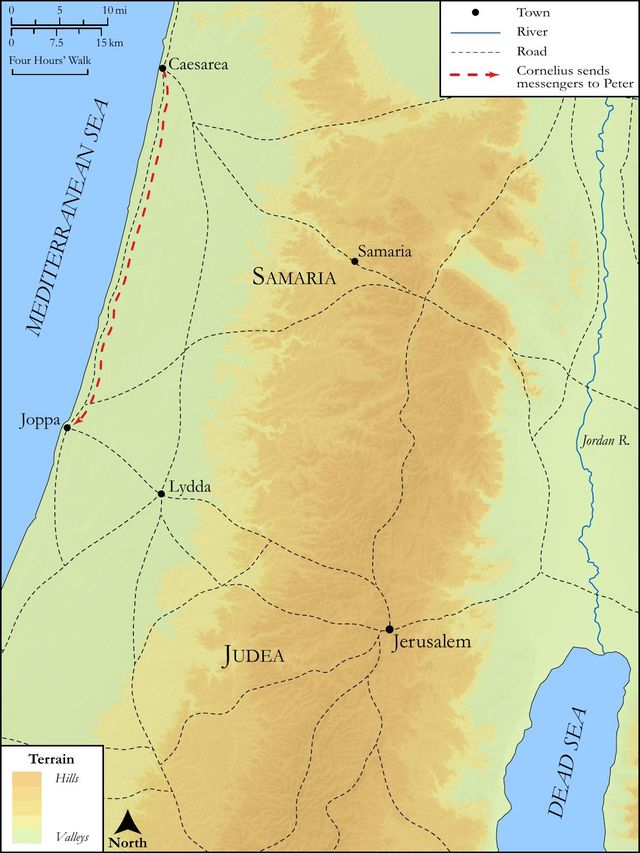
1.It was when the messengers sent from Cornelius were now nigh the city, Act 10:9. Peter knew nothing of their approach, and they knew nothing of his praying; but he that knew both him and them was preparing things for the interview, and facilitating the end of their negotiation. To all God's purposes there is a time, a proper time; and he is pleased often to bring things to the minds of his ministers, which they had not thought of, just then when they have occasion to use them.
2.It was when Peter went up upon the house-top to pray, about noon.
(1.)Peter was much in prayer, much in secret prayer, though he had a great deal of public work upon his hands.
(2.)He prayed about the sixth hour, according to David's example, who, not only morning and evening, but at noon, addressed himself to God by prayer, Psa 55:17. From morning to night we should think to be too long to be without meat; yet who thinks it is too long to be without prayer?
(3.)He prayed upon the house-top; thither he retired for privacy, where he could neither hear nor be heard, and so might avoid both distraction and ostentation. There, upon the roof of the house, he had a full view of the heavens, which might assist his pious adoration of the God he prayed to; and there he had also a full view of the city and country, which might assist his pious compassion of the people he prayed for.
(4.)He had this vision immediately after he had prayed, as an answer to his prayer for the spreading of the gospel, and because the ascent of the heart to God in prayer is an excellent preparative to receive the discoveries of the divine grace and favour.
3.It was when he became very hungry, and was waiting for his dinner (Act 10:10); probably he had not that day eaten before, though doubtless he had prayed before; and now he would have eaten, ēthele geusasthai - he would have tasted, which intimates his great moderation and temperance in eating. When he was very hungry, yet he would be content with a little, with a taste, and would not fly upon the spoil. Now this hunger was a proper inlet to the vision about meats, as Christ's hunger in the wilderness was to Satan's temptation to turn stones into bread.
II.The vision itself, which was not so plain as that to Cornelius, but more figurative and enigmatical, to make the deeper impression.
1.He fell into a trance or ecstasy, not of terror, but of contemplation, with which he was so entirely swallowed up as not only not to be regardful, but not to be sensible, of external things. He quite lost himself to this world, and so had his mind entirely free for converse with divine things; as Adam in innocency, when the deep sleep fell upon him. The more clear we get of the world, the more near we get to heaven: whether Peter was now in the body or out of the body he could not himself tell, much less can we, Co2 12:2, Co2 12:3. See Gen 15:12; Act 22:17.
2.He saw heaven opened, that he might be sure that his authority to go to Cornelius was indeed from heaven - that it was a divine light which altered his sentiments, and a divine power which gave him his commission. The opening of the heavens signified the opening of a mystery that had been hid, Rom 16:25.
3.He saw a great sheet full of all manner of living creatures, which descended from heaven, and was let down to him to the earth, that is, to the roof of the house where he now was. Here were not only beasts of the earth, but fowls of the air, which might have flown away, laid at his feet; and not only tame beasts, but wild. Here were no fishes of the sea, because there were none of them in particular unclean, but whatever had fins and scales was allowed to be eaten. Some make this sheet, thus filled, to represent the church of Christ. It comes down from heaven, from heaven opened, not only to send it down (Rev 21:2), but to receive souls sent up from it. It is knit at the four corners, to receive those from all parts of the world that are willing to be added to it; and to retain and keep those safe that are taken into it, that they may not fall out; and in this we find some of all countries, nations, and languages, without any distinction of Greek or Jew, or any disadvantage put upon Barbarian or Scythian, Col 3:11. The net of the gospel encloses all, both bad and good, those that before were clean and unclean. Or it may be applied to the bounty of the divine Providence, which, antecedently to the prohibitions of the ceremonial law, had given to man a liberty to use all the creatures, to which by the cancelling of that law we are now restored. By this vision we are taught to see all the benefit and service we have from the inferior creatures coming down to us from heaven; it is the gift of God who made them, made them fit for us, and then gave to man a right to them, and dominion over them. Lord, what is man that he should be thus magnified! Psa 8:4-8. How should it double our comfort in the creatures, and our obligations to serve God in the use of them, to see them thus let down to us out of heaven!
4.He was ordered by a voice from heaven to make use of this plenty and variety which God had sent him (Act 10:13): "Rise, Peter, kill and eat: without putting any difference between clean and unclean, take which thou hast most mind to." The distinction of meats which the law made was intended to put a difference between Jew and Gentile, that it might be difficult to them to dine and sup with a Gentile, because they would have that set before them which they were not allowed to eat; and now the taking off of that prohibition was a plain allowance to converse with the Gentiles, and to be free and familiar with them. Now they might fare as they fared, and therefore might eat with them, and be fellow-commoners with them.
5.He stuck to his principles, and would by no means hearken to the motion, though he was hungry (Act 10:14): Not so, Lord. Though hunger will break through stone walls, God's laws should be to us a stronger fence than stone walls, and not so easily broken through. And he will adhere to God's laws, though he has a countermand by a voice from heaven, not knowing at first but that Kill, and eat, was a command of trial whether he would adhere to the more sure word, the written law; and if so his answer had been very good, Not so, Lord. Temptations to eat forbidden fruit must not be parleyed with, but peremptorily rejected; we must startle at the thought of it: Not so, Lord. The reason he gives is, "For I have never eaten any thing that is common or unclean; hitherto I have kept my integrity in this matter, and will still keep it." If God, by his grace, has preserved us from gross sin unto this day, we should use this as an argument with ourselves to abstain from all appearance of evil. So strict were the pious Jews in this matter, that the seven brethren, those glorious martyrs under Antiochus, choose rather to be tortured to death in the most cruel manner that ever was than to eat swine's flesh, because it was forbidden by the law. No wonder then that Peter says it with so much pleasure, that his conscience could witness for him that he had never gratified his appetite with any forbidden food.
6.God, by a second voice from heaven, proclaimed the repeal of the law in this case (Act 10:15): What God hath cleansed, that call thou not common. He that made the law might alter it when he pleased, and reduce the matter to its first state. God had, for reasons suited to the Old Testament dispensation, restrained the Jews from eating such and such meats, to which, while that dispensation lasted, they were obliged in conscience to submit; but he has now, for reasons suited to the New Testament dispensation, taken off that restraint, and set the matter at large - has cleansed that which was before polluted to us, and we ought to make use of, and stand fast in, the liberty wherewith Christ has made us free, and not call that common or unclean which God has now declared clean. Note, We ought to welcome it as a great mercy that by the gospel of Christ we are freed from the distinction of meats, which was made by the law of Moses, and that now every creature of God is good, and nothing to be refused; not so much because hereby we gain the use of swine's flesh, hares, rabbits, and other pleasant and wholesome food for our bodies, but chiefly because conscience is hereby freed from a yoke in things of this nature, that we might serve God without fear. Though the gospel has made duties which were not so by the law of nature, yet it has not, like the law of Moses, made sins that were not so. Those who command to abstain from some kinds of meat at some times of the year, and place religion in it, call that common which God hath cleansed, and in that error, more than in any truth, are the successors of Peter.
7.This was done thrice, Act 10:16. The sheet was drawn up a little way, and let down again the second time, and so the third time, with the same call to him, to kill, and eat, and the same reason, that what God hath cleansed we must not call common; but whether Peter's refusal was repeated the second and third time is not certain; surely it was not, when his objection had the first time received such a satisfactory answer. The trebling of Peter's vision, like the doubling of Pharaoh's dream, was to show that the thing was certain, and engage him to take so much the more notice of it. The instructions given us in the things of God, whether by the ear in the preaching of the word, or by the eye in sacraments, need to be often repeated; precept must be upon precept, and line upon line. But at last the vessel was received up into heaven. Those who make this vessel to represent the church, including both Jews and Gentiles, as this did both clean and unclean creatures, make this very aptly to signify the admission of the believing Gentiles into the church, and into heaven too, into the Jerusalem above. Christ has opened the kingdom of heaven to all believers, and there we shall find, besides those that are sealed out of all the tribes of Israel, an innumerable company out of every nation (Rev 7:9); but they are such as God has cleansed.
III.The providence which very opportunely explained this vision, and gave Peter to understand the intention of it, Act 10:17, Act 10:18.
1.What Christ did, Peter knew not just then (Joh 13:7): He doubted within himself what this vision which he had seen should mean. He had no reason to doubt the truth of it, that it was a heavenly vision; all his doubt was concerning the meaning of it. Note, Christ reveals himself to his people by degrees, and not all at once; and leaves them to doubt awhile, to ruminate upon a thing, and debate it to and fro in their own minds, before he clears it up to them.
2.Yet he was made to know presently, for the men who were sent from Cornelius were just now come to the house, and were at the gate enquiring whether Peter lodged there; and by their errand it will appear what was the meaning of this vision. Note, God knows what services are before us, and therefore how to prepare us; and we then better know the meaning of what he has taught us when we find what occasion we have to make use of it.
Historical interpretation
Five Centuries of Reception
9 surviving comments on this verse. Each one is dated, so this reads as a timeline rather than a list.
Select a marker to jump to its quote. Markers stagger vertically where authors wrote within a few decades of each other.
Peter, on the day on which he experienced the vision of Universal Community, (exhibited) in that small vessel, had ascended into the more lofty parts of the house, for prayer's sake "at the sixth hour." The same (apostle) was going into the temple, with John, at the ninth hour," when he restored the paralytic to his health.
If it is from the fact that we read that Peter and he who was with him entered the temple "at the ninth (hour), the hour of prayer," who will prove to me that they had that day been performing a Station, so as to interpret the ninth hour as the hour for the conclusion and discharge of the Station? Nay, but you would more easily find that Peter at the sixth hour had, for the sake of taking food, gone up first on the roof to pray; so that the sixth hour of the day may the rather be made the limit to this duty, which (in Peter's case) was apparently to finish that duty, after prayer.
But the apostle Peter, when he was in Joppa and “wanted to pray, ascended into the upper part” [of the house]. Immediately, I take these words to be not in vain, that he did not pray in lower places but “ascended to the higher.” For the reason that so great an apostle chose to pray “in a higher place” is not superfluous, but rather, I believe, to show that Peter, because “he had died with Christ, was seeking the things that are above, where Christ is sitting at the right hand of God” and “not the things upon the earth.” “He ascended” there, to that “roof,” to those heights about which the Lord also says, “Let the one who is on the roof not go down to remove anything from the house.” Then, so that you may know that we do not say these things suspiciously about Peter because “he ascends to the higher,” you will confirm it from the following. It says, “He went up to the higher place to pray, and he saw the heavens open.” Does it not yet appear to you that Peter had gone up “to the higher,” not only in the body but also in mind and spirit?…It is appropriate that Peter stays “at the house of a tanner,” that one, perhaps, about whom Job says, “you clothed me with skin and flesh.”
"And on the morrow, as they journeyed, and drew nigh to the city" - observe how the Spirit connects the times: no sooner than this, and no later, He causes this to take place - "Peter about the sixth hour went up upon the housetop to pray": that is, privately and quietly, as in an upper chamber.
"And as they went on their journey, and drew nigh to the city": in order that Peter should not be in perplexity too long. "Peter went up upon the housetop," etc. Observe, that not even his hunger forced him to have recourse to the sheet.
[Daniel 6:10] "Now when Daniel learned of it, that is, of the law which had been enacted, he entered his house, and with the windows in his upper room opened up in the direction of Jerusalem, he continued to bow his knees three times a day and worshipped, and made confession before his God just as he was previously accustomed to do." We must quickly draw from our memory and bring together from all of Holy Scripture all the passages where we have read of domata, which mean in Latin either "walled enclosures" (menia) or "beds" or "sun-terraces," and also the references to anogaia, that is, "upper rooms." For after all, our Lord celebrated the passover in an upper room (Mark 14:15, Luke 22:12), and in the Acts of the Apostles the Holy Spirit came upon the one hundred and twenty souls of believers while they were in an upper room (Acts 1:13). And so Daniel in this case, despising the king's commands and reposing his confidence in God, does not offer his prayers in some obscure spot, but in a lofty place, and opens up his windows towards Jerusalem, from whence he looked for the peace . He prays, moreover, according to God's behest, and also according to what Solomon had said when he admonished the people that they should pray in the direction of the Temple. Furthermore, there are three times in the day when we should bow our knees unto God, and the tradition of the Church understands them to be the third hour, the sixth hour, and the ninth hour. Lastly, it was at the third hour that the Holy Spirit descended upon the Apostles (Acts 2:15) . It was at the sixth hour that Peter, purposing to eat, ascended to the upper room for prayer (Acts 10:9). It was at the ninth hour that Peter and John were on their way to the Temple (Acts 3:1).
Peter proceeds to go to the high upper story as it is now the blazing middle of the day: the high place looking down upon the earth teaches Peter always to follow heavenly, not earthly things; the circuit of the sixth hour also discloses the [number of the] age in which Christ came into the world to dispense the wealth of him who saves. The number, with respect to days, manifests the pattern by which he earlier established the world which the Redeemer, coming in this very age, forbids to be crushed under the sway of sin. Finally it is said that these things also took place at the sixth [hour]; when the Master, weary from his journey [and] sitting at the mouth of the well, asks for a cup of water by means of the maid’s vessel, he is about to provide his church’s rest everywhere from the font. In the [same] hour that Peter was hungry, his godly Master thirsted, always loving to add to his gifts. He who increased the honor of [Peter’s] name enabled him at the same time to nourish faith. The earth will rejoice, filled by this hunger [of Peter’s] which, richer than any gift, flows deliciously and, as it brings eternal feasts, leaves no one empty.
To pray about the sixth hour. At the sixth hour, Peter hungered amidst the prayers, certainly for the salvation of the world, which the Lord in the sixth age of the world came to seek and save. He also wished to indicate this when at the same hour of the day, he thirsted by the well of the Samaritan woman.
Peter went up to the housetop. This signifies that the Church, leaving behind earthly desires, will have its conversation in the heavens.
Continue studying Acts 10:9 across the web’s major study libraries — every link below opens this exact verse, chapter, or book on the destination site.
Read & Compare
 BibleGatewayThis verse in more than 200 translations and 70 languages.
 Bible.comThe YouVersion reader — hundreds of translations, reading plans, and highlights.
 ESV.orgCrossway's official English Standard Version reader.
 NET BibleThe NET translation with 60,000+ translators' notes on every rendering decision.
 STEP BibleTyndale House's free study tool — original text, vocabulary, and scholarly resources.
 BibliaLogos Bible Software's free web reader.
 USCCBThe New American Bible (Revised Edition) with the U.S. bishops' study notes.
Commentaries
 BibleHub CommentariesDozens of classic commentaries on this verse, gathered on one page.
 StudyLightMore than 100 commentary sets — the largest collection on the web.
 BibleRefPlain-English commentary on what this verse means, verse by verse.
 Enduring WordDavid Guzik's free commentary on this chapter, widely used by Bible teachers.
 Bible Study ToolsVerse commentary alongside Greek and Hebrew study aids.
Original Language & Research
- BibleHub InterlinearThe verse word by word — original language, transliteration, and English.
- BibleHub LexiconEvery word's original-language definition and Strong's entry.
 Blue Letter BibleDeep-study tools — Strong's numbers, concordance, and word studies.
 CNTR CollationThe earliest Greek manuscripts of this verse, collated letter by letter.
Sermons, Hymns & Audio


TrulyRandomVerse is not affiliated with these sites and doesn’t control their content. They’re linked because they’re genuinely useful.
Summary
Acts 10:9 serves as a crucial narrative bridge, meticulously detailing Peter's spiritual routine and God's providential timing. As Cornelius's messengers approach Joppa, Peter ascends to a private space on the housetop to engage in his customary midday prayer. This seemingly ordinary act of devotion is divinely orchestrated to prepare Peter's heart and mind for the extraordinary revelation he is about to receive, which will fundamentally reshape the early church's understanding of Gentile inclusion and the universal scope of the Gospel.
Context
ShowHideLiterary Context
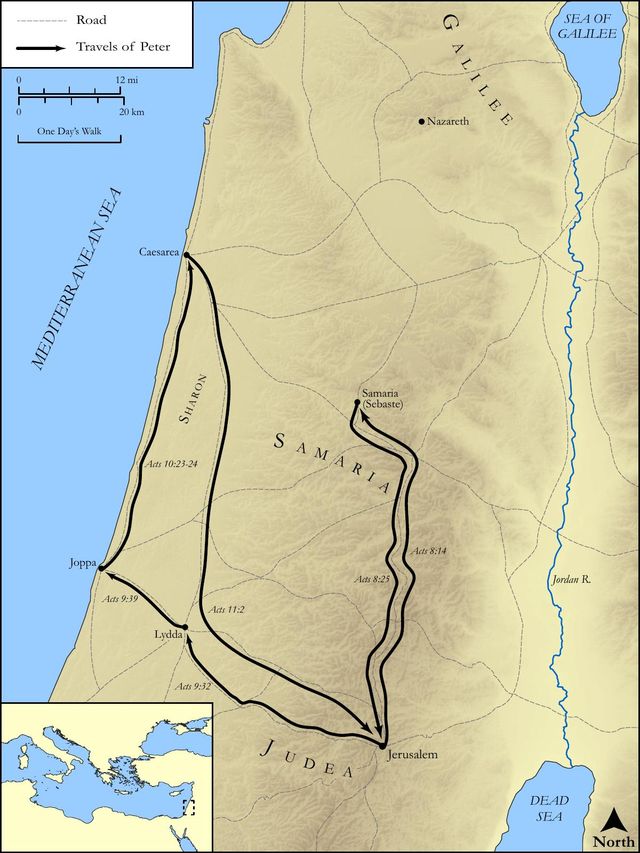
This verse is strategically placed within a narrative that skillfully interweaves two parallel, divinely initiated events: Cornelius's vision in Caesarea and Peter's subsequent vision in Joppa. Immediately preceding Acts 10:9, Acts 10:1-8 describes how God, through an angel, instructs Cornelius, a devout Roman centurion, to send for Peter. While Cornelius's men are en route, the focus shifts to Peter, who is lodging with Simon the tanner in Joppa. The precise timing of Peter's prayer, coinciding with the messengers' approach, underscores the divine choreography at play, setting the stage for the groundbreaking encounter that will unfold in the subsequent verses, particularly Acts 10:10-16.
Historical & Cultural Context
The setting is Joppa (modern Jaffa), a coastal city with a significant port, located northwest of Jerusalem. Jewish homes in this period commonly featured flat rooftops accessible by external stairs, providing a private, elevated space for various activities, including prayer, rest, or even sleeping in warm weather. The "sixth hour" (noon) was one of the traditional times for daily prayer among devout Jews, alongside the third hour (9 AM) and the ninth hour (3 PM), as evidenced in practices described in Psalm 55:17 and Daniel 6:10. This adherence to a disciplined prayer schedule highlights Peter's piety and his rootedness in Jewish custom, which makes the subsequent divine challenge to his deeply held convictions about dietary laws and Gentile purity all the more significant.
Key Themes
ShowHideActs 10:9 contributes to several overarching themes in the book of Acts. Firstly, it powerfully illustrates Divine Providence and Timing, showing God's meticulous orchestration of events to bring about His redemptive purposes. The synchronization of Cornelius's messengers arriving just as Peter is praying is not coincidental but divinely appointed. Secondly, it highlights the importance of Spiritual Discipline; Peter's consistent practice of prayer positions him to be receptive to God's voice and prepared for radical new instructions. This consistent seeking of God, as seen in Acts 6:4, is a hallmark of the early church. Finally, the verse initiates the theme of Preparation for Revelation and the Overcoming of Barriers, as Peter's quiet time on the housetop serves as the immediate precursor to the vision that will challenge his Jewish presuppositions and pave the way for the inclusion of Gentiles into the Christian community, a pivotal moment in the expansion of the Gospel beyond its Jewish origins, as further explored in Acts 11:1-18.
Exposition and Analysis
ShowHideKey Word Analysis
ShowHideThis verb (G1448) means "to make near" or "to approach." In this context, it describes the physical proximity of Cornelius's messengers to the city of Joppa. However, its significance extends beyond mere geography; it subtly implies the drawing near of a pivotal moment in salvation history, as two distinct narratives (Peter's and Cornelius's) are about to converge through divine appointment. The approaching messengers symbolize the approaching fulfillment of God's broader plan for the inclusion of the Gentiles.
Derived from a word meaning "to build," dōma (G1430) specifically refers to the flat roof of an ancient house. More than just a physical location, the housetop in this narrative functions as a place of solitude, elevation, and spiritual encounter. It provides Peter with a private space, removed from the distractions of the household, where he can engage in communion with God. This elevated position can also be seen symbolically as a place where one is open to heavenly revelation, a common motif in biblical narratives where significant divine encounters occur in high places.
This verb (G4336) denotes a specific act of prayer directed to God, implying supplication and worship. Peter's action of "going up... to pray" highlights his consistent spiritual discipline and devotion. This was not an arbitrary decision but part of a regular, structured prayer life, which positioned him to be spiritually receptive. The act of prayer itself underscores the divine initiative in the unfolding events; it is in a posture of seeking God that Peter is prepared to receive a revelation that would challenge his deepest theological and cultural assumptions.
Verse Breakdown
ShowHide"¶ On the morrow, as they went on their journey, and drew nigh unto the city,"
This opening clause establishes the precise timing and movement of Cornelius's messengers. "On the morrow" (the day after Cornelius's vision) emphasizes the immediate progression of events, highlighting God's swift execution of His plan. "As they went on their journey, and drew nigh unto the city" places the messengers geographically close to Joppa, creating a sense of impending convergence. This detail is crucial for understanding the divine synchronicity that will soon unfold, as Peter's vision occurs precisely when these Gentile representatives are at the threshold of his location.
"Peter went up upon the housetop"
This phrase describes Peter's deliberate action. His ascent to the housetop signifies a purposeful seeking of solitude and an elevated vantage point. As discussed in the key word analysis, the housetop was a common, private, and quiet space in ancient homes, ideal for contemplation and spiritual exercises. This physical act of separation from the household below underscores his intention to engage in a focused spiritual discipline, setting the scene for a profound personal encounter with God.
"to pray about the sixth hour:"
This final clause reveals the specific purpose of Peter's ascent and the time of day. "To pray" explicitly states his spiritual activity, reinforcing his devout character and consistent prayer life. The "sixth hour," corresponding to noon (around 12 PM), was a traditional time for daily prayer among Jews. This detail not only grounds the narrative in historical Jewish practice but also emphasizes Peter's spiritual readiness. It is during this routine act of devotion that God chooses to intervene with a radical, paradigm-shifting revelation, demonstrating that God often speaks to us in our moments of faithful obedience and spiritual discipline.
Literary Devices
ShowHideThe verse effectively employs Juxtaposition and Divine Orchestration to underscore its significance. The narrative simultaneously tracks Cornelius's messengers' journey and Peter's private spiritual discipline, creating a powerful sense of impending convergence. This Parallelism highlights God's sovereign hand in coordinating seemingly separate human actions to achieve His overarching redemptive plan. Furthermore, the Symbolism of the "housetop" as a place of elevated perspective and private communion with God is significant, foreshadowing the spiritual elevation and new understanding Peter is about to receive. The "sixth hour" also carries Symbolic weight, representing a time of traditional Jewish piety, which ironically becomes the moment when God challenges Peter's deeply ingrained Jewish customs regarding purity and inclusion, setting the stage for a dramatic shift in the early church's mission.
Theological and Thematic Connections
ShowHideActs 10:9 is a pivotal verse that underscores the theme of divine initiative in the expansion of the Gospel. It demonstrates that God actively prepares His servants for new stages of His redemptive plan, often through spiritual disciplines like prayer. Peter's prayer on the housetop is not merely a routine act but a divinely appointed moment for God to reveal His universal heart for humanity, breaking down the long-standing barriers between Jew and Gentile. This scene foreshadows the universal reach of the New Covenant, where all who believe, regardless of ethnic or social background, are welcomed into God's family. It highlights that God's plan often involves challenging our preconceived notions and comfort zones, requiring humility and obedience to His unfolding will.
Reflection and Application
ShowHideActs 10:9 offers profound lessons for contemporary believers, emphasizing the critical role of spiritual discipline and openness to God's leading. Peter's consistent prayer life positioned him to receive a groundbreaking revelation that would redefine the boundaries of the early church. Similarly, our own commitment to regular prayer and seeking God's face creates a spiritual readiness within us, enabling us to discern His will, even when it challenges our comfort zones or long-held assumptions. This verse reminds us that God is always at work, orchestrating events and preparing hearts, often in ways we cannot immediately perceive. Our task is to remain faithful in our walk with Him, cultivating a posture of humility and expectancy, ready to respond when He calls us to participate in His redemptive work, especially in reaching those we might otherwise overlook or exclude. It encourages us to examine our own biases and be willing to embrace God's expansive love for all people, just as Peter ultimately did.
Questions for Reflection
ShowHideFAQ
ShowHideWhy did Peter go up on the housetop to pray?
ShowHidePeter went up on the housetop primarily to find a private and quiet space for prayer. In ancient Middle Eastern homes, flat rooftops were common features, offering seclusion from the busy household below and an elevated position that could provide a sense of being closer to God. This practice was not unusual for devout Jews seeking a place for focused spiritual communion, allowing for uninterrupted reflection and supplication, preparing him for the significant vision he was about to receive, as detailed in Acts 10:10-16.
What is the significance of "the sixth hour" in this verse?
ShowHide"The sixth hour" refers to noon (around 12 PM) according to Jewish reckoning. This was one of the traditional times for daily prayer among devout Jews, alongside the third hour (9 AM) and the ninth hour (3 PM). Its significance lies in highlighting Peter's adherence to a disciplined and pious Jewish lifestyle. The fact that God chose this moment of Peter's routine devotion to deliver a revolutionary vision underscores divine intentionality. It shows that God often meets us in our consistent obedience and spiritual disciplines, using familiar contexts to introduce new, paradigm-shifting truths, as seen in the broader narrative of Acts 10.
Christ-Centered Fulfillment
ShowHideActs 10:9, with Peter's prayer on the housetop, serves as a crucial bridge to the Christ-centered fulfillment of God's universal redemptive plan. Peter's subsequent vision and his encounter with Cornelius are direct outworkings of Christ's mission to break down all dividing walls and reconcile humanity to God. Just as Jesus declared that He came not to abolish the Law but to fulfill it (Matthew 5:17), Peter's experience demonstrates how the Law's ceremonial distinctions, particularly regarding clean and unclean foods and association with Gentiles, were being fulfilled and transcended in Christ. The "unclean" becoming "clean" in Peter's vision directly mirrors Christ's work on the cross, where He purifies all who believe, making them acceptable to God (Hebrews 10:10-14). This moment in Acts foreshadows the church's understanding that in Christ, "there is neither Jew nor Gentile, neither slave nor free, nor is there male and female, for you are all one in Christ Jesus" (Galatians 3:28). Peter's reluctant yet obedient embrace of Gentile inclusion is a powerful testament to the expansive, boundary-breaking love of Christ, who, by His blood, has brought near those who were far off, creating one new humanity (Ephesians 2:13-16). The housetop prayer, therefore, is not just about Peter's personal spiritual growth, but a divinely orchestrated moment preparing the way for the Gospel's universal triumph through the finished work of Jesus Christ.