


Acts 11:5
Bible text: King James Version (1769 Blayney text) · Public domain
Bible text: King James Version with Strong's numbers · Public domain
Bible text: Berean Standard Bible · Public domain
Bible text: American Standard Version (1901) · Public domain
Bible text: World English Bible, Messianic edition · Public domain
Bible text: Geneva Bible (1599) · Public domain
Bible text: Young's Literal Translation · Public domain
- ἐγὼegōI myselfG1473P-1NSPersonal pronoun Nominative 1st Singular
- ἤμηνēmēnwasG1510V-IMI-1SVerb Imperfect Middle Indicative 1st Singular
- ἐνeninG1722PREPPreposition
- πόλειpolei[the] cityG4172N-DSFNoun Dative Singular Feminine
- ἸόππῃIoppēof JoppaG2445N-DSF-LNoun Dative Singular Feminine Location
- προσευχόμενοςproseuchomenosprayingG4336V-PNP-NSMVerb Present Middle Or Passive Deponent Participle Nominative Singular Masculine
- καὶkaiandG2532CONJConjunction
- εἶδονeidonI sawG1492V-2AAI-1SVerb 2nd Aorist Active Indicative 1st Singular
- ἐνeninG1722PREPPreposition
- ἐκστάσειekstaseia tranceG1611N-DSFNoun Dative Singular Feminine
- ὅραμαhoramaa visionG3705N-ASNNoun Accusative Singular Neuter
- καταβαῖνονkatabainondescendingG2597V-PAP-ASNVerb Present Active Participle Accusative Singular Neuter
- σκεῦόςskeuosa vesselG4632N-ASNNoun Accusative Singular Neuter
- τιticertainG5100X-ASNIndefinite pronoun Accusative Singular Neuter
- ὡςhōslikeG5613PRTParticle or Disjunctive
- ὀθόνηνothonēna sheetG3607N-ASFNoun Accusative Singular Feminine
- μεγάληνmegalēngreatG3173A-ASFAdjective Accusative Singular Feminine
- τέσσαρσινtessarsinby fourG5064A-DPFAdjective Dative Plural Feminine
- ἀρχαῖςarchaiscornersG746N-DPFNoun Dative Plural Feminine
- καθιεμένηνkathiemenēnbeing let downG2524V-PPP-ASFVerb Present Passive Participle Accusative Singular Feminine
- ἐκekout ofG1537PREPPreposition
- τοῦtou<the>G3588T-GSMDefinite article Genitive Singular Masculine
- οὐρανοῦouranouheavenG3772N-GSMNoun Genitive Singular Masculine
- καὶkaiandG2532CONJConjunction
- ἦλθενēlthenit came downG2064V-2AAI-3SVerb 2nd Aorist Active Indicative 3rd Singular
- ἄχριachrias far asG891PREPPreposition
- ἐμοῦ·emoumeG1473S-1SGSNPossessive pronoun Genitive 1st Person Singular Neuter
English is a literal word-by-word gloss of the Greek, not the KJV's wording. Why?
This is the original text the KJV's translators worked from — each Greek word with its own literal English meaning in this verse, prepared by scholars at Tyndale House, Cambridge. The KJV translates whole sentences, not word by word, so its wording differs: one Greek word can become several English words, and the KJV may choose “charity” where the gloss reads “love”. Both are faithful — they answer different questions. For the KJV's own rendering, switch to the KJV text.
Details
See on the biblical-era maps
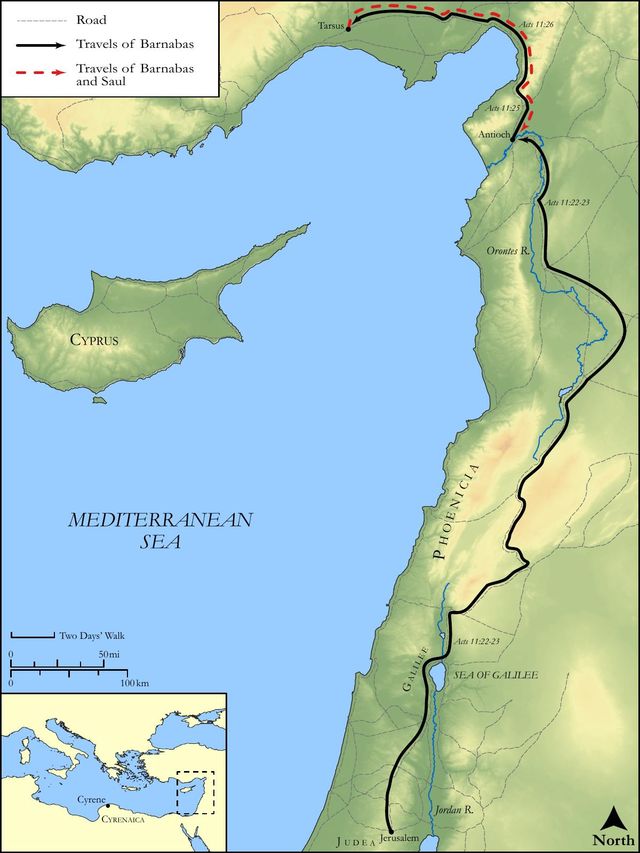
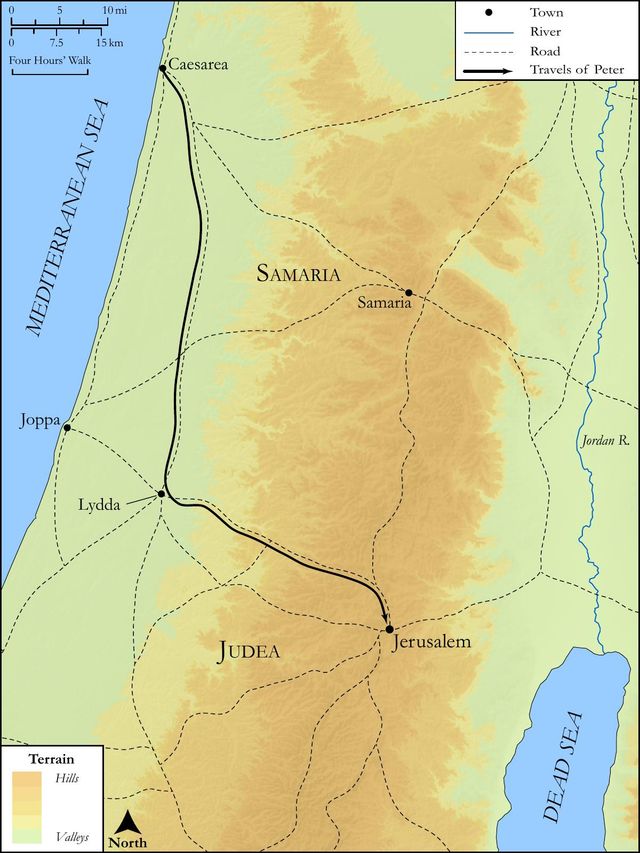
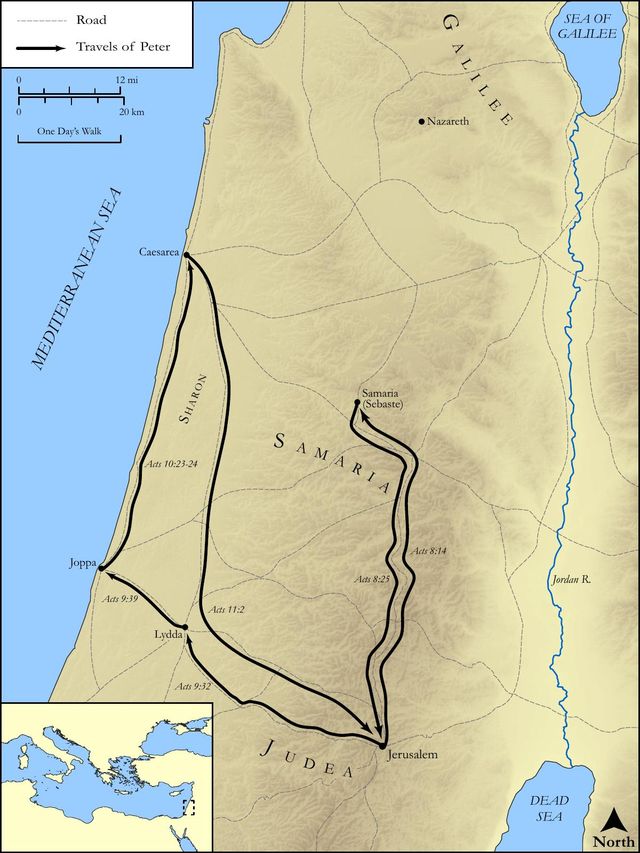
Study this verse
Public-domain commentary
Matthew Henry
From his Commentary on the Whole Bible. Henry comments on passages, not single verses — this entry covers Acts 11:1–18. His four-level outline is real structure in the source text, so it is rendered as structure.
The preaching of the gospel to Cornelius was a thing which we poor sinners of the Gentiles have reason to reflect upon with a great deal of joy and thankfulness; for it was the bringing of light to us who sat in darkness. Now it being so great a surprize to the believing as well as the unbelieving Jews, it is worth while to enquire how it was received, and what comments were made upon it. And here we find,
I.Intelligence was presently brought of it to the church in Jerusalem, and thereabouts; for Cesarea was not so far from Jerusalem but that they might presently hear of it. Some for good-will, and some for ill-will, would spread the report of it; so that before he himself had returned to Jerusalem the apostles and the brethren there and in Judea heard that the Gentiles also had received the word of God, that is, the gospel of Christ, which is not only a word of God, but the word of God; for it is the summary and centre of all divine revelation. They received Christ; for his name is called the Word of God, Rev 19:13. Not only that the Jews who were dispersed into the Gentile countries, and the Gentiles who were proselyted to the Jewish religion, but that the Gentiles also themselves, with whom it had hitherto been thought unlawful to hold common conversation, were taken into church-communion, that they had received the word of God. That is,
1.That the word of God was preached to them, which was a greater honour put upon them than they expected. Yet I wonder this should seem strange to those who were themselves commissioned to preach the gospel to every creature. But thus often are the prejudices of pride and bigotry held fast against the clearest discoveries of divine truth.
2.That it was entertained and submitted to by them, which was a better work wrought upon them than they expected. It is likely they had got a notion that if the gospel were preached to the Gentiles it would be to no purpose, because the proofs of the gospel were fetched so much out of the Old Testament, which the Gentiles did not receive: they looked upon them as not inclined to religion, nor likely to receive the impressions of it; and therefore were surprized to hear that they had received the word of the Lord. Note, We are too apt to despair of doing good to those who yet, when they are tried, prove very tractable.
II.That offence was taken at it by the believing Jews (Act 11:2, Act 11:3):
When Peter had himself come up to Jerusalem, those that were of the circumcision, those Jewish converts that still retained a veneration for circumcision, contended with him. They charged it upon him as a crime that he went in to men uncircumcised, and did eat with them; and thereby they think he has stained, if not forfeited, the honour of his apostleship, and ought to come under the censure of the church: so far were they from looking upon him as infallible, or as the supreme head of the church that all were accountable to, and he to none. See here,
1.How much it is the bane and damage of the church, to monopolize it, and to exclude those from it, and from the benefit of the means of grace, that are not in every thing as we are. There are narrow souls that are for engrossing the riches of the church, as there are that would engross the riches of the world, and would be placed alone in the midst of the earth. These men were of Jonah's mind, who, in a jealousy for his people, was angry that the Ninevites received the word of God, and justified himself in it.
2.Christ's ministers must not think it strange if they be censured and quarrelled with, not only by their professed enemies, but by their professing friends; not only for their follies and infirmities, but for their good actions seasonably and well done; but, if we have proved our own work, we may have rejoicing in ourselves, as Peter had, whatever reflections we may have from our brethren. Those that are zealous and courageous in the service of Christ must expect to be censured by those who, under pretence of being cautious, are cold and indifferent. Those who are of catholic, generous, charitable principles, must expect to be censured by such as are conceited and strait-laced, who say, Stand by thyself, I am holier than thou.
III.Peter gave such a full and fair account of the matter of fact as was sufficient, without any further argument or apology, both to justify him, and to satisfy them (Act 11:4): He rehearsed the matter from the beginning, and laid it before them in order, and then could appeal to themselves whether he had done amiss; for it appeared all along God's own work, and not his.
1.He takes it for granted that if they had rightly understood how the matter was they would not have contended with him, and commended him. And it is a good reason why we should be moderate in our censures, and sparing of them, because if we rightly understood that which we are so forward to run down perhaps we should see cause to run in with it. When we see others do that which looks suspicious, instead of contending with them, we should enquire of them what ground they went upon; and, if we have not an opportunity to do that, should ourselves put the best construction upon it that it will bear, and judge nothing before the time.
2.He is very willing to stand right in their opinion, and takes pains to give them satisfaction. He does not insist upon his being the chief of the apostles, for he was far from the thought of that supremacy which his pretended successors claim. Nor does he think it enough to tell them that he is satisfied himself in the grounds he went upon, and they need not trouble themselves about it; but he is ready to give a reason of the hope that is in him concerning the Gentiles, and why he had receded from his former sentiments, which were the same with theirs. It is a debt we owe both to ourselves and to our brethren to set those actions of ours in a true light which at first looked ill and gave offence, that we may remove stumbling-blocks out of our brethren's way. Let us now see what Peter pleads in his own defence.
(1.)That he was instructed by a vision no longer to keep up the distinctions which were made by the ceremonial law; he relates the vision (Act 11:5, Act 11:6), as we had it before Act 10:9, etc. The sheet which was there said to be let down to the earth he here says came even to him, which circumstance intimates that it was particularly designed for instruction to him. We should thus see all God's discoveries of himself, which he has made to the children of men, coming even to us, applying them by faith to ourselves. Another circumstance here added is that when the sheet came to him he fastened his eyes upon it, and considered it, Act 11:6. If we would be led into the knowledge of divine things, we must fix our minds upon them, and consider them. He tells them what orders he had to eat of all sorts of meat without distinction, asking no questions for conscience' sake, Act 11:7. It was not till after the flood (as it should seem) that man was allowed to eat flesh at all, Gen 9:3. That allowance was afterwards limited by the ceremonial law; but now the restrictions were taken off, and the matter set at large again. It was not the design of Christ to abridge us in the use of our creature-comforts by any other law than that of sobriety and temperance, and preferring the meat that endures to eternal life before that which perishes. He pleads that he was as averse to the thoughts of conversing with Gentiles, or eating of their dainties, as they could be, and therefore refused the liberty given him: Not so, Lord; for nothing common or unclean has at any time entered into my mouth, Act 11:8. But he was told from heaven that the case was now altered, that God had cleansed those persons and things which were before polluted; and therefore that he must no longer call them common, nor look upon them as unfit to be meddled with by the peculiar people (Act 11:9); so that he was not to be blamed for changing his thoughts, when God had changed the thing. In things of this nature we must act according to our present light; yet must not be so wedded to our opinion concerning them as to be prejudiced against further discoveries, when the matter may either be otherwise or appear otherwise; and God may reveal even this unto us, Phi 3:15. And, that they might be sure he was not deceived in it, he tells them it was done three times (Act 11:10), the same command given, to kill and eat, and the same reason, because that which God hath cleansed is not to be called common, repeated a second and third time. And, further to confirm him that it was a divine vision, the things he saw did not vanish away into the air, but were drawn up again into heaven, whence they were let down.
(2.)That he was particularly directed by the Spirit to go along with the messengers that Cornelius sent. And, that it might appear that the vision was designed to satisfy him in this matter, he observes to them the time when the messengers came - immediately after he had that vision; yet, lest this should not be sufficient to clear his way, the Spirit bade him go with the men that were then sent from Cesarea to him, nothing doubting (Act 11:11, Act 11:12); though they were Gentiles he went to, and went with, yet he must make no scruple of going along with them.
(3.)That he took some of his brethren along with him, who were of the circumcision, that they might be satisfied as well as he; and these he had brought up from Joppa, to witness for him with what caution he proceeded, forseeing the offence that would be taken at it. He did not act separately, but with advice; not rashly, but upon due deliberation.
(4.)That Cornelius had a vision too, by which he was directed to send for Peter (Act 11:13): He showed us how he had seen a angel in his house, that bade him send to Joppa for one Simon, whose surname is Peter. See how good it is for those that have communion with God, and keep up a correspondence with heaven, to compare notes, and communicate their experiences to each other; for hereby they may strengthen one another's faith: Peter is the more confirmed in the truth of his vision by Cornelius's, and Cornelius by Peter's. Here is something added in what the angel said to Cornelius; before it was, Send for Peter, and he shall speak to thee, he shall tell thee what thou oughtest to do (Act 10:6, Act 10:32); but here it is, "He shall tell thee words whereby thou and thy house shall be saved (Act 11:14), and therefore it is of vast concern to thee, and will be of unspeakable advantage, to send for him." Note,
[1.]The words of the gospel are words whereby we may be saved, eternally saved; not merely by hearing them and reading them, but by believing and obeying them. They set the salvation before us, and show us what it is; they open the way of salvation to us, and, if we follow the method prescribed us by them, we shall certainly be saved from wrath and the curse, and be for ever happy.
[2.]Those that embrace the gospel of Christ will have salvation brought by it to their families: "Thou and all thy house shall be saved; thou and thy children shall be taken into covenant, and have the means of salvation; thy house shall be as welcome to the benefit of the salvation, upon their believing, as thou thyself, even the meanest servant thou hast. This day is salvation come to this house," Luk 19:9. Hitherto salvation was of the Jews (Joh 4:22), but now salvation is brought to the Gentiles as much as ever it was with the Jews; the promises, privileges, and means of it are conveyed to all nations as amply and fully, to all intents and purposes, as ever it had been appropriated to the Jewish nation.
(5.)That which put the matter past all dispute was the descent of the Holy Ghost upon the Gentile hearers; this completed the evidence that it was the will of God that he should take the Gentiles into communion.
[1.]The fact was plain and undeniable (Act 11:15): "As I began to speak" (and perhaps he felt some secret reluctance in his own breast, doubting whether he was in the right to preach to the uncircumcised), "presently the Holy Ghost fell on them in as visible signs as on us at the beginning, in which there could be no fallacy." Thus God attested what was done, and declared his approbation of it; that preaching is certainly right with which the Holy Ghost is given. The apostle supposes this, when he thus argues with the Galatians: Received you the Spirit by the works of the law, or by the hearing of faith? Gal 3:2.
[2.]Peter was hereby put in mind of a saying of his Master's, when he was leaving them (Act 1:5): John baptized with water; but you shall be baptized with the Holy Ghost, Act 11:16. This plainly intimated, First, that the Holy Ghost was the gift of Christ, and the product and performance of his promise, that great promise which he left with them when he went to heaven. It was therefore without doubt from him that this gift came; and the filling of them with the Holy Ghost was his act and deed. As it was promised by his mouth, so it was performed by his hand, and was a token of his favour. Secondly, That the gift of the Holy Ghost was a kind of baptism. Those that received it were baptized with it in a more excellent manner than any of those that even the Baptist himself baptized with water.
[3.]Comparing that promise, so worded, with this gift just now conferred, when the question was started, whether these persons should be baptized or no, he concluded that the question was determined by Christ himself (Act 11:17): "Forasmuch then as God gave them the like gift as he did to us - gave it to us as believing in the Lord Jesus Christ, and to them upon their believing in him - What was I, that I could withstand God? Could I refuse to baptize them with water, whom God had baptized with the Holy Ghost? Could I deny the sign to those on whom he had conferred the thing signified? But, as for me, who was I? What! able to forbid God? Did it become me to control the divine will, or to oppose the counsels of Heaven?" Note, Those who hinder the conversion of souls withstand God; and those take too much upon them who contrive how to exclude from their communion those whom God has taken into communion with himself.
IV.This account which Peter gave of the matter satisfied them, and all was well.
Thus, when the two tribes and a half gave an account to Phinehas and the princes of Israel of the true intent and meaning of their building themselves an altar on the banks of Jordan, the controversy was dropped, and it pleased them that it was so, Jos 22:30. Some people, when they have fastened a censure upon a person, will stick to it, though afterwards it appear ever so plainly to be unjust and groundless. It was not so here; for these brethren, though they were of the circumcision, and their bias went the other way, yet, when they heard this,
1.They let fall their censures: they held their peace, and said no more against what Peter had done; they laid their hand upon their mouth, because now they perceived that God did it. Now those who prided themselves in their dignities as Jews began to see that God was staining their pride, by letting in the Gentiles to share, and to share equally, with them. And now that prophecy was fulfilled, Thou shalt no more be haughty because of my holy mountain, Zep 3:11.
2.They turned them into praises. They not only held their peace from quarrelling with Peter, but opened their mouths to glorify God for what he had done by and with Peter's ministry; they were thankful that their mistake was rectified, and that God had shown more mercy to the poor Gentiles than they were inclined to show them, saying, Then hath God also to the Gentiles granted repentance unto life! He hath granted them not only the means of repentance, in opening a door of entrance for his ministers among them, but the grace of repentance, in having given them his Holy Spirit, who, wherever he comes to be a Comforter, first convinces, and gives a sight of sin and sorrow for it, and then a sight of Christ and joy in him. Note,
(1.)Repentance, if it be true, is unto life. It is to spiritual life; all that truly repent of their sins evidence it by living a new life, a holy, heavenly, and divine life. Those that by repentance die unto sin thenceforward live unto God; and then, and not till then, we begin to live indeed, and it shall be to eternal life. All true penitents shall live, that is, they shall be restored to the favour of God, which is life, which is better than life; they shall be comforted with the assurance of the pardon of their sins, and shall have the earnest of eternal life, and at length the fruition of it.
(2.)Repentance is God's gift; it is not only his free grace that accepts it, but his mighty grace that works it in us, that takes away the heart of stone, and gives us a heart of flesh. The sacrifice of God is a broken spirit; it is he that provides himself this lamb.
(3.)Wherever God designs to give life he gives repentance; for this is a necessary preparative for the comforts of a sealed pardon and a settled peace in this world, and for the seeing and enjoying of God in the other world.
(4.)It is a great comfort to us that God has exalted his Son Jesus, not only to give repentance to Israel, and the remission of sins (Act 5:31), but to the Gentiles also.
Historical interpretation
Historical reception
1 surviving comment on this verse from the historical church.
Observe his freedom from all elation and vainglory. For it says, "But Peter rehearsed the matter from the beginning, and expounded it by order unto them, saying, I was in the city of Joppa, praying:" he does not say why, nor on what occasion: "and in a trance I saw a vision, a certain vessel descend, as it had been a great sheet, let down from heaven by four corners; and it came even to me: upon the which when I had fastened mine eyes, I considered, and saw fourfooted beasts of the earth, and wild beasts, and creeping things, and fowls of the air. And I heard a voice saying unto me, Arise, Peter; slay and eat." As much as to say, This of itself was enough to have persuaded me - my having seen the linen sheet: but moreover a Voice was added. "But I said, Not so, Lord: for nothing common or unclean hath at any time entered into my mouth." Do you mark? "I did my part," says he: "I said, that I have never eaten aught common or unclean:" with reference to this that they said, "Thou wentest in, and didst eat with them." But this he does not say to Cornelius: for there was no need to mention it to him. "But the voice answered me again from heaven, What God hath cleansed, that call not thou common. And this was done three times: and all were drawn up again into heaven."
Continue studying Acts 11:5 across the web’s major study libraries — every link below opens this exact verse, chapter, or book on the destination site.
Read & Compare
 BibleGatewayThis verse in more than 200 translations and 70 languages.
 Bible.comThe YouVersion reader — hundreds of translations, reading plans, and highlights.
 ESV.orgCrossway's official English Standard Version reader.
 NET BibleThe NET translation with 60,000+ translators' notes on every rendering decision.
 STEP BibleTyndale House's free study tool — original text, vocabulary, and scholarly resources.
 BibliaLogos Bible Software's free web reader.
 USCCBThe New American Bible (Revised Edition) with the U.S. bishops' study notes.
Commentaries
 BibleHub CommentariesDozens of classic commentaries on this verse, gathered on one page.
 StudyLightMore than 100 commentary sets — the largest collection on the web.
 BibleRefPlain-English commentary on what this verse means, verse by verse.
 Enduring WordDavid Guzik's free commentary on this chapter, widely used by Bible teachers.
 Bible Study ToolsVerse commentary alongside Greek and Hebrew study aids.
Original Language & Research
- BibleHub InterlinearThe verse word by word — original language, transliteration, and English.
- BibleHub LexiconEvery word's original-language definition and Strong's entry.
 Blue Letter BibleDeep-study tools — Strong's numbers, concordance, and word studies.
 CNTR CollationThe earliest Greek manuscripts of this verse, collated letter by letter.
Sermons, Hymns & Audio


TrulyRandomVerse is not affiliated with these sites and doesn’t control their content. They’re linked because they’re genuinely useful.
Summary
Acts 11:5 presents Peter's personal recounting of the pivotal vision he received in Joppa, a divine revelation that fundamentally challenged his deeply ingrained Jewish understanding of ritual purity and the boundaries of God's covenant people. This supernatural encounter, featuring a great sheet filled with diverse animals, served as God's direct preparation for Peter's groundbreaking ministry to the Gentile household of Cornelius, thereby initiating the inclusion of non-Jews into the nascent Christian community without requiring adherence to Mosaic ceremonial law.
Context
ShowHideLiterary Context
This verse is embedded within Peter's defense before the apostles and elders in Jerusalem, as recorded in Acts 11:1-18. Having heard that Peter had entered the home of uncircumcised men and eaten with them, the Jewish believers in Jerusalem "criticized him" (Acts 11:2). Peter's detailed recounting of the vision in Acts 10:9-16 and his subsequent encounter with Cornelius and his household (Acts 10:17-48) serves as his justification. By reiterating the divine imperative behind his actions, Peter demonstrates that he was not acting on his own accord but in direct obedience to God's clear instruction, thereby paving the way for the acceptance of Gentile converts.
Historical & Cultural Context
Peter's vision occurred in Joppa (modern Jaffa), a coastal city with a significant port, located northwest of Jerusalem. As a devout Jew, Peter would have meticulously observed the dietary laws (kashrut) outlined in the Mosaic Law, which distinguished between "clean" and "unclean" animals (Leviticus 11). These laws were not merely dietary regulations but deeply embedded cultural and religious markers that reinforced Jewish distinctiveness and separation from Gentile nations. Jews typically avoided social interaction, especially shared meals, with Gentiles, who were considered ritually unclean. The challenge presented by the vision was therefore immense, striking at the core of Peter's identity and the prevailing social norms of his time.
Key Themes
ShowHideActs 11:5 contributes significantly to several overarching themes within the book of Acts. Firstly, it highlights the theme of Divine Initiative and Guidance, emphasizing that the expansion of the Gospel to the Gentiles was not a human strategy but a direct command from God, initiated through supernatural revelation. Secondly, it powerfully illustrates the Overcoming of Barriers, particularly the breaking down of the long-standing Jewish-Gentile divide, a central theological development in early Christianity. The vision's message, "What God has made clean, do not call common" (Acts 10:15), extends beyond food to people, signifying God's universal redemptive plan. Lastly, the verse underscores the importance of Prayer and Openness to God's Will, as Peter's receptiveness to this transformative vision occurred during a time of prayer, demonstrating how spiritual disciplines can prepare one for divine encounter and new understanding.
Exposition and Analysis
ShowHideKey Word Analysis
ShowHideMeaning "a displacement of the mind, i.e. bewilderment, 'ecstasy.'" This term signifies a profound, supernatural state where Peter's normal consciousness was suspended, allowing for direct perception of divine realities. It emphasizes that the vision was not a dream or a product of his imagination, but an external, divinely imposed experience that overwhelmed his natural senses.
A primary verb meaning "to see (literally or figuratively); by implication, (in the perfect tense only) to know." While often used for physical sight, in the context of a "trance," it denotes a spiritual or revelatory seeing, implying a direct apprehension of truth or a divine manifestation. This seeing was accompanied by understanding and knowledge imparted by God.
Meaning "the sky; by extension, heaven (as the abode of God); by implication, happiness, power, eternity; specially, the Gospel (Christianity)." The origin "from heaven" underscores the divine authority and origin of the vision. It was not an earthly phenomenon but a direct communication from God's dwelling place, imbuing the message with ultimate authority and significance.
Verse Breakdown
ShowHide"I was in the city of Joppa praying:"
This opening clause establishes the setting and Peter's posture. Joppa, a coastal city, was where Peter was staying with Simon the tanner (Acts 10:6). His act of "praying" highlights his spiritual receptivity and availability to God, often a precursor to divine revelation in Scripture.
"and in a trance I saw a vision,"
This phrase describes the supernatural nature of Peter's experience. The "trance" (ékstasis) indicates an altered state of consciousness, a profound spiritual experience where Peter was taken "outside himself" to receive a direct message from God, distinct from a mere dream or contemplation. The "vision" (hórama) signifies a divine manifestation or spectacle.
"A certain vessel descend, as it had been a great sheet, let down from heaven by four corners;"
This is the central imagery of the vision. "A certain vessel" (skeûos) is clarified as "a great sheet" (othónē), implying a large, perhaps sail-like, piece of linen. Its descent "from heaven" by "four corners" emphasizes its divine origin and universal scope—suggesting something encompassing all parts of the world or all types of creatures.
"and it came even to me:"
This final clause personalizes the vision, indicating that this divine communication was specifically directed at Peter. It was not a general phenomenon but an intentional, personal encounter designed to prepare him for a specific mission and to challenge his deeply held convictions.
Literary Devices
ShowHideThe passage employs several key literary devices. Symbolism is paramount, with the "great sheet" serving as a potent symbol of God's inclusive plan. The sheet, containing "all kinds of four-footed animals, wild beasts, reptiles, and birds of the air" (Acts 10:12), symbolizes the entire spectrum of humanity, particularly the Gentiles, previously considered "unclean" by Jewish law. Its descent "from heaven" underscores Divine Authority and initiative, indicating that this new understanding of inclusion originates solely from God. The "trance" itself is a form of Supernatural Revelation, a common narrative device in biblical literature (e.g., Ezekiel's visions, Paul's Damascus Road experience) to signify direct communication from God that transcends ordinary human experience and carries undeniable divine weight. The narrative structure, where Peter recounts the vision, also functions as Repetition for Emphasis, reinforcing the divine mandate for Gentile inclusion to his skeptical audience in Jerusalem.
Theological and Thematic Connections
ShowHidePeter's vision in Joppa is a watershed moment in salvation history, marking a profound shift in God's redemptive plan from a primary focus on the Jewish people to a universal outreach encompassing all nations. It dismantles the rigid categories of "clean" and "unclean" that had defined Jewish identity and separation for centuries, revealing that God's grace extends beyond ethnic and ritual boundaries. This theological reorientation is crucial for understanding the expansion of the early church and the core message of the Gospel: that salvation is available to all through faith in Christ, irrespective of their background, and that God's people are now defined by their relationship with Him, not by adherence to ceremonial law.
Reflection and Application
ShowHideActs 11:5 offers profound lessons for believers today, challenging us to examine our own preconceptions and biases that might hinder God's inclusive work in the world. Just as Peter's worldview was radically transformed by divine revelation, we are called to remain open to God's ongoing guidance, especially when it pushes us beyond our comfort zones or challenges long-held traditions. The "great sheet" vision reminds us that God's love and redemptive embrace are boundless, extending to every person regardless of their background, ethnicity, social status, or past. It compels us to cultivate a posture of humility and spiritual receptivity, recognizing that God often reveals His next steps when we are earnestly seeking Him in prayer. This passage encourages us to actively participate in God's mission of reconciliation, breaking down barriers and extending genuine welcome to all, reflecting the expansive and unconditional love of Christ to a diverse world.
Questions for Reflection
ShowHideFAQ
ShowHideWhat was the significance of the "trance" Peter experienced?
ShowHideThe "trance" (Greek: ékstasis) was a crucial element, signifying a state of profound spiritual rapture or ecstasy where Peter's normal consciousness was suspended. This was not a mere dream or a product of his own thoughts, but a direct, supernatural intervention by God. Its significance lies in underscoring the divine origin and authority of the message Peter received. It demonstrated that the vision was an undeniable revelation from God, designed to convey a specific, transformative truth that would challenge Peter's deeply held Jewish beliefs about clean and unclean, and ultimately about the inclusion of Gentiles into the family of God. This divine imposition ensured that Peter, and later the Jerusalem church, understood that this radical shift in ministry was God's will, not a human innovation.
Christ-Centered Fulfillment
ShowHideActs 11:5, with Peter's vision of the great sheet, finds its ultimate Christ-centered fulfillment in the person and work of Jesus, who is the very embodiment of God's inclusive grace. The vision's message, "What God has made clean, do not call common" (Acts 10:15), directly echoes Christ's own teachings that it is not what goes into a person that defiles them, but what comes out of their heart (Mark 7:18-23). Jesus's ministry consistently broke down social and religious barriers, reaching out to the lowly, the Samaritan woman (John 4:7-42), tax collectors like Zacchaeus (Luke 19:1-10), and even Gentiles, as seen in His healing of the Syrophoenician woman's daughter (Mark 7:24-30). His death on the cross ultimately abolished the "dividing wall of hostility" between Jew and Gentile, creating "one new humanity" (Ephesians 2:14-16). Thus, Peter's vision is not merely about dietary laws but about the universal reach of the Gospel, made possible by Christ's atoning work, which welcomes all people into God's family through faith, fulfilling the promise that in Abraham's seed "all the families of the earth shall be blessed" (Genesis 12:3).