


Ezekiel 2:9
Bible text: King James Version (1769 Blayney text) · Public domain
Bible text: Berean Standard Bible · Public domain
Bible text: American Standard Version (1901) · Public domain
Bible text: World English Bible, Messianic edition · Public domain
Bible text: Geneva Bible (1599) · Public domain
Bible text: Young's Literal Translation · Public domain
- וָאֶרְאֶהva·'er·'Ehand I sawH7200Conj-w ¦ V-Qal-ConsecImperf-1csVerb Qal Consecutive Imperfect 1st Singular common genderוָandאֶרְאֶהI saw
- וְהִנֵּהve·hi·nehand there!H2009Conj-w ¦ PrtParticle Interjectionוְandהִנֵּהthere!
- יָדyada handH3027N-csNoun Singular common gender Absolute
- שְׁלוּחָהshe·lu·Chah[was] stretched outH7971V-Qal-PassPrtcpl-fsVerb Qal Participle Passive Singular Feminine Absolute
- אֵלָי'e·Laito meH413Prep ¦ 1csPrepositionאֵלָtoיme
- וְהִנֵּהve·hi·nehand there!H2009Conj-w ¦ PrtParticle Interjectionוְandהִנֵּהthere!
- בוֹvo[was] in itPrep-b ¦ 3msSuffix Personal 3rd Singular Masculineב[was] inוֹit
- מְגִלַּתme·gi·lata scroll ofH4039N-fscNoun Singular Feminine Construct
- סֵפֶרSe·fera documentH5612N-msNoun Singular Masculine Absolute
English is a literal word-by-word gloss of the Hebrew, not the KJV's wording. Why?
This is the original text the KJV's translators worked from — each Hebrew word with its own literal English meaning in this verse, prepared by scholars at Tyndale House, Cambridge. The KJV translates whole sentences, not word by word, so its wording differs: one Hebrew word can become several English words, and the KJV may choose “the LORD” where the gloss reads “Yahweh”. Both are faithful — they answer different questions. For the KJV's own rendering, switch to the KJV text.
Details
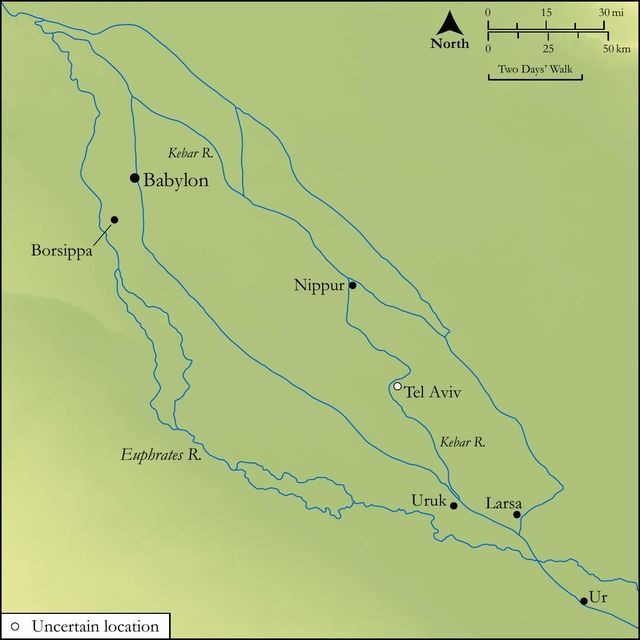
See on the biblical-era map
Study this verse
Public-domain commentary
Matthew Henry
From his Commentary on the Whole Bible. Henry comments on passages, not single verses — this entry covers Ezekiel 2:6–10. His three-level outline is real structure in the source text, so it is rendered as structure.
The prophet, having received his commission, here receives a charge with it. It is a post of honour to which he is advanced, but withal it is a post of service and work, and it is here required of him,
I.That he be bold.
He must act in the discharge of this trust with an undaunted courage and resolution, and not be either driven off from his work or made to drive on heavily, by the difficulties and oppositions that he would be likely to meet with in it: Son of man, be not afraid of them, Eze 2:6. Note, Those that will do any thing to purpose in the service of God must not be afraid of the face of man; for the fear of men will bring a snare, which will be very entangling to us in the work of God.
1.God tells the prophet what was the character of those to whom he sent him, as before, Eze 2:3, Eze 2:4. They are briers and thorns, scratching, and tearing, and vexing a man, which way soever he turns. They are continually teazing God's prophets and entangling them in their talk (Mat 22:15); they are pricking briers and grieving thorns. The best of them is as a brier, and the most upright sharper than a thorn-hedge, Mic 7:4. Thorns and briers are the fruit of sin and the curse, and of equal date with the enmity between the seed of the woman and the seed of the serpent. Note, Wicked men, especially the persecutors of God's prophets and people, are as briers and thorns, which are hurtful to the ground, choke the good seed, hinder God's husbandry, are vexatious to his husbandmen; but they are nigh unto cursing and their end is to be burned. Yet God makes use of them sometimes for the correction and instruction of his people, as Gideon taught the men of Succoth with thorns and briers, Jdg 8:16. Yet this is not the worst of their character: they are scorpions, venomous and malignant. The sting of a scorpion is a thousand times more hurtful than the scratch of a brier. persecutors are a generation of vipers, are of the serpent's seed, and the poison of asps is under their tongue; and they are more subtle than any beast of the field. And, which makes the prophet's case the more grievous, he dwells among these scorpions; they are continually about him, so that he cannot be safe nor quiet in his own house; these bad men are his bad neighbours, who thereby have many opportunities, and will let slip none, to do him a mischief. God takes notice of this to the prophet, as Christ to the angel of one of the churches, Rev 2:13. I know thy works, and where thou dwellest, even where Satan's seat is. Ezekiel had been, in vision, conversing with angels, but when he comes down from this mount he finds he dwells with scorpions.
2.He tells him what would be their conduct towards him, that they would do what they could to frighten him with their looks and their words; they would hector him and threaten him, would look scornfully and spitefully at him, and do their utmost to face him down and put him our of countenance, that they might drive him off from being a prophet, or at least from telling them of their faults and threatening them with the judgments of God; or, if they could not prevail in this, that they might vex and perplex him, and disturb the repose of his mind. They were now themselves in subjection, divested of all power, so that they had no other way of persecuting the prophet than with their looks and their words; and so they did persecute him. Behold, thou hast spoken and done evil things as thou couldest, Jer 3:5. If they had had more power, they would have done more mischief. They were now in captivity, smarting for their rebellion, and particularly their misusing God's prophets; and yet they are as bad as ever. Though thou brag a fool in a mortar, yet will not his foolishness depart from him; no providences will of themselves humble and reform men, unless the grace of God work with them. But, how malicious soever they were, Ezekiel must not be afraid of them nor dismayed, he must not be deterred from his work, or any part of it, nor be disheartened or dispirited in it by all their menaces, but go on in it with resolution and cheerfulness, assuring himself of safety under the divine protection.
II.It is required that he be faithful, Eze 2:7.
1. he must be faithful to Christ who sent him: Thou shalt speak my words unto them. Note, As it is the honour of prophets that they are entrusted to speak God's words, so it is their duty to cleave closely to them and to speak nothing but what is agreeable to the words of God. Ministers must always speak according to that rule. 2. He must be faithful to the souls of those to whom he was sent: Whether they will hear of whether they will forbear, he must deliver his message to them as he received it. He must bring them to comply with the word, and not study to accommodate the word to their humours. "It is true they are most rebellious, they are rebellion itself; but, however, speak my words to them, whether they are pleasing or unpleasing." Note, The untractableness and unprofitableness of people under the word are no good reason why ministers should leave off preaching to them; nor must we decline an opportunity by which good may be done, though we have a great deal of reason to think no good will be done.
III.It is required that he be observant of his instructions.
1.Here is a general intimation what the instructions were that were given him, in the contents of the book which was spread before him, Eze 2:10.
(1.)His instructions were large; for the roll was written within and without, on the inside and on the outside of the roll. It was as a sheet of paper written on all the four sides. One side contained their sins; the other side contained the judgments of God coming upon them for those sins. Note, God has a great deal to say to his people when they have degenerated and become rebellious.
(2.)His instructions were melancholy. He was sent on a sad errand; the matter contained in the book was, lamentations, and mourning, and woe. The idea of his message is taken from the impression it would make upon the minds of those that carefully attended to it; it would set them a weeping and crying out, Woe! and, Alas! Both the discoveries of sin and the denunciations of wrath would be matter of lamentation. What could be more lamentable, more mournful, more woeful, than to see a holy happy people sunk into such a state of sin and misery as it appears by the prophecy of this book the Jews were at this time? Ezekiel echoes to Jeremiah's lamentations. Note, Though God is rich in mercy, yet impenitent sinners will find there are even among his words lamentations and woe.
2.Here is an express charge given to the prophet to observe his instructions, both in receiving his message and delivering it. he is now to receive it and is here commanded,
(1.)To attend diligently to it: son of man, hear what I say unto thee, Eze 2:8. Note, Those that speak from God to others must be sure to hear from God themselves and be obedient to his voice: "Be not thou rebellious; do not refuse to go on this errand, or to deliver it; do not fly off, as Jonah did, for fear of disobliging thy countrymen. They are a rebellious house, among whom thou livest; but be not thou like them, do not comply with them in any thing that is evil." If ministers, who are reprovers by office, connive at sin and indulge sinners, either show them not their wickedness or show them not the fatal consequences of it, for fear of displeasing them and getting their ill-will, they hereby make themselves partakers of their guilt and are rebellious like them. If people will not do their duty in reforming, yet let ministers do theirs in reproving, and they will have the comfort of it in the reflection, whatever the success be, as that prophet had, Isa 50:5. The Lord God has opened my ear, and I was not rebellious. Even the best of men, when their lot is cast in bad times and places, have need to be cautioned against the worst of crimes.
(2.)To digest it in his own mind by an experience of the favour and power of it: "Do not only hear what I say unto thee, but open thy mouth, and eat that which I give thee. Prepare to eat it and eat it willingly and with an appetite." All God's children are content to be at their heavenly father's finding, and to eat whatever he gives them. That which God's hand reached out to Ezekiel was a roll of a book, or the volume of a book, a book or scroll of paper or parchment fully written and rolled up. Divine revelation comes to us from the hand of Christ; he gave it to the prophets, Rev 1:1. When we look at the roll of thy book we must have an eye to the hand by which it is sent to us. He that brought it to the prophet spread it before him, that he might now swallow it with an implicit faith, but might fully understand the contents of it, and then receive it and make it his own. Be not rebellious, says Christ, but eat what I give thee. If we receive not what Christ in his ordinances and providences allots for us, if we submit not to his word and rod, and reconcile not ourselves to both, we shall be accounted rebellious.
Historical interpretation
Four Centuries of Reception
7 surviving comments on this verse. Each one is dated, so this reads as a timeline rather than a list.
Select a marker to jump to its quote. Markers stagger vertically where authors wrote within a few decades of each other.
The scroll symbolizes the prophets and the apostles. In it the Old Testament was written on the reverse and the New on the obverse. Moreover, the scroll symbolizes the secret, the spiritual teaching—and in such a dignified manner that it may be read on both sides. In reality it is of such a kind that there is a connection between reading the outside and understanding the inside.
(Verse 9.) In which was a wrapped book, and he unfolded it before me, and it was written inside and outside: and there were written in it lamentations, and a song, and woe. And he said to me: Son of man, whatever you find, eat. Concerning the wrapped book, the seventy chapters of the book were translated. In the hand of the Lord sitting on the throne, which was sent and extended. Concerning which it is also said in the Psalms: In the chapter of the book it is written about me (Psalm 39:8). Chapter, let us understand the beginning. This book was wrapped and sealed, written inside and outside, or before and after, of such difficulty that no one was able to open and read it, neither in heaven, nor on earth, nor underneath the earth, except the lion of the tribe of Judah, the root of David and Jesse, whom John in the Apocalypse said devoured it (Rev. 5), not whole, but in a chapter, that is, in the beginning. For it is impossible for human nature to devour the entire treasure of this book. And He unfolded it before the prophet, and He made it available to be read and understood, who is said to be marked in Isaiah as belonging to the people who do not believe (Isa. XXIX). For even to this day the veil is placed upon the Jews in the old Testament. And it was written before and after; concerning things to come and concerning things past. Truly, outwardly in historical writing, but inwardly in spiritual understanding, of which the Psalmist says: The glory of the king's daughter is from within (Psal. XLIV, 14). And there were written in it both inward and outward lamentations, and song, and woe. Lamentations, concerning those who are called to penance, just as Samuel and the Apostle Paul mourned and lamented for Saul and the Corinthians, whom they desired to save (2 Chronicles 16; 2 Corinthians 12). Song about those who are worthy of God's testimony, and whom the Psalmist commands: Sing to the Lord a new song (Psalm 95 and 97, verse 1). Furthermore, woe to those who have completely despaired and, when they come into the depths of sin, they scorn (Prov. XVIII).
If God were to stand up as the avenger of sin, the church would lose many of its saints and certainly would be deprived of the apostle Paul.
Let him therefore say: "Which was written within and without," because in sacred eloquence the strong are satisfied by more hidden and sublime sayings, and we little ones are nourished by plainer precepts. Whence it is written: "The high mountains are for the deer, the rock is a refuge for the hedgehogs." For let those have the mountains of understanding who already know how to make the leaps of contemplation. But let the rock be a refuge for the hedgehogs, because we little ones, covered with the thorns of our sins, even if we cannot understand lofty things, are saved in the refuge of our rock, that is, in faith in Christ. Whence also it is said to certain ones: "I judged myself to know nothing among you except Christ Jesus, and him crucified." As if he were saying: Because I considered that you could not grasp the mysteries of his divinity, I spoke to you only of the weakness of his humanity.
"And I looked, and behold, a hand was sent to me, in which was a rolled-up book; and he spread it out before me, and it was written inside and outside." Just as the order of preachers is designated by the prophet, so the pages of Sacred Scripture are designated by the book which he received. Now the scroll is the obscure speech of Sacred Scripture, which is wrapped up in the profundity of its meanings, so that it may not easily be penetrated by the understanding of all. But the scroll is unrolled before the prophet, because the obscurity of sacred speech is opened before preachers. The hand of God had extended a rolled-up scroll when He was saying to the apostles: "The kingdom of heaven has become like a man who sowed good seed in his field. But while men were sleeping, his enemy came and sowed weeds among the wheat, and went away. And when the grass had grown and produced fruit, then the weeds also appeared," and the rest which your charity remembers even without my recounting it. But He unrolled the scroll which He had shown rolled up when He explained what He had spoken through riddles, saying: "He who sows the good seed is the Son of Man. The field is the world. The good seed, these are the sons of the kingdom; but the weeds are the sons of wickedness. The enemy who sowed them is the devil. The harvest is the consummation of the age, and the harvesters are angels. Therefore just as the weeds are gathered and burned with fire, so it will be at the consummation of the age." And so the rolled-up scroll is unrolled when what had been set forth obscurely is opened through the breadth of understanding. Truth unrolled this rolled-up scroll when He accomplished in His disciples what is written: "Then He opened their minds to understand the Scriptures."
Concerning this book it is further added: "Which was written within and without." For the book of sacred eloquence is written within through allegory, without through history. Within through spiritual understanding, but without through the simple sense of the letter, still suited to those who are weak. Within, because it promises invisible things; without, because it arranges visible things through the rectitude of its precepts. Within, because it promises heavenly things, but without because it teaches how earthly things are to be despised, whether they are to be used or fled from out of desire. For it speaks certain things concerning heavenly secrets, but commands other things in external actions. And indeed those things which it commands outwardly are plain, but those things which it narrates concerning internal matters cannot be fully apprehended.
Whence it is written: "Stretching out the heaven like a skin, who covers its upper parts in the waters." For what is signified by the name of heaven except sacred Scripture? From which the sun of wisdom, and the moon of knowledge, and from the ancient Fathers the stars of examples and virtues shine for us. This is stretched out like a skin, because, formed through the tongue of flesh by its writers, it is unfolded before our eyes by being expounded through the words of teachers. But what is signified by the name of waters except the most holy choirs of angels? Of which it is written: "And let the waters that are above the heavens praise the name of the Lord." The Lord covers the upper parts of this heaven in the waters, because the deep things of sacred eloquence, that is, those things which it narrates concerning the nature of divinity or concerning eternal joys, while we are still ignorant, are known to the angels alone in secret. Therefore this heaven is both stretched out before us, and yet its upper parts are covered in the waters, because both certain things of sacred eloquence now lie open to us through the opening of the spirit, and certain things which can be manifest to the angels alone are still kept hidden from us. Concerning which hidden things, however, we already perceive a part through spiritual understanding, we have already received the pledge of the Holy Spirit, because we have not yet fully known these things, and yet we love them from the depths of our heart, and in many spiritual senses which we have already known, we are fed with the food of truth.
Continue studying Ezekiel 2:9 across the web’s major study libraries — every link below opens this exact verse, chapter, or book on the destination site.
Read & Compare
 BibleGatewayThis verse in more than 200 translations and 70 languages.
 Bible.comThe YouVersion reader — hundreds of translations, reading plans, and highlights.
 ESV.orgCrossway's official English Standard Version reader.
 NET BibleThe NET translation with 60,000+ translators' notes on every rendering decision.
 STEP BibleTyndale House's free study tool — original text, vocabulary, and scholarly resources.
 BibliaLogos Bible Software's free web reader.
 USCCBThe New American Bible (Revised Edition) with the U.S. bishops' study notes.
Commentaries
 BibleHub CommentariesDozens of classic commentaries on this verse, gathered on one page.
 StudyLightMore than 100 commentary sets — the largest collection on the web.
 BibleRefPlain-English commentary on what this verse means, verse by verse.
 Enduring WordDavid Guzik's free commentary on this chapter, widely used by Bible teachers.
 Bible Study ToolsVerse commentary alongside Greek and Hebrew study aids.
Original Language & Research
- BibleHub InterlinearThe verse word by word — original language, transliteration, and English.
- BibleHub LexiconEvery word's original-language definition and Strong's entry.
 Blue Letter BibleDeep-study tools — Strong's numbers, concordance, and word studies.
 SefariaThe Hebrew text with Rashi and centuries of Jewish commentary.
Sermons, Hymns & Audio


TrulyRandomVerse is not affiliated with these sites and doesn’t control their content. They’re linked because they’re genuinely useful.
Summary
Ezekiel 2:9 marks a pivotal moment in the prophet Ezekiel's divine commissioning, immediately following his profound vision of God's glory and the command to stand. This verse describes the tangible manifestation of God's message: the appearance of a hand reaching out to Ezekiel, presenting him with a scroll. This imagery powerfully conveys the divine origin, authoritative nature, and comprehensive scope of the prophetic word that Ezekiel is about to receive and proclaim to a rebellious house of Israel, setting the stage for the challenging ministry ahead.
Context
ShowHideLiterary Context
Ezekiel 2:9 is situated at a critical juncture in the prophet's call, serving as the climax of his initial encounter with the divine. It immediately follows the awe-inspiring vision of God's glory described in Ezekiel 1 and the direct command for Ezekiel to stand up and receive his commission in Ezekiel 2:1-8. The preceding verses emphasize God's sovereignty and the prophet's submission, preparing him for a difficult ministry to a "rebellious house" (Ezekiel 2:5-7). The appearance of the hand and the scroll in verse 9 directly sets the stage for the content of the scroll, which is subsequently described as filled with lamentation, mourning, and woe (Ezekiel 2:10), and then consumed by Ezekiel (Ezekiel 3:1-3), symbolizing his full reception and internalization of the divine message. This sequence underscores the direct, personal, and weighty nature of God's revelation to His chosen messenger.
Historical & Cultural Context
The prophet Ezekiel was a priest living among the Judean exiles by the Chebar River in Babylon, deported during the second wave of Babylonian captivity in 597 BC, alongside King Jehoiachin and the elite of Jerusalem. This period was marked by national despair, false hopes of a swift return, and a pervasive spiritual rebellion among the exiles who struggled to reconcile their circumstances with God's covenant promises. In this context, the "roll of a book" (a scroll) was the primary medium for recording and transmitting important texts, including legal documents, historical records, and prophetic oracles. The act of receiving a scroll directly from a divine hand would have profoundly underscored the authoritative, unalterable, and comprehensive nature of the message, distinguishing it from human pronouncements or mere opinions. It signaled that this was not a message of human origin, but a direct communication from the God who remained sovereign even in exile.
Key Themes
ShowHideEzekiel 2:9 powerfully contributes to several overarching themes within the book of Ezekiel and prophetic literature generally. Firstly, it highlights Divine Revelation and Authority, emphasizing that God's word is not merely human insight but a direct, tangible communication from the Almighty. The "hand" signifies God's active involvement and the divine origin of the prophetic message, much like God's powerful hand was seen in the deliverance from Egypt. Secondly, the "roll of a book" underscores the Prophetic Mandate and the Burden of the Word. It symbolizes the complete, pre-ordained, and often difficult message that the prophet is commissioned to deliver, emphasizing that Ezekiel is a faithful messenger, not an originator, of the divine word. This aligns with the call of other prophets who were given a specific word to speak, such as Jeremiah. Finally, the image of a "roll of a book" points to the Written and Enduring Nature of God's Word. In a culture where scrolls preserved vital information, this imagery conveys that God's communication is precise, recorded, and meant to be faithfully transmitted and preserved, ensuring its lasting impact and accessibility, much like the Law given to Moses.
Exposition and Analysis
ShowHideKey Word Analysis
ShowHideThis primitive word refers to "the open one," indicating power, means, and direction. In this context, the "hand" is an anthropomorphic representation of God's direct involvement and active power in conveying His message to Ezekiel. It signifies divine initiative and authority, demonstrating that the revelation is not a product of Ezekiel's own mind but an external, divine impartation, symbolizing God's active agency.
Derived from the root "to roll," this term precisely denotes a "scroll" or "volume." It describes the physical form of the written document common in Israel. Its use here emphasizes that the divine message is not an abstract idea or a fleeting vision, but a concrete, complete, and tangible communication, meant to be unrolled, read, and fully comprehended.
This word refers to "writing (the art or a document)" and by implication, a "book" or "scroll." When combined with mᵉgillâh ("roll"), it reinforces the idea of a written, authoritative text. It highlights the structured, intentional, and preserved nature of God's revelation, indicating that the message is comprehensive and intended for faithful transmission and enduring remembrance, serving as evidence or a register of divine decree.
Verse Breakdown
ShowHide"And when I looked, behold,"
This opening phrase immediately draws the reader into Ezekiel's experience, emphasizing the sudden and striking nature of the vision. The Hebrew verb for "looked" (H7200, râʼâh) signifies seeing, perceiving, or discerning, highlighting Ezekiel's receptive posture. The interjection "behold" (Hebrew: הִנֵּה, hinnēh) functions to signal something remarkable and unexpected, demanding immediate attention and underscoring the divine initiative.
"an hand [was] sent unto me;"
This clause describes the direct, personal, and active involvement of God in the commissioning. The "hand" is a powerful symbol of divine agency and power, reaching out directly to Ezekiel. The verb "sent" (H7971, shâlach) implies a deliberate, purposeful dispatch, signifying that this encounter is not accidental but a divinely orchestrated event to convey a specific message and empower the prophet.
"and, lo, a roll of a book [was] therein;"
This final clause reveals the content delivered by the divine hand. The "roll of a book" (Hebrew: mᵉgillâh çêpher) is a scroll, the ancient form of a written document. Its presence within the hand signifies that the divine message is concrete, complete, and written. It implies that the revelation is not merely an oral prophecy but a fixed, authoritative text that Ezekiel is to receive, internalize, and then proclaim. The repetition of "lo" (הִנֵּה, hinnēh) again emphasizes the striking and awe-inspiring nature of this divine revelation.
Literary Devices
ShowHideEzekiel 2:9 is rich in Symbolism. The "hand" is a powerful symbol of God's direct agency, power, and active involvement in human affairs, particularly in the commissioning of His prophets. It conveys divine authority and the personal nature of God's call to Ezekiel. The "roll of a book" is another potent symbol, representing the divine word itself—complete, authoritative, and pre-ordained. It signifies that the message is not a human invention but a divinely revealed truth, fixed and ready to be delivered. This scene also employs Visionary Language, characteristic of prophetic literature, where spiritual realities are conveyed through vivid, often surreal, imagery experienced by the prophet. The entire encounter is part of a larger Theophany, a visible manifestation of God to humanity, emphasizing the sacred and overwhelming nature of the divine presence and communication. Furthermore, the use of a "hand" can be seen as Anthropomorphism, attributing human characteristics (a hand) to God to make His actions comprehensible to human understanding, without implying a literal physical form.
Theological and Thematic Connections
ShowHideEzekiel 2:9 profoundly underscores the nature of divine revelation as an active, intentional, and authoritative act of God. The image of the hand delivering a scroll emphasizes that God's word is not a human construct but a direct impartation from the divine realm, complete and unalterable. This divine initiative validates the prophet's message and establishes its ultimate authority. It teaches us that God communicates purposefully, entrusting His messages to chosen vessels for the benefit of His people. The physical form of the "roll of a book" highlights the enduring and precise nature of God's truth, meant to be preserved, studied, and proclaimed across generations. This divine communication is not merely informative but transformative, carrying the weight of God's will and judgment, and demanding a response from those who hear it.
Reflection and Application
ShowHideEzekiel 2:9 serves as a profound reminder of the sacred origin and weighty nature of God's Word. Just as a divine hand delivered a specific, comprehensive message to Ezekiel, God continues to reveal Himself and His truth to us through the inspired Scriptures. This verse challenges us to approach the Bible not as a mere human text, but as the "roll of a book" delivered by God's own hand—authoritative, complete, and imbued with divine power. It calls us to receive God's Word with reverence, to internalize its message, and to allow it to shape our understanding, our character, and our mission in the world. Like Ezekiel, we are called to be recipients of divine truth, but also, in a sense, its messengers, living out and sharing the transformative power of God's revealed will. In a world saturated with human opinions and fleeting trends, this verse anchors us in the unchanging, divinely authored truth that alone provides true guidance and spiritual nourishment.
Questions for Reflection
ShowHideFAQ
ShowHideWhat is the significance of the "hand" in this verse?
ShowHideThe "hand" in Ezekiel 2:9 is highly significant as an anthropomorphic representation of God's direct agency and power. It signifies that the message Ezekiel is about to receive does not originate from human wisdom or imagination but is a direct, tangible impartation from God Himself. This imagery underscores the divine authority and personal nature of Ezekiel's commissioning, emphasizing that God is actively involved in revealing His will and empowering His prophet. It serves to validate the prophetic message as truly divine, much like the "finger of God" inscribed the Law on tablets (e.g., Exodus 31:18).
Why is the message delivered as a "roll of a book" (a scroll) and not just spoken?
ShowHideThe delivery of the message as a "roll of a book" (a scroll) is crucial for several reasons. Firstly, it indicates the complete and comprehensive nature of the divine revelation; it's not a fragmented message but a full, pre-ordained text. Secondly, in Israel, scrolls were the primary means of preserving and transmitting important, authoritative documents, such as legal codes, historical records, and prophetic oracles. This emphasizes the enduring, unalterable, and weighty nature of God's word, meant to be faithfully recorded, studied, and proclaimed. It highlights that God's communication is precise and intended for lasting remembrance, unlike fleeting oral pronouncements. This mirrors the emphasis on written revelation seen throughout Scripture, from the Law of Moses to the prophetic books.
Christ-Centered Fulfillment
ShowHideEzekiel 2:9, with its imagery of a divine hand delivering a written scroll, profoundly foreshadows the ultimate and perfect revelation of God in Jesus Christ. While Ezekiel received a written word, often filled with lamentation and judgment for a rebellious people, Christ himself is the living, incarnate Word of God. The "hand" that sent the scroll to Ezekiel finds its ultimate expression in God the Father sending His Son into the world (e.g., John 3:16). The "roll of a book" containing God's message points forward to Jesus, who embodies and fulfills all of God's revelation. As John 1:1-3 declares, "In the beginning was the Word, and the Word was with God, and the Word was God... All things were made through him." Furthermore, Hebrews 1:1-2 states that "in these last days [God] has spoken to us by his Son." The scroll in Ezekiel's hand contained a message of judgment, but also implicitly, a promise of restoration through obedience. Christ, the ultimate Word, not only pronounces judgment but also offers the ultimate means of reconciliation and life through His atoning sacrifice. He is the Lamb worthy to open the scroll with seven seals, revealing God's final purposes and bringing them to fruition, thereby fulfilling the very essence of divine revelation.