


Revelation 10:8
Bible text: King James Version (1769 Blayney text) · Public domain
Bible text: King James Version with Strong's numbers · Public domain
Bible text: Berean Standard Bible · Public domain
Bible text: American Standard Version (1901) · Public domain
Bible text: World English Bible, Messianic edition · Public domain
Bible text: Geneva Bible (1599) · Public domain
Bible text: Young's Literal Translation · Public domain
- ΚαὶKaiAndG2532CONJConjunction
- ἡhētheG3588T-NSFDefinite article Nominative Singular Feminine
- φωνὴphōnēvoiceG5456N-NSFNoun Nominative Singular Feminine
- ἣνhēnthatG3739R-ASFRelative pronoun Accusative Singular Feminine
- ἤκουσαēkousaI heardG191V-AAI-1SVerb Aorist Active Indicative 1st Singular
- ἐκekout ofG1537PREPPreposition
- τοῦtou<the>G3588T-GSMDefinite article Genitive Singular Masculine
- οὐρανοῦouranouheavenG3772N-GSMNoun Genitive Singular Masculine
- πάλινpalinagainG3825ADVAdverb
- λαλοῦσανlalousanwas speakingG2980V-PAP-ASFVerb Present Active Participle Accusative Singular Feminine
- μετ᾽met᾽withG3326PREPPreposition
- ἐμοῦemoumeG1473S-1SGSNPossessive pronoun Genitive 1st Person Singular Neuter
- καὶkaiandG2532CONJConjunction
- λέγουσαν·legousansayingG3004V-PAP-ASFVerb Present Active Participle Accusative Singular Feminine
- ὕπαγεhupagedo goG5217V-PAM-2SVerb Present Active Imperative 2nd Singular
- λάβεlabedo takeG2983V-2AAM-2SVerb 2nd Aorist Active Imperative 2nd Singular
- τὸtotheG3588T-ASNDefinite article Accusative Singular Neuter
- βιβλίονbiblionlittle scrollG975N-ASNNoun Accusative Singular Neuter
- τὸtowhichG3588T-ASNDefinite article Accusative Singular Neuter
- ἠνεῳγμένονēneōgmenonopenedG455V-RPP-ASNVerb Perfect Passive Participle Accusative Singular Neuter
- ἐνeninG1722PREPPreposition
- τῇtēatheG3588T-DSFDefinite article Dative Singular Feminine
- χειρὶcheirihandG5495N-DSFNoun Dative Singular Feminine
- τοῦtouof theG3588T-GSMDefinite article Genitive Singular Masculine
- ἀγγέλουangelouangelG32N-GSMNoun Genitive Singular Masculine
- τοῦtouwhoG3588T-GSMDefinite article Genitive Singular Masculine
- ἑστῶτοςhestōtosstandingG2476V-RAP-GSMVerb Perfect Active Participle Genitive Singular Masculine
- ἐπὶepiuponG1909PREPPreposition
- τῆςtēstheG3588T-GSFDefinite article Genitive Singular Feminine
- θαλάσσηςthalassēsseaG2281N-GSFNoun Genitive Singular Feminine
- καὶkaiandG2532CONJConjunction
- ἐπὶepiuponG1909PREPPreposition
- τῆςtēstheG3588T-GSFDefinite article Genitive Singular Feminine
- γῆςgēslandG1093N-GSFNoun Genitive Singular Feminine
English is a literal word-by-word gloss of the Greek, not the KJV's wording. Why?
This is the original text the KJV's translators worked from — each Greek word with its own literal English meaning in this verse, prepared by scholars at Tyndale House, Cambridge. The KJV translates whole sentences, not word by word, so its wording differs: one Greek word can become several English words, and the KJV may choose “charity” where the gloss reads “love”. Both are faithful — they answer different questions. For the KJV's own rendering, switch to the KJV text.
Details
See on the biblical-era maps

Study this verse
Public-domain commentary
Matthew Henry
From his Commentary on the Whole Bible. Henry comments on passages, not single verses — this entry covers Revelation 10:8–11. His two-level outline is real structure in the source text, so it is rendered as structure.
Here we have, I. A strict charge given to the apostle, which was, 1. That he should go and take the little book out of the hands of that mighty angel mentioned before. This charge was given, not by the angel himself who stood upon the earth, but by the same voice from heaven that in the fourth verse had lain an injunction upon him not to write what he had discerned by the seven thunders. 2. To eat the book; this part of the charge was given by the angel himself, hinting to the apostle that before he should publish what he had discovered he must more thoroughly digest the predictions, and be in himself suitably affected with them.
II.An account of the taste and relish which this little book would have, when the apostle had taken it in; at first, while in his mouth, sweet.
All persons feel a pleasure in looking into future events, and in having them foretold; and all good men love to receive a word from God, of what import soever it be. But, when this book of prophecy was more thoroughly digested by the apostle, the contents would be bitter; these were things so awful and terrible, such grievous persecutions of the people of God, and such desolation made in the earth, that the foresight and foreknowledge of them would not be pleasant, but painful to the mind of the apostle: thus was Ezekiel's prophecy to him, Eze 3:3.
III.The apostle's discharge of the duty he was called to (Rev 10:10):
He took the little book out of the angel's hand, and ate it up, and he found the relish to be as was told him.
1.It becomes the servants of God to digest in their own souls the messages they bring to others in his name, and to be suitably affected therewith themselves.
2.It becomes them to deliver every message with which they are charged, whether pleasing or unpleasing to men. That which is least pleasing may be most profitable; however, God's messengers must not keep back any part of the counsel of God.
IV.The apostle is made to know that this book of prophecy, which he had now taken in, was not given him merely to gratify his own curiosity, or to affect him with pleasure or pain, but to be communicated by him to the world. Here his prophetical commission seems to be renewed, and he is ordered to prepare for another embassy, to convey those declarations of the mind and will of God which are of great importance to all the world, and to the highest and greatest men in the world, and such should be read and recorded in many languages. This indeed is the case; we have them in our language, and are all obliged to attend to them, humbly to enquire into the meaning of them, and firmly to believe that every thing shall have its accomplishment in the proper time; and, when the prophecies shall be fulfilled, the sense and truth of them will appear, and the omniscience, power, and faithfulness of the great God will be adored.
Historical interpretation
Seven Centuries of Reception
5 surviving comments on this verse. Each one is dated, so this reads as a timeline rather than a list.
Select a marker to jump to its quote. Markers stagger vertically where authors wrote within a few decades of each other.
"Seven thunders uttered their voices." The seven thunders uttering their voices signify, the Holy Spirit of sevenfold power, who through the prophets announced all things to come, and by His voice John gave his testimony in the world; but because he says that he was about to write the things which the thunders had uttered, that is, whatever things had been obscure in the announcements of the Old Testament; he is forbidden to write them, but he was charged to leave them sealed, because he is an apostle, nor was it fitting that the grace of the subsequent stage should be given in the first. "The time," says he, "is at hand."45 For the apostles, by powers, by signs, by portents, and by mighty works, have overcome unbelief. After them there is now given to the same completed Churches the comfort of having the prophetic Scriptures subsequently interpreted, for I said that after the apostles there would be interpreting prophets.
For the apostle says: "And he placed in the Church indeed, first, apostles; secondly, prophets; thirdly, teachers,"46 and the rest. And in another place he says: "Let the prophets speak two or three, and let the others judge."47 And he says: "Every woman that prayeth or prophesieth with her head uncovered, dishonoureth her head"48 And when he says, "Let the prophets speak two or three, and let the others judge," he is not speaking in respect of the Catholic prophecy of things unheard and unknown, but of things both announced and known. But let them judge whether or not the interpretation is consistent with the testimonies of the prophetic utterance.49 It is plain, therefore, that to John, armed as he was with superior virtue, this was not necessary, although the body of Christ, which is the Church, adorned with His members, ought to respond to its position.
The voice from heaven is the command of God, who breathes into the heart of the church and orders her to receive from the open book that which the church is to preach before the future peace. For it seems to us that to accept the open book from the hand of the angel is to understand the truth of the law and the prophets, which has been made manifest in Christ. And for that reason it says that [the church] should take the open book, which is no longer, as above, the sealed [book]. “For Christ is the end of the law unto righteousness for everyone who believes.” Christ, who is the truth, wished then to be born from the earth, that is, from Mary, when “Righteousness looked down from heaven.” That is why I think that it is said, “I heard a voice from heaven speaking with me,” just as [Christ] himself said, “I am the Beginning who is also speaking to you.”
And the voice which I heard from heaven spoke to me again, etc. As the Lord reveals the mysteries of the future time, saying: For the kingdom of heaven is at hand (Matthew X), the Church is also admonished to take up the same book of preaching. Although these words can also be fittingly applied to John himself, who would return to preach after exile.
And the voice which I heard again speaking to me, and saying: Go, take the book from the hand of the angel who standeth upon the sea, and upon the earth. The voice that ordered him above to seal the voices of the thunders for those who would not believe them or for little people, is now inviting the holy Church, in its preachers, to the book open. This voice is understood to be a spiritual one with which God instructs the hearts of preachers so that they may understand the manifest truth of the law and the prophets, which is shut, whether in the seven thunders or in the seven seals, for those who are doomed to perish altogether. The steps with which the holy Church goes to the angel are not physical, but spiritual; they are the mental desire by which it is seen to come closer to God. Then since the voice of the angel giving this order is followed by a most ready state of mind on the saints' part, it is rightly said after that:
And I heard a voice from heaven again, speaking. What did it say? Go, take the little scroll [βιβλίον] that is open in the hand of the angel.
Continue studying Revelation 10:8 across the web’s major study libraries — every link below opens this exact verse, chapter, or book on the destination site.
Read & Compare
 BibleGatewayThis verse in more than 200 translations and 70 languages.
 Bible.comThe YouVersion reader — hundreds of translations, reading plans, and highlights.
 ESV.orgCrossway's official English Standard Version reader.
 NET BibleThe NET translation with 60,000+ translators' notes on every rendering decision.
 STEP BibleTyndale House's free study tool — original text, vocabulary, and scholarly resources.
 BibliaLogos Bible Software's free web reader.
 USCCBThe New American Bible (Revised Edition) with the U.S. bishops' study notes.
Commentaries
 BibleHub CommentariesDozens of classic commentaries on this verse, gathered on one page.
 StudyLightMore than 100 commentary sets — the largest collection on the web.
 BibleRefPlain-English commentary on what this verse means, verse by verse.
 Enduring WordDavid Guzik's free commentary on this chapter, widely used by Bible teachers.
 Bible Study ToolsVerse commentary alongside Greek and Hebrew study aids.
Original Language & Research
- BibleHub InterlinearThe verse word by word — original language, transliteration, and English.
- BibleHub LexiconEvery word's original-language definition and Strong's entry.
 Blue Letter BibleDeep-study tools — Strong's numbers, concordance, and word studies.
 CNTR CollationThe earliest Greek manuscripts of this verse, collated letter by letter.
Sermons, Hymns & Audio


TrulyRandomVerse is not affiliated with these sites and doesn’t control their content. They’re linked because they’re genuinely useful.
Summary
Revelation 10:8 marks a pivotal moment in John's apocalyptic vision, as a familiar voice from heaven reiterates a divine command, instructing him to approach and take possession of the small, open scroll held by the mighty angel. This directive signals John's transition from a passive observer to an active participant in the unfolding prophetic drama, preparing him for a renewed commission to prophesy concerning future events.
Context
ShowHideLiterary Context
This verse immediately follows the dramatic pronouncements of the mighty angel, who has descended with the open little book and sworn an oath that there would be no more delay (Revelation 10:1-7). Crucially, it also comes after John was explicitly forbidden to write down the words of the seven thunders (Revelation 10:4). The voice from heaven, which previously gave that prohibition, now speaks "again," indicating a continuity of divine authority and a direct, personal commission to John. This command to "take the little book" sets the stage for John's subsequent action of eating the scroll and his renewed prophetic mandate in Revelation 10:9-11, highlighting a shift from witnessing to active engagement with the divine revelation.
Historical & Cultural Context
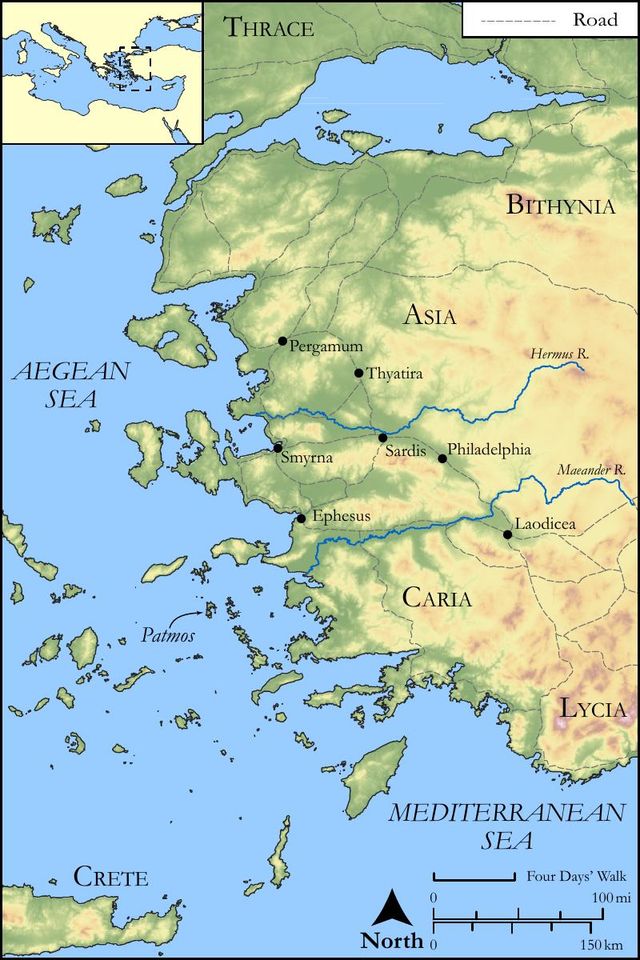
John's vision on the island of Patmos occurred during a period of intense Roman persecution, likely under Emperor Domitian. Apocalyptic literature, common in Jewish and early Christian traditions, often featured heavenly messengers, symbolic objects, and divine commissions to prophets (e.g., Ezekiel, Daniel). The concept of a prophet receiving and even "eating" a scroll to internalize its message was a known motif (Ezekiel 2:8-10 and Ezekiel 3:1-3). The "voice from heaven" would have resonated with Old Testament prophetic calls and the New Testament accounts of divine affirmation (e.g., at Jesus' baptism and transfiguration). The imagery of an angel standing upon both "sea and earth" signifies the universal scope of the events and judgments contained within the book, reflecting the pervasive reach of Roman imperial power but ultimately God's supreme sovereignty over all creation.
Key Themes
ShowHideRevelation 10:8 contributes significantly to several overarching themes within the book of Revelation and biblical prophecy. First, it underscores the theme of Divine Sovereignty and Control, as the heavenly voice issues a direct, authoritative command, demonstrating God's meticulous orchestration of end-time events. Second, it highlights the Nature of Revelation, particularly the contrast between sealed and open knowledge; unlike the seven-sealed scroll in Revelation 5:1, this "little book" is explicitly "open," signifying its immediate accessibility and readiness for disclosure. Third, the verse emphasizes Prophetic Commission and Obedience, as John is not merely a passive recipient but is commanded to "go and take" the book, underscoring the active role required of God's chosen messengers. This active participation foreshadows his renewed mandate to prophesy again (Revelation 10:11), reinforcing the idea that God's people are called to engage with and proclaim His truth.
Exposition and Analysis
ShowHideKey Word Analysis
ShowHideThis term refers to a tone, sound, or articulate utterance. In this context, it signifies a divine communication, emphasizing the authoritative source of the command given to John. The repetition of this voice speaking "again" links it to previous divine instructions, reinforcing its authenticity and John's direct connection to heavenly revelation.
This is a diminutive form of biblion (book or scroll), meaning a "booklet" or "small scroll." The diminutive implies a specific, perhaps more focused or immediate, revelation compared to the larger, comprehensive seven-sealed scroll of Revelation 5. Its small size does not diminish its profound importance, as it contains critical prophetic information that John is commissioned to receive.
This verb means "to get hold of" or "to receive." It denotes an active, deliberate action on John's part. He is not merely to observe or hear about the book but to physically acquire it, signifying his personal appropriation and internalization of its contents, which will be further emphasized by his eating of the scroll in the subsequent verses.
Verse Breakdown
ShowHide"And the voice which I heard from heaven spake unto me again"
This clause re-establishes the divine origin and authority of the message. The phrase "spake unto me again" indicates a continuation of John's direct communication with God, reinforcing the authenticity and personal nature of his prophetic commission, following the instruction regarding the seven thunders.
"and said, Go and take the little book"
This is the direct, imperative command issued to John. "Go" implies movement towards the angel, and "take" signifies an active appropriation of the scroll. This command highlights John's transition from a passive recipient of visions to an active participant in the prophetic drama, being commissioned for a specific task.
"which is open in the hand of the angel"
This descriptive phrase specifies the object of the command and its immediate state. The "open" nature of the book is crucial, contrasting with previously sealed revelations and indicating that its contents are ready to be disclosed, understood, and acted upon. Its location "in the hand of the angel" signifies that it is readily available and presented for John's reception.
"which standeth upon the sea and upon the earth"
This final clause describes the mighty angel, reinforcing his immense authority and the universal scope of the message contained within the little book. The angel's stance over both the terrestrial and maritime realms symbolizes God's sovereign dominion over all creation and the global impact of the coming judgments and revelations.
Literary Devices
ShowHideThe verse employs several significant literary devices. Repetition is evident in the phrase "spake unto me again," which links this command to previous divine communications John has received, establishing continuity and reinforcing the authoritative source of the message. Symbolism is pervasive, particularly with the "little book," which represents a specific, open revelation distinct from other scrolls in the vision. The angel's posture, "standeth upon the sea and upon the earth," is a powerful symbol of universal authority and the global reach of the prophetic message. Furthermore, the direct imperative, "Go and take," functions as a command, highlighting John's active role and the divine directive that propels the narrative forward, emphasizing the obedience required of a prophet.
Theological and Thematic Connections
ShowHideRevelation 10:8 underscores the profound truth that God's divine will is progressively revealed to His chosen servants, often through direct and unambiguous commands. The shift from a sealed scroll to an "open" little book signifies that there are specific aspects of God's plan that are meant for immediate understanding and proclamation, even if other parts remain mysterious. This verse emphasizes the active participation required of those who receive divine revelation; it's not merely for contemplation but for engagement and action. John's commission to "take" the book highlights the necessity of internalizing God's truth, preparing him to prophesy again, even when the message may be both sweet and bitter. It also reinforces the theme of God's ultimate sovereignty, as the command originates from heaven and concerns a message delivered by an angel with universal authority.
Reflection and Application
ShowHideRevelation 10:8 serves as a powerful reminder that God's revelation is not meant to remain distant or theoretical; it demands our active engagement. Just as John was commanded to "take" the little book, we are called to embrace, internalize, and live out the truths of God's Word. The "open" nature of the book can symbolize the accessibility of God's truth to those who earnestly seek it, urging us to approach Scripture with a receptive heart, ready to understand and apply its messages, even if they challenge our comfort or call us to difficult tasks. This verse encourages us to move beyond passive listening to active obedience, recognizing that God commissions us for specific purposes within His unfolding plan. Our willingness to "go and take" His Word—to study it, meditate on it, and allow it to transform us—is foundational to fulfilling our divine calling and participating in His work in the world.
Questions for Reflection
ShowHideFAQ
ShowHideWhy is it a "little book" and not the "seven-sealed scroll" mentioned earlier in Revelation?
ShowHideThe "little book" (Greek: bibliarídion) in Revelation 10 is distinct from the "seven-sealed scroll" (Greek: biblion) in Revelation 5. The seven-sealed scroll contains the comprehensive plan of God's redemption and judgment for all of history, which only the Lamb is worthy to open. In contrast, the "little book" is explicitly "open" from the outset and appears to contain a specific, perhaps more immediate, revelation concerning a particular phase of God's judgments or John's renewed prophetic ministry. Its diminutive size might suggest a focused message rather than a universal one, and its open state indicates that its contents are ready for immediate disclosure and action, unlike the previously sealed scroll that required the Lamb's intervention to be opened.
Christ-Centered Fulfillment
ShowHideWhile Revelation 10:8 focuses on John's prophetic commission, its deeper significance is illuminated through a Christ-centered lens. The "voice from heaven" that speaks to John echoes the divine affirmation of Jesus as God's beloved Son at His baptism and transfiguration, highlighting that all true revelation ultimately originates from the Father and is mediated through Christ. Jesus Himself is the ultimate revelation of God (John 1:18), the Word made flesh (John 1:14), and the one who fully discloses the Father's will. It is Christ, the Lamb of God, who alone was found worthy to open the seven-sealed scroll, demonstrating His sovereign authority over all of history and judgment. John's command to "take the little book" foreshadows the Great Commission given by Christ, where His disciples are commanded to "go" and "make disciples of all nations," teaching them to obey everything He has commanded (Matthew 28:19-20). Thus, John's active reception of the prophetic message serves as a model for all believers called to embrace and proclaim the truth of God, whose ultimate revelation and authority reside in Jesus Christ, the King who stands sovereign over "the sea and the earth" (Ephesians 1:20-22).