


Revelation 10:2
Bible text: King James Version (1769 Blayney text) · Public domain
Bible text: King James Version with Strong's numbers · Public domain
Bible text: Berean Standard Bible · Public domain
Bible text: American Standard Version (1901) · Public domain
Bible text: World English Bible, Messianic edition · Public domain
Bible text: Geneva Bible (1599) · Public domain
Bible text: Young's Literal Translation · Public domain
- καὶkaiandG2532CONJConjunction
- ἔχωνechōnhavingG2192V-PAP-NSMVerb Present Active Participle Nominative Singular Masculine
- ἐνeninG1722PREPPreposition
- τῇtēatheG3588T-DSFDefinite article Dative Singular Feminine
- χειρὶcheirihandG5495N-DSFNoun Dative Singular Feminine
- αὐτοῦautouof himG846P-GSMPersonal pronoun Genitive Singular Masculine
- βιβλαρίδιονbiblaridiona little scrollG974N-ASNNoun Accusative Singular Neuter
- ἠνεῳγμένονēneōgmenonopenedG455V-RPP-ASNVerb Perfect Passive Participle Accusative Singular Neuter
- καὶkaiAndG2532CONJConjunction
- ἔθηκενethēkenhe placedG5087V-AAI-3SVerb Aorist Active Indicative 3rd Singular
- τὸνtontheG3588T-ASMDefinite article Accusative Singular Masculine
- πόδαpodafootG4228N-ASMNoun Accusative Singular Masculine
- αὐτοῦautouof himG846P-GSMPersonal pronoun Genitive Singular Masculine
- τὸνton<the>G3588T-ASMDefinite article Accusative Singular Masculine
- δεξιὸνdexionrightG1188A-ASMAdjective Accusative Singular Masculine
- ἐπὶepiuponG1909PREPPreposition
- τῆςtēstheG3588T-GSFDefinite article Genitive Singular Feminine
- θαλάσσηςthalassēsseaG2281N-GSFNoun Genitive Singular Feminine
- τὸνtontheG3588T-ASMDefinite article Accusative Singular Masculine
- δὲdeandG1161CONJConjunction
- εὐώνυμονeuōnumonleftG2176A-ASMAdjective Accusative Singular Masculine
- ἐπὶepiuponG1909PREPPreposition
- τῆςtēstheG3588T-GSFDefinite article Genitive Singular Feminine
- γῆςgēsearthG1093N-GSFNoun Genitive Singular Feminine
English is a literal word-by-word gloss of the Greek, not the KJV's wording. Why?
This is the original text the KJV's translators worked from — each Greek word with its own literal English meaning in this verse, prepared by scholars at Tyndale House, Cambridge. The KJV translates whole sentences, not word by word, so its wording differs: one Greek word can become several English words, and the KJV may choose “charity” where the gloss reads “love”. Both are faithful — they answer different questions. For the KJV's own rendering, switch to the KJV text.
Details
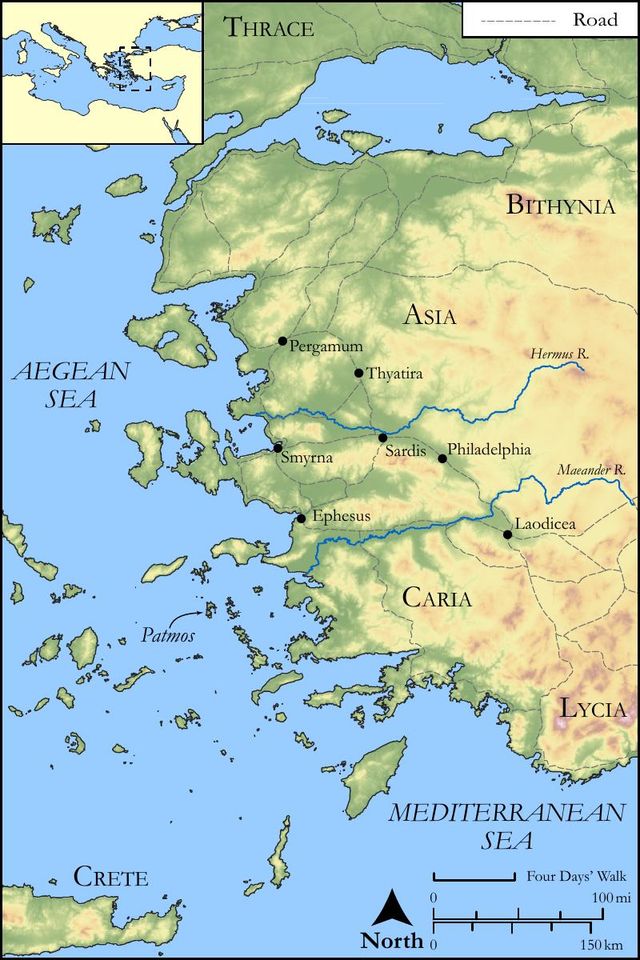
See on the biblical-era maps

Study this verse
Public-domain commentary
Matthew Henry
From his Commentary on the Whole Bible. Henry comments on passages, not single verses — this entry covers Revelation 10:1–7. His three-level outline is real structure in the source text, so it is rendered as structure.
Here we have an account of another vision the apostle was favoured with, between the sounding of the sixth trumpet and that of the seventh. And we observe,
I.The person who was principally concerned in communicating this discovery to John - an angel from heaven, another mighty angel, who is so set forth as would induce one to think it could be no other than our Lord and Saviour Jesus Christ!
1.He was clothed with a cloud: he veils his glory, which is too great for mortality to behold; and he throws a veil upon his dispensations. Clouds and darkness are round about him.
2.A rainbow was upon his head; he is always mindful of his covenant, and, when his conduct is most mysterious, yet it is perfectly just and faithful.
3.His face was as the sun, all bright, and full of lustre and majesty, Rev 1:16.
4.His feet were as pillars of fire; all his ways, both of grace and providence, are pure and steady.
II.His station and posture:
He set his right foot upon the sea and his left foot upon the earth, to show the absolute power and dominion he had over the world. And he held in his hand a little book opened, probably the same that was before sealed, but was now opened, and gradually fulfilled by him.
III.His awful voice:
He cried aloud, as when a lion roareth (Rev 10:3), and his awful voice was echoed by seven thunders, seven solemn and terrible ways of discovering the mind of God.
IV.The prohibition given to the apostle, that he should not publish, but conceal what he had learned from the seven thunders, Rev 10:4.
The apostle was for preserving and publishing every thing he saw and heard in these visions, but the time had not yet come.
V.The solemn oath taken by this mighty angel.
1.The manner of his swearing: He lifted up his hand to heaven, and swore by him that liveth for ever, by himself, as God often has done, or by God as God, to whom he, as Lord, Redeemer, and ruler of the world, now appeals.
2.The matter of the oath: that there shall be time no longer; either,
(1.)That there shall be now no longer delay in fulfilling the predictions of this book than till the last angel should sound; then every thing should be put into speedy execution: the mystery of God shall be finished, Rev 10:7. Or,
(2.)That when this mystery of God is finished time itself shall be no more, as being the measure of things that are in a mutable changing state; but all things shall be at length for ever fixed, and so time itself swallowed up in eternity.
Historical interpretation
Seven Centuries of Reception
7 surviving comments on this verse. Each one is dated, so this reads as a timeline rather than a list.
Select a marker to jump to its quote. Markers stagger vertically where authors wrote within a few decades of each other.
"I saw another mighty angel coming down from heaven, clothed with a cloud; and a rainbow was upon his head, and his face was as it were the sun, and his feet as pillars of fire: and he had in his hand an open book: and he set his right foot upon the sea, and his left foot upon the earth." He signifies that that mighty angel who, he says, descended from heaven, clothed with a cloud, is our Lord, as we have above narrated.
"His face was as it were the sun." That is, with respect to the resurrection.
"Upon his head was a rainbow." He points to the judgment which is executed by Him, of shall be.
"An open book." A revelation of works in the future judgment, or the Apocalypse which John received.
"His feet," as we have said above, are the apostles. For that both things in sea and land are trodden under foot by Him, signifies that all things are placed under His feet. Moreover, he calls Him an angel, that is, a messenger, to wit, of the Father; for He is called the Messenger of great counsel. He says also that He cried with a loud voice. The great voice is to tell the words of the Omnipotent God of heaven to men, and to bear witness that after penitence is closed there will be no hope subsequently.
With reason did his face shine “as the sun in full strength,” for he opened the book that had been sealed in mystery. “He placed his right foot upon the sea and his left foot upon the land,” so that he might confirm the precept of his law by land and by sea. Nor was it without reason that he placed his right foot on the sea and his left foot on the land. In the right foot he signifies the stronger members who have been made firm through great dangers. In the left foot he indicates the crowd of candidates who have not yet received the sign of the faith.
If earlier the deep secrets of the Old Testament were recognized to have been hidden in the sealed book, it is appropriate that the revealed grace of the New Testament is believed to be disclosed here in the opened book. Therefore, the apostle confidently says, “And we, with unveiled face, beholding the glory of the Lord, are being changed into his likeness from glory to glory, as though by the Spirit of the Lord.” Indeed, this is why his face is said to shine like the sun. Moreover, the right foot upon the sea represents those members who are strong so that they might suffer the attacks of persecution.… The left foot upon the land represents those who are not exposed to the greater dangers. For God does not allow us to be tempted beyond what we are able, but with temptation [he] provides also a way, so that we might endure. It is certain, nonetheless, that the proclamation is extended by way of land and sea.
And he set his right foot on the sea, and his left foot on the land. The preaching of the Christian faith is spread by land and sea. But, allegorically, stronger members are set in greater dangers, and others in suitable places. For God does not allow us to be tempted beyond what we can bear (1 Corinthians X).
And he had in his hand a little book open. This is the book previously mentioned, which, long closed by its cover, was finally opened by the grace of the Lord, so that, according to the prophet, even the deaf might hear the words of the book (Isaiah XXIX). And his face deservedly shines like the sun, because he now carries the book open.
And he had in his hand a little book open. The angel's hand is the working of our salvation, that is Christ's incarnation. The little book open is the declared grace of the New Testament. Note also that if the angel's face had not shone first, he would not be holding the little book open in his hand, because it is in his plan that the whole sum of the Scriptures was revealed. And he set his right foot upon the sea, and his left foot upon the earth. In this sentence, a distinction is shown between preachers and between times: those who are, as it were, the right foot, are the stronger ones who are neither lifted up by success nor thrown down by adversity, and say, The darkness thereof, and the light thereof are alike. [Ps. 138:12] These are set upon the sea, that is, to endure the persecutions of the wicked. As for the left foot, it is those of lesser strength: as they are sent in time of peace, it is as if they were set upon the solidity of the earth. For just as a king sends his stronger men to face the enemy, so does Christ.
And he is said to have held in his hand a tiny open scroll [βιβλιδάριον]. Daniel, recalling such small scrolls [βιβλίων], says: "before him sat a judge, and scrolls [βίβλοι] were opened." (Dan. 7:10) The tiny scroll [βιβλιδάριον] was one in which were recorded the names and the multitude of the very impious who were to be punished. Therefore, it was also diminutively called a "tiny scroll" [βιβλιδάριον], since it is a kind of scroll [βίβλου]. Both terms have been used in the Holy Scripture, in which the names of all men are written, according to what was previously stated by me. The term "tiny scroll" [βιβλιδάριον] refers to the record containing the names of the exceedingly impious. For the worshippers of idols were not so numerous, nor marked by murders and poisonings and other afflictions that would serve to fill an entire scroll small [βιβλίον] with the diseases they caused.
And he set his right foot upon the sea, and his left foot on the land. This was a sign both of the greatness of the saints and a sign that those who have sinned on the earth as well as those in the sea, such as shipwrecked individuals or others who have committed evil deeds, would bear the consequences of punishment.
Continue studying Revelation 10:2 across the web’s major study libraries — every link below opens this exact verse, chapter, or book on the destination site.
Read & Compare
 BibleGatewayThis verse in more than 200 translations and 70 languages.
 Bible.comThe YouVersion reader — hundreds of translations, reading plans, and highlights.
 ESV.orgCrossway's official English Standard Version reader.
 NET BibleThe NET translation with 60,000+ translators' notes on every rendering decision.
 STEP BibleTyndale House's free study tool — original text, vocabulary, and scholarly resources.
 BibliaLogos Bible Software's free web reader.
 USCCBThe New American Bible (Revised Edition) with the U.S. bishops' study notes.
Commentaries
 BibleHub CommentariesDozens of classic commentaries on this verse, gathered on one page.
 StudyLightMore than 100 commentary sets — the largest collection on the web.
 BibleRefPlain-English commentary on what this verse means, verse by verse.
 Enduring WordDavid Guzik's free commentary on this chapter, widely used by Bible teachers.
 Bible Study ToolsVerse commentary alongside Greek and Hebrew study aids.
Original Language & Research
- BibleHub InterlinearThe verse word by word — original language, transliteration, and English.
- BibleHub LexiconEvery word's original-language definition and Strong's entry.
 Blue Letter BibleDeep-study tools — Strong's numbers, concordance, and word studies.
 CNTR CollationThe earliest Greek manuscripts of this verse, collated letter by letter.
Sermons, Hymns & Audio


TrulyRandomVerse is not affiliated with these sites and doesn’t control their content. They’re linked because they’re genuinely useful.
Summary
Revelation 10:2 vividly portrays a mighty angel, described in the preceding verse, holding a small, open scroll and demonstrating unparalleled dominion by placing one foot upon the sea and the other upon the earth. This scene serves as a pivotal interlude in John's apocalyptic vision, signaling a new phase of divine revelation and underscoring God's absolute sovereignty over all creation—both the chaotic forces of the sea and the inhabited dry land—as His ultimate purposes are about to be unveiled.
Context
ShowHideLiterary Context
This verse is strategically positioned as an interlude between the cataclysmic events of the sixth trumpet judgment and the eagerly anticipated seventh trumpet. Similar to the pause found in Revelation 7, this interlude offers a moment of respite from the unfolding judgments, providing crucial theological insight and preparing the reader for a deeper understanding of God's unfolding plan. The angel's appearance and authoritative stance introduce a shift in focus from sequential judgments to a specific, imminent revelation and a renewed call to prophetic witness.
Historical & Cultural Context
In Scripture, the sea often symbolizes untamed forces, whose bounds the LORD alone has set, contrasting with the ordered, inhabited land. For John's original audience, familiar with Old Testament imagery, God's dominion over the sea (e.g., Psalm 89:9) was a powerful testament to His absolute power. The act of placing feet on both sea and earth would immediately convey a universal claim of ownership and authority, echoing the imagery of conquering kings or divine beings establishing their dominion over all known realms. This gesture would have resonated deeply with a people living under Roman imperial rule, where emperors often claimed universal authority, but here, it is God's messenger asserting true, ultimate dominion.
Key Themes
ShowHideRevelation 10:2 contributes significantly to several overarching themes within the book of Revelation and biblical theology. Foremost is the theme of Divine Sovereignty, powerfully conveyed by the angel's stance, which asserts God's ultimate control over all creation, both natural and human realms. This reinforces the truth that despite the chaos and suffering depicted in the judgments, God remains firmly in charge, orchestrating all events according to His perfect will, as declared in Psalm 24:1. Another crucial theme is Divine Revelation. The "little book open" signifies that God's purposes, previously hidden or sealed (Revelation 5:1), are now being unveiled. This points to the ongoing nature of God's communication with humanity and the progressive unfolding of His plan, particularly concerning the "mystery of God" mentioned later in Revelation 10:7. This scene also underscores the Call to Prophetic Witness, as John is subsequently commanded to take and eat the scroll, signifying his commission to further prophesy, a theme central to the book's purpose.
Exposition and Analysis
ShowHideKey Word Analysis
ShowHideA diminutive of biblion, meaning "a booklet" or "small scroll." This term distinguishes it from the larger, seven-sealed scroll in Revelation 5, suggesting its contents are more specific, perhaps pertaining to a particular phase of God's plan or a specific message to be delivered, rather than the entirety of divine destiny. Its diminutive size implies a focused, perhaps more immediate, revelation.
Meaning "to open up (literally or figuratively, in various applications)." The state of the book being "open" is crucial. Unlike the sealed scroll of Revelation 5, which required the Lamb to open its seals, this scroll is already accessible. This signifies that its contents are revealed, ready to be read, understood, and enacted, emphasizing the imminence and clarity of the message it contains.
Meaning "to place (in the widest application, literally and figuratively; properly, in a passive or horizontal posture)." While the Strong's definition emphasizes a passive or horizontal posture, in this context, the angel's action of "setting" his feet implies a deliberate, authoritative, and firm placement. It conveys an act of establishing dominion and taking a resolute stand, signifying the angel's, and by extension God's, active assertion of control over the designated realms.
Verse Breakdown
ShowHide"And he had in his hand a little book open:"
This clause introduces the central object of this interlude. The angel, previously described as mighty and clothed with a cloud, now holds a small scroll that is already unrolled or unsealed. This "little book" (βιβλαρίδιον) is distinct from the seven-sealed scroll of destiny in Revelation 5, which only the Lamb was worthy to open. Its "open" state signifies that its contents are now accessible, revealed, and ready to be understood or enacted, indicating an imminent and specific divine message or set of events.
"and he set his right foot upon the sea,"
The angel's posture immediately conveys immense authority. Placing the right foot (traditionally associated with power, strength, and dominance) upon the sea is a profound symbolic act. The sea, in biblical and ancient thought, often represents chaos, the unruly nations, or even the abyss. By placing his foot upon it, the angel asserts God's absolute dominion over all chaotic forces and the vast, often turbulent, gentile world, bringing them under divine control.
"and [his] left [foot] on the earth,"
Completing the authoritative stance, the angel places his left foot upon the earth. The earth (γῆ) typically represents the inhabited dry land, the realm of humanity, and established kingdoms. This dual placement—right foot on sea, left foot on earth—symbolizes universal dominion. It proclaims God's ultimate sovereignty and ownership over every sphere of creation, encompassing both the wild, untamed elements and the structured, human-controlled world. The angel's stance is a visual declaration that God's authority extends to every corner and aspect of existence.
Literary Devices
ShowHideRevelation 10:2 is rich in Symbolism. The "little book open" symbolizes a specific, accessible divine revelation, distinct from the sealed mysteries of earlier chapters. Its openness signifies that God's purposes are no longer hidden but are now ready to be disclosed and acted upon. The angel's colossal stance, with one foot on the sea and the other on the earth, is a powerful symbol of Universal Dominion. The sea often represents chaos, the gentile nations, or unruly forces, while the earth represents the inhabited world and humanity. This posture visually communicates God's absolute sovereignty over all creation, both the natural elements and human affairs. The angel himself functions as a Theophany or Angelophany, a visible manifestation of God's presence or message, embodying divine power and authority. The entire scene acts as a Dramatic Interlude, pausing the sequence of trumpet judgments to introduce a new prophetic commission and emphasize the divine control underpinning all events. The description also employs Anthropomorphism, attributing human-like physical characteristics (feet, hand) and actions (holding, setting) to the angel to make his divine authority comprehensible to human understanding.
Theological and Thematic Connections
ShowHideRevelation 10:2 powerfully reinforces the biblical truth of God's absolute and comprehensive sovereignty over all creation and history. The angel's authoritative stance, bridging both sea and land, serves as an undeniable visual declaration that no realm, no force, and no human endeavor lies outside of God's ultimate control. This divine dominion is not merely theoretical but active, as evidenced by the "open little book," which signifies that God's specific plans and mysteries are being actively revealed and brought to fruition. This interlude assures believers that even amidst the escalating judgments and global turmoil depicted in Revelation, God's purposes are unfolding precisely as He intends, leading to the ultimate establishment of His kingdom. It underscores that revelation is progressive, and God continuously unveils His will to His servants, preparing them for their role in His grand narrative.
Reflection and Application
ShowHideRevelation 10:2 offers profound spiritual nourishment and practical guidance for believers navigating a world that often feels chaotic and out of control. The angel's majestic posture, with one foot on the sea and the other on the earth, serves as a powerful visual reminder that God's sovereignty is absolute and encompasses every aspect of existence—from the unpredictable forces of nature to the complex affairs of human nations. This truth should instill immense confidence and peace, knowing that no matter how turbulent world events become, God's hand is firmly upon all things, guiding them according to His eternal purpose. The "open little book" further calls us to attentiveness and readiness. It signifies that God is continually revealing His will and His plans, not keeping them hidden, but making them accessible to those who seek Him. This encourages us to remain vigilant in studying His Word, discerning His movements in the world, and being prepared to participate in His unfolding story. In a world prone to anxiety and despair, this verse anchors our hope in a God who is not only sovereign but also actively revealing His purposes, inviting us to trust in His comprehensive plan and to respond with faithful obedience.
Questions for Reflection
ShowHideFAQ
ShowHideWhat is the significance of the "little book" being "open" in Revelation 10:2?
ShowHideThe "little book" (Greek: bibliarídion) being "open" is highly significant because it contrasts sharply with the seven-sealed scroll in Revelation 5:1, which only the Lamb was worthy to open. Its open state in Revelation 10:2 signifies that its contents are no longer hidden or mysterious but are now accessible, revealed, and ready to be understood or enacted. This implies an imminent and specific divine message or a new phase of God's prophetic plan that is about to unfold. It suggests a clarity and immediacy to the revelation, preparing John and the readers for a direct engagement with its contents, which are later revealed to be a call to prophesy (Revelation 10:9-11).
Why does the angel place one foot on the sea and one on the earth?
ShowHideThe angel's colossal stance, with his right foot upon the sea and his left foot upon the earth, is a powerful symbolic gesture of universal dominion and authority. In ancient thought and biblical imagery, the sea often represented chaos, the unruly gentile nations, or the unknown, while the earth represented the inhabited dry land, the realm of humanity and established kingdoms. By placing a foot on each, the angel visually proclaims God's absolute sovereignty over all creation—both the wild, untamed forces and the ordered, human-controlled world. This posture asserts that no part of existence is outside of God's ultimate control and that His divine plan encompasses every sphere, preparing the way for the ultimate establishment of His kingdom over all things (Psalm 24:1).
How does this interlude in Revelation 10 relate to the rest of the book's narrative?
ShowHideRevelation 10 serves as a crucial interlude between the sixth trumpet judgment and the seventh trumpet, similar to the interlude in Revelation 7. These interludes provide a pause in the sequence of judgments to offer theological explanation, reinforce divine sovereignty, and prepare for subsequent events. Chapter 10 specifically introduces a new prophetic commission for John, symbolized by his eating of the "little book" (Revelation 10:9-11). This prepares the reader for the detailed descriptions of the two witnesses and the measurement of the temple in Revelation 11, linking the angel's universal authority to the specific events and prophetic tasks that follow before the final trumpet sounds and the kingdom of God is declared.
Christ-Centered Fulfillment
ShowHideRevelation 10:2, while depicting a mighty angel, ultimately points to the supreme authority and revelatory work of Jesus Christ. The angel's universal dominion, symbolized by his feet on sea and earth, foreshadows the ultimate and comprehensive authority given to Christ. As the resurrected Lord, Jesus declared, "All authority has been given to Me in heaven and on earth" (Matthew 28:18). He is the true sovereign over all creation, both the chaotic forces and the inhabited world, having triumphed over sin and death. Furthermore, the "little book open" finds its ultimate fulfillment in Christ as the supreme Revealer of God's mysteries. While the angel presents an open book, it is Christ, the Lamb who was slain, who alone was found worthy to open the seven-sealed scroll of destiny (Revelation 5). He is the embodiment of God's complete revelation, the Word made flesh, through whom all divine truth is communicated. The angel's commission to John to prophesy again (Revelation 10:11) is ultimately a call to bear witness to Christ, the one who holds the keys of death and Hades (Revelation 1:18). Thus, the scene in Revelation 10:2, with its powerful imagery of dominion and open revelation, serves as a profound testament to the unparalleled sovereignty and revelatory role of Jesus Christ, the Alpha and the Omega, who is Lord of all.