


Revelation 10:1
Bible text: King James Version (1769 Blayney text) · Public domain
Bible text: King James Version with Strong's numbers · Public domain
Bible text: Berean Standard Bible · Public domain
Bible text: American Standard Version (1901) · Public domain
Bible text: World English Bible, Messianic edition · Public domain
Bible text: Geneva Bible (1599) · Public domain
Bible text: Young's Literal Translation · Public domain
- ΚαὶKaiAndG2532CONJConjunction
- εἶδονeidonI sawG1492V-2AAI-1SVerb 2nd Aorist Active Indicative 1st Singular
- ἄλλονallonanotherG243A-ASMAdjective Accusative Singular Masculine
- ἄγγελονangelonangelG32N-ASMNoun Accusative Singular Masculine
- ἰσχυρὸνischuronmightyG2478A-ASMAdjective Accusative Singular Masculine
- καταβαίνονταkatabainontacoming downG2597V-PAP-ASMVerb Present Active Participle Accusative Singular Masculine
- ἐκekout ofG1537PREPPreposition
- τοῦtou<the>G3588T-GSMDefinite article Genitive Singular Masculine
- οὐρανοῦouranouheavenG3772N-GSMNoun Genitive Singular Masculine
- περιβεβλημένονperibeblēmenonhaving clothed himself withG4016V-RMP-ASMVerb Perfect Middle Participle Accusative Singular Masculine
- νεφέληνnephelēna cloudG3507N-ASFNoun Accusative Singular Feminine
- καὶkaiandG2532CONJConjunction
- ἡhētheG3588T-NSFDefinite article Nominative Singular Feminine
- ἶριςirisrainbowG2463N-NSFNoun Nominative Singular Feminine
- ἐπὶepiuponG1909PREPPreposition
- τῆςtēstheG3588T-GSFDefinite article Genitive Singular Feminine
- κεφαλῆςkephalēsheadG2776N-GSFNoun Genitive Singular Feminine
- αὐτοῦautouof himG846P-GSMPersonal pronoun Genitive Singular Masculine
- καὶkaiandG2532CONJConjunction
- τὸtotheG3588T-NSNDefinite article Nominative Singular Neuter
- πρόσωπονprosōponfaceG4383N-NSNNoun Nominative Singular Neuter
- αὐτοῦautouof himG846P-GSMPersonal pronoun Genitive Singular Masculine
- ὡςhōs[was] likeG5613PRTParticle or Disjunctive
- ὁhotheG3588T-NSMDefinite article Nominative Singular Masculine
- ἥλιοςhēliossunG2246N-NSMNoun Nominative Singular Masculine
- καὶkaiandG2532CONJConjunction
- οἱhoitheG3588T-NPMDefinite article Nominative Plural Masculine
- πόδεςpodesfeetG4228N-NPMNoun Nominative Plural Masculine
- αὐτοῦautouof himG846P-GSMPersonal pronoun Genitive Singular Masculine
- ὡςhōslikeG5613PRTParticle or Disjunctive
- στῦλοιstuloipillarsG4769N-NPMNoun Nominative Plural Masculine
- πυρόςpurosof fireG4442N-GSNNoun Genitive Singular Neuter
English is a literal word-by-word gloss of the Greek, not the KJV's wording. Why?
This is the original text the KJV's translators worked from — each Greek word with its own literal English meaning in this verse, prepared by scholars at Tyndale House, Cambridge. The KJV translates whole sentences, not word by word, so its wording differs: one Greek word can become several English words, and the KJV may choose “charity” where the gloss reads “love”. Both are faithful — they answer different questions. For the KJV's own rendering, switch to the KJV text.
Details
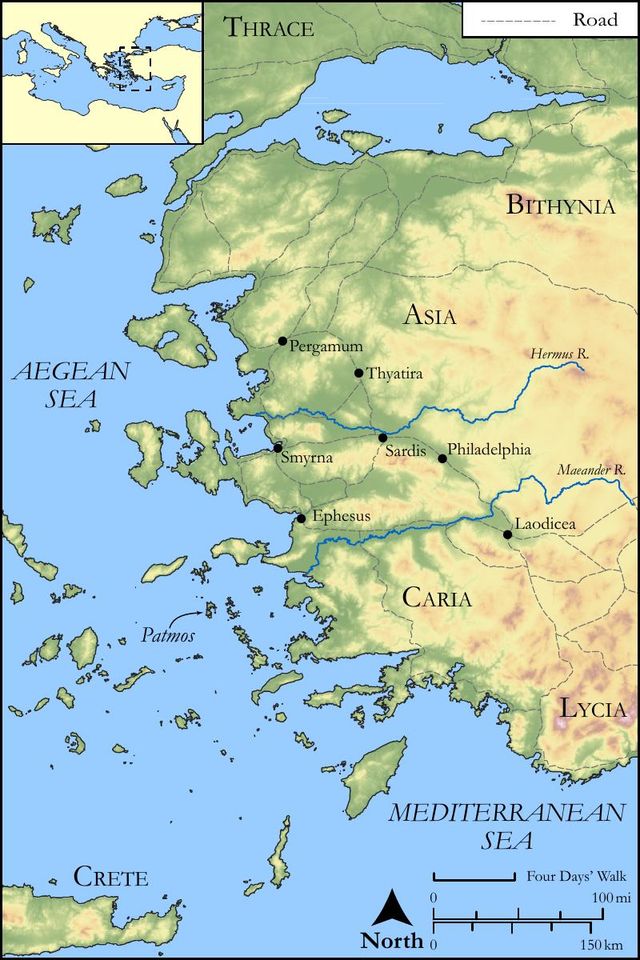
See on the biblical-era maps

Study this verse
Public-domain commentary
Matthew Henry
From his Commentary on the Whole Bible. Henry comments on passages, not single verses — this entry covers Revelation 10:1–7. His three-level outline is real structure in the source text, so it is rendered as structure.
Here we have an account of another vision the apostle was favoured with, between the sounding of the sixth trumpet and that of the seventh. And we observe,
I.The person who was principally concerned in communicating this discovery to John - an angel from heaven, another mighty angel, who is so set forth as would induce one to think it could be no other than our Lord and Saviour Jesus Christ!
1.He was clothed with a cloud: he veils his glory, which is too great for mortality to behold; and he throws a veil upon his dispensations. Clouds and darkness are round about him.
2.A rainbow was upon his head; he is always mindful of his covenant, and, when his conduct is most mysterious, yet it is perfectly just and faithful.
3.His face was as the sun, all bright, and full of lustre and majesty, Rev 1:16.
4.His feet were as pillars of fire; all his ways, both of grace and providence, are pure and steady.
II.His station and posture:
He set his right foot upon the sea and his left foot upon the earth, to show the absolute power and dominion he had over the world. And he held in his hand a little book opened, probably the same that was before sealed, but was now opened, and gradually fulfilled by him.
III.His awful voice:
He cried aloud, as when a lion roareth (Rev 10:3), and his awful voice was echoed by seven thunders, seven solemn and terrible ways of discovering the mind of God.
IV.The prohibition given to the apostle, that he should not publish, but conceal what he had learned from the seven thunders, Rev 10:4.
The apostle was for preserving and publishing every thing he saw and heard in these visions, but the time had not yet come.
V.The solemn oath taken by this mighty angel.
1.The manner of his swearing: He lifted up his hand to heaven, and swore by him that liveth for ever, by himself, as God often has done, or by God as God, to whom he, as Lord, Redeemer, and ruler of the world, now appeals.
2.The matter of the oath: that there shall be time no longer; either,
(1.)That there shall be now no longer delay in fulfilling the predictions of this book than till the last angel should sound; then every thing should be put into speedy execution: the mystery of God shall be finished, Rev 10:7. Or,
(2.)That when this mystery of God is finished time itself shall be no more, as being the measure of things that are in a mutable changing state; but all things shall be at length for ever fixed, and so time itself swallowed up in eternity.
Historical interpretation
Eight Centuries of Reception
9 surviving comments on this verse. Each one is dated, so this reads as a timeline rather than a list.
Select a marker to jump to its quote. Markers stagger vertically where authors wrote within a few decades of each other.
The angel also, as he goes forth on a white horse, conquering and to conquer, receives a crown of victory; and another is adorned with an encircling rainbow (as it were in its fair colours)-a celestial meadow.
"I saw another mighty angel coming down from heaven, clothed with a cloud; and a rainbow was upon his head, and his face was as it were the sun, and his feet as pillars of fire: and he had in his hand an open book: and he set his right foot upon the sea, and his left foot upon the earth." He signifies that that mighty angel who, he says, descended from heaven, clothed with a cloud, is our Lord, as we have above narrated.
"His face was as it were the sun." That is, with respect to the resurrection.
"Upon his head was a rainbow." He points to the judgment which is executed by Him, of shall be.
"An open book." A revelation of works in the future judgment, or the Apocalypse which John received.
"His feet," as we have said above, are the apostles. For that both things in sea and land are trodden under foot by Him, signifies that all things are placed under His feet. Moreover, he calls Him an angel, that is, a messenger, to wit, of the Father; for He is called the Messenger of great counsel. He says also that He cried with a loud voice. The great voice is to tell the words of the Omnipotent God of heaven to men, and to bear witness that after penitence is closed there will be no hope subsequently.
In this angel the person of our Savior is indicated. On his body he wears the church as though she were a cloud. For the church was constituted in the body of Christ and is often described in diverse manners. At times we read of her as a cloud, as a robe, as the sun, as the moon and as clothes white as snow. And even the saints are compared with clouds, as we read in the prophet Isaiah, “These are they who will fly as the clouds.” To be sure, the cloud with which he is clothed is his body, which was conceived by the Holy Spirit. The “rainbow over his head” indicates the promise and the perseverance of his church. “His face was like the sun, and his feet as pillars of fire.” There is here a great and marvelous plan, so that at the beginning of this book he might show the fire of the last persecution and afterward might indicate the future brightness of the saints as a fire. For at first he spoke of “his feet as refined in a furnace,” and afterward he describes his face “as the shining in full strength.” That he might show how great is the brightness of the church, he now mentions the face before the feet, which are refined, and afterward compares his feet with pillars of fire.
He sees the Lord Christ coming down from heaven dressed in a cloud, which is the church. Or, he is clothed by the cloud of his flesh, which is elsewhere said to be a new bride who descends from heaven, or as Daniel says, the Son of man has come on the clouds of the heavens. The arc above his head represents the promise of propitiation, which remains among those who are good, but it signifies also those who will be decorated with martyrdom before the advent of the Lord, as Abel and others.… And his face was as the sun, since the Lord Jesus Christ was made manifest through the glory of the resurrection, of which we read, “In the sun he has set his tabernacle,” that is, where he is revealed so that he might no longer be hidden. For by his face is indicated the revelation of the present, which the prophet awaited and said, “Show your face, and we shall be saved.” His feet are the apostles who were enflamed by the words of God and by the Holy Spirit and were sent out to preach. As it says, “Did not our hearts burn within us while he talked to us on the road and opened to us the Scriptures?” They are called “pillars” on account of the stability of the church, and of them the prophet said, “I have strengthened its pillars,” and “How beautiful upon the mountains are the feet which announce and declare peace.” Finally, the apostle said, “Who [Peter, James, John] were reputed to be pillars of the church.”
The cloud, the rainbow and the light like the sun show how we are to understand this holy angel. For through these [symbols] the manifold character of its virtues and the brightness of the angelic nature and understanding is revealed.
And I saw another mighty angel coming down from heaven, clothed with a cloud. The Lord, the angel of great counsel, descended from heaven, clothed with the cloud of flesh. As Isaiah also says: Behold, the Lord is riding on a swift cloud and will come to Egypt (Isaiah XIX), and a rainbow was upon his head. Around the good, the promise of propitiation remains.
And his face was like the sun, etc. With the face of the Lord shining, that is, his knowledge manifested through the glory of the resurrection, his feet are prepared to evangelize and proclaim peace on the mountains (Romans X), illuminated by the fire of the Holy Spirit, and established like pillars. For James, Cephas, and John seemed to be pillars of the Church.
And I heard another mighty angel come down from heaven, clothed with a cloud. It is right for him to be called an angel, because he appeared to men as the new messenger of eternal life, about whom we read, angel of great counsel; and to be called strong, because it is demonstrated that he overcame the aerial powers when he died, whence this: the Lord mighty in battle. [Ps. 23:8] When he says another, it does not mean that he is actually talking about something different, but it is the habit of recapitulation: he saw another angel because he repeated another vision. The angel appeared clothed with a cloud because it was clothed in the flesh that the Lord was seen among men, and his descent from heaven was precisely his adoption of the flesh. And a rainbow was on his head. The head of Christ, as the apostle says, is the divinity itself. [1 Cor. 11:3] By the rainbow is symbolized the reconciliation of the world that was achieved by the plan of the Word incarnate; its mystery was explained earlier. Note also that, having described the last struggle, and passing over the seventh seal, with which both the end of the consummation and the Lord's coming are expected to take place, he comes back to the beginning of Christ's incarnation, which has just been spoken about, and describes his preaching. Once this narration is finished, he comes back to the things he had left aside for a while. Let us however remember that when he has brought this narration to its end, the end needs to be joined to the broken order; for the passage where it is said, in the following, The second woe is past, [Rev. 11:14] implicitly refers to the one where, in the end of the previous book, we spoke of the destruction of the wicked horses and Gentiles. Note also that he behaves in an unusual manner in this narration, and delimits both narrations not with one end, but with two, because he distinguishes the interrupted order and the recapitulation separately, as will become apparent a bit later. And his face was as the sun. The angel's face is Christ's incarnation, by means of which he became known to mortals, and concerning which the Psalmist says, Shew us thy face, and we shall be saved. [Ps. 79:4] This face is not compared to the sun because of its brightness, in which it is incomparably greater than the sun, but because, like the sun, it had a rising in being born, a setting in dying, and again a rising in being resurrected; whence Solomon, The sun riseth, and goeth down, etc. [Eccles. 1:5] The face may also be understood to mean the saints. And his foot as a pillar of fire. The angel's feet are the preachers, thanks to whom God's wisdom incarnate has, so to speak, walked through the whole world. It is fitting for them to be compared to a pillar and to fire because they both bear the Church's edifice, which is laid upon them, and, kindled by the Holy Spirit, set the hearts of their listeners on fire to the love of God by their preaching.
Moreover, John, the divine narrator in the present discourse, recounts the events that occurred when the sixth angel sounded his trumpet, which I have not yet fully explained all at once, since the fifth discourse is so long, I therefore did not reveal it in full. But what else does he write that has happened?
Therefore, those who, while still alive, having heard or even seen the punishments inflicted upon the wrongdoers, did not repent, but remained wicked as previously stated, John says that I saw an angel descending from heaven, bringing images of punishments.
He says that his vision and form were as follows: he was clothed with a cloud. The cloud symbolizes the eternal and invisible nature of the holy angels; for the cloud is a symbol of the unseen. The prophet, indicating the invisible nature of God, describes "clouds and thick darkness are round about him." (Ps. 97:2)
And a rainbow was upon his head; as if the head and the foremost among the good angels were saying, it is brightness; for angels are beings of light. (2 Cor. 11:14)
And his face is said to be like the sun; and this too is an appearance of pure brightness. But the rainbow is the brightness of a created nature, signifying virtue; therefore, the brightness of the rainbow is not uniform, but varied, indicating all the virtues of the angels. The sun, indeed, signifies their natural brilliance by a gleaming light. Therefore, it was surrounded by a rainbow, for virtues are around us; but its face resembled the sun, for in us all natural excellence is present in abundance.
And his feet were like pillars of fire. The fire signifies the punishment that he came to bring upon the impious.
Continue studying Revelation 10:1 across the web’s major study libraries — every link below opens this exact verse, chapter, or book on the destination site.
Read & Compare
 BibleGatewayThis verse in more than 200 translations and 70 languages.
 Bible.comThe YouVersion reader — hundreds of translations, reading plans, and highlights.
 ESV.orgCrossway's official English Standard Version reader.
 NET BibleThe NET translation with 60,000+ translators' notes on every rendering decision.
 STEP BibleTyndale House's free study tool — original text, vocabulary, and scholarly resources.
 BibliaLogos Bible Software's free web reader.
 USCCBThe New American Bible (Revised Edition) with the U.S. bishops' study notes.
Commentaries
 BibleHub CommentariesDozens of classic commentaries on this verse, gathered on one page.
 StudyLightMore than 100 commentary sets — the largest collection on the web.
 BibleRefPlain-English commentary on what this verse means, verse by verse.
 Enduring WordDavid Guzik's free commentary on this chapter, widely used by Bible teachers.
 Bible Study ToolsVerse commentary alongside Greek and Hebrew study aids.
Original Language & Research
- BibleHub InterlinearThe verse word by word — original language, transliteration, and English.
- BibleHub LexiconEvery word's original-language definition and Strong's entry.
 Blue Letter BibleDeep-study tools — Strong's numbers, concordance, and word studies.
 CNTR CollationThe earliest Greek manuscripts of this verse, collated letter by letter.
Sermons, Hymns & Audio


TrulyRandomVerse is not affiliated with these sites and doesn’t control their content. They’re linked because they’re genuinely useful.
Summary
Revelation 10:1 introduces a profoundly majestic and powerful angel descending from heaven, whose appearance is laden with rich symbolic imagery. This dramatic interlude, positioned between the sixth and seventh trumpet judgments, serves to pause the unfolding narrative of divine wrath, preparing John and the reader for a new phase of revelation concerning God's unwavering faithfulness, the ultimate triumph of His kingdom, and the significance of a divine message yet to be delivered. The angel's awe-inspiring presence underscores the gravity and divine authority of the events that are about to transpire.
Context
ShowHideLiterary Context
Revelation 10:1 serves as a pivotal interlude within the larger sequence of the seven trumpets. Following the devastating judgments unleashed by the first six trumpets, which describe widespread destruction and human unrepentance (Revelation 8:7-13 and Revelation 9:1-21), chapters 10 and 11:1-13 provide a crucial pause before the sounding of the climactic seventh trumpet (Revelation 11:15). This structural break is characteristic of Revelation, offering moments of theological reflection, further revelation, or a shift in focus before the narrative of judgment proceeds. The appearance of this "mighty angel" signals a new, significant divine action and the delivery of a message that will profoundly impact the remaining prophetic narrative.
Historical & Cultural Context
The imagery employed in describing this angel draws heavily on Old Testament traditions of divine manifestation. Clouds often symbolized the presence and glory of God (the Shekinah) in the Old Testament, as seen at Mount Sinai or in the tabernacle. The rainbow, of course, directly evokes God's covenant faithfulness established with Noah after the flood (Genesis 9:13). Descriptions of faces shining like the sun or feet like fire are common in biblical theophanies and visions of divine beings, signifying purity, power, and overwhelming glory, often associated with judgment and holiness. These elements would have resonated deeply with John's Jewish-Christian audience, grounding the apocalyptic vision in familiar divine attributes.
Key Themes
ShowHideThis verse contributes significantly to several key themes within Revelation. Firstly, it powerfully reiterates the theme of Divine Authority and Sovereignty. The angel's majestic and powerful appearance, reminiscent of descriptions of God Himself or the glorified Christ, emphasizes that even amidst chaos and judgment, God remains firmly in control. Secondly, the presence of the rainbow prominently highlights God's Covenant Faithfulness and Mercy. Even as judgments unfold, the rainbow serves as a powerful reminder of God's enduring promises and His commitment to His creation and His people, echoing its appearance around God's throne in Revelation 4:3. Lastly, the angel's role as a "mighty angel" underscores the theme of Divine Messengers and Revelation, indicating that God continues to communicate His will and plan to humanity, even in the most dire circumstances.
Exposition and Analysis
ShowHideKey Word Analysis
ShowHideDerived from a root meaning "force" or "strength," this adjective describes someone or something as powerful, strong, or valiant. When applied to an angel, as here and in Revelation 5:2, it denotes extraordinary strength, authority, and significance, distinguishing this angel from others and indicating a special commission or elevated status.
This term literally means "messenger." While it can refer to human messengers, in the New Testament and especially in Revelation, it almost exclusively refers to celestial beings who serve as God's emissaries, conveying His messages, executing His judgments, or performing His will. The addition of "mighty" underscores the importance of this particular messenger and his forthcoming message.
This word specifically refers to the arc of colors seen in the sky. In biblical context, it is most famously associated with the covenant God made with Noah after the flood, promising never again to destroy all life by water (Genesis 9:13). Its presence here, upon the angel's head, symbolically connects this powerful messenger to God's enduring covenant faithfulness and mercy, even amidst the unfolding judgments.
The celestial body that provides light and warmth. In biblical imagery, the sun often symbolizes glory, power, righteousness, and divine presence. For the angel's face to be "as it were the sun" indicates an overwhelming, radiant glory, reflecting divine majesty and purity, similar to descriptions of Christ's glorified appearance in Revelation 1:16.
A primary word for fire, which in scripture carries diverse symbolic meanings including divine presence, purity, judgment, and refining. The angel's feet being "as pillars of fire" conveys stability, immense power, and a connection to divine judgment and holiness, reminiscent of the pillar of fire that guided Israel (Exodus 13:21) or the fiery presence of God.
Verse Breakdown
ShowHide"¶ And I saw another mighty angel come down from heaven"
John's vision continues with the appearance of a new, distinct celestial being. The term "another" (Greek: állos) implies this angel is different in kind or role from those previously seen, particularly the trumpet angels. "Mighty" (Greek: ischyrós) emphasizes his extraordinary power and authority, setting him apart. His descent "from heaven" signifies his divine origin and commission, indicating he is a direct emissary of God.
"clothed with a cloud"
This imagery immediately evokes the presence and glory of God. Clouds are frequently associated with divine manifestations (theophanies) throughout scripture, symbolizing God's mystery, majesty, and sometimes His judgment or guidance, as seen at Mount Sinai or during Christ's Transfiguration (Matthew 17:5). The angel's being "clothed" with it suggests he is enveloped in or embodies this divine presence.
"and a rainbow [was] upon his head"
The rainbow is a powerful symbol of God's covenant faithfulness and mercy, first given to Noah as a sign of God's promise never again to destroy the earth by flood (Genesis 9:13). Its position "upon his head" signifies that this angel is either crowned with or embodies God's covenant promises, serving as a reminder of divine mercy even amidst the judgments. It also echoes the rainbow around God's throne in Revelation 4:3.
"and his face [was] as it were the sun"
This description highlights the angel's radiant glory and purity. The sun is a source of intense light and warmth, and its brilliance here suggests an overwhelming, divine splendor. This imagery parallels descriptions of the glorified Christ (Revelation 1:16) and conveys the angel's close association with divine majesty and holiness.
"and his feet as pillars of fire"
The angel's feet, symbolizing his stability, movement, and authority, are described as "pillars of fire." Fire in scripture often represents divine presence, holiness, purification, and judgment. "Pillars" suggest strength, immovability, and support. This imagery conveys the angel's firm foundation in divine power, his unwavering purpose, and his connection to God's righteous judgment and purifying presence.
Literary Devices
ShowHideRevelation 10:1 is rich in Symbolism and Imagery, painting a vivid picture of a powerful divine messenger. The cloud enveloping the angel symbolizes God's mysterious presence and glory, reminiscent of Old Testament theophanies. The rainbow upon his head is a potent symbol of God's covenant faithfulness and mercy, reassuring the reader of divine promises even amidst judgment. His face shining like the sun employs Simile to convey overwhelming divine radiance, purity, and authority, echoing descriptions of the glorified Christ. Similarly, his feet like pillars of fire use Simile to depict stability, immense power, and a connection to divine judgment and holiness. The entire description is a form of Anthropomorphic Representation (or Theomorphic Representation), attributing human-like features to a divine being but with exaggerated, supernatural qualities to convey his extraordinary nature and divine commission. The verse also utilizes Intertextuality, drawing on established biblical motifs to enrich its meaning and connect the current vision to the broader narrative of God's interaction with humanity.
Theological and Thematic Connections
ShowHideThe appearance of this mighty angel in Revelation 10:1 profoundly underscores the theological truth of God's active involvement and sovereign control over all creation and history. Even in the midst of escalating judgments and apocalyptic turmoil, God does not abandon His creation but sends powerful emissaries to carry out His will and communicate His unfolding plan. The angel's majestic and symbolic appearance serves as a divine affirmation of God's faithfulness (the rainbow) and His ultimate power (sun-like face, fiery feet), reminding believers that His purposes will prevail, and His covenant promises endure, regardless of the chaos depicted. This interlude offers a moment of divine reassurance and a renewed focus on the divine source of all revelation and authority.
Reflection and Application
ShowHideRevelation 10:1 offers profound encouragement and a call to steadfast faith for believers navigating uncertain times. The majestic appearance of this mighty angel, clothed in divine glory and bearing symbols of God's unwavering faithfulness, reminds us that no matter how chaotic or overwhelming the circumstances of life or the world may seem, God remains sovereignly enthroned and actively engaged. The rainbow upon the angel's head is a powerful visual sermon: even amidst the darkest judgments, God's covenant promises of mercy and preservation stand firm. This should inspire us to trust in His ultimate plan, knowing that His character is immutable, and His word is true. We are called to look beyond the immediate trials and fix our gaze on the divine power and faithfulness that undergird all reality, finding peace and assurance in His control.
Questions for Reflection
ShowHideFAQ
ShowHideWho is this mighty angel, and is he Christ?
ShowHideWhile the text does not explicitly name this "mighty angel," his description shares striking similarities with the glorified Christ Himself, particularly as described in Revelation 1:13-16, with a face like the sun and feet like burnished bronze (fire). However, the angel is consistently presented as "another" and a messenger, distinct from God or Christ. The imagery likely emphasizes his divine commission and authority, indicating that he is an extremely high-ranking celestial being, perhaps even an archangel, who embodies aspects of God's glory and power to fulfill a specific, crucial role in the unfolding prophecy. He acts as God's representative, delivering a message and performing actions on God's behalf, rather than being God or Christ in person.
Christ-Centered Fulfillment
ShowHideThe majestic "mighty angel" of Revelation 10:1, though not Christ Himself, serves as a powerful prefigurement and reflection of Christ's own glorious attributes, authority, and redemptive work. His descent from heaven, clothed with a cloud, echoes Christ's ascension and future return in glory, as seen in Acts 1:9-11. The rainbow upon the angel's head, a symbol of God's covenant faithfulness, ultimately finds its ultimate fulfillment in Jesus Christ, who is the mediator of a new and better covenant (Hebrews 8:6) and the embodiment of God's steadfast love and mercy. The angel's face shining like the sun directly parallels the description of the glorified Christ in Revelation 1:16 and the Transfiguration (Matthew 17:2), signifying Christ's divine nature, purity, and illuminating truth. Furthermore, his feet as pillars of fire speak to Christ's unwavering authority, His righteous judgment, and His purifying presence, as He is the one who "walks among the seven golden lampstands" (Revelation 2:1) and whose eyes are like a flame of fire (Revelation 1:14). Thus, this mighty angel's appearance points beyond himself to the supreme majesty, covenant faithfulness, and ultimate authority of Jesus Christ, who is the true and final revealer of God's plan and the victorious Lamb who will bring all things to their appointed end.