


Revelation 9:21
- καὶkaiAndG2532CONJConjunction
- οὐounotG3756PRT-NNegative Particle Negative
- μετενόησανmetenoēsanthey repentedG3340V-AAI-3PVerb Aorist Active Indicative 3rd Plural
- ἐκekofG1537PREPPreposition
- τῶνtōntheG3588T-GPMDefinite article Genitive Plural Masculine
- φόνωνphonōnmurdersG5408N-GPMNoun Genitive Plural Masculine
- αὐτῶνautōnof themG846P-GPMPersonal pronoun Genitive Plural Masculine
- οὔτεoutenorG3777CONJ-NConjunction Negative
- ἐκekofG1537PREPPreposition
- τῶνtōntheG3588T-GPNDefinite article Genitive Plural Neuter
- φαρμάκωνpharmakōnsorceriesG5333N-GPNNoun Genitive Plural Neuter
- αὐτῶνautōnof themG846P-GPMPersonal pronoun Genitive Plural Masculine
- οὔτεoutenorG3777CONJ-NConjunction Negative
- ἐκekofG1537PREPPreposition
- τῆςtēstheG3588T-GSFDefinite article Genitive Singular Feminine
- πορνείαςporneiassexual immoralityG4202N-GSFNoun Genitive Singular Feminine
- αὐτῶνautōnof themG846P-GPMPersonal pronoun Genitive Plural Masculine
- οὔτεoutenorG3777CONJ-NConjunction Negative
- ἐκekofG1537PREPPreposition
- τῶνtōntheG3588T-GPNDefinite article Genitive Plural Neuter
- κλεμμάτωνklemmatōntheftsG2809N-GPNNoun Genitive Plural Neuter
- αὐτῶνautōnof themG846P-GPMPersonal pronoun Genitive Plural Masculine
English is a literal word-by-word gloss of the Greek, not the KJV's wording. Why?
This is the original text the KJV's translators worked from — each Greek word with its own literal English meaning in this verse, prepared by scholars at Tyndale House, Cambridge. The KJV translates whole sentences, not word by word, so its wording differs: one Greek word can become several English words, and the KJV may choose “charity” where the gloss reads “love”. Both are faithful — they answer different questions. For the KJV's own rendering, switch to the KJV text.
Details
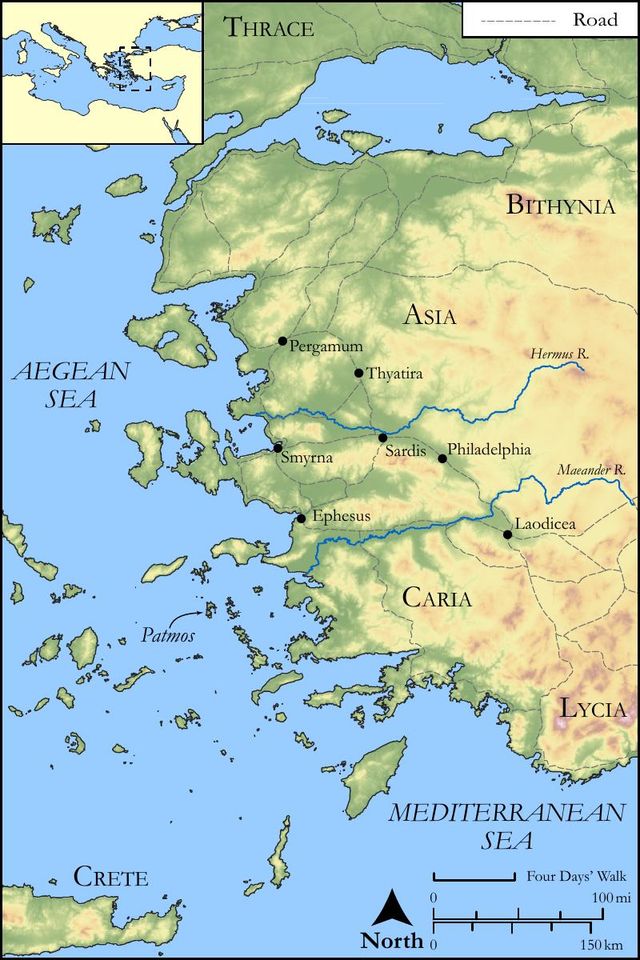
See on the biblical-era map

Study this verse
Public-domain commentary
Matthew Henry
From his Commentary on the Whole Bible. Henry comments on passages, not single verses — this entry covers Revelation 9:13–21. His three-level outline is real structure in the source text, so it is rendered as structure.
Here let us consider the preface to this vision, and then the vision itself.
I.The preface to this vision:
A voice was heard from the horns of the golden altar, Rev 9:13, Rev 9:14. Here observe,
1.The power of the church's enemies is restrained till God gives the word to have them turned loose.
2.When nations are ripe for punishment, those instruments of God's anger that were before restrained are let loose upon them, Rev 9:14.
3.The instruments that God makes use of to punish a people may sometimes lie at a great distance from them, so that no danger may be apprehended from them. These four messengers of divine judgment lay bound in the river Euphrates, a great way from the European nations. Here the Turkish power had its rise, which seems to be the story of this vision.
II.The vision itself:
And the four angels that had been bound in the great river Euphrates were now loosed, Rev 9:15, Rev 9:16. And here observe,
1.The time of their military operations and executions is limited to an hour, and a day, and a month, and a year. Prophetic characters of time are hardly to be understood by us; but in general the time is fixed to an hour, when it shall begin and when it shall end; and how far the execution shall prevail, even to a third part of the inhabitants of the earth. God will make the wrath of man praise him, and the remainder of wrath he will restrain.
2.The army that was to execute this great commission is mustered, and the number found to be of horsemen two hundred thousand thousand; but we are left to guess what the infantry must be. In general, it tells us, the armies of the Mahomedan empire should be vastly great; and so it is certain they were.
3.Their formidable equipage and appearance, Rev 9:17. As the horses were fierce, like lions, and eager to rush into the battle, so those who sat upon them were clad in bright and costly armour, with all the ensigns of martial courage, zeal, and resolution.
4.The vast havoc and desolation that they made in the Roman empire, which had now become antichristian: A third part of them were killed; they went as far as their commission suffered them, and they could go no further.
5.Their artillery, by which they made such slaughter, described by fire, smoke, and brimstone, issuing out of the mouths of their horses, and the stings that were in their tails. It is Mr. Mede's opinion that this is a prediction of great guns, those instruments of cruelty which make such destruction: he observes, These were first used by the Turks at the siege of Constantinople, and, being new and strange, were very terrible, and did great execution. However, here seems to be an allusion to what is mentioned in the former vision, that, as antichrist had his forces of a spiritual nature, like scorpions poisoning the minds of men with error and idolatry, so the Turks, who were raised up to punish the antichristian apostasy, had their scorpions and their stings too, to hurt and kill the bodies of those who had been the murderers of so many souls.
6.Observe the impenitency of the antichristian generation under these dreadful judgments (Rev 9:20); the rest of the men who were not killed repented not, they still persisted in those sins for which God was so severely punishing them, which were,
(1.)Their idolatry; they would not cast away their images, though they could do them no good, could not see, nor hear, nor walk.
(2.)Their murders (Rev 9:21), which they had committed upon the saints and servants of Christ. Popery is a bloody religion, and seems resolved to continue such.
(3.)Their sorceries; they have their charms, and magic arts, and rites in exorcism and other things.
(4.)Their fornication; they allow both spiritual and carnal impurity, and promote it in themselves and others.
(5.)Their thefts; they have by unjust means heaped together a vast deal of wealth, to the injury and impoverishing of families, cities, princes, and nations. These are the flagrant crimes of antichrist and his agents; and, though God has revealed his wrath from heaven against them, they are obstinate, hardened, and impenitent, and judicially so, for they must be destroyed.
III.From this sixth trumpet we learn,
1.God can make one enemy of the church to be a scourge and plague to another.
2.He who is the Lord of hosts has vast armies at his command, to serve his own purposes.
3.The most formidable powers have limits set them, which they cannot transgress.
4.When God's judgments are in the earth, he expects the inhabitants thereof should repent of sin, and learn righteousness.
5.Impenitency under divine judgments is an iniquity that will be the ruin of sinners; for where God judges he will overcome.
Historical interpretation
Four Centuries of Reception
4 surviving comments on this verse. Each one is dated, so this reads as a timeline rather than a list.
Select a marker to jump to its quote. Markers stagger vertically where authors wrote within a few decades of each other.
The rest of humankind, who were spared and did not suffer these things, yet remained unrepentant. They will suffer these same things, since they did not keep themselves from idolatries and murders and fornications and thefts and works of magic. It is clear that the universal wrath comes from such things as these. These various deceits effect a frenzy in those nations that do not acknowledge the truth and that worship idols and the creature rather than the creator. And this is certainly so among those who confess to know God but deny him by their works and who wrap themselves up in the form of piety but deny the power of it.… May it be that we display the purity and authenticity of our faith in Christ by deeds so that we never hear those terrible words, “Truly, truly I say to you, I do not know you.” “Depart from me, you workers of iniquity.” Rather, may we hear this blessed invitation, “Come, you blessed of my Father, inherit the kingdom prepared for you from the foundation of the world.”
And they did not repent of their murders, etc. To their impious religion, they also add wicked morals. After describing the cruelty of the Antichrist, he, in his manner, recapitulates the beginning of Christ's birth and the glory of the Church to show the ruin of the same.
The power of the horses is in their mouths, and in their tails. By the mouth is represented the knowledge of teachers, and by the tail, which should be placed behind, temporal power. So their power is in their mouths and tails because their way of preaching is to persuade people of wrong things; but as they are sustained by temporal powers, they are exalted through the things that are behind. For their tails are like to serpents, and have heads: and with them they hurt. Here, inversely, wicked teachers are represented by the tails, and secular power by the heads. It is fitting to say that bad preachers are like serpents, because it is with the voice of the one whose hiss Eve was allured by that they advise bad things. Since it is with the support of powerful people that they violently bring many people to do forbidden things, it is right to say that they have heads, which, according to another translation, are called dragons' heads. Then, in order to show that the Gentiles also belong to this body, he said after that, And the rest of the men, who are not, and did not do penance from the works of their hands, that they should not adore devils, and idols of gold, and silver, and brass, and stone, and wood, which neither can see, nor hear, nor walk: and did not do penance from their murders, nor from their fornication, nor from their thefts, as if he were saying, “People of this kind also seem to belong to the aforementioned number.” Whereas throughout the other prophecies we find a great many things that correspond to our Mediator symbolized by earthly things and few by heavenly things, in this prophecy John has quite often represented his coming by an angel. To what end, if not to show that this prophecy is richer than others? Whence it is now said:
The prophet, striking the spiritual harp, recounted to us concerning those punished in Hades, saying to God: "that there is no one in death who remembers you; and in Hades, who will confess to you," (Ps. 6:6) depriving them both of joy according to God and repentance? For through the remembrance of God there is spiritual joy, for the same one writes that elsewhere he "remembered God and was glad," (Ps. 76:4) but through not confessing repentance— for confession is the declaration of those who have sinned, arising from remorse and turning back through shame that comes near to the soul.
For in truth, God has appointed for us two lives, the present and the future. In the present life, He has given us the ability and authority to govern ourselves according to reason; but in the future life, there will be recompense for what has been lived, and neither the present life is subject to judgment, unless perhaps someone is profitably reminded and urged to repentance, nor the future life is a state so that we might be reformed from a misused life to a better one. Since these things are so, how then has it been said concerning those punished there?
"And the rest of the people, who were not killed by these plagues, neither repented from the works of their hands". It does not say that those who did not repent in that life, but that those still living, and not from obedience and seeing the things that were then to come, repented from these and those unlawful deeds. By this said "plague", they do not die the intellectual death, calling punishment death, as they co-exist eternally with the wicked, unless they are punished by another, indeed worse, which, though attempting to say it, he wisely kept silent. May it happen that all of us become free; by the grace and generosity of our Lord Jesus Christ, with whom to the Father be glory with the Holy Spirit forever. Amen.
Continue studying Revelation 9:21 across the web’s major study libraries — every link below opens this exact verse, chapter, or book on the destination site.
Read & Compare
 BibleGatewayThis verse in more than 200 translations and 70 languages.
 Bible.comThe YouVersion reader — hundreds of translations, reading plans, and highlights.
 ESV.orgCrossway's official English Standard Version reader.
 NET BibleThe NET translation with 60,000+ translators' notes on every rendering decision.
 STEP BibleTyndale House's free study tool — original text, vocabulary, and scholarly resources.
 BibliaLogos Bible Software's free web reader.
 USCCBThe New American Bible (Revised Edition) with the U.S. bishops' study notes.
Commentaries
 BibleHub CommentariesDozens of classic commentaries on this verse, gathered on one page.
 StudyLightMore than 100 commentary sets — the largest collection on the web.
 BibleRefPlain-English commentary on what this verse means, verse by verse.
 Enduring WordDavid Guzik's free commentary on this chapter, widely used by Bible teachers.
 Bible Study ToolsVerse commentary alongside Greek and Hebrew study aids.
Original Language & Research
- BibleHub InterlinearThe verse word by word — original language, transliteration, and English.
- BibleHub LexiconEvery word's original-language definition and Strong's entry.
 Blue Letter BibleDeep-study tools — Strong's numbers, concordance, and word studies.
 CNTR CollationThe earliest Greek manuscripts of this verse, collated letter by letter.
Sermons, Hymns & Audio


TrulyRandomVerse is not affiliated with these sites and doesn’t control their content. They’re linked because they’re genuinely useful.
Summary
Revelation 9:21 concludes a vivid depiction of the sixth trumpet judgment, revealing a profoundly disturbing human response to overwhelming divine wrath: a complete and shocking lack of repentance. Despite witnessing catastrophic plagues that decimated a third of humanity, the survivors remained stubbornly entrenched in their idolatry and a litany of grievous sins—murders, sorceries, fornication, and thefts—demonstrating an extreme hardening of heart and a defiant refusal to turn from their evil ways, even in the face of unmistakable divine judgment.
Context
ShowHideLiterary Context
This verse immediately follows the description of the sixth trumpet judgment, where a vast demonic cavalry, released from the Euphrates, slays a third of humanity (Revelation 9:13-19). The preceding verse, Revelation 9:20, explicitly states that "the rest of the men which were not killed by these plagues yet repented not of the works of their hands." Verse 21 then serves as a chilling amplification and specification of this unrepentance, detailing the specific categories of moral and spiritual depravity that humanity clung to. It underscores the profound spiritual blindness and hardened will of those who reject God, even when confronted with the most undeniable evidence of His power and judgment. This section highlights the escalating nature of divine judgment alongside the escalating stubbornness of humanity, setting the stage for further judgments and the eventual culmination of God's plan.
Historical & Cultural Context
The sins listed in Revelation 9:21 were rampant in the Greco-Roman world of John's day, reflecting the moral decay and spiritual darkness that characterized pagan society. "Murders" (φόνος) could refer to literal killings, but also to the widespread violence, oppression, and disregard for human life prevalent in an empire built on conquest and slavery. "Sorceries" (φαρμακεία) was deeply intertwined with pagan worship, magic, and the occult, often involving the use of drugs (hence "pharmacy") to induce altered states for divination or communication with spirits, directly opposing the worship of the one true God. "Fornication" (πορνεία) encompassed all forms of sexual immorality, including prostitution, adultery, and incest, which were commonplace and often linked to temple prostitution in pagan cults. "Thefts" (κλέμμα) points to pervasive dishonesty, greed, and disregard for justice and property rights, reflecting a breakdown of societal integrity. John's audience would recognize these as characteristic sins of the idolatrous and corrupt world system that stood in opposition to God and His people.
Key Themes
ShowHideRevelation 9:21 powerfully contributes to several key themes within the book of Revelation and broader biblical theology. Foremost is the theme of Humanity's Stubborn Rebellion and Unrepentance. Despite experiencing unprecedented divine judgments, humanity's will remains fixed against God, illustrating the depth of human depravity and the profound spiritual blindness that prevents turning to God. This echoes themes found in the Old Testament, such as Pharaoh's hardened heart in Exodus 7-12, and prophetic warnings against unrepentance in Jeremiah 5:3. Another prominent theme is the Nature and Pervasiveness of Sin, particularly the specific categories listed: violence, occult practices, sexual immorality, and greed. These are not merely individual transgressions but represent pervasive moral corruption and spiritual rebellion, often linked to idolatry as seen in Revelation 9:20. Finally, the verse highlights the Justice and Patience of God, demonstrating that while God executes judgment, He also patiently waits for repentance, yet there comes a point where human resistance reaches its climax, revealing the ultimate consequences of rejecting His gracious call, as also seen in 2 Peter 3:9.
Exposition and Analysis
ShowHideKey Word Analysis
ShowHideMeaning "to think differently or afterwards, i.e. reconsider (morally, feel compunction)." This word signifies a fundamental change of mind, a turning from one's former way of thinking and acting, accompanied by a moral shift and regret for past actions. In the context of Revelation 9:21, the absence of this repentance despite overwhelming divine judgment underscores the profound spiritual hardening of humanity. It is not merely a superficial sorrow but a deep, transformative reorientation of one's will towards God.
Meaning "medication ('pharmacy'), i.e. (by extension) magic (literally or figuratively)." While the root refers to the use of drugs, in the biblical context, especially in Revelation, it carries the strong connotation of magical arts, enchantments, and occult practices. This often involved the use of potions or drugs to induce trances or visions for the purpose of divination, pagan worship, or manipulation, directly linking it to idolatry and demonic influence. Its inclusion here highlights humanity's reliance on illicit spiritual power outside of God.
Meaning "stealing (properly, the thing stolen, but used of the act)." This refers to acts of stealing, robbery, and illicit acquisition of property. Its presence in this list of egregious sins demonstrates that even amidst cosmic judgments, basic moral failures related to covetousness and disregard for others' rights persist. It points to a fundamental breakdown of justice and ethical conduct, reflecting a self-centeredness that prioritizes personal gain over righteousness.
Verse Breakdown
ShowHide"Neither repented they"
This opening phrase immediately establishes the central theme of the verse: the shocking and defiant lack of a change of heart or mind among the survivors. Despite the cataclysmic judgments they have just endured, there is no turning away from their sinful ways, no remorse, and no turning towards God. This highlights the depth of human stubbornness and rebellion against divine authority.
"of their murders"
This refers to the sin of taking human life unlawfully, reflecting a profound disregard for the sanctity of life. In a broader sense, it can also encompass acts of violence, oppression, and hatred that lead to the destruction of others, whether physically or spiritually. Its inclusion signifies a pervasive culture of violence and animosity.
"nor of their sorceries"
This points to the practice of magic, occult arts, and the use of drugs for illicit spiritual purposes. It signifies a reliance on demonic powers or deceptive spiritual forces rather than the true God, often intertwined with idolatry. This reveals a spiritual rebellion that seeks power and knowledge through forbidden means, rejecting God's sovereignty.
"nor of their fornication"
This encompasses all forms of sexual immorality, including adultery, prostitution, and any sexual activity outside the bounds of God's design for marriage. It speaks to a pervasive breakdown of moral boundaries and a pursuit of illicit physical gratification, demonstrating a disregard for purity and covenant.
"nor of their thefts"
This refers to the act of stealing, robbery, and dishonesty in acquiring possessions. It signifies a widespread lack of integrity, greed, and a disregard for justice and the property rights of others. This points to a societal decay where self-interest and illicit gain supersede ethical conduct and communal well-being.
Literary Devices
ShowHideRevelation 9:21 employs several powerful literary devices to underscore its grim message. The most prominent is Repetition, specifically the repeated use of "nor of their" (Greek: οὔτε ἐκ) before each listed sin. This anaphoric structure creates a relentless, emphatic rhythm that highlights the comprehensive and unwavering nature of humanity's unrepentance. It builds a cumulative sense of their stubborn refusal to abandon any of their evil practices, making the refusal to repent even more pronounced. This repetition also functions as a Catalogue or List, systematically detailing the specific categories of sin that characterize the unrepentant. By itemizing "murders," "sorceries," "fornication," and "thefts," the text provides concrete examples of the moral and spiritual depravity, making the abstract concept of "unrepentance" tangible and horrifying. Finally, there is a powerful Juxtaposition between the severity of the divine judgments described in the preceding verses and the utter lack of change in human behavior. This stark contrast amplifies the depth of human rebellion and the shocking resilience of sin in the face of overwhelming evidence of God's power and justice.
Theological and Thematic Connections
ShowHideRevelation 9:21 stands as a stark theological commentary on the profound depth of human depravity and the stubborn resistance of the fallen will to God. It shatters any notion that mere external pressure or even cataclysmic judgment will automatically lead to repentance. Instead, it reveals that true repentance is a work of the heart, a turning that must be willing, and without it, even divine judgment can harden rather than soften. This verse underscores that humanity's problem is not merely ignorance of God's power, but a deep-seated rebellion against His moral authority and a preference for sin over righteousness. It serves as a sobering reminder of the eschatological reality that not all will repent, even in the face of the most undeniable evidence of God's existence and judgment, highlighting the critical importance of a personal, internal transformation.
Reflection and Application
ShowHideRevelation 9:21 presents a chilling mirror for self-examination, reminding us that the human heart, left to its own devices, possesses an astonishing capacity for stubbornness and resistance to God, even in the face of undeniable truth and severe consequences. It challenges us to consider whether we, too, might be clinging to "our murders" (our hatreds, our violence of speech or spirit), "our sorceries" (our attempts to control life through means apart from God, our reliance on anything other than His Spirit, our flirtations with the occult), "our fornication" (our sexual impurities, our lusts), or "our thefts" (our dishonesty, our greed, our taking what is not ours, whether material or relational). This verse serves as a powerful call to a continual posture of repentance for believers, recognizing that spiritual hardening is a subtle and dangerous process. It urges us to be quick to acknowledge sin, to turn from it decisively, and to embrace God's grace for transformation, rather than defiantly clinging to patterns that lead to destruction.
Questions for Reflection
ShowHideFAQ
ShowHideWhy didn't the people in Revelation 9:21 repent despite experiencing such terrible plagues?
ShowHideThe text indicates a profound spiritual hardening and a defiant will. It's not that they lacked information or experience of God's power, but that their hearts were unwilling to change. This illustrates a key biblical truth: repentance is not merely a reaction to external circumstances but a choice of the will, often enabled by God's grace. Their refusal to repent, even after witnessing a third of humanity perish, demonstrates the ultimate depth of human rebellion against God and a preference for their sinful ways and idolatry over submission to divine authority. This aligns with other biblical accounts where people harden their hearts against God, such as Pharaoh in the book of Exodus.
What does "sorceries" (pharmakeia) specifically refer to in this context?
ShowHideWhile the Greek word pharmakeia (φαρμακεία) is the root of our English word "pharmacy" and can refer to the use of drugs, in the biblical context, especially in Revelation, it primarily denotes the practice of magic, enchantment, and occult arts. This often involved the use of drugs or potions to induce trances or visions for pagan worship, divination, or communication with spirits. It signifies a reliance on supernatural powers outside of God, seeking control or knowledge through illicit, demonic means, and is closely associated with idolatry and deception, as seen in Revelation 18:23.
Are the sins listed in Revelation 9:21 still relevant today, and how?
ShowHideAbsolutely. The sins of "murders, sorceries, fornication, and thefts" are timeless manifestations of human depravity and rebellion against God's moral law. "Murders" extends beyond literal killing to include all forms of violence, hatred, and disregard for human life. "Sorceries" encompasses not just ancient magic but any reliance on spiritual powers apart from God, including New Age practices, occultism, and seeking control through manipulation or illicit means. "Fornication" represents all forms of sexual immorality and the breakdown of God's design for sexuality. "Thefts" includes not only literal stealing but also greed, dishonesty, and exploitation. These sins continue to plague societies worldwide, demonstrating that human nature remains unchanged and that the call to repentance is as urgent today as it was in John's time.
Christ-Centered Fulfillment
ShowHideRevelation 9:21, with its bleak portrayal of unrepentant humanity, powerfully underscores the absolute necessity of Jesus Christ. The stubborn refusal of those in the vision to turn from their murders, sorceries, fornication, and thefts reveals the depth of human sin and the inability of judgment alone to transform the heart. This dire spiritual condition highlights the profound need for a Savior who can not only atone for such pervasive sin but also empower genuine repentance. Jesus, the Lamb of God who takes away the sin of the world, offers the very repentance that humanity in Revelation 9:21 so tragically rejects. His death on the cross addresses the guilt of every sin listed, from the shedding of innocent blood to the spiritual rebellion of sorcery, the moral decay of fornication, and the injustice of theft. Through His resurrection, He offers new life and the power of the Holy Spirit to break the chains of these very sins, enabling a true change of mind and heart (metanoéō). The Gospel, centered on Christ, is God's ultimate answer to humanity's hardened heart, offering not just judgment but also the gracious invitation to forgiveness and transformation for all who will believe and turn to Him (Mark 1:15; Acts 17:30). He is the only one who can truly deliver us from the power and consequences of these destructive sins, leading us into a life of righteousness and true freedom.