


Revelation 18:24
Bible text: King James Version (1769 Blayney text) · Public domain
Bible text: Berean Standard Bible · Public domain
Bible text: American Standard Version (1901) · Public domain
Bible text: World English Bible, Messianic edition · Public domain
Bible text: Geneva Bible (1599) · Public domain
Bible text: Young's Literal Translation · Public domain
- καὶkaiAndG2532CONJConjunction
- ἐνeninG1722PREPPreposition
- αὐτῇautēaherG846P-DSFPersonal pronoun Dative Singular Feminine
- αἷμαhaima[the] bloodG129N-NSNNoun Nominative Singular Neuter
- προφητῶνprophētōnof prophetsG4396N-GPMNoun Genitive Plural Masculine
- καὶkaiandG2532CONJConjunction
- ἁγίωνhagiōnof saintsG40A-GPMAdjective Genitive Plural Masculine
- εὑρέθηheurethēwas foundG2147V-API-3SVerb Aorist Passive Indicative 3rd Singular
- καὶkaiandG2532CONJConjunction
- πάντωνpantōnof allG3956A-GPMAdjective Genitive Plural Masculine
- τῶνtōnthoseG3588T-GPMDefinite article Genitive Plural Masculine
- ἐσφαγμένωνesphagmenōnslainG4969V-RPP-GPMVerb Perfect Passive Participle Genitive Plural Masculine
- ἐπὶepionG1909PREPPreposition
- τῆςtēstheG3588T-GSFDefinite article Genitive Singular Feminine
- γῆςgēsearthG1093N-GSFNoun Genitive Singular Feminine
English is a literal word-by-word gloss of the Greek, not the KJV's wording. Why?
This is the original text the KJV's translators worked from — each Greek word with its own literal English meaning in this verse, prepared by scholars at Tyndale House, Cambridge. The KJV translates whole sentences, not word by word, so its wording differs: one Greek word can become several English words, and the KJV may choose “charity” where the gloss reads “love”. Both are faithful — they answer different questions. For the KJV's own rendering, switch to the KJV text.
Details
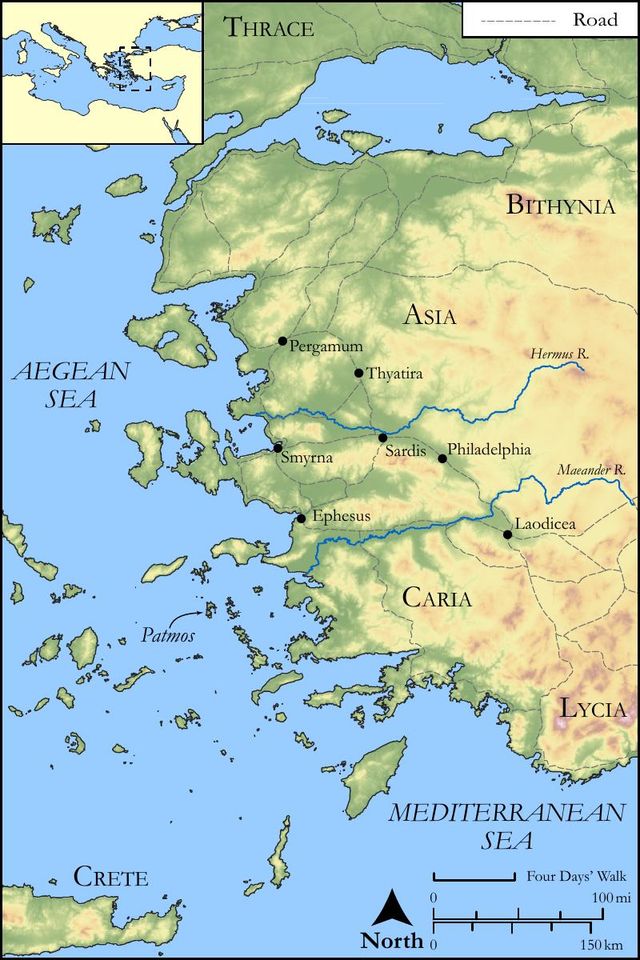
See on the biblical-era maps

Study this verse
Public-domain commentary
Matthew Henry
From his Commentary on the Whole Bible. Henry comments on passages, not single verses — this entry covers Revelation 18:9–24. His three-level outline is real structure in the source text, so it is rendered as structure.
Here we have,
I.A doleful lamentation made by Babylon's friends for her fall; and here observe,
1.Who are the mourners, namely, those who had been bewitched by her fornication, those who had been sharers in her sensual pleasures, and those who had been gainers by her wealth and trade - the kings and the merchants of the earth: the kings of the earth, whom she had flattered into idolatry by allowing them to be arbitrary and tyrannical over their subjects, while they were obsequious to her; and the merchants, that is, those who trafficked with her for indulgences, pardons, dispensations, and preferments; these will mourn, because by this craft they got their wealth.
2.What was the manner of their mourning.
(1.)They stood afar off, they durst not come nigh her. Even Babylon's friends will stand at a distance from her fall. Though they had been partakers with her in her sins, and in her sinful pleasures and profits, they were not willing to bear a share in her plagues.
(2.)They made a grievous outcry: Alas! alas! that great city, Babylon, that mighty city!
(3.)They wept, and cast dust upon their heads, Rev 18:19. The pleasures of sin are but for a season, and they will end in dismal sorrow. All those who rejoice in the success of the church's enemies will share with them in their downfall; and those who have most indulged themselves in pride and pleasure are the least able to bear calamities; their sorrows will be as excessive as their pleasure and jollity were before.
3.What was the cause of their mourning; not their sin, but their punishment. They did not lament their fall into idolatry, and luxury, and persecution, but their fall into ruin - the loss of their traffic and of their wealth and power. The spirit of antichrist is a worldly spirit, and their sorrow is a mere worldly sorrow; they did not lament for the anger of God, that had now fallen upon them, but for the loss of their outward comfort. We have a large schedule and inventory of the wealth and merchandise of this city, all which was suddenly lost (Rev 18:12, Rev 18:13), and lost irrecoverably (Rev 18:14): All things which were dainty and goodly have departed from thee, and thou shalt find them no more at all. The church of God may fall for a time, but she shall rise again; but the fall of Babylon will be an utter overthrow, like that of Sodom and Gomorrah. Godly sorrow is some support under affliction, but mere worldly sorrow adds to the calamity.
II.An account of the joy and triumph there was both in heaven and earth at the irrecoverable fall of Babylon:
while her own people were bewailing her, the servants of God were called to rejoice over her, Rev 18:20. Here observe,
1.How universal this joy would be: heaven and earth, angels and saints, would join in it; that which is matter of rejoicing to the servants of God in this world is matter of rejoicing to the angels in heaven.
2.How just and reasonable; and that,
(1.)Because the fall of Babylon was an act of God's vindictive justice. God was then avenging his people's cause. They had committed their cause to him to whom vengeance belongs, and now the year of recompence had come for the controversies of Zion; and, though they did not take pleasure in the miseries of any, yet they had reason to rejoice in the discoveries of the glorious justice of God.
(2.)Because it was an irrecoverable ruin. This enemy should never molest them any more, and of this they were assured by a remarkable token (Rev 18:21): An angel from heaven took up a stone like a great millstone, and cast it into the sea, saying, "Thus shall Babylon be thrown down with violence, and be found no more at all; the place shall be no longer habitable by man, no work shall be done there, no comfort enjoyed, no light seen there, but utter darkness and desolation, as the reward of her great wickedness, first in deceiving the nations with her sorceries, and secondly in destroying and murdering those whom she could not deceive," Rev 18:24. Such abominable sins deserved so great a ruin.
Historical interpretation
Two Centuries of Reception
3 surviving comments on this verse. Each one is dated, so this reads as a timeline rather than a list.
Select a marker to jump to its quote. Markers stagger vertically where authors wrote within a few decades of each other.
Babylon is likened to a great millstone which is thrown down, for the revolving of times, as though it were a millstone, grinds down those who love the world, and it sends them in circles. Of these the Scriptures say, “The wicked walk in a circle.” … “The sound of harpers and musicians and flute players and trumpeters is no longer heard in her.” That is, the joy and happiness of the wicked passes away and is no longer to be found. And it adds the reason for this, “for your merchants were the great men of the earth,” that is, they had received good things in their lives. “The blood of the prophets and the saints was found in her and of all who have been slain by [her] upon the earth.” Did the same city kill the apostles that also killed the prophets and all of the rest of the martyrs? Rather, this is the city of all the proud and arrogant, which Cain established by the blood of his brother and which he named after the name of his son, Enoch, that is, after his posterity. For all the wicked in whom Babylon resides succeed one another and persecute the church of God until the end of the world. In the city of Cain “all the righteous blood” is poured out “from the blood of righteous Abel to the blood of Zechariah,” that is, of the people and of the priests, “between the sanctuary and the altar,” that is, between the people and the priests. This was said because not only the people but also the priests conspired in the death of Zechariah.… This is the city which killed the prophets and stoned those who were sent to it. This is that city that is built upon blood, as the Scriptures say, “Woe to him who builds a city with blood and founds a city on iniquity.”
Just as a millstone sinks with force into the sea, so also the destruction of this Babylon will be sudden, so that afterward no trace of her will be found. The absence of harpers, minstrels and the rest is an indication of this. And he gives the reason for this. [Babylon] deceived all nations with her sorcery and was the recipient of the blood of prophets and the other saints. It is possible that this passage depicts the impious Babylon among the Persians, for at various times until now she has received the blood of many saints and continually rejoices in sorceries and deceptions. And this gives us an occasion for prayer, that she receive the rewards prophesied for arrogance against Christ and his servants.
And in her was found the blood of prophets and saints, etc. Did the same city kill the apostles, which also killed the prophets, or all the saints? But this is the city that Cain founded with the blood of his brother, and he named it after his son Enoch, that is, all his posterity. For the seven generations of Cain are described. In the building of this city, all the righteous blood is poured out from the blood of righteous Abel to the blood of Zechariah (Matt. 23), that is, of the people and the priest.
Continue studying Revelation 18:24 across the web’s major study libraries — every link below opens this exact verse, chapter, or book on the destination site.
Read & Compare
 BibleGatewayThis verse in more than 200 translations and 70 languages.
 Bible.comThe YouVersion reader — hundreds of translations, reading plans, and highlights.
 ESV.orgCrossway's official English Standard Version reader.
 NET BibleThe NET translation with 60,000+ translators' notes on every rendering decision.
 STEP BibleTyndale House's free study tool — original text, vocabulary, and scholarly resources.
 BibliaLogos Bible Software's free web reader.
 USCCBThe New American Bible (Revised Edition) with the U.S. bishops' study notes.
Commentaries
 BibleHub CommentariesDozens of classic commentaries on this verse, gathered on one page.
 StudyLightMore than 100 commentary sets — the largest collection on the web.
 BibleRefPlain-English commentary on what this verse means, verse by verse.
 Enduring WordDavid Guzik's free commentary on this chapter, widely used by Bible teachers.
 Bible Study ToolsVerse commentary alongside Greek and Hebrew study aids.
Original Language & Research
- BibleHub InterlinearThe verse word by word — original language, transliteration, and English.
- BibleHub LexiconEvery word's original-language definition and Strong's entry.
 Blue Letter BibleDeep-study tools — Strong's numbers, concordance, and word studies.
 CNTR CollationThe earliest Greek manuscripts of this verse, collated letter by letter.
Sermons, Hymns & Audio


TrulyRandomVerse is not affiliated with these sites and doesn’t control their content. They’re linked because they’re genuinely useful.
Summary
Revelation 18:24 delivers the climactic indictment against "Babylon the Great," revealing the profound and undeniable reason for its catastrophic judgment: its pervasive guilt in shedding innocent blood. This verse serves as the ultimate divine justification for Babylon's complete destruction, asserting that the global system it represents is responsible for the persecution of God's faithful and the widespread violence inflicted upon all humanity throughout history.
Context
ShowHideLiterary Context
This verse serves as the culminating statement in the pronouncement of judgment against Babylon the Great, detailed extensively in Revelation 17 and Revelation 18. Following a series of laments from kings, merchants, and mariners over Babylon's sudden and irreversible ruin (Revelation 18:9-19), and a celebratory call to rejoice in its downfall (Revelation 18:20), verse 24 provides the ultimate, unassailable divine justification for this severe and absolute judgment. It acts as the final charge in a courtroom of heaven, sealing Babylon's fate by exposing its historical and pervasive culpability for violence and oppression against God's people and humanity at large.
Historical & Cultural Context
While "Babylon" in Revelation is primarily a symbolic entity, it draws heavily from historical and cultural realities. Historically, it evokes the ancient city of Babylon, notorious for its idolatry, oppression, and destruction of Jerusalem (as seen in Jeremiah 50-51). In John's immediate context, "Babylon" was widely understood as a veiled reference to Rome, the dominant imperial power of the time, known for its persecution of Christians, its vast economic influence, and its idolatrous emperor worship. The phrase "blood of prophets and saints" resonates with the long history of martyrdom, from Old Testament prophets (e.g., Matthew 23:34-36) to the early Christian martyrs who suffered under Roman rule. The concept of blood crying out for justice is deeply rooted in biblical tradition, from Abel's blood in Genesis 4:10 to the souls under the altar in Revelation 6:9-11.
Key Themes
ShowHideRevelation 18:24 powerfully contributes to several overarching themes within the book and broader biblical theology. It underscores the theme of Divine Justice and Retribution, asserting that God meticulously remembers all acts of injustice and violence, and will ultimately bring perfect recompense against oppressive practices. The verse highlights the Persecution of God's People, emphasizing the ongoing conflict between the world's systems and those who remain faithful to Christ, often at the cost of their lives. Furthermore, it speaks to the Universal Guilt of Worldly Systems that oppose God, portraying Babylon as a comprehensive symbol of all human powers, ideologies, and economic systems that promote idolatry, greed, and violence, extending their destructive influence "upon the earth." This final indictment serves as a solemn reminder of God's unwavering commitment to righteous judgment and the vindication of His suffering saints.
Exposition and Analysis
ShowHideKey Word Analysis
ShowHideThis term (G129) refers to literal blood, but in a biblical context, it carries profound theological weight, signifying life itself (Leviticus 17:11), the means of atonement (Hebrews 9:22), and, crucially here, the evidence of violent death and the cry for justice. The "blood" found in Babylon signifies its guilt in taking innocent lives, a violation so grievous it demands divine retribution.
The verb (G4969) denotes a violent, often sacrificial, slaughter. It is used for animals butchered for food or sacrifice, and in Revelation, frequently describes the Lamb "slain" (e.g., Revelation 5:6). Its use here emphasizes the brutal, intentional, and often ritualistic nature of the persecution and murder perpetrated by Babylon, underscoring the severity of its crimes.
This word (G40) describes those who are sacred, pure, morally blameless, or consecrated to God. In Revelation, "saints" refers to believers, God's holy people, who are set apart for Him. Their inclusion alongside "prophets" highlights that Babylon's victims are not random but specifically those devoted to God, making their shedding of blood a direct affront to the divine.
Verse Breakdown
ShowHide"And in her was found"
This phrase signifies a definitive discovery and an undeniable culpability. It's not merely an accusation but a declaration of a proven fact, as if a divine investigation has concluded with overwhelming evidence. Babylon's guilt is inherent and exposed.
"the blood of prophets, and of saints"
This specifies the primary victims of Babylon's atrocities. "Prophets" refers to those who speak God's word, often facing opposition and martyrdom for their truth-telling. "Saints" encompasses all faithful believers who have suffered persecution for their allegiance to Christ. This highlights the spiritual nature of Babylon's antagonism—it targets those consecrated to God.
"and of all that were slain upon the earth"
This broadens the scope of Babylon's guilt beyond just God's direct covenant people. It indicates that the oppressive rule represented by Babylon is responsible for widespread violence, injustice, and human suffering globally. This suggests its pervasive evil influence extends to all innocent blood shed by tyrannical, ungodly regimes and systems throughout human history, making its judgment universally just.
Literary Devices
ShowHideRevelation 18:24 employs several potent literary devices to convey its message of divine judgment. Symbolism is paramount, with "Babylon" serving as a multifaceted symbol not merely of a historical city but of all worldly systems that oppose God, persecute His people, and promote idolatry and injustice. The "blood" found in her is also symbolic, representing not just literal death but the accumulated guilt of violence and the cry for divine justice. The phrase "prophets, and of saints, and of all that were slain upon the earth" utilizes a form of merism or synecdoche, where specific categories (prophets, saints) are mentioned to represent a larger whole (all innocent victims), emphasizing the comprehensive nature of Babylon's guilt. The entire verse functions as a powerful declaration of retributive justice, where the punishment meted out to Babylon is directly and proportionately linked to its heinous crimes, underscoring the biblical principle that God will ultimately avenge the innocent.
Theological and Thematic Connections
ShowHideRevelation 18:24 powerfully encapsulates the biblical theme of divine justice for the shedding of innocent blood, a principle deeply embedded in both Old and New Testaments. It affirms God's unwavering commitment to holding oppressive powers accountable for their violence and persecution. From the very beginning, the "blood" of the righteous has cried out from the earth, demanding a divine response, and this verse signifies the ultimate answer to that cry. It assures believers that no act of injustice, no martyrdom, and no suffering for righteousness goes unnoticed by God, and that His perfect justice will ultimately prevail against all systems that stand in opposition to His kingdom. The fall of Babylon is not merely an act of vengeance but a righteous vindication of all who have suffered for truth.
Reflection and Application
ShowHideRevelation 18:24 offers profound comfort to those who have suffered or witnessed injustice, providing an unwavering assurance that God sees, remembers, and will ultimately act. In a world where evil often seems to triumph and the innocent suffer without apparent recourse, this verse reminds us that divine justice is not merely a hope but a certainty. It challenges us to discern and distance ourselves from "Babylonian" systems—any ideologies, economic practices, or political powers that promote greed, oppression, spiritual rebellion, or violence, regardless of their worldly allure or apparent success. For believers, this means a call to ethical discernment, a commitment to standing for truth and justice, and a willingness to endure suffering for righteousness, knowing that our ultimate vindication rests in God's hands. It also serves as a powerful reminder to value the sanctity of human life, created in God's image, and to plead the cause of the vulnerable and persecuted in our own contexts.
Questions for Reflection
ShowHideFAQ
ShowHideWhat does "Babylon" represent in Revelation, and how does its "bloodguilt" relate to its symbolic meaning?
ShowHideIn Revelation, "Babylon" is not merely a literal city but a profound symbolic representation of all worldly systems, empires, and ideologies that stand in opposition to God, persecute His people, and promote idolatry, greed, and injustice. It embodies the collective forces of human rebellion against divine authority, often characterized by immense economic power, spiritual deception, and moral depravity, as detailed in Revelation 17 and Revelation 18. Its "bloodguilt" for "prophets, and of saints, and of all that were slain upon the earth" is central to its symbolic meaning. This guilt signifies that Babylon, as the embodiment of anti-God worldly power, is directly responsible for the persecution and martyrdom of God's faithful throughout history, as well as for the broader violence and oppression that has led to the shedding of innocent blood across the globe. This universal culpability makes its final, devastating judgment entirely just and necessary in God's divine plan.
Christ-Centered Fulfillment
ShowHideRevelation 18:24, while a declaration of judgment against an oppressive rule, finds its ultimate Christ-centered fulfillment in several profound ways. First, Jesus Christ Himself is the quintessential "Lamb who was slain" (Revelation 5:6), the innocent one whose blood was shed by the very systems of this world (represented by both religious and imperial powers, like Rome, a type of Babylon). His sacrifice on the cross is the ultimate act of innocent blood shed, yet it is also the atoning blood that speaks a "better word than the blood of Abel" (Hebrews 12:24), offering forgiveness and reconciliation rather than merely crying out for vengeance. Furthermore, Christ identifies intimately with His persecuted people; when Saul persecuted the early Christians, Jesus declared, "Saul, Saul, why are you persecuting Me?" (Acts 9:4-5). Thus, the blood of prophets and saints found in Babylon is, in a profound sense, the blood of Christ's own body, the Church. Finally, it is Christ, the righteous Judge (John 5:22), who will execute this final justice against Babylon. His return as the triumphant King (Revelation 19:11-16) ensures that all innocent blood will be avenged, and His eternal kingdom will replace all earthly oppression, bringing an end to all violence and injustice.