


Revelation 9:17
Bible text: King James Version (1769 Blayney text) · Public domain
Bible text: King James Version with Strong's numbers · Public domain
Bible text: Berean Standard Bible · Public domain
Bible text: American Standard Version (1901) · Public domain
Bible text: World English Bible, Messianic edition · Public domain
Bible text: Geneva Bible (1599) · Public domain
Bible text: Young's Literal Translation · Public domain
- ΚαὶKaiAndG2532CONJConjunction
- οὕτωςhoutōsthusG3779ADVAdverb
- εἶδονeidonI sawG1492V-2AAI-1SVerb 2nd Aorist Active Indicative 1st Singular
- τοὺςtoustheG3588T-APMDefinite article Accusative Plural Masculine
- ἵππουςippoushorsesG2462N-APMNoun Accusative Plural Masculine
- ἐνeninG1722PREPPreposition
- τῇtēatheG3588T-DSFDefinite article Dative Singular Feminine
- ὁράσειhoraseivisionG3706N-DSFNoun Dative Singular Feminine
- καὶkaiandG2532CONJConjunction
- τοὺςtousthoseG3588T-APMDefinite article Accusative Plural Masculine
- καθημένουςkathēmenoussittingG2521V-PNP-APMVerb Present Middle Or Passive Deponent Participle Accusative Plural Masculine
- ἐπ᾽ep᾽onG1909PREPPreposition
- αὐτῶνautōnthemG846P-GPMPersonal pronoun Genitive Plural Masculine
- ἔχονταςechontashavingG2192V-PAP-APMVerb Present Active Participle Accusative Plural Masculine
- θώρακαςthōrakasbreastplatesG2382N-APMNoun Accusative Plural Masculine
- πυρίνουςpurinousfieryG4447A-APMAdjective Accusative Plural Masculine
- καὶkaiandG2532CONJConjunction
- ὑακινθίνουςhu'akinthinoushyacinthineG5191A-APMAdjective Accusative Plural Masculine
- καὶkaiandG2532CONJConjunction
- θειώδειςtheiōdeisbrimstoneG2306A-APMAdjective Accusative Plural Masculine
- καὶkaiAndG2532CONJConjunction
- αἱhaitheG3588T-NPFDefinite article Nominative Plural Feminine
- κεφαλαὶkephalaiheadsG2776N-NPFNoun Nominative Plural Feminine
- τῶνtōnof theG3588T-GPMDefinite article Genitive Plural Masculine
- ἵππωνippōnhorses [were]G2462N-GPMNoun Genitive Plural Masculine
- ὡςhōslikeG5613PRTParticle or Disjunctive
- κεφαλαὶkephalaiheadsG2776N-NPFNoun Nominative Plural Feminine
- λεόντωνleontōnof lionsG3023N-GPMNoun Genitive Plural Masculine
- καὶkaiandG2532CONJConjunction
- ἐκekout ofG1537PREPPreposition
- τῶνtōntheG3588T-GPNDefinite article Genitive Plural Neuter
- στομάτωνstomatōnmouthsG4750N-GPNNoun Genitive Plural Neuter
- αὐτῶνautōnof themG846P-GPMPersonal pronoun Genitive Plural Masculine
- ἐκπορεύεταιekporeuetaiproceedG1607V-PNI-3SVerb Present Middle Or Passive Deponent Indicative 3rd Singular
- πῦρpurfireG4442N-NSNNoun Nominative Singular Neuter
- καὶkaiandG2532CONJConjunction
- καπνὸςkapnossmokeG2586N-NSMNoun Nominative Singular Masculine
- καὶkaiandG2532CONJConjunction
- θεῖονtheionbrimstoneG2303N-NSNNoun Nominative Singular Neuter
English is a literal word-by-word gloss of the Greek, not the KJV's wording. Why?
This is the original text the KJV's translators worked from — each Greek word with its own literal English meaning in this verse, prepared by scholars at Tyndale House, Cambridge. The KJV translates whole sentences, not word by word, so its wording differs: one Greek word can become several English words, and the KJV may choose “charity” where the gloss reads “love”. Both are faithful — they answer different questions. For the KJV's own rendering, switch to the KJV text.
Details
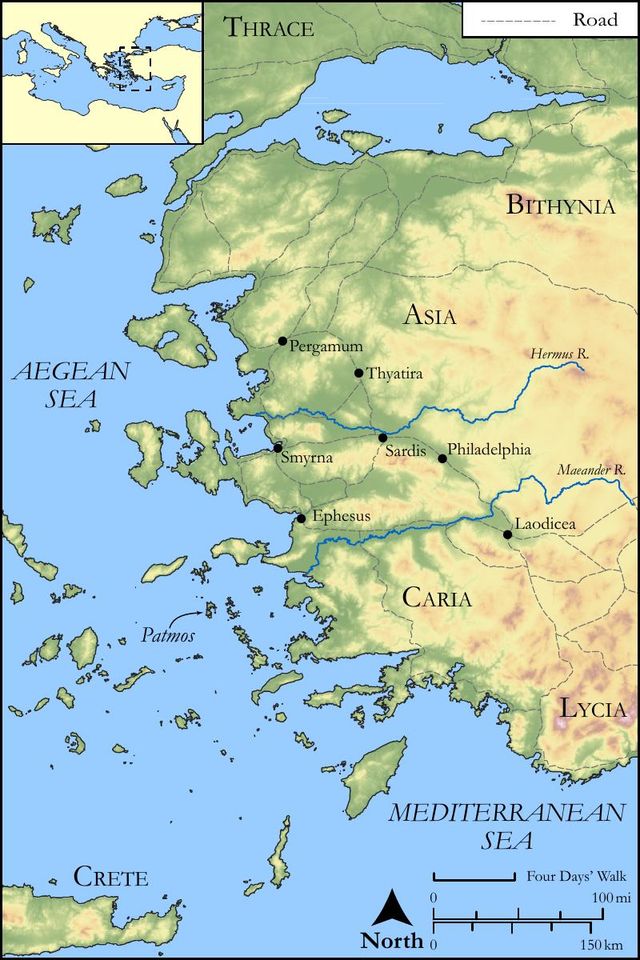
See on the biblical-era maps

Study this verse
Public-domain commentary
Matthew Henry
From his Commentary on the Whole Bible. Henry comments on passages, not single verses — this entry covers Revelation 9:13–21. His three-level outline is real structure in the source text, so it is rendered as structure.
Here let us consider the preface to this vision, and then the vision itself.
I.The preface to this vision:
A voice was heard from the horns of the golden altar, Rev 9:13, Rev 9:14. Here observe,
1.The power of the church's enemies is restrained till God gives the word to have them turned loose.
2.When nations are ripe for punishment, those instruments of God's anger that were before restrained are let loose upon them, Rev 9:14.
3.The instruments that God makes use of to punish a people may sometimes lie at a great distance from them, so that no danger may be apprehended from them. These four messengers of divine judgment lay bound in the river Euphrates, a great way from the European nations. Here the Turkish power had its rise, which seems to be the story of this vision.
II.The vision itself:
And the four angels that had been bound in the great river Euphrates were now loosed, Rev 9:15, Rev 9:16. And here observe,
1.The time of their military operations and executions is limited to an hour, and a day, and a month, and a year. Prophetic characters of time are hardly to be understood by us; but in general the time is fixed to an hour, when it shall begin and when it shall end; and how far the execution shall prevail, even to a third part of the inhabitants of the earth. God will make the wrath of man praise him, and the remainder of wrath he will restrain.
2.The army that was to execute this great commission is mustered, and the number found to be of horsemen two hundred thousand thousand; but we are left to guess what the infantry must be. In general, it tells us, the armies of the Mahomedan empire should be vastly great; and so it is certain they were.
3.Their formidable equipage and appearance, Rev 9:17. As the horses were fierce, like lions, and eager to rush into the battle, so those who sat upon them were clad in bright and costly armour, with all the ensigns of martial courage, zeal, and resolution.
4.The vast havoc and desolation that they made in the Roman empire, which had now become antichristian: A third part of them were killed; they went as far as their commission suffered them, and they could go no further.
5.Their artillery, by which they made such slaughter, described by fire, smoke, and brimstone, issuing out of the mouths of their horses, and the stings that were in their tails. It is Mr. Mede's opinion that this is a prediction of great guns, those instruments of cruelty which make such destruction: he observes, These were first used by the Turks at the siege of Constantinople, and, being new and strange, were very terrible, and did great execution. However, here seems to be an allusion to what is mentioned in the former vision, that, as antichrist had his forces of a spiritual nature, like scorpions poisoning the minds of men with error and idolatry, so the Turks, who were raised up to punish the antichristian apostasy, had their scorpions and their stings too, to hurt and kill the bodies of those who had been the murderers of so many souls.
6.Observe the impenitency of the antichristian generation under these dreadful judgments (Rev 9:20); the rest of the men who were not killed repented not, they still persisted in those sins for which God was so severely punishing them, which were,
(1.)Their idolatry; they would not cast away their images, though they could do them no good, could not see, nor hear, nor walk.
(2.)Their murders (Rev 9:21), which they had committed upon the saints and servants of Christ. Popery is a bloody religion, and seems resolved to continue such.
(3.)Their sorceries; they have their charms, and magic arts, and rites in exorcism and other things.
(4.)Their fornication; they allow both spiritual and carnal impurity, and promote it in themselves and others.
(5.)Their thefts; they have by unjust means heaped together a vast deal of wealth, to the injury and impoverishing of families, cities, princes, and nations. These are the flagrant crimes of antichrist and his agents; and, though God has revealed his wrath from heaven against them, they are obstinate, hardened, and impenitent, and judicially so, for they must be destroyed.
III.From this sixth trumpet we learn,
1.God can make one enemy of the church to be a scourge and plague to another.
2.He who is the Lord of hosts has vast armies at his command, to serve his own purposes.
3.The most formidable powers have limits set them, which they cannot transgress.
4.When God's judgments are in the earth, he expects the inhabitants thereof should repent of sin, and learn righteousness.
5.Impenitency under divine judgments is an iniquity that will be the ruin of sinners; for where God judges he will overcome.
Historical interpretation
Four Centuries of Reception
6 surviving comments on this verse. Each one is dated, so this reads as a timeline rather than a list.
Select a marker to jump to its quote. Markers stagger vertically where authors wrote within a few decades of each other.
The horses are men, and their riders are evil spirits. Just as we could say in a good sense “You mounted upon your horses,” referring to preachers, “and your victorious cavalry,” so here in an evil sense [these horses] are joined to iniquitous spirits.… And although little similarity can be found between locusts and horses, the same is true concerning lions. Yet each of these is suitable for symbolizing the persons of heretics.… The description of the breastplate signifies the punishments of the impious, for we read that those who worship the beast are promised fire and sulphur, and “the smoke of their torments goes up for ever and ever.”
I think that these “horses” are either men who, like beasts, lust after women, or they are those who are submitted to demons and are ruled by them. For those who sit upon others are those who also govern them. It is common for these to use not only each other as servants but also to use evil people as instruments for plotting against people of similar kind. We interpret “the breastplates of fire and of smoke and of sulfur” to signify the aerial nature of the evil demons and of their destructive work, and that the heads of lions show their murderous and beastly nature.
And from their mouths proceeds fire and smoke and sulfur. He shows what he had said about hyacinth smoke. But these things do not clearly come out of their mouths, but by harmful preaching, they generate punishment for themselves and their listeners. For, he says, I will bring forth a fire from the midst of you, which shall devour you (Ezek. XXVIII).
And thus I saw the horses in the vision, and those who sat on them, etc. The malignant spirits, in whose hearts they preside, are clothed with their punishments. For we read that those worshipping the beast are to be tormented with fire and sulfur, and the smoke of their torment will ascend forever and ever. Note that in the plague of locusts he did not say he saw horsemen, but only horses. Here indeed, the magnitude of the persecutions shows the open presence of the opposing power. Thus, here the heads are of lions, while there the faces are indeed human, but the teeth are only bestial. Because often heretics show some humanity, but the ministers of the final storm extort what they persuade by words and signs even through punishments.
And thus I saw the horses in the vision: and they that sat on them, had breastplates of fire and of hyacinth and of brimstone. These horses, that is preachers of errors, in whom the seduced people are also understood, have demons as riders, not to guide them, but to make them fall headlong. By the name of breastplates are symbolized the torments of the wicked, hard and impossible to get rid of with any prayer. By of hyacinth we should understand “of smoke,” for out of fire comes smoke. The very color of hyacinth also indicates this, as it has the appearance of air. And the heads of the horses were as the heads of lions. The heads of the horses are initiators of errors, who are both strong at crushing the weak and full of bad smells; whence it is rightly said after that, and from their mouths proceeded fire, and smoke, and brimstone. By these three plagues was slain the third part of men, by the fire and by the smoke and by the brimstone, which issued out of their mouths. This is because bad people's preaching prepares eternal torments for its followers, and these torments are metaphorically symbolized by this preaching, the effect being represented by the cause.
The "fire" of wrath and punishment is a symbol;
the "hyacinth" signifies that those sent are heavenly, for heaven is akin to the "hyacinth"; and the godlike ones please God, as if they were divine, for to please is to sing. And who would please God more than the holy angels?
Continue studying Revelation 9:17 across the web’s major study libraries — every link below opens this exact verse, chapter, or book on the destination site.
Read & Compare
 BibleGatewayThis verse in more than 200 translations and 70 languages.
 Bible.comThe YouVersion reader — hundreds of translations, reading plans, and highlights.
 ESV.orgCrossway's official English Standard Version reader.
 NET BibleThe NET translation with 60,000+ translators' notes on every rendering decision.
 STEP BibleTyndale House's free study tool — original text, vocabulary, and scholarly resources.
 BibliaLogos Bible Software's free web reader.
 USCCBThe New American Bible (Revised Edition) with the U.S. bishops' study notes.
Commentaries
 BibleHub CommentariesDozens of classic commentaries on this verse, gathered on one page.
 StudyLightMore than 100 commentary sets — the largest collection on the web.
 BibleRefPlain-English commentary on what this verse means, verse by verse.
 Enduring WordDavid Guzik's free commentary on this chapter, widely used by Bible teachers.
 Bible Study ToolsVerse commentary alongside Greek and Hebrew study aids.
Original Language & Research
- BibleHub InterlinearThe verse word by word — original language, transliteration, and English.
- BibleHub LexiconEvery word's original-language definition and Strong's entry.
 Blue Letter BibleDeep-study tools — Strong's numbers, concordance, and word studies.
 CNTR CollationThe earliest Greek manuscripts of this verse, collated letter by letter.
Sermons, Hymns & Audio


TrulyRandomVerse is not affiliated with these sites and doesn’t control their content. They’re linked because they’re genuinely useful.
Summary
Revelation 9:17 offers a chilling and highly symbolic description of the cavalry unleashed during the sixth trumpet judgment, as witnessed by the Apostle John. This verse meticulously details the terrifying appearance of the horses and their riders, emphasizing their destructive power through vivid imagery of fiery breastplates, lion-like heads, and the emission of fire, smoke, and brimstone from their mouths. It serves as a stark portrayal of divine wrath and the overwhelming nature of the judgments poured out upon an unrepentant world.
Context
ShowHideLiterary Context
This verse is situated within the broader apocalyptic narrative of the trumpet judgments, specifically following the sounding of the sixth trumpet in Revelation 9:13. Immediately preceding this verse, four angels bound at the great river Euphrates are released, commanding an immense army of two hundred million horsemen (Revelation 9:14-16). Verse 17 then provides a detailed visual account of these terrifying entities, focusing on their appearance and the instruments of their destruction. The subsequent verses in Revelation 9:18-19 further elaborate on the means by which this army inflicts death, directly linking their destructive power to the elements described in verse 17. This entire passage underscores the escalating intensity of God's judgments leading up to the final consummation.
Historical & Cultural Context
John's vision, written to early Christian communities facing persecution, draws heavily on Old Testament prophetic imagery and contemporary Roman military symbolism. The concept of a vast, destructive cavalry would have resonated with audiences familiar with the formidable Roman legions. The imagery of fire, smoke, and brimstone directly evokes Old Testament accounts of divine judgment, most notably the destruction of Sodom and Gomorrah (Genesis 19:24) and the theophanies associated with Mount Sinai (Exodus 19:18). These elements would have immediately conveyed God's righteous wrath and the certainty of His intervention in human affairs. The use of "breastplates" (Greek: thōrax) would have been a recognizable piece of military armor, but here it is imbued with supernatural, destructive properties.
Key Themes
ShowHideThe primary theme conveyed by Revelation 9:17 is the Divine Judgment of God upon a rebellious and unrepentant world. The terrifying appearance of these horsemen signifies an unstoppable, overwhelming, and devastating force of judgment, highlighting the severity of God's wrath against sin. Another crucial theme is Symbolic Imagery, which is characteristic of apocalyptic literature. The "breastplates of fire, and of jacinth, and brimstone," the "heads of lions" for the horses, and the emission of destructive elements from their mouths are not literal but serve to convey the nature, intensity, and origin of their destructive power. This imagery contributes to the overarching theme of an Unstoppable Force, where the sheer number of the army (mentioned in Revelation 9:16) combined with their fearsome appearance indicates an irresistible power designed to inflict widespread destruction and bring about God's purposes.
Exposition and Analysis
ShowHideKey Word Analysis
ShowHideThis primary verb signifies not merely a casual glance but a profound act of perceiving or beholding, often implying a deep understanding or knowing. In the context of John's vision, it emphasizes that he was given a direct, divinely revealed insight into these terrifying figures, underscoring the reality and significance of what he was shown.
Derived from "out of" (ek) and "to go" (poreúomai), this verb denotes a forceful emanation or proceeding forth. Here, it vividly describes the destructive elements—fire, smoke, and brimstone—not just being present, but actively erupting from the mouths of the horses, highlighting their inherent capacity for devastation.
This word refers to sulfur, a substance historically and biblically associated with divine judgment and destruction, particularly in the context of fire and consuming wrath. Its inclusion here, alongside fire and smoke, powerfully conveys the destructive, purifying, and punitive nature of the judgment being enacted.
Verse Breakdown
ShowHide"And thus I saw the horses in the vision, and them that sat on them,"
John begins by affirming the visionary nature of his experience, emphasizing that he "saw" these entities, not merely imagined them. The focus is immediately on the "horses" and their "riders," indicating a unified, active force. The phrase "in the vision" reinforces that this is a divinely granted revelation, not an earthly observation.
"having breastplates of fire, and of jacinth, and brimstone:"
This clause describes the protective and symbolic armor of the riders. "Fire" (red) suggests destructive heat and wrath. "Jacinth" (a deep blue or purplish color) can symbolize smoke, bruising, or the dark, ominous nature of the judgment. "Brimstone" (yellowish, sulfurous) directly links to the destructive, purifying judgment associated with God's wrath. These colors combine to paint a picture of a force consumed by and inflicting fiery, sulfurous destruction.
"and the heads of the horses [were] as the heads of lions;"
This striking simile attributes ferocity, power, and predatory might to the horses themselves. Lions are symbols of strength and untamed aggression, suggesting that the horses are not merely mounts but active agents of destruction, possessing a terrifying, devouring quality.
"and out of their mouths issued fire and smoke and brimstone."
This final, climactic detail reveals the primary mode of attack. The "fire, smoke, and brimstone" are not just symbolic colors on breastplates but active, destructive elements emanating directly from the horses' mouths. This imagery underscores their supernatural, demonic origin and their capacity to inflict widespread death and torment, reminiscent of a fiery, suffocating, and poisonous assault.
Literary Devices
ShowHideRevelation 9:17 is rich in Symbolism and Vivid Imagery, characteristic of apocalyptic literature. The colors of the breastplates—fire (red), jacinth (dark blue/purple), and brimstone (yellow/sulfurous)—are highly symbolic, representing the destructive, consuming, and punitive nature of the judgment. The comparison of the horses' heads to lions is a powerful Simile, immediately conveying ferocity, strength, and a predatory nature, transforming the horses from mere beasts of burden into active agents of terror. The emission of "fire, smoke, and brimstone" from their mouths is a potent Metaphor for the instruments of divine wrath, directly linking this judgment to Old Testament accounts of God's fiery judgment, such as that on Sodom and Gomorrah. The entire description employs Hyperbole to convey the overwhelming and terrifying nature of this supernatural army, pushing beyond literal description to evoke a profound sense of dread and the unstoppable force of God's judgment.
Theological and Thematic Connections
ShowHideRevelation 9:17 powerfully articulates the theme of divine judgment, emphasizing God's absolute sovereignty over all creation and His ultimate right to execute justice upon a rebellious world. The terrifying imagery underscores the severity of sin and the inevitable consequences for those who refuse to repent. This vision serves as a stark reminder that God is not only a God of love and mercy but also a God of righteous wrath, whose patience will eventually give way to judgment. It highlights that even the most dreadful events are part of His sovereign plan, designed to bring about His perfect will, whether through purification or punishment. The passage ultimately calls humanity to acknowledge God's authority and seek reconciliation before the full outpouring of His wrath.
Reflection and Application
ShowHideThe intense imagery of Revelation 9:17, while describing future apocalyptic events, carries profound implications for believers today. It serves as a potent reminder of the holiness of God and the seriousness of sin. In a world often dismissive of divine judgment, this verse reaffirms that God will indeed hold humanity accountable. For those who have placed their faith in Jesus Christ, this passage should not evoke fear but rather a deeper appreciation for the salvation offered through His sacrifice, which delivers us from the wrath to come. It also instills a sense of urgency for evangelism, compelling us to share the Gospel message of repentance and redemption with a world desperately in need of God's mercy. Furthermore, it encourages perseverance in faith, knowing that God remains sovereign even amidst the most terrifying displays of His power, and that His ultimate plan will prevail.
Questions for Reflection
ShowHideFAQ
ShowHideAre the horses and riders in Revelation 9:17 literal or symbolic?
ShowHideThe description of the horses and riders in Revelation 9:17 is overwhelmingly symbolic, typical of apocalyptic literature like the Book of Revelation. While the "two hundred million" army mentioned in Revelation 9:16 might suggest a literal force, the specific details—horses with lion heads, breastplates of fire, jacinth, and brimstone, and fire, smoke, and brimstone issuing from their mouths—transcend any known literal military or biological reality. These vivid images are intended to convey the terrifying nature, immense destructive power, and supernatural origin of this judgment. They symbolize a divinely permitted, overwhelming force of judgment that will inflict widespread death and torment upon unrepentant humanity, rather than describing literal creatures or a conventional army. The symbolism emphasizes the quality and character of the judgment, not a photographic representation of it.
Christ-Centered Fulfillment
ShowHideWhile Revelation 9:17 vividly portrays God's judgment, its ultimate Christ-centered fulfillment lies in understanding Jesus' role as both the Lamb who takes away the sin of the world and the righteous Judge who will execute all judgment. The destructive elements seen here—fire, smoke, and brimstone—are the very expressions of God's wrath against sin, a wrath that was fully poured out upon Christ on the cross (Isaiah 53:5). For those who believe, Christ's sacrifice means deliverance from this wrath (Romans 5:9). However, for those who reject Him, Christ Himself, who holds "the keys of hell and of death" (Revelation 1:18), will be the one through whom these judgments are administered. The terrifying power of these horses foreshadows the ultimate, undeniable authority of Christ, who will return not only as Savior but also as the conquering King and Judge, with "eyes like a flame of fire" (Revelation 19:11-12), to bring all things to their just conclusion. Thus, this verse, though grim, implicitly points to the necessity of Christ's atoning work and His final, sovereign rule.