


Revelation 9:18
Bible text: King James Version (1769 Blayney text) · Public domain
Bible text: King James Version with Strong's numbers · Public domain
Bible text: Berean Standard Bible · Public domain
Bible text: American Standard Version (1901) · Public domain
Bible text: World English Bible, Messianic edition · Public domain
Bible text: Geneva Bible (1599) · Public domain
Bible text: Young's Literal Translation · Public domain
- ἀπὸapobyG575PREPPreposition
- τῶνtōn<the>G3588T-GPFDefinite article Genitive Plural Feminine
- τριῶνtriōnthreeG5140A-GPFAdjective Genitive Plural Feminine
- τούτωνtoutōntheseG3778D-GPFDemonstrative pronoun Genitive Plural Feminine
- ἀπεκτάνθησανapektanthēsanwas killedG615V-API-3PVerb Aorist Passive Indicative 3rd Plural
- τὸto<the>G3588T-NSNDefinite article Nominative Singular Neuter
- τρίτονtritona thirdG5154A-NSNAdjective Nominative Singular Neuter
- τῶνtōn<the>G3588T-GPMDefinite article Genitive Plural Masculine
- ἀνθρώπωνanthrōpōnof mankindG444N-GPMNoun Genitive Plural Masculine
- ἐκekbyG1537PREPPreposition
- τοῦtoutheG3588T-GSNDefinite article Genitive Singular Neuter
- πυρὸςpurosfireG4442N-GSNNoun Genitive Singular Neuter
- καὶkaiandG2532CONJConjunction
- ἐκekfromG1537PREPPreposition
- τοῦtoutheG3588T-GSMDefinite article Genitive Singular Masculine
- καπνοῦkapnousmokeG2586N-GSMNoun Genitive Singular Masculine
- καὶkaiandG2532CONJConjunction
- ἐκekfromG1537PREPPreposition
- τοῦtoutheG3588T-GSNDefinite article Genitive Singular Neuter
- θείουtheioubrimstoneG2303N-GSNNoun Genitive Singular Neuter
- τοῦtouwhichG3588T-GSNDefinite article Genitive Singular Neuter
- ἐκπορευομένουekporeuomenouis proceedingG1607V-PNP-GSNVerb Present Middle Or Passive Deponent Participle Genitive Singular Neuter
- ἐκekout ofG1537PREPPreposition
- τῶνtōntheG3588T-GPNDefinite article Genitive Plural Neuter
- στομάτωνstomatōnmouthsG4750N-GPNNoun Genitive Plural Neuter
- αὐτῶνautōnof themG846P-GPMPersonal pronoun Genitive Plural Masculine
English is a literal word-by-word gloss of the Greek, not the KJV's wording. Why?
This is the original text the KJV's translators worked from — each Greek word with its own literal English meaning in this verse, prepared by scholars at Tyndale House, Cambridge. The KJV translates whole sentences, not word by word, so its wording differs: one Greek word can become several English words, and the KJV may choose “charity” where the gloss reads “love”. Both are faithful — they answer different questions. For the KJV's own rendering, switch to the KJV text.
Details
See on the biblical-era maps

Study this verse
Public-domain commentary
Matthew Henry
From his Commentary on the Whole Bible. Henry comments on passages, not single verses — this entry covers Revelation 9:13–21. His three-level outline is real structure in the source text, so it is rendered as structure.
Here let us consider the preface to this vision, and then the vision itself.
I.The preface to this vision:
A voice was heard from the horns of the golden altar, Rev 9:13, Rev 9:14. Here observe,
1.The power of the church's enemies is restrained till God gives the word to have them turned loose.
2.When nations are ripe for punishment, those instruments of God's anger that were before restrained are let loose upon them, Rev 9:14.
3.The instruments that God makes use of to punish a people may sometimes lie at a great distance from them, so that no danger may be apprehended from them. These four messengers of divine judgment lay bound in the river Euphrates, a great way from the European nations. Here the Turkish power had its rise, which seems to be the story of this vision.
II.The vision itself:
And the four angels that had been bound in the great river Euphrates were now loosed, Rev 9:15, Rev 9:16. And here observe,
1.The time of their military operations and executions is limited to an hour, and a day, and a month, and a year. Prophetic characters of time are hardly to be understood by us; but in general the time is fixed to an hour, when it shall begin and when it shall end; and how far the execution shall prevail, even to a third part of the inhabitants of the earth. God will make the wrath of man praise him, and the remainder of wrath he will restrain.
2.The army that was to execute this great commission is mustered, and the number found to be of horsemen two hundred thousand thousand; but we are left to guess what the infantry must be. In general, it tells us, the armies of the Mahomedan empire should be vastly great; and so it is certain they were.
3.Their formidable equipage and appearance, Rev 9:17. As the horses were fierce, like lions, and eager to rush into the battle, so those who sat upon them were clad in bright and costly armour, with all the ensigns of martial courage, zeal, and resolution.
4.The vast havoc and desolation that they made in the Roman empire, which had now become antichristian: A third part of them were killed; they went as far as their commission suffered them, and they could go no further.
5.Their artillery, by which they made such slaughter, described by fire, smoke, and brimstone, issuing out of the mouths of their horses, and the stings that were in their tails. It is Mr. Mede's opinion that this is a prediction of great guns, those instruments of cruelty which make such destruction: he observes, These were first used by the Turks at the siege of Constantinople, and, being new and strange, were very terrible, and did great execution. However, here seems to be an allusion to what is mentioned in the former vision, that, as antichrist had his forces of a spiritual nature, like scorpions poisoning the minds of men with error and idolatry, so the Turks, who were raised up to punish the antichristian apostasy, had their scorpions and their stings too, to hurt and kill the bodies of those who had been the murderers of so many souls.
6.Observe the impenitency of the antichristian generation under these dreadful judgments (Rev 9:20); the rest of the men who were not killed repented not, they still persisted in those sins for which God was so severely punishing them, which were,
(1.)Their idolatry; they would not cast away their images, though they could do them no good, could not see, nor hear, nor walk.
(2.)Their murders (Rev 9:21), which they had committed upon the saints and servants of Christ. Popery is a bloody religion, and seems resolved to continue such.
(3.)Their sorceries; they have their charms, and magic arts, and rites in exorcism and other things.
(4.)Their fornication; they allow both spiritual and carnal impurity, and promote it in themselves and others.
(5.)Their thefts; they have by unjust means heaped together a vast deal of wealth, to the injury and impoverishing of families, cities, princes, and nations. These are the flagrant crimes of antichrist and his agents; and, though God has revealed his wrath from heaven against them, they are obstinate, hardened, and impenitent, and judicially so, for they must be destroyed.
III.From this sixth trumpet we learn,
1.God can make one enemy of the church to be a scourge and plague to another.
2.He who is the Lord of hosts has vast armies at his command, to serve his own purposes.
3.The most formidable powers have limits set them, which they cannot transgress.
4.When God's judgments are in the earth, he expects the inhabitants thereof should repent of sin, and learn righteousness.
5.Impenitency under divine judgments is an iniquity that will be the ruin of sinners; for where God judges he will overcome.
Historical interpretation
Four Centuries of Reception
4 surviving comments on this verse. Each one is dated, so this reads as a timeline rather than a list.
Select a marker to jump to its quote. Markers stagger vertically where authors wrote within a few decades of each other.
[The smoke, fire, and sulphur from their mouths] are the blasphemies that proceed from their mouths against God. “Their tails are like serpents.” The leaders [of the heretics] we call “tails,” and the rulers of the world we call “heads.” It is through these that the devil does his harm, and without these he is not able to do harm. For either irreligious kings do harm by an evil exercise of authority, or worldly prelates do harm by teaching badly.
“The fire that proceeds with smoke and sulfur from their mouths,” through which one third of humankind is killed, signifies those sins that consume the fruits of the heart by means of the poisonous assaults and instigations of the demons. Or the fire signifies the devastation of cities by fire and by the shedding of blood, which God allows to be done through the hands of the barbarians.
And thus I saw the horses in the vision: and they that sat on them, had breastplates of fire and of hyacinth and of brimstone. These horses, that is preachers of errors, in whom the seduced people are also understood, have demons as riders, not to guide them, but to make them fall headlong. By the name of breastplates are symbolized the torments of the wicked, hard and impossible to get rid of with any prayer. By of hyacinth we should understand “of smoke,” for out of fire comes smoke. The very color of hyacinth also indicates this, as it has the appearance of air. And the heads of the horses were as the heads of lions. The heads of the horses are initiators of errors, who are both strong at crushing the weak and full of bad smells; whence it is rightly said after that, and from their mouths proceeded fire, and smoke, and brimstone. By these three plagues was slain the third part of men, by the fire and by the smoke and by the brimstone, which issued out of their mouths. This is because bad people's preaching prepares eternal torments for its followers, and these torments are metaphorically symbolized by this preaching, the effect being represented by the cause.
Then the vision varies and exalts the power of the holy angels, warning against "lions" and "fire", "smoke" and divine beings and serpents, through all of which their terrible and incredible nature is signified.
Continue studying Revelation 9:18 across the web’s major study libraries — every link below opens this exact verse, chapter, or book on the destination site.
Read & Compare
 BibleGatewayThis verse in more than 200 translations and 70 languages.
 Bible.comThe YouVersion reader — hundreds of translations, reading plans, and highlights.
 ESV.orgCrossway's official English Standard Version reader.
 NET BibleThe NET translation with 60,000+ translators' notes on every rendering decision.
 STEP BibleTyndale House's free study tool — original text, vocabulary, and scholarly resources.
 BibliaLogos Bible Software's free web reader.
 USCCBThe New American Bible (Revised Edition) with the U.S. bishops' study notes.
Commentaries
 BibleHub CommentariesDozens of classic commentaries on this verse, gathered on one page.
 StudyLightMore than 100 commentary sets — the largest collection on the web.
 BibleRefPlain-English commentary on what this verse means, verse by verse.
 Enduring WordDavid Guzik's free commentary on this chapter, widely used by Bible teachers.
 Bible Study ToolsVerse commentary alongside Greek and Hebrew study aids.
Original Language & Research
- BibleHub InterlinearThe verse word by word — original language, transliteration, and English.
- BibleHub LexiconEvery word's original-language definition and Strong's entry.
 Blue Letter BibleDeep-study tools — Strong's numbers, concordance, and word studies.
 CNTR CollationThe earliest Greek manuscripts of this verse, collated letter by letter.
Sermons, Hymns & Audio


TrulyRandomVerse is not affiliated with these sites and doesn’t control their content. They’re linked because they’re genuinely useful.
Summary
Revelation 9:18 describes a horrifying outcome of the sixth trumpet judgment, where a third of humanity is killed by a supernatural plague. This devastating loss of life is attributed to "fire, smoke, and brimstone" that issues forth from the mouths of the demonic cavalry, highlighting the immense scale and terrifying nature of God's righteous judgment against a rebellious world.
Context
ShowHideLiterary Context
Revelation 9:18 is situated within the unfolding vision of the sixth trumpet judgment. This verse directly follows the description of the immense demonic army—two hundred million horsemen—whose appearance and destructive capabilities are detailed in Revelation 9:16-17. The "fire, smoke, and brimstone" are explicitly stated to originate from the mouths of these horses, which are depicted with lion-like heads and serpent-like tails, possessing both destructive power in their mouths and tails. The verse serves as the grim climax of this particular plague, revealing the devastating human cost, before the narrative shifts to the persistent unrepentance of humanity in Revelation 9:20-21.
Historical & Cultural Context
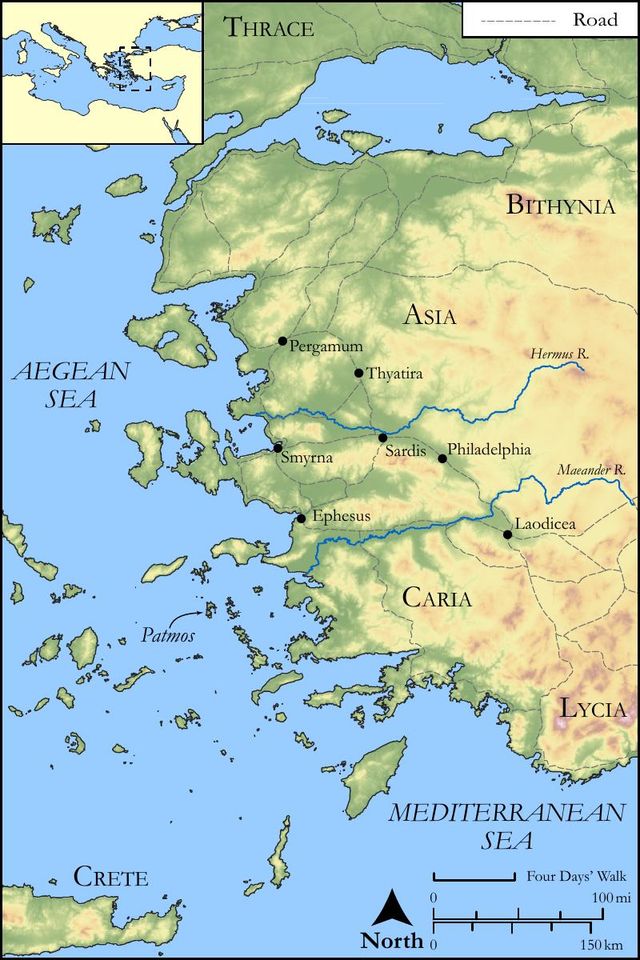
The book of Revelation, written by John during his exile on Patmos, is an apocalyptic prophecy addressed to seven churches in Asia Minor, likely facing persecution. The imagery of destructive cavalry and elements like fire, smoke, and brimstone would have resonated with both Roman military power (though here supernaturalized) and Old Testament narratives of divine judgment. The "fire and brimstone" motif, for instance, immediately recalls the destruction of Sodom and Gomorrah in Genesis 19:24, symbolizing God's fierce wrath against sin. The concept of a "third part" being affected is a recurring motif in Revelation's judgments (e.g., Revelation 8:7-12), signifying severe, widespread judgment, yet not total annihilation, leaving a remnant for potential repentance.
Key Themes
ShowHideThis verse powerfully contributes to several overarching themes in Revelation and biblical theology. Foremost is the theme of Divine Judgment and Wrath, emphasizing God's active and righteous response to human sin and rebellion. The severity of the plague underscores the Consequences of Unrepentance, as humanity, despite experiencing such horrific devastation, remains stubbornly defiant, as highlighted in Revelation 9:20-21. The supernatural origin of the destruction points to Supernatural Warfare and Demonic Agency, indicating that these are not merely human conflicts but divinely orchestrated events involving spiritual forces. Ultimately, even amidst chaos and destruction, the passage reinforces the Sovereignty of God, who remains in control, orchestrating events according to His ultimate plan for history and redemption.
Exposition and Analysis
ShowHideKey Word Analysis
ShowHideMeaning "to kill outright; figuratively, to destroy." In this context, it signifies a literal and decisive termination of life. The passive voice ("was killed") emphasizes that humanity is the recipient of this destructive force, highlighting the overwhelming power of the judgment.
Meaning "sulphur." This word carries strong Old Testament connotations, particularly from the account of Sodom and Gomorrah, where God rained "fire and brimstone" (Genesis 19:24). Its inclusion here immediately evokes divine, purifying judgment and destructive wrath.
Meaning "to depart, be discharged, proceed, project." This verb describes the origin and forceful emission of the destructive elements ("fire, smoke, and brimstone") from the mouths of the demonic horses. It emphasizes the direct and intentional nature of the attack, making the horses the immediate agents of this specific plague.
Verse Breakdown
ShowHide"By these three was the third part of men killed"
This clause identifies the agents of death ("these three" referring to fire, smoke, and brimstone) and quantifies the scale of the judgment. "The third part of men" indicates a staggering, global catastrophe, where a significant, yet not total, portion of the world's population perishes. This partial judgment serves as a severe warning, leaving a remnant to witness God's power and perhaps repent.
"by the fire, and by the smoke, and by the brimstone"
This specifies the exact instruments of destruction. These elements are not merely natural disasters but supernaturally empowered agents of divine wrath. The repetition of "by the" (G1537, hypó) emphasizes the direct agency of these three distinct, yet coordinated, forces.
"which issued out of their mouths"
This final phrase clarifies the source of the destructive elements. "Their mouths" refers to the demonic horses described in the preceding verses, highlighting the terrifying, unnatural, and demonic origin of this plague. It underscores that this is not conventional warfare but a supernatural outpouring of judgment.
Literary Devices
ShowHideRevelation 9:18 employs several potent literary devices to convey its message. Symbolism is paramount, with "fire, smoke, and brimstone" serving as powerful symbols of divine wrath, judgment, and the destructive consequences of sin, drawing heavily on Old Testament imagery (e.g., the destruction of Sodom and Gomorrah). The "third part of men killed" is also symbolic, representing a massive, catastrophic loss of life that is widespread but not utterly annihilating, signifying a severe yet partial judgment. The horses themselves are symbolic of demonic power and the instruments of God's judgment. The vivid and terrifying imagery used throughout the description of the demonic cavalry and their destructive output aims to evoke a sense of horror and awe at the magnitude of God's power and the severity of His judgment. Furthermore, the passage contains strong allusion to Old Testament accounts of divine retribution, reinforcing the continuity of God's character and His consistent response to human rebellion.
Theological and Thematic Connections
ShowHideRevelation 9:18 stands as a stark reminder of God's unwavering justice and the dire consequences of persistent human rebellion. It underscores that God is not merely a loving Father but also a righteous Judge who will, in His appointed time, execute wrath upon sin. The scale of the judgment—a third of humanity—reveals the gravity of human unrepentance and the depth of God's righteous anger. This verse challenges any notion of a passive deity, affirming God's active involvement in the unfolding of history and His sovereign control over even the most terrifying events. It serves as a profound call to take sin seriously and to recognize the urgency of turning to God before such judgments are fully unleashed.
Reflection and Application
ShowHideRevelation 9:18, while depicting a future apocalyptic event, carries profound implications for our present lives. It compels us to confront the reality of divine judgment and the holiness of God, who cannot tolerate sin indefinitely. This passage should cultivate a healthy fear of the Lord, not a paralyzing dread, but a reverent awe that leads to obedience and a desire to live in accordance with His will. The unrepentance of humanity in the face of such overwhelming devastation serves as a sobering warning: suffering alone does not guarantee a change of heart. True repentance is a gift of God, and this verse should stir within us a deep compassion for those who remain spiritually blind and an urgent desire to share the good news of salvation. It reminds us that our hope is not in escaping suffering, but in being found in Christ, who delivers us from the wrath to come.
Questions for Reflection
ShowHideFAQ
ShowHideIs the "third part of men" a literal number, or is it symbolic?
ShowHideWhile some interpreters take the number literally, many scholars view the numbers in Revelation, particularly "one-third," as symbolic. In apocalyptic literature, numbers often convey qualitative rather than strictly quantitative meaning. "One-third" signifies a massive, devastating loss of life that is widespread and catastrophic, yet not total annihilation. It emphasizes the severity of God's judgment, indicating a significant portion of humanity will perish, but also implies that a remnant remains, providing a stark warning and a final opportunity for repentance before the ultimate consummation of judgment.
What is the significance of "fire, smoke, and brimstone" in this verse?
ShowHideThe imagery of "fire, smoke, and brimstone" is deeply rooted in Old Testament narratives of divine judgment. Most notably, it recalls God's destruction of Sodom and Gomorrah in Genesis 19:24, where these elements symbolized God's righteous wrath against profound wickedness. In Revelation 9:18, these elements signify the terrifying and purifying nature of God's judgment against a rebellious world. They are instruments of divine wrath, highlighting the supernatural and inescapable consequences of persistent sin and unrepentance, often associated with the very essence of hell itself (Revelation 14:10-11).
Are these judgments described in Revelation 9 literal events, or are they purely symbolic?
ShowHideThe interpretation of Revelation's judgments, including those in Revelation 9, varies widely among scholars. Some hold a futurist view, believing these describe literal events that will occur before Christ's second coming. Others see them as symbolic representations of spiritual realities, historical events, or ongoing principles of divine judgment throughout history. Regardless of whether one interprets the details as literal or symbolic, the core theological message remains consistent: God is sovereign, sin has severe consequences, and divine judgment is a reality. The vivid imagery serves to convey the terrifying nature and devastating impact of God's righteous wrath against human rebellion and unrepentance.
Christ-Centered Fulfillment
ShowHideWhile Revelation 9:18 vividly portrays the terrifying reality of God's wrath against a sinful world, its ultimate Christ-centered fulfillment is found not in the judgment itself, but in the provision of salvation from that judgment through Jesus Christ. The "fire, smoke, and brimstone" speak to the righteous anger of God that humanity deserves due to its rebellion. However, the good news of the Gospel is that God, in His infinite love, sent His Son, Jesus, to bear this very wrath on the cross. Romans 5:9 declares that "having now been justified by His blood, we shall be saved from wrath through Him." Christ became the ultimate substitute, taking upon Himself the judgment due to humanity, so that those who believe in Him might be spared from the consuming fire of God's justice. He is the Lamb of God who takes away the sin of the world, and His atoning sacrifice is the only means by which humanity can escape the terrifying judgments described in Revelation. Thus, even in the midst of prophecies of destruction, the cross of Christ stands as the ultimate demonstration of God's love and the sole refuge from the wrath to come.