


Acts 11:4
Bible text: King James Version (1769 Blayney text) · Public domain
Bible text: Berean Standard Bible · Public domain
Bible text: American Standard Version (1901) · Public domain
Bible text: World English Bible, Messianic edition · Public domain
Bible text: Geneva Bible (1599) · Public domain
Bible text: Young's Literal Translation · Public domain
- ἀρξάμενοςarxamenoshaving begunG757V-AMP-NSMVerb Aorist Middle Participle Nominative Singular Masculine
- δὲdenowG1161CONJConjunction
- ὁho<the>G3588T-NSMDefinite article Nominative Singular Masculine
- ΠέτροςPetrosPeterG4074N-NSM-PNoun Nominative Singular Masculine Individual
- ἐξετίθετοexetithetohe was explaining [it]G1620V-IMI-3SVerb Imperfect Middle Indicative 3rd Singular
- αὐτοῖςautoisto themG846P-DPMPersonal pronoun Dative Plural Masculine
- καθεξῆςkathexēsin orderG2517ADVAdverb
- λέγων·legōnsayingG3004V-PAP-NSMVerb Present Active Participle Nominative Singular Masculine
English is a literal word-by-word gloss of the Greek, not the KJV's wording. Why?
This is the original text the KJV's translators worked from — each Greek word with its own literal English meaning in this verse, prepared by scholars at Tyndale House, Cambridge. The KJV translates whole sentences, not word by word, so its wording differs: one Greek word can become several English words, and the KJV may choose “charity” where the gloss reads “love”. Both are faithful — they answer different questions. For the KJV's own rendering, switch to the KJV text.
Details
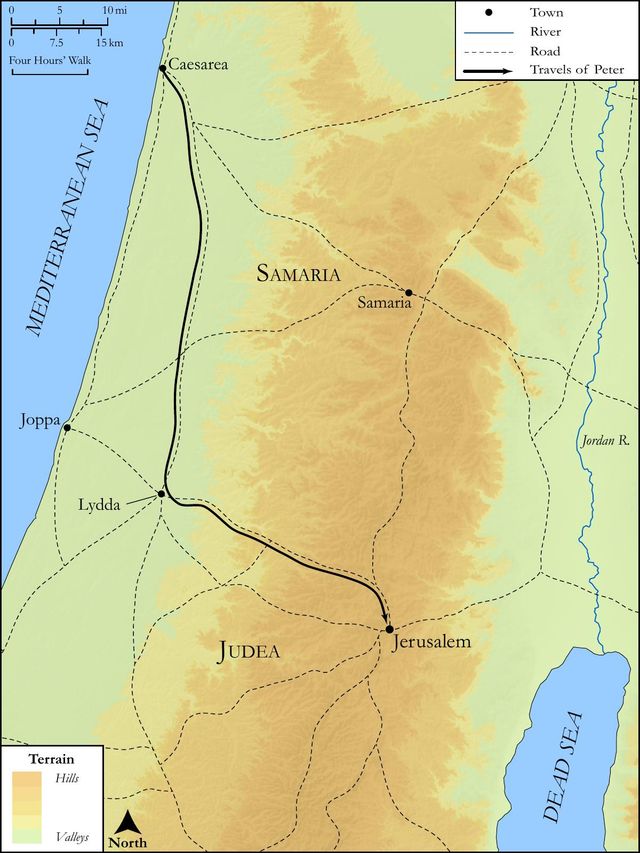
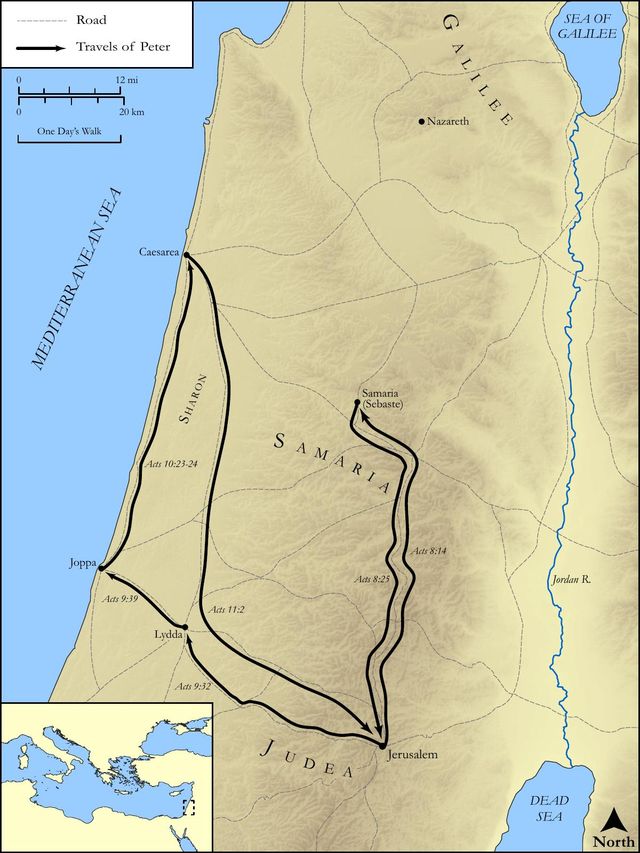
See on the biblical-era maps
Study this verse
Public-domain commentary
Matthew Henry
From his Commentary on the Whole Bible. Henry comments on passages, not single verses — this entry covers Acts 11:1–18. His four-level outline is real structure in the source text, so it is rendered as structure.
The preaching of the gospel to Cornelius was a thing which we poor sinners of the Gentiles have reason to reflect upon with a great deal of joy and thankfulness; for it was the bringing of light to us who sat in darkness. Now it being so great a surprize to the believing as well as the unbelieving Jews, it is worth while to enquire how it was received, and what comments were made upon it. And here we find,
I.Intelligence was presently brought of it to the church in Jerusalem, and thereabouts; for Cesarea was not so far from Jerusalem but that they might presently hear of it. Some for good-will, and some for ill-will, would spread the report of it; so that before he himself had returned to Jerusalem the apostles and the brethren there and in Judea heard that the Gentiles also had received the word of God, that is, the gospel of Christ, which is not only a word of God, but the word of God; for it is the summary and centre of all divine revelation. They received Christ; for his name is called the Word of God, Rev 19:13. Not only that the Jews who were dispersed into the Gentile countries, and the Gentiles who were proselyted to the Jewish religion, but that the Gentiles also themselves, with whom it had hitherto been thought unlawful to hold common conversation, were taken into church-communion, that they had received the word of God. That is,
1.That the word of God was preached to them, which was a greater honour put upon them than they expected. Yet I wonder this should seem strange to those who were themselves commissioned to preach the gospel to every creature. But thus often are the prejudices of pride and bigotry held fast against the clearest discoveries of divine truth.
2.That it was entertained and submitted to by them, which was a better work wrought upon them than they expected. It is likely they had got a notion that if the gospel were preached to the Gentiles it would be to no purpose, because the proofs of the gospel were fetched so much out of the Old Testament, which the Gentiles did not receive: they looked upon them as not inclined to religion, nor likely to receive the impressions of it; and therefore were surprized to hear that they had received the word of the Lord. Note, We are too apt to despair of doing good to those who yet, when they are tried, prove very tractable.
II.That offence was taken at it by the believing Jews (Act 11:2, Act 11:3):
When Peter had himself come up to Jerusalem, those that were of the circumcision, those Jewish converts that still retained a veneration for circumcision, contended with him. They charged it upon him as a crime that he went in to men uncircumcised, and did eat with them; and thereby they think he has stained, if not forfeited, the honour of his apostleship, and ought to come under the censure of the church: so far were they from looking upon him as infallible, or as the supreme head of the church that all were accountable to, and he to none. See here,
1.How much it is the bane and damage of the church, to monopolize it, and to exclude those from it, and from the benefit of the means of grace, that are not in every thing as we are. There are narrow souls that are for engrossing the riches of the church, as there are that would engross the riches of the world, and would be placed alone in the midst of the earth. These men were of Jonah's mind, who, in a jealousy for his people, was angry that the Ninevites received the word of God, and justified himself in it.
2.Christ's ministers must not think it strange if they be censured and quarrelled with, not only by their professed enemies, but by their professing friends; not only for their follies and infirmities, but for their good actions seasonably and well done; but, if we have proved our own work, we may have rejoicing in ourselves, as Peter had, whatever reflections we may have from our brethren. Those that are zealous and courageous in the service of Christ must expect to be censured by those who, under pretence of being cautious, are cold and indifferent. Those who are of catholic, generous, charitable principles, must expect to be censured by such as are conceited and strait-laced, who say, Stand by thyself, I am holier than thou.
III.Peter gave such a full and fair account of the matter of fact as was sufficient, without any further argument or apology, both to justify him, and to satisfy them (Act 11:4): He rehearsed the matter from the beginning, and laid it before them in order, and then could appeal to themselves whether he had done amiss; for it appeared all along God's own work, and not his.
1.He takes it for granted that if they had rightly understood how the matter was they would not have contended with him, and commended him. And it is a good reason why we should be moderate in our censures, and sparing of them, because if we rightly understood that which we are so forward to run down perhaps we should see cause to run in with it. When we see others do that which looks suspicious, instead of contending with them, we should enquire of them what ground they went upon; and, if we have not an opportunity to do that, should ourselves put the best construction upon it that it will bear, and judge nothing before the time.
2.He is very willing to stand right in their opinion, and takes pains to give them satisfaction. He does not insist upon his being the chief of the apostles, for he was far from the thought of that supremacy which his pretended successors claim. Nor does he think it enough to tell them that he is satisfied himself in the grounds he went upon, and they need not trouble themselves about it; but he is ready to give a reason of the hope that is in him concerning the Gentiles, and why he had receded from his former sentiments, which were the same with theirs. It is a debt we owe both to ourselves and to our brethren to set those actions of ours in a true light which at first looked ill and gave offence, that we may remove stumbling-blocks out of our brethren's way. Let us now see what Peter pleads in his own defence.
(1.)That he was instructed by a vision no longer to keep up the distinctions which were made by the ceremonial law; he relates the vision (Act 11:5, Act 11:6), as we had it before Act 10:9, etc. The sheet which was there said to be let down to the earth he here says came even to him, which circumstance intimates that it was particularly designed for instruction to him. We should thus see all God's discoveries of himself, which he has made to the children of men, coming even to us, applying them by faith to ourselves. Another circumstance here added is that when the sheet came to him he fastened his eyes upon it, and considered it, Act 11:6. If we would be led into the knowledge of divine things, we must fix our minds upon them, and consider them. He tells them what orders he had to eat of all sorts of meat without distinction, asking no questions for conscience' sake, Act 11:7. It was not till after the flood (as it should seem) that man was allowed to eat flesh at all, Gen 9:3. That allowance was afterwards limited by the ceremonial law; but now the restrictions were taken off, and the matter set at large again. It was not the design of Christ to abridge us in the use of our creature-comforts by any other law than that of sobriety and temperance, and preferring the meat that endures to eternal life before that which perishes. He pleads that he was as averse to the thoughts of conversing with Gentiles, or eating of their dainties, as they could be, and therefore refused the liberty given him: Not so, Lord; for nothing common or unclean has at any time entered into my mouth, Act 11:8. But he was told from heaven that the case was now altered, that God had cleansed those persons and things which were before polluted; and therefore that he must no longer call them common, nor look upon them as unfit to be meddled with by the peculiar people (Act 11:9); so that he was not to be blamed for changing his thoughts, when God had changed the thing. In things of this nature we must act according to our present light; yet must not be so wedded to our opinion concerning them as to be prejudiced against further discoveries, when the matter may either be otherwise or appear otherwise; and God may reveal even this unto us, Phi 3:15. And, that they might be sure he was not deceived in it, he tells them it was done three times (Act 11:10), the same command given, to kill and eat, and the same reason, because that which God hath cleansed is not to be called common, repeated a second and third time. And, further to confirm him that it was a divine vision, the things he saw did not vanish away into the air, but were drawn up again into heaven, whence they were let down.
(2.)That he was particularly directed by the Spirit to go along with the messengers that Cornelius sent. And, that it might appear that the vision was designed to satisfy him in this matter, he observes to them the time when the messengers came - immediately after he had that vision; yet, lest this should not be sufficient to clear his way, the Spirit bade him go with the men that were then sent from Cesarea to him, nothing doubting (Act 11:11, Act 11:12); though they were Gentiles he went to, and went with, yet he must make no scruple of going along with them.
(3.)That he took some of his brethren along with him, who were of the circumcision, that they might be satisfied as well as he; and these he had brought up from Joppa, to witness for him with what caution he proceeded, forseeing the offence that would be taken at it. He did not act separately, but with advice; not rashly, but upon due deliberation.
(4.)That Cornelius had a vision too, by which he was directed to send for Peter (Act 11:13): He showed us how he had seen a angel in his house, that bade him send to Joppa for one Simon, whose surname is Peter. See how good it is for those that have communion with God, and keep up a correspondence with heaven, to compare notes, and communicate their experiences to each other; for hereby they may strengthen one another's faith: Peter is the more confirmed in the truth of his vision by Cornelius's, and Cornelius by Peter's. Here is something added in what the angel said to Cornelius; before it was, Send for Peter, and he shall speak to thee, he shall tell thee what thou oughtest to do (Act 10:6, Act 10:32); but here it is, "He shall tell thee words whereby thou and thy house shall be saved (Act 11:14), and therefore it is of vast concern to thee, and will be of unspeakable advantage, to send for him." Note,
[1.]The words of the gospel are words whereby we may be saved, eternally saved; not merely by hearing them and reading them, but by believing and obeying them. They set the salvation before us, and show us what it is; they open the way of salvation to us, and, if we follow the method prescribed us by them, we shall certainly be saved from wrath and the curse, and be for ever happy.
[2.]Those that embrace the gospel of Christ will have salvation brought by it to their families: "Thou and all thy house shall be saved; thou and thy children shall be taken into covenant, and have the means of salvation; thy house shall be as welcome to the benefit of the salvation, upon their believing, as thou thyself, even the meanest servant thou hast. This day is salvation come to this house," Luk 19:9. Hitherto salvation was of the Jews (Joh 4:22), but now salvation is brought to the Gentiles as much as ever it was with the Jews; the promises, privileges, and means of it are conveyed to all nations as amply and fully, to all intents and purposes, as ever it had been appropriated to the Jewish nation.
(5.)That which put the matter past all dispute was the descent of the Holy Ghost upon the Gentile hearers; this completed the evidence that it was the will of God that he should take the Gentiles into communion.
[1.]The fact was plain and undeniable (Act 11:15): "As I began to speak" (and perhaps he felt some secret reluctance in his own breast, doubting whether he was in the right to preach to the uncircumcised), "presently the Holy Ghost fell on them in as visible signs as on us at the beginning, in which there could be no fallacy." Thus God attested what was done, and declared his approbation of it; that preaching is certainly right with which the Holy Ghost is given. The apostle supposes this, when he thus argues with the Galatians: Received you the Spirit by the works of the law, or by the hearing of faith? Gal 3:2.
[2.]Peter was hereby put in mind of a saying of his Master's, when he was leaving them (Act 1:5): John baptized with water; but you shall be baptized with the Holy Ghost, Act 11:16. This plainly intimated, First, that the Holy Ghost was the gift of Christ, and the product and performance of his promise, that great promise which he left with them when he went to heaven. It was therefore without doubt from him that this gift came; and the filling of them with the Holy Ghost was his act and deed. As it was promised by his mouth, so it was performed by his hand, and was a token of his favour. Secondly, That the gift of the Holy Ghost was a kind of baptism. Those that received it were baptized with it in a more excellent manner than any of those that even the Baptist himself baptized with water.
[3.]Comparing that promise, so worded, with this gift just now conferred, when the question was started, whether these persons should be baptized or no, he concluded that the question was determined by Christ himself (Act 11:17): "Forasmuch then as God gave them the like gift as he did to us - gave it to us as believing in the Lord Jesus Christ, and to them upon their believing in him - What was I, that I could withstand God? Could I refuse to baptize them with water, whom God had baptized with the Holy Ghost? Could I deny the sign to those on whom he had conferred the thing signified? But, as for me, who was I? What! able to forbid God? Did it become me to control the divine will, or to oppose the counsels of Heaven?" Note, Those who hinder the conversion of souls withstand God; and those take too much upon them who contrive how to exclude from their communion those whom God has taken into communion with himself.
IV.This account which Peter gave of the matter satisfied them, and all was well.
Thus, when the two tribes and a half gave an account to Phinehas and the princes of Israel of the true intent and meaning of their building themselves an altar on the banks of Jordan, the controversy was dropped, and it pleased them that it was so, Jos 22:30. Some people, when they have fastened a censure upon a person, will stick to it, though afterwards it appear ever so plainly to be unjust and groundless. It was not so here; for these brethren, though they were of the circumcision, and their bias went the other way, yet, when they heard this,
1.They let fall their censures: they held their peace, and said no more against what Peter had done; they laid their hand upon their mouth, because now they perceived that God did it. Now those who prided themselves in their dignities as Jews began to see that God was staining their pride, by letting in the Gentiles to share, and to share equally, with them. And now that prophecy was fulfilled, Thou shalt no more be haughty because of my holy mountain, Zep 3:11.
2.They turned them into praises. They not only held their peace from quarrelling with Peter, but opened their mouths to glorify God for what he had done by and with Peter's ministry; they were thankful that their mistake was rectified, and that God had shown more mercy to the poor Gentiles than they were inclined to show them, saying, Then hath God also to the Gentiles granted repentance unto life! He hath granted them not only the means of repentance, in opening a door of entrance for his ministers among them, but the grace of repentance, in having given them his Holy Spirit, who, wherever he comes to be a Comforter, first convinces, and gives a sight of sin and sorrow for it, and then a sight of Christ and joy in him. Note,
(1.)Repentance, if it be true, is unto life. It is to spiritual life; all that truly repent of their sins evidence it by living a new life, a holy, heavenly, and divine life. Those that by repentance die unto sin thenceforward live unto God; and then, and not till then, we begin to live indeed, and it shall be to eternal life. All true penitents shall live, that is, they shall be restored to the favour of God, which is life, which is better than life; they shall be comforted with the assurance of the pardon of their sins, and shall have the earnest of eternal life, and at length the fruition of it.
(2.)Repentance is God's gift; it is not only his free grace that accepts it, but his mighty grace that works it in us, that takes away the heart of stone, and gives us a heart of flesh. The sacrifice of God is a broken spirit; it is he that provides himself this lamb.
(3.)Wherever God designs to give life he gives repentance; for this is a necessary preparative for the comforts of a sealed pardon and a settled peace in this world, and for the seeing and enjoying of God in the other world.
(4.)It is a great comfort to us that God has exalted his Son Jesus, not only to give repentance to Israel, and the remission of sins (Act 5:31), but to the Gentiles also.
Historical interpretation
Historical reception
3 surviving comments on this verse. Each one is dated, so this reads as a timeline rather than a list.
But not so does Peter frame his defence: for he was wise, or rather it was not his wisdom, but the Spirit that spake the words. And by the matter of his defence, he shows that in no one point was he the author, but in every point God, and upon Him he casts the whole. "The trance," he says - "it was He that caused me to fall into it, for 'I was in Joppa,' etc.: the vessel - it was He that showed it; I objected: again, He spake, and even then I did not hear: the Spirit commanded me to go, and even then though I went, I did not run: I told that God had sent me, and after these things, even then I did not baptize, but again God did the whole. God baptized them, not I."
The words were not those of the prudent Peter but of the Spirit. And in his defense he showed God as the absolute author and himself as the author of nothing. He said what he did in his ecstasy, “I was in the city of Joppa, and he showed the vessel, as I have said before; and again he said and I did not hear. The Spirit ordered me to leave, and so, after leaving, I did not run. I said that God had sent me, and so I did not baptize after these things, but again God did everything. God himself baptized, not I.”
Observe his freedom from all elation and vainglory. For it says, "But Peter rehearsed the matter from the beginning, and expounded it by order unto them, saying, I was in the city of Joppa, praying:" he does not say why, nor on what occasion: "and in a trance I saw a vision, a certain vessel descend, as it had been a great sheet, let down from heaven by four corners; and it came even to me: upon the which when I had fastened mine eyes, I considered, and saw fourfooted beasts of the earth, and wild beasts, and creeping things, and fowls of the air. And I heard a voice saying unto me, Arise, Peter; slay and eat." As much as to say, This of itself was enough to have persuaded me - my having seen the linen sheet: but moreover a Voice was added. "But I said, Not so, Lord: for nothing common or unclean hath at any time entered into my mouth." Do you mark? "I did my part," says he: "I said, that I have never eaten aught common or unclean:" with reference to this that they said, "Thou wentest in, and didst eat with them." But this he does not say to Cornelius: for there was no need to mention it to him. "But the voice answered me again from heaven, What God hath cleansed, that call not thou common. And this was done three times: and all were drawn up again into heaven."
Continue studying Acts 11:4 across the web’s major study libraries — every link below opens this exact verse, chapter, or book on the destination site.
Read & Compare
 BibleGatewayThis verse in more than 200 translations and 70 languages.
 Bible.comThe YouVersion reader — hundreds of translations, reading plans, and highlights.
 ESV.orgCrossway's official English Standard Version reader.
 NET BibleThe NET translation with 60,000+ translators' notes on every rendering decision.
 STEP BibleTyndale House's free study tool — original text, vocabulary, and scholarly resources.
 BibliaLogos Bible Software's free web reader.
 USCCBThe New American Bible (Revised Edition) with the U.S. bishops' study notes.
Commentaries
 BibleHub CommentariesDozens of classic commentaries on this verse, gathered on one page.
 StudyLightMore than 100 commentary sets — the largest collection on the web.
 BibleRefPlain-English commentary on what this verse means, verse by verse.
 Enduring WordDavid Guzik's free commentary on this chapter, widely used by Bible teachers.
 Bible Study ToolsVerse commentary alongside Greek and Hebrew study aids.
Original Language & Research
- BibleHub InterlinearThe verse word by word — original language, transliteration, and English.
- BibleHub LexiconEvery word's original-language definition and Strong's entry.
 Blue Letter BibleDeep-study tools — Strong's numbers, concordance, and word studies.
 CNTR CollationThe earliest Greek manuscripts of this verse, collated letter by letter.
Sermons, Hymns & Audio


TrulyRandomVerse is not affiliated with these sites and doesn’t control their content. They’re linked because they’re genuinely useful.
Summary
Acts 11:4 captures a pivotal moment in the early church's expansion, as Peter, upon returning to Jerusalem, faces intense scrutiny from Jewish believers concerning his unprecedented interaction with uncircumcised Gentiles. This verse sets the stage for his detailed and systematic defense, where he meticulously recounts the divine orchestrations that led him to the household of Cornelius, thereby justifying the inclusion of Gentiles into the nascent Christian community and paving the way for the Gospel's universal reach.
Context
ShowHideLiterary Context
Acts 11:4 immediately follows the challenging confrontation Peter faces from "those of the circumcision party" in Jerusalem, who are critical of his actions (see Acts 11:2-3). This verse initiates Peter's comprehensive explanation, which serves as a recapitulation of the events detailed in Acts 10. His narrative begins with his transformative vision in Joppa (Acts 10:9-16), continues through the divine summons to Caesarea, and culminates in the undeniable outpouring of the Holy Spirit on Gentiles (Acts 10:44-48). Peter's methodical recounting is crucial for the Jerusalem church to understand and accept this radical shift in God's redemptive plan.
Historical & Cultural Context
The early church was predominantly Jewish, deeply rooted in the traditions of the Mosaic Law, including strict dietary laws and prohibitions against associating with Gentiles, especially entering their homes or eating with them. The "circumcision party" represented a significant faction of Jewish Christians who believed that Gentile converts must fully adhere to Jewish customs, including circumcision, to be part of God's people. Peter's actions directly challenged these deeply ingrained cultural and religious boundaries. His return to Jerusalem, the spiritual and administrative center of early Christianity, meant he had to account for his actions to the established leadership and community, highlighting the nascent church's struggle to reconcile its Jewish heritage with the universal implications of the Gospel.
Key Themes
ShowHideThis verse and the subsequent narrative contribute significantly to several key themes within Acts and the broader New Testament. Firstly, it underscores Apostolic Accountability, demonstrating that even a leading apostle like Peter was subject to the scrutiny and questioning of the church community, highlighting the importance of transparency and communal discernment in leadership. Secondly, it powerfully illustrates Divine Mandate, as Peter's meticulous explanation clarifies that his actions were not based on personal whim or a disregard for Jewish law, but were direct responses to God's explicit commands and miraculous signs, emphasizing that the expansion to Gentiles was God's initiative. Finally, and most profoundly, it is foundational to the theme of the Inclusion of Gentiles into the body of Christ, setting a precedent that salvation in Christ is for all people, regardless of ethnic background or prior religious practice, a truth that would later be formally affirmed at the Jerusalem Council.
Exposition and Analysis
ShowHideKey Word Analysis
ShowHideThis word, meaning "to commence" or "to begin," indicates that Peter started his account from the very beginning of the sequence of events. It implies a chronological and foundational starting point for his explanation, ensuring that his audience understood the entire divine process that led to his actions.
Derived from "to expose" or "to set out," this term means "to declare" or "to explain." It signifies Peter's intention to lay out the facts clearly and thoroughly, to make plain what had transpired, and to provide a comprehensive and persuasive explanation of his conduct.
Meaning "consecutively" or "in order," this adverb emphasizes the systematic and sequential nature of Peter's presentation. He did not offer a haphazard defense but a well-structured, logical recounting of events, designed to build a compelling case for the divine origin of his actions and the inclusion of Gentiles.
Verse Breakdown
ShowHide"But Peter rehearsed [the matter] from the beginning"
This clause highlights Peter's immediate and proactive response to the criticism. The conjunction "But" (G1161, dé) signals a contrast to the accusations, indicating Peter's shift from being questioned to providing a defense. He chose to start his account from the very first divine instruction he received, ensuring a full and foundational understanding for his audience.
"and expounded [it] by order unto them"
This phrase describes the methodical and persuasive nature of Peter's explanation. He didn't just recount; he "expounded," meaning he clarified and interpreted the events, and he did so "by order," indicating a logical, step-by-step presentation. This systematic approach aimed to leave no room for doubt about the divine guidance behind his actions.
"saying"
This simple word introduces Peter's direct speech, signaling the commencement of his detailed testimony. It sets the stage for the narrative that follows in Acts 11:5-17, where Peter articulates the visions, commands, and miraculous outpouring of the Holy Spirit that led him to embrace the Gentiles.
Literary Devices
ShowHideThe verse employs several significant literary devices. Narrative Framing is evident as Peter's speech serves to re-present the events of Acts 10 from his perspective, framing them for a new, skeptical audience in Jerusalem. This functions as an Apologia or a formal defense speech, where Peter systematically justifies his actions against the accusations. Furthermore, the act of Peter "rehearsing" and "expounding by order" demonstrates Recapitulation, where previously narrated events are retold, not merely for repetition, but for rhetorical effect—to persuade, clarify, and establish the divine authority behind his actions for those who were not privy to the initial events. This structured recounting underscores the divine legitimacy of the Gentile mission.
Theological and Thematic Connections
ShowHideActs 11:4 is profoundly significant as it marks a critical juncture in the theological understanding of the early church regarding God's inclusive plan for salvation. Peter's willingness to submit to accountability and meticulously explain his actions underscores the principle that God's new work often challenges established traditions and requires humble discernment. His testimony, rooted in undeniable divine encounters and the outpouring of the Holy Spirit, serves to dismantle deeply ingrained prejudices and expand the theological boundaries of who constitutes God's people. This moment affirms that God shows no partiality, and salvation through Christ is a gift extended to all who believe, regardless of their ethnic or religious background, thereby fulfilling the universal scope of the Abrahamic covenant.
Reflection and Application
ShowHideActs 11:4 offers timeless lessons for believers and the church today, particularly concerning leadership, unity, and openness to God's transformative work. Peter, despite his apostolic authority, humbly submits to the scrutiny of the Jerusalem church, modeling a profound commitment to accountability and transparency within the body of Christ. This willingness to explain, rather than demand acceptance, fosters an environment of understanding and trust, even amidst significant theological and cultural disagreements. For us, this highlights the importance of patient communication and seeking to understand differing perspectives when conflicts arise, prioritizing unity over personal conviction. Moreover, Peter's experience challenges us to remain open to God's Spirit leading us beyond our comfort zones and traditional understandings. Just as the early church had to grapple with deeply ingrained prejudices regarding the inclusion of Gentiles, we too must be willing to re-examine our own preconceptions and biases, ensuring that our communities truly reflect the boundless love and inclusive nature of God's kingdom.
Questions for Reflection
ShowHideFAQ
ShowHideWhy was Peter questioned by the Jerusalem church?
ShowHidePeter was questioned by the Jerusalem church, specifically "those of the circumcision party," because he had entered the home of an uncircumcised Gentile, Cornelius, and eaten with him. This was a significant violation of deeply ingrained Jewish customs and purity laws, which prohibited such close association with non-Jews. For many Jewish believers, this action seemed to contradict the Mosaic Law and challenged their understanding of how Gentiles could be included in God's covenant people. They believed that Gentiles first needed to become proselytes to Judaism, including circumcision, before being accepted into the Christian community (see Acts 11:2-3).
What was the significance of Peter's "rehearsal from the beginning" and "expounding by order"?
ShowHideThe significance lies in Peter's methodical and transparent approach to addressing the accusations. By "rehearsing from the beginning," he ensured that his audience understood the entire sequence of divine interventions—from his vision in Joppa to the Holy Spirit's outpouring on Cornelius's household—demonstrating that his actions were not arbitrary but divinely mandated. "Expounding by order" emphasizes the systematic and logical presentation of events, leaving no room for doubt about the clear instructions and miraculous confirmations he received from God. This detailed, step-by-step testimony was crucial for overcoming the deep-seated prejudices of the Jewish believers and convincing them of God's explicit will for Gentile inclusion, as fully detailed in Acts 10.
Christ-Centered Fulfillment
ShowHideActs 11:4, with Peter's methodical defense of his actions, powerfully illustrates the Christ-centered fulfillment of God's redemptive plan. Peter's encounter with Cornelius and the subsequent outpouring of the Spirit on Gentiles are not random events but direct outworkings of Christ's mission and the new covenant He inaugurated. Jesus Himself consistently broke down social and religious barriers during His earthly ministry, reaching out to overlooked groups like Zacchaeus (Luke 19:1-10) and the Samaritan woman (John 4:7-42), foreshadowing the universal scope of the Gospel. His Great Commission explicitly commanded His disciples to "make disciples of all nations" (Matthew 28:18-20), and He promised the Holy Spirit would empower them to be His witnesses "to the ends of the earth" (Acts 1:8). Peter's testimony, therefore, is the Spirit-empowered actualization of Christ's universal call, demonstrating that through His death and resurrection, Christ has indeed "broken down the dividing wall of hostility" between Jew and Gentile, creating "one new humanity" in Himself (Ephesians 2:14-16). The events Peter recounts are not merely about a change in church policy, but about the glorious unfolding of God's eternal purpose in Christ to redeem people "from every tribe and language and people and nation" (Revelation 5:9).