


Acts 10:18
Bible text: King James Version (1769 Blayney text) · Public domain
Bible text: Berean Standard Bible · Public domain
Bible text: American Standard Version (1901) · Public domain
Bible text: World English Bible, Messianic edition · Public domain
Bible text: Geneva Bible (1599) · Public domain
Bible text: Young's Literal Translation · Public domain
- καὶkaiAndG2532CONJConjunction
- φωνήσαντεςphōnēsanteshaving called outG5455V-AAP-NPMVerb Aorist Active Participle Nominative Plural Masculine
- ἐπυνθάνοντοepunthanontothey were askingG4441V-INI-3PVerb Imperfect Middle Or Passive Deponent Indicative 3rd Plural
- εἰeiifG1487CONDConjunction
- ΣίμωνSimōnSimonG4613N-NSM-PNoun Nominative Singular Masculine Individual
- ὁhowhoG3588T-NSMDefinite article Nominative Singular Masculine
- ἐπικαλούμενοςepikaloumenosis being calledG1941V-PPP-NSMVerb Present Passive Participle Nominative Singular Masculine
- ΠέτροςPetrosPeterG4074N-NSM-PNoun Nominative Singular Masculine Individual
- ἐνθάδεenthadehereG1759ADVAdverb
- ξενίζεταιxenizetaiis lodgedG3579V-PPI-3SVerb Present Passive Indicative 3rd Singular
English is a literal word-by-word gloss of the Greek, not the KJV's wording. Why?
This is the original text the KJV's translators worked from — each Greek word with its own literal English meaning in this verse, prepared by scholars at Tyndale House, Cambridge. The KJV translates whole sentences, not word by word, so its wording differs: one Greek word can become several English words, and the KJV may choose “charity” where the gloss reads “love”. Both are faithful — they answer different questions. For the KJV's own rendering, switch to the KJV text.
Details
See on the biblical-era maps
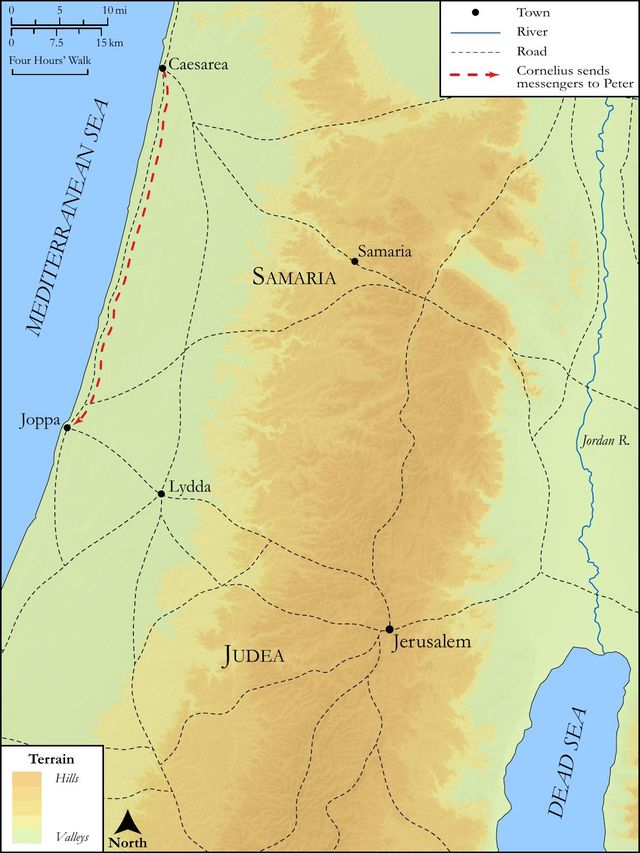
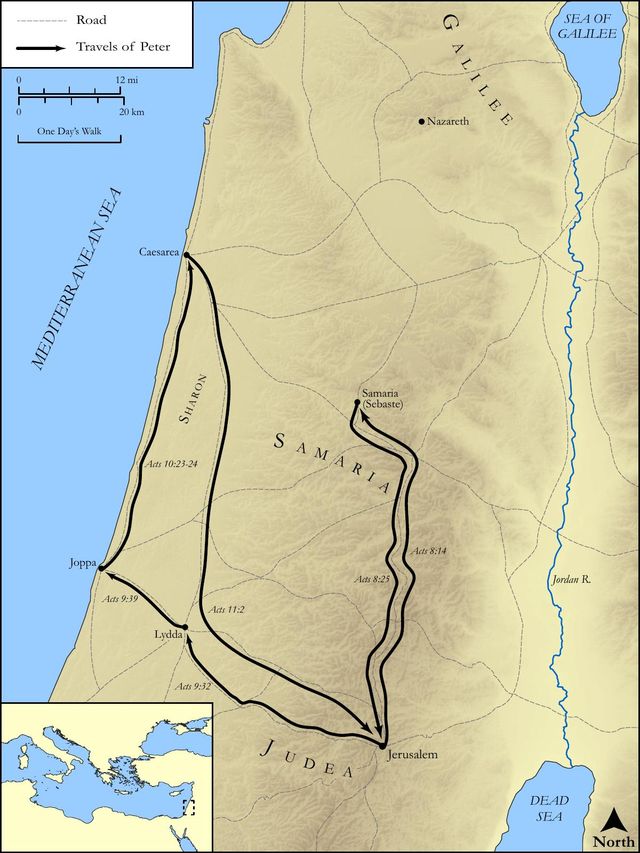
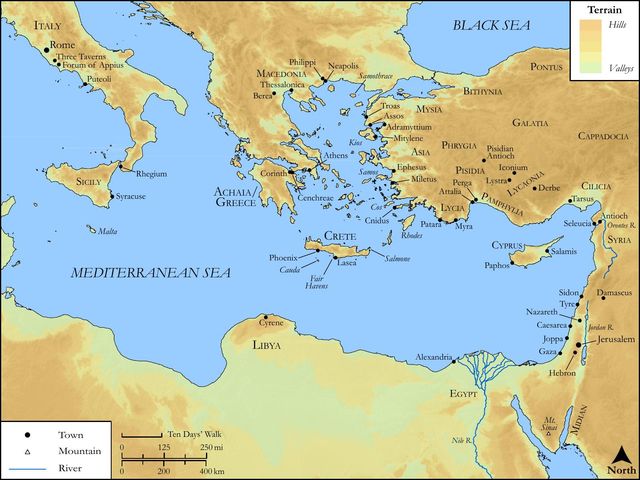
Study this verse
Public-domain commentary
Matthew Henry
From his Commentary on the Whole Bible. Henry comments on passages, not single verses — this entry covers Acts 10:9–18. His three-level outline is real structure in the source text, so it is rendered as structure.
Cornelius had received positive orders from heaven to send for Peter, whom otherwise he had not heard of, or at least not heeded; but here is another difficulty that lies in the way of bringing them together - the question is whether Peter will come to Cornelius when he is sent for; not as if he thought it below him to come at a beck, or as if he were afraid to preach his doctrine to a polite man as Cornelius was: but it sticks at a point of conscience. Cornelius is a very worthy man, and has many good qualities, but he is a Gentile, he is not circumcised; and, because God in his law had forbidden his people to associate with idolatrous nations, they would not keep company with any but those of their own religion, though they were ever so deserving, and they carried the matter so far that they made even the involuntary touch of a Gentile to contract a ceremonial pollution, Joh 18:28. Peter had not got over this stingy bigoted notion of his countrymen, and therefore will be shy of coming to Cornelius. Now, to remove this difficulty, he has a vision here, to prepare him to receive the message sent him by Cornelius, as Ananias had to prepare him to go to Paul. The scriptures of the Old Testament had spoken plainly of the bringing in of the Gentiles into the church. Christ had given plain intimations of it when he ordered them to teach all nations; and yet even Peter himself, who knew so much of his Master's mind, could not understand it, till it was here revealed by vision, that the Gentiles should be fellow-heirs, Eph 3:6. Now here observe,
I.The circumstances of this vision.
1.It was when the messengers sent from Cornelius were now nigh the city, Act 10:9. Peter knew nothing of their approach, and they knew nothing of his praying; but he that knew both him and them was preparing things for the interview, and facilitating the end of their negotiation. To all God's purposes there is a time, a proper time; and he is pleased often to bring things to the minds of his ministers, which they had not thought of, just then when they have occasion to use them.
2.It was when Peter went up upon the house-top to pray, about noon.
(1.)Peter was much in prayer, much in secret prayer, though he had a great deal of public work upon his hands.
(2.)He prayed about the sixth hour, according to David's example, who, not only morning and evening, but at noon, addressed himself to God by prayer, Psa 55:17. From morning to night we should think to be too long to be without meat; yet who thinks it is too long to be without prayer?
(3.)He prayed upon the house-top; thither he retired for privacy, where he could neither hear nor be heard, and so might avoid both distraction and ostentation. There, upon the roof of the house, he had a full view of the heavens, which might assist his pious adoration of the God he prayed to; and there he had also a full view of the city and country, which might assist his pious compassion of the people he prayed for.
(4.)He had this vision immediately after he had prayed, as an answer to his prayer for the spreading of the gospel, and because the ascent of the heart to God in prayer is an excellent preparative to receive the discoveries of the divine grace and favour.
3.It was when he became very hungry, and was waiting for his dinner (Act 10:10); probably he had not that day eaten before, though doubtless he had prayed before; and now he would have eaten, ēthele geusasthai - he would have tasted, which intimates his great moderation and temperance in eating. When he was very hungry, yet he would be content with a little, with a taste, and would not fly upon the spoil. Now this hunger was a proper inlet to the vision about meats, as Christ's hunger in the wilderness was to Satan's temptation to turn stones into bread.
II.The vision itself, which was not so plain as that to Cornelius, but more figurative and enigmatical, to make the deeper impression.
1.He fell into a trance or ecstasy, not of terror, but of contemplation, with which he was so entirely swallowed up as not only not to be regardful, but not to be sensible, of external things. He quite lost himself to this world, and so had his mind entirely free for converse with divine things; as Adam in innocency, when the deep sleep fell upon him. The more clear we get of the world, the more near we get to heaven: whether Peter was now in the body or out of the body he could not himself tell, much less can we, Co2 12:2, Co2 12:3. See Gen 15:12; Act 22:17.
2.He saw heaven opened, that he might be sure that his authority to go to Cornelius was indeed from heaven - that it was a divine light which altered his sentiments, and a divine power which gave him his commission. The opening of the heavens signified the opening of a mystery that had been hid, Rom 16:25.
3.He saw a great sheet full of all manner of living creatures, which descended from heaven, and was let down to him to the earth, that is, to the roof of the house where he now was. Here were not only beasts of the earth, but fowls of the air, which might have flown away, laid at his feet; and not only tame beasts, but wild. Here were no fishes of the sea, because there were none of them in particular unclean, but whatever had fins and scales was allowed to be eaten. Some make this sheet, thus filled, to represent the church of Christ. It comes down from heaven, from heaven opened, not only to send it down (Rev 21:2), but to receive souls sent up from it. It is knit at the four corners, to receive those from all parts of the world that are willing to be added to it; and to retain and keep those safe that are taken into it, that they may not fall out; and in this we find some of all countries, nations, and languages, without any distinction of Greek or Jew, or any disadvantage put upon Barbarian or Scythian, Col 3:11. The net of the gospel encloses all, both bad and good, those that before were clean and unclean. Or it may be applied to the bounty of the divine Providence, which, antecedently to the prohibitions of the ceremonial law, had given to man a liberty to use all the creatures, to which by the cancelling of that law we are now restored. By this vision we are taught to see all the benefit and service we have from the inferior creatures coming down to us from heaven; it is the gift of God who made them, made them fit for us, and then gave to man a right to them, and dominion over them. Lord, what is man that he should be thus magnified! Psa 8:4-8. How should it double our comfort in the creatures, and our obligations to serve God in the use of them, to see them thus let down to us out of heaven!
4.He was ordered by a voice from heaven to make use of this plenty and variety which God had sent him (Act 10:13): "Rise, Peter, kill and eat: without putting any difference between clean and unclean, take which thou hast most mind to." The distinction of meats which the law made was intended to put a difference between Jew and Gentile, that it might be difficult to them to dine and sup with a Gentile, because they would have that set before them which they were not allowed to eat; and now the taking off of that prohibition was a plain allowance to converse with the Gentiles, and to be free and familiar with them. Now they might fare as they fared, and therefore might eat with them, and be fellow-commoners with them.
5.He stuck to his principles, and would by no means hearken to the motion, though he was hungry (Act 10:14): Not so, Lord. Though hunger will break through stone walls, God's laws should be to us a stronger fence than stone walls, and not so easily broken through. And he will adhere to God's laws, though he has a countermand by a voice from heaven, not knowing at first but that Kill, and eat, was a command of trial whether he would adhere to the more sure word, the written law; and if so his answer had been very good, Not so, Lord. Temptations to eat forbidden fruit must not be parleyed with, but peremptorily rejected; we must startle at the thought of it: Not so, Lord. The reason he gives is, "For I have never eaten any thing that is common or unclean; hitherto I have kept my integrity in this matter, and will still keep it." If God, by his grace, has preserved us from gross sin unto this day, we should use this as an argument with ourselves to abstain from all appearance of evil. So strict were the pious Jews in this matter, that the seven brethren, those glorious martyrs under Antiochus, choose rather to be tortured to death in the most cruel manner that ever was than to eat swine's flesh, because it was forbidden by the law. No wonder then that Peter says it with so much pleasure, that his conscience could witness for him that he had never gratified his appetite with any forbidden food.
6.God, by a second voice from heaven, proclaimed the repeal of the law in this case (Act 10:15): What God hath cleansed, that call thou not common. He that made the law might alter it when he pleased, and reduce the matter to its first state. God had, for reasons suited to the Old Testament dispensation, restrained the Jews from eating such and such meats, to which, while that dispensation lasted, they were obliged in conscience to submit; but he has now, for reasons suited to the New Testament dispensation, taken off that restraint, and set the matter at large - has cleansed that which was before polluted to us, and we ought to make use of, and stand fast in, the liberty wherewith Christ has made us free, and not call that common or unclean which God has now declared clean. Note, We ought to welcome it as a great mercy that by the gospel of Christ we are freed from the distinction of meats, which was made by the law of Moses, and that now every creature of God is good, and nothing to be refused; not so much because hereby we gain the use of swine's flesh, hares, rabbits, and other pleasant and wholesome food for our bodies, but chiefly because conscience is hereby freed from a yoke in things of this nature, that we might serve God without fear. Though the gospel has made duties which were not so by the law of nature, yet it has not, like the law of Moses, made sins that were not so. Those who command to abstain from some kinds of meat at some times of the year, and place religion in it, call that common which God hath cleansed, and in that error, more than in any truth, are the successors of Peter.
7.This was done thrice, Act 10:16. The sheet was drawn up a little way, and let down again the second time, and so the third time, with the same call to him, to kill, and eat, and the same reason, that what God hath cleansed we must not call common; but whether Peter's refusal was repeated the second and third time is not certain; surely it was not, when his objection had the first time received such a satisfactory answer. The trebling of Peter's vision, like the doubling of Pharaoh's dream, was to show that the thing was certain, and engage him to take so much the more notice of it. The instructions given us in the things of God, whether by the ear in the preaching of the word, or by the eye in sacraments, need to be often repeated; precept must be upon precept, and line upon line. But at last the vessel was received up into heaven. Those who make this vessel to represent the church, including both Jews and Gentiles, as this did both clean and unclean creatures, make this very aptly to signify the admission of the believing Gentiles into the church, and into heaven too, into the Jerusalem above. Christ has opened the kingdom of heaven to all believers, and there we shall find, besides those that are sealed out of all the tribes of Israel, an innumerable company out of every nation (Rev 7:9); but they are such as God has cleansed.
III.The providence which very opportunely explained this vision, and gave Peter to understand the intention of it, Act 10:17, Act 10:18.
1.What Christ did, Peter knew not just then (Joh 13:7): He doubted within himself what this vision which he had seen should mean. He had no reason to doubt the truth of it, that it was a heavenly vision; all his doubt was concerning the meaning of it. Note, Christ reveals himself to his people by degrees, and not all at once; and leaves them to doubt awhile, to ruminate upon a thing, and debate it to and fro in their own minds, before he clears it up to them.
2.Yet he was made to know presently, for the men who were sent from Cornelius were just now come to the house, and were at the gate enquiring whether Peter lodged there; and by their errand it will appear what was the meaning of this vision. Note, God knows what services are before us, and therefore how to prepare us; and we then better know the meaning of what he has taught us when we find what occasion we have to make use of it.
Historical interpretation
Historical reception
2 surviving comments on this verse. Each one is dated, so this reads as a timeline rather than a list.
Observe too how he did not at once receive them. For, it says, they "called, and asked, whether Simon, which was surnamed Peter, were lodging there." As it was a mean looking house, they asked below, they inquired of the neighbors.
His perplexity neither lasts long when it did occur, nor did it occur before this, but just at the moment when they "asked whether he were lodging there."
Continue studying Acts 10:18 across the web’s major study libraries — every link below opens this exact verse, chapter, or book on the destination site.
Read & Compare
 BibleGatewayThis verse in more than 200 translations and 70 languages.
 Bible.comThe YouVersion reader — hundreds of translations, reading plans, and highlights.
 ESV.orgCrossway's official English Standard Version reader.
 NET BibleThe NET translation with 60,000+ translators' notes on every rendering decision.
 STEP BibleTyndale House's free study tool — original text, vocabulary, and scholarly resources.
 BibliaLogos Bible Software's free web reader.
 USCCBThe New American Bible (Revised Edition) with the U.S. bishops' study notes.
Commentaries
 BibleHub CommentariesDozens of classic commentaries on this verse, gathered on one page.
 StudyLightMore than 100 commentary sets — the largest collection on the web.
 BibleRefPlain-English commentary on what this verse means, verse by verse.
 Enduring WordDavid Guzik's free commentary on this chapter, widely used by Bible teachers.
 Bible Study ToolsVerse commentary alongside Greek and Hebrew study aids.
Original Language & Research
- BibleHub InterlinearThe verse word by word — original language, transliteration, and English.
- BibleHub LexiconEvery word's original-language definition and Strong's entry.
 Blue Letter BibleDeep-study tools — Strong's numbers, concordance, and word studies.
 CNTR CollationThe earliest Greek manuscripts of this verse, collated letter by letter.
Sermons, Hymns & Audio


TrulyRandomVerse is not affiliated with these sites and doesn’t control their content. They’re linked because they’re genuinely useful.
Summary
Acts 10:18 succinctly describes the arrival of Cornelius's envoys at the house of Simon the tanner in Joppa, where they inquire about the whereabouts of Simon, who is also known as Peter. This seemingly simple action marks a pivotal moment in the unfolding narrative of God's redemptive plan, as it sets the stage for the convergence of two divinely orchestrated encounters—Cornelius's vision and Peter's vision—leading to the groundbreaking inclusion of Gentiles into the early Christian community.
Context
ShowHideLiterary Context
Acts 10:18 is nestled within a highly significant narrative sequence in the book of Acts, immediately following two parallel divine revelations. Prior to this verse, Cornelius, a devout Roman centurion in Caesarea, receives an angelic visitation instructing him to send for Simon Peter, who is residing in Joppa at the house of Simon the tanner (Acts 10:3-8). Simultaneously, Peter, on the rooftop in Joppa, experiences a profound vision of a great sheet descending, filled with all kinds of animals, with a divine command to "kill and eat" what was considered unclean, a vision repeated three times (Acts 10:9-16). The arrival of Cornelius's men in Acts 10:17-18, precisely as Peter is pondering the meaning of his vision, underscores the divine synchronization and the immediate practical outworking of God's revealed will. This moment is the critical juncture where the divine command meets human obedience, propelling the narrative towards the expansion of the gospel beyond its Jewish origins.
Historical & Cultural Context
The setting of Acts 10 is crucial for understanding the profound implications of this encounter. Caesarea was a Roman administrative center, a cosmopolitan city with a significant Gentile population, while Joppa was a coastal Jewish town. The very idea of a devout Jew like Peter lodging with a tanner, whose trade involved handling dead animals, was already a significant departure from strict Jewish purity laws, as such contact rendered one ritually unclean (Numbers 19:11-13). Furthermore, for Jews to enter a Gentile's house or associate closely with Gentiles was considered defiling (Acts 10:28). Cornelius, as a Roman centurion, represented the Gentile world, specifically the Roman military occupation, which was often viewed with disdain by Jews. The meticulous details of the messengers' journey—from Caesarea to Joppa, a distance of about 30-35 miles, taking roughly a day—emphasize the intentionality and effort involved in bridging these significant cultural and religious divides, all under divine impetus.
Key Themes
ShowHideActs 10:18 contributes significantly to several overarching themes within the book of Acts and the broader biblical narrative. Foremost is the theme of Divine Orchestration and Sovereignty, where God meticulously arranges circumstances and guides individuals—both Jew and Gentile—to fulfill His redemptive purposes. The precise timing of the messengers' arrival with Peter's vision is a clear testament to God's active hand. Another crucial theme is the Breaking of Barriers and Inclusion, particularly the dismantling of the long-standing religious and social distinctions between Jews and Gentiles. This event is a foundational step towards the universal offer of salvation, demonstrating that God shows no partiality (Acts 10:34-35). It highlights the Expansion of the Gospel, moving beyond Jerusalem and Judea to Samaria and the "ends of the earth," a mandate given by Jesus in Acts 1:8. Finally, the verse subtly underscores the theme of Obedience to Divine Instruction, as both Cornelius's men and Peter are responding to direct commands from God, even when those commands challenge deeply ingrained traditions and prejudices.
Exposition and Analysis
ShowHideKey Word Analysis
ShowHideThis verb (G4441) signifies an inquiry made to ascertain information, to learn by casual intelligence, or to question. It differs from other Greek words for asking in that it implies seeking information rather than making a request, a demand, or a search for something hidden. In this context, Cornelius's men are not demanding Peter's presence but are carefully and precisely inquiring about his lodging, confirming the details given to Cornelius by the angel. Their question is direct and purposeful, seeking to verify the divine instructions.
This middle voice verb (G1941) means "to entitle" or "to call upon." Here, it refers to Peter's well-known appellation. The inclusion of "which was surnamed Peter" (G1941 G4074) is not merely descriptive but serves to confirm the identity of Simon. The name "Peter" (Greek: Petros), meaning "rock," was bestowed upon Simon by Jesus Himself (John 1:42), signifying his foundational role in the early church. This detailed identification ensures that the messengers have indeed found the correct individual, validating the divine guidance provided to Cornelius.
This verb (G3579) means "to be a host" or, in the passive voice as here, "to be a guest" or "to lodge." It also carries the connotation of being or appearing "strange," as it derives from the word for "stranger" or "foreigner" (ξένος, xenos). The fact that Peter, a prominent Jewish apostle, was lodging in the house of Simon the tanner (Acts 9:43) was already unconventional, as a tanner's trade involved contact with dead animals, making him ritually unclean according to Jewish law. This detail subtly foreshadows the even greater breaking of social and religious norms that is about to occur with Peter's interaction with Gentiles.
Verse Breakdown
ShowHide"And called,"
This initial phrase indicates the action taken by Cornelius's men upon arriving at Simon the tanner's house. The Greek word (G5455, phōnéō) simply means to emit a sound, to call out, or to address. It suggests they announced their presence, perhaps by knocking or shouting, seeking attention from within the house. This is a practical, human action initiating the divine encounter.
"and asked whether Simon,"
Following their initial call, the men proceeded to make a specific inquiry. The conjunction "and" (G2532, kai) links the two actions, indicating a direct sequence. Their question was precise, seeking to confirm the presence of a specific individual named Simon. The Greek particle "whether" (G1487, ei) introduces a direct question, indicating their intent to verify information.
"which was surnamed Peter,"
This clause provides crucial identifying information. It clarifies which Simon they are seeking, distinguishing him from any other person named Simon who might be present. The use of "surnamed Peter" emphasizes the apostle's unique identity and the significance of the name given to him by Jesus, confirming that the men are looking for the very individual God intended them to find.
"were lodged there."
This final clause completes the inquiry, specifying the purpose of their call and question. They are not merely asking if Simon Peter is in the house but if he is lodging there, indicating a more permanent or extended stay. The adverb "there" (G1759, entháde) points to the specific location where they have arrived, the house of Simon the tanner. This detail confirms the accuracy of the angelic instructions given to Cornelius and sets the stage for Peter's encounter with them.
Literary Devices
ShowHideActs 10:18, though brief, employs several subtle but effective literary devices. The most prominent is Narrative Juxtaposition, as the arrival of Cornelius's men is perfectly timed with Peter's perplexing vision, creating a powerful sense of divine orchestration. This immediate follow-up to Peter's vision highlights God's active hand in bringing His plan to fruition. There is also an element of Dramatic Irony, as the reader is aware of the full significance of Peter's vision and Cornelius's angelic encounter, while Peter and the messengers are still in the process of understanding God's broader purpose. The phrase "Simon, which was surnamed Peter" functions as a form of Identification and Confirmation, ensuring the reader (and the messengers) that the correct individual is being sought, a detail that underscores the precision of divine guidance. Finally, the mention of Peter "lodged there" (at a tanner's house) serves as Foreshadowing, subtly hinting at Peter's growing willingness to transcend traditional Jewish purity laws, which will be fully realized in his subsequent interaction with the Gentiles.
Theological and Thematic Connections
ShowHideActs 10:18 serves as the critical point of convergence for the divine plans revealed to Cornelius and Peter, initiating the practical outworking of God's universal redemptive purpose. Theologically, it underscores God's meticulous sovereignty in orchestrating human events to achieve His will, particularly in breaking down the long-standing ethnic and religious barriers between Jews and Gentiles. This moment is foundational to understanding the expansion of the gospel beyond its initial Jewish confines, demonstrating that salvation is offered to all who believe, regardless of their background. It highlights the principle that God is impartial and desires all people to come to repentance and knowledge of the truth.
Reflection and Application
ShowHideActs 10:18, though a simple verse describing an inquiry, carries profound implications for our walk of faith today. It powerfully reminds us that God is actively at work, orchestrating circumstances and guiding individuals to fulfill His purposes, often in ways that challenge our preconceived notions and comfort zones. Just as Cornelius's men diligently sought Peter, and Peter was prepared by God to receive them, we are called to be attentive to God's leading, even when it directs us to unfamiliar or uncomfortable territory. This narrative challenges us to examine our own biases and prejudices, whether cultural, social, or spiritual, and to be open to God working through people and in situations we might initially dismiss. It teaches us about the importance of divine timing and the beauty of God's perfect plan unfolding through seemingly ordinary human actions. Our willingness to step out in faith, to seek God's messengers, and to embrace those whom God is drawing, regardless of their background, is crucial for the continued expansion of His Kingdom.
Questions for Reflection
ShowHideFAQ
ShowHideWhy is it significant that Peter was "lodged there" at Simon the tanner's house?
ShowHideThe significance lies in the cultural and religious context of the time. Tanners worked with dead animal hides, a profession that rendered them ritually unclean according to strict Jewish law. For a devout Jew like Peter, an apostle, to lodge with a tanner was already a step outside conventional Jewish purity practices (Acts 9:43). This detail subtly prepares the reader for Peter's even greater transgression of Jewish social norms when he enters the house of Cornelius, a Gentile, which was considered defiling for a Jew (Acts 10:28). It highlights Peter's growing openness to God's leading, which was already challenging his traditional understanding of purity and separation.
What does this verse contribute to the overall narrative of Acts?
ShowHideActs 10:18 is a pivotal verse because it represents the physical convergence of two divinely orchestrated events: Cornelius's angelic vision and Peter's sheet vision. It marks the moment when God's plan for the inclusion of Gentiles into the Christian community begins to unfold in a tangible way. The arrival of Cornelius's men at Peter's lodging is the direct catalyst for Peter's journey to Caesarea, where he will preach the gospel to Cornelius and his household, leading to their conversion and the outpouring of the Holy Spirit on Gentiles (Acts 10:44-48). This event is a foundational step in demonstrating that the gospel is for all nations, fulfilling the Great Commission given by Jesus in Acts 1:8.
Christ-Centered Fulfillment
ShowHideActs 10:18, though seemingly a minor detail of inquiry, points powerfully to the Christ-centered fulfillment of God's redemptive plan. The breaking down of the wall between Jew and Gentile, initiated in this chapter, is the very essence of Christ's reconciling work on the cross. Jesus, through His death and resurrection, abolished the law of commandments contained in ordinances, creating "one new man" out of two, thereby making peace (Ephesians 2:14-16). Peter's vision and subsequent obedience to enter a Gentile home directly reflects the universal scope of the gospel that Jesus inaugurated. The "Simon, which was surnamed Peter" who is sought out in this verse is the same Peter whom Jesus commissioned to "feed my sheep" (John 21:17), a commission that now clearly extends beyond the boundaries of Israel. This moment in Acts 10 anticipates the fulfillment of the Great Commission, where disciples are to be made of "all nations" (Matthew 28:19), demonstrating that in Christ, there is "neither Jew nor Greek" (Galatians 3:28). The meticulous divine orchestration leading to this inquiry underscores that the inclusion of the Gentiles was not an afterthought but a central part of God's eternal purpose, realized through the atoning work of Jesus Christ, the Lamb of God who takes away the sin of the world (John 1:29).